Essay: Pride

By R.M. Harper

I smoothed the dress across my chest as the Pride Parade smiled, danced, and sang its way past San Francisco City Hall. It was the kind of summer day the world paints the Bay: seventy degrees, a kissing breeze, and not a cloud in sight. Parents carried children on their shoulders to watch the floats pass by. Would it be easier for them, knowing what they could be, or are we moving backwards through the decadence of our time? 

Violet cheered the Chicanx parade group passing twirling, smiling, holding hands. Her outfit alternated pink-black, nails and denim skirt, fishnets, scales of silver eyeshadow, six-foot-two, a neon angel in combat boots. We were in the MFA program together at Saint Mary’s College, in East Bay. She was a good friend and a great Dungeon Master. I was glad she had offered to come with me: it was my first Pride. 

Entering the Civic Center I took in the panorama pink and plural. There were booths all along the Civic Center selling stickers, candy, cock rings, clothes. The crowd was making its way toward the main stage where drag queens smiled scarlet to the heartbeat drum of the stereo bass. A masc voice called out to us as we passed by. 

Read More

Essay: Taxonomy of the Self

By Maya Friedman

              “When you’re with other people, your mind isn’t your own,” she once
              said, and although she was talking about perception, and connecting to
              the realm of feeling, I think about language too. Can you be alone with
              language? What a dream that would be, what a nightmare.”

              • T. Fleischmann, from Time Is the Thing a Body Moves Through


The scene: several white canopies on the grass at night, alternating between downpour and dripping, a crowd bunched up to the edges of the covering and gathered beneath its own white breath.

I had to write my pronouns down on a white name tag, sticky and big as a brick. The event: “Queers in the Outdoors,” an opportunity for Portland’s sporty gays to find friends with which to hike, ski, camp, and maybe kiss. I was there to test the solubility of my queerness under the guise of finding people to carpool to the mountain with. I panic- ordered a bitter beer at the bar, stuttered a delayed thank you to the bartender who complimented my shirt, and wondered if the veteran queers could smell my fear, uncertainty, and lack of experience. I was there to see if someone could see me within the bi, asexual, gender-questioning maelstrom that consumes me whenever I have to introduce myself.

Read More

Praying I Wouldn’t Be Last

By Maya Afilalo

The Featured Art is “Blossoming” by Greta Delapp

The summer after ninth grade, I had my first kiss. All school year, I’d been on a mission to no longer be “prude”—the kissing equivalent of a virgin. It seemed other girls were always talking about their conquests. Who they had kissed, and where, and whether the boys felt them up over or under the bra. I longed to be part of these conversations, to offer my own tale of triumph, to sagely weigh in on others’ dilemmas. Instead, I stood to the side, quiet, fiddling with my razr flip phone. That summer was the Summer of Death: Michael Jackson, Walter Cronkite, Farrah Fawcett, Billy Mays. Others, whose names I didn’t recognize. I was fourteen years old, and death was no deterrent to my desire.

I wondered if my lack of suitors had something to do with my appearance. Through middle school, I had sported frizzy curls cropped into an unfortunate bob. Every day, I wore a Life is Good T-shirt or a hoodie or both. Adidas track pants. I had what my well-intentioned cousin once called “only a little bit of a mustache.” When high school started, I made an effort. I traded my swishy pants for jeans, my shapeless T-shirts for fitted tops from Old Navy. I got my ears pierced. I kept the bob, though I began styling it with John Frieda mousse that came in a tall silver can. It was my cousin who showed me how to apply the mousse. He was my age, also curly-haired, had been kissing girls for years.

Read More

The Names You Choose

By Nicole VanderLinden
Winner, New Ohio Review Fiction Contest: selected by Lauren Groff

Featured Art: Beach Scene by James Hamilton

Vanessa had wanted the luau, something extravagant—never mind that we were a moon away from our original budget. But that was Vanessa, always doubling down. She swam in mountain lakes; she was the only person I knew who’d been arrested for playing chicken. “We’re in Maui,” she said, letting geography make its case. “It’d be fun for the kids.”

This wasn’t all true, because our youngest, Chloe, dreamed of puréed bananas. She was barely a toddler. She’d never tasted salt, and bubble baths made her shriek. It was the other kid my wife had been alluding to, the child of our concern, our Anna.

Vanessa bought tickets to the luau. I was suggestible—there were so many things I was trying to save then, money the least precious among them. We returned to the cool of our room by three so we could shower and put calamine lotion on our burns, our sun-chapped faces. Vanessa took Chloe with her and got dressed in the bathroom, where she’d laid out various makeup cases and where the tub had jets, and I waited for Anna, who was twelve and who, when she was ready, spun for me in a white sundress lined in eyelet lace.

At the luau, we inched toward the entrance on the resort grounds, entertainers beating drums and offering drinks made with canned pineapple juice. Chloe sat on her mother’s hip with her wild, straight-up ponytail and gave everyone her skeptical face, the one that prefaced an opinion you couldn’t predict. “Drum,” she said seriously, as if naming objects for the first time. “Drink.” Anna had put on a dark hoodie, though it was still hot, and shuffled ahead of us all.

Read More

Putting Girls on the Map

By Irene Keliher

Featured Art: Orchid Blossoms by Martin Johnson Heade

Only a few students competed in Kingston Junior High’s first geography bee  and nobody came to watch. We lined up in the band room submerged in our  flannel shirts, fidgeting, happy to escape sixth period. Pine trees pressed the  window. No one expected to win except me, though I wouldn’t admit it and  tried my best to look bored. I tucked my hands into my baggy Adidas jacket,  the only brand-name clothing I owned—I almost never took it off—poised to  triumph if I could answer the next question. Mrs. Raymond, chubby purveyor  of the world to our damp county, read us questions from a stapled packet  stamped National Geographic Society. 

“What world river has seen the greatest number of refugees cross its  shores?” She pronounced ref-u-gees in three careful beats and looked mournful, as if uncertain there could be an answer to such a question. 

Read More

Bit

By LaTanya McQueen

Because of her own curiosity she said yes when he asked her to put the bit on him. The bit, or gag, was an iron mask shaped like half a moon with a hook that went around the front of a person’s head. A spiked collar connected to the mask through a lock at the back of the neck.

He collected historical artifacts like these, the iron bit and scold’s bridle women were once punished with wearing, the shackles and chains forced upon slaves, items all from a not-too-distant era. When she asked him why, he told her he had a fascination for history long forgotten.

“Forgotten?” she asked and he shrugged in response.

She was used to men wanting things like this from her, to be blindfolded with her wrists cuffed and legs tied. She’d been expecting a day to come when he’d ask her if she would wear the bit, because hadn’t their relationship been leading up to this? Men, both white and black alike, were always asking in various ways to put her in this position, one of servitude, of serving. They wanted her on her back with her legs spread, body motionless, a mouth open only for moaning or what he’d force in. So many of them held this secret desire within themselves but eventually, with time, they always found a way to tell her.

She picked the bit up. As she felt its weight, she imagined what her fore-bearers must have experienced as the iron was fastened on. “Where did you get this?”

“eBay,” he said. The simplicity of his answer made her laugh. She asked him if it was real.

“I think so. Go ahead. Put it on,” he urged, and she did.

Read More

Roses and Begonias; Or, Things That Can Crush You

By J.H. Bond

We’re in a bathroom at McDonald’s and it smells like pee and I’m helping my dad put his makeup on. It’s his eyebrows that he struggles the most with. They’re supposed to arc like dark rainbows high up on his forehead. He can’t do them in the mirror—they look like mountains.

“Get ’em even, Mitchell,” Dad tells me, as he kneels down, eye-level.

I’m always drawing pictures. Now I’m drawing one on my dad. His real eyebrows are gone, lost under a mask of white. I give him some new ones with a makeup pencil, then paint the tip of his nose bright red.

He pulls on his stockings. Zips up his yellow-gold jumpsuit. I hand him his giant shoes and ask how come they’re so big. Goofy factor, he says.

He fits on his wig and it blazes like fire.

“How do I look?” he asks me.

“Like a clown,” I say.

*

Dad’s got three parties this afternoon. I count eight kids at the first and I don’t know any of them. Dad’s trying to make a wiener dog balloon and I’m at a table in the corner, drawing pictures of the motel I’ve been living in with my mom.

I sort of hate the kids Dad entertains. He gives this boy with braces the wiener dog balloon and a freckle-faced girl a turtle. They’re all cracking up and happy like Dad’s a good clown, but he’s not. Every time he tries to juggle he splatters an egg. Kids laugh, but still. He can’t do tricks. He doesn’t tell jokes. He just falls down and spills stuff, and slips in the stuff he spilled.

Read More

Wings of Wind

By Eliot Fintushel

Featured Art: West Wind by Duncan Grant

“He goes on wings of wind,” is what a psalm says, one of the psalms. Another one says, “Happy is he who shall grab your babies and hurl them against a rock.” When I try to explain these scriptures to Miriam and Cassie, they look at me like I’m stupid. Do you call that a friend? In the Jesus times, friends even kissed each other on the lips for hello—Miriam would be caught dead first. Cassie, okay, actually, even on the lips, which I am going to tell you about it, except for the fact that she is damned to Hell.

Like, I’m the one who is stupid! This is what the Bible says about sinners like Miriam and Cassie: “They have their reward.” Namely, shit.

Miriam wears this, like, Nazi dirndl, which she thinks is cool, with her curly once-upon-a-time blonde hair and with sunglasses with red rims, and she looks like melted cheese with a worm in it, but she walks like she thinks she is a beauty queen, you know, with, like, her one heel right in front of, like, the toe of her other foot, in a straight line, supposedly, except that it’s crooked!

Read More

Your Mother Wouldn’t Approve

By Krystal Sanders

Of the way you spend Saturday morning in your room, instead of helping Papaw with the lawn work. You watch him on the riding mower, in customary slacks and suspenders, coasting back and forth beneath your window as if the ragged scream of the machine will summon you like a siren to your manly duty. You raise the binoculars Papaw used when he was stationed in West Africa during WWII, long before his shoulders bowed and his skin darkened with liver spots. They are clunky, large in your hands even though you’ve had a growth spurt and you’re well on your way to catching up to Peter, who’s a whole six feet and had college basketball scouts watching him at every game last season. It was Peter’s senior year of high school, your freshman year. The fall had been glorious, riding the cloud of popularity as Peter Thompson’s younger brother. The other kids, the teachers and coaches, cafeteria ladies, librarians, all looking at you with an expectation that was not yet a burden. You joined the Fellowship of Christian Students, which Peter was president of, and took the Advanced Placement classes he’d taken. You had more friends than you’d ever had before. Through the lens, Papaw’s face jumps up at you. You’re intimately aware of every wrinkle, every nose hair. He guides the mower in long, straight lines, first in front of your window at the corner of the house, on the second floor, and then away toward the county road. The motor’s howl falls to a low growl, builds back up as he returns exactly two feet to the left, is eventually reduced to a low grumble at the back of the house.

Your mother wouldn’t approve of the way you watch the world, binoculars pressed to your face, aimed into the neighborhood across the county road. The man who owns the nearest corner lot, 5371, has some kind of shepherd. The dog roams along its chainlink fence, pants in the heat, takes a shit. You catch a glimpse of motion deeper in the neighborhood and sit up straight. You focus on the door that caught your eye, at 5377 striding out of the back of her house in shorts and a man’s plaid shirt. She is headed to the metal trash barrel at the back of the lot. You know she will stand there for a long time, and then go back inside. You imagine burying your fingers in the tangle of her long hair. She is barefoot, and the thought of the stiff crunchiness of the yellow grass against the tender arches of her feet almost makes you moan.

Read More

Year of the Rat

By Lucas Church

Featured Art: Chinese Zodiac Animals in Harmony by Kerima Swain

On my birthday, the twenty-fifth anniversary of a space shuttle disaster, I move in with Uncle, who lives next to a trash heap. The heap is privately owned, not the county dump, not open to just anybody, and it’s haloed with crows. I squirrel myself upstairs while Uncle watches the video of the spaceship disintegrating into smoke, repeating. I mention in passing an ex-boyfriend with fists like cans of beans, that he’s looking for me, probably. Outside the crows bicker while I hide under the covers, the house full of Uncle’s sobs back to the television.

The shuttle exploded hours before I was born. A question of timing, my mother said.

Fast forward to our routine each morning: Uncle sloughs to the door and asks if I am okay, if I need anything. I always say no, but offer to clean his pool, where trash from the heap sometimes catches. Uncle doesn’t ask about Ex, though he’s gleaned I’m running from Ex’s jealousies and agendas, but rattles out something about decisions, good and bad, where they end us all up.

After weeks of this dance, he finally needs something: We lack pudding. Uncle has a sweet tooth. Or maybe we could go for dinner, he says, talk about things, hit some of the friendly bars, etc. Two guys on the prowl then silence and we all feel embarrassed for him together.

Read More

Cooking with Fire

By Cady Vishniac

Featured Art: Hunters resting in a forest at night by Kilian Christoffer Zoll, 1830–60

At the Retreat for Warriors at the Blundsheim Nature Reserve, Pete watches Dave shoot one of the docile young Blundsheim bucks square in the chest with his crossbow, and the buck falls neatly on the spot. Deer, Dave tells Pete, are like women—even though this particular one was actually male—because they’re skittish and must be wooed with a hunter’s silence.

Pete doesn’t get it. The warriors haven’t been especially silent, and women, in his experience, like to be talked to. Still, he nods. Dave is the Elder in this Circle of Responsibility, and Pete’s father-in-law. This is Pete’s first Retreat.

Another man in the Circle jokes that he hopes the deer was a feminist, but Dave ignores the guy, instead looking at Pete directly and saying, “We are harvesting this animal, like a farmer with an ear of corn.” He’s always tossing out these nuggets of homespun wisdom, which, Pete thinks, are annoying enough to explain why his wife, Pete’s mother-in-law, left him. Maybe Dave wasn’t silent enough.

Read More

Manhandled

By Tamie Parker Song

Featured Art: Flowers of a Hundred Worlds (Momoyogusa): Ivy (Tsuta) by Kamisaka Sekka 神坂 雪佳

Our house is a toilet full of shit and fistfuls of toilet paper, long past flushing. It is the bones of kitchen cups smashed with cigarettes. It is the way we don’t turn on the lights anymore. The way we do not light the fire. It is dead flies in the windows; a pantry with food cans several years old. The house used to be Mom, music on the record player; hair cuts in the kitchen, blueberry pancakes for breakfast, light. Now it is cupboards we keep opening, hoping. Then fishing grabs for us, pulls us under, and we stop even opening the cupboards.

We are commercial salmon fishermen on an island in Alaska seventy miles by plane or boat from the nearest town. Only our family lives on this island, and the crew who works for us, and even though everyone is watching me no one is watching out for me. I have been fishing my whole life, the only girl on an all-male crew. I am fifteen.

Dad eats tubs of frosting and bowls of raw cake batter. He wears the same clothes for six weeks at a time and does not bathe. Mom has stopped coming to the island, and Dad can’t or won’t cook, so I start eating with the crew. DeWitt eats with us sometimes, and sometimes with Dad. DeWitt fishes almost exclusively with Dad, while I trade around and fish with different crew. I try not to think about leaving DeWitt at home. He is only thirteen. But something in my body is trying to pull itself away.

Read More

Last Call

By Penny Zang

Each night, after work, we changed our names. We were trying on new identities, seeing which ones fit. Serena and I would throw off our aprons and get undressed in the car, wiggling into tight black pants and shirts thin as napkins. Sometimes we wore red lipstick, sometimes eye glitter. Then we’d find a new bar with the same tattered barstools we were used to balancing on, the same veil of smoke and low light that felt like home. To the men who approached us, we turned into different girls, ones who knew how to charm even without the promise of making a tip.

Our new names were decided on the spot, never the same name twice. They were names we’d once used for our baby dolls, names we’d wished our moms had given us: Isabel, Deanna, Lily. Everything else came later—our stories, our new personalities—fueled by beer and tequila, a practiced game of improvisation. Sometimes men invited us home or out to their car. Sometimes the night just fizzled and we’d stumble out to the street in the wrong direction, too lost to even know it. We’d stop to eat greasy pizza and compare notes, our throbbing feet the only part of us that wanted to give up.

Read More

Quite a Storm

By Brenda Miller

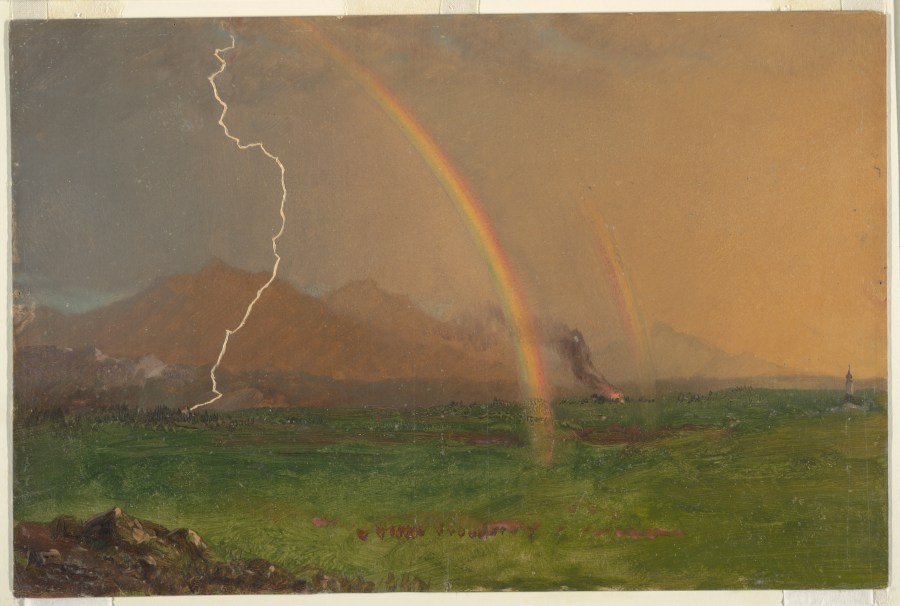
Featured Art: Alpine Scene in Thunderstorm by Frederic Edwin Church

You can see storms in the desert from a long way off: dark clouds building, wind picking up, lightning bolts flashing and touching ground. You listen for the thunder growling up behind, wait for the moment when everything will be synchronized—and then you’re in it, in the thick of it, trees bending and shaking, something rattling the roof, the lightning and thunder now one animal trying to get in. The only thing between you and the storm is the sliding glass door, and you see the jackrabbits going for cover, and you know the power will go out, and you know you’ll have to find the flashlight and batteries and candles and matches, and you’ll try to eat all the food in the fridge before it spoils, before your boyfriend gets home and blames you for the storm. You’ll still have to get up at 4 a.m. and drive your truck into town, dash from the cab in the rain and wind, knock at the locked glass door frantically for the baker to let you in, the baker who had looked you up and down, said: why does a college girl like you want a job like this? You had no answer for that question, but you still got the job because you were white and sober and scared, and so now you run inside, put on the big white apron, start pressing fresh donuts into frosting, sprinkling them with chocolate jimmies and coconut, scooping out the powdered sugar and glaze.

Read More