No Ideas But in Things: The Un-Poetic Education of Adult World

By Bethany Bruno

There is a specific archetype of the millennial poet, a figure of earnest conviction we recognize instantly. She is armed with a liberal arts degree, student debt, and the belief that her interior life is a subject of profound importance. She was taught in workshops that her voice matters, and she took it to heart.

This is Amy (Emma Roberts), the heroine of Scott Coffey’s 2013 comedy Adult World, and the film suggests not that poetry is foolish, but that Amy’s fantasy of herself as a poet is incomplete. It challenges the idea that art is born fully formed from feeling alone and suggests, instead, that a voice is shaped through contact with other people, disappointment, work, and the humiliations of ordinary life.

Amy’s conviction is almost tender in its excess. She doesn’t simply write. She insists she is “writing nonstop, all the time,” that “things are pouring out of me you wouldn’t even believe.” She tells her father, with the panic of someone who can’t separate inspiration from destiny, “I mean, I’m feeling a lot. I’m thinking a lot. I’m inspired, Dad. I’m inspired!”

I first watched the movie a few years after my own college graduation, and Amy’s predicament felt less like fiction and more like my life. I was a wannabe writer drowning in debt, working a dead-end retail job, hoarding spare dollars not for savings, but for submission fees. That gap between what you long to be and what you can afford to be is the part of becoming a writer no workshop teaches.

Read More

Pasolini’s Chaucer: An Edged Smile

By Brock Henry Allen

In his adaptation of The Canterbury Tales, Pier Paolo Pasolini appears only a handful of times as the medieval poet of the tales, Geoffrey Chaucer, and in these few moments I feel reproached and hopeful. Slotted between stories of deception, lust, and retribution, the bodies and souls of Chaucer’s characters bared before the camera, Pasolini-as-Chaucer sits in his chair, or late at night lounges in his bed with a quill in hand, and in these brief depictions his face glows in the reflection of a mind skittering through the imagination. As he writes, head in hand and eyes cast upward, he smiles. I had forgotten this feeling, and I wanted it again.

Pasolini’s film maintains an amateurish quality befitting a man who saw himself foremost as a writer, as he sought a “poetry of cinema.” His editing in particular cuts hard between close-ups and establishing shots, with this viewer often unable to understand what or where is being established. The Canterbury Tales was shot in English, dubbed in Italian, and then redubbed in English (I think I got that right), and this also lends the film a quality of mis-timing between the characters, the pauses between lines regularly too long as if each person understands little of what the other has said. In particular, Pasolini likes to linger on smiling faces, of angels or devils or his beloved Ninetto Davoli, until these smiles stiffen toward grimace. It all creates a feeling particular to Pasolini that I’ve only experienced while watching his other films—The Gospel According to St. Matthew, The Decameron, or Arabian Nights (I have not seen his most infamous film, Salo, or 120 Days of Sodom; it frightens me), and in these smiles, and in the spaces between the characters’ words, I feel peculiarly entranced. At times, I feel bored, but never detached. It’s an unusual sensation, because unlike other hypnotic stylists of his country, like Fellini, Antonioni, or Bertolucci, whose painstaking productions heavily wear the appearance of masterpiece, Pasolini’s appear as a charming accident, off-handed, like something he nearly scrapped, a sketch that has against the odds lived.

Read More

On Poetry

By Diana Khoi Nguyen
Featured Art: “Carrying Hay” by Hannah Hatley

Though Lee Chang-dong’s Poetry is a Korean film, I found myself thinking of the Vietnamese word nước, as the opening shot reveals rippling water. A close shot, bird’s eye view of the water, a near-black filter dissolving slowly from the sun-glinted ripples. Nước, meaning water first, for me. Nước, meaning also: country, state, the tide coming in, the tide going out. A place so connected to water it shares the word. The camera doesn’t fall into the river, but moves with it, panning to reveal grade-school-aged boys playing in the grassy sand bank, moving rocks, digging holes. The sun is overhead, it’s 11am perhaps, and the body of a 16-year-old girl floats along like the body of each young woman in every movie and television show I’ve seen before: dead.

Danusha Laméris touched briefly upon Poetry in an earlier New Ohio Review essay, “Beautiful, Brilliant, and Dead: Portraits of the Female Poet in Film.” She writes that literature and art are rife with images of dead women and dead poets: “[t]he dead girl, appearing again and again, by the river bank, in the river.” Kristy Guevara-Flanagan’s short film, What Happened to Her (2016), similarly examines contemporary culture’s obsession with dead women on screen. The dead girl in Poetry’s opening scene isn’t a poet, but she is a casualty in the world of cruel boys (and men); and her death eventually causes the film’s protagonist, Yang Mi-ja, to reflect on her life and society and write her first poem.

And Poetry, itself, feels like a poem: plot is more than mere narrative content; it serves as material arranged and composed in such a way that I found I could trace craft moves that exist in poetry writing: juxtaposition, (visual) syntactical surprise, the interwoven portraits of boys vs. girls, men vs. women . . . all of these have a metrical rhythm in the film. Perhaps what I am trying to describe is that while watching, I felt I was also reading a poem.

Read More

The Post in the Machine: on Poetry and Il Postino

By Rowland Bagnall

Il Postino (1994) tells the story of Pablo Neruda’s brief exile in Italy. The film is adapted from the novel Burning Patience (1985) by Antonio Skármeta, which fictionalizes Neruda’s 1952 stint on Capri, during which he occupied a villa owned by the Italian historian Edwin Cerio. Skármeta’s novel relocates the episode to Isla Negra, a village on the coast of Chile, fast-forwarding events to 1969 in order to encompass both the poet’s Nobel Prize (awarded in 1971) and death in 1973. The novel unfolds against a backdrop of political unrest; Neruda died just days after the overthrow of Salvador Allende’s socialist government, a successful coup d’état led by General Pinochet. Il Postino, co-written by director Michael Radford and the film’s star, Massimo Troisi, restores the events of the story to Italy, exiling Neruda to another island in the Gulf of Naples. While the location isn’t specified, much of the film takes place on Procida, where Mario (Troisi), a simple, gentle man with a desire to outgrow his surroundings, lives with his aging father in a small fishing community.

The set-up of the film is straightforward enough. One night at the cinema, Mario sees a black-and-white newsreel of Neruda’s arrival in Rome, the voiceover explaining that the famous communist love poet has been unable to return to Chile on account of his political views. The footage soon turns to the island that Neruda is to stay on, at which point the audience bursts into applause, one man leaping to his feet when he sees himself up on the screen: “That’s me!” On his way home, Mario spots an advertisement for a job at the post office that requires a bicycle. Uninspired by his life as a fisherman, he bikes to an interview with the local postmaster-cum-telegrapher (Renato Scarpa) who promptly offers him the gig. Mario’s task will be to deliver mail to a single addressee, the celebrated poet, Pablo Neruda.

Read More

Gertrude Stein: The Matriarch of the Paris Salon

By Sunni Brown Wilkinson

             The artist’s job is not to succumb to despair but to find
                   an antidote for the emptiness of existence.
                     –Gertrude Stein in Midnight in Paris.


I’ll admit something: all through graduate school I kept this to myself, but . . . I never liked Gertrude Stein. I remember a woman in my cohort swooning over Tender Buttons, but every time I read a Stein poem, I was just confused. What was she trying to accomplish? I didn’t get it. It felt too erudite, too experimental for me. Also a Stein fan, a professor at a nearby college told me she wanted to teach scansion to her Intro to Poetry students using Stein’s poems, and I couldn’t think of a better way to turn undergrads off poetry. Or Stein.

The photos didn’t do Stein any favors either. She looked severe with her short haircut and the perennial scowl she turned to the camera. She seemed terrifying. Someone more likely to be your friend’s ancient great aunt who only spoke to her dogs than a world-travelling, ground-breaking poet. Enter Kathy Bates in Woody Allen’s Midnight in Paris.

Read More

Online Exclusive: Poetry in The English Patient

By John Hodgen
Art by Sage Kerrigan-Christ

There is no poet in The English Patient. Not a single one. And the patient isn’t English. And there is only one bodice ripped, though it is readily repaired by the penitent ripper. There’s a Canadian nurse who believes with good reason that everyone she ever loves is doomed to die. There’s a sapper from a bomb disposal squad who blows up and one who doesn’t. There’s a thief and morphine-addicted spy everyone calls Caravaggio whose thumbs are cut off and who blames a Hungarian count. And there is an English pilot’s wife who engages in a torrid and doomed affair with the Hungarian count who ultimately becomes the titular English patient. And still, there is no poet. Not one. 

And yet there is, and her name is Katharine Clifton, and she has no idea she’s a poet, but she embodies one and may be the best representation of a poet to appear in a major motion picture that somehow thinks it’s a poem as well. Katharine is a change agent, a newly and already badly married woman dropped in out of the pre-war skies over Cairo to move within a group of men who represent the British Royal Geographic Society but call themselves, somewhat poetically, the International Sand Club. She seems as out of place as a poet among mapmakers, but she’ll transform them all.  Nothing is ever quite what it seems in this film. Transference is all. A great war is coming peopled by lovers and traitors and fools. And Katharine is Circe but a Circe of true love whose childhood best friend has become her husband who now calls her “Sausage” and defends the word “uxoriousness,” to explain over-worshipping a wife. Then she engages with Count Lazlo Almasy, who worships his aloneness and history, especially that of his beloved Herodotus in his battered leather-bound book, and who does not worship wives until he meets her. That transference of allegiances, that dramatic awakening is what poems often aim for and what movies that want to be poems aim for as well. It works best if the author of The English Patient, Michael Ondaatje, is more often a poet than a novelist. Anthony Minghella, the screenwriter and director, is also a poet, a visual one, line after line of the film filled with imagistic figures of speech, charged and charred language, parallel characters, interwoven stories and countries, and even the Arabic names for the winds of Egypt and the parts of the body for which there can never be enough names. 

Read More

The Dazed Poetics of Richard Linklater’s Waking Life

By Lilia Santeramo

If Richard Linklater loves one thing, it’s good talk. There are few directors, save for the ones we suspect inspired him, whose films rival Linklater’s in sheer chattiness. In a Linklater film, the plot and action happen primarily within and around unending speech. Waking Life, Linklater’s 2001 foray into animated film, is no different.

The film follows a nameless, desultory young man played by Wiley Wiggins as he navigates a bizarre, existentially fraught dream in which he also happens to be trapped. In the dream, Wiggins encounters a large cast of characters who explain their worldviews, which are often influenced by briefly referenced artists, thinkers, and poets. As the film progresses, it repeatedly uses talk of art as an avenue to reach understanding and awareness.

For Wiggins, it becomes apparent that reaching awareness—of his own dream state, of art itself—is the key to freedom from his seemingly endless, inescapable reverie. Though only a few poets are mentioned in the film, each time they are Wiggins reaches a pivotal moment in his journey out of the dream. Once, as he becomes lucid; and then again, right before he wakes up at the urging of a character who resembles Linklater himself, after that character rants about Yeats’ lover.

Yes, at its worst, Waking Life is name-droppy and unconvincingly “deep.” The film is often indulgent of the musings of stoned teenagers, made more palatable because instead of kids, a contemplative French woman and her lover (Julie Delpy and Ethan Hawke as Before Sunrise’s Céline and Jesse) vocalize these ideas as they sit in bed, so it’s, you know, sophisticated. This is the kind of movie Woody Allen might have made if he was a slacker. But Waking Life isn’t just for Dorito-fingered, channel-surfing philosophers who reference artists and intellectuals without bothering to examine their ideas.

Read More

Facing the Music

By Kimberly Johnson

Kenneth Branagh’s film adaptations of Shakespeare plays represent a formidable corpus. In Rolling Stone, Peter Travers called his 1989 film adaptation of Henry V “thrilling” and gushed that Branagh’s performance “captures the poetry and potency of Shakespeare” with an “unquenchable fire.” Of Branagh’s Hamlet, Geoffrey O’Brien raved that in this particular, “brilliant,” version, the play “is allowed all its complexity.” As of February 2026, the two films are rated 98% and 95%, respectively, on Rotten Tomatoes.

In stark contrast to these rhapsodic responses is the general reception of Branagh’s 2000 Love’s Labours Lost, whose Rotten Tomatoes aggregation currently hovers just over exact middling, at 51%. Even the more or less positive reviewers think it “wildly uneven,” and less generous viewers dismiss it as “silly, redundant, odd.” The chief irritation seems largely to arise from Branagh’s decision to adapt the play into a musical spectacular lifted straight out of the golden age of cinema. In Branagh’s Love’s Labours Lost, characters burst out into song at random junctures and pause discussion to hoof it like downmarket Fred-and-Ginger wannabes. Bewilderment at Branagh’s impetuous decision to transpose Shakespearean seriousness into madcap fluff animates a goodly portion of the hate this film has received.

I’m here to stand against the haters. Not because Branagh proves to bedazzlingly light on his feet—indeed, none of the ensemble company seems remotely expert at sashaying across the screen in heels or warbling their tentative notes along to the soundtrack’s catalogue of standards by Cole Porter, George and Ira Gershwin, Jerome Kern, Irving Berlin, and other titans of the American songbook. Alicia Silverstone is, as it turns out, no Judy Garland. Nevertheless, I will defend Branagh’s decision to make a musical out of Shakespeare’s play until my last breath because of his perceptive understanding that the Hollywood musical offers an honorable modern analogue for Love’s Labours Lost, a romantic comedy that is not really about either romance or comedy but is very much
about sonnets.

Read More

A Matter of Life and Death

By David Lazar

Michael Powell directed several of the greatest English films of the twentieth century, in collaboration with Emeric Pressburger, his screenwriting and producing partner. Of these, my favorite has always been A Matter of Life and Death (1946, originally titled Stairway to Heaven in the U.S.). It is a film of urgency and whimsy, familiar tropes (angels, wings in heaven, celestial judge) and original images (an RAF flyer quoting poetry as his plane, in flames, heads down; the same pilot on the beach speaking to a naked Pan-like boy). But before we get to the film’s romantic and poetic soul, perhaps we should start with the prelude, unlike anything that had been presented in a narrative film previously.

We are told, “Any resemblance to any other world known or unknown is purely coincidental,” a play on the preemptive dodge of liabilities in narratives that draw on “actual events.” But Powell and Pressburger, ambitiously, are really telling us that we’re going to see something new. In soft, deep-blue technicolor, we see distant stars as an authoritative baritone documentary-like voiceover intones: “This is the universe. Big, isn’t it?”

Read More

“Late to Counsel”: Poetry as Trace Evidence in Kiss Me Deadly

By Matthew VanWinkle
Featured Art: “Philadelphia Parking” by Max Cavitch

In the noir classic Kiss Me Deadly (directed by Robert Aldrich, 1955), the big break in the case arrives in an unusual way. Mike Hammer (Ralph Meeker) has been wearing out shoe leather, punching hoods, kissing dames—time-honored investigative techniques by the standards of the genre, but he hasn’t made a lot of headway with them. The lead that puts him on track is an excerpt from a Christina Rossetti sonnet, haltingly read by Lily Carver (Gaby Rodgers), who’s mixed up in the business somehow.

   Remember me when no more day by day
       You tell me of a future that you plann’d.
   Only remember me; you’ll [sic] understand[.]
        But [sic] if the darkness and corruption leave
   A vestige of the thoughts that once we had [. . .]

Lily is picking her spots in the poem pretty haphazardly. She’s vocalizing lines 5-7 and then jumping ahead to the eleventh and twelfth lines. Something in her improvised edit clicks with Mike, though; he asks to hear those last two lines again. He and Lily head out, hot on the trail to somewhere cold.

Mike’s looking for something but he’s not sure what. He just knows that it’s big, and that it has something to do with Christina Bailey (Cloris Leachman), a hitchhiker he’d picked up in the movie’s opening sequence. She’s in trouble, barefoot and out of breath on the highway blacktop. After a stop at a gas station—Christina heads into the bathroom while an attendant unwraps a tree branch from the front axle—she informs Mike that she’s named after Rossetti. She keeps looking over her shoulder as he drives, expecting the worst. Just before she’s proven right—they’re run off the road and she’s tortured to death under interrogation—she tasks him with her last wish: “remember me.”

Read More

Broken Voices: Wenders, Tarkovsky, and the Plight of Modern Poetry

By Michael Lavers
Featured Art: “Memento Mori” by Max Cavitch

I.

Wim Wenders’ 1987 film Wings of Desire is, among other things, an elegy for Homer. We see the aged poet (played by Curt Bois) wandering through a divided Berlin, no longer the unifying voice of a community, the consolidator of disparate histories and legends, but, in his own words, “an old man with a broken voice . . . ignored and mocked.” He can’t climb a flight of stairs without pausing to catch his breath.

No longer the center that binds together what otherwise would remain scattered—the Earth and the stars, mortals and gods, time and eternity—his poem is studied in a library whose patrons cannot see its author passing by, burrowed as they are in their deaf and mute analyses.

Throughout the film, he interacts with no one. All we hear are his beleaguered thoughts: “Those who once listened to me over time became my readers instead. They no longer sit in a circle but apart, each oblivious to the other.” This isolation is made hideously visible in the city’s great graffitied wall, topped with razor wire, surrounded by once-glorious buildings left pockmarked by bullets and bombs.

Read More

Kept in the Dark: Poetry, Collaboration, and Collapse in “Pandaemonium” and “Tom and Viv”


by Matthew VanWinkle
Featured art: View from Mount Holyoke, Northampton, Massachusetts, after a Thunderstorm—The Oxbow by Thomas Cole

In a sheepish prefatory note to the belatedly published “Kubla Khan,” Coleridge recalls a felicitous if ultimately frustrated exception to his usual habits of poetic composition. He writes that “all the images [in “Kubla Khan”] rose up before him as things, with a parallel production of the correspondent expressions, without any sensation or consciousness of effort.” Coleridge identifies his usual artistic challenge, here overcome with miraculous ease, as finding words for images. Those who seek to bring poets, and poetry, to life on film are confronted with the counter-difficulty of finding images for words. Or, more precisely, filmmakers face the daunting task of rendering the wrangling of words visually compelling. (The footage of Coleridge reciting “This Lime-Tree Bower My Prison” to delirious crowds at Wembley Stadium has been lost, regrettably.) So how do filmmakers inject motion and volume to a creative process that is presumably usually so still, so muted?

Read More

Jean Cocteau and “Orpheus”: The Poet as Filmmaker

by Steve Vineberg
Featured Art: Valley with Fir (Shade on the Mountain) by Henri-Edmond Cross

Jean Cocteau recognized no boundaries between forms of art. He was a poet, a novelist, a playwright, and a visual artist, and each of these media also functioned as a bridge that led him into filmmaking—not just conceptually, since movies are a hybrid of all of these other forms, but often literally. He filmed two of his plays, Les parents terribles and The Eagle Has Two Heads, and wrote the screenplay for Jean-Pierre Melville’s adaptation of his novel Les enfants terribles, and his great 1950 movie Orpheus reimagines his 1926 play of the same name. Read More

Keep Me In By Keeping Me Out: Poetry On Screen

by Carrie Oeding
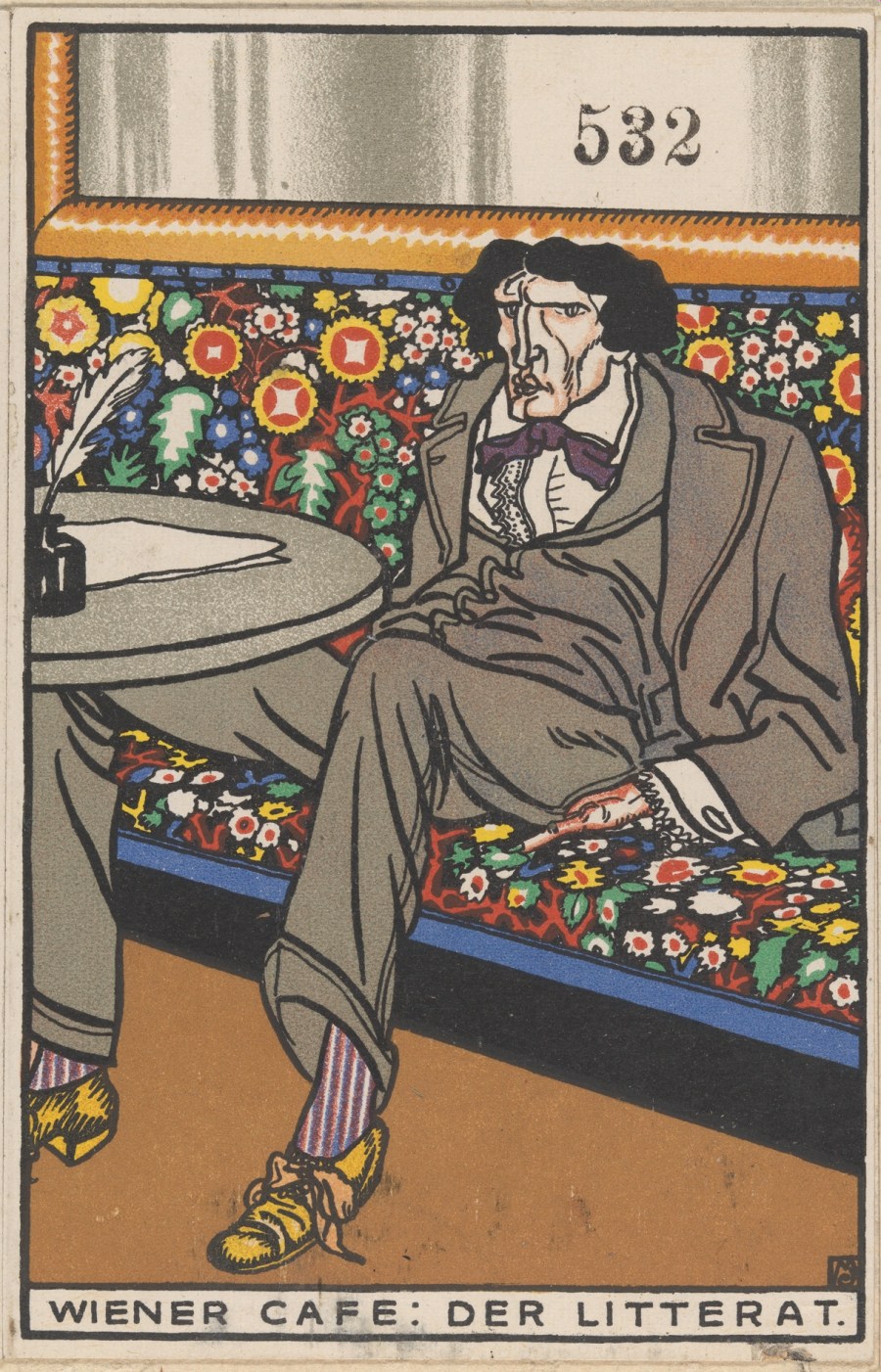
Featured Art: Viennese Café: The Man of Letters by Moriz Jung

In the late Nineties I repeatedly watched Hal Hartley’s Henry Fool (1997), not really certain why. I had first rented it only because Parker Posey was in it, but the cult film stayed with me like the Sylvia Plath poems I fanatically read as a teen in my small county library in rural Minnesota. Both seemed like mostly impenetrable, but meaningful code. Both were transgressive.

The big difference between these obsessions was that I trusted what Plath was doing and didn’t trust Hartley. Or, I didn’t trust my obsession with the film, which follows the lives of two aspiring writers. What I find compelling twenty years later is that I have the same response. Henry Fool is funny, repulsive, wildly off the mark about the process of writing, and wildly provocative; and I now think that it’s something this otherwise explicit film withholds—the book-length, controversial poem which the plot is built on—that continues to fascinate and repel. Read More

A Personal Affair: The Making of a Poetry Film

by Michele Poulos
Featured Art: The Chariot of Apollo by Odilon Redon

In my twenties, I moved around a lot. I spent much of the first half of that decade in New York City where I changed apartments at least once, and sometimes two or three times, each year. At twenty-seven I moved to New Orleans. At twenty-eight I ended up in Chapel Hill, North Carolina. At twenty-nine I was back in New Orleans, then at thirty I was in Richmond, Virginia, where I’ve lived, off and on, since 2000. With each relocation, one DVD moved with me every time: Poetry in Motion. Read More

Against Literary Biopics Generally, Unless, Maybe—But Definitely and Especially Against “The End of the Tour”

by Kathryn Nuernberger
Featured Art: Study of Arms for “The Cadence of Autumn” by Evelyn De Morgan

When I walked out on A Quiet Passion, the 2016 Emily Dickinson biopic, I decided I was walking out on all biopics about writers forever. 1 The genre has built-in structural problems that seem almost insurmountable. For one thing, a writer’s work is neither their life nor their personality. For another, staring out a window or at a blank page cannot be sustained on screen for longer than a single montage. Moreover, a life well-lived2 seldom has a coherent narrative arc.

Read More

Beautiful, Brilliant, and Dead: Portraits of the Female Poet in Film

by Danusha Laméris
Featured Art: Standing Girl, Back View by Egon Schiele

The film Maya Dardel, a 2017 American-Polish drama, written and directed by Zachary Cotler and Magdalena Zyzak, opens with a famous, gravellyvoiced, fictional poet, played by the mysterious Lena Olin, contemplating her demise. Sequestered at her hideaway in the mountains of Santa Cruz, California, overlooking the redwood forest (around the bend from where I happen to live) she’s decided to kill herself. But not before choosing a young, male heir, whom she will select by way of a contest, through a sort of Atalanta-esque maneuver. Only, instead of a race, she will subject her suitors to feats of sexual and psychological endurance. All of which she has announced on NPR.

Read More