The Muse of Work

By Ellen Bass

Featured Image: “Portrait of Mrs Marie Jeanette de Lange” (1900) by Jan Toorop

If I could choose my muse,
she’d have red hair, short, spikey,
and green cateye glasses with rhinestones at the tips.
She’d wear a sleeveless white blouse, ruffled
over shallow scallop-shell breasts.
Can you see how young she is?
I think she’s the girl Sappho loved,
the one with violets in her lap.
When she opens the door, a flurry of spring,
apple blossoms and plum, sweeps in.
But I’ve been assigned the Muse of Work.
It turns out she’s a dead ringer for my mother
as she scrambles the eggs, sips black coffee,
a Marlboro burning in a cut-glass ashtray.
Then she opens the store. The wooden shelves shine
with amber whiskeys and clear vodkas,
bruise-dark wine rising in the slender necks.
Read More

Dispatches From the Interior

By Geoffrey Brock

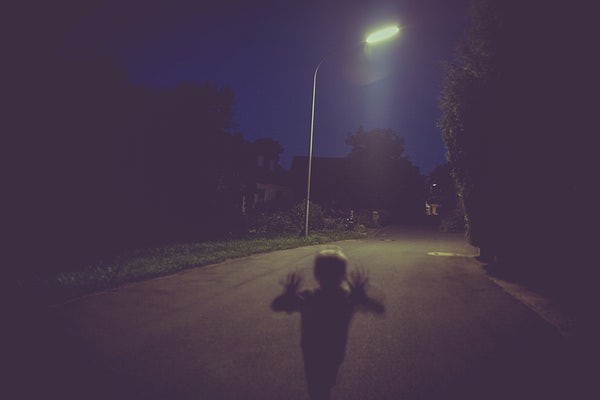
Featured Image: “A Lone Child Walking Down the Street at Night“, Unknown Artist

Like the one where you stumble along happily drunk
after closing a bar and reach your car only to find it
surrounded by militia who take you in to question you
about why you left your son alone in the car so long
and you say I lost track of time though that’s not true
and Can I see him and they refuse and Is he okay and
you’re panicking and thinking What if he died in there
or the one the very next night when you find yourself
atop some posh hotel listening to some poet speaking
and realize you haven’t seen your son since morning
when you let him go down to the lobby alone to play
despite the warnings you now recall about the natives
and you race for the elevator but there is no elevator
and so you find the stairs and descend floor by floor
and each landing is a shabby apartment living room
and though you can sometimes tell someone is home
water running for instance or light under a shut door
you never see anyone or gain any real insight into this
country of ancient dearth and modern resentment
what country is this anyway? and after the gauntlet of
these empty private foreign lives you emerge at last
into a brightly lit and darkly paneled colonial lobby
and scramble frantic now through the patrician crowd
looking for help but when you ask a giant suited man
if he speaks English he replies in the plummiest nasals
I don’t just speak it I am it and merely cocks one brow
about your son so you race outside where a boy squats
alone in the penumbra by a bush and you tilt his face
to the light but he isn’t yours too small and dark and
you keep looking and see others and scream one name
and then oh god you see his hunched familiar shape
rise out of the pile of dead leaves he had hidden under
and stumble toward you arms extended the pajamas
he was wearing this morning now tattered and filthy
and when you scoop him up you discover obscenities
and anti-American slogans scrawled in black marker
on his face and blood or something caking his nostrils
and he doesn’t speak or cry and nothing shines forth
from those eyes and you carry him cradle him through
this endless third-world night trying to comfort him
but knowing you will never be able to comfort him but
cooing You’re safe now Daddy’s here or the one where


Read More

Stupid Sandwich

By Nathan Anderson

Featured Image: “The Grocer’s Encyclopedia” by an unknown artist

So yeah, we all have these moments that suck
because what they mean
is like a mystery, like the Mariners last year
good a team as any, traded
what’s-his-name, the fat one, for that Puerto Rican dude
with a wicked right arm
and didn’t even make the playoffs.
Anyway, I can see you’re a man of the world like me,
standing here I don’t know how long and still
no damn bus. But like I was saying
we all have these moments and last week
there I was after work, making a stupid sandwich,
the kind of stupid-ass food people like me always make
when I can’t figure out what I’m feeling
and I feel like being true to myself
is about the dumbest thing a man can do,
knowing how easy it is for the truth to mess things up.

Read More

Remembered Grace

By Jim Daniels

My mother rolls her walker through the rug
like pushing a dull reel mower through high grass.
She cannot see, so maybe the simile should be sound instead—
like bad jokes from a dull boor. The brittle thread of escape
snapped long ago, sewing kit trashed, needles only and constant
from pain—knee/back/hip. Blurry edges of God rim
her miraged vision. She burns a sandwich on the grill
but not herself—thrill enough to earn a pill. Today
she’s skipping church, and it’s just next door. She calls me
from the kitchen to carry her cup back to her chair—no free
hands. She must watch where she lands when it’s all freefall
and whiffs of Jesus not happy with her. I’m a tourist
with a bad map. She’s a local with time. She waves her hand
as she talks, one graceful thing. She flirts with air.


Read More

Speed of Light

By Mark Irwin

Featured Image: “Blossoming Cherry on a Moonlit Night” by Ohara Koson

Married in Beijing, they had their names carved on
a grain of rice. Mai wore a yellow silk gown. He wore
a black suit. Embraced in the photo turned sideways
they resemble a tiger scrambling through strewn mums.
That evening they ate salted mango and shrimp. He
can still taste that, see the tortoise-shell clip sun-
splintered in her hair. That evening continues, stalled
like the sea-filled drapes in their room. For twenty
years he worked at a lab that accelerated protons. Here
are photographs of their two girls on Lake Michigan,
then in Zermatt, standing before the Matterhorn,
whose moraines, cirques, and ravines resemble those
through two names magnified on a grain of rice, or
of that shadow looming through the CAT scan of her brain.


Read More

Saying Goodbye to Dad

by Kate Fetherston

Feature image: Pierre-Auguste Renoir. Near the Lake, 1879-1880. The Art Institute of Chicago.

My dad died alone in a VA hospital
as July sun beat without mercy into the raw

seesaw of breath busting seams between
each cell. Third spacing doctors call it

when cell walls no longer sustain
boundaries with integrity, fluid

sluices into interstitial no-man’s
land and overpowers whatever little

plans were made for a garden and some
trees. When my brothers and I got

the news and flew in from the various
places to which we’d fled, I’d just split

on my first lover after years of her
threatened suicide, bouts of drunken

depression, and refusals to take
her medicine too numerous

to recount. Her view: I’d been trained
strictly for fixer-uppers, too stupid

or stubborn to leave, but, waxing
romantic, she’d croon, “You’ll do me

for a rough old mate.” The day she smashed
my stuff into the carpet and poured

ten pounds of flour over
everything, I might have stayed for

more of the same, but I threw
crumpled clothing into my pack,

startled when she whispered, “I’m
just like your crazy

old man, aren’t I?” I didn’t
answer because we both knew

Read More

One Day Your Parents Confess You Have a Twin

by Todd Boss

Feature image: Ugo da Carpi. The Sibyl and a Child Bearing a Torch, 1510-1530. The Art Institute of Chicago.

who was given up for adoption early on, when it was
clear they couldn’t manage him. It was, says your father,
the worst decision they’d ever made. (It’s you and your
parents at the kitchen table. Between you, the steam
from the teapot uncurls in a kind of breathing statuary.)
He was your inverse, your yin: When you went to sleep,
that’s when his terrorizing of everyone would begin.
He went from home to home to group home, and then
to prison, half mad, a drug-addled teen, with your name
tattooed over the veins in both forearms. “That’s when
we moved to Minnesota,” says your mother, but of course
he found you here, at the end of an abbreviated sentence,
and slit your throat while you slept. This was last year.
You’ve been dead ever since. We know this must be hard
for you to hear: but you don’t exist. You’re your own twin
brother’s obsession with you. (Can it be? Instinctively,
you reach to touch yourself about the shoulders, the neck,
but everything’s . . . identical.) It’s like a mad dream—
yes, the recurring one you’ve had since you were a child,
in which you go from door to door, trying to trade
your life for another’s, but nobody will trade, and you go
on and on, pounding, until, impossibly, you finally find
someone willing, and you wake. Your mother reaches
through the figure of steam to lift the teapot and pour
from out its only portal a little stream into her cup, her
husband’s cup, the cup in front of you. She sets the teapot
down, and now there are four apparitions dwindling there,
silken, gesturing. One of them says, We love you the same.
But you can hardly hear them as you push up your sleeves
—one at a time—and read, and reread, your name.


Read More

Royalty

by George Bilgere

Feature image: Odilon Redon. The Beacon, 1883, reworked c. 1893. The Art Institute of Chicago.

So this young couple, overweight
and seriously tattooed, comes into the café,
and each of them is actually wearing a baby
in one of those tummy-papoose things,
and they have two enormous dogs
designed to kill elk and wolves,
not sit under the table at a coffee shop,
and as I watch them smile at their babies
which are now screaming bloody murder
while the great slobbering mastiffs
begin earnestly licking their own privates,
something terrible happens to me:
it’s like The Manchurian Candidate,
when Lawrence Harvey suddenly realizes
the reason he’s been acting so strangely
is because he’s been brainwashed by Soviet agents:

Read More

Wet Carpet Awakening

By Kevin Stein

Featured art: Europeans Embracing by an unidentified artist

Cursing the stubbed-toe 2 a.m. call—my father?

I picked up a woman’s feather-brushed gush, “Wilbur,

it’s a grandson! Jamaal José O’Bryant.”

And I, unhappily not Wilbur, croaked Wrong number as one does

when plucked frog-eyed off sleep’s lily pad.

She was old. Who else misdials the pay phone’s tiny numbers?

Who else marries a Wilbur, their grandchild an American blend?

Outside rain misted not cats and dogs but litters of kittens.

Her lavender sachet apology, my bed-headed threnody,  my 

No problem, and click. Lightning cracked night’s black egg

in halves I couldn’t tap back in place:

My father’s dead. I’m next.

Revelation arrives like that, thunder trailing the flash.

I rode the open window’s wet carpet awakening,

storm flipping its toggle above the wind-blown yarrow,

electric as any newborn. Shaggy, late autumn, nearly gone-to-seed-

bloom, naked ecstatic.

I floated my trial run out a window the rain had come

in. When the dark made light of me I was.


Read More

Playing My Part

By Sharon Dolin

Featured art: Dancers by Edgar Degas

I let him go. I complied. Adjusted. Saw. Did not see his disappearing
act of staying while leaving the body. It felt so familiar.
My zombie-mom (on Stelazine, Thorazine to tamp

her paranoia down), would be there/not there to make
macaroni and cheese, do the wash, help me with my Spanish.
I knew she was sick, I knew she loved me though she lay in bed until noon,

again in the afternoon, comatose with the New York Post, her arm bent
at the elbow to cover her face. This was what love could feel like—
somnolent, absent. Why be paranoid when he slept in the same pose.

Sometimes cooked dinner, did the wash. Who knew a blunt face
could hold so much hate. The child in me saw his numbing out,
going to bed early, not as aversion but a version of my mother’s love

and all I had to do—as when she’d be taken away, hospitalized, shocked—
was wait for his return. (Is there a Penelope inside every troubled wife?)
Didn’t my mom always come back?


Read More

Carnival Nocturne

By Mark Wagenaar

Peanut shells crackle beneath your pink slippers
as you pace. The players behind routines of a different sort
long after the show is over, long after the spectators
return home, their caricatures slipping from their grasp
as they unlock the front door. Teeny the strongman
is calling the torn names in the phone book
he ripped in half, as Vasserot listens outside, smoking
a cigarette with his left foot, his arms a phantom
presence he feels each time he reaches for another can
of peaches. Karlov the Great has gone to bed
regretting his dinner, three light bulbs & a seven-foot
feathered boa, while in the next room Madame Sossman
is about to win a red nose & a pair of floppy shoes,
unless Noodles can beat three Hangmans.
Monsieur LeBeau stands in the big tent, still listening
to the cheers of the departed crowd. His daughter
won’t return his phone calls, but tomorrow
will bring a new town, with a different name & story,
where anything is possible, & tonight the stars’ white flames
burn on their blue wicks – she’s out there, somewhere,
the one you left behind on the Serengeti, in the night
that paces in a circle with its one black shoe, beneath wires
no one will ever see, the sickle moon’s ivory
as beautiful as your tusks once were.


Read More

On a Thursday Afternoon of His Life

By Michael Chitwood

my brother-in-law wrote a letter he never mailed.
In it he explained what a dog smells when it smells fear.
He described what he saw when he saw blue.
He mentioned a moment that afternoon:
he was alone in the house,
somewhere not too far off was the rumble of heavy equipment,
then he heard his name pronounced by a familiar voice he’d never heard before.
He gave two options for how things would turn out
and wrote “one or the other.”
He noticed how “or the” was almost “other.”
He mentioned that in the next line of the letter.
Why am I telling you this he wondered next.
He said Friday was his favorite evening, in the fall, the team just taking
    the field.
He knew he would not mail the letter but wrote it out long hand with the
    pen he kept by the phone for taking messages.
The letter will be found years from now in the back of a drawer that
    contains a hinge and a set of brass keys to doors that are long gone or I
    should say now always open.
The closing was hood something, the last word smudged,
good luck? goodbye? good something, good.


Read More

Cake

By Mark Kraushaar

Featured Image: Landscape by Peter von Bemmel 1685-1754

She’s in the first booth left of the planters.
She’s been waiting an hour now.
She’s been waiting at the Watertown Family Buffet
with her little girl who’s dreamed up
some kind of a costume:
giant glasses, backwards cap, taffeta gown
which is clearly for him, for Al who’s
just now arriving, finally, and now

he’s seen them, and now
he’s walking over, and now
he’s standing there, standing there,
husband and father, or boyfriend and father,
or boyfriend and father figure, except he’s way too late,
he’s too late times two and the party’s over
thank-you, and, no, they’re not having,
not the grin, not the story, not the hug.

The woman gets up, and then, face baggy with patience,
she nods to the girl who scoots out too,
and they exit together.
So over the chips and spilt dip,
over the drained Pepsi and the big white cake
with “Al” in caps and quotes
he watches them go,
looks out at the parking lot,
opens his book.
Here’s the waitress with her pad and pen.
And what in hell is he reading?


Read More

House on the Lake

By Liz Robbins

Featured Image: Greenwood Lake by Jasper Francis Cropsey 1875

When Dad was dying, everyone wanted
to take care of him, no one
wanted to.

We sent flowered cards, everyone wanted
the easy parts.

His cancer was a quiet purple flower
that grew too familiar when it took
over the bed.

The purple wanted the easy parts,
the purple wanted the hard parts, the liver.

We all went one way, then another.
We were the roots, we scattered.

We couldn’t compete, that’s all we could
do. We wanted to sit around and stare
at the clouded sky and drink.

His IV was clear, the only thing.

He had ten months, ten years.

We walked around Lily-Pad Lake,
where hordes of trout wriggled
to breathe.

Read More

Tool Box

By Maura Stanton

Under the rusting red metal lid we’re waiting for you—your father’s tools.
We always knew you weren’t going to build a doghouse or repair the stairs or
tighten a bibcock faucet, but we wanted to be of use as in the old days. Ah, the
old days! When we heard your father’s tread on the basement steps, we were
thrilled. The hammer clenched its head, the bubble trembled in the level, the
pliers stretched its jaws. But after your father died it was worse than we ex-
pected. You carted us out to your car, left us for months in the trunk, and then
stuck us on the floor of this hall closet next to the vacuum cleaner. Now the
hacksaw’s teeth are rusting, the file’s worn down, and the measuring tape sags
beside the plane. The poor jackscrew, no longer attached to a work bench, has
grown forgetful, and thinks it’s really a micrometer caliper. All you care about
is duct tape these days, tearing off flashy shreds to cover your botched work
while the tough little nails languish. So watch out! All of us in here are fed up
with your disregard for some of mankind’s oldest inventions, so if you ever do
open this lid you’re going to get hurt.


Whirlpool

By George Bilgere

In the morning, after much delay,
I finally go down to the basement
To replace the broken dryer belt.

First, I unbolt the panels
And sweep up the dust mice and crumbling spiders.
I listen to the sounds of the furnace
Thinking things over
At the beginning of winter.

Then I stretch out on the concrete floor
With a flashlight in my mouth
To contemplate the mystery
Of the tensioner-pulley assembly.

And finally, with a small, keen pleasure,
I slip the new belt over the spindle, rise,
And screw everything back together.

Later, we have Thanksgiving dinner
With my wife’s grandmother, who is dying
Of bone cancer. Maybe,
If they dial up the chemo, fine-tune the meds,
We’ll do this again next year.

But she’s old, and the cancer
Seems to know what it’s doing.
Everyone loves her broccoli casserole.
As for the turkey, it sits on the table,
A small, brown mountain we can’t see beyond.

That night I empty the washer,
Throw the damp clothes into the dryer.
For half an hour my wife’s blouses
Wrestle with my shirts
In a hot and whirling ecstasy,

Because I replaced an ancient belt
And adjusted the tensioner-pulley assembly.


Read More

Haircut Talk

By Peter Stokes
Featured Image: Baby (Cradle) by Gustav Klimt

Lenny’s elbows jut from the sleeves
Of his blue barber’s shirt
And carve the air about my head
In a series of unreadable signs
That I trace in the glass of his square barber’s mirror
Where I watch myself watching his face give expression
To the subtlest whir from his scissors and comb.
Or we talk for a moment
About a change in the weather
And I realize for the first time
That Lenny is gay.
“So how’s married life?”
He says through the silence,
The strange edge in his voice
Like a barb on a wire
In the point-blank talk of our new acquaintance,
And I smile a smile that communicates nothing
And it’s suddenly clear that Lenny is drunk.
How much, then, I wonder, does he want to know
About my wife in the hall
With the bread knife in her hand,
Or the one about me,
It was midnight at Tim’s place,
Falling down drunk from the top of the stairs,
Or the sub-zero talk in the car outside Lena’s
And making her cry until 3:00 a.m.
And I talk to myself,
Three speeches in the silence,
And all of this world,
On the still point of a pin,
Spins through the minutes
With nobody talking
As we confess to ourselves
Everything we conceal
And the hair from my head just falls to the floor.


Read More