Vernonox

By Rick Andrews

<BEGIN AT MARK 1> 

                                  Thank you. I appreciate it. Thank you. You’re too kind.
                 Thanks so much, everyone. <GESTURE TO CROWD>. There’s an
                 excitement in the air tonight. Can you feel it? 
                                  Let’s give it up one more time for our amazing speakers,
                shall we? Let them hear it, folks!  

<LET APPLAUSE DIE DOWN

                                  You know, people ask me why I started Vernonox. They
                 come up to me in the lobby, they recognize me at bars, in airports.
                 People all over the world stop me on the street and say “Michael—
                 Michael D. Powers—why did you start Vernonox?” I tell them
                 there are three reasons. 

Read More

Essay: Little Giants, The Story of a Fire Hydrant and Other Heroes 

By Heather Buchanan

The patent for the fire hydrant was lost in a fire.  

There is a convincing theory that Frederick Graff, Sr. invented this life-saving device in 1801. He was the Chief Engineer of the Philadelphia Water Works. He came up with the idea of replacing wood pipes with an iron pipe system. He developed 37 other waterworks throughout the United States. He served the city of Philadelphia for 42 years and a stone gazebo with a bust of him was erected at Fairmount Water Works. It seems only natural that he would be the person who invented the fire hydrant. But the proof went up in flames along with 9,957 other patents and 7,000 patent models in 1836 when the U.S. Patent Office burned to the ground. At first, the Post Office was suspected of arson. It shared the building with the Patent Office and was already under investigation for awarding dishonest mail contracts. Rumors spread that they started the fire to destroy evidence. But, since the Post Office managed to save all their documents, investigators decided it was more likely an accident caused by someone improperly storing hot ashes in a box in the basement.  

There was an attempt to recover these patents by getting duplicates from the original inventors, but this process was slow-moving and expensive. The endeavor was abandoned in 1849. Only 2,845 of the lost 9,957 patent records were restored.  

Read More

Squids

By Liz Breazeale

Featured Art: by Nsey Benajah

The first ghost stepped out of the ocean in the summer, shimmering and hazy with captured light. We saw the age in her body, moving as though still burdened by a vast and lonely sea. Her wrinkles like the finest, most fragile spiderwebs we’d ever destroyed.

She came to rest on a foamy lip of shore. Her outline was set and static, her insides swirling, misty, full of translucent opals spun in an ancient hand. We realized later that every ghost was different in texture, but only when we couldn’t count them anymore, when they’d packed themselves across the sand.

Tourists surrounded her, our first ghost, asked where she came from and why. But she didn’t even try to answer. Just planted herself on that sharp beach in Maine and watched the shore birds scuttle and dive.

We spread the video of her like an invasive species, a creature introduced in the most fertile of ecosystems. Amongst ourselves, we debated whether she was a projection or performance art, a trick of the light or a stunt like Holograph Tupac. We asked one another, is she yours? Hoping one of us was the answer, some brilliant marketing ploy, some Don Draper–genius viral advertisement to be jealous of, but knowing under our skin this was something else, something new.

Read More

Recovery

by Max Bell
Story originally published in New Ohio Review Issue 25
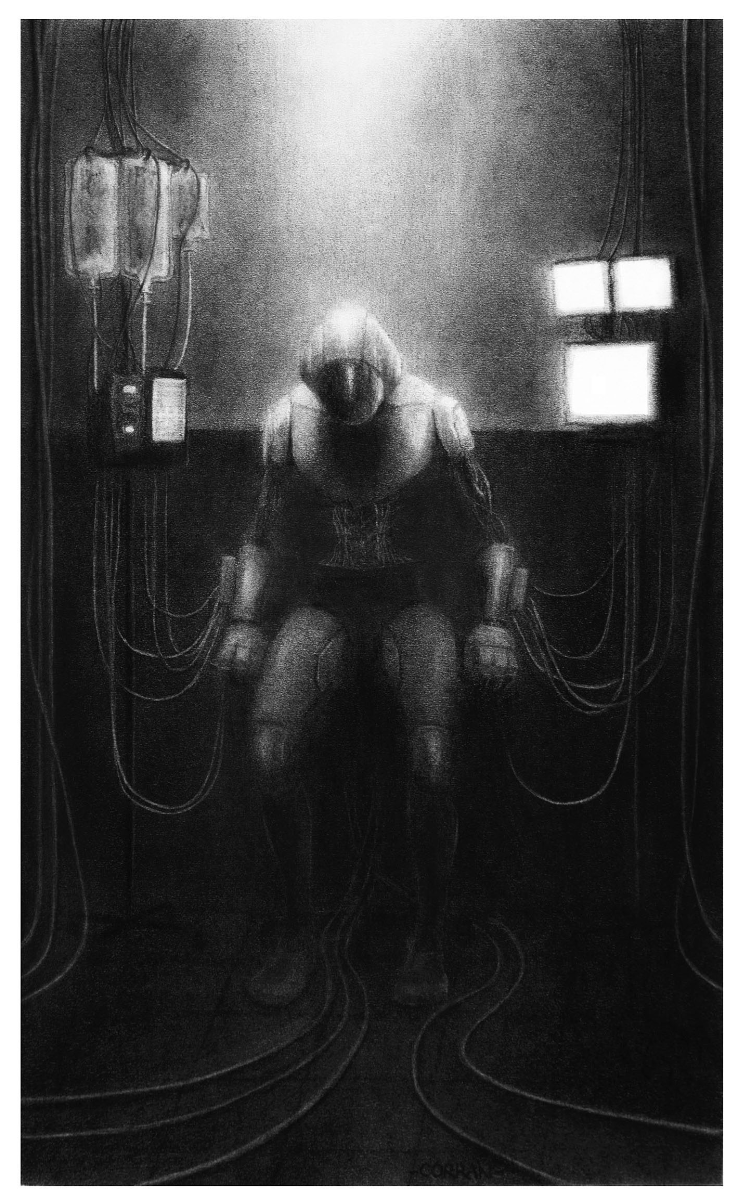
Featured Art: Recharge by Corran Brownlee


Two Weeks 

Lisa left when the droid arrived. There was no period of transition, no time for Richard to adjust. After she signed for it, she carried it into the living room, set it down in front of him on the worn shag, and began saying her goodbye. Like the stitches in his hip, she was disappearing, dissolving in front of him. He did not, however, rejoice in the knowledge of her impending absence. Read More

Parliament Lights

By Jonathan Durbin

It is too early to be up when the girl rises to pack. Winter rain taps the window but otherwise outside the street is silent and dark. No joggers or dog walkers or idling delivery trucks. No cars, not yet. No sign of Mike Lavoie.

The girl wishes for a cigarette but there isn’t time enough to smoke. She isn’t allowed anyway. There is no smoking in the shelter, the boy made that clear. If she smokes there they’ll be forced out and then where will they stay? Her mother’s? Nowhere is safe. Not anymore. The boy rolls onto her side of the bed, his hair thick with night grease, and mutters into her pillow. It sounds like You know better.

Their luggage lies open on the rug at the foot of the bed. The girl and the boy agreed to take just the one suitcase. Any more luggage and they’d be weighed down, that’s what he said. They might have to leave the shelter in a hurry. But the suitcase is half-full and they’ve barely the things they’d want for a long weekend. A fraction of their socks, a sampling of their underwear. A small quota of tees and jeans and hooded sweatshirts. Her things and his things thrown together, mixed up inside.

They argued about this last night, like they argued about it the night before and the night before that too. The girl cannot imagine how they will pack everything into a space so small. Fear of mistakes has led her to dither and ask the boy’s opinion about silly things. Which Nalgene bottle he prefers. If they should buy instant coffee or grounds. If it’s all right for her to bring whiskey.

Stop worrying, he has told her again and again. The shelter is equipped to last a long time. Months, maybe a year. Mike Lavoie has stocked it with tins of tuna and bags of salt-cured pork, iodine tablets and a generator and fresh batteries for flashlights. Oxygen canisters and Ibuprofen and cases of disinfectant wipes. Two motorcycles with full tanks of gas, and all the bullets and rifles they’ll need to hunt or defend the land.

Read More

No One Dies in Fiction Anymore

By Kaj Tanaka

Featured Art: Heart of Darkness by Sean Scully

I. Sherman Alexie

Once again last night, a dead woman appeared to me. She spoke my name and asked me to help her back into the world of the living. She said she was so close to me; it would only take a small caress and she would be flesh and blood again. I didn’t move. Her face hung over my bed until the dream resolved itself, and I was awake again, and this morning was gray and cold just like yesterday morning and the morning before.

This morning, I heard our neighbors’ little daughter crying in the room above us amid the crashing of furniture while her parents fought. The crying and the fighting were so loud my wife wondered if we should call the police—we decided not to, and then my wife left for work, and the fighting died down. I texted my wife to let her know things were quiet again. She texted me “okay.”

Today, I read Sherman Alexie’s poem “How to Write the Great American Indian Novel” for the first time. I have spent the last three years of my life writing a novel about the time I spent living on an Indian reservation in South Dakota, and when I read Sherman Alexie’s poem, I realized that what I had written, while true, was not useful. No one needed my novel, and I was stupid to think anyone did in the first place. I should have known a year ago when one of my Lakota friends ended our relationship because of this novel—when he heard what it was about, when I told him. We’d been drinking out in the bad-lands; the sun was coming up, and I asked for his approval—“blessing” I think I said. He threw an empty bottle at me. He told me I was selling him out just like all white people do eventually, which is pretty much what Sherman Alexie was saying also. And the next day, we were hungover, and we pretended to have blacked out the entire incident. Even so, we have not spoken since.

Read More

The Killing Square

By Michael Credico

Featured Art: Unfinished Study of Sheep by Constant Troyon, 1850

It’s the manipulations that end you. I was told this by Sam Shaw after he learned he’d been promoted to the inside. We were on the outside of the outside in the designated smoking area. I was smoking. Sam Shaw said, “What’s suffering worth?” He broke off the shards of animal blood that had froze to his overalls.

I shook like I was caught in electric wires. The cigarette butt hissed when I let it drop into a snowdrift. I could hardly feel myself living, felt like I was alive as a series of smoke breaks.

Sam Shaw said, “Nothing’s dead-end as it seems.”

“Easy for you to think,” I said. “You’re on the inside now.”

I warmed my hands with the heat of the conveyor’s gear motor, clenched and unclenched until my circulation was good enough that I could reach for my cutter and hand it off to Sam Shaw without either of us losing a precious something. Sam Shaw cut into a plastic clamshell that contained a dress shirt and tie combo. He pulled the tie too tight. I told him he couldn’t breathe. He called himself a real professional. I lined up the next group of animals.

“You ain’t dressed for this no more,” I said.

Sam Shaw looked at me and then the cutter. “Take it easy on me,” he said, taking an animal by its pit, cutting it with no regard for the stainlessness of the shirt.

Read More

Black Telephone

By Robert Long Foreman

Featured Art: Death: “My Irony Surpasses All Others” by Odilon Redon, 1888

Michael, you are gone, and in this house where you once were there is an antique telephone as black as your coffin. Heavier than it looks, it is as full as the hole the men dug for you, early one morning, as they talked about summer and things they saw on TV.

Old things weigh more than they look—dead, leaden things like you and the black telephone.

You have been gone three weeks, and now my mother is gone, too. When she left for Providence she left me here with Michael, whom you left behind like a copy of yourself when you went. He doesn’t ask where you are anymore. Instead he says, nine times a day, that he’s going to call you on his telephone.

He found it at the flea market where my mother took him, to take him off my hands and take me off of his.

When I’m not looking, he lifts the receiver and talks to you. He doesn’t say your name, and I don’t ask who is on the line. I know it’s you.

Read More