You, Strung

By Keith Kopka

Selected as winner of the 2015 New Ohio Review Poetry Contest by Robert Pinsky

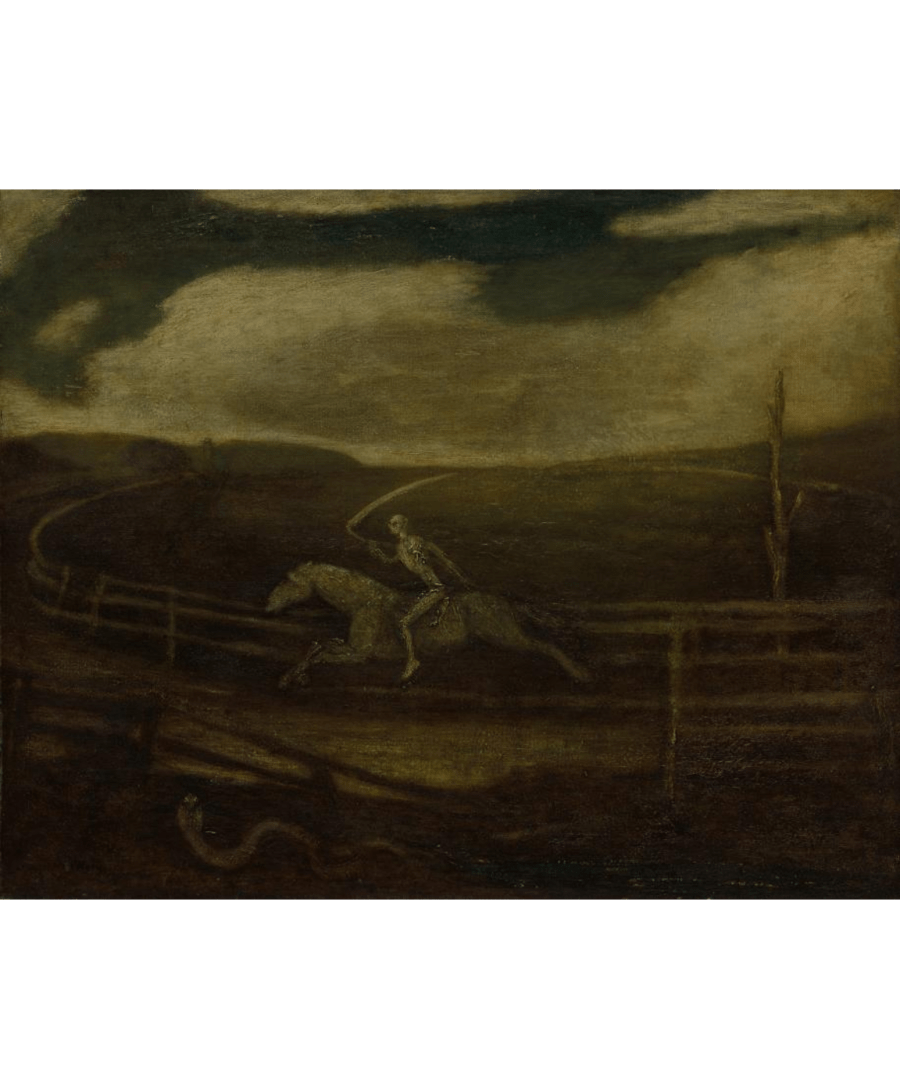
Featured Art: The Race Track (Death on a Pale Horse) by Albert Pinkham Ryder

Young John Wayne leaps, without effort,
onto the back of a Palomino, and I know
he’ll catch the leader of the Taylor Gang
for what he’s done to his woman. He’ll swing
for this one. Wayne is ruthless, but it’s hard

to forget him cut open for cancer research,
the forty pounds of meat wadding through
his colon like a saddle strap. You and Wayne
have a lot in common: doctor’s hands

searched the mineshaft of your stomach,
catalogued what they took, then fastened
you with a wandering stitch. Still, nothing
extracted from anyone can explain why
the body takes revenge on the body.

                             ***
Hanging is the ninth most popular
suicide method behind gunshot to chest;
it has an almost seventy-eight percent

success rate, and takes seven minutes.
In the west, thousands gathered
to watch hanging judges size bight

and neck, and after the bags dropped
some took pieces of the scaffold or rope
as keepsakes. You hung, too.

I still have the pair of shoes you loaned
me in gym class on a nail hook
in the back of my closet.

Read More

The Wall

By Christopher Kempf

Selected as runner-up for the 2015 New Ohio Review Poetry Contest by Robert Pinsky

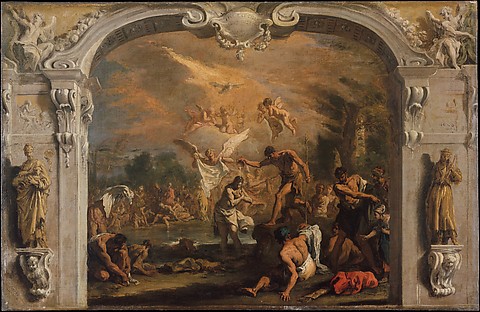
Featured Art: Ruins of an Ancient City by John Martin

                At mile twenty, roughly, the muscles
of the legs will collapse. Calves
                 twitching at random. The hamstrings’
                                                    sacked meat seizing. Scarry,
in The Body in Pain, explains
                                             that language too, tasked
                    with conveying affliction, fails. That pain,
   she argues, obliterates
                                                          discourse. I limped

                           past the drunk undergrads
of Boston College, my body’s stock-
                                                           pile of glycogen finally
                                       exhausted. The wall, runners
               call it.  The bonk.  The blowing
                                                                                         up. & after,
             the body in pain will make
                                                       of its own fat fuel. I followed

               the shimmering column of runners right
                                     onto Boylston Street. In three
                                                                                            hours two
           coinciding explosions would themselves
                                                                   leave the city—except
    for its sirens—speechless. The limes, Latin

        for boundary line, signified
                                         to ancient Romans the most remote
                              walls of the sacred Empire. Lie-
     
  meez Arabicus for instance.
                                                         Limit.
                                                                      The legions
                           Caesar trusted most though & therefore
    dreaded, he kept
               stationed on the Plain of Mars a mile only
                                      west from the city walls. He watched
     from the seventh hill the drilling
                                                                    columns, consulted
                                          each morning in the sky above him
             the wheeling birds.  A body,
                                                                            he knew well, will
                      at sometime or other, hungry
                                                                                for blood, break
               in on itself & eat.


Read More

Rumors About Dread Mills

By Rodney Jones

Featured Images: Rouen Cathedral, West Façade by Claude Monet, 1894, Courtesy National Gallery of Art, Washington

1974

At last they have him in church, a short service and the family silent, but the moments after the funeral are like a test.

True: The new base-tube press at Lockland Copper weighed sixty-seven tons. When they had completed the building and brought it in the door, six engineers agreed they would have to lift the roof to get the crane in and lower it into the pit. He heard from Tip Smith, a drinking buddy, a welder on the job, and wrote the board, saying he would do it for 10,000. Went to the ice plant, ordered eigh- teen blocks, filled the pit, rolled the press onto the ice; then, as the ice melted, pumped out the water.

True: Drunk every day for sixteen years. False: Mostly homebrew or moon- shine.

True: Every morning Maurice Orr’s rooster pissed him off. False: He caught the rooster in a sack, dug a hole behind the house, buried it with just the neck and head sticking out, cranked the mower, and mowed the lawn.

False: The story that besotted on the back lawn he ordered Jawaharal to dance and choreographed the steps with a Colt revolver. (Gunsmoke.)

True: Jawaharal inherited his logic gene and argued when he called him “Jerry.”

False: He never hit a lick at a snake. Once he pruned the grapevine. Twice, after midnight, he picked roasting ears from Leldon Spence’s garden.

True: When the money from the press job ran out, he wrote bad checks until his name was published on the glass doors of every business from Cold Springs to Decatur. It hit him then one day: go from store to store, copy all the names, print the list of deadbeats twice a year and sell subscriptions to each store for fifty dollars.

True: His Deadbeat Protection Flier taking off before the Credit Protection Act: drinking Jim Beam in the air over Georgia and Louisiana, he was a sloppy man who made a million dollars.

True: The gay son home from Palo Alto. The wife, a holy roller in a sari. His brilliant, inebriated redneck math, marks in the chicken yard. The liver. The heart—details of the unannotated life: grease-prints on Erdös in Combinator- ics, unused tickets to see Conway Twitty—Cliffs Notes for Abyss Studies—

His mind at the end like a hand reaching for a pocket when he wasn’t wearing a shirt.

“I would kill myself if there were anyone better.”


Read More

BBC

By Mike Wright

Featured Image: View of Toledo by El Greco, 1599-1600

I leave the World Service
on at night, snoozing through
the British iteration of gang rape
and kidnapping. I’ll stir sometimes
to hear a few moments of economic
collapse, but it’s really white noise,
blanching the laughter of drunks outside.
Sleeping to tragedy helps tamp down
my father’s last days, his morphine speech,
how my mother sent me to Kentucky
Fried Chicken with a coupon
for his last meal, and how shame
drove me to throw the coupon out.
If his death were broadcast in the night,
his of thousands of dying fathers,
and you slept well, how could
I begrudge you a night of rest?


Read More

POOF

By Sandy Gingras

My mother wants her head to be frozen
after she dies. I’m against it, but
there’s no talking to her. She has a brochure.

On the cover, there’s a picture
of a white building with no windows.
I tell her, I go, “I’m never gonna visit you there.”

She says, “Fine, fine,” the way she does.
She reads me the whole brochure.
She’ll be maintained at something-something degrees

until they come up with the technology to defrost
her. The, she says, “POOF. It’ll be like
being microwaved.” I go, “Think about

what happens to popcorn.” She keeps on reading
about how they’ll just fiddle around with her DNA,
and she’ll grow a whole new body. I don’t get that part.

I go, “What if they can’t grow you a body,
and you’re stuck being an alive head forever.”
She says, “Then you’ll have to carry me around.”

I knew it. I knew it.


Read More

The Egg

By Eric Nelson

We’re sitting at the table the way people do
When a family member dies and a stream of well-wishers
Arrive with sympathy and food.

Everyone is concerned for the widow, 70, tough, wiry,
Who now seems weak and befuddled, staring at people
She’s known for years without answering,

Rising and walking out the back door, staring at the woods
At the far end of their land.
Returning to the table without a word.

We’re all thinking how often one spouse dies
Soon after the other, dies of nothing
But lack. Because we are surrounded by guns, her husband’s

Sizeable collection—pistols in glass cases, rifles
In racks and corners—talk turns to their value, the merits
Of revolvers versus semi autos, plinking, protection.

Now, for the first time, the widow speaks, remembering
That she went to the coop this morning and found curled
In a nesting box a snake, unhinged mouth filled

With a whole egg, disappearing a swallow at a time.
She walked back to the house, pulled her .410
Off the rack, returned to the coop and blew its head off.

A hog-nose, she says. A good snake. But I had to.
She shrugs her shoulders. I had to. Glancing
At each other, we nod in agreement, relieved.


Read More

Dialing The Dead

By Mark Kraushaar

I’d never call.
First of all, I’d be intruding, and besides
I can see my dead friend with all his dead friends
even now, translucent, weightless, winging
through a cloud or sitting in a circle
on some creaky, folding chairs—
Hello, my name is Peter and I’ve
been dead ten years, car wreck.
Hello my name is Edith and I’ve
been dead a week, pneumonia.
Hello, my name is Frank and I’ve been . . . .

Oh, I know they’d all be friendly but even
dialing later when I guess he’d be alone
I’d have too many questions:
If you’re nowhere now and nothing
is this the same as everywhere and everything?
And, Peter, do you sleep in heaven?
Do you eat up there?
What’s the weather anyway?
And that tenderness of heart we try so hard
to keep a secret: in heaven we’re
wide open, aren’t we?
Stay in touch.
No, don’t.


Read More

Fear of the Bird Migration

By Darren Morris

Featured Art: Bird by Peter Takal

I was attempting
the old familiar,
the regular slog,
when I slipped into
missing her again,
the child my wife and I
would never have.
Sometimes she was
a girl and sometimes
a boy. But like heaven,
I held her there
in my mind, a place
of light where nothing
is done, but all is felt.
She was a multitude.
The great uncapturable
plasm of love. Often
she was only
a finch’s thin line across
a rice-paper sky, tearing
through all stations of life.
The way she might
have worn her hair,
or adorned the surprising aspect
of surface-self for appeal.
Or how the supremacy
of personality might emerge,
wriggling out as it does.
Or the first run-in with
terrible, terrible sexuality.

Read More

Still Listening

By Robert Cording

Featured Art: Confusion of Christmas by Julia Thecla

I. Hospice Jumble

The Jumble in the paper too hard for him to read,
my mother suggested we make up our own: Dear,

she said to her husband, your first word is life.
Reduced to words we jumbled, he joked file

it. My brother offered another, mean,
thinking perhaps of his diabetes, a name

like cancer to our family. Then, lamp,
lit at his bedside, and the one palm

visible outside his one windowed room.
My father got them quickly, the last, moor,

said with all the sadness of being far from shore . . .
A grandchild solved that one—horse,

she blurted, noticing that he had left
us for a while. By his bed, my mother felt

his hands and face and eyes. Bob, please,
she said, but he was already asleep,

snoring, not dead. My mother sighed, O God.
My brother, in the spirit still, said dog. Read More

My Dead Father Remembers My Birthday

By Lesley Wheeler

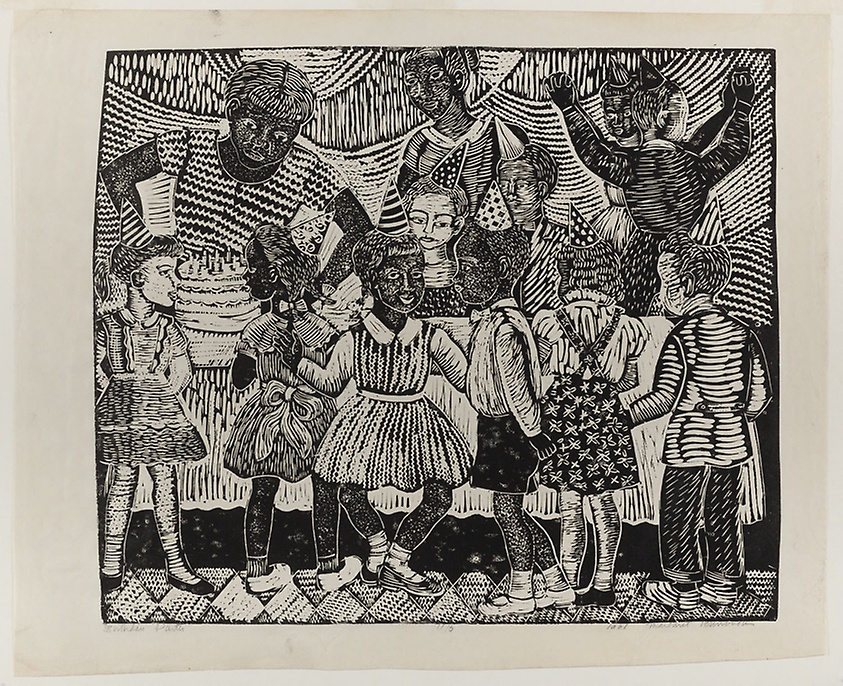
Featured Art: Birthday Party by Margaret Burroughs

Dream-phone rang and I thought: that’s exactly
his voice. I haven’t forgotten. Then: but I could
forget, because he’s dead. Hi, sorry it’s been so long,
but I was sick and the doctors messed everything up.

He made that shrug-noise, dismissive but pained,
meaning he’s lying or leaving something out.
It’s snowing here, and then a click, click, over the line,
and a neutral woman’s voice, slightly officious:
This recording was intercepted. If you wish to replay
this message, dial this number now,
and she recited
a blizzard of digits while I flailed
for a pen then found myself tangled in blankets.
The window a bruise beginning to fade.

Here mist wreathes the trunks. In a few months
snow will crisp the grass, insulate and numb the oaks
with feathery layers that would soak and freeze
a human being. When and where is he? Snug,
maybe, watching weather through double panes.
Or wanting to be. I heard a bead of doubt
suspended in his voice, a cool guess he’d missed
something, before my operator intervened,
reason declaring: This is memory. The line is cut.


Read More

Finality

By Mark Cox

Featured Art: Jonny Dunn’s Sandwich Shop, Paducah, Kentucky by Walker Evans

She did not fit her body anymore—
she was lost inside it—
not like some punished child
wincing in the corner of a vast room—
not, either, like a ring fitted snug in its box—
more like the single yellow pill
in her white medicine cup—
that’s how she was, waiting—
carving precise cubes
from a thin lamb chop, chewing
with such listless fatigue,
I feared she might never finish,
and so pretended that by looking away
I was preserving her dignity.

Chewing and swallowing—
that’s how I remember her—
not as a face or even sequence of faces,
but as a complex montage,
a simultaneous superimposition
of every face she’d worn since birth. Read More

Three Houses and a Wish

By Linda Bamber

Featured Art: House by a River by Edward Hopper

1. Chevy Chase

Choked up to see the in-ground cellar door
behind the house
I was born in long ago

then had doubts, cell handy,
called older sister far away.

She said, wrong house!
Original had front yard oaks,
big porch . . .

found right house, had no
response at all. Used up tears on
house that didn’t know me from Adam! Read More

Looking on the Bright Side

By John Brehm

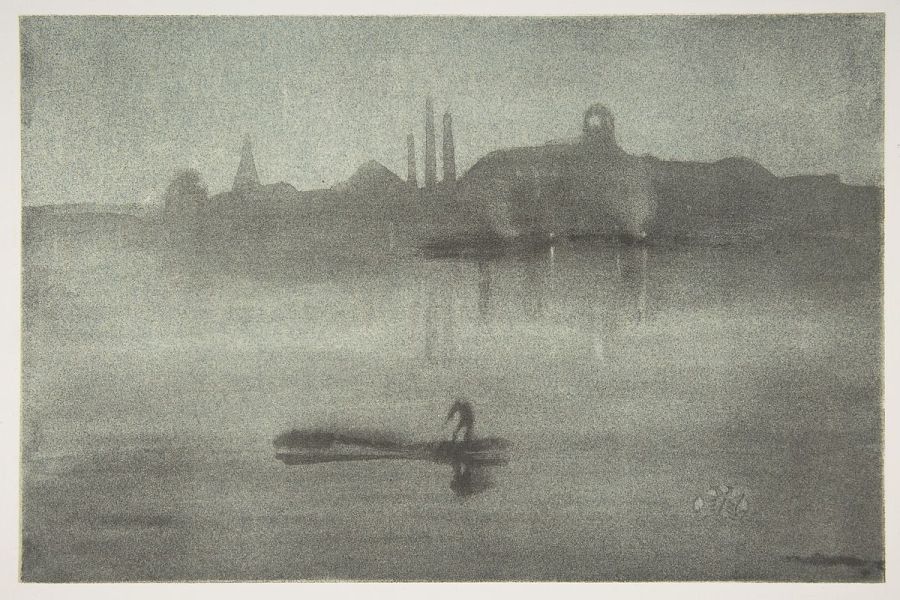
Featured Art: Nocturne by James McNeill Whistler

Death: at least it’ll give me a chance to catch up
on my sleep. No more tossing and turning
worrying about what’s going to happen next.
Unless of course my dreams of dancing girls
and hookah parties come true.
In which case it’ll give me a chance
to catch up on all the fun I missed
being too tired from lack of sleep.
A win-win situation.
Unless of course the dancing girls turn out to be
my former lovers, flitting before me
with vengeful or disdainful expressions
on their still painfully lovely faces.
In which case I can go on writing the poems
of failed love that failed to make me
famous when I was alive.
A suitable way to while away eternity.
Unless of course the hookahs are filled
not with tobacco but with heavenly peyote,
(food of the gods the gods left for us)
in which case it’ll give me a chance
to catch up on the deathless
bliss of boundless mystical oneness
my fear of death always kept me
from fully experiencing
here and now.


Read More

Nothing

By Lawrence Raab

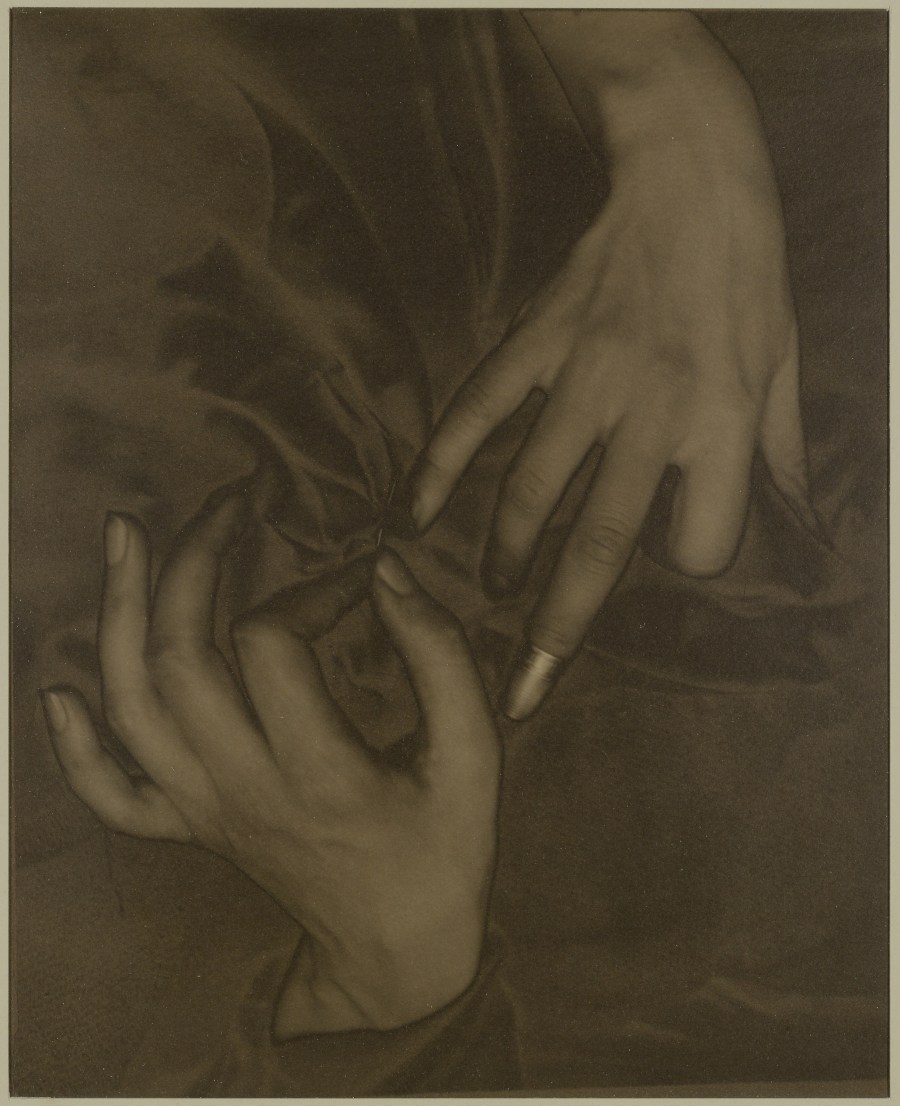
Featured Art: Georgia O’Keeffe—Hands and Thimble by Alfred Stieglitz

Why not believe death is also nothing?
—Dean Young

Sometimes nothing’s a glass
waiting to be filled, and sometimes

it’s sleep without dreams, a blank slate
no one gets to leave a message on,

that sheet of water boys skip stones across
to watch them vanish. And sometimes

nothing’s only a word that can hide
what it means inside what it means.

But when I’ve seen death it’s looked
like betrayal, like life taking back

what it promised, slowly picking
our friends apart until nothing

must feel like an answer, and death
slips into the room pretending to care.

Did it brush by me just now,
did it mean to touch my hand?


Read More

A Simple Request

By Patricia Corbus

Featured Art: Threatening Sky, Bay of New York by Thomas Chambers

                                                                                                —for Wes

Here I am, still drowning in the world,
   while you are opening Dame Simplicity’s closet—

   and I say, Be good to him, Simple Goodness,
Air and water, expand for him! Moon, be a smiling
              china plate for him to leap over!

       In the cupboard where cups wait quietly
and beautiful old words are folded in flannel cloths:

Mother, Father, Long-suffering, Beloved, Forgiveness—

Lay him down in simple peace, homely pleasures,
       between jars filled with feathers and shells—
near Grandmother’s broom that sweeps so clean.

What aromatic, wild poultice crushed to the breast
                         soothes and heals all?—

                        It is the essence of Brother
overpowering me with some stinging nettle of sweetness—

Whatever sunset door you go through, hold open for me.


Read More

Tauromaquia

By Deborah Casillas

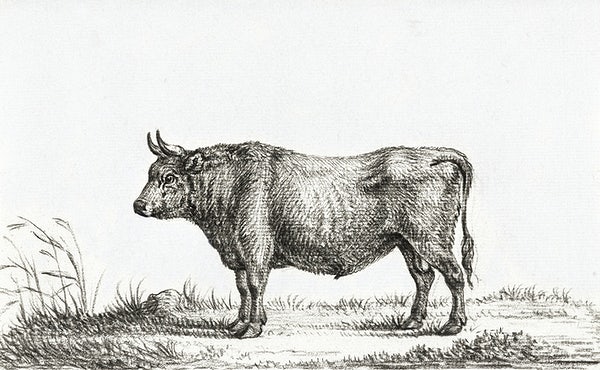
Featured Image: “Standing Bull” by Jean Bernard

The days dragged on, steady ticking of the clock.
My mother’s cancer; surgery, injections, drugs.
Long afternoons I sat in my grandfather’s library
looking at books. Shelves of books about bullfighting—
la lidia, combat; la corrida, the running of the bulls.
Books on Manolete, Belmonte, Joselito,
his copies of The Brave Bulls, Blood and Sand,
Death in the Afternoon. Books aficionados collect,
those fanatic followers of the taurine subculture.
I stacked volumes beside me, looked at pictures
of the black bulls, studied their deadly horns,
the ritual sacrifice. Here were portraits of the famous
matadors, their lives venerated like the lives of saints.

Read More

Saying Goodbye to Dad

by Kate Fetherston

Feature image: Pierre-Auguste Renoir. Near the Lake, 1879-1880. The Art Institute of Chicago.

My dad died alone in a VA hospital
as July sun beat without mercy into the raw

seesaw of breath busting seams between
each cell. Third spacing doctors call it

when cell walls no longer sustain
boundaries with integrity, fluid

sluices into interstitial no-man’s
land and overpowers whatever little

plans were made for a garden and some
trees. When my brothers and I got

the news and flew in from the various
places to which we’d fled, I’d just split

on my first lover after years of her
threatened suicide, bouts of drunken

depression, and refusals to take
her medicine too numerous

to recount. Her view: I’d been trained
strictly for fixer-uppers, too stupid

or stubborn to leave, but, waxing
romantic, she’d croon, “You’ll do me

for a rough old mate.” The day she smashed
my stuff into the carpet and poured

ten pounds of flour over
everything, I might have stayed for

more of the same, but I threw
crumpled clothing into my pack,

startled when she whispered, “I’m
just like your crazy

old man, aren’t I?” I didn’t
answer because we both knew

Read More

One Day Your Parents Confess You Have a Twin

by Todd Boss

Feature image: Ugo da Carpi. The Sibyl and a Child Bearing a Torch, 1510-1530. The Art Institute of Chicago.

who was given up for adoption early on, when it was
clear they couldn’t manage him. It was, says your father,
the worst decision they’d ever made. (It’s you and your
parents at the kitchen table. Between you, the steam
from the teapot uncurls in a kind of breathing statuary.)
He was your inverse, your yin: When you went to sleep,
that’s when his terrorizing of everyone would begin.
He went from home to home to group home, and then
to prison, half mad, a drug-addled teen, with your name
tattooed over the veins in both forearms. “That’s when
we moved to Minnesota,” says your mother, but of course
he found you here, at the end of an abbreviated sentence,
and slit your throat while you slept. This was last year.
You’ve been dead ever since. We know this must be hard
for you to hear: but you don’t exist. You’re your own twin
brother’s obsession with you. (Can it be? Instinctively,
you reach to touch yourself about the shoulders, the neck,
but everything’s . . . identical.) It’s like a mad dream—
yes, the recurring one you’ve had since you were a child,
in which you go from door to door, trying to trade
your life for another’s, but nobody will trade, and you go
on and on, pounding, until, impossibly, you finally find
someone willing, and you wake. Your mother reaches
through the figure of steam to lift the teapot and pour
from out its only portal a little stream into her cup, her
husband’s cup, the cup in front of you. She sets the teapot
down, and now there are four apparitions dwindling there,
silken, gesturing. One of them says, We love you the same.
But you can hardly hear them as you push up your sleeves
—one at a time—and read, and reread, your name.


Read More

Wet Carpet Awakening

By Kevin Stein

Featured art: Europeans Embracing by an unidentified artist

Cursing the stubbed-toe 2 a.m. call—my father?

I picked up a woman’s feather-brushed gush, “Wilbur,

it’s a grandson! Jamaal José O’Bryant.”

And I, unhappily not Wilbur, croaked Wrong number as one does

when plucked frog-eyed off sleep’s lily pad.

She was old. Who else misdials the pay phone’s tiny numbers?

Who else marries a Wilbur, their grandchild an American blend?

Outside rain misted not cats and dogs but litters of kittens.

Her lavender sachet apology, my bed-headed threnody,  my 

No problem, and click. Lightning cracked night’s black egg

in halves I couldn’t tap back in place:

My father’s dead. I’m next.

Revelation arrives like that, thunder trailing the flash.

I rode the open window’s wet carpet awakening,

storm flipping its toggle above the wind-blown yarrow,

electric as any newborn. Shaggy, late autumn, nearly gone-to-seed-

bloom, naked ecstatic.

I floated my trial run out a window the rain had come

in. When the dark made light of me I was.


Read More

Between the Heaves of Storm

By Lance Larsen

Featured Image: Approaching Storm by Edward Mitchell Bannister

We have buried our aunt with words and hymns.
Now to finish the job with dirt.
In the front of the church, a hearse
waits to lead the cortège of headlights
to the cemetery two miles away.
But here, in the back parking lot,
a grandniece, perhaps six, has squirmed
out of her itchy skirt and grabbed
a pink hula hoop from the family van.
We put the morning on pause,
three or four of us, car doors flung open.
Plenty of time to take in this emptying quiet,
her skirt puddled now on asphalt
like a secret entrance to the underworld.
And plenty of room for her little girl hips.
She jounces and gyrates, as if trying
to coax rain out of the wispy clouds
floating above our fair city.
Twelve, thirteen, fourteen . . . She counts
with a wheezy underwater voice,
the kind one uses to address homemade dolls—
limp dolls, badly stitched, x’s for eyes,
velcro on the hands to hold
an embrace after the arms grow tired.
Little grandniece swings her hips.
Green undies, dishrag sky, a waiting 
that fills the parking lot even as it clears.
Any worries about the next life set
spinning for now in reassuring orbits, rattly pink.


Read More

The Day After My Death

By Jeff Worley

Featured Image: Italian or Swiss Town by Frederic Edwin Church 1868

—after lines by Michael Van Walleghen

The moon, stars and weather
will happen as they always have,

though surely with my breath gone
the wind, in some slight measure,

will falter. Absent my footsteps
the earth will feel along its spine

a momentary shiver of abandonment.
And my friends? Won’t they gather

with me again, in whatever purple-
swagged room, for wine and stories,

some of them nearly impossibly true?
Meanwhile, the mailman, humming

like a bee in a blossom, will slip
my name into the metal box:

an unsigned note from The Paris Review
saying, simply, Sorry.


Read More

House on the Lake

By Liz Robbins

Featured Image: Greenwood Lake by Jasper Francis Cropsey 1875

When Dad was dying, everyone wanted
to take care of him, no one
wanted to.

We sent flowered cards, everyone wanted
the easy parts.

His cancer was a quiet purple flower
that grew too familiar when it took
over the bed.

The purple wanted the easy parts,
the purple wanted the hard parts, the liver.

We all went one way, then another.
We were the roots, we scattered.

We couldn’t compete, that’s all we could
do. We wanted to sit around and stare
at the clouded sky and drink.

His IV was clear, the only thing.

He had ten months, ten years.

We walked around Lily-Pad Lake,
where hordes of trout wriggled
to breathe.

Read More

Heroic

By Lawrence Raab

“People who plan their own memorial services,”

my friend was saying, “don’t get the point of death.”

There’d been songs and prayers and ecumenical readings.

Then one of the children played the trumpet

and the brother told too many stories that weren’t

sad or funny. Now we were headed to the reception

to be sincere about how much he’d have appreciated it.

But I liked thinking you could say of someone,

He didn’t get the point of death, and make it sound

like a brave refusal. As we walked up the hill

on that stubbornly beautiful day, I liked that idea

a lot more than hearing about people battling their illnesses

when all they’re really doing is lying there with a chemo drip

in their arms, then stumbling off to throw up. I know, I

know it’s only a figure of speech, a way of granting

courage to those whose bodies can’t manage it,

but what I want is the strapping on of bright armor,

the hefting of great swords, then striding out

into the blinding plain, massed armies on either side.

Sure, the odds are against us. In fact, we’re doomed,

which is why the clarity of standing here

has become important. Not the battle itself, but these

few minutes of stillness—the ocean in the distance

brandishing its light, and the sea-birds inscribing

their invisible maps across the field of the sky,

and the colorful flags of our armies testing the wind.


Lawrence Raab is the author of seven collections of poetry, most recently The History of Forgetting (Penguin, 2009). His collection What We Don’t Know About Each Other won the National Poetry Series and was a finalist for the 1993 National Book Award. He has received a Guggenheim fellowship, a Junior Fellowship from the University of Michigan Society of Fellows, and grants from the National Endowment for the Arts and the Massachusetts Council on the Arts. He teaches literature and writing at Williams College, where he is the Morris Professor of Rhetoric.

Originally appeared in NOR 8.

Objective Correlative

By Ann Keniston

Featured Art: The Letter by Alice Pike Barney

All I could do was think of her face.
Or not think of it, the way
after receiving her letter I felt
relief, gratitude, and then
lost the actual note she wrote,
the tiny, lovely photograph
of her children I’d vowed to cherish.
And then I saw: my grief was
the objective correlative, a hook
on which I could hang all the scraps
of whatever other sadnesses
I was more frightened of. And the grief,
like a person, like her in her solicitude,
almost prevented me from seeing this


Read More

Tool Box

By Maura Stanton

Under the rusting red metal lid we’re waiting for you—your father’s tools.
We always knew you weren’t going to build a doghouse or repair the stairs or
tighten a bibcock faucet, but we wanted to be of use as in the old days. Ah, the
old days! When we heard your father’s tread on the basement steps, we were
thrilled. The hammer clenched its head, the bubble trembled in the level, the
pliers stretched its jaws. But after your father died it was worse than we ex-
pected. You carted us out to your car, left us for months in the trunk, and then
stuck us on the floor of this hall closet next to the vacuum cleaner. Now the
hacksaw’s teeth are rusting, the file’s worn down, and the measuring tape sags
beside the plane. The poor jackscrew, no longer attached to a work bench, has
grown forgetful, and thinks it’s really a micrometer caliper. All you care about
is duct tape these days, tearing off flashy shreds to cover your botched work
while the tough little nails languish. So watch out! All of us in here are fed up
with your disregard for some of mankind’s oldest inventions, so if you ever do
open this lid you’re going to get hurt.


Outbound Fall River 1967

By David Rivard

Well, you know how it is
when you’re thirteen, & deep
in the factory bosses’ graveyard—your hair
damp, atmospherically

violet in the August dusk—the children
you run with calling back
over gravestones & wrought-iron Grand
Army of the Republic

picket fences—in this cemetery
catty-corner
from the China Inn (Catholic chow mein
sandwiches

served there Fridays,
Wayne Yee’s family cooks them)—
you know all those
grassy family plots you walk over, strongholds

Read More

Early Life

By Sydney Lea

All the pastor’s years of serving God
and humankind—they’re nothing now.
His congregation has long resigned itself
to anecdotal, meandering sermons.
But how forgive his mixing the liturgy
of welcome to a new church member
with the ceremony—however it may be related—
of baptism? The poor young parents

blush and fidget while veteran members feel
something between impatience and rage.

The minister and infant, robed and sleeping,
appear serene, above it all,
the one too young, even awake, to know
what’s going on and the other unable
to keep intact his thinking. Painful pauses.
Autumn rain on the roof like gunfire.

Read More

The Meeting

By Catie Rosemurgy

They were deep in it and about to vote on what it was.
The leaves above them began to drip and blur
the proceedings. Thumper, Miss Peach, the yellow pile of wax
that was the Candlestick Maker, all of them
batted whatever lashes they had at the middle distance and recited
possible recipes for what was leaking out of their eyes.

The Black Coat read from The Official Complaint:
for years everything has been about itself, the music
about music, the light about light. In the small patch of woods
on the south end of town, someone played with a rock and a feather
and was never seen or heard from again.

3 parts: dirt thrown at the moon___1 part: other people’s bodies

Miss Peach straightened her lichen vest, lay down,
and pretended she was dead. Thumper sang a cappella about berries
and knowing what to do, the Black Coat swatted patchy bluebirds
from Miss Peach’s eyes. Everyone’s mouth craved the irritation of dirt,
but their faces, all mere surface damage and glow,
spoke of more. Of a time when things happened
and led quickly to other things. Of a place beyond the trunks of trees.

Soon they would lose the light filtering in from the big game down the road.
No matter. They could feel their faces
beginning to cave in and didn’t need to see.

3 parts: footsteps approaching your nest
1 part: your head held above the crowd on a satin pillow

1 part: wild mint___2 parts: your mother seeing you walk into a clearing
after you’ve been dead for so many years


Read More