Final Visitation

By Dan Albergotti

Featured Art: by Paul Gauguin

After talking with him for thirty minutes,
as he lay cocooned in a thin wool blanket,
I told my father I had to head back to Conway.

He turned his ashen head a bit and said, Conway . . .
that’s where my son lives. I met my sister’s eyes
before fixing his in mine to say, Father, I am your son.

His eyes widened in that way that makes
us say, You look like you’ve seen a ghost,
or as if he’d found himself the quarry of a hunt.

I touched his hand before I left to show him
I was real. I think I could have walked through walls
to get to my car, so grateful was I to be that ghost.


Read More

Donovan

By Susan Browne

Featured Art: by Carol M Highsmith

I walk down my neighborhood street called mountain
although there is no mountain     only rolling hills
although hills don’t really roll        & as I look
at a window display of shoes & pass by the candy store
a gasp happens in my head    a quake in my heart     they aren’t
here      my father who loved sweets
my mother who loved shoes    & the sun shines
on a world of orphans      I quake along mountain street
like a rolling gasp although if someone asked
how are you I’d say fine      like most of us are
& aren’t       I thought sadness was a prison
but it connects us & if a chain it should be
one of tenderness     my father died
two years ago although sometimes I say a year
a way of keeping him closer      can’t do that
anymore with my mother      need math on paper      the ache
woven into each leaf although there are birds & nests
we live in a tsunami     waves of being & non-being
but I’m no philosopher standing at the counter buying
bunion pads     feeling drowned & drying
under fluorescent lights & warmed by the smile
of the clerk who blesses me with have a great day as I go out
to mountainless mountain & remember donovan’s song
playing in my parents’ house in the sixties      first there is
a mountain then there is no mountain then there is


Read More

The Roots of Phobia Lie in History

By David O’Connell

I hate their tiny hands, the silent-screen-villains’ way they have
of rubbing them together, chest-high, as they squat on countertop

or wall and stare me down with gas-mask goggle eyes.
Hate how they materialize from clear blue sky to picnic, to garbage,

to shit. It’s their disregard. Their monotonous, dull thudding—wings
to window—so persistent that it bullies my attention. As does

that intermittent buzz, somewhere in the house, taunting me to try
and stalk it down. In swarms, if possible, I hate them more. Despise

their ganged-up arrogance, the lazy way they rise—helicopters
from midtown—when I approach each mutilated victim of the cat.

But it’s more than that. If not a full-blown phobia, my aversion’s
on the spectrum. And I believe them, those psychiatrists

who guess true phobic hate (blistered, crippling) may indicate
that terror’s being leeched from something other than experience,

that, right now, somewhere in my genome’s mud, there lies
a clutch of rusting drums leaking grim ancestral memories: flies

inside the suppurating wound, flies on the gangrene rot, flies
alighting on the child too weak—or worse—to brush them off.

And if that’s true, wouldn’t it account for why I sweat
when I catch sight of one upon my pillow or hear its stuttering hum?

No. Not entirely. Terror’s well delves deeper. Its waters seep
from hollows in the Id infested with the blind, albino worms of nightmare.

And more than suffering, more even than the thought of the loved body’s
eventual decay, its stench a honey drawing clouds of flies to mate

and lay those eggs that, hours after death, make cold skin pulse,
then writhe—more than this, it’s what comes after that fuels phobia.

Read More

Sunday at the Mall

By Tony Hoagland

Featured Art: Crouching Woman by Ferdinand Victor Eugene Delacroix

Sweetheart, if I suddenly flop over in the mall one afternoon
while taking my old-person-style exercise
and my teeth are chattering like castanets,
and my skull is going nok nonk nok on the terra cotta tiles
                                       of the well-swept mall floor;

my tongue stuck out, my eyes rolled up in my head—
Don’t worry, baby, we knew this kind of excitement
might possibly occur,
and that’s not me in there anyway—

I’m already flying backwards, high and fast
into the big arcades and spaces of my green life
where I made and gave away and traded sentences with people I loved
that made us all laugh and rise up in
unpredictable torrents of fuchsia.

Dial 911, or crouch down by the body if you want—
but sweetheart, the main point I’m making here is:
don’t worry don’t worry don’t worry:

Those wild birds will never be returning
to any roost in this world.
They’re loose, and gone, and free as oxygen.

Don’t despair there, under the frosted glass skylight,
in front of the Ethiopian restaurant
with the going-out-of-business sign.

Because sweetheart, this life
is a born escape artist,
a migrating fever,
a convict tattooed in invisible ink,
without mercy or nostalgia.

It came down to eat a lot of red licorice
and to adore you imperfectly,
and to stare at the big silent moon
as hard as it could,

then to swoop out just before closing time
right under the arm of the security guard
who pulls down the big metal grate
and snaps shut the lock in its hasp

as if it, or he, could ever imagine
anything that could prevent anything.


Read More

Learning Swedish in Secret as a Joke

By Bobbie Jean Huff

Featured Art: Breton Girls Dancing Pont Aven by Paul Gauguin

All this passing on going on, almost
as if it were contagious. Words you’ve recently learned
spill easily from your lips:
Wenckebach, biliary, Cetuximab, granuloma,
the new bright colors of life. Just when
you were getting bored with the
pinks, purples, and greens on offer
for almost seven decades,

you’d happily now trade blasts and plasma cells for
brown or black or tan. But as surely
and hard as you know how many platelets it takes
to sustain life, you know that
more new words will show up soon.
Months ago you learned that “consistent with” means
you have it, and, last week, that “refractory” means
the treatment has quit working.

Now that you realize you’ll never learn Swedish,
in secret and as a joke
(to surprise your daughter-in-law with at dinner time),
you understand it’s not that you’re running out of
brain cells,
you’re running out of time.
You can’t learn sjuka and middag while you’re learning
leukopenia and transampullary.

You never expected this.
You never thought it would come to this!
(That’s the funny part. Has it ever not been there?)
Wake up and
you will see it even now,
gliding merrily in your direction,
not even bothering to look you in the eye,
as if you are the last thing on its mind—and if

you squint you will notice it gather a little speed
(the teensiest of fuck-you’s),
like a sailboat in languid waters
a moment after the wind has shifted.


Read More

You Are My Sunshine

By Bobbie Jean Huff

Let me begin by offering my condolences, I said,
holding out my hand. She shook out her umbrella
and placed it open, just beside the altar. They thought
it was an ulcer, she said. They gave him some tablets.
Did he have any special requests? I asked. Favorite
hymns? Or something for Communion, like maybe
Water Music? He was worse by Christmas, she said.
He couldn’t manage the pumpkin pie. He always loved
my pumpkin pie. The King of Love is nice, I said. I
opened the book to page 64. As an alternate to Crimond,
you know. Most people don’t recognize it as the 23rd
Psalm. In January his feet turned black, she said. Toe by
toe. It took exactly ten days. The shadow of a branch
moved slowly back and forth behind the stained glass.
I thought: When I get home I’ll check my toes. Will
there be Communion? I asked, finally.

The last three days he started to hiccup, she said.
He wouldn’t take any water. It never stopped, the
hiccupping. Not once, not one minute until he went. I
could play Pachelbel’s Canon. That’s very popular now.
There’s no reason it can’t work at funerals as well as
weddings. At the very end, she said—then stopped, her
eyes squeezed shut behind her glasses—as if the
rejected water, each wretched hiccup, and every
blackened toe formed a chain she could use to haul
herself back to September, when she would claim
him, finally whole again.
She reached for her umbrella and frowned. Play
what you like, she said. He was never fond of music.
Not hymns, anyhow. Only once in fifty-three years
did I catch him singing. You are My Sunshine, I
believe it was.


Read More

Spring

By Lauren Shapiro

Featured Art: The Cock Sparrow by George Edwards

The nice teachers at the kindergarten open house
point out the Unifix cubes and color game;
they are professional in their analysis of play. Later
at Lainy’s party the operators of Jump ’N Bounce
just look away while the kids wrestle into an idyllic
sense of self. A mother tells me, hushed, how
one November morning Jason’s father parked the car
and blew his head off. Then it’s time for cake.
The kids are sweaty, tumbling over each other
for a spot at the table. I search Jason’s face
for a sign, a scar, but don’t find it—he’s waving
a noisemaker in Sean’s face, his mother chatting
pleasantly in the corner. Cue the birthday music.
Next day, we’re late, and I walk my distressed son
into school. “We might miss the eggs hatching!” he yells,
bounding down the stairs. The class is huddled
around the incubator, the glow from the heat lamp
flushing their faces. This must be a rite of passage,
watching a chick’s birth surrounded by friends.
It’s on the docket, tailored to the lesson plan, deemed
developmentally appropriate. It’s March, after all,
when the world glosses over its losses.


Read More

Mailing a Letter

By Dawn Davies

Featured Art: Evocation of Roussel by Odilon Redon

The letter came back from the post office so mangled
it was as if the mailman had plucked it out of my box
before being jumped by a clot of street thugs.
Then, still carrying his mail bag, stumbled into a bar
because it was the third time this year that he’d gotten jumped
in my neighborhood, and why do guys gotta pick on him
just because he’s short (under five-six don’t make a man,
his father always said). Then drank scotch and soda
until the bartender made him stop, walked the dimming
summer streets in search of his truck, slept in a doorway,
woke up and vomited into his mailbag, found his truck
and skulked home to his wife, who had sent all four children
to the neighbors and was waiting up in yesterday’s clothes,
with a suitcase and a left hook brewing. Because she hated
the late hours the USPS forced him to carry, and by “late hours”
they both know she meant his cheating with the tiny
Castilian woman two zip codes over, and this thought
that poisoned her days now propelled her to stomp on his mailbag
and kick it off the porch for all that the mailbag stood for:
the overtime, the philandering, the childless Castilian
with the twenty-two inch waist. But then when she saw his face
with his eyebrows tipped and sorry, and she knew
that he hadn’t been sneaking around, but had gotten into trouble,
she sat him down, fed him coffee, and washed his wounds
before sending him back out for his morning shift,
because they both needed him to keep this job
(there was a pension attached, she had secretly started divorce
proceedings, was hungry for the alimony).
And so he got back to work and wiped off the fouled, wretched
letters in his bag, feeding them through the system
before getting called into the supervisor’s, and because
the letter was wet, it got mangled in the maw of a sorting machine,
the address smeared and clotty, the stamp curled and dystonic,
and three weeks later, once the mailman was off probation,
the letter came back to him, smelling like machine oil and vomit,
clawed and shredded, stamped “Return to Sender,”
and he shoved it back in my mailbox with bite marks
from the beast that had mauled it, this letter to my father
on his deathbed, explaining why I wouldn’t be going to see him.


Read More

If Your Spouse Dies First

By Stephanie Johnson

Featured Art: Lady Lilith by Dante Rossetti

Option One

              Move to a different country.
              Take a new spouse.
              Make beautiful different-country babies
              with soft, different-country hair

and only speak your old-country language
late at night in between dreams.
Your new husband will ask the following morning
who this person is; you keep repeating his name.

              Oh, you say, in your new language.
              Don’t worry about it. Just an old friend.

Option Two

Build a house. Bake your late spouse’s remains
into the walls. Like the spectrophiliac Amethyst Realm,
feel paranormal hands on your legs and back
as you rub yourself on the corners of the foyer.

              Moan the name
              your ears haven’t heard
              since you reopened the coffin
              and saw silver bones.

Option Three

              Meet a woman with dark hair
              and patience longer than yours.
              Tell her a lie:
              you’ve never done this before.

                             She’ll grin and say, “Sure you haven’t.”
                            Later, in her shower, pressed against
                            the pink tile wall, you can’t help but notice
                            she uses his same shampoo.

Read More

My Father Visits Not Long After My Mother (His Wife Twenty Years Ago) Dies

By Brock Guthrie

Featured Art: by Paul Gavarni

My father’s in town for a quick couple days
and it’s early morning and not much to do

and he needs some smokes and I need
a few things from Lowe’s. We walk to my car

and he says, “Man, you need a car wash,”
and I say, “Yeah, I’ve just been so busy,”

which isn’t really untrue, but I tell him
there’s a place on the way. We get in my car

and he says, “Go to McDonald’s, I’ll buy,”
and we wait in the drive-thru and he says,

“You need a vacuum too,” and I don’t reply
because the food is ready. I pass him his

Egg McMuffin and drive down the road,
carefully unwrapping my breakfast burrito,

and this commercial I’ve heard a dozen times
comes on the radio, some guy with a nasally

New York accent, but only now do I gather
it’s an advertisement for snoring remedies.

My father says, “If there are two vacuum hoses,
I can do one side and you can do the other.”

We drive past strip malls. I wave vaguely
toward a Mexican restaurant I kind of like

but I can’t think of what I want to say about it,
so I kind of mumble and my father does too

except his is more reply, like, “Is that right?”
The car wash kiosk has eight confusing options.

Read More

My Babysitter Karen B Who Was Sent to Willard Asylum

Winner, New Ohio Review Poetry Contest
selected by Kevin Prufer

By Jessica Cuello

There are only two photos of me as a child.
She took them, she had no child.

She had Kool Cigarettes and a job at the drugstore.
She gave me the Crayola box with the built-in sharpener.

Four hundred suitcases were stored in the attic
of Willard Asylum for the Chronic Insane.

She joined her twin brother there.
She wore her black hair down.

A child could admire it.
She bought me an Easter basket,

a stuffed rabbit whose fur rubbed off.
She walked everywhere.

She painted circles of blush on her cheeks.
Loony, people said so,

I mean grown-ups who saw signs
who passed her on our street before she

started to call and say Remember,
on the phone she said Remember,

Remember the date we killed her brother,
forgetting he’d been committed.

I took her hand and tagged along like an animal.
She was perfect to a child.

Read More

Near the Campo Aponal, on My Father’s Birthday

By David Brendan Hopes

Featured Art: A Rocky Coast by William Trost Richards

De Sandro’s café with the orange tablecloths
wades into the one stone street
without tourists, all the Venetians pushing
their big delivery carts at first of morning.
From what I understand of it,
the shouting is voluble,
happy, glad to be alive, almost never
without reference to anatomy.

Nine years after your death it is still your birthday.
I’m treating you to cappuccino and showing off
my lacework of Italian.
Ecco, I cry, pointing to the beautiful faces,
the beautiful things.

Everything was outlandish to you. Nothing is to me.
In that way balance is achieved across the long years.

But I think you would like these people.
They would pull out the orange chairs, sit down,
listen to what you have to say. You would be old
and wise in a city old and wise, and that would be
enough.

I’d better think of something else before the mood
turns heavy and hard to carry over the Rialto Bridge
with the shops just opening.
All those selfie-taking children,
all that brightness bearing down.

Happy birthday, I want to say,
from the last place on earth, where the earth dissolves
and the crazy towers lean out over
watching for what comes—sinuous, flowing,
unexpected—next.


Read More

The Problem

By Grant Clauser

Featured Art: Sketch for Beach Scene by Joaquín Sorolla y Bastida

The town decided
that blowing up the body
was the best way to move it,
but the only explosives expert
was a groundskeeper
who’d planted mines in the war.
Still, people set up beach chairs
and umbrellas on the dune
to watch. When it blew,
slabs the size of picnic tables
crushed cars a quarter mile away.
One man was killed by a bone shard
through the heart.
Another still walks with a limp
from the impact of blubber.

For days the town pretended
this had all been the plan, everything
was good, but then under cover
of night, we rented front loaders
from the neighboring towns,
buried what we could and burned
the rest in smoky mounds
that choked us when the wind
blew in from the ocean.
The beach was unusable all summer.


Read More

Hilltop Cemetery

The poem, “Hilltop Cemetery” by Brendan Cooney, originally appeared in NOR 22. It became the inspiration for this short film, by Bridie Jackson.


Gentleman Caller

By Elton Glaser 

So this is death come walking, looking mighty fine,
Him with a firm stride and a dragon-headed cane,
Dandy with diamonds in his smile, all howdy-do
And sweet potato pie, him strutting right up
To your own front door, that big stick knocking
On the frame and tapping his spats, making
The neighbors stare and the dogs back down,
Him idling under the hum of the porch light,
Spreading his shine wherever he pleases, sounding
A little cocky when he calls your name—

And what’s your mama gonna do about that?


Read More

Laundry

By Robert Cording

Featured Art: The Bathing Hour, Chester, Nova Scotia by William James Glackens

This morning, doing the laundry,
smoothing collars and shirt plackets
before placing it all in the dryer,
I saw the ghost of my recently dead mother,
her red-capillaried face looking on
approvingly in the steam.

I didn’t expect to see her,
and some of this must be pretend,
but she was there, making a place for herself
over by the baskets, in the light
that fell through the windows
at an angle that never seemed to change.

We got to talking—who doesn’t want
to talk with the dead again
when it’s morning and mostly sunny?—
about the telephone pole in our old backyard,
and the sound of the pulleys and ropes
that carried the wash in and out.

I was lingering over the way a drying sheet
took in a breeze and released it
as if it were breathing,
but my mother chattered away non-stop,
moving as she always did, from topic
to topic without transition,

only pausing here and there to punctuate
with one of her sayings—
Doing the wash makes you happy.
It says you can begin again.
And unlike when she was alive
that seemed true. As the light’s angle

sharpened, none of our mistakes,
our fights or failures, the old
argument about Dad—or even
the ridiculous, proper way
to fold a bottom sheet—held us back
as we finished the first load of darks.

And by the time she held a shirt
by the shoulders, folded it in thirds,
then flipped the bottom half under the top
and laid it in the pile for the living,
I was whistling, caught up entirely
in the rhythm and pace of our task.


Read More

At Milward Funeral Home, Lexington, KY

By Jeff Worley

Featured Art: Bloemenzee by Theo van Hoytema

Someone has to identify the body.
The funeral facilitator, Jeanne,
gestures me into the room and clicks
the door shut behind me.

You finally got your wish,
I say to my mother.
She’s wearing a shade of lipstick
that unbecomes her, a subtle peach
she would have hated. Her face
is her face and of course is not,
her hair parted in the middle,
a new look. Her hands, composed
across her sternum, are the color
of parchment, skin thin as vellum.

I don’t stroke her arm. I don’t kiss
her forehead, as I thought I would.
Instead, I wonder, oddly, if the funeral
people use the same gorgeous quilt
that covers my mother now,
with its sunbursts and bluebirds,
for everybody.

When I think I have stayed long enough,
Brahms trailing off in the corners,
Jeanne is sitting outside the door,
her long fingers forming a steeple.
I want to say to her I have no idea
who that is, I’m sorry, but levity
isn’t encouraged here. Although
I would only be speaking the truth:
Alzheimer’s riddled her brain
and sucked the marrow from her spirit;
she became a stranger and a stranger
to herself. What else was there to do
but believe along with her that Hoss
and his Bonanza brothers were indeed
aliens from another planet, that Pat Sajak
was “in on it,” along with everyone else
who came and went in Mom’s room,
stealing her clothes, her makeup,
the nursing home grand conspiracy . . .

I’m sorry it’s taking me so long,
Mom said in a rare lucid moment
last week, and I had nothing to say,
and I tugged the blanket snugly
under her chin, and I handed her
the plastic cup full of water which
she waved away.


Read More

There Was a Young Woman With Cancer

By Susan Blackwell Ramsey

Featured Art: In the Spirit of Hoffmann by Paul Klee

With each remission she’d take it up again,
her search for proof her great love Edward Lear
was influenced by the Irish poet Mangan,
and while we weeded she would bend my ear
with her latest evidence: an owl here,
elsewhere a pussycat or a beard, a wren.
I was polite, but it was pretty thin.
There was one word, though,
some nonsense confabulation that occurred
in Mangan first, so odd that it could not
be accident. Then cancer, like a weed
we’d missed, some snapped-off root or dormant seed.
The last cure killed her. I would give a lot
to be able to recall that word.


Read More

It Depends

By Lisa Rhoades 

Featured Art: Still Life with Bottle, Carafe, Bread, and Wine by Claude Monet

We are all sick. We are all dying.
This is more or less
the truth, depending on the day.
Depending on the location,
some more than others
are headed home with hospice, toward
a tragic confrontation, a chicken bone, black ice.
Maybe it’s because of breakfast—
years of bitter coffee, the eggs
we were warned away from,
bracelets of sweet cereal O’s.
Perhaps it would help
if more of us knew CPR,
unless it all depends
on the weather of our hearts.
Don’t be fooled
by how quickly flesh folds
back into itself to heal,
or by the ones who are limping,
waxy-skinned and quiet. They will not carry
your part of this forever.
Maybe you should cover your cough,
not be so careless with knives.


Read More

Here Below

By Sarah Carleton

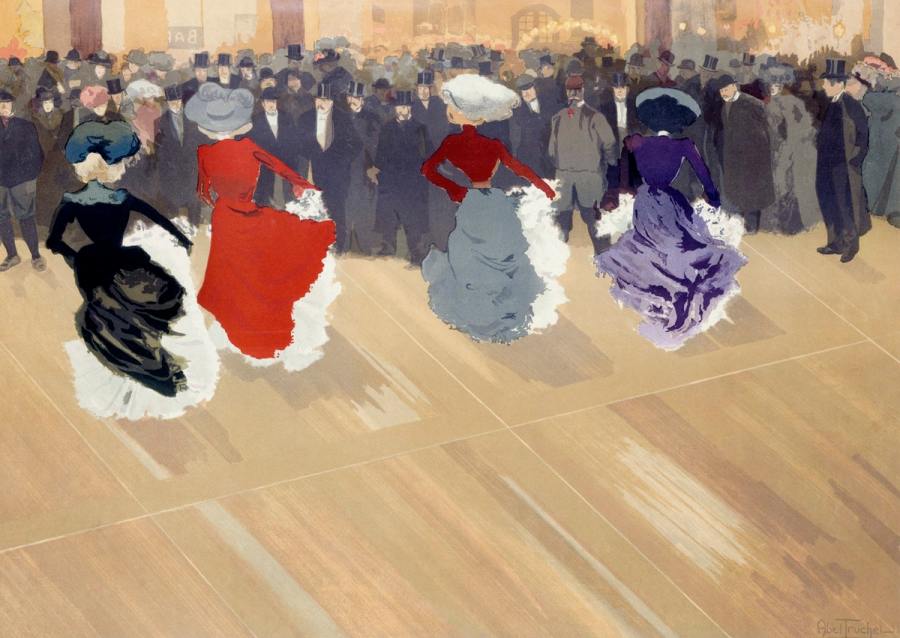
Featured Art: The quadrille at the Moulin-Rouge by Louis Abel-Truchet

Before a careless bulldozer buried him under a ton of dirt
he played with impeccable pulse.
He anchored tunes with a standup bass,

left fingers spidering, right hand patting pauses,
a running commentary that thumped below the chitchat,
bristling with off-color intent.

Just as hothouse plants rooted and swelled
to his sweet, muttered, nasty guy’s-guy nothings,
we set our feet in the soil of his crude jokes and thrived.

His wife didn’t pay much mind to the dirty stories
and sly non-secrets. When he laid their deck,
he penciled women’s names on the underside of the planking,

like an ode to abundance, and she just laughed, shrugging.
We take our cue from her and refuse to fret,
but celebrate him in smut and subtext.

Without crawling among the snakes to check, we hope
we made the list––divas of warm skin and rayon dresses
immortalized on a two-by-ten––

and we also aspire to be like his wife,
who stands aboveboard, rolling her eyes, knowing
her name has been etched more than once in that slatted dark.


Read More

I Tie My Shoes

By George Bilgere

Featured art: ‘Sorrowing Old Man (At Eternity’s Gate)’ by Vincent Van Gogh

I’m walking home late after work
along Meadowbrook Road when I realize
the guy half a block ahead of me
is Bill, from Religious Studies.
I recognize his bald spot, like a pale moon
in the dusk, and his kind of shuffling,
inward-gazing gait. Bill walks
like a pilgrim, measuring his stride
for the long journey, for the next step
in the hard progression of steps.

And while I like Bill, and in some ways
even admire him (he wrote something important
maybe a decade ago on Vatican II),
I slow down a little bit. I even stop
and pretend to tie my shoes, not wanting
to overtake him, because I’m afraid
of the thing he’s carrying, which is big
and invisible and grotesque, a burden
he’s lugging through the twilight, its weight
and unwieldiness slowing him down,
as it has for five years, since a drunk
killed his teenaged son, and Bill’s bald spot
dawned like a tonsure and his gait
grew tentative and unsure, and his gaze
turned inward as his body curled itself
around the enormous, boy-shaped
emptiness, and the question
he spends his days asking God.

And if I caught up with him
and we walked together through the dusk
he would ask me about my own son,
who is three, and the vast prospect of the future
onto which that number opens, involving
Little League and camp-outs and touch
football in the backyard would hang there,
terrible and ablaze in the autumn twilight,
and the two of us would have to slog
down Meadowbrook Road like penitents,
adding its awful weight to the weight of his son
on our backs, our shoulders, and so I fail
Bill, and stop and pretend to tie my shoes.


Read More

My Mother’s Dogs

By Sandy Gingras

Featured Art: Three Dogs Fighting by Antonio Tempesta

They are big and smelly and mean,
and they’re living in her basement.
I think they are dogs, but they might be wolves.
Eight or eighteen of them, something like that.
They all would bite me if I gave them
the chance, so I’m really careful
when I herd them out into the yard.
What is it with my mother?
Most families just have pets—usually one dog
and a cat, nothing like this. How
did she let this happen to her?

She’s living in some decrepit house now on Rt. 9
in the next town over and she’s evidently lost
her taste in furniture. Everything is gold
with rickety legs. She and I watch
the dogs patrol around the yard
from behind a glass sliding door. My mother is angry
now that she’s old, and I think that maybe
she and the dogs deserve each other, but
I can tell that my mother is scared too,
and I want to help her out because
I’m the problem-solver in our family.

The dogs don’t play like normal dogs,
they just move around the yard
like big bullet-headed missiles. We have to get rid
of them somehow, I tell my mother who is
suddenly smaller than she was, and then I hold her
in my arms and she’s a little girl. Whatever you do,
don’t let them in, I whisper, but
she’s already dead of lung cancer.


Read More

Detective Story

By James Lineberger

Featured Art: by sir Edwin Landseer

When I worked as a janitor at the courthouse
I met a detective in the Sheriff’s department
whose son, I learned, had committed suicide
some months earlier. Having lost a son myself
in a car-train collision, I tried to offer my condolences.
“Your boy kill himself?” the detective asked bluntly.
“We never knew,” I replied. The detective grunted
noncommittally and opened his desk drawer to take out
a photo of his son, a young man in his twenties, kneeling
and embracing a dog as he grinned for the camera.
“Two days before it happened,” the detective said.
“About the same age as our son,” I said.
The detective stared at the photo for a moment.
“You got a dog?” he asked.
“Two,” I said.
“Thing about a dog,” he said, “a person can screw up
a hundred ways, and his dog will love him when he can’t
even love his self.”
“Our son’s dog still sleeps at the foot of his bed,” I said.
The detective turned the photograph over on its face
and glanced up at me, his eyes as cold as stars.
“Ain’t his dog,” he said. “It’s mine.”


Read More

Of Course Death

By Roy Mash

Of course death is on its way,
       and life’s a blink,
and yes the unexamined one sucks,
       and doubtless
we’re well-advised, periodically,
       to expose ourselves
to the nuisance of these truths,
       waggling their
fingers with their thumbs in
       their ears, ever
heckling us with the raspberry
        of our mortality.

Still, we cannot carpe every diem,
       squeegee the universe
of each last moment, shovel our
       noses 24/7 into
the coffee or the roses or
       what-have-you.
Virgin-bedding stratagems aside,
       some days, maybe
even most days, the unforgiving
       minute’s happy
just to be left alone, frittered
       on some dopey
soap opera, or stewing over
       a parking ticket.

Read More

The Boy on the Ridge

By Michael Pearce

Featured Art: Precarious Glimmering, a Head Suspended from Infinity, plate 3 of 6 by Odilon Redon, 1891

I rode my bike down from Pilgrim Hill
toward the river that splits our town.
Along the way I waved to Sheriff Roy
and Mildred Floss, then wondered what
they were saying about me and my family.

It was fall and the road was littered
with goose shit and hyena shit and
shit-shadows shrinking in the rising sun,
and Estelle was bringing milk and muffins
to Mayor Bob’s bedside and pretending
his soul was alive inside its doltish husk
and my Noni was sitting in the bathtub
like a pile of wet clothes while Grappa
lay in bed dreaming of blood-hungry Cossacks
cruising the Steppe on thundering horses
and the town was still quiet enough
that you could hear the river’s bashful giggle.
I was headed to my shop
to build a desk for McElroy.

Up on Pilgrim Hill my mother’s voice
had spoken to me from her grave
in the Jewish section, had told me
about a little boy of few delights
and many sorrows who roams the high ridge
where Dorsell Quivers chases fox and deer.
My mother’s voice said only she
can see that little boy right now,
but he’ll saunter down and climb into
the belly of a comely maiden
as soon as I’m ready to be his dad.

I don’t want a boy of many sorrows,
I was such a boy and my heart
isn’t big enough to bear another,
to blaze the cul-de-sac of his youth
or watch his terror of his own hungry body
and the other demons of his undoing
hound him from his destiny.

Read More

Little Red Book

By Jeffrey Harrison

Featured Art: Le Code Noir by Pierre Prault

I unearth it while cleaning up my office,
The Little Book of Common Sense Investing
that my father sent me two years before he died,
its bright red cover like an accusation,
a yellow Post-it bearing his cheerful
half-script still attached: “Jeff—even if you read
only the first part of this book, you’ll get the gist.
Return it some time, no hurry. Love, Dad.”
I chose to place the emphasis on “no hurry”
and hadn’t cracked its little crimson spine
when, a year later, he asked me what I thought.
When I told him I hadn’t gotten to it yet,
he said he wanted it back, so he could lend it
“to someone who might actually read it.”
“But I might still read it,” I said half-heartedly.
“No, you won’t.” Which made me all the more
determined not to read it, so I said fine,
I’d send it back. But I never did—and then
he got sick, and our investment
in that particular contest seemed pointless.

But here it is again, this little red book
so unlike Mao’s, as if my father were making
a move from beyond the grave. Okay, my turn.
Is it because I need to prove him wrong
even now, or that I want to make amends
belatedly for disappointing him yet again
that I open the book and begin reading?
Or am I doing it in his honor? And is he
still trying to tell me I invested
in the wrong things?—poetry, for instance.
“Counting angels on a pin,” he said once.
Which is just the kind of cliché I find in the book.
Later, though, he claimed to like my poems,
the funny ones at least. And if we drew a graph
of our relationship over his last decades
it would look a lot like the Dow: a steady ascent
with several harrowing jagged downward spikes.
The little red book says nothing about those,
though it does advise not getting too caught up
in the market’s dramatic nose-dives.

Unless, perhaps, you’re trying to realize
your loss—another topic that the book,
with its rosy perspective, blithely avoids
as it enthuses on “the miracle of compounding.”
But instead of getting annoyed I feel an odd
joy: my father could have written this book.
He too was an optimist who liked to talk
about money, and so I used to ask him questions—
What’s the best kind of mortgage to get? Is life
insurance a good idea?—and those led
to some of our least fraught conversations.
That’s why he gave me the book. And he
was right: I get the gist after two chapters.
And the suggestions seem helpful, if limited—
I even underline a few sentences.
Still, that other book, the one about losses,
would be more complicated, and harder to write,
its author finally coming to understand
that, no matter what the future brings,
he won’t be able to ask his father’s advice.


Read More

Phone Call

By Stephanie Rogers

Featured Art: Figure with Guitar II by Henry Fitch Taylor

When I got the phone call, I listened
to my sister’s voice give
no hint, at first, that overnight,
like that, her life had changed.
I said hello and flipped through
a book on the nightstand, knowing
deep down, from all my missed
calls, that she was preparing
to tell me something
important. How are you? I asked,
trying to delay what I knew already
I didn’t want to hear. And after
her silence, then, I sat straight up—I was still
in bed—my eyes blinking
awake, the automatic
coffee pot dripping into the quiet,
and I said it: What’s wrong, Heather?
expecting for one singular moment the death
of our father, the sniffed
pills, the heroin finally ending
his life. But when she said
nothing, I demanded, this time, hearing
the pitch of her voice fill with the sound a brass
instrument might make breathing
a low note, barely
audible, into the crashing,
noisy universe. And she said it: Joel killed himself
last night, choking
on “killed,” and when I said, Oh
my god Heather
oh my god, she understood, she told me
later, for the first time,
that her husband was never
coming back. The sun peeked through
the window blinds. It flashed across
the framed faces of his daughters, who I pictured,
for a second, on the swing set
behind their house, their father pushing them
higher each time they swung back to him, further
away each time, further away.


Read More

We Remember You for Now

By Stephanie Rogers

Featured Art: Figurative Abstraction by Unknown

Now when my heart beats, it sounds like
crunched leaves skittering, the revving up

of a broken-down Honda. I can’t visit him
at a cemetery, or even the park. Scatter

my ashes there, he asked, and then injected
god knows how much, enough to warrant

a coroner call. Hahaha. Joke is Heather said nope,
stuffed and stored him in the back

of our mother’s closet. He lives there now,
sucking up the radiator heat. Joel, damn,

man. Come back and lick the spilt fizz off
the Budweiser can again. No one here

is going anywhere if I have a say, and how
didn’t I have a say with you? You plunged,

you syringed, each time needling—gentle,
I hope, as my grandmother crocheting

a winter hat for your oldest girl. I won’t
for long torture myself for you, I thought,

biting into a string of candy hearts around
my neck, your kid insisting, eat it, the sick-

sweet sticky hands of a two-year-old with
a dad resting inside a shoebox next to

a bowling ball. You did it. Congratulations.
I’m elated. I’m devastated. I’m a copycat

singing your songs to your girls to sleep.
Listen, creep: we remember you for now,

but now is a ragged dog, dragging its bum
leg along the buzzing halls of a new house.


Read More

When Mr. Bridges Died

By Mark Kraushaar

Featured Art: (Children Swimming) by Unidentified 

When Mr. Bridges died I knew
the whole eighth grade would have to gather
in the gym and sit there on those cheerless,
folding metal chairs set up by string-bean
Donny Graf the constant burper.
Mr. Bridges was a substitute,
we hardly knew him, but
I knew that there we’d be, all of us,
and there would be our stiff-grinning
twitchy principal, Mr. Albert Fraze, to slowly,
slowly stand and tell us what a deep
and lasting loss this was for all of us.
And later, sitting there three rows from the exit
by fatso Robert Randall who’d socked me
in the stomach on the 8 bus once,
I knew that Mr. Fraze would drill us
with the first long look that said, Every one of you
should be ashamed, ashamed for even thinking about,
for even thinking about thinking about
turning your gaze away one ten
thousandth of an inch:
a man is dead today.
And then would come this clumsy, freighted
metaphor and though I doubt I knew the word
(metaphor) I knew our Mr. Fraze: Mr. Bridges
was a kind of bridge, he’d say,
or found a bridge, or formed a bridge, or built
a bridge, or was a bridge from ignorance to wisdom,
from confusion to compassion, blah, blah, blah,
which is exactly what he said so that
sitting there I thought of that four-cabled
quarter-mile Roebling tower bridge
and I thought of its glittering
river city Cincinnati since we’d studied it all week.
I pictured its reaching, curving waterway, the great
Ohio and I thought of the circling terns and swirling slicks
and chemical froths and then I thought of a row of houseboats
and a paddlewheel steamer with a single, smiling
tourist, anyone and no one, waving once.


Read More

Fantaisie

By Donald Platt

Featured Art: Garden Flowers by Edna Boies Hopkins

                               Each person is
a solar system, the bits of birth’s Big Bang orbiting
                               some sun that both attracts

and repels. Elliptically, my mother orbits her own death,
                               that great shining
ball of fire I cannot look directly at. She draws closer to it,

                              then pulls away. She rotates
as she revolves. Together we write her obituary. Born.
                              Schooled. Worked as.

Married to. Gave birth. Resided. Retired. Is survived by.
                               The old story
we all get to write if we’re lucky, or one that will willy-nilly

                              get written for us.
I leave the day she’ll die blank. She gives me the notes
                              she wrote last night:

“Funeral in Christ Church and Bill Eakins to preach.
                              Ask Women’s Guild
to serve a simple refreshment. Give $100 to organist.

                              Give $5,000
to church. Give $500 to Bill Eakins. Give $1,000 to women.
                              Give $250

to soloist. No calling hours. Only the church service.
                              Nobody
getting up and saying nice things about me. Everyone

                              has their own
memories—good, bad, and indifferent. Chief purpose
                              of a funeral

is to pray for the departed. Also to give comfort
                              to those who grieve.
Call Hickey Funeral Home.” As an afterthought, she added

                              “Ask Charlene
to play Saint-Saëns’ Fantaisie for violin and harp.
                              You’ll need to find

a harpist.” Everyone needs a harpist to accompany her living
                              and her dying.
No one to turn to but the seated, marble harp player

                              at the Metropolitan Museum
of Art, early Cycladic, eleven and a half inches high
                              He embraces

the D-shaped instrument, whose top is ornamented
                              with the head
of a waterfowl. Against his right thigh and stone shoulder, he rests

                              the weight
of the instrument. It has no strings. His raised right thumb plucks
                              five thousand years of silence.


Read More

Believe that Even in My Deliberateness I Was Not Deliberate

By Gail Mazur

Featured Art: Butterfly by Mary Altha Nims

Believe that even in my deliberateness I was not deliberate
—The end words form this line from Gwendolyn Brooks’
poem, “the mother”

We’d be calm, we’d be serene, as long as we could believe

in the blue dragonflies and balletic monarchs that

hovered near us in a kind of peaceable kingdom even

while my love’s illness menaced the peace in

the summer yard, in the fragile house, in the air I breathed in my

deliberateness. My only stratagem, deliberateness:

to accept our lot in that pathless time. I

thought I’d know what he’d want; what I’d want was-

n’t any different. Wouldn’t it be, wouldn’t it finally be, not

to consider how finite our August? Not to deliberate?


Read More

Talking to My Dead Mother About Dogs

By Stephanie Gangi

Featured Art: Dog with pups by India, Rajasthan, Ajmer, probably Sawar school

          That damn dog.
Which one, Ma?
          The first one.
There is no first one, there was always a dog, Ma.
          The shepherd, the one who kept the baby
          from rolling in to the road down the hill in front of the house.
That was me, Ma. I was the baby.
          I know that. Rex. Rex.
          And what about your father’s, who jumped
          out the car window at a toll booth, headed for the hills. Skippy,
          ungrateful mutt.
          Then we got Duchess, because of Lassie on television.
          Duchess was weak. Duchess didn’t last.
          The toy poodle came in a hat box. She matched the décor!
          I swear to god, she did.

Your chateau phase.
          What about your dogs?
My dogs? My dogs, Ma?
The fear biter who darted in the dark at the ankles of my bad choices?
The herder who swam himself spent, circling me circling me when I was at sea?
The too-happy dog, who I couldn’t keep, I forget why?
Now this one, the big one, this horse of a dog who braces himself
so I can stand? Who, the slower I go, the stronger he gets?
Who can’t rest until I rest? This dog, Ma?
This last one? Ma?


Read More

At the Columbarium

By Jackie Craven

Featured Art: Edge of the Woods Near L’Hermitage, Pontoise by Camille Pissarro

“We’d invite you in,” my mother said, “but where
would we put you?” I must have seemed enormous
squatting before her door, third drawer from center.

If not for the marble nameplate, I might’ve seen
a diorama of Jacobean chairs, tiny forks and spoons,
and my stepfather’s bonsai.

“There’s barely enough room for the two of us,”
my mother went on. Deep inside the granite walls,
my stepfather growled, “I blame the Realtor.”

Dogwoods fluttered, casting stained blossoms
into the fountain. Down the hill, a procession of bagpipes
let out a skirl. “She promised us a view,” my mother shrilled.

I think my parents imagined themselves still
at the retirement home, rolling along a tulip-edged path
from the Independent Wing, past Assisted Living,

over to Memory Care, where the Admissions Lady
touched my arm and whispered, “Don’t worry.
We’ll help them downsize.”

Read More

After the Funeral

By Holly Day

Featured Art: A Funeral by Jean-Paul Laurens

When my father was ten, his mother died
and he went outside into the street after her funeral and screamed
at God. He said, “Take me,
you fucker!” to God, and his younger brother, my
uncle, was so scared he ran
into the room they both shared and hid. Later, when
my father came back, my uncle asked him what Hell was like,
why God had let him come back, if he had seen
their mother, what she was wearing.


Read More

You, Strung

By Keith Kopka

Selected as winner of the 2015 New Ohio Review Poetry Contest by Robert Pinsky

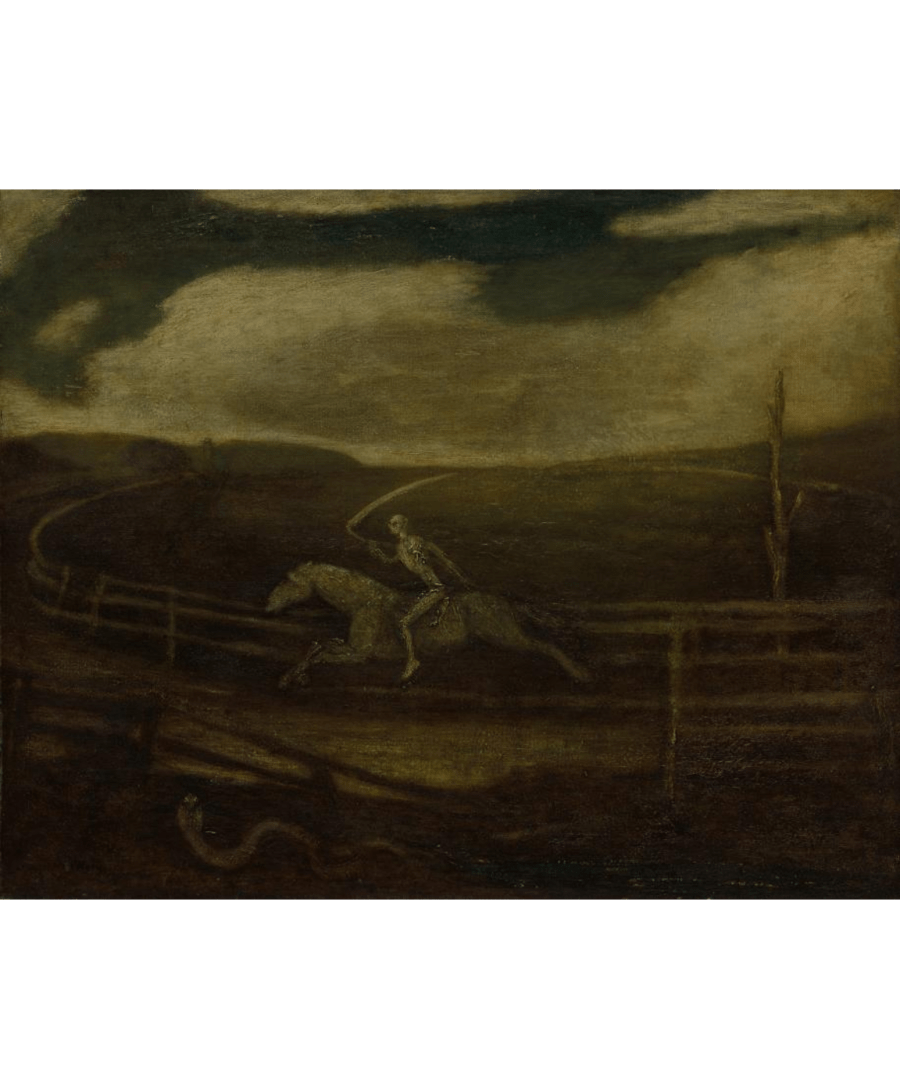
Featured Art: The Race Track (Death on a Pale Horse) by Albert Pinkham Ryder

Young John Wayne leaps, without effort,
onto the back of a Palomino, and I know
he’ll catch the leader of the Taylor Gang
for what he’s done to his woman. He’ll swing
for this one. Wayne is ruthless, but it’s hard

to forget him cut open for cancer research,
the forty pounds of meat wadding through
his colon like a saddle strap. You and Wayne
have a lot in common: doctor’s hands

searched the mineshaft of your stomach,
catalogued what they took, then fastened
you with a wandering stitch. Still, nothing
extracted from anyone can explain why
the body takes revenge on the body.

                             ***
Hanging is the ninth most popular
suicide method behind gunshot to chest;
it has an almost seventy-eight percent

success rate, and takes seven minutes.
In the west, thousands gathered
to watch hanging judges size bight

and neck, and after the bags dropped
some took pieces of the scaffold or rope
as keepsakes. You hung, too.

I still have the pair of shoes you loaned
me in gym class on a nail hook
in the back of my closet.

Read More

The Wall

By Christopher Kempf

Selected as runner-up for the 2015 New Ohio Review Poetry Contest by Robert Pinsky

Featured Art: Ruins of an Ancient City by John Martin

                At mile twenty, roughly, the muscles
of the legs will collapse. Calves
                 twitching at random. The hamstrings’
                                                    sacked meat seizing. Scarry,
in The Body in Pain, explains
                                             that language too, tasked
                    with conveying affliction, fails. That pain,
   she argues, obliterates
                                                          discourse. I limped

                           past the drunk undergrads
of Boston College, my body’s stock-
                                                           pile of glycogen finally
                                       exhausted. The wall, runners
               call it.  The bonk.  The blowing
                                                                                         up. & after,
             the body in pain will make
                                                       of its own fat fuel. I followed

               the shimmering column of runners right
                                     onto Boylston Street. In three
                                                                                            hours two
           coinciding explosions would themselves
                                                                   leave the city—except
    for its sirens—speechless. The limes, Latin

        for boundary line, signified
                                         to ancient Romans the most remote
                              walls of the sacred Empire. Lie-
     
  meez Arabicus for instance.
                                                         Limit.
                                                                      The legions
                           Caesar trusted most though & therefore
    dreaded, he kept
               stationed on the Plain of Mars a mile only
                                      west from the city walls. He watched
     from the seventh hill the drilling
                                                                    columns, consulted
                                          each morning in the sky above him
             the wheeling birds.  A body,
                                                                            he knew well, will
                      at sometime or other, hungry
                                                                                for blood, break
               in on itself & eat.


Read More

Rumors About Dread Mills

By Rodney Jones

Featured Images: Rouen Cathedral, West Façade by Claude Monet, 1894, Courtesy National Gallery of Art, Washington

1974

At last they have him in church, a short service and the family silent, but the moments after the funeral are like a test.

True: The new base-tube press at Lockland Copper weighed sixty-seven tons. When they had completed the building and brought it in the door, six engineers agreed they would have to lift the roof to get the crane in and lower it into the pit. He heard from Tip Smith, a drinking buddy, a welder on the job, and wrote the board, saying he would do it for 10,000. Went to the ice plant, ordered eigh- teen blocks, filled the pit, rolled the press onto the ice; then, as the ice melted, pumped out the water.

True: Drunk every day for sixteen years. False: Mostly homebrew or moon- shine.

True: Every morning Maurice Orr’s rooster pissed him off. False: He caught the rooster in a sack, dug a hole behind the house, buried it with just the neck and head sticking out, cranked the mower, and mowed the lawn.

False: The story that besotted on the back lawn he ordered Jawaharal to dance and choreographed the steps with a Colt revolver. (Gunsmoke.)

True: Jawaharal inherited his logic gene and argued when he called him “Jerry.”

False: He never hit a lick at a snake. Once he pruned the grapevine. Twice, after midnight, he picked roasting ears from Leldon Spence’s garden.

True: When the money from the press job ran out, he wrote bad checks until his name was published on the glass doors of every business from Cold Springs to Decatur. It hit him then one day: go from store to store, copy all the names, print the list of deadbeats twice a year and sell subscriptions to each store for fifty dollars.

True: His Deadbeat Protection Flier taking off before the Credit Protection Act: drinking Jim Beam in the air over Georgia and Louisiana, he was a sloppy man who made a million dollars.

True: The gay son home from Palo Alto. The wife, a holy roller in a sari. His brilliant, inebriated redneck math, marks in the chicken yard. The liver. The heart—details of the unannotated life: grease-prints on Erdös in Combinator- ics, unused tickets to see Conway Twitty—Cliffs Notes for Abyss Studies—

His mind at the end like a hand reaching for a pocket when he wasn’t wearing a shirt.

“I would kill myself if there were anyone better.”


Read More

BBC

By Mike Wright

Featured Image: View of Toledo by El Greco, 1599-1600

I leave the World Service
on at night, snoozing through
the British iteration of gang rape
and kidnapping. I’ll stir sometimes
to hear a few moments of economic
collapse, but it’s really white noise,
blanching the laughter of drunks outside.
Sleeping to tragedy helps tamp down
my father’s last days, his morphine speech,
how my mother sent me to Kentucky
Fried Chicken with a coupon
for his last meal, and how shame
drove me to throw the coupon out.
If his death were broadcast in the night,
his of thousands of dying fathers,
and you slept well, how could
I begrudge you a night of rest?


Read More

POOF

By Sandy Gingras

My mother wants her head to be frozen
after she dies. I’m against it, but
there’s no talking to her. She has a brochure.

On the cover, there’s a picture
of a white building with no windows.
I tell her, I go, “I’m never gonna visit you there.”

She says, “Fine, fine,” the way she does.
She reads me the whole brochure.
She’ll be maintained at something-something degrees

until they come up with the technology to defrost
her. The, she says, “POOF. It’ll be like
being microwaved.” I go, “Think about

what happens to popcorn.” She keeps on reading
about how they’ll just fiddle around with her DNA,
and she’ll grow a whole new body. I don’t get that part.

I go, “What if they can’t grow you a body,
and you’re stuck being an alive head forever.”
She says, “Then you’ll have to carry me around.”

I knew it. I knew it.


Read More

The Egg

By Eric Nelson

We’re sitting at the table the way people do
When a family member dies and a stream of well-wishers
Arrive with sympathy and food.

Everyone is concerned for the widow, 70, tough, wiry,
Who now seems weak and befuddled, staring at people
She’s known for years without answering,

Rising and walking out the back door, staring at the woods
At the far end of their land.
Returning to the table without a word.

We’re all thinking how often one spouse dies
Soon after the other, dies of nothing
But lack. Because we are surrounded by guns, her husband’s

Sizeable collection—pistols in glass cases, rifles
In racks and corners—talk turns to their value, the merits
Of revolvers versus semi autos, plinking, protection.

Now, for the first time, the widow speaks, remembering
That she went to the coop this morning and found curled
In a nesting box a snake, unhinged mouth filled

With a whole egg, disappearing a swallow at a time.
She walked back to the house, pulled her .410
Off the rack, returned to the coop and blew its head off.

A hog-nose, she says. A good snake. But I had to.
She shrugs her shoulders. I had to. Glancing
At each other, we nod in agreement, relieved.


Read More

Dialing The Dead

By Mark Kraushaar

I’d never call.
First of all, I’d be intruding, and besides
I can see my dead friend with all his dead friends
even now, translucent, weightless, winging
through a cloud or sitting in a circle
on some creaky, folding chairs—
Hello, my name is Peter and I’ve
been dead ten years, car wreck.
Hello my name is Edith and I’ve
been dead a week, pneumonia.
Hello, my name is Frank and I’ve been . . . .

Oh, I know they’d all be friendly but even
dialing later when I guess he’d be alone
I’d have too many questions:
If you’re nowhere now and nothing
is this the same as everywhere and everything?
And, Peter, do you sleep in heaven?
Do you eat up there?
What’s the weather anyway?
And that tenderness of heart we try so hard
to keep a secret: in heaven we’re
wide open, aren’t we?
Stay in touch.
No, don’t.


Read More

Fear of the Bird Migration

By Darren Morris

Featured Art: Bird by Peter Takal

I was attempting
the old familiar,
the regular slog,
when I slipped into
missing her again,
the child my wife and I
would never have.
Sometimes she was
a girl and sometimes
a boy. But like heaven,
I held her there
in my mind, a place
of light where nothing
is done, but all is felt.
She was a multitude.
The great uncapturable
plasm of love. Often
she was only
a finch’s thin line across
a rice-paper sky, tearing
through all stations of life.
The way she might
have worn her hair,
or adorned the surprising aspect
of surface-self for appeal.
Or how the supremacy
of personality might emerge,
wriggling out as it does.
Or the first run-in with
terrible, terrible sexuality.

Read More

Still Listening

By Robert Cording

Featured Art: Confusion of Christmas by Julia Thecla

I. Hospice Jumble

The Jumble in the paper too hard for him to read,
my mother suggested we make up our own: Dear,

she said to her husband, your first word is life.
Reduced to words we jumbled, he joked file

it. My brother offered another, mean,
thinking perhaps of his diabetes, a name

like cancer to our family. Then, lamp,
lit at his bedside, and the one palm

visible outside his one windowed room.
My father got them quickly, the last, moor,

said with all the sadness of being far from shore . . .
A grandchild solved that one—horse,

she blurted, noticing that he had left
us for a while. By his bed, my mother felt

his hands and face and eyes. Bob, please,
she said, but he was already asleep,

snoring, not dead. My mother sighed, O God.
My brother, in the spirit still, said dog. Read More

My Dead Father Remembers My Birthday

By Lesley Wheeler

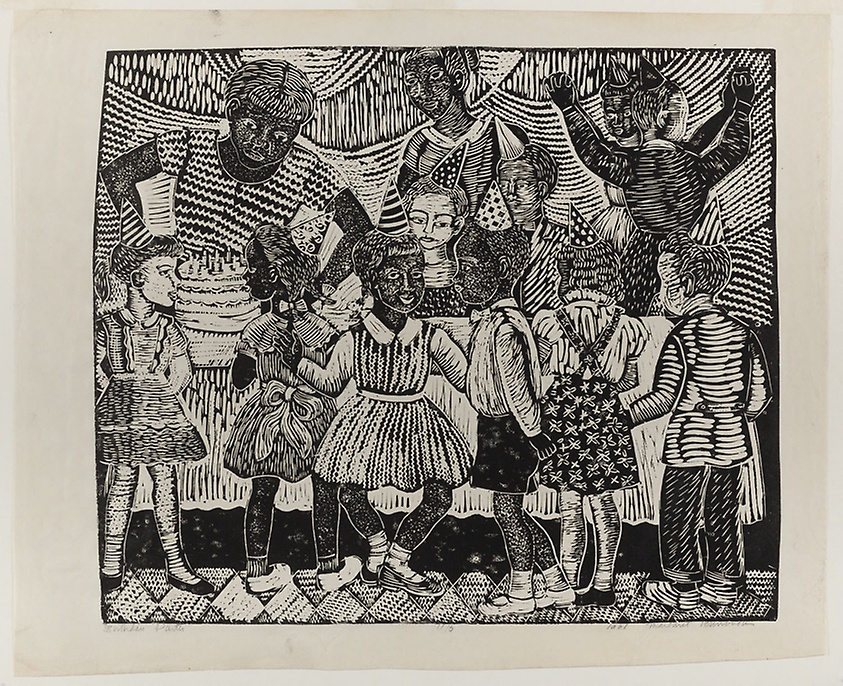
Featured Art: Birthday Party by Margaret Burroughs

Dream-phone rang and I thought: that’s exactly
his voice. I haven’t forgotten. Then: but I could
forget, because he’s dead. Hi, sorry it’s been so long,
but I was sick and the doctors messed everything up.

He made that shrug-noise, dismissive but pained,
meaning he’s lying or leaving something out.
It’s snowing here, and then a click, click, over the line,
and a neutral woman’s voice, slightly officious:
This recording was intercepted. If you wish to replay
this message, dial this number now,
and she recited
a blizzard of digits while I flailed
for a pen then found myself tangled in blankets.
The window a bruise beginning to fade.

Here mist wreathes the trunks. In a few months
snow will crisp the grass, insulate and numb the oaks
with feathery layers that would soak and freeze
a human being. When and where is he? Snug,
maybe, watching weather through double panes.
Or wanting to be. I heard a bead of doubt
suspended in his voice, a cool guess he’d missed
something, before my operator intervened,
reason declaring: This is memory. The line is cut.


Read More

Finality

By Mark Cox

Featured Art: Jonny Dunn’s Sandwich Shop, Paducah, Kentucky by Walker Evans

She did not fit her body anymore—
she was lost inside it—
not like some punished child
wincing in the corner of a vast room—
not, either, like a ring fitted snug in its box—
more like the single yellow pill
in her white medicine cup—
that’s how she was, waiting—
carving precise cubes
from a thin lamb chop, chewing
with such listless fatigue,
I feared she might never finish,
and so pretended that by looking away
I was preserving her dignity.

Chewing and swallowing—
that’s how I remember her—
not as a face or even sequence of faces,
but as a complex montage,
a simultaneous superimposition
of every face she’d worn since birth. Read More

Three Houses and a Wish

By Linda Bamber

Featured Art: House by a River by Edward Hopper

1. Chevy Chase

Choked up to see the in-ground cellar door
behind the house
I was born in long ago

then had doubts, cell handy,
called older sister far away.

She said, wrong house!
Original had front yard oaks,
big porch . . .

found right house, had no
response at all. Used up tears on
house that didn’t know me from Adam! Read More

Looking on the Bright Side

By John Brehm

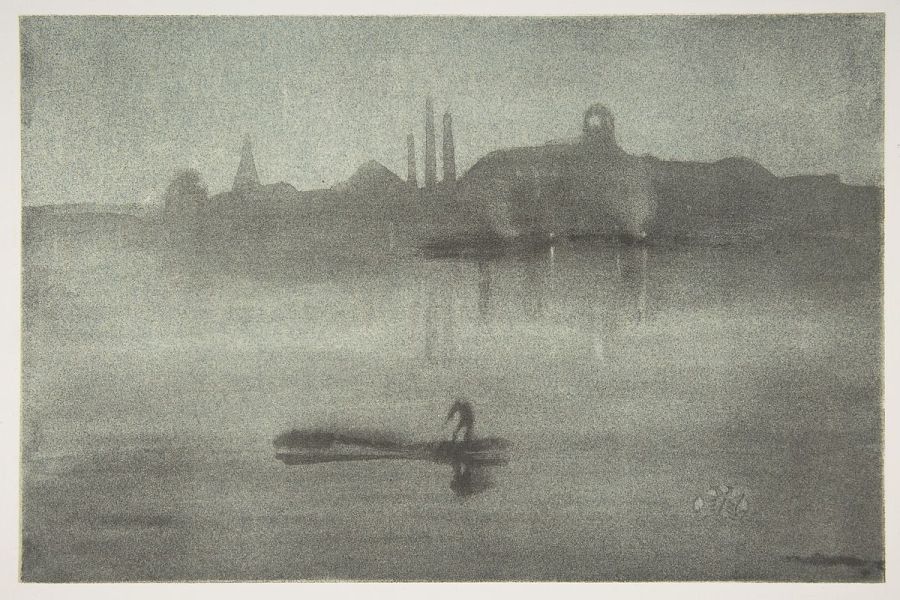
Featured Art: Nocturne by James McNeill Whistler

Death: at least it’ll give me a chance to catch up
on my sleep. No more tossing and turning
worrying about what’s going to happen next.
Unless of course my dreams of dancing girls
and hookah parties come true.
In which case it’ll give me a chance
to catch up on all the fun I missed
being too tired from lack of sleep.
A win-win situation.
Unless of course the dancing girls turn out to be
my former lovers, flitting before me
with vengeful or disdainful expressions
on their still painfully lovely faces.
In which case I can go on writing the poems
of failed love that failed to make me
famous when I was alive.
A suitable way to while away eternity.
Unless of course the hookahs are filled
not with tobacco but with heavenly peyote,
(food of the gods the gods left for us)
in which case it’ll give me a chance
to catch up on the deathless
bliss of boundless mystical oneness
my fear of death always kept me
from fully experiencing
here and now.


Read More

Nothing

By Lawrence Raab

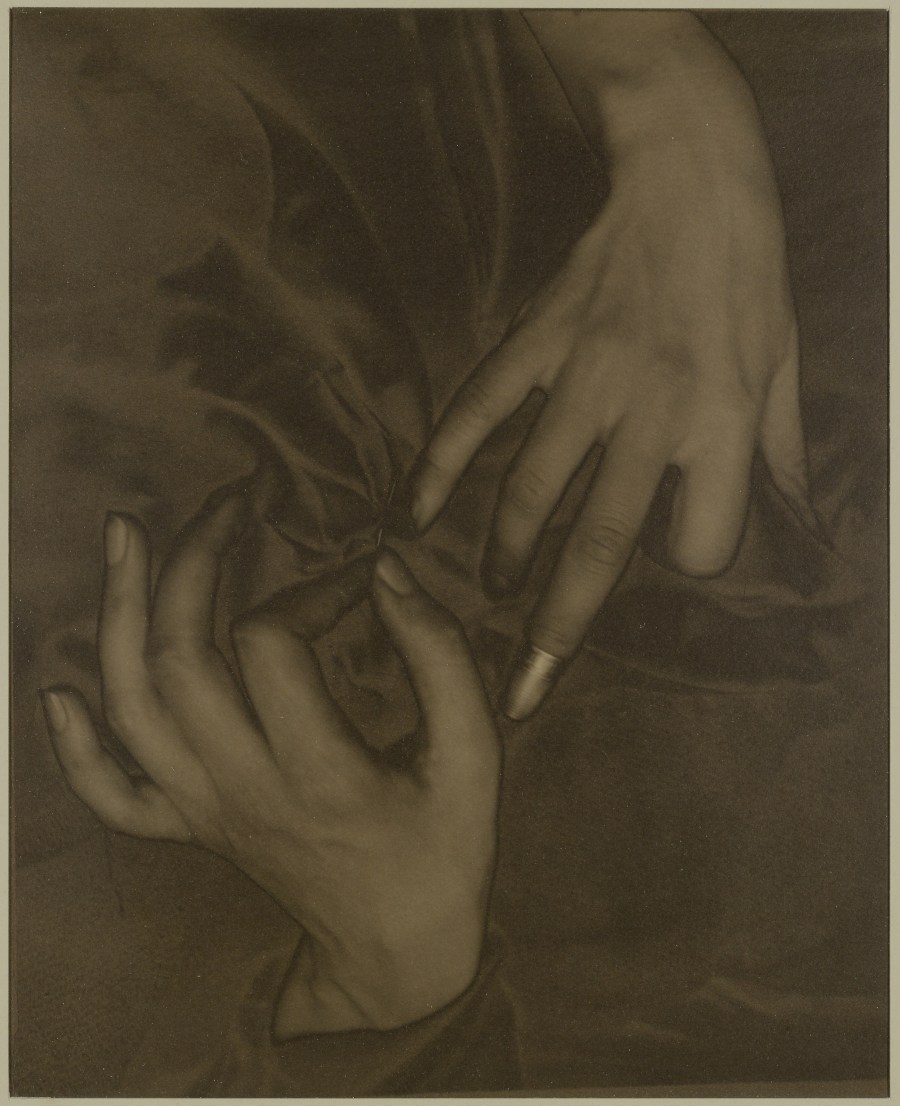
Featured Art: Georgia O’Keeffe—Hands and Thimble by Alfred Stieglitz

Why not believe death is also nothing?
—Dean Young

Sometimes nothing’s a glass
waiting to be filled, and sometimes

it’s sleep without dreams, a blank slate
no one gets to leave a message on,

that sheet of water boys skip stones across
to watch them vanish. And sometimes

nothing’s only a word that can hide
what it means inside what it means.

But when I’ve seen death it’s looked
like betrayal, like life taking back

what it promised, slowly picking
our friends apart until nothing

must feel like an answer, and death
slips into the room pretending to care.

Did it brush by me just now,
did it mean to touch my hand?


Read More

A Simple Request

By Patricia Corbus

Featured Art: Threatening Sky, Bay of New York by Thomas Chambers

                                                                                                —for Wes

Here I am, still drowning in the world,
   while you are opening Dame Simplicity’s closet—

   and I say, Be good to him, Simple Goodness,
Air and water, expand for him! Moon, be a smiling
              china plate for him to leap over!

       In the cupboard where cups wait quietly
and beautiful old words are folded in flannel cloths:

Mother, Father, Long-suffering, Beloved, Forgiveness—

Lay him down in simple peace, homely pleasures,
       between jars filled with feathers and shells—
near Grandmother’s broom that sweeps so clean.

What aromatic, wild poultice crushed to the breast
                         soothes and heals all?—

                        It is the essence of Brother
overpowering me with some stinging nettle of sweetness—

Whatever sunset door you go through, hold open for me.


Read More

Tauromaquia

By Deborah Casillas

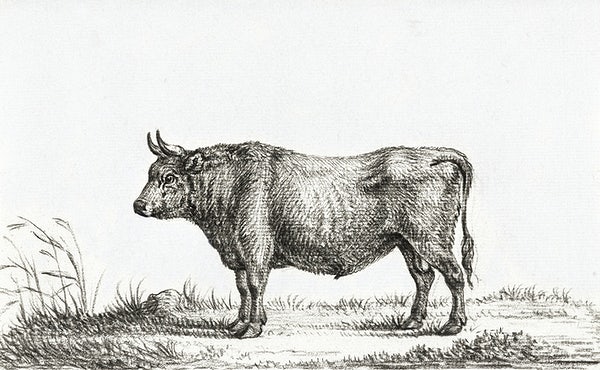
Featured Image: “Standing Bull” by Jean Bernard

The days dragged on, steady ticking of the clock.
My mother’s cancer; surgery, injections, drugs.
Long afternoons I sat in my grandfather’s library
looking at books. Shelves of books about bullfighting—
la lidia, combat; la corrida, the running of the bulls.
Books on Manolete, Belmonte, Joselito,
his copies of The Brave Bulls, Blood and Sand,
Death in the Afternoon. Books aficionados collect,
those fanatic followers of the taurine subculture.
I stacked volumes beside me, looked at pictures
of the black bulls, studied their deadly horns,
the ritual sacrifice. Here were portraits of the famous
matadors, their lives venerated like the lives of saints.

Read More

Saying Goodbye to Dad

by Kate Fetherston

Feature image: Pierre-Auguste Renoir. Near the Lake, 1879-1880. The Art Institute of Chicago.

My dad died alone in a VA hospital
as July sun beat without mercy into the raw

seesaw of breath busting seams between
each cell. Third spacing doctors call it

when cell walls no longer sustain
boundaries with integrity, fluid

sluices into interstitial no-man’s
land and overpowers whatever little

plans were made for a garden and some
trees. When my brothers and I got

the news and flew in from the various
places to which we’d fled, I’d just split

on my first lover after years of her
threatened suicide, bouts of drunken

depression, and refusals to take
her medicine too numerous

to recount. Her view: I’d been trained
strictly for fixer-uppers, too stupid

or stubborn to leave, but, waxing
romantic, she’d croon, “You’ll do me

for a rough old mate.” The day she smashed
my stuff into the carpet and poured

ten pounds of flour over
everything, I might have stayed for

more of the same, but I threw
crumpled clothing into my pack,

startled when she whispered, “I’m
just like your crazy

old man, aren’t I?” I didn’t
answer because we both knew

Read More

One Day Your Parents Confess You Have a Twin

by Todd Boss

Feature image: Ugo da Carpi. The Sibyl and a Child Bearing a Torch, 1510-1530. The Art Institute of Chicago.

who was given up for adoption early on, when it was
clear they couldn’t manage him. It was, says your father,
the worst decision they’d ever made. (It’s you and your
parents at the kitchen table. Between you, the steam
from the teapot uncurls in a kind of breathing statuary.)
He was your inverse, your yin: When you went to sleep,
that’s when his terrorizing of everyone would begin.
He went from home to home to group home, and then
to prison, half mad, a drug-addled teen, with your name
tattooed over the veins in both forearms. “That’s when
we moved to Minnesota,” says your mother, but of course
he found you here, at the end of an abbreviated sentence,
and slit your throat while you slept. This was last year.
You’ve been dead ever since. We know this must be hard
for you to hear: but you don’t exist. You’re your own twin
brother’s obsession with you. (Can it be? Instinctively,
you reach to touch yourself about the shoulders, the neck,
but everything’s . . . identical.) It’s like a mad dream—
yes, the recurring one you’ve had since you were a child,
in which you go from door to door, trying to trade
your life for another’s, but nobody will trade, and you go
on and on, pounding, until, impossibly, you finally find
someone willing, and you wake. Your mother reaches
through the figure of steam to lift the teapot and pour
from out its only portal a little stream into her cup, her
husband’s cup, the cup in front of you. She sets the teapot
down, and now there are four apparitions dwindling there,
silken, gesturing. One of them says, We love you the same.
But you can hardly hear them as you push up your sleeves
—one at a time—and read, and reread, your name.


Read More

Wet Carpet Awakening

By Kevin Stein

Featured art: Europeans Embracing by an unidentified artist

Cursing the stubbed-toe 2 a.m. call—my father?

I picked up a woman’s feather-brushed gush, “Wilbur,

it’s a grandson! Jamaal José O’Bryant.”

And I, unhappily not Wilbur, croaked Wrong number as one does

when plucked frog-eyed off sleep’s lily pad.

She was old. Who else misdials the pay phone’s tiny numbers?

Who else marries a Wilbur, their grandchild an American blend?

Outside rain misted not cats and dogs but litters of kittens.

Her lavender sachet apology, my bed-headed threnody,  my 

No problem, and click. Lightning cracked night’s black egg

in halves I couldn’t tap back in place:

My father’s dead. I’m next.

Revelation arrives like that, thunder trailing the flash.

I rode the open window’s wet carpet awakening,

storm flipping its toggle above the wind-blown yarrow,

electric as any newborn. Shaggy, late autumn, nearly gone-to-seed-

bloom, naked ecstatic.

I floated my trial run out a window the rain had come

in. When the dark made light of me I was.


Read More

Between the Heaves of Storm

By Lance Larsen

Featured Image: Approaching Storm by Edward Mitchell Bannister

We have buried our aunt with words and hymns.
Now to finish the job with dirt.
In the front of the church, a hearse
waits to lead the cortège of headlights
to the cemetery two miles away.
But here, in the back parking lot,
a grandniece, perhaps six, has squirmed
out of her itchy skirt and grabbed
a pink hula hoop from the family van.
We put the morning on pause,
three or four of us, car doors flung open.
Plenty of time to take in this emptying quiet,
her skirt puddled now on asphalt
like a secret entrance to the underworld.
And plenty of room for her little girl hips.
She jounces and gyrates, as if trying
to coax rain out of the wispy clouds
floating above our fair city.
Twelve, thirteen, fourteen . . . She counts
with a wheezy underwater voice,
the kind one uses to address homemade dolls—
limp dolls, badly stitched, x’s for eyes,
velcro on the hands to hold
an embrace after the arms grow tired.
Little grandniece swings her hips.
Green undies, dishrag sky, a waiting 
that fills the parking lot even as it clears.
Any worries about the next life set
spinning for now in reassuring orbits, rattly pink.


Read More