Mothers in the World Above and Below

By Abby Horowitz

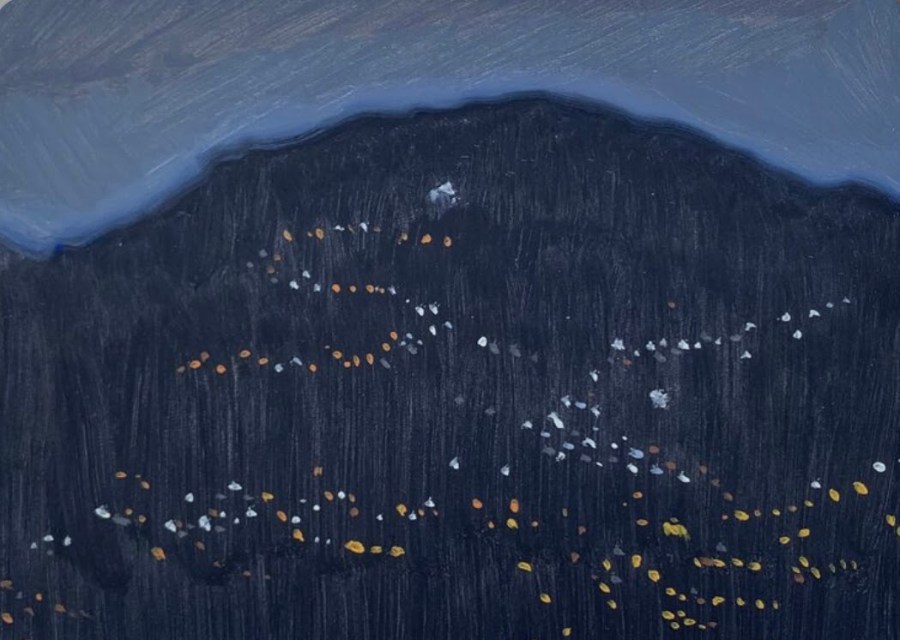
Featured Art: “Persona-03” by Mateo Galvano

Your mother haunts the hardest; that’s what Selah’s told whenever she starts to whine: why hasn’t she come yet to pick me up?

Her mother haunts the hardest, so Selah is at the care center the whole day long, so long that Ms. Drae takes pity on her and gives her second servings of afternoon snack. The other kids trail after their parents up to the parking lot and off to home and there’s Selah again, all alone in a playground full of nobody, or at least nobody that she can see isn’t it possible that she’s got her own ghosts? Oh, get out of your head and get onto those swings, Ms. Drae tells her; then her eyes sink back down to her phone.

Selah swings, she jumps, she slides. Lady-like, please, Ms. Drae calls when Selah’s robe slips up by her thighs, but Selah ignores her. Let the world see her underwear; if only there were someone to look. She takes a clump of dirt and rubs it onto her leg. Look! she says, running up to Ms. Drae, A bruise! But Ms. Drae only rolls her eyes and shoos her away rather than tell her (again) what of course she already knows: you can’t have bruises if you don’t have blood.

Read More

Survival of the Unfit: A Retrospective

By Jodie Noel Vinson
Excursion to St. Fé—Thistle Beds—Habits of the Bizcacha—Little Owl—Saline Streams—Level    Plain—Mastodon—St. Fé—Change in Landscape—Geology—Tooth of extinct Horse . . . Flocks    of Butterflies—Aeronaut Spiders—Phosphorescence of the Sea—Port Desire—Guanaco—Port St. Julia—Geology of Patagonia—Fossil gigantic Animal . . . Causes of Extinction

(Charles Darwin, Voyage of the Beagle)

Tongue crimson in morning ulcerated—stomach constricted dragging—Feet coldish—Pulse 58 to 62—or slower and like thread. Appetite good—not thin. Evacuation regular and good. Urine scanty (because do not drink) often much pinkish sediment when cold—seldom headache or nausea.—Cannot walk abv ½ mile—always tired—conversation or excitement tires me much

(Charles Darwin, note to Dr. Chapman)

Charles Darwin had “taken the horizontal,” as he would have put it as a seasick young man on board the Beagle. He lay in bed, snowy beard cascading over the coverlet that shrouded his six-foot frame. Emma could see her husband was in so much pain he was “longing to die.” Their daughter Henrietta, hovering bedside, lamented how “this terrible nausea still goes on.” Darwin, before passing away on that April afternoon in 1882 at age seventy-three, answered with the equanimity of one who has lived in daily discomfort: “It is not terrible. But it is nausea.”

At this point, Darwin had been ill for over half his life. “I was almost quite broken down,” he described his chronic ailment in a journal, “head swimming, hands trembling and never a week without violent vomiting.” The naturalist took copious notes on his malady over the years, during which his stomach caused him “incessant discomfort, I may say misery,” as he once wrote to his cousin William Fox, predicting: “I shall go to my grave, I suppose, grumbling and growling with daily, almost hourly, discomfort.”

*

Read More

Survival of the Unfit: A Retrospective

By Jodie Noel Vinson

Excursion to St. Fé—Thistle Beds—Habits of the Bizcacha—Little Owl—Saline Streams—Level Plain—Mastodon—St. Fé—Change in Landscape—Geology—Tooth of extinct Horse . . . Flocks of Butterflies—Aeronaut Spiders—Phosphorescence of the Sea—Port Desire—Guanaco—Port St. Julia—Geology of Patagonia—Fossil gigantic Animal . . . Causes of Extinction

(Charles Darwin, Voyage of the Beagle)

Tongue crimson in morning ulcerated—stomach constricted dragging—Feet coldish—Pulse 58 to 62—or slower and like thread. Appetite good—not thin. Evacuation regular and good. Urine scanty (because do not drink) often much pinkish sediment when cold—seldom headache or nausea.—Cannot walk abv ½ mile—always tired—conversation or excitement tires me much

(Charles Darwin, note to Dr. Chapman)

Charles Darwin had “taken the horizontal,” as he would have put it as a seasick young man on board the Beagle. He lay in bed, snowy beard cascading over the coverlet that shrouded his six-foot frame. Emma could see her husband was in so much pain he was “longing to die.” Their daughter Henrietta, hovering bedside, lamented how “this terrible nausea still goes on.” Darwin, before passing away on that April afternoon in 1882 at age seventy-three, answered with the equanimity of one who has lived in daily discomfort: “It is not terrible. But it is nausea.”

At this point, Darwin had been ill for over half his life. “I was almost quite broken down,” he described his chronic ailment in a journal, “head swimming, hands trembling and never a week without violent vomiting.” The naturalist took copious notes on his malady over the years, during which his stomach caused him “incessant discomfort, I may say misery,” as he once wrote to his cousin William Fox, predicting: “I shall go to my grave, I suppose, grumbling and growling with daily, almost hourly, discomfort.”

*

Read More

Baby Suits

By Jonathon Atkinson

Selected as winner of the 2023 New Ohio Review Fiction Contest by Megan Giddings

Infants develop the ability to see during their first months of life. They can’t discern figures against a background until they’re two or three months old, a milestone whose achievement comes as a shock. The resolution of so much detail out of that myopic blur is overwhelming, frightening; hence, at least in part, their characteristic astonished stare. Their field of vision remains cloudy until they are about a year old, at which point—setting aside the effects of our immersion in language and concepts, the coursing rush of lived life—a child’s vision reaches typical adult levels.

Read More

I Am No Beekeeper

By Arya Samuelson

Selected as winner of the 2023 New Ohio Review Nonfiction Contest by Barrie Jean Borich

My housemate sleeps all day, makes art all night, and paints giant bees. “I want people to feel my paintings,” she says, stroking the palm of her hand against a still dripping head-to-toe canvas.

I keep my hands in pockets. We’ve only been at the art residency for a week, and she has already transformed her garage studio into a whimsical world of texture and wonder and touch. My art is trapped inside me. Weighs down my womb with rocks.

Read More

Wolf

By Julia Strayer
Selected as the winner of the 2022 New Ohio Review Fiction Contest by Madeline ffitch

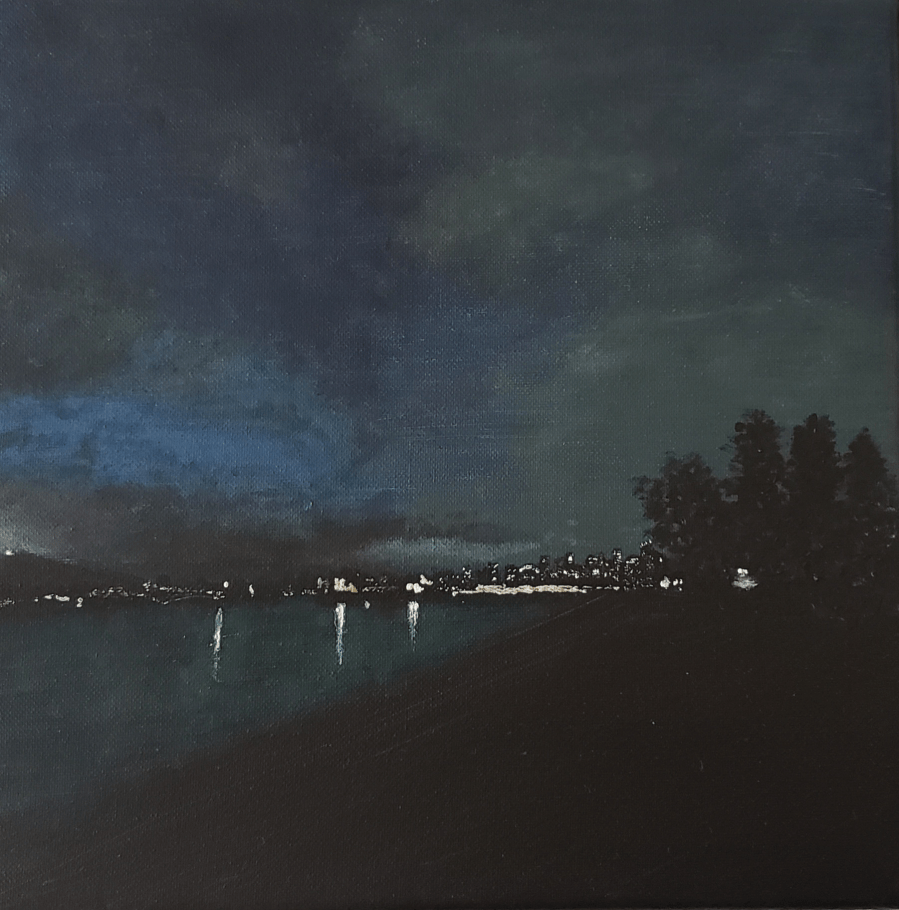
Featured Art: Monte Constantino, Night by Alex Spragens

I lost her the night of the squalls, when wind raged hard enough to rip trees from the ground—my husband helping neighbors with a collapsed roof, and me with blood that wouldn’t stop and wouldn’t stop. I carried her for four months. I had imagined her face.

I walked the dark house alone, not wanting to sit, hearing crying that wasn’t mine while the moon trailed after me. I searched out the front window for my husband’s headlights because it wouldn’t feel real until I could tell him, but my breath fogged the glass, and I couldn’t see. Finally, I slept because I was too tired to do anything else.

Empty and quiet. My body. The house. Except for the walls, which were run through with mice and scratching.

They say children choose their parents. What does that say of me? What does that say?


In the wild, a wolf mother will carry a dead pup around in her mouth, showing the body to the rest of the pack, before she buries it.

Read More

Speak Up

By Jesse Lee Kercheval

Selected as winner of the 2022 Nonfiction Contest by Melissa Febos

1.

I dream I am teaching and it is not going well. I still have these dreams though I retired a year ago. Counting grad school, I taught 38 years so this particular nightmare is hardwired into my nervous system. In my usual dream, I am talking, then shouting, at students who are talking to each other and not paying any attention at all—something that never happened in real life, unless a dream counts as life. In this dream, though, it is the students who are yelling at me. I can see their mouths open, their tongues wagging, every one of their white teeth, remarkably straight after years of expensive orthodontia—but it is a silent movie. I touch my ears, a reflexive movement to check if my hearing aids are there. Yes, but somehow they seem to have swollen, tripled in size, and to be plugging my ears like fat kids’ fingers, making sure all I hear is the sounds of my body, heart, lungs, that we hear without using our ears at all.

Read More

The Mentor

By Lexi Pandell

Selected as winner of the 2022 Editors’ Prize in Fiction by Patrick O’Keeffe

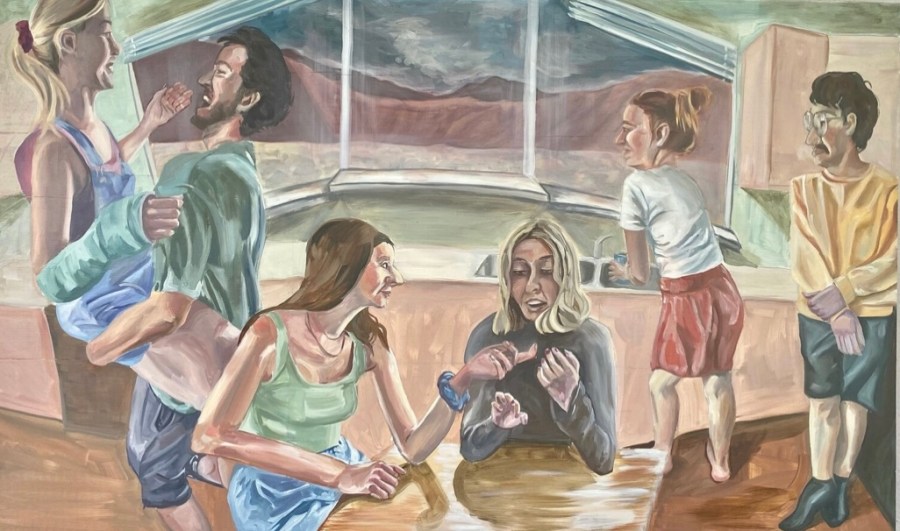
Featured Art: When Lunches Synch Up by Mallory Stowe

In a shingled house at the edge of the Berkeley Hills—near campus with its bulletin boards covered in smeary flyers for an upcoming Angela Davis lecture and another of a white woman toting a machine gun, and close enough to the Greek Amphitheater that the roar of a concert reverberated through the thin windows—Jane Gardener sat with six other women at a kitchen table. This was a dinner party. She’d forced herself to go with the intention of socializing. Yet she couldn’t stop thinking about how, though Lori said these dinners were about learning from other women in the restaurant industry, her presence felt like a charity. The stench of feet persisted despite the hand-dipped incense wafting in the corner. How could Lori purport to care about food, yet burn out her nose with cheap nag champa?

All of them were restaurateurs, except for Eartha, the German woman Jane employed as sous-chef at Dîner, whom she had invited to help her survive the affair.

“Isn’t spending time with friends supposed to be enjoyable?” Eartha had asked.

They weren’t her friends, though. Not really. Once, there had been more women in this coterie, some she’d actually liked. But, one by one, they had married and turned their attention to their home lives.

Read More

Doppel

By Max Bell

Selected as winner of the 2021 Fiction Contest by Anthony Marra

Featured Art: King Lake, California by Albert Bierstadt 

I hear every word. I know exactly where I am. Dr. Shelley, sitting across from me in her white lab coat in her air-conditioned Westwood office, has told me that I have cancer. The pain in my chest does not signal the cancer’s home but its most recent lodging. Each scan and test reveals that it is too late for any combination of surgery and chemotherapy. I should not have ignored the signs. I delayed it all for too long.

Dr. Shelley pauses after delivering the news, searching my face to deduce how soon she can relay more information, how quickly she should speak, how she should modulate her voice. No speed or timbre seems apt. I do not worry about how she will sound after the silence. Taking offense at anything in this moment, or in any other, suddenly seems a waste of valuable time.

Why have the movies lied when depicting the cancer revelation scene? The world does not dissolve into a warm haze. Everything is clear, sharper than before. It’s as though I am someone with astigmatism who’s found the perfect corrective lenses. The sun strikes through the glass of the office’s wall-to-wall window, accentuating the details of each object in the room. The ridges of the lone paper clip on Dr. Shelley’s desk are as clear as the dotted brushstrokes of the purple-red sunset that casts a shadow over the sand in the reproduction of Lemmen’s Beach at Heist, which hangs in a dark brown frame next to her college degrees. I can read the spines of the books on Dr. Shelley’s shelves, the letters on each embossed in muted gold on leather that looks like tanned human skin.

Read More

Winter

By Faith Shearin
Selected as winner of the 2021 New Ohio Review Nonfiction Contest by Jerald Walker

The last day of my old life, the one in which I knew my own identity, was Halloween 2018. I was out walking our dog, Wookiee, a small, flat-faced shih tzu with an underbite, through the streets of our Massachusetts neighborhood, when I felt the presence of my husband, Tom, though he was away, on a business trip in Colorado. It was evening and I was flanked by children wearing masks, capes, and wings, all of them carrying paper sacks of candy. I paused beneath a maple tree decorated with cloth ghosts, near a lawn littered with fake tombstones, and the dog sniffed the air where my husband’s apparition formed. I saw Tom materialize for a moment and he was young again: slender and dark, his hair a mass of black curls; he was opening the window of his dorm room at Princeton; I felt as if he was trying to show me something; I was aware of a rush of velvet air and the full intensity of his love before he vanished again, into the blowing leaves, and pumpkins, and the sounds of children knocking on doors. I was expecting him to fly home in a few hours and thought perhaps he had fallen asleep on a plane and begun dreaming of me; he sometimes came to me in dreams. But when I checked my phone I found no text; instead, there were a series of phone calls from a number I didn’t recognize, which turned out to be a hospital in Colorado, the last from a chaplain who said: your husband has had a heart attack and is being prepared for emergency surgery. I do not know if Tom was awake or under anesthesia when his ghost found me; I don’t know if he was fully alive or if his spirit was already seeping away. All night his Australian colleagues held vigil in the hospital, sending texts while fashioning boomerangs from coffee stirrers. By the following day, Tom’s sisters and mother and I converged in a waiting room, along with his friend Bob, who had flown home to Virginia from the Denver conference, then back again, when he heard Tom was in surgery.

Read More

The Names You Choose

By Nicole VanderLinden
Winner, New Ohio Review Fiction Contest: selected by Lauren Groff

Featured Art: Beach Scene by James Hamilton

Vanessa had wanted the luau, something extravagant—never mind that we were a moon away from our original budget. But that was Vanessa, always doubling down. She swam in mountain lakes; she was the only person I knew who’d been arrested for playing chicken. “We’re in Maui,” she said, letting geography make its case. “It’d be fun for the kids.”

This wasn’t all true, because our youngest, Chloe, dreamed of puréed bananas. She was barely a toddler. She’d never tasted salt, and bubble baths made her shriek. It was the other kid my wife had been alluding to, the child of our concern, our Anna.

Vanessa bought tickets to the luau. I was suggestible—there were so many things I was trying to save then, money the least precious among them. We returned to the cool of our room by three so we could shower and put calamine lotion on our burns, our sun-chapped faces. Vanessa took Chloe with her and got dressed in the bathroom, where she’d laid out various makeup cases and where the tub had jets, and I waited for Anna, who was twelve and who, when she was ready, spun for me in a white sundress lined in eyelet lace.

At the luau, we inched toward the entrance on the resort grounds, entertainers beating drums and offering drinks made with canned pineapple juice. Chloe sat on her mother’s hip with her wild, straight-up ponytail and gave everyone her skeptical face, the one that prefaced an opinion you couldn’t predict. “Drum,” she said seriously, as if naming objects for the first time. “Drink.” Anna had put on a dark hoodie, though it was still hot, and shuffled ahead of us all.

Read More

We Are the Bachelorettes and We Insist

By Susan Finch
Winner, Editors’ Prize in Prose: selected by Mandy Berman

Featured Art: Woman in Silver V-neck Long-sleeved Dress by Inga Seliverstova

As bachelorettes, we solemnly promise the next forty-eight hours will include three brunches, two happy hours, fifteen moderate disagreements, one unforgettable fight, eight matching T-shirts, one bar crawl, one pedal tavern, one sprained wrist, three twisted ankles, sixteen hangovers, too many tearful promises to count, and one sober regret. We are the bachelorettes and we insist.

We must begin with brunch, and in order to fit three brunches into forty-eight hours, we will congregate Friday morning. After all, brunch is the most important meal of the day. We can eat French toast and French fries, and getting tipsy or emotional (i.e., Lydia has too many feelings after bottomless mimosas) will not be frowned upon. Not every restaurant serves brunch on Friday, so we must select carefully, find a place that has an all-day breakfast menu, and really, why shouldn’t a restaurant serve breakfast food all day. It’s not so hard to whip up a couple of poached eggs, is it? We will reserve the table for 10:30; the proper time to eat brunch is 11, but we already know that some of our bachelorettes will be late—particularly Tara, the bride’s sister. She’s a musician and runs on her own schedule, and of course, Felicia. She hasn’t been able to get anywhere on time since the new baby.

Event attire is outlined in the invitation—brunches are for sundresses or rompers paired with cute cowboy boots or wedge sandals. We do not do flats—flats are for business casual events or maybe if you’re trying to let someone down easy. Matching T-shirts will be provided for the pedal tavern that begins promptly at four. The shirts may be knotted at your hip or tucked in with a cute belt, but please do not leave your shirt untucked. Evening wear will have two themes: Friday red and Saturday sparkle, and the bride, of course, will wear white. No one else should plan to wear white or anything white adjacent —no cream, no ivory, no pearl, no silver, no soft grays, no misty light blues or sugary beige. Don’t pack it. Don’t even think about it. We don’t want anyone to steal the bride’s thunder. After all, we are the bachelorettes, and it is our job to insist.

Read More

There Will Be Salvation Yet

By Tania De Rozario
Winner, New Ohio Review Nonfiction Contest: selected by Ira Sukrungruang

Featured Art: The Last Supper By H. Siddons Mowbray

1993. That’s when it happens. Two months after your twelfth birthday. It’s a sweaty afternoon. This day which blisters with possibility. This day you learn that there are demons inside of you.

You’re on your way home from school. You know something is wrong the minute you get off the bus. Your mother waits at the bus stop, teary-eyed. Your relationship has grown monosyllabic, but the tears feel like a warning, so you ask.

What’s wrong?

It is when she smiles that something inside you unravels. You realize hers are happy tears. But her smile is vacant. Placid. A Stepford Wives smile. The tears fall but there is nothing behind them. She’s a mannequin crying on command. A talking-doll with electronics scrambled.

You don’t have the language for this yet.

She grabs you, holds you tight: Nana has been saved!

Read More

Small Boy

By Joseph Scapellato

Selected as runner-up of the 2014 New Ohio Review Fiction Contest by Aimee Bender

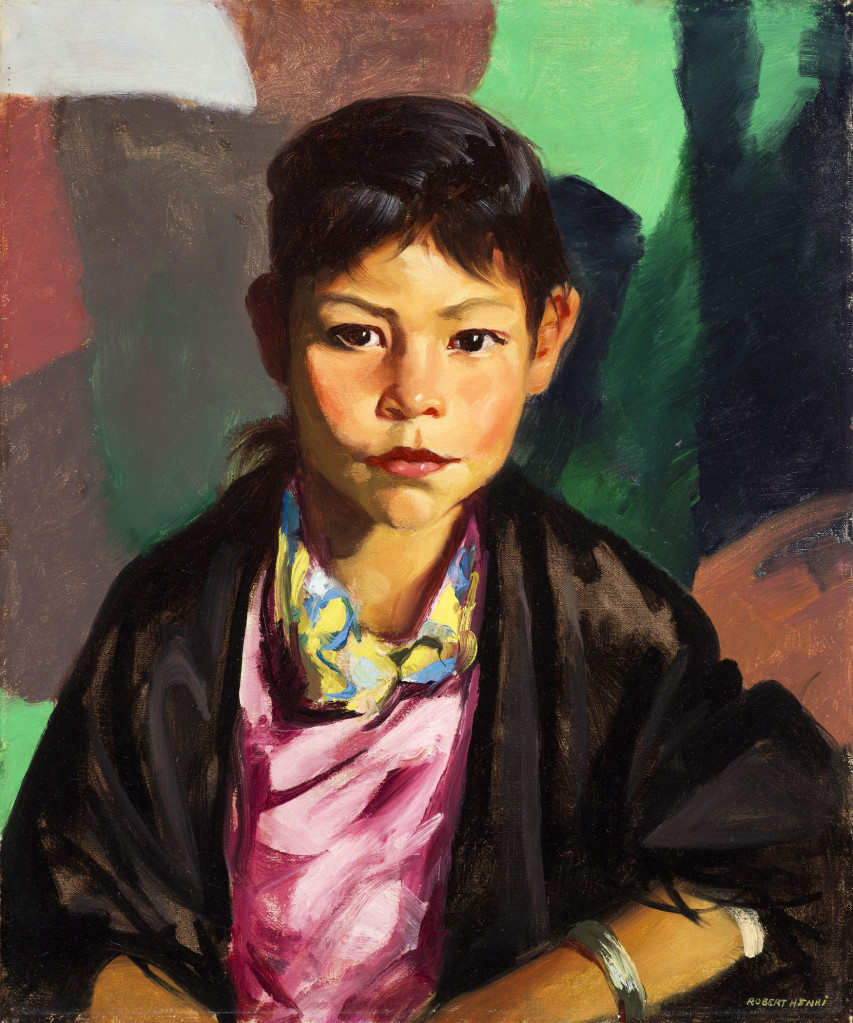
Featured Art: Pepita by Robert Henri

The small boy says to his big sister, “Why did we kill all the Indians?”

They’re in the basement playing a video game. Both of them are white.

“We didn’t kill them,” says his big sister, “our ancestors did.”

“Why did our ancestors kill all the Indians?”

“Okay, not really our ancestors because Dad’s family came in the 20s and Mom’s in the Sixties and the Indians were already totally dead by then, mostly.”

“Why did ancestors kill all the Indians?”

“But I guess you could say it was us, pretty much, because today we’re basically the same culture as the culture of the people who killed the Indians back then. And it’s ‘Native Americans,’ not ‘Indians.’ ‘Indians’ is ignorant.”

The small boy says to his angry stepmom, “Why did we kill all the Native Americans?”

They’re returning from the grocery store in hardly any traffic. Plastic bags stuffed with food rustle in the back seat.

Read More

Coyotes

By Terri Leker
Winner of the 2019 New Ohio Review Fiction Contest, selected by Claire Vaye Watkins

The coyotes moved into the woods behind my house just after I learned I was pregnant. On a quiet June morning, while my husband slept, I pulled on my running shoes and grabbed a leash from a hook at the back door. Jute danced around my feet on her pipe-cleaner legs, whining with impatience. It would have taken more than this to wake Matt, but I hushed her complaints with a raised finger and we slipped outside. A light breeze blew the native grasses into brown and golden waves as we wandered, camouflaging Jute’s compact frame. She sniffed the dirt, ears telescoping as though she were asking a question. When we reached a shady thicket of red madrones and live oaks, I unclipped the leash and wound it around my wrist.

It was over with Richard, had been since I’d found out about the baby. Anyway, I had come to believe that adultery sounded more illicit than it actually was. Between managing my schedule with Matt and making time to rendezvous with Richard, an affair often seemed more about time management than sexual gratification. I was meticulous with the calendar, but I would have known that the baby was Matt’s regardless, because Richard’s sperm could not locomote. He had told me so early on, while showing me the master bedroom of his faithfully restored North Oakland Victorian. His unexpected disclosure had interrupted my admiration of the exposed brick walls, so unusual for the earthquake-conscious Bay Area. Matt was having dinner just then with friends, thinking I was helping my mother set up her new television (she would be dead within a few months, but we all pretended to be optimists then), so he was eating eggplant parmesan at the Saturn Café as I lay with Richard on his king-sized bed, hearing words like motility and capacitation. Richard’s sober tone had suggested that I might comfort him in his sterility, which I did, if the definition of comfort was a passionate encounter that lasted as long as one might spend unboxing a 48-inch HDTV and connecting it to both Netflix and Hulu. But Matt and I had tried to have a baby for three years, so I took the pregnancy as a sign to recommit myself to my husband, who, predictably, jumped up and down on our unmade bed when I shared the news, attempting, in his white-socked excitement, to pull me up with him, not realizing that doing so might judder the bundle of cells loose, delivering me back to Richard and a childless but aesthetically pleasing life.

Read More

Promised Lands

By Christie Tate

Winner, New Ohio Review Nonfiction Contest: selected by Kiese Laymon

Featured Art: Sunset over a Pond, c. 1880 by François-Auguste Ravier

I.

The first time I walked into Grandma’s church, I was a little girl in white Stride Rite leather sandals and a pale yellow dress with a sash. The First Baptist Church of Forreston, Texas. There was no parking lot, so Grandma, like a dozen others, steered her big blue Chevy off the road into the grass in front of the sign welcoming all worshippers.

The white clapboard building looked like the school-church from Little House on the Prairie. Simple wooden porch with four steps. Plain white steeple. Two long skinny windows. Our regular church in Dallas was three times larger, had bells that chimed every hour, and its thick walls held colorful stained glass depicting Jesus carrying the cross, falling, dying.

My older brother and I trailed behind Grandma, who hung her big leather purse in the crook of one arm and used the other to grip the wooden rail to steady her arthritic knees. My brother and I jockeyed to sit next to her because we wanted to plumb her treasure-filled purse. Doublemint gum. A map of the highways crisscrossing the Texas plains. A keychain with a long plastic placard with her name blazed across it. Virginia. Same as the state. I liked to run my finger along the raised white letters.

Before we opened the door, we could hear voices singing “What a Friend We Have in Jesus.” I shot a look at my brother. We were late—something we were never allowed to be on Sunday mornings with our parents at Holy Trinity. My brother shrugged. I grabbed Grandma’s free hand and let the rush of air and music pour over me as she opened the door and led us to the back row.

Read More

Rabbit Summer

By Jane Marcellus

Winner, Editors’ Prize for Prose, selected by Dinty W. Moore

He is standing there in a spattered white lab coat, holding up a bunch of carrots. I am standing here in the doorway, hoping I’ve come to the right place.

“You must be Jane,” he says. “Guess who these are for?”

From a few feet away, I notice his eyes. They are brown—so brown that I cannot see his pupils. I keep looking at his eyes, trying to nd them, trying to make certain that it is me, here, that he is looking at. His gaze makes me aware that I am actually a person standing here, in this spot—a person with a name, which is Jane, which he knows. I am not used to feeling seen. I am used to feeling invisible. It is unnerving—blinding even—to be seen by a person whose pupils I cannot see, a person who knows my name.

I am young, although I do not know it. Twenty-one. I confuse feeling seen, and this odd feeling of being blinded, for love.

“Yes,” I say. “I’m Jane.”

*

The job is feeding lab rabbits and washing beakers in the college biology labs. It is my third job this summer, on account of an argument with my mother. For the past four summers, I have worked at one of the jobs she got me. She is a legal secretary for the state of Oklahoma, and she likes to get me typing jobs. Since the summer I was seventeen, I have gone along with this. I can live at home and make more money there than waitressing or busing tables. I save the money to pay for the college, which is in Connecticut and expensive, even with the scholarship. I am not sure I deserve the college, so typing has seemed like a kind of penance. But it is beginning to feel dangerous. I will graduate in another year. I sense relief rising in my mother like a prayer. Finally, I will come home for good and she can get me on with the state. I will be a secretary, not for the summer but for life.

Read More

Return

Winner, New Ohio Review Fiction Contest
selected by Mary Gaitskill

By Analía Villagra

He was gone for eleven years, and Jackie is still getting used to the idea that Victor is out. Exonerated. His release had warranted a few sentences on the local NPR station, so Jackie knows that he has been at his mother’s place, three blocks away, for a week. She has not yet run into him on the street. Each time she leaves her apartment she scans the sidewalks, and when he does not materialize she feels equal parts relief and disappointment. Thursday afternoon she goes out of her way to walk past his building, willing him to be on the front steps or looking out the window. She slows down. Would he even recognize her now? Her hair is short, with a few stray glints of gray, no longer halfway to her waist and shimmering black. Her eyes have shadows beneath them. Her hips have spread. She’s thirty years old, in good shape she thinks, unless you’ve spent a decade fantasizing about a nineteen-year-old body. Jackie blushes. This is the first time she’s admitted to herself that she wondered—hoped? assumed?—that Victor thought about her while he was away. Eleven years. Maybe he’ll recognize her, maybe he won’t. She can’t decide which is worse, so she stares down at the sidewalk and hurries past the building.

She goes to the Y to pick her daughter up from camp. Graciela is running around the outdoor play area with a group of other kids, their hair wild, their clothes and faces filthy.

“Mama!” Grace shrieks when she sees her.

Jackie waves. She locates the teenagers wearing staff T-shirts, and they hand her the sign-out sheet without pausing their conversation. Jackie half-listens to the latest counselor drama while Grace gathers her things.

Read More

Clean For Him the Ashes

By David E. Yee
Winner, New Ohio Review Fiction Contest selected by Colm Tóibín

Featured Art: The Burning of the Houses of Lords and Commons, 16 October 1834 by Joseph Mallord William Turner

I remember watching the Cotton family’s kitchen burn, felt only a ripple of urgency. Knew it was the kitchen because the houses on this stretch are all the same split-levels built north of Ellicott City, the semi-rural bit just past 70—two main avenues laced together by branches of side streets, neighborhoods pocketed along them. I kept waiting for the flames to reach out like arms through the windows, but there were just these little tips of orange licking the gutter. Our plots were far enough apart that the heat didn’t warp my siding, but the pungent smell of that old wood burning, the paint peeling, felt toxic, jarred me from an otherwise peaceful Monday night.

Firefighters got it out in five. I had my face in the blinds, shifted to see the Cottons—father, mother, two boys—standing shoeless in the grass. It was warm for a September evening, but they huddled, heads tipped skyward as the tail of the smoke crept up past the alder trees lining our backyards. The Chief handed Mr. Cotton a phone, and he just stared at it like he was waiting for a call, didn’t dial, gave it back to the Chief when he was done talking to his crew. The crowd of neighbors gathered on the opposite curb began to thin as the trucks pulled away, and I went back to dusting my living room.

Read More

Sometimes the Mother Eats Her Young

By Rachel Cochran
Winner, New Ohio Review Nonfiction Contest selected by Phillip Lopate

I. Snakes

My parents divorce when I’m five, maybe six, at which point Mom takes the three of us and leaves the state, sardine-packs the whole (broken) family unit into the spare room of her parents’ place in Dallas, where she learns a new routine. Works at an ice cream shop. Avoids the kitchen phone when Dad calls each Saturday morning at 9:00. Cries most nights. (We learn to sleep over it.) She dates around, first a guy named Laslie, who takes us to the rodeo, and whose apartment I walk into one day to find that he’s napping naked on the couch. It’s the first naked man I’ve ever seen in person, and it strikes me that the space between his legs looks strangely melted, folded, mottled pink like ground meat. There’s another guy named Andy, the recently divorced brother of my grandparents’ across-the-street neighbor. Andy takes us to a theme park, gives us a day full of sweat and sky and sticky candy. Days later, in the toy aisle of a Family Dollar, my sister shakes a Magic 8-Ball, still in its packaging, and asks it, “Is Mom going to marry Laslie?”

Don’t count on it.

“Is Mom going to marry Andy?”

It is certain.

She marries Andy when he asks, and we follow him down to the Gulf, pile into a spare room at his parents’ place this time, even smaller than the first one (We learn to take up less space.)

Read More

A Creature, Stirring

Winner, New Ohio Review Nonfiction Contest
selected by Elena Passarello

By Gail Griffin

Featured Art: The Kitchen by James McNeill Whistler, 1858

It is Christmas night—or, more accurately, two in the morning of December 26th. I am on the small porch at the side of my house. My cat is in my lap. The door to the living room is closed. Every window inside the house is wide open, because the house is full of smoke—a vile, stinky smoke. The porch is winterized, but I have opened one window about six inches because of the smoke escaping from the house. And what I am saying to myself is Well, at least the temperature’s up in the twenties.

The cat is unusually docile. He knows that something fairly strange is going on, and he is cold. I murmur to him that we’ll be all right, over and over. With sudden, crystalline clarity I know that I am absolutely alone in the universe, except for this small animal.

Will it reassure you or just make the whole scene weirder if I tell you that the smoke is from burnt cat food?

Read More

Neighbors

By Suzanne McConnell

Selected as winner of the 2015 New Ohio Review Fiction Contest by Maud Casey

Featured Art: Gardener’s House at Antibes by Claude Monet

I wake to the phone ringing like an alarm. It’s the middle of the night. I clamber out of bed, hard-won sleep, into the living room, grope for the receiver. “Isabella,” my neighbor Viv says in her throaty, demanding voice. “I’ve lost my keys. I’m at the booth two blocks away. Come downstairs and let me in.” The phone clicks off.

I light a cigarette, and now I hear her raving like a maniac coming down the street. I move to the kitchen window and stand in the dark in my nightgown, trembling with rage, waiting for her figure to catch up with her voice shattering the night, and now I see her at the edge of the streetlight.

Read More

Rock Harbor

Selected as runner-up for the 2015 New Ohio Review Fiction Contest by Maud Casey

By Susan Finch

Featured Art: Early Morning After a Storm at Sea by Winslow Homer

When Bob Miller slipped and fell from the rooftop deck of his ex-wife’s houseboat into the inky black of Rock Harbor, it almost appeared as if he’d done it on purpose. The fall took him feet over head, his flailing arms tightening into a V like he was performing a cartwheel. His fingers spread open in sunbursts, his legs stretched wide and long like a dancer’s, and his toes tensed into sharp points. As he tumbled the twenty-five feet into the shadowy water, his whole body seemed to expand and explode into a star.

The entire party saw Bob’s fall or, at least, when the police conducted the official investigation, partygoers would claim they had. And in truth, the spinning and twisting of Bob Miller’s body end-over-end was so spectacular that in hearing the story later in whispers passing across the marina from slip to slip, everyone felt they had seen it. Those who knew Bob assumed he’d been dared to do it. He had always been a bit of a showoff and couldn’t say no to a challenge. When he was thirteen, he’d purchased a dirt bike and had performed stunts for his friends on the weekend, vaulting over a campfire, navigating the narrow wall between the cornfield and the river, and once, after a double-dog-dare, he’d launched the bike from the hayloft of his father’s dilapidated barn and taken a nasty spill on the landing, fracturing his femur.

Read More

The Undersized Negative

By Robert Glick

Selected as winner of the 2014 New Ohio Review Fiction Contest by Aimee Bender

Sometimes the day after Mom’s miscarriage, a chemistry teacher with chin-only stubble interrupts class to tell you he is dying. There were so many reasons not to be anywhere. I, Dr. Watermelon, convened everyone at the abandoned house, which I insisted on calling the sketch house, on account of the Etch A Sketch I had found in a toy chest. My buddy Filbert plopped himself down on one of the oyster chairs; the air clouded with dust mites and dried skin. “Finders, keepers,” he said. We demanded answers of the Harris family from phone bills and colanders, from the oregano scent of the bathroom cleaner, from a postal sack half-full of gas caps. The throat to the fireplace was choked; perhaps a bird’s nest. Rob and Ron each kept one eye perched on the doorless front door, wary of the patriarch Dustin Oskar Harris barging in to reclaim what he once owned. They thought the sketch house itself was sketchy, as if its waxy kitchen linoleum had been responsible for mawing open and swallowing its former occupants. Ron suggested that we get sizzled on the freon from the fridge. Rob agreed; they were repurposers. “Highly toxic,” Filbert said, reluctantly we transitioned to flicking matches at the shelves—flyfishing magazines, nautical books – knowing damp, expecting sulfur, anticipating cartwheels of burn through the air. Filbert, nicknamed for the teratomic testicle lodged like a moon above his kidney, had a talent for fire: me, not so much. I was a Pisces; I went as long as I could underwater.

Filbert’s lit match flew through the air and landed on my crotch. I didn’t want to move. I felt crowned, blinkered by a halo of marsh fog. I observed the flicker of little flame, a prickle of warmth on my jeans. “Huh,” I said. That was my best eloquent admiration for the trajectory of heat and light.

Read More

The Best Man

By Brian Trapp

Selected as winner of the 2013 New Ohio Review Fiction Contest by Stuart Dybek

Featured Art: Chinese Garden by Cooper Hewitt

Outside the bride’s village, I lean against the side of a silver Audi with Mr. Wu, my boss’s businessman friend. I thought we were going to his wedding, where  I will be his best man, but I guess as per Chinese custom, we are going to the bride’s house first. We have traveled twenty-five minutes into the Chinese countryside, where we wait for the rest of the wedding caravan. The second half of the dancing lion is late, and the head walks around with its neon-red body dragging behind, a giant mutant worm.

On the ride over, tall buildings gave way to dingy shops. The road narrowed, going from the usual off-white tiled apartments to the old-timey black-tiled Chinese roofs— the tops curved into crescent moons. Smoke spewed from small factories and then green patches of farms appeared, pieces from two different puzzles jammed into one another’s edges.

Read More

Crimes of the Video Age

By Bradley Bazzle

Selected as runner-up for the 2013 New Ohio Review Fiction Contest by Stuart Dybek

Featured Art: Decorative Study: Satyr by Aubrey Vincent Beardsley

In the spring of 1985, Ben lived with his friend Marco in a second-floor apartment near the college where they were sophomores. For fun they watched girls sunbathe down in the small back yard across the alley. They kept a potted ficus by the window to obscure their faces.

One day, while they were staring at the girls through the ficus leaves, Marco said he had an idea. He went down the hall and came back holding the VHS camcorder Ben got for Christmas and kept beneath his bed.

Marco said they should use the camcorder to film the girls. “That way we can watch them on the VCR at night,” he said, “when it’s more fun to watch sexy stuff.”

“No way,” Ben said.

“But we can pause it and look really hard.” Marco described in loving detail the way the girls’ bikini bottoms pinched their thighs and the way their breasts drooped to the sides when they lay on their backs.

Ben liked that stuff too, but he wondered if filming the girls didn’t make him and Marco weirdos. Instead of explaining this to Marco he said, “Don’t touch my stuff. Camcorders are expensive.”

Read More

Return of the Media Five

By Maya Sonenburg

Second Prize, New Ohio Review Fiction Contest
selected by Charles Baxter

Featured Art: The Eventuality of Destiny by Giorgio de Chirico

I am this heart, this brain, only these, right now—no other. This is what Susan (that’s her name now) tells herself every morning upon waking. She opens her eyes and sees the flaking ceiling above her, sees the wash of sunlight coming through leaves. She touches her chest, feels her heart beating steadily—no rush of fear—and exhales. She’s alone. She touches her head, hair just starting to gray and she’s not bothering to color it. “This can be my new disguise,” she thinks, “my new self.” One of the million selves she’s been in the last twenty-odd years. She rubs her eyes and before she can silence herself again, she remembers days when she thought more, remembered more: a million legs all running toward the Pentagon or induction center or federal courthouse. Flowers in the barrel of a gun. A Viet Cong flag. Giant puppets of Kissinger, Nixon, McNamara. Or their heads atop the bodies of gigantic hawks, perched among the blackened trees of a burned landscape. Bring the war home. A placard of a napalmed child. If people see, they will join us and this atrocity will have to stop. A million hands waving. A million arms, fists raised in salute. They were the million legs and hands of her—her legs and hands—the million-limbed body of resistance, then revolution. Why does she allow these things to come back to her today? Because it’s spring and her curtains are the color of a daffodil she handed to a child once at a demonstration? She remembers when the remembered voices were always with her, singing off-key but loudly together. She never felt alone. But then suddenly she was alone, amputated from everyone and everything she knew. Most mornings she silences these memories of memories, she manages to.

Read More

The Rush of Losing

by Daniel Larkins

Selected as winner of the 2011 New Ohio Review Fiction Contest by Don de Grazia

Featured image: Henri de Toulouse-Lautrec. At the Moulin Rouge, 1892–1895. The Art Institute of Chicago.

10. The race is over before it ends.


7. Tim leans forward. His blue dress shirt is untucked, unbuttoned, and his stomach shoves the undershirt out of his pants. When he loses it’s like a win, because when he wins he doesn’t want to keep on betting. Losing answers the question, Why continue? When he loses, he likes to think he can parlay that into a victory, persevere to make up for the loss.

All the TVs are muted. In his shoes he can feel the rumble of Holland Tunnel traffic from a couple blocks away. His twin boys are twelve and his fingertips are black. His nails are short and dull. His wife Meg used to have monthly manicures and the designer kitchen she wanted, but no more would she get a stupid room for hanging pots and pans and whatever else she liked to hang from racks and nails.

Tim leans forward. He has a hangnail, and it bleeds and stings, and his left hand balls into a fist on his thigh and his other wraps around a rolled-up Racing Form. It’s a tool, a bat, a weapon.

Read More

The Truest Thing

by Emily Nagin

Selected as runner-up of the 2011 New Ohio Review Fiction Contest by Don de Grazia

Feature image: Martin Johnson Heade. York Harbor, Coast of Maine, 1877. The Art Institute of Chicago.

In January, Nancy burst out laughing during the Shapiro funeral. She started laughing during a eulogy, though the eulogy itself was not funny. It was about deer hunting. The man giving it was stocky, red-cheeked, and blond, his buzz cut so close that from a distance, he looked bald. He spoke directly into the lectern, as if it had asked him to recall his father’s life. From her spot at the back of the chapel, all Nancy could see was the top of his head.

Her coworker, Lenny Faberman, sat across the aisle from her. Out of the corner of her eye, Nancy could see him fidgeting with his cufflinks. Last week, Lenny had caught Nancy crying while she embalmed an old woman. He’d stood in the basement doorway for a full minute, then said, “Did you know her?”

Nancy sniffed and wiped her eyes on her upper arm. She shook her head.

Read More

The Animal Trade

Winner of the 2009 New Ohio Review Prize in Fiction (selected by Peter Ho Davies)

By Christine Nicolai

Featured Art: Paard by Anton Mauve

It was close to midnight when Vic heard a shotgun echoing somewhere nearby. If Sue were still around, he’d have put on his boots and stomped out to the porch in his bathrobe, scanning the front yard and street in the twilight. If she were here, he’d have seen that it was all clear and come back to bed where she’d have been frozen under the blankets, breathing those shallow, rabbitty breaths, like she was flattened in a clump of weeds, waiting for the fox to move on. Without Sue, Vic told himself it wasn’t a shotgun he’d heard, because shots at midnight usually meant someone was doing something they shouldn’t.

This was midsummer, humid and hot. Even though it was long after the fourth, the noise could have been an M-80 or Salute, picked up from the reservation. Every couple of weeks one of the guys at the restaurant complained about kids lobbing cherry bombs into front lawns and tearing off down the street, yelping at the stars. That was an explanation he could almost hold in his hand, except that he knew it was the sharp-edged sound of a shotgun that had crackled through the night. His jeans were on the floor. He put them on in the dark and went to check the doors, sticking his head out the back, trying to make out more than just the outline of the barn against the dark sky. The gate leading to the back pasture appeared to be shut, which meant that Toby, the gelding Sue had left behind, should be all right. He closed the door.

Read More