Once I Was a Digger of Graves

By John Hodgen

Once on a Saturday on the way back to work, to Pine Grove Cemetery, one
grave down and another to go, walking down Athol Road from the Templeton
Diner with my friend Freddie Maahs, co-digger of graves, whose father was a
drunk, and mine, dead for six months, whom I had argued with, who wouldn’t
go to church with me, and whom I’d told to go to hell a week before he died,
we had decided, Freddie and I, young men that we were, sophomores in high
school, walking back to work, that we wouldn’t be going to the diner anymore,
too much money we thought, two hot dogs, a NuGrape with chips, thirty-five
cents, plus the twenty-cent tip, and the walk there and back probably making
us late. Not a good idea with Mr. Brown either, our boss at Pine Grove, who
was waiting for us, and who probably wanted to kill us, Mr. Brown, who looked
like Robert Frost, and acted like him too, no two roads diverged ever with him,
just the one true way, and who, a month later, would be killed himself when
his pickup truck stalled pulling out from the cemetery, a trailer truck driver
coming over the rise who couldn’t see him in time. Still, in that lunch hour
we passed Paula Hunt’s house, twice, going up, going down, and the name
the shop kids called her, Paula, who was beautiful but didn’t even know it,
and with whom we both were in love, Paula, who that summer only wanted
to be touched, but we were both afraid and didn’t know how. And there on
Athol Road walking back, Freddie on one side and I on the other, only seven
minutes more before we’d be late, he said, Freddie’s Timex in his watchpocket,
the strap broken off, I found a red rubber ball someone had lost by the side
of the road, and with all that we were up against, our damning poverty, our
numbing stupidity, our fathers both drunken and gone, Mr. Brown in the last,
vast unknown month of his life, Death coming looking for him each day where
he worked, the two of us with another grave now to dig, and Paula still waiting
as we walked by her house, only longing to be held, to be touched, in the same
way that we did without knowing it at all, and with all the gathering armies,
the vagaries of happenstance, consistency and insoluble time, like headstones
moving on the horizon, I started throwing the red ball to him, Freddie Maahs,
just for the hell of it, one bounce in the middle of the road, each of us catching
it each time in one hand, nobody missing, perfect as a pendulum, then winging
it, chucking it, faster and harder, right in front of passing cars, to see how close
we could come, the idea delicious somehow, each throw coming closer, just
being idiots, nobody stopping just yet, but us knowing they could, someone
giving us the finger, calling us assholes, dipshits, or dumb fucks, or maybe,
sooner or later, God forbid, someone really pulling over, getting out, coming
at us, arms all askew, some dumb bastard, some slack-jawed yokel, pissing and
moaning, ready to punch us both out just for the hell of it. And I knew in
that moment I would’ve just stood there, would’ve just taken it, welcomed it,
truly, the beating I so richly deserved, thinking that they’d end up feeling worse
somehow one day down the road, when they heard they’d been pounding the
dead guy’s kid, the kid from the cemetery, the weird one, the fool, touched in
the head, people would say, the idiot, who kept asking for it, wanting only to be
touched in that rough, ragged way, who kept saying with each haymaker, with
the blood in his mouth, I wasn’t throwing at you, something else I was throwing
at, something in you, within you, I don’t have anymore, wasn’t you in your living,
your fullness, I was throwing at, something moving and heavy like your life where
you are, Jesus, sweet Jesus, I just wanted to hold you, I didn’t even hit you, didn’t
touch your goddamn car.  


Read More

Has the Neighborhood Changed? Yes

By Alice Owen Duggan

The mailbox has teeth in its mouth now, so you can’t steal
the mail—and the gas pump plays swaying ukulele tunes,
while you stand in the snow under the palms.

Wild teen turkeys hang out by the bank and even here,
in Contentmentville, a girl holds up her word, Hungry,
outside our grocery store.

I could mention a murder and let it stick in your throat and mine.
Or move swiftly on and describe my husband, gray and frail.
You asked about change. On a hot afternoon

as he carried a heavy box to our car, three people wanted to help.
In fact an amazement of help has come our way—Adam who hooked up
our amplifier, Bill who searched out the right fluorescent,

Mindy who’s unafraid of our chaos, boxes it up. So all is still sweetness
and light, is it not, it is not. Always there’s something to keep on the back burner
of rage. The pocket park with its grove of pine, its gentle welcome, is gone,

replaced by a dull hulking bank where yes, I cash my checks, this isn’t
the teller’s fault. I would never give up my anger, otherwise how
could I be myself? But we’re talking about the neighborhood.


Read More

Why She Won’t Have Wire Clothes Hangers in Our House

By Nick Norwood

because of the way they bang together on a closet rod
get left behind in sleazy motel rooms
crappy apartments where things didn’t go well

because she is not irrational
other people are irrational, not her

when she was a little girl she and a friend snuck in
an abandoned farmhouse nobody’d lived in for twenty or thirty years
the earth plowed right up to the front porch
weeds springing up between the boards:
inside, in a back room, two of them, like bent dusty filaments
hanging at odd angles on a bowed rusted length of irrigation pipe
unmusical in their slow, sad clanging
wind moaning through the broken windows

askew on the floor in an empty unit in condemned government housing
pick them up and set them jangling
the joyless sound like the same notes an octave higher
of iron bars clanking shut in county lockup
that same awkward swinging on the clothes rod
as bodies from tree limbs

and who hasn’t had to jump the rent in the middle of the night
or help somebody jumping rent load her car
a friend’s sister
a friend’s sister’s friend from work
her backseat full of clothes on hangers from shuttered dry-cleaning shops
a burnt-smelling hair dryer
wallowed-out shoes
tampons rowed like soldiers in a half-empty box

and who hasn’t had to try to unlock a car door with one
back in the day
in some cold dark parking lot in a bad neighborhood
down the street from a bar
where you slammed well-drink whiskey
your fingers frozen as popsicles
the idiot end of the straightened hanger
banging against the inside of the window
fumbling around the knob
bark bark against the glass
the keys glinting in the ignition

lying in the street, bent, sheathed in gray-brown mud
they’re about the saddest thing you could ever see
sadder than a teeth flosser thrown down on the sidewalk
sadder than a used condom

and who doesn’t know that a hook made from one
is vicious as a shiv

and when she was a kid on a camping trip sitting around the fire
they told her to stab her marshmallow with one
impale it on the clothes hanger before she surrendered it to the flames
then, later, as a teenager on the beach she saw the beer-bong crowd
skewering shrimp the same vicious way
to grill them over a driftwood fire
like they were cooking little embryos

and who hasn’t had to try to explain this one more time to her mother
and it’s just too fucking exhausting
and who hasn’t heard her mother say she’s praying for her
and imagined that vicious wire thing hooked inside her belly
because the law has spoken

somewhere deep-sea fishing off the Cape the wise and upright
their heavy robes depending from carved cherrywood hangers back in chambers
snag mountable trophies on hooks
barbed as gaffs


Read More

Ford Bronco

By Parker Logan

The moon hangs over the bayou in a way 
   that would make Linda Ronstadt yearn for a place 
that never existed  

   when I see my employer’s brand new,  
formerly-sky-blue, Ford Bronco bump off towards 

the city, tires still clean after two and a half weeks  
   of sitting stashed a thousand feet away from the dumpster  
filled with animal waste and saw dust,  

   not a single spit of dirt whipped up 
on the now-silver-wrapped four doors 

   I haven’t been able to look away from: 
I thought they were filming a movie, 
   that cream colored dream of a vehicle 

      parked over the lines in the placard 
spaces where all the big bosses park, 

   right next to the mechanic’s No Parking door. 
      I’m full-body pig-squealing  
and I’m not sure why. I know 

   people make money at my job, 
mix drinks and don’t get hang overs, 

   swim in the sea lion pool on storm watch, 
and I don’t even own a car, don’t wanna spend 
      the rest of my summers worrying 

about a promissory note when we’re all broke 
   except for my bosses, apparently, 

      but that’s not a surprise: I work  
at the fucking zoo, which is like a circus,
 
   and there’s always a clown with a big red 
nose at those things, only ours 
   swindles millions in the name 

of community outreach, neighborhood improvement, 
   big developments, exciting new construction projects 
      to make the city more contiguous, baby, 

   grimey cash, and why the fuck 
did he paint the car millenial greige like my old coworkers 

at the library liked: what was that guy thinking, 
   dropping money on a beauty 
just to knock its teeth in? Even I know 

it’s sin to take a song bird’s wings 
   and clip them 

      or sell a work horse in its prime 
to make glue. Look: all I’m saying is 
   I’ve been eyeing things and coveting 

others material possessions, fondling  
   my little life in my right hand and the world 

in my left, and ever since kindergarten 
      I’ve been a southpaw 
swinging like a mad clown, myself, on the playground. 

I’ve been counting my nickels, 
   saving my dimes,  

and nothing I own looks so cool 
   as that besmirched automobile in the moon light, 
      desire wading deep in the water. 


Read More

Not too bad either

By Ada Lowenthal

Of course I’m grateful for positive things—sunflowers’ petaled, oversized eyes, my size
on the rack at TJ Maxx, the surrealist lyrics of Beck’s “Hotwax”—but even on a Monday,
I say ¡Olé! for negatives, which aren’t too bad either: my non-criminal children, my non-
biting dog, my non-stick pan frying drunken noodles, my chronic kidney condition
remaining non-fatal. One page of my dictionary boasts six tiny-font columns of “non-”
words that are, in fact, words. So it’s a non-issue. And certainly I’m safer with a non-
slip mat in the bath, probably healthier with non-fat milk in my glass, and undoubtedly
thankful for non-addictive Wellbutrin and all classes of statins. When I spell non sequitur,
you know I speak French, non-toxic masculinity is tender and trenchantly fresh, inspiring
plaudits for non-violent protests, despite repeat beatings, concomitantly saluting brave
U.S. non-coms, like my late (toxic) father, and though Connecticut’s steeples skew Protestant,
on non-denominational town greens non-combatants hallow the fallen with monuments,
and at heaven’s gate, with the gods non-committal, maybe my mother won’t need to reproach
me, if at least, just this once, I’m non-confrontational, while on the far side of the yard rise
furious rows of sunflowers, each green stalk a tall cluster column, each potent head
richly stippled with seeds, sundials under the sun.


Read More

Bumping Around

by Eileen Pettycrew

Featured Art: Vaider, by John Schriner

Then I saw a man sheltering from the rain
inside a concrete circle meant to be
a work of art. I didn’t want to think
he was homeless, just a commuter waiting
for the light rail. Forgive me,
I’ve seen trash spilling from hillsides,
tents popping up like mushrooms in the dark.
Mattresses, ripped tarps, lamps, rugs,
metal and plastic twisted into a pile
reaching the top of a broken-down RV.
Last week I saw a flag flying at half-staff
after another mass shooting,
and underneath the flag, an electronic billboard
that said Walk Away from Joint Pain.
Forgive me for thinking it was a signal
to drag my sorry body up and over the wind,
to rise like vapor, like water cycling
around the earth, sky to land and back again,
one big circle that never ends.
Let me feel a little love for everything.
The steaming pile of wood chips, the barren
stumps, the grove of trees still bearing
open wounds from February’s ice storm.
The days I shivered in a cold house,
bumping around in the dark with a flashlight,
hoping the batteries would last.


Read More

I Should Know a Millionaire

By Erik Wilbur

Featured Art: Family by Harry Grimm, Nancy Dick, and Carolyn Williams 

two-jobs-having-scrubbers-of-piss-stains-from-pitted-grout-in-fast-food-bathrooms.

I’ve met my fair share of honest hunched-over-the-dish-pit-scraping-
nibbled-on-fork-fucked-duck-confit-into-trash-bins-SOBs.

You’ve hauled that trash to the alley tons of times. I’ve seen beads of sweat
on many American faces. I’ve seen a bead of sweat catch the right light        

on a man’s brow and then fall into a scrap-metal bin like a lost diamond.
Each of us should have how-we-made-it stories, instead of stories about waiting          

all day in a line that runs down a city sidewalk for nothing. Man, I’m tired
of only knowing broke-ass-just-tryin-to-get-by-motherfuckers,         

tired of seeing skinny dudes my age at intersections twirling cardboard arrows
or watching mothers put items back on grocery shelves after silently adding up     

the contents of their shopping carts. America, by now I thought
I’d know one millionaire, at least, ‘cause I’ve seen enough bootstrap-pulling     

to pull whole ghettos out of crab grass and chain link, enough to pull the bars off
every window and every kid off stray-bullet-stray-chihuahua-streets—

if no one were pushing down on them, I mean.


Read More

Second-Hand Tongue

By Tamara Miller

Once I bought a beautiful tongue at a second-hand store. It was an impulse buy; I probably paid more than it was worth, if it was even worth anything at all. After I got it home I felt a little ashamed and regretted my purchase. What did I need a second tongue for while my own just wasted away in my head, unused? But the thing about this new tongue was that it liked to wag. When my god-given tongue locked down tight against my teeth, this second tongue would start in, first about righteousness and then about salvation, until I realized something terrible: my new tongue had caught religion. It was a preaching kind of tongue, silvery and sly as the devil. I tried to silence it, with candy and pride and fear, the way you do with tongues, but it would not deviate from the path of righteousness it liked to march up and down my esophagus like a parade of Stormtroopers. Shut-up, I called with my other tongue. Please. Shut-up before someone hears us. Before someone realizes we are not who we say we are.


Read More

Wants

By Chris Greenhalgh

I want a punchbag hung in my office and / people to hear the first thump straight
after they leave. / I want you to call me. I want the linctus with / the double action
that both soothes my throat and / brings back memories of a time when I was loved.
/ I want the road below me, the sun above me / and beside me, you. I want to wipe
the legend / “You Will Die” spelled backwards from the bathroom mirror / each
morning as I brush my teeth. I want you / to drive while I change gears. I want my
life story / voiced by William Shatner. I want a belle dame / with plenty of merci.
I want a view of the sea. / I want the future with you and me in it. / I want my
doctor not to have a personalized / number plate. I want my coffee hot, my mattress
/ hard and my maps beautiful rather than useful. / I want small hard bits of chocolate
snapped 
off. / From mind, I want world. From lips, I want the madness / of kissing.
I want to know where businesses / end and scams begin. I want to confuse salesmen
/ by offering more than the asking price. I want to / stand in an elevator shaft
of rainfall / and look up into the light. I want to know where / you were last night.
I want this confederacy / of selves dismantled and slowly made whole again.


Read More

You Are My Sunshine

By Alpay Ulku

Featured Art: Landscape by Paul Nash

We’re in the Taqueria Uptown. People are eating, or gazing out of windows, or talking to each other. The food is delicious and the coffee hot and fresh. A man walks in with a cheap guitar and pleads for our attention, then fumbles through three mangled songs.

You can hear the pain in his voice. If he were drowning in Lake Michigan, he would flail and grab the lifeguard in a bear hug.

How much do we owe this guy, who’s interrupted us at dinner? What is it we owe each other? Nothing at all?

Bless you all, I hope I’ve brought some sunshine to our lives. He looks around. All that playing has made me hungry for a nice steak taco.

Everyone tenses and ignores him.

It’s my dream to be a paid musician.

A jornalero says something in Spanish. The waitress shrugs and writes the order.

Could I have a side of sour cream with that? he asks her. You see, the peppers burn my mouth. He looks over to the jornalero. My mouth is very soft and sensitive.

The jornalero ducks his head, embarrassed and a little pissed. He nods okay.

It’s terrible to be so lonely, he says to no one in particular.

The waitress has laugh lines around her eyes, she likes to laugh. But her face is neutral now. She brings him the sour cream in a saucer with a plastic spoon, and the taco.

Everyone is hoping that nothing more is going to happen next.


Read More

My Mother’s Neck

By Sarah Suhr

Trailer parks as a winding tire swing,
              as Zigzags and a one-dollar wine cooler.
                             Trailer parks as an ice cube in sweet tea.

Trailer parks as a drunk dad on a dirt bike,
              and that chunk of flesh gone from his head.
                             Trailer parks as a shatter, as a fist, as a scream.

Black–Camaro trailer parks.
              Black Sabbath, black leash.
                             Ticks-on-the-dog trailer parks.

Fingers-in-a-pussy trailer parks.
              Good-Lord-Grant-us-Grace trailer parks.
                             Trailer parks as Dad who called me shithead.

Naked-Barbie trailer parks,
              Moon-Pies and Welch’s Grape Soda.
                             I’m sorry, I’m sorry trailer parks.

Fish-smoker trailer parks.
              Pot-in-a-closet trailer parks.
                             An aluminum shed full of porn.

Trailer parks as loose underwear,
              lawn mattresses, CoverGirl.
                             Trailer parks as half a box of tree ornaments,

as a repossessed Ford Taurus (cream),
              as a shatter, a fist, a scream.
                             Trailer parks as cans of peas.

Piss-in-a-5-gallon-bucket trailer parks,
              cinderblocks and plywood.
                             Trailer parks as three shredded tires.

I’m sorry, I’m sorry trailer parks.
              Wild poppies growing alongside weeds,
                             and that police photo of Mom’s choked neck.

Unpaid-propane-bill, cold-water trailer parks.
              Trailer parks as a grip, a gasp, a little hand on a loaded gun.

                             A-phone-call-from-jail trailer parks.


Read More

Mitigation

By Craig van Rooyen

Featured Art: by Romina Farías

Somehow it’s good to know
the wildfires have not touched the face
of our local TV anchor
delivering her lines
with a touch of sadness that never approaches
despair, even as her bangs cascade
onto her forehead like evening clouds
descending the Coast Range.
I think of her in her dressing room
before she offers her face to us—
the one that will help us fall asleep—
while a line of flames somewhere far away
descends the ridge and licks into a kitchen,
melting the refrigerator magnets,
popping cans of spray oil, and setting
the dog out back to howling, jerking
against its chain.
I see her in front of the mirror,
surrendering to the ministrations of tiny brushes— 
a makeup artist leaning in like a lover.
Foundation first, an A-side attack
on brow furrows and laugh lines.
Then concealer to suppress the advance
of crow’s feet into the Botox buffer zone.
Within a half-hour, the spread of creases
and fissures 95% contained.
The brushes flit across her face
like prayer flags, and I can almost smell
the warm breath of the girl who sticks out
the tip of her tongue, leaning close
to line the boundary
where the fullness of a lower lip
begins its concave plunge
into smooth white chin.
Our TV anchor practicing her lines,
mastering her face.
We need to love her for this.
For the way she shows us how to keep
a chin from trembling, an eye from twitching
even while the chained dog
curls in on itself in the burning.


Read More

The Double

By Gary Dop

Featured Art: by Tim Mossholder

When I order fast food, I feel superior
to the place I am in, the people
who serve me, and the grease
about to grip my gut, but
the cashier asks “Is that poetry?”
pointing at the distressed volume I hold.
I say, “Yes,” and she says, “Yes,
I thought so,” her eyes bloom,
no longer machines. Her hand rests
on the input screen as she quotes Frost
or Dickinson: something about “long sleep,
a famous sleep,” and she adds, “Was ever idleness
like this?” Flustered, I reply: “I’ll take
the double with mustard and pickles.” She sees
into me, a mass-produced poetry patty
stamped for the look of flavor. She sees
my surprise and knows that beneath our exchange,
burger for cash, is deeper change:
The life I’ve slept inside, she takes, discards,
and watches me wake.


Read More

Blood Buzz, AZ

By Shane Lake

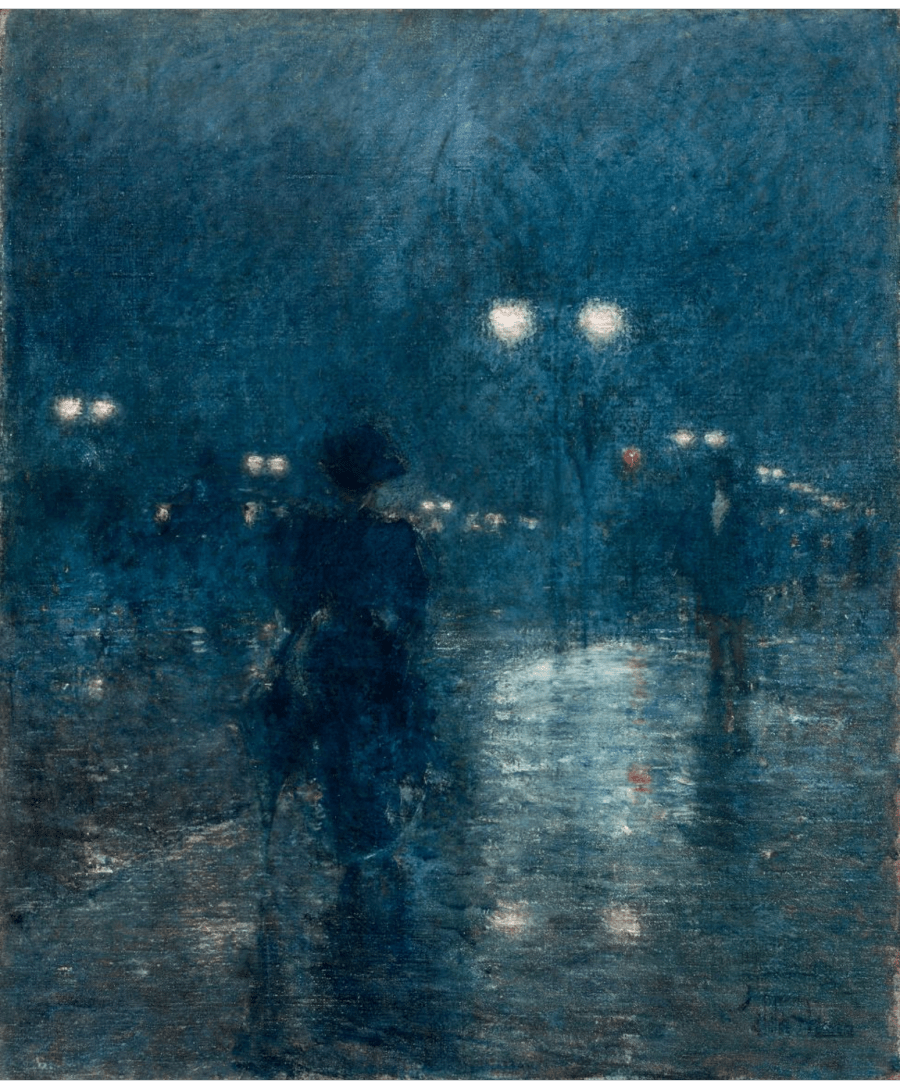
Featured Art: Fifth Avenue Nocturne by Childe Hassam

A Red Cross bus gets hit by a truck
and lands on its side, the driver unconscious.

Blood spills from the broken glass,
coats the pavement in bubbling rust.

It is 1977 and the theme for summer is .44 caliber.
It is one hundred fifteen degrees.

A crowd forms in the contagious heat,
pulls back as the red pool expands.

I watch from the ailing shade of a palm tree,
the sweet taste of blood in the air, on my tongue.

Someone tries to rescue the driver
but the mix is slippery. He lands on his back.

His impact speckles the closest few,
who scream and cover their mouths with their hands.

Sirens sound, and soon the fire trucks are here,
hosing donations into the street drain.

Secretly, we all enjoy this,
being here at the scene of the crash

where news vans make stars of us all.
We want our trauma to trump everyone else’s.

We want to be able to say:

“You weren’t there. You wouldn’t understand.”

Read More

My Mouth Versus Your Mouth

By Devon J. Moore

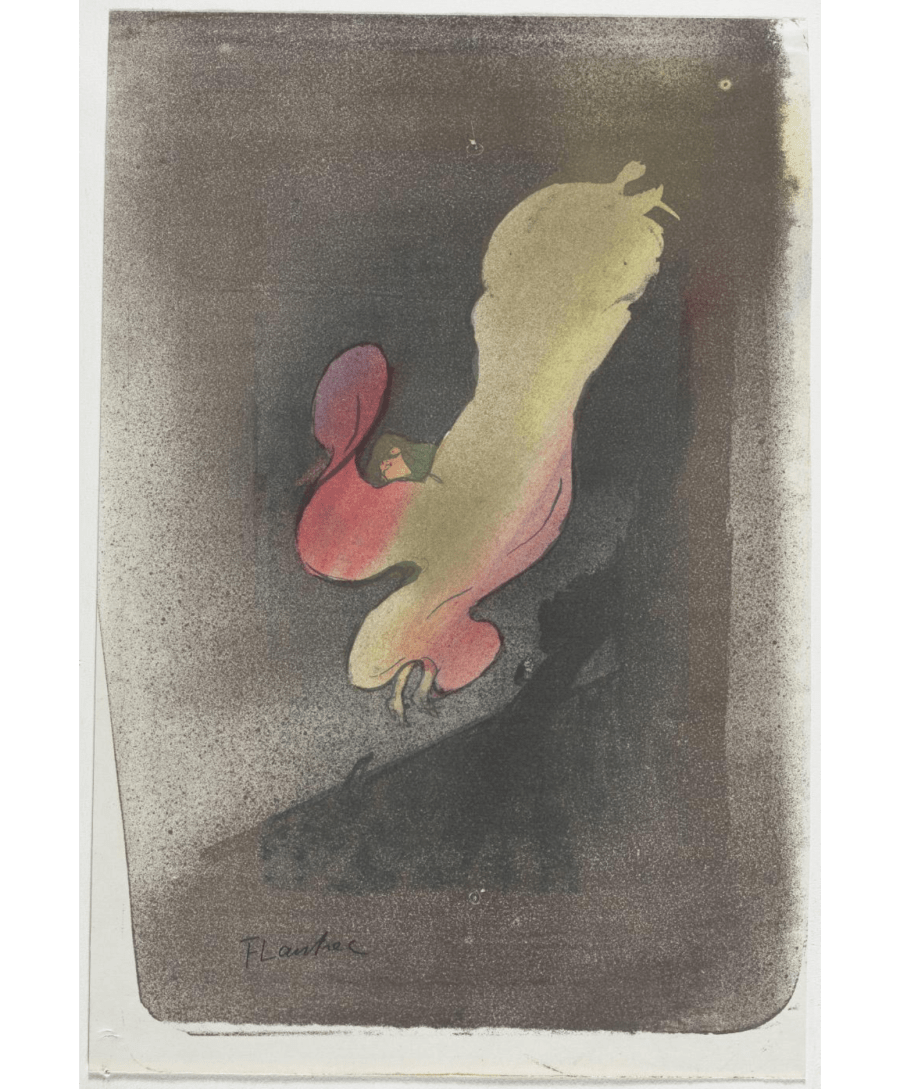
Featured Art: Miss Loïe Fuller by Henri de Toulouse-Lautrec

Gwyneth Paltrow is on the air again
saying something about the difficulty of being
a mother on set is more difficult than being
a mother in an office, on a train, commuting
to those 9 to 5s. She says you have it easier
when your life is synchronized to the needs of mouths
that are not your mouth, to the needs of bosses
that don’t know your name. You have it easier when
you’re alone in a room with a baby,
when the sun hasn’t risen and your chest is dripping milk
and you wonder if today is the day the paycheck
or the 7 o’clock bus or the sun won’t come.
Gwyneth, I don’t have a baby,
but my dread is bigger than your dread,
my breasts are bigger, heavier, than your breasts.
Do you still feel the need to compare?
How about this? My cat would be cuter than your cat
if it hadn’t been for that sick neighbor and his box cutters.
My lover left and his back got smaller,
more quickly, than your lover’s back.
My dad dying sucked more than your dad dying sucked.
I could do this ridiculousness all day. But, Gwyneth,
the memory of my mother needs me
to say, that novel she always wanted to write
never got written. I was a needy daughter,
maybe even needier than your daughter.
I demanded
she look at me instead
of a book or the movie on the TV,
and maybe, Gwyneth, you were
in it, being thinner than my mother
but not prettier. There were days
my pretty mother didn’t look at me
because she couldn’t see past the dark
space in herself and I hated her.
There was a day my mother cried in the laundromat
when a woman, another mother, asked her what she did
for a living, and when my mother said she was a home
health care aide, the woman said that meant
my mother was nothing
but a maid.
The color of blood is more vivid and harder to clean
in my daydreams than in your daydreams,
and a powerless life is harder to describe to the powerful
than the sound of my mother crying on the rug.
But I’ll try.


Read More

Royalty

by George Bilgere

Feature image: Odilon Redon. The Beacon, 1883, reworked c. 1893. The Art Institute of Chicago.

So this young couple, overweight
and seriously tattooed, comes into the café,
and each of them is actually wearing a baby
in one of those tummy-papoose things,
and they have two enormous dogs
designed to kill elk and wolves,
not sit under the table at a coffee shop,
and as I watch them smile at their babies
which are now screaming bloody murder
while the great slobbering mastiffs
begin earnestly licking their own privates,
something terrible happens to me:
it’s like The Manchurian Candidate,
when Lawrence Harvey suddenly realizes
the reason he’s been acting so strangely
is because he’s been brainwashed by Soviet agents:

Read More