Kids Running After a Car

By Hee-June Choi

after the Korean War

Asphalt covered half the street; the rest was
overgrown with sunberries we ate. At the sound of a horn,
we ran to the car; in its bluish smoke, we saw
our future like a 3-D film. When my friend

JC tied his feet to the back bumper of a jeep
to sneak a ride, its engine started;
market people screamed as his bleeding head
was dragged for a hundred yards.

Our most daring venture was to the mountain cave
to dig out bullets for spinning tops’ axles.
But we had to cross locals’ territory––my forehead
still bears the scar of a thrown stone.

These road brawls ended when someone
in the cave shouted: Corpses!—soldiers in a mass grave.
Yet, those were carefree days. Dropping by any house
at mealtime, I ate with them if they laid me a place

—if not, I played next to their dinner table.
House doors were left unlocked:
what thief would steal an empty bag of rice?
In summer, we slept in the public pool’s storage shack,

no parents looking for us.
It was the children’s utopia: what we didn’t have,
we didn’t need. Even now, walking my suburban street
late at night, I snoop around for remnants of those days:

that sour tailpipe smoke must be a shimmer
in the air somewhere on Earth.


Read More

Aural Projection

By John A. Nieves

I used to believe in the tang of orange
Tic-Tacs—that it had anything to do
with oranges. That three bright sugar

pills in my child-hand could shine
up a dark morning. And they did. What
little magic. What’s so easy to miss

so much. I believed rainbows on
window dew hid tiny treasures, that sneezing
while saying someone’s name meant

they were thinking of me, that everything
I loved would stay forever if I took
care of it, if I did my part. I have almost

none of that now: the purple stuffed
rabbit, my two pet Siamese cats, my best
friend across the way, my whole

family. I used to believe music could
change the weather. I’m lying. I still
do. I still believe people attach themselves

to songs they love, creep into their choruses.
This may be literally true in the science
of memory. This may also make me

superstitious. But, O, when I sing
you, I can almost reach. There is no way
there is nothing there.


Read More

The Cost of Living

By Mark Kraushaar

With the thumb and first finger make an L.
L is for loser.
It’s a thing anymore.
Now think of 8th grade.
There was King of Detention Jimmy Ramish.
There was Too Tall Eunice Bugg, plus
Kitchen Tom plus Clyde Skopina
who’d said his father was an astronaut—
he was lying and Brenda
Kleefish let him know we knew it too.
Glide, she’d called him, meanly,
Glide away, she’d say and wave.
There was dummy Aldo Krull
and there was fatso Mitchell Beacham,
Beachball, he was called, of course.
And Annie Friebert?
Annie’s winter colds
were worst and left a criss-crossed
slug trail up her parka sleeve.
Achoo we’d say, achoo, achoo.
Hey Annie drop your hankie?
Ha, ha, ha, ha-choo.
She was a neighbor and our folks were friends.
But with Clyde Skopina came a certain desperation,
nothing anyone could name, leastwise not me—
it’s just I wish I’d looked out a little for him.
In the lunch line once, believing we
were friends, touching my arm,
and smiling hard to trick the facts,
he said, My dad can lift a car.


Read More

The Hair Cutting

By Ockert Greef

The boy is sitting backward on a cheap plastic chair
His shoulders bowed under a faded orange towel

Behind him stands a shirtless man
His belly drooping over bright blue running shorts

They are on a roofless cement stoop
At the back of a small, dull house
With one window and one door
A large tree leans over them
Letting the sun through to draw yellow lines
Across the stoop, the boy and the man

In front of the boy on the cement is a radio
And behind it, a big engine on a rusty metal stand

The big-bellied man lays his index finger
On the crown of the boy’s head
Bending it forward and down

With a thick hand he moves a pair of clippers up
Against the back of the boy’s head
Hair falling on the faded orange towel

He moves the clippers slowly
Up and down
Flicking the clippers every now and then
To send small flocks of hair flying

Now he stops
Tilts his head
Stares past the boy in the direction of the radio

He stands just like that, frozen
Speckles of dust circling his index finger
On the boy’s bowed head
A lost piece of hair drifting down

The boy’s eyes are closed
His face so relaxed, he could be sleeping

And behind him, the big-bellied man’s eyes close
Just for a moment
And then open.


Read More

Wisteria

By Sara T. Baker

Fifty years ago, a tramp came to our door.
I didn’t see him, just heard the rumor
ascend the stairs with my clamoring brothers;
by the time the three of us thundered down
again, there were only wet footprints
leading from door to kitchen and back.
My mother had fed him, a woman alone
with six children in an alien land, wisteria
dripping from the porch roof, a green April rain
drenching everything. It is the grape-like must
of blooming wisteria, its decadence, and the dark
empty house, and those glistening tracks
that I remember, and the woman with her fierce,
generous heart, so that when my doorbell rings
today and a large man looms on my porch
with his empty belly and full story,
I do not hesitate.


Read More

Kintsugi as Bob Marley, Yo La Tengo, Thelonious Monk, and Over the Rhine

By Becca J. R. Lachman

When you couldn’t hold your head up, we all sat
at the black keys, your 6-pound frame swallowed
by a nightgown. New to all this, how’d we know
exactly which intervals would hum you back into sleep
at 8, midnight, 5:25? Verses we’d shrieked or whispered
as kids surfaced, out of nowhere. For our own sanity,

            we grew our daily rituals: I love coffee, I love
            tea-eeeee, crooned into morning through
            bluetooth speakers until we had it memorized.
            Dance parties to shake off the electricity of
            worry or bliss, drowning out the refrain where
            you might really leave us. I fell again


for your foster Da then, how vast his inner library
was, finding the song to make you stop crying.
Your toothless grin was wide as your face when
the trio of us swayed. Soon, you reached toward
mouths, added rhythm at the Baldwin with
an atonal foot, moan-humming along like

            you knew, already, what breath and sound could do
            inside a body. I can believe in a God who thought up
            music, can sit down at a piano in an empty house
            and be saved by something again. I wonder what
            Japanese artists would say about our old grand,
            jagged cracks in its lid where a contractor had

a very bad day. Or about your story and ours,
no doubt too much in this house and beyond it
to lacquer completely with silver or gold.


Read More

In Center Field

By Ted Kooser

Ball glove a big clown’s hand on my hand
and punching my other fist into it
as one was expected to do, ten or twelve then,

I stepped backward and backward, farther
and farther away from the bright, buzzing
diamond, and on into the dewy, tall grass

and ticking crickets, where the Milky Way
began to take over, and, stepping backward,
I entered the universe, the stars brighter

and more numerous the farther I went,
the air cooler, and I no longer cared much
about softball, about catching that high fly,

the ball coming down out of the mothy glow
like a planet, slapping right into my glove,
teammates far in the distance, applauding,

as I backed into that great, spacious dark
sprinkled with stars, feeling light on my feet
as if I were floating, spreading my arms out

like wings as I slowly fell back against it
though not really falling, dissolving into it
backwards, eons beyond center field.


Read More

Cocooned

By Maud Welch

Featured Image: Before I Leave by Tanner Pearson

There’s a split down the center
            of your upper lip, like the crack
of a window on that first warm-
            blooded day of spring, when 

cherry blossoms sprinkle back
            broken pavement and we feel
able bodied to birth sticky children
            of our own on training wheels –

Read More

Sonnet (I Have Two Moms)

By Luciana Arbus-Scandiffio

In the seventh grade we debated gay marriage. I was con.
I stayed home. Kept my hair in a braid and kept my braid
to myself. Tucked my name like a secret up my sleeve.
Wore hideous loafers. Ate full-sized boxes of Twizzlers.
Became rigid, a painting. Still Life with Social Studies.
My skullcap, full of doves. My face, a hot button.
Press it! Pierce my timid ears. In the bathroom eating
a turkey sandwich and Jenny dragging my zipper down
to see what was there. Con: my whole life riding
on a hyphen. Con: my hands blue with luck. An eyelash
on my finger. Two of anything can build a bridge.
The love makes me lonely. The love makes my family.
A slogan of roses. A crown of sugar ants
eating through the gymnasium floor.


Read More

The Secret

By Bridget O’Bernstein

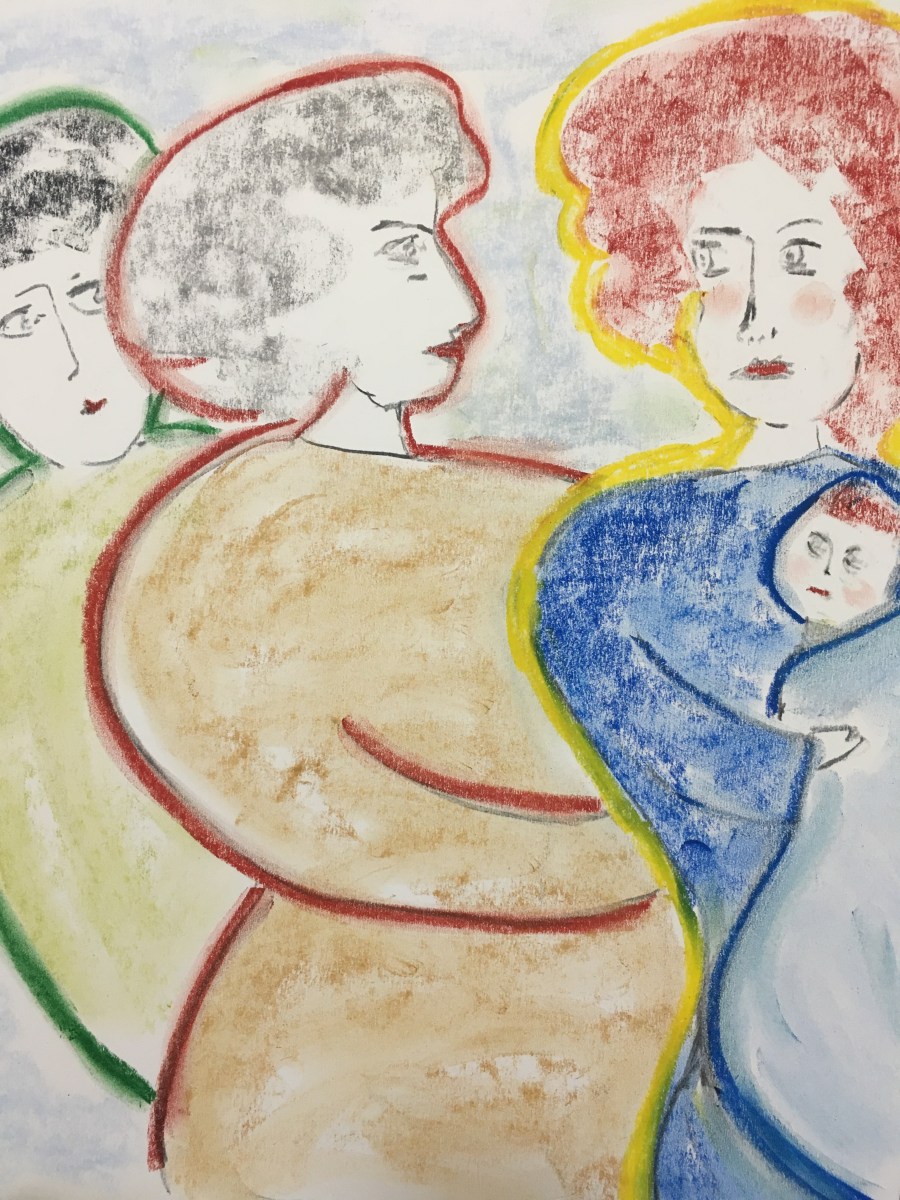
Featured art: Women in Groups by Jesse Lee Kercheval

As a child, I flew alone to California
to spend the summer with my mother’s three sisters.
Aunt Moe made a soup out of bones and covered me
with a canvas blanket in the rock garden.
I played with Aunt Sheila’s cat under the willow for hours.
She walked over with a brush in her hand and said,
You can speak to cats, too? I nodded.
Before I left, Aunt Kate gave me a green velvet book
into which she’d taped a stick of spearmint gum
for my plane ride home.
When I arrived in Brooklyn with my secret,
my father pouted when I wouldn’t share it.
And when I said, It’s private,
his face made a face of such hurt surprise,
like I’d cut him, that I immediately gave it away.
I said, I can speak to cats,
at which point he laughed and went out to the deck
with his coffee, shaking his head.
What a mistake!
To extend to my father
the wonder of my secret, like a rose,
for safekeeping.
I stood there afterward, shocked
at the way I’d invaded myself by sharing it.
Now I had nothing. Read More

Force of Habit

By Kathleen Winter

Featured Art: Girl Arranging Her Hair by Abbott Handerson Thayer

The woman in the Oldsmobile was awfully young
to have a kid, her kid would have said, if she’d had
a voice not just a body jittery inside her precious cotton
dress with ducks stitched in the smocked bodice
flat across her washboard chest. A woman’s hand
was every bit as flat when she had to slap somebody’s
face, so it wasn’t best sometimes to have a voice in case
you asked the woman one too many times how Seguin
was different from Saigon or where the dad had
gone or who was gonna fix the swing or when can we
get a collie or what’s the matter with twirling a lock
of hair around your index finger all day long it felt
so smooth & cool spooled round your finger &
released & caught & wound again, secured.
What’s wrong with messing with this living little
bit of you, a darling little thing. You couldn’t stop it
even if you wanted to.


Read More

What Is There To Do in Akron, Ohio?

By Darius Simpson

Featured Art: Open Lock, Akron, Ohio by James Henry Moser

complain about the weather. wait five minutes
watch the boys you grew up with outgrow you
bury your cousin. go sledding on the tallest hill you can find
keep a family warm until their son thaws out of prison
ice skate between the skyscrapers downtown
inherit an emergency exit sign from your father
spray-paint your best friend’s brother on a t-shirt
daydream your way through a semester-long funeral
watch jeans and sleeves and family portraits unravel
play soccer with the black boys who almost evaporated
with the icicles. kick it outside with the skeletons
from your childhood. go to columbus and pretend
to be a grown-up. spend a weekend at kalahari resort
and call it a vacation. go back home. leave. shoot dice
with the dead boys playing dress up. stay long enough
to become a tourist attraction in a city nobody stops in
mount bikes and ride until the sun dribbles
out of the sky’s mouth. wade through the oatmeal july makes
of morning air. swim in a public pool where everyone
is drowning and no one knows how to survive
what happened last month. stop runnin in and out unless
you got somethin’ on the gas bill. seal yourself with cold air
while the trees melt. bet the boy down the street, who’ll have
the best first day fit. come out amid orange leaves lookin fresher
than all the food in a five-mile radius of granny’s house.
eat jojos from rizzi’s on sunday after pastor guilt trips you
on your way past the pulpit. dream about a city
where headstones don’t show up to dinner unannounced
where fried chicken isn’t on speed dial and diabetes
isn’t the family heirloom. where grief isn’t so molasses
root for lebron in whatever he’s wearing. become
an athlete as a way out of corner sales. never escape.
start a pickup game that never ends. rake leaves
with a rusted afro pick your older brother left you in his will.
let the leaf bags melt into the chimney on the side of the house.
play basketball with the ghosts who don’t know what year it is
volunteer at your local funeral home. open a cemetery
across the street from the playground. mow green.
cut ties with your grass-seller. survive the summer.


Read More

Dear Sister of My Childhood

By Stephanie Rogers

             Remember Mom and how she sent us away
to play near the highway ditch, us throwing gravel,
   cracking a windshield, an accident. The wronged

                        woman dragged us by the arms, back
   to Mom, who was talking on the phone with Dad,
                                            their separation not quite

        official, the whistle of the kettle in the kitchen.
Listen, the woman yelled at Mom
           who paid attention then. Your kids banged up

                       my ride with a rock, and Mom twisted
the phone cord around her wrist, smiled a sorry,
            sent us to our bedroom where we blanketed

                        the stuffed animals, planned a fantasy
ship trip, and swung them over
              the green carpet ocean till a rabbit flew off

           and drowned, the kittens and bears unaware
of their fallen friend. What the hell?
                          We were fun kids, placing our heads

                on Dad’s chest, listening for his heartbeat,
our faces like mother
                              birds covering the nest. We licked

         our plates clean when told, laughed at the old
dog dragging its ass across the rug, salted up
                              those outdoor slugs that vanished

                          into mush. Dear sister, visit me now.
New York City stays
                           windy all year, the crowds shouting

                    their snare-drum quips at one another,
the summer sweaty as beach shells, Dad dead
  from a rip in the intestine, Mom’s boyfriend gone

on the vodka binge, and all my life spent rounding
corners like a whirlwind, my smoke
                                settling now. But here I am, still

                broke and meddling in your Nashville life,
your three girls sweet as key lime pie
                    smashed in the face, their tresses: long

         and swaying down their backs the way honey
slips softly from the spoon. Let’s crescendo
              under the moon together with our banter,

                                        tempers under the weather
for once, us in love with our stupid boyfriends,
                                                               giddy as a cow

Read More

Lucky

By Steven Dawson

Featured Art: Firer by Felicity Gunn 

The first time I watched Braveheart
was in the basement of Lucky’s dope house.
I remember the soft cone of light

reaching out from that small box TV
as if asking for spare change from the dark
and how that little glass frame made

blue-faced Wallace look so much
like an action figure (back when Mel
was somebody’s idea of a hero).

And in the downstairs bathroom hung
a cage with Lucky’s bird, a gray parrot
he took from a woman who couldn’t

pay him and that bird would pull
every dull feather from its back
and curse in Spanish as I watched.

I was nine or ten and alone with Braveheart,
that bird, and basement boxes I imagined filled
with a life before Lucky, when his name

might have been Greg or Brandon or even Mel.
This is how my brother babysat—
upstairs and horizontal with a needle

sleeping in his bowtied arm
like some guardian angel taking
work naps among hallway sleeping bags

swollen with strangers
practicing how to be dead
and Lucky’s bird downstairs

screaming chinga tu madre.


Read More

Calling Annie Oakley

By Kirsten Abel

Written on the side of a payphone
lashed to the wall of the bathroom in a Montreal café
is Annie Oakley’s telephone number.
I see it while I’m peeing.
That’s how close the payphone is.
Annie Oakley in black marker and then her number.
I’ve only touched a gun once.
Or maybe I didn’t touch it, I just thought about touching it
and then said, No, thank you.
It was my father’s gun. It was small, perfect
for fitting into a lady’s hand. Is that called a .38 Special?
Annie Oakley would know.
I didn’t grow up with guns.
I didn’t grow up with my father.
People sometimes think that is a great tragedy.
I did grow up near a little lake, beside
which lived two goats and a horse.
In spring and summer I would walk with my sisters
the dirt trail overlooking the mountain to the gravel path to the stables.
If the goats were out,
we’d pass them cabbage through the fence.
Back then I thought the greatest tragedy was August
ending or my eighth-grade crush dumping me
for a girl with nearly my same name.
I’ve always had trouble locating the appropriate level of sadness
about the father thing.
I’m not saying it doesn’t register.
I’ve just known from a young age there was nothing to do about it.
Here is me.
Here is my father.
The distance between us could be as close as me to this payphone
or as far as the mountain felt from the lake.
Either way it changes things.
Either way it’s done.
Annie Oakley shot a squirrel’s head clean off at age eight.
It was her first shot.
Here is me, I hear her saying.
Here is the squirrel.
Right through the head or right through the thigh or right through the gut.
Either way it’s done.


Read More

My Babysitter Karen B Who Was Sent to Willard Asylum

Winner, New Ohio Review Poetry Contest
selected by Kevin Prufer

By Jessica Cuello

There are only two photos of me as a child.
She took them, she had no child.

She had Kool Cigarettes and a job at the drugstore.
She gave me the Crayola box with the built-in sharpener.

Four hundred suitcases were stored in the attic
of Willard Asylum for the Chronic Insane.

She joined her twin brother there.
She wore her black hair down.

A child could admire it.
She bought me an Easter basket,

a stuffed rabbit whose fur rubbed off.
She walked everywhere.

She painted circles of blush on her cheeks.
Loony, people said so,

I mean grown-ups who saw signs
who passed her on our street before she

started to call and say Remember,
on the phone she said Remember,

Remember the date we killed her brother,
forgetting he’d been committed.

I took her hand and tagged along like an animal.
She was perfect to a child.

Read More

My Younger Self Attempts Breakdancing at the Sadie Hawkins Dance

By Kerry James Evans

Featured Art: Dryland Farming #24, Monegros County, Aragon, Spain by Edward Burtynsky

I spin like an adolescent bottle
pointing in empty directions,

the colors of the divided gym
spiraling like one of Mrs. Peters’

chemistry experiments, the blurry
girls staring, the boys huddled together

like cows in a thunderstorm.
A minute ago, I’d sensed the movement,

two Samanthas on their way to our side
with their rare request.

Would you like to . . . ?
But I wasn’t waiting. I’d have my say first.

Now, I listen for the beat to drop
and I pose, balancing

all my weight on my left hand,
each leg a limp karate kick.

I move as a squid flees
a cameraman’s light,

arms crawling like
honeysuckle along a trellis.

If I love my body,
if any of us love our bodies,

we don’t know it yet.
What I do know?

Read More

The Clipper Ship

By Ted Kooser

Featured Art: Early Morning After a Storm at Sea by Winslow Homer

There was a cheaply framed clipper flying in full sail
over the sofa, and it leaned just a little into the glass
as if to look down on me lying there bored, and it carried
more sail than anything in Iowa. It looked as if some boy
had broken a lot of white cups and saucers and stacked up
the pieces, just so, so they wouldn’t fall off of the sill
of that window that opened onto a faraway sea, a sea
that the ship had only recently ripped open, revealing
the world’s white cotton lining. That overstuffed sofa
was heavy and brown like a barge, and it smelled like
the one suit in my grandfather’s closet, an angry blue
like the sea in the picture, and as I lay there, climbing
the main mast’s springy rigging onto a lofty spar
where I could look down on myself, I could see the sofa
slowly sinking, the carpet all patterned with flotsam
slapping against it, and I wondered, as one might wonder,
if the ship would ever arrive in time to save me, or if I,
hanging high in the rigging, would simply wave it on.


Read More

Happiness

By Daniel Arias-Gomez

Sometimes it sneaks up on me, as I look out the window
of a bus, for example, and see a woman in huaraches running
in the rain—her right arm waving, her left
hand pulling a boy, a backpack bumping
against his shoulders. The woman opens
her mouth, but I only hear rain
against the glass—a black braid lashes
her neck, and from her arm
dangle two mesh bags with a plaid pattern
woven out of strands of plastic and filled with vegetables, beans, rice. My mother
used those same bags when we went to the market on Sundays. One day
she bought me a bag all for myself, the same
as hers but smaller, in which I dropped
tangerines, peanuts, mazapanes, as I followed her
through market stalls. The bus driver sees
the woman and the boy in time
and stops—her face loosens, and she smiles,
and her smile takes in all the rain
and all the mud on the street and on her huaraches, and she turns
to the boy and says
something to him,
and he smiles back.


Read More

The Reflex

By Mitchell Jacobs

Featured Art: Boats and setting sun by Ohara Koson

The scent of shampoo reminds me of carrots.
There’s an explanation, I swear, surfacing
from a developing-Polaroid brown. It’s April.
At recess an upside-down pizza slab is gooing
into the cracked blacktop, and a grainy beat
blasts from some girl’s hot-orange earbuds.
On the grass all the boys are playing wallball
with one of those rubber balls like a big pink eraser,
and when I’m up I don’t chuck it far enough
so Austin says, “Come on, Mitchell, you can’t
even throw like the girls,” which is heartbreaking
for a bunch of reasons. Back home, Duran Duran’s
“The Reflex” spins in the Discman on my bathtub rim.
You’ve gone too far this time, and I’m dancing
on the Valentine. My tunes are twenty years out of date
but I know them by heart. I’ve been lying there half an hour,
tub empty, stoking a burn in my gut. Next day in L.A.
(that’s Language Arts), it’s Fat Shawn’s turn at vocab charades
but he just stands there thinking until somebody shouts
“Rotund!” and that’s not his word but it is the end
of the game. That’s how cruelty works around here.
I’m no Shawn but I am Tree Kid and no one
tells me why. The reflex is a lonely child . . .
Jake calls me a poser for wearing skate shoes,
which is how I learn I wear skate shoes, and then
I chase him and kick him with those shoes. Mostly
I’m a head-down kind of kid. I don’t peek at the pull-down map
during the geography quiz. I don’t snicker when
the health teacher says gluteus maximus, but I am
the one who laughs when she can’t spell epididymis.
Another night and it’s the tub again, lights off, interpreting
the song with nonsense lyrics I’m sure have something
to do with all this clench and spasm. The reflex is a door
to finding treasure in the dark. I un-twist-tie
the plastic produce bag and glob out more Pantene, hating
the boys who run around cocksure with their narrow
calves and their throwing arms with actual
visible muscles and those stupid impossible taut butts
and I’ll show them with this soaped-up carrot
what I can take, how it stings, how I tighten my fist
as I hear them spit out my name.


Read More

Parrots Over Suburbia

By Craig van Rooyen

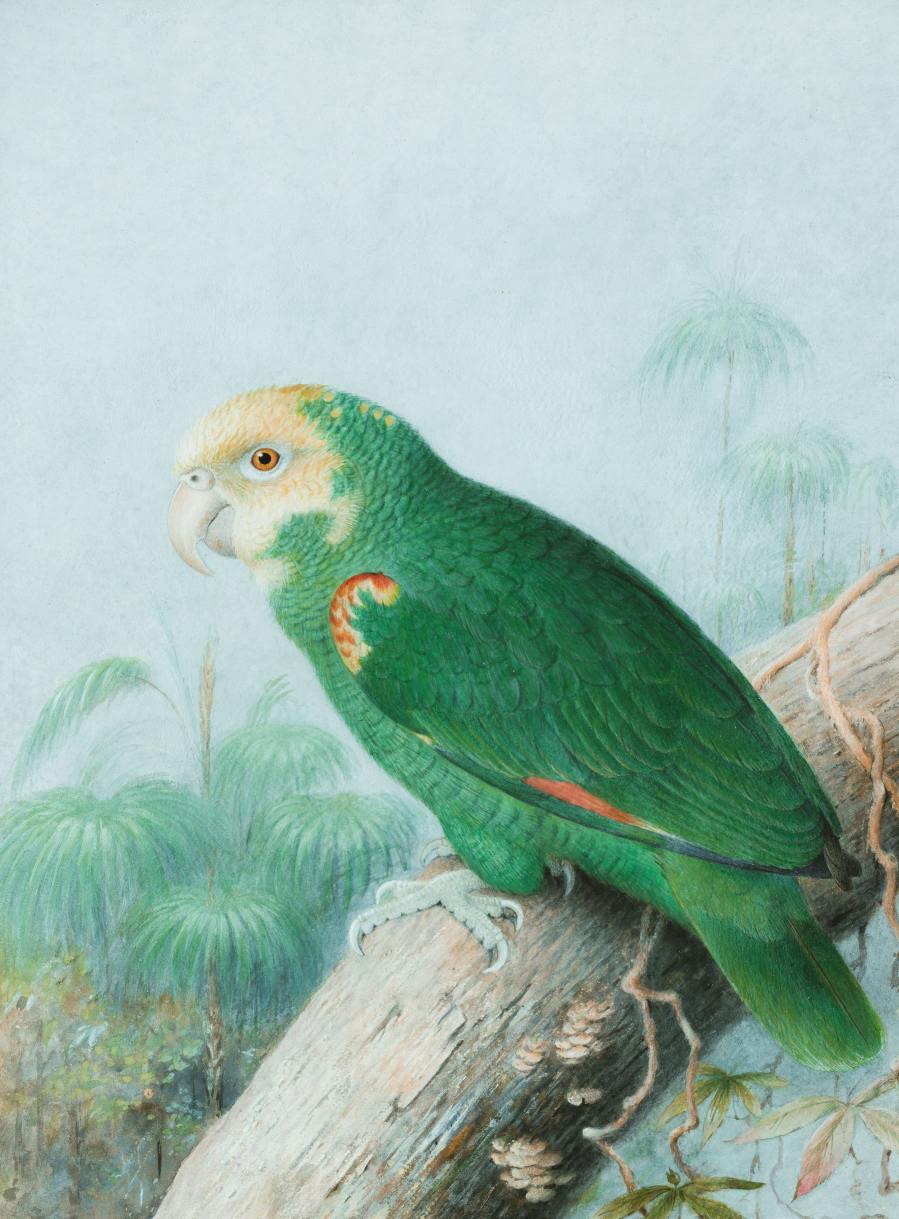
Featured Art: by McGill Library

There are two,
as if some ark came to rest
on the high school football field
and Noah flung them through an open window
to test whether this cement-skinned town
can sustain life.
See them there, trimming
lava-dipped wings in the sky above Costco,
bills curved like question marks.
And what do they ask, out of earshot
of the man with sunflower seeds?
Do you know what it means
to circle, to draw and redraw the tightening
circumference of your life
above the grid of 50-year roofs,
in steak smoke risen from backyard barbecues?
The parrots’ owner is no prophet.
Summer evenings, he wrenches
on a ’67 Mustang that drips its innards
onto his Avenue L driveway.
And at dusk, he makes his arm a perch,
takes the two from their cage,
feeds them from his lips, knowing
if they love him he need not maim their wings.
So they fly in circles
and on every pass above the fenced playground,
swoop near to watch the girl in high-tops and earbuds
swinging, head thrown back to reveal
her pale and wild throat.


Read More

Coronation with Plastic Flowers

By Kelly Michels

Featured Art: by Karl Blossfeldt

She says it feels like flowers blooming in her veins.
                                The lilies watch her, unmoved
in the window.
                                She becomes the petals’
white polyester sheen, its rigid spine, slumped posture
                                leaning against the rim
of an old coffee mug filled with week-old cigarette butts.
                                This is how
I will remember her: bottles of pills, the walls scumbled
                                yellow, a flower blooming
in her veins, her gray breath rising

                                in a haze thirty years ago
the way she placed each plastic flower away from
                                the sun, the sting, anything
that could touch the color of the petal as if the light
                                could drag each one into the white,
worn sky, make it fade before her eyes. What else is beauty for?
                                but to be spun, set on a window sill
curtains drawn, petals hugged in dust, as she slept,
                                no sun to tell her if it was day or night,
the three of us kids trying to keep still, feeling our way
                                through the dark dreamt room,
unable to understand that this was the tick-tock of time.
                                 This was what it meant
to live forever.

                  Only nothing lives forever.
                                                The perfect moment—

the gardenias in full bloom
                                chatter staggering through a promenade,
the quivering flit of sparrows chasing
                                the listless light of noon
until suddenly even this ends,
                                 until suddenly a car alarm ruins everything,
the chatter dissolves into people
                                 screaming over each other,
birds fleeing, the owner trying to turn the damn thing off.

               Maybe there were too many moments
that could never stay quiet or whole in her hands
               like the day we took
our first steps, said our first words, or the day
               she fell in love,
slept all night in his open arms, dreamt of the way
               he looked at her as the ocean
wind tossed her floral dress,
               dreamt of the way time could stop,
only to wake up and find every living thing
               changed in some way

everything except
               the flowers in her hands.


Read More

Intercession

By Jennifer Leonard*

When, years later, I learn Kevin Miller,
the boy who grew up next door, is in jail
for drugs and a stolen car and a gun,
I think of eighth grade:
Kevin with his buck teeth and buzz cut
always getting into fights, Kevin suspended
once for carving the F-word into a church pew
during Wednesday Mass, then again
for slinging walnuts against the windshield
of Mrs. Sabatino’s car.
And that one time, on the field at the end
of the street, where the boys gathered after school
to pick teams, Mark McGarity said,
We don’t want the retard,
meaning my brother—
and Kevin said, What the fuck, man,
and Mark said, Well then prove he can catch a ball,
and when Kevin shrugged and said Fine,
and told my brother to go out for a pass,
and my brother did, but did not catch the ball—
when it bounced twice off the ground,
and my brother looked down at his sneakers,
and Mark told Kevin, Yeah dude, there’s no way,
and all the other boys stood
in a sort of ring, and waited for someone
to hurt someone else—
but instead, Kevin thumped my brother
on the back and said, Let’s go. And my brother—
who may not ever be able to memorize equations
or read, but knows when a man risks himself
for another—
he followed Kevin home to our back yard,
where Kevin threw my brother the football,
and though the ball passed again and again
through my brother’s hands,
Kevin kept throwing, telling my brother
where to move and when, and I can picture, now,
my brother’s face so serious and filled
with concentration—
and Kevin, throwing until their shadows
fell long over the yard.


Read More

Little Girl Pulling Off the Tablecloth

By Wisława Szymborska
Translated from the Polish by Joanna Trzeciak

She’s been in this world for over a year,
but not everything in this world has been examined
and brought under control.

Now being probed are things
that cannot move on their own.

They need to be nudged,
slid, shoved,
moved from one place to another.

Not all of them want it: not the wardrobe,
the cupboard, the unyielding walls, the table.

But already the cloth on the stubborn table
—when firmly grasped by the hem—
reveals an urge to roam.

On the tablecloth, glasses, plates,
a creamer, spoons, a bowl
all quiver in anticipation.

It’s interesting,
what move will they make,
as they teeter on the edge:
a journey across the ceiling?
a flight around the lamp?
a leap to the windowsill, and from there to the tree?

Read More

’69

By Kathy Fagan

Featured Art: Alfred Sisley by Pierre-Auguste Renoir

If it’s been ten times it’s been forty-five
I’ve checked the man out in the car behind
mine, teeth bared, laughing in my rearview.

I cannot stop myself from watching him,
sun full on his face. He’s all alone—
we are, among our fellow rush commuters—

and then it dawns on me: it’s Mr. Cahill
from sixth grade, my first male teacher (heart, be still!),
who taught sex ed to us in ‘69,

in Catholic school, till someone narked and he
was gone for good. Those days, we venerated
the venereal, reciting sex words right

Read More