Review: Taylor Byas’s Bloodwarm
By Eric Stiefel

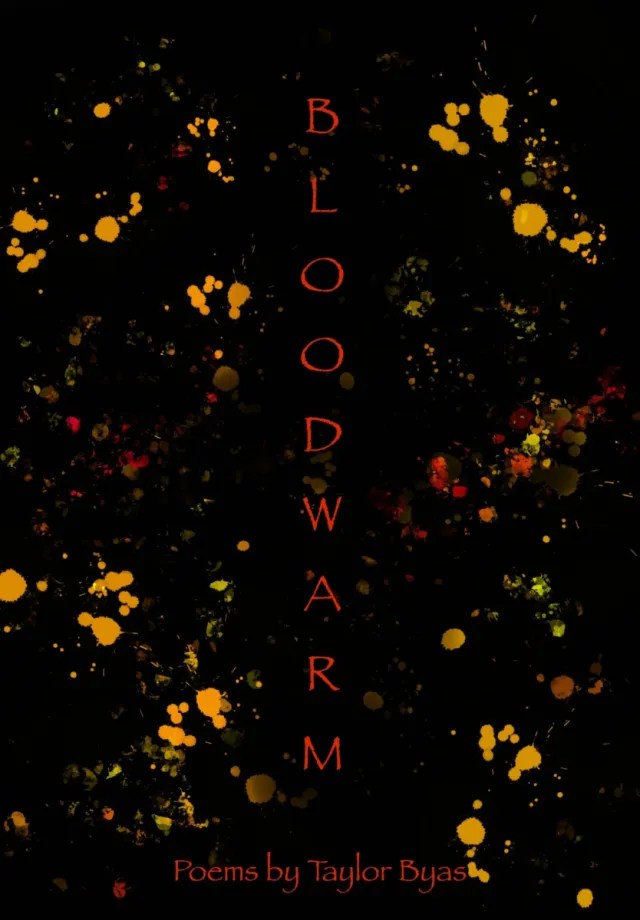
Taylor Byas’s debut chapbook, Bloodwarm (Variant Lit, 2021), does the work that a good chapbook should: It’s bold, concise, and daring, and it hones in on what it wants to say, collecting its poems as variations on a theme without spending too much time retreading worn territory.  Bloodwarm dances between the formal and the formally engaging, from sonnets to pantoums to erasures, to poems written from the past, to poems written as voicemails, as highway exit signs.

The collection starts in media res with “My Twitter Feed Becomes Too Much” (p. 1), opening with a pair of violent images from 2020’s George Floyd protests against police brutality (and the further police brutality inspired by the protests).  “I come across pictures of two rubber bullets / nestled in a palm,” the poem begins, later telling us “The caption reads These maim, break skin, / cause blindness.”  These lines are contrasted with the next image: “Another photo—a hollow / caved into a woman’s scalp, floating hands // in blue gloves dabbing at the spill.”  

Read More
Review: Jeanne-Marie Osterman’s Shellback

by: Eric Stiefel

Jeanne-Marie Osterman’s debut full-length poetry collection, Shellback (Paloma Press 2021), does the difficult work of using inventive and unflinching verse to deal with a lineage of familial trauma, alternating between the speaker’s father’s wartime experiences in World War II’s pacific theater, the difficulties of a childhood with a father who’s haunted by the war, and her aging father’s final days.  

The collection begins with an explanation of its title (“shellback” is a nickname for a veteran sailor who’s been hazed through a violent initiation ceremony after sailing across the equator) and a poem called “Epilogue” (p. 13), which paints a portrait of the speaker’s father during the last days of his life.  After opening with the lines “He’s losing his grip / Last Saturday night, / trying to shave for church.”  While sitting in the dark, the speaker’s father asks her to read to him: “This is how we talk about death: / He asks me to read / the last part twice / where Sam’s frozen corpse / comes back to life.” 

This move sets the stage for the rest of Shellback—a daughter trying desperately to understand the life of the man who raised her, a father who doesn’t know how to explain.  Fortunately, Shellback isn’t afraid of dealing with challenging subject matter, whether the speaker is recounting kamikaze attacks her father survived during the war or navigating the indignities of her elderly father’s decline. 

Read More

Review: Adam O. Davis’s Index of Haunted Houses

by Eric Stiefel

Adam O. Davis’s Index of Haunted Houses (Sarabande Books, 2020) explores the spaces that contemporary America has left behind, from abandoned homes from the 18th century to dilapidated motels and empty trainyards.  While Adam O. Davis’s debut, hybrid collection of original photography and poetry, Index of Haunted Houses focuses on ghosts and the places where they linger, its spectral figures never appear overtly.  Davis leaves their presence to be sensed by readers as they explore the spaces of the poems in this book, which is often filled with white space and possibility. 

Most of the photographs depict empty spaces or dilapidated buildings, empty trainyards, crumbling motels, an empty road and an open field with a sign that reads “PRIMITIVE ROAD, CAUTION, USE AT YOUR OWN RISK.”  The eerie tone of these black-and-white photographs resonates with the poems in the collection—something in America has been lost, though that something hasn’t truly left us.

Read More