Paste

By Joe Plicka

“Unknown / Man / Died Eating / Library Paste / July 14 1908”

                        — epitaph on a headstone at Pioneer
                         Cemetery in Goldfield, Nevada

We were called to Braddock, arriving after midnight to find a woman, recently widowed, laboring with her fourth child. She stood in the kitchen near a burning stove, unclothed and sodden, gripping a thick cord dangling from the rafters. As her pains grew, she called for her oldest daughter to bring a syrup she’d somehow procured from a druggist in Cleveland, an anodyne she was willing and able to try in the absence of her late husband, whom she fairly cursed for his commonplace insistence—when he was alive, of course—that a daughter of Eve not “thrust aside the decrees of Providence.” The druggist, however, had mixed the compound with blackstrap molasses rather than rose honey and the poor woman found the flavor unpalatable. She cried for flour paste, which her daughter fetched from a printer’s devil down the road. This paste she mingled with her bitter cure in an empty sardine tin and continued to taste it with a wooden spoon, even as she birthed a healthful boy with the most immoderate hair one ever saw on an infant.

                           — Mabel Gaskin, midwife, 1850

Read More

“Above the River”: James Wright’s Ohio “Bloodroots”

By Therese Gleason

Featured Art by Claire Bateman

The Ohio River runs through James Wright’s oeuvre, a throughline leading back to the hardscrabble community of his youth. It’s a region ravaged by strip mining, extractive industry and labor practices, and dead-end factory jobs resulting in generational poverty. Yet despite his professed hatred of and determination to escape his native Martins Ferry in the Appalachian foothills, Wright returns again and again in his poems to the banks of the river he grew up exploring. This boundary between Ohio and West Virginia, between water and land, is haunted by the ghosts of drowned childhood friends, miners “dead with us” in the gorges, and memories of violence witnessed—and perpetrated—in his youth. But the sacred and profane river—with its “bare-ass beach” that is “supposed to be some holiness”—is also his “Muse of black sand.” “How can I live without you?” he writes. “Come up to me, love, / Out of the river, or I will / Come down to you.”

Read More

Buried Fruit

by Robert Stothart

Featured Art: Generations, by John Schriner

I am re-begot
Of absence, darknesse…
Things which are not.
—John Donne

1

Now they’re standin’ in a rusty row all empty
And the L & N don’t stop here anymore.
—Johnny Cash

Winter’s first fuel came cheap, scrap wood, free for the taking, piled along the road next to the sawmill half a mile back toward town from my house. Lying in bed—borrowed mattress on a patched linoleum floor—I listened to wood fires pop and snap taking night chill off my two rooms. Light from the yellow flames pierced through slots in the iron stove’s iron door and danced in reflection across the inside of my front window.  

In September, Mother Annie told me to go get wood at the sawmill. I had no running water, only a well with a handpump and an outhouse at the place I rented. I had electricity and cooked on a hotplate. The potbellied stove stood cold in the center of my front room for two months. 

Read More

This Is How It Will Feel

By Jennifer Watkins

Featured Art: Woman and Child by Mary Cassatt

At three years old, you will sit beside me in a rusty Ford as we head south on I-95. The air conditioning will blow lukewarm air, and you will feel hot and sticky. From the carrier in the backseat, our cat will growl long and low. Looking out of the passenger window, you will see stacks of steel lattice speed by, connected by strands of drooping lines. Through the back windshield, a shrinking ribbon of asphalt, lengthening and disappearing into the horizon. After many hours, the dirt will turn from brown to orange.

“I want my daddy,” you will say.

“Daddy’s staying in Maryland,” I will reply.

A few weeks later, after boxes have been unpacked in the Georgia apartment complex called Cherry Tree Hill, a card will arrive in the mail. Tearing open the envelope, you will find a photograph of your father. He’ll be sitting in a leather office chair, smiling for his daughter’s benefit and wearing neatly pressed blues. You will clutch the picture to your chest, pressing your cheek against its sharp edges. You will kiss the photo over and over. I will tell you to stop.

“You’ll ruin it,” I’ll say.

I will hold you as you cry, and you will hear my heart beat as you lie against my chest. At three years old, you will learn: your mother is flesh and blood. Your father is envelopes and stamps.

Read More

The Animal Trade

Winner of the 2009 New Ohio Review Prize in Fiction (selected by Peter Ho Davies)

By Christine Nicolai

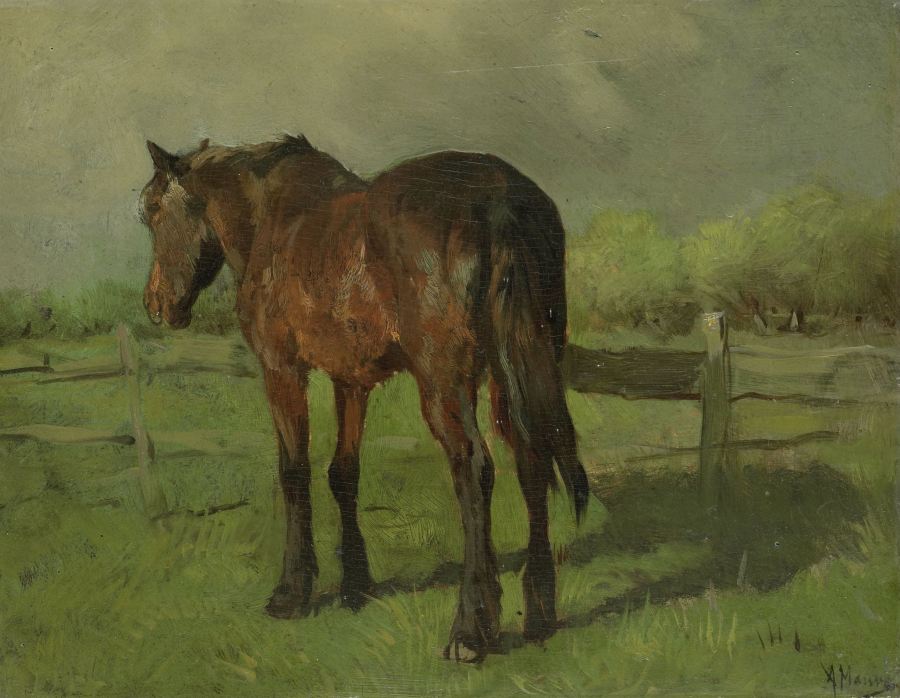
Featured Art: Paard by Anton Mauve

It was close to midnight when Vic heard a shotgun echoing somewhere nearby. If Sue were still around, he’d have put on his boots and stomped out to the porch in his bathrobe, scanning the front yard and street in the twilight. If she were here, he’d have seen that it was all clear and come back to bed where she’d have been frozen under the blankets, breathing those shallow, rabbitty breaths, like she was flattened in a clump of weeds, waiting for the fox to move on. Without Sue, Vic told himself it wasn’t a shotgun he’d heard, because shots at midnight usually meant someone was doing something they shouldn’t.

This was midsummer, humid and hot. Even though it was long after the fourth, the noise could have been an M-80 or Salute, picked up from the reservation. Every couple of weeks one of the guys at the restaurant complained about kids lobbing cherry bombs into front lawns and tearing off down the street, yelping at the stars. That was an explanation he could almost hold in his hand, except that he knew it was the sharp-edged sound of a shotgun that had crackled through the night. His jeans were on the floor. He put them on in the dark and went to check the doors, sticking his head out the back, trying to make out more than just the outline of the barn against the dark sky. The gate leading to the back pasture appeared to be shut, which meant that Toby, the gelding Sue had left behind, should be all right. He closed the door.

Read More