Animal Control

By Anna Sheffer
Featured Art: “The Bride” by Alex Brice

The buffalo’s tail swished. Clumps of sod mashed around in its mouth. Dana watched through the sliding glass door, safely hidden behind the curtains. If she wasn’t so afraid, it would have been funny, spying on this creature demolishing their yard as if it were an inconsiderate neighbor. But the welcome pamphlet had said these animals were unpredictable—not to be approached under any circumstance—so she was on hold with the nature preserve, listening to jazz flute riffs while wrapped in the curtains she had bought less than a month ago.  

Libby materialized, round four-year-old stomach protruding in front of her. A plastic horse figurine dangled by its mane from her closed fist. “Mommy, what are you doing?” She had been playing quietly in front of the TV just minutes ago; why couldn’t she go back to whatever she’d been up to?  

Before Dana could reply, Libby peeked around the curtain and let out a delighted squeal. “Look, mommy, a buffafwo! Did you see it?” 

Read More

Trick of the Light

By Jessica Jo Staricka
Featured Art: “Nope” by Alex Brice

One night twenty years later, among cardboard boxes fuzzy with dust in the basement of my mom’s final house, I find a tennis racket. I’m puzzled. We never played tennis. Maybe the racket was trash left behind by a previous renter that we accidentally packed and brought with us on one of our many moves. Maybe Gladys and I begged a dollar off our mom to buy it at a garage sale and made up our own game pitching pinecones to each other in one of the back yards. 

But when I pick it up, its exact heft and balance rush me out of this basement and twenty years back, to the perfume of white pines and the prick of their needles through the holes in my sneakers, to the gravel yards and dandelion lawns and empty horse corrals and collapsing barns of the half-dozen ramshackle farmhouses we rented growing up, to their living rooms on summer nights, where Twins games played on TV, where I tinkered with salvaged arts and crafts, where my sister Gladys played an out-of-tune piano if the house happened to come with one, and where a bat appeared in the corner of the ceiling. 

Read More

5 things getting attacked by a dog taught me about mid-level B2B sales management

By JB Andre

Featured Art: Stephen Reichert, A List of the Reasons of Why I am Getting Into Computers, 2025. Oil pastel, pen and marker on paper, 14″ x 11″. 

First I want to start off by saying that I am OK. An ambulance ride, eight stitches, and a lot of painkillers later, I am safely at home with my beautiful, loving family. Shoutout my amazing wife @CamillaSpringer for taking such good care of me after my hospital stay. I also want to take this time to share my gratitude with friends and family who have reached out to wish me a safe recovery—and to those who haven’t: it’s not too late! I have decided to post about this following the success of my more personal article: “What I learned about leadership when my Grandmother died.” To all of my readers, again I thank you for your well-wishes. Please don’t forget to like, share, re-post, and comment. Follow me if you don’t already for more great business content!

Yesterday morning, I was walking my labradoodle puppy (say hi Max!), or, I suppose, we were coming back from a trip to the park, and crossing the parking lot to our apartment (for those of you shocked that we still live in an apartment, check out my article “The risks of homeownership for early-career entrepreneurs”). About halfway across the parking lot, I saw a nasty-looking dog. About 70, 80 pounds, brown, a mutt with a broad, square face like something between a pit and a shepherd, but low to the ground and stocky. I recognized this dog and knew it was trouble (check out my post “Max got attacked by a dog but he’s OK: Resources on pet care and picking an affordable veterinarian”). It was walking up to us slowly, but I have to admit—I ran! Which brings me to my first of five tips.

Read More

Flights

By Jill Schepmann

Featured Art: “Spring Returns and So Do I” by Leo Arkus

I walk out of class, my mis-spoken and fragmented explanations of the day racing. A greatest hits of my unworthiness as a teacher. I think of earlier in the day, walking around the lake with a friend. The building I’ve just left is called Lone Mountain, which stands on a hill, in a city of hills, dramatic, grand. And I trick myself again into believing that I belong here. Sometimes, Lone Mountain makes me witness the fog coming off the Pacific to swallow San Francisco’s avenues. Sometimes, the glass buildings downtown. Once, on a rainy, windy day, I looked out my classroom window to see two giant cypress trees grown as one split and fall away from each other, their branches pointed skyward until they came to rest in sudden-found angles, fossilized insects on their backs. 

As I descend the mountain, I think of going home to my new girlfriend in Oakland. Oakland is also new to me. Susannah is making pasta for us. This caretaking, too, is new. I walk a little quicker thinking of the way she comes to unlock the door when I’m too long finding my keys. Her warm lips. Cupping her elbow in my palm. Her cheek resting against mine. I quicken. I quicken. 

Read More

I Am No Beekeeper

By Arya Samuelson

Selected as winner of the 2023 New Ohio Review Nonfiction Contest by Barrie Jean Borich

My housemate sleeps all day, makes art all night, and paints giant bees. “I want people to feel my paintings,” she says, stroking the palm of her hand against a still dripping head-to-toe canvas.

I keep my hands in pockets. We’ve only been at the art residency for a week, and she has already transformed her garage studio into a whimsical world of texture and wonder and touch. My art is trapped inside me. Weighs down my womb with rocks.

Read More

Wolf

By Julia Strayer
Selected as the winner of the 2022 New Ohio Review Fiction Contest by Madeline ffitch

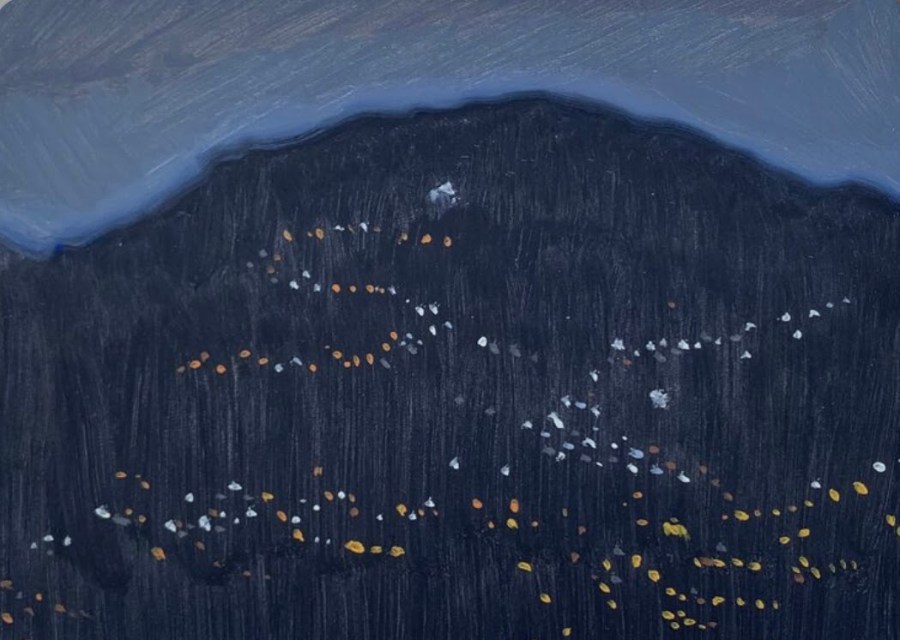
Featured Art: Monte Constantino, Night by Alex Spragens

I lost her the night of the squalls, when wind raged hard enough to rip trees from the ground—my husband helping neighbors with a collapsed roof, and me with blood that wouldn’t stop and wouldn’t stop. I carried her for four months. I had imagined her face.

I walked the dark house alone, not wanting to sit, hearing crying that wasn’t mine while the moon trailed after me. I searched out the front window for my husband’s headlights because it wouldn’t feel real until I could tell him, but my breath fogged the glass, and I couldn’t see. Finally, I slept because I was too tired to do anything else.

Empty and quiet. My body. The house. Except for the walls, which were run through with mice and scratching.

They say children choose their parents. What does that say of me? What does that say?


In the wild, a wolf mother will carry a dead pup around in her mouth, showing the body to the rest of the pack, before she buries it.

Read More

The Man with the Yellow Hat

By Dustin M. Hoffman

The man with the yellow hat dragged his monkey out onto the balcony and locked it inside the wire-walled kennel. He’d reached desperation. The monkey he’d named George had finally followed his curiosity to disaster. The monkey had nearly killed a man. From behind the sliding glass door, he studied the monkey’s stillness, wondered what terrifying curiosity he could be conjuring now: a swing from the powerlines, steak knives chucked from their sixth-floor apartment.

Cool fingers trailed up the back of his neck, bumping down his hat brim. “Don’t you think he’s learned his lesson?” the scientist, his girlfriend, whispered into his ear. She joined him at the glass door.

The man clenched the syringe in his pocket. After two years of fostering, the man had become certain that the monkey he’d named George couldn’t be trained. The scientist imagined the man kinder, so much more patient. But there was a frailty he hid just as carefully as his balding scalp under the hat. His patience, his compassion for defenseless animals, was rubbed threadbare. So, he carried a fatal needle for the monkey, the quick solution, finally. She was wrong about him. Everyone was wrong.

Read More

A Shark Story

By Erika Warmbrunn

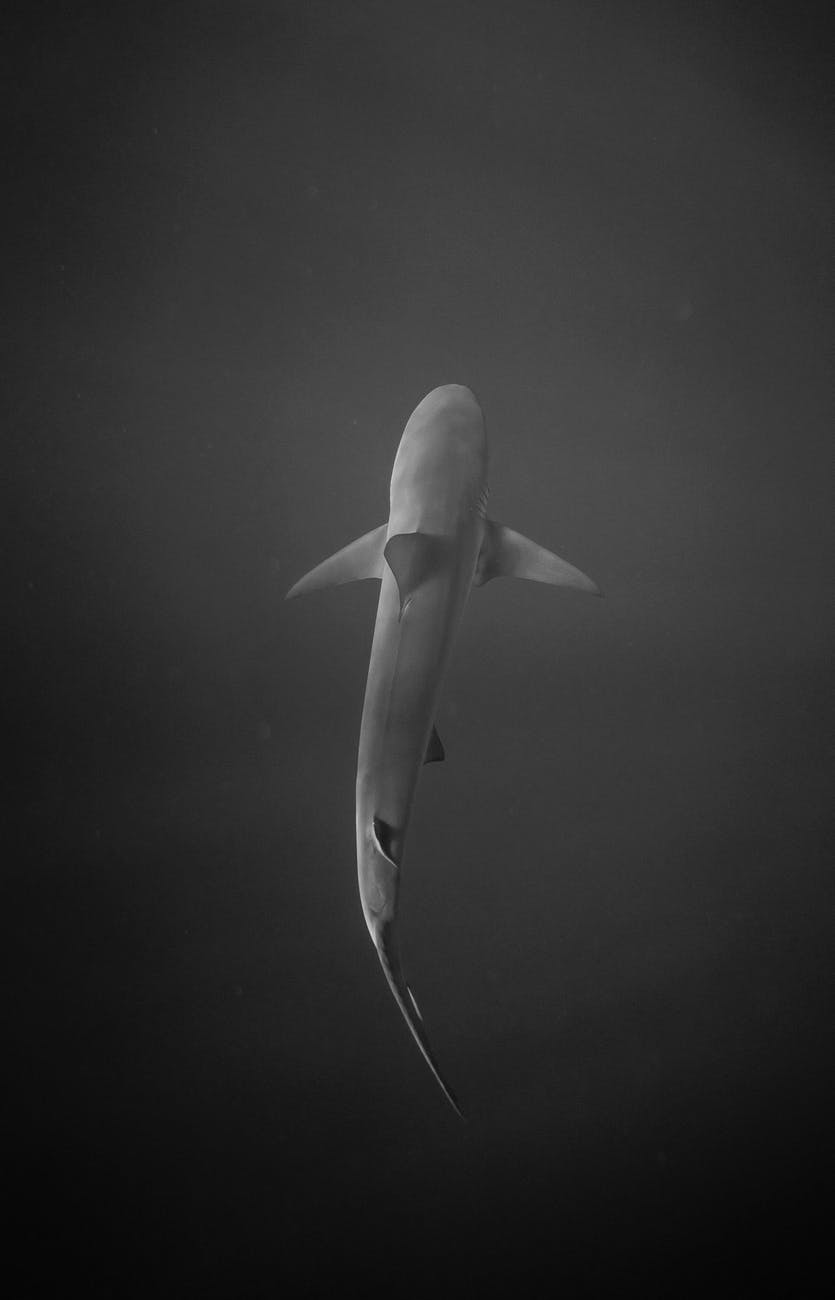
A dark shadow lifted off the sand and floated forward.

“Sting-ray!” she thought, and reached up to pull her goggles down over her eyes. They had seen several rays during their dives that week. She hoped this would be a spotted eagle ray. Velvety black beneath an ebullience of crisp white dots, the spotted eagle rays had been her favorites. She ducked below the surface.

And saw that it was not a spotted eagle ray.

It was not a ray of any kind.

It was a shark.

She had never seen a shark before. Of course she’d seen a shark before: in a movie, in an aquarium. But that was the sensation: I’ve never seen a shark before, but I know one when I see one, and that shape swaying through the not quite crystal-clear water, that is a shark. It felt primal: ancient, encoded, instinctive recognition of predator.

Read More

Landfall

By Jeremy Griffin

By the time Nicole arrives at the clinic, the parking lot is already full of folks waiting to drop off their pets before hightailing it out of town, out of the path of the hurricane. All morning she’s been battling that crampy twinge in her hand—dystonia, Dr. Epstein calls this, involuntary muscle contractions—and she hoped that she would be able to spend most of today hiding in her office. A foolish hope, considering that all of the pet-friendly hotels within a 100-mile radius have already sold out. Unlocking the front doors, she marshals a smile as the sleepy-eyed clients slump into the lobby with their cat carriers and their leashed dogs.

Inside, she leaves the receptionist to check everyone in while she goes around the building flicking on lights. In the kennel at the back of the building, she feeds and waters the dozen or so animals already boarding and begins taking the dogs outside one by one. Technically, this is a job for the assistants, but as owner Nicole takes a sheepish sort of pleasure in micromanaging. A canopy of clouds hangs low in the sky, the wind already churning ominously. By tomorrow afternoon, the rains will be here, thick and driving. Initial projections had the hurricane cutting west, into the Gulf of Mexico. Perhaps Nicole shouldn’t have been surprised when the projections abruptly shifted, the storm now expected to hook northeast, right through the Carolinas. That’s her life in a nutshell, isn’t it? A sudden change in trajectory, something to brace for. You’re just feeling sorry for yourself, her mother might scold, caustic old bird that she was, and she would be right. But her mother is long gone, and so who cares if Nicole is feeling a little morose this morning? It’s her clinic, she can feel whatever she wants.

She waits until all the other dogs have been walked before taking out the rottweiler that Animal Control dropped off yesterday. It was found near the airport, a scrawny female with patchy fur and a missing chunk of ear. Upon being hustled into the van, the animal bit one of the officers on the hand. “Fucker cost me three stitches,” the fellow said when he dropped the dog off, holding up his bandaged hand for Nicole to see.

Read More

Donna Was Not a Cat Person

By Halle Ruth

Featured Art: Chowder by Troy Goins

Donna forgot about the cat. She had promised to take care of it when her sister went on another one of her vacations. But the cat slipped to the bottom of Donna’s to-do list until he was barely hanging on, his presence barely noticed and left to his own devices, roaming her sister’s home on his lonesome. Donna did not want the cat staying in her own home, choosing to sacrifice the time it would take to drive to her sister’s to feed it every other day rather than let its fur coat her hardwood floors.  

She woke early that morning and decided to take advantage of the rare combination of a day off and unusually warm October weather to tackle the overgrown landscaping surrounding the house. At the beginning of summer, she paid a neighborhood kid to pull weeds and lay mulch, but the upkeep fell to her, and she hadn’t been particularly diligent about keeping the crab grass at bay. Her husband suggested hiring the kid again, but Donna refused. Everyone else in the neighborhood either cared for their yards themselves or hired professionals who drove around in logo-covered trucks that hauled riding lawnmowers, hedge trimmers, and leaf blowers. None of them cheaped out and hired a teenager to do a half-assed job to save a few dollars. It was embarrassing that they even hired him in the first place, like they couldn’t afford to do any better than that. Ella, who lived across the street, would have never done such a thing. Donna was sure of it.

Read More

The Problems of the Wild

by Abby Horowitz

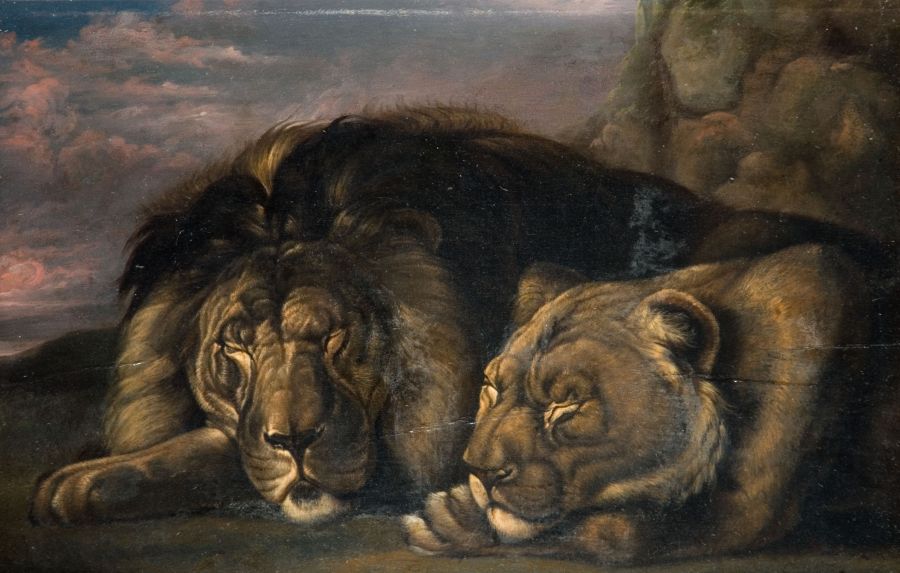
Featured Art: Sleeping Lion and Lioness by Samuel Raven

I am trying to tell Francine about the new babies in my life. They’re lions, baby lions, and they have fur the color of corn flakes and little ears that look straight off a teddy bear and they turn my heart right to butter. But here is the kicker: their mother is dead. Something weird must have happened when she birthed them because a little while later, they found her stretched out in the dirt up front by the viewing glass. The father lion was roaring on his big rock, with his mane standing on end, while the cubs were kneading their paws into the mother lion’s white underbelly and gnawing at her black teats. But no dice, that lioness would roar no more and now things do not look good for those little cubs. Because they’re not taking well to the fake milk they’re getting now or the plastic nipples they’re getting it from, and the father lion keeps pawing around with an evil  look on his face that is making the zoo staff nervous. Read More

Dune Cat

by Winnie Anderson

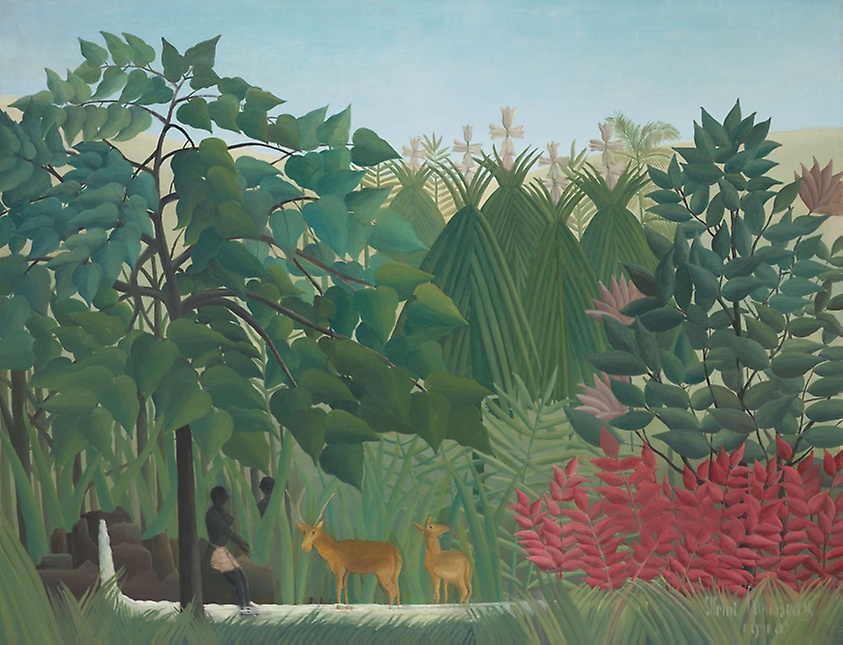
Featured Artwork: The Waterfall by Henri Rousseau 

Eons ago, during the Pleistocene Epoch, the jaguar left his home and traveled across the cold arid grassland: his resolve set. The floods were coming again. If he stayed, the land would either be covered with water or be broken into land pockets, from which there’d be no escape. The time was now. He had to go.

In him the jaguar carried echoes of history, tens of millions of years’ worth of heat spikes, ice ages, tectonic upheavals, and mega-explosions. Time swirled uniquely around him. He felt two trajectories at once—like a stone cast into the deep lake of time, sinking down to the bottom where all life may have begun, as well as the outward rippling cat’s paw upon its surface. History. Present. Future. All there, his for the grappling. Read More

Critical Insect Studies

by Tom Whalen

Featured art: Still Life with Poppy, Insects, and Reptiles by Otto Marseus van Schrieck

One more step and we are out of the circle and have entered the domain, equally delineated and autonomous, of a different species.
—Vladimir Nabokov, “Father’s Butterflies”

My wife departed on the day I began in earnest my Critical Insect Studies. Before this date, I had only jotted down a few thoughts and titles, cut and pasted a few class papers, nothing more, but I was sure, as much as I had ever been sure of anything, basking in my certainty like an oiled blonde in Cannes, that I had found, at age twenty-seven, the subject on whose wings my career would soar from campus to campus, lecture hall to lecture hall around the globe, sometimes Sam coming along, though increasingly, I imagined, taken up with his own concerns. Perhaps we would have had children by then, or new avatars, I didn’t know, or perhaps we would have drifted apart, he wanting nothing to do with me or my fame. Read More

In the Second Month of Parched Land

by Daiva Markelis

Featured art: Two Camels by John Frederick Lewis

We came across the camels every time we picnicked that merciless autumn, huge herds grazing on sparse vegetation. Camel comes from jamal, the Arabic root word for beauty. From a distance they did look lovely, their curvy silhouettes mimicking the contours of the dunes. Up close, however, they seemed slightly ridiculous, like bad female impersonators, batting their Scarlet O’Hara lashes to keep the sand out of their eyes, their long necks sloping towards us, then coyly withdrawing. Read More

Coyotes

By Terri Leker
Winner of the 2019 New Ohio Review Fiction Contest, selected by Claire Vaye Watkins

The coyotes moved into the woods behind my house just after I learned I was pregnant. On a quiet June morning, while my husband slept, I pulled on my running shoes and grabbed a leash from a hook at the back door. Jute danced around my feet on her pipe-cleaner legs, whining with impatience. It would have taken more than this to wake Matt, but I hushed her complaints with a raised finger and we slipped outside. A light breeze blew the native grasses into brown and golden waves as we wandered, camouflaging Jute’s compact frame. She sniffed the dirt, ears telescoping as though she were asking a question. When we reached a shady thicket of red madrones and live oaks, I unclipped the leash and wound it around my wrist.

It was over with Richard, had been since I’d found out about the baby. Anyway, I had come to believe that adultery sounded more illicit than it actually was. Between managing my schedule with Matt and making time to rendezvous with Richard, an affair often seemed more about time management than sexual gratification. I was meticulous with the calendar, but I would have known that the baby was Matt’s regardless, because Richard’s sperm could not locomote. He had told me so early on, while showing me the master bedroom of his faithfully restored North Oakland Victorian. His unexpected disclosure had interrupted my admiration of the exposed brick walls, so unusual for the earthquake-conscious Bay Area. Matt was having dinner just then with friends, thinking I was helping my mother set up her new television (she would be dead within a few months, but we all pretended to be optimists then), so he was eating eggplant parmesan at the Saturn Café as I lay with Richard on his king-sized bed, hearing words like motility and capacitation. Richard’s sober tone had suggested that I might comfort him in his sterility, which I did, if the definition of comfort was a passionate encounter that lasted as long as one might spend unboxing a 48-inch HDTV and connecting it to both Netflix and Hulu. But Matt and I had tried to have a baby for three years, so I took the pregnancy as a sign to recommit myself to my husband, who, predictably, jumped up and down on our unmade bed when I shared the news, attempting, in his white-socked excitement, to pull me up with him, not realizing that doing so might judder the bundle of cells loose, delivering me back to Richard and a childless but aesthetically pleasing life.

Read More

Soda Money

By Emily Johns-O’Leary

Featured Art: Little Walter’s Toys, 1912 by August Macke

Edison was allowed to spend one-third of his monthly spending money on manatee merchandise, but it usually came to about half. His mother was a marine biologist, and Edison had seen a photograph in one of her magazines when he was six and couldn’t stop looking at the manatee’s bloated snout and flippers like gray oven mitts pinned to the balloon of its body. He was thirty-one now and bought his own nature magazines to look for more pictures, more patient expressions on the floating creatures. Their eyes seemed to want to listen only to him.

He woke early on a Thursday worried about his spending money. He moved Harold’s plush tail and found his phone beneath an umbrella his father had given him. Edison paused to close and open the umbrella, watching the manatee’s face crumple and smooth. Ten years earlier, when his parents said he should have more independence, when his case manager found a retired woman on the other side of San Diego whose client with special needs had moved out of her basement room, they encouraged him not to decorate the walls like his childhood bedroom. “You’re grown up now, Eddy,” his mother said, and his father—so rarely in the same room as his mother and stepdad— nodded and squeezed his shoulder. But Edison had been up all night thinking about moving out of his parents’ house, just like his high school classmates. He was certainly going to decorate the room with manatees.

Read More

Flight Lessons

By Barbara Ganley

Featured Art: “Holy Holy Holy” by Yan Sun

Because it’s Thursday, nearing five o’clock, Lucie is well into a doozie of a headache. Every week at this time little Jenny Baker hands her one as they sit side by side in the dining room and Jenny busily tortures the piano. She’s a narrow slip of a thing with a distracting, gum-baring smile made stranger today by a drift of tiny metallic stars sweeping across her cheeks like cosmic freckles.

Her orange high tops smack the stool’s taloned feet bapbap as she bludgeons the keys in an apparent heavy-metal version of “Long Long Ago.”

The piano, old and patient, takes it. Lucie, who is neither of those things, says, “A bit slower and softer now. See if you can find the melancholy.”

She uses her hands to play a phantom keyboard floating in the air. She must look ridiculous. “Sing the words if you like. I find that helps.” She is ridiculous.

Jenny, clearly having the same thought, grins at the keys, speeds up and hammers away. She doesn’t sing. She never sings.

What ten-year-old doesn’t sing?

But of course Lucie is confusing children with birds, Jenny with Bacchus, her grandfather’s sidekick and belter of sea shanty and Broadway schmaltz. Since moving back home, she has learned far more about thirty-year-old African grey parrots than about ten-year-old humans. Prefers them, too, if truth be told, even if they do bite. Lucie understands that people would find that small of her. But this ten-year-old human next to her couldn’t care less. A look of near madness flashes across the girl’s starry face. Her thin hair switches about her neck like an agitated tail. She’s seeing herself onstage, adoring fans at her feet. Next she’ll be peeling the stars from her face and tossing them to the crowd.

Read More

Slutty Rush

By Frankie Barnet

All throughout my girlhood it was my primary ambition to be as dumb as possible. My father was a professor of mathematics who attempted to teach me algebra at age nine and preached discipline and rationality above all else. My mother was a reform Hutterite who cut her own hair. He once bought her a Costco membership for Christmas and she went only once, finding the experience gluttonous.

I had a best friend in this youth, a girl named Kelly who lived down the block. At her home I tried many foods for the first time: sushi, avocado, specialty cheese. I once saw her parents dancing without any music playing on my way to the bathroom while she and I watched It Takes Two in the basement.

Yet still, despite these differences in our home lives, Kelly shared my dream: to be weightless from a lack of knowledge. To float up and up and up. Away and free.

Our favorite thing to do together was to play a game in which we imitated two girls from our grade at school who were so dumb it was impossible. Their names were Stacey and Sasha. In addition to being idiots they were also sluts, a not uncommon pairing Kelly and I both coveted. “Like, totally,” we’d say, pretending to be them. “Like, oh my gaaaawd.” “Like, like, literally like.”

During the summer between ninth and tenth grade, Kelly and I walked through the river valley playing our game (“So oh my God, what did you, like, do last night?” “So I like literally boned Matt G. soooo bad!”) when we spotted an injured rabbit just off the path and decided to pick it up. Dumb, right? Just the kind of thing we, as them, loved to do.

“He could be, like, our baby.”

“Let’s take him home, like, literally.”

“Oh my God, because I’m pregnant, like, from boning all the time.”

“Totally pregnant, and I don’t literally know who did it to me.”

Read More

Ye Are of More Value than Many Sparrows

By Elton Glaser

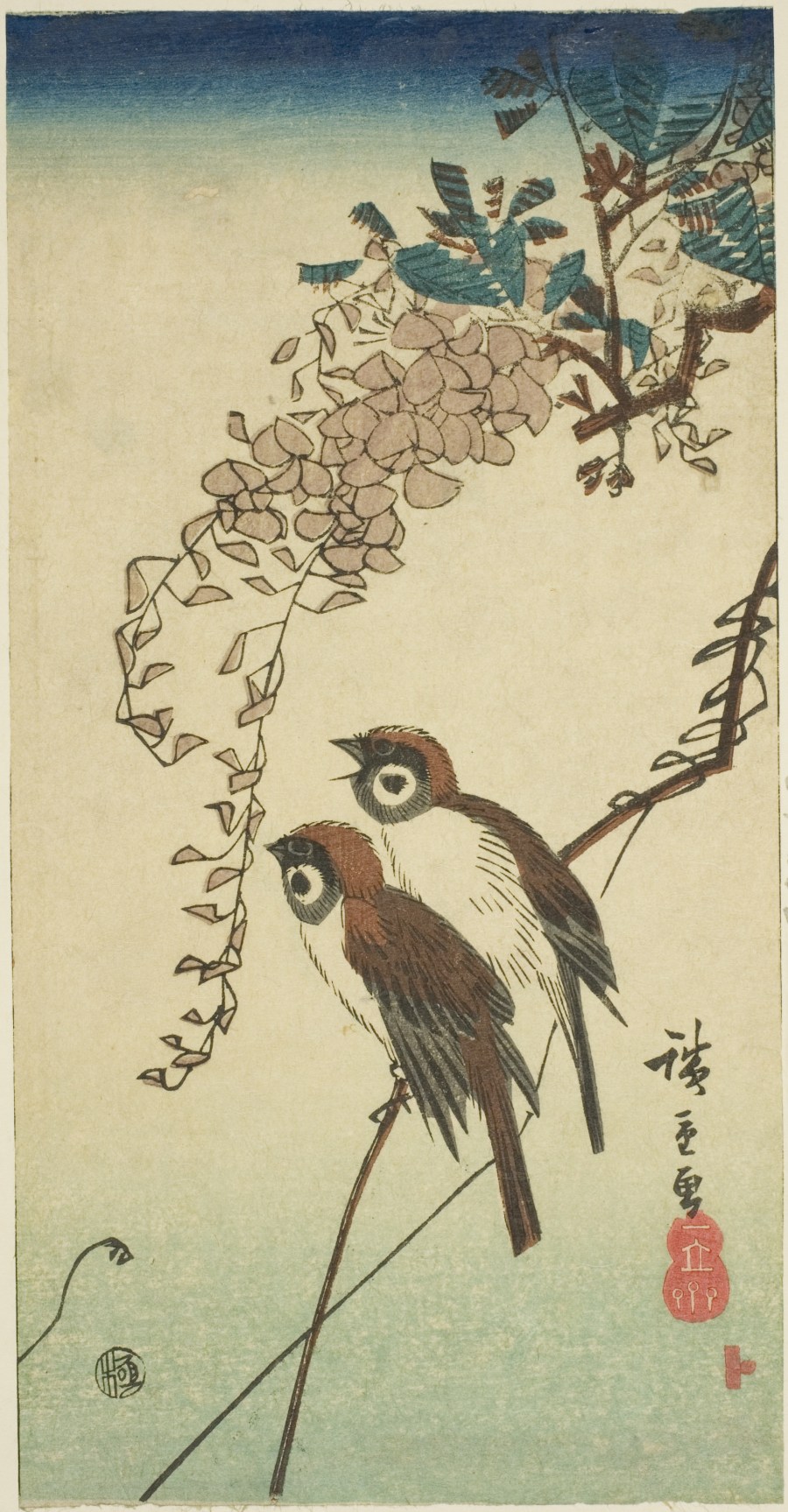
Featured Art: Sparrows and wisteria by Utagawa Hiroshige

Luke 12:7

How many sparrows are enough? I can’t tell
If there are more this afternoon than yesterday.

And if there’s one missing, or two, or eight,
What does it matter? All I know is

They are not so many since I took the feeders down
After your death. They came for the seeds

Your kind hands set out. I give them nothing.
Now, if they come, they come only

For reasons of their own, these quick birds
Dowdy in their grays and browns, and leave behind

That whistle and trill, or the echo of it,
Singing not for me, but for the moment’s pleasure

Of lifting their wings in warm air, alive
To the light. And in their easy glide and sweep,

Oblivious of anything but song, I find myself
A listener outside the choir, and still

Inside those memories of the missing kindness
That drew them here, however many, however few.


Read More

Delectable Hazards at the Animal Dive

By Michael Chaney

By the time the cow set down the samosas, covering the spot where he’d earlier hooved his name, Fox seemed different to Pig.

“Simply marvelous,” Pig said with an air, trying to play it off.

Fox coughed. “May I have more water?” Annoyance puckered her auburn snout.

“Not a problem,” said the cow. “Mind if I brag about our wines?”

“Please do, darling.” Fox had a lovey-dovey way of talking. To Pig, she was not so different from the elegant junk in herringbone patterns on the walls: bugles, radios, troughs, collars, toys, and white puffy gloves. Read More

Delectable Hazards at the Animal Dive

By Michael Chaney

Featured Art: Chinese painting featuring two birds on a flowering tree branch

By the time the cow set down the samosas, covering the spot where he’d earlier hooved his name, Fox seemed different to Pig.

“Simply marvelous,” Pig said with an air, trying to play it off.

Fox coughed. “May I have more water?” Annoyance puckered her auburn snout.

“Not a problem,” said the cow. “Mind if I brag about our wines?”

“Please do, darling.” Fox had a lovey-dovey way of talking. To Pig, she was not so different from the elegant junk in herringbone patterns on the walls: bugles, radios, troughs, collars, toys, and white puffy gloves.

“I don’t drink,” Fox said, touching the waiter’s hoof. It was gentle. His bell never so much as whispered as she did it. Anyone else would have gotten a bray from all four of his stomachs, Pig was thinking, distracted by the samosas. Their crispy folds smuggled the aroma of mudzhki, the kind Pig’s grandsow used to make with cabbage and sweet layings. Read More

Dune Cat

By Winnie Anderson

Featured Art: by Oliver Goldsmith

Eons ago, during the Pleistocene Epoch, the jaguar left his home and traveled across the cold arid grassland: his resolve set. The floods were coming again. If he stayed, the land would either be covered with water or be broken into land pockets, from which there’d be no escape. The time was now. He had to go.

In him the jaguar carried echoes of history, tens of millions of years’ worth of heat spikes, ice ages, tectonic upheavals, and mega-explosions. Time swirled uniquely around him. He felt two trajectories at once—like a stone cast into the deep lake of time, sinking down to the bottom where all life may have begun, as well as the outward rippling cat’s paw upon its surface. History. Present. Future. All there, his for the grappling.

Alone he headed south: crossing over what one day would be named the Bering land bridge. Well-suited to the task, weighing close to 400 pounds, the norm then, he ran through a dense mantle of cold and silence. In the morning light his rust-colored coat appeared red, broken only by dotted circular cave-black rosettes. The travel was hard, but the jaguar came into it, growing stronger as he went—proof he’d done the right thing by giving his instinct its due.

After months of traveling, and though he was not cold, his body began to shiver. Prescience told him change was imminent seconds before a rogue wind thrust the jaguar into a zigzag shudder of time, as if the stone sinking deep into the lake had jerked off course and suddenly crabbed sideways. Calling on everything he had by stirring up wells of power contained within him, the jaguar fought against this unknown force he could not fathom.

Read More

A Creature, Stirring

Winner, New Ohio Review Nonfiction Contest
selected by Elena Passarello

By Gail Griffin

Featured Art: The Kitchen by James McNeill Whistler, 1858

It is Christmas night—or, more accurately, two in the morning of December 26th. I am on the small porch at the side of my house. My cat is in my lap. The door to the living room is closed. Every window inside the house is wide open, because the house is full of smoke—a vile, stinky smoke. The porch is winterized, but I have opened one window about six inches because of the smoke escaping from the house. And what I am saying to myself is Well, at least the temperature’s up in the twenties.

The cat is unusually docile. He knows that something fairly strange is going on, and he is cold. I murmur to him that we’ll be all right, over and over. With sudden, crystalline clarity I know that I am absolutely alone in the universe, except for this small animal.

Will it reassure you or just make the whole scene weirder if I tell you that the smoke is from burnt cat food?

Read More

In the Second Month of Parched Land

By Daiva Markelis

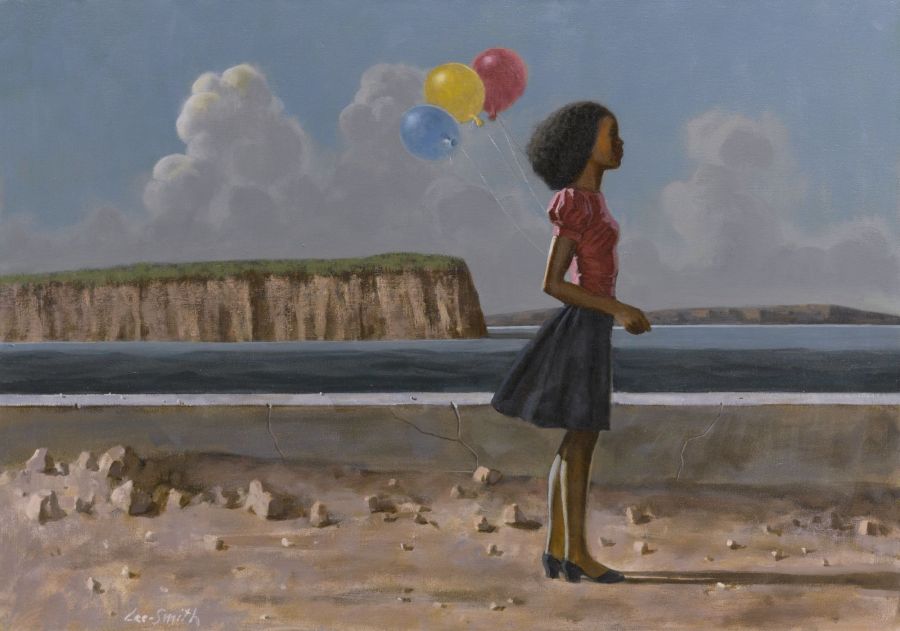
Featured Art: Stroll with Balloons by Hughie Lee Smith

We came across the camels every time we picnicked that merciless autumn, huge herds grazing on sparse vegetation. Camel comes from jamal, the Arabic root word for beauty. From a distance they did look lovely, their curvy silhouettes mimicking the contours of the dunes. Up close, however, they seemed slightly ridiculous, like bad female impersonators, batting their Scarlett O’Hara lashes to keep the sand out of their eyes, their long necks sloping toward us, then coyly withdrawing.

That we saw them so near the city surprised us. We’d heard stories of naive Westerners who’d driven for hours looking for adventure—for camels—and then stopped to explore the landscape with their pitifully small water bottles, supplemented, in some cases, by flasks of 100-proof siddiqi. Some were lost in the Empty Quarter, the largest desert in the world, never to be heard from again. I wrote a friend: If I were to start a literary journal here, I’d call it The Empty Quarterly.

Sometimes we’d see a row of black tents with goats tethered to a nearby post. Once, an old Bedouin waved a gnarled hand back and forth like a weathered stick. I thought we were in trouble, trespassing on his property, but as he ambled closer all he said, in a slow, proud English, was “See my camels.” He invited my husband into the largest of the tents. I waited in the air-conditioned Mazda, fiddling with the radio. Masculine voices jabbered in endless variations of the little Arabic I knew: Assalamu alaikum wa rahmatullah, Allah akbar, Inshalla. The sounds seemed to emanate from deep down the throat, a rush of rough and phlegmy h’s, a conspiracy of k’s.

Read More

Crow

By William Kelley Woolfitt

I’ve been told Crow’s story so many times I remember it better than my own memories. It was my bedtime, naptime, and story-time story. I think my parents told it to each other too, in whispers, in each other’s arms, striped with moonlight coming in through the blinds, too tired to say anything new.

There was a storm the night my parents drove me home from the hospital. I was a few hours old. Mother says that the rain was too fast for the windshield wipers, that Father pulled over three times. Father says that Mother sat in the backseat and held me the whole way. When we got home, we had to wait almost an hour for the rain to die down. Father found some jazz on the radio, climbed into the back to be with Mother and me. That was the first time he held me. Mother fell asleep, and dreamed she was a passenger in a boat.

Wind toppled the elm in our front yard, though later on some neighbors claimed it had been hit by lightning. It just missed our house. One branch scratched our bedroom window. Crows spent the night on our porch, their nest in the elm ruined.

Mrs. Yamato across the street saw the crows on our porch swing, screamed and dropped her chopsticks. An omen of death, she thought. She came running over with a broom. All the crows flew away, except a baby. Father put the baby crow in a shoebox and thanked Mrs. Yamato for her concern. Mother went into the yard, walked around the fallen elm and its jagged stump, poked into the fallen nests and found shiny things: bottle caps, bits of tinfoil, Father’s screwdriver, her own gold pendant necklace.

Read More

The Swans

By Anamyn Turowski

Featured Image: “Woman with a Butterfly at a Pond with Two Swans” by Jan Toorop

She bought the swans because of the empty pond. Lonely; that’s why, really. She saw two swans in profile in a poultry magazine she’d picked up at the dentist’s. She paid $1500 for a pair. As if swans could change anything. Her husband says she needs birds like she needs a hole in her head. A lobotomy, she thinks, that’s what I need. Every time she stares out the window toward the pond, the empty water makes her cry. She charged the pair on a new credit card that came in the mail that day. What’s the interest on that card? You never read the fine print.

She isn’t the sexiest wife. She’s aware of this. Since the operation he hasn’t touched her. That was three years ago. They’ve the house and the dog and their two grown children who call on birthdays, Christmas.

Read More

Queenie

by Jeff W. Bens

Feature image: Johann Christian Reinhart. Lying Goat, from Die Zweite Thierfolge, 1800. The Art Institute of Chicago.

Dr. Frank Shire had never been down to Athlone before, hadn’t been back to Ireland to see the Kennelly brothers in the decade since he’d finished his fellowship at the University College of Animal Surgery, had seen them just the one time when they’d visited New York. The only American at the Fisherman’s Rest, the only American in all of Athlone for all he knew at that time of year, November, in the wet cold, driven straight to their father’s fisherman’s hotel by the Kennellys before he’d even had a chance to eat breakfast after the all-night flight to Shannon from JFK.

“She may be dying,” is all Robbie K said.

His brother Michael added, “She may be dead.”

Read More

The Last Litter

By Melissa Cistaro

Featured Image: Sunset by Edward Mitchell Bannister 1883

1975

It’s a nice place to visit my mom, a lot better than the last one. I get to stay for almost a week and even be here for my tenth birthday. There’s a bed with a blue quilt, a shelf piled high with boxes of puzzles and the scent of my mom’s L’Air du Temps perfume drifting down the hallway. She lives on this dairy farm with 180 cows and her new boyfriend, Roger Short. One of the first things she mentioned about Roger is that he’s colorblind. She says he can’t see how horrible the wall-to-wall chartreuse carpet looks in his house—in fact he can’t see the color green at all. I think that’s a shame, because there are green fields like patchwork for miles around his farm. But then again, I suppose that being colorblind is just fine for Roger since he only raises black-and-white cows.

Read More