Zenyatta

By Grady Chambers

Featured Art: French Knight, 14th Century, by Paul Mercuri

              Breeders’ Cup, November 2010

In a different life she wins.
In a different November in Kentucky she leans
into the last curve of the brown-combed track
as she passes the thick of the field. In that one,
in a bar far away, in our lucky coats
and muddy white sneakers, we rise
with the televised crowd as she quickens
at the flick of the jockey, as the grandstand churns
at the distance beginning to close, as the line comes closer.

And we know it as her rider leans forward,
as Zenyatta knows it in her legs
as the horse before her turns
and knows it’s over, the brown mane flying by
in a whip of color and dust, as the stands become a flicker
of white tickets, as her name is spoken skyward like a chant.

Read More

A Brief History of Hunger

By Mary Jo Firth Gillett

Up from the mire of the primordial soup
came one-celled, tiny cavernous bits
whose innards knew a hollow ache only cured
when their shape-shifting borders engulfed
smaller bits, and came a world more complicated,
the paramecium with its oral groove,
the surprising planaria—nick its frontispiece
and the split becomes two hungry heads!—
then came, as ever, competition begetting variation,
to move or not to move, that was the question—
whether it was more propitious to see
with eyes multitudinous or on stalks or both,
whether it was better to be safely anchored,
waiting in camouflage, or to mount an assault,
evolution’s choices simple, almost biblical—seek
and ye shall find or lurk with bait in the hope that all
will come to him who waits, and then came
specialized beaks and teeth, fanciful horns
and coloration prompting procreation,
as well as a multitude of eating adaptations—
the water bird’s fused nostrils, air sacs in head and neck
to absorb impact as the feathered darts, pillaging
angels, plummet—and came homo sapiens with a myriad
of tastes and ways to cook—sear and braise, sauté
and soufflé, pickle and brine—came table manners, the urge
to gorge, to purge, came sorbet and gourmet, foods
delectable and indigestible, epicurean delights, food fights,
and all the ravenous mouths of tomorrow and tomorrow.


Read More

Florida Man Throws Alligator into Wendy’s Drive-Thru Window

By Mitchell Jacobs

Featured Art: Alligators by John Singer Sargent

The attendant hands him a soda and turns her back, thinking
of straws—how she’s running low, and their candy-red stripes,
and the way everything here comes wrapped up in paper, and

then a 3½-foot alligator is clawing the air.
                                                                          As if she pressed
the wrong button on the register. Or maybe, during lunch rush,
she’d ignored an oncoming hurricane tossing them about.

In any case, she shrieks, finding for this alligator non sequitur
no earthly explanation. Back when the heavens functioned
with less subtlety, she might have turned to the logic of myth.

The god of rapacity took the shape of a lizard
to penetrate the food hall’s oil-glossed aperture.

Perhaps the oracle of Jupiter, FL on his faux-leather throne
delivers this cold-blooded message to confront corporate greed
teeth to teeth.
                        Not that the police have succeeded

in extracting a motive. The culprit’s Frosty-smeared lips are sealed.
His charge: assault with a deadly weapon. Yet it rings untrue.
For Florida Man, we need a more particular punishment:

accused of wielding a projectile reptile,
the defendant shall be flung naked
into the Loxahatchee Slough.

If indeed he is a criminal, there will be no proper dunking.
If he is a hero, he will don no duckweed laurel as he rises
from the mud. But the surveillance camera remembers:

it’s not so wide, the gap between the actual and the possible.
About the space from Nissan Frontier to take-out window
where an alligator, bewildered, sees the kitchen’s steam

like fog over a marsh in red bloom, smells the billows
of meaty fragrance, hears the gatekeeper’s yodel of welcome,
and for a moment
                                 flies.


Read More

Parrots Over Suburbia

By Craig van Rooyen

Featured Art: by McGill Library

There are two,
as if some ark came to rest
on the high school football field
and Noah flung them through an open window
to test whether this cement-skinned town
can sustain life.
See them there, trimming
lava-dipped wings in the sky above Costco,
bills curved like question marks.
And what do they ask, out of earshot
of the man with sunflower seeds?
Do you know what it means
to circle, to draw and redraw the tightening
circumference of your life
above the grid of 50-year roofs,
in steak smoke risen from backyard barbecues?
The parrots’ owner is no prophet.
Summer evenings, he wrenches
on a ’67 Mustang that drips its innards
onto his Avenue L driveway.
And at dusk, he makes his arm a perch,
takes the two from their cage,
feeds them from his lips, knowing
if they love him he need not maim their wings.
So they fly in circles
and on every pass above the fenced playground,
swoop near to watch the girl in high-tops and earbuds
swinging, head thrown back to reveal
her pale and wild throat.


Read More

My Mother’s Dogs

By Sandy Gingras

Featured Art: Three Dogs Fighting by Antonio Tempesta

They are big and smelly and mean,
and they’re living in her basement.
I think they are dogs, but they might be wolves.
Eight or eighteen of them, something like that.
They all would bite me if I gave them
the chance, so I’m really careful
when I herd them out into the yard.
What is it with my mother?
Most families just have pets—usually one dog
and a cat, nothing like this. How
did she let this happen to her?

She’s living in some decrepit house now on Rt. 9
in the next town over and she’s evidently lost
her taste in furniture. Everything is gold
with rickety legs. She and I watch
the dogs patrol around the yard
from behind a glass sliding door. My mother is angry
now that she’s old, and I think that maybe
she and the dogs deserve each other, but
I can tell that my mother is scared too,
and I want to help her out because
I’m the problem-solver in our family.

The dogs don’t play like normal dogs,
they just move around the yard
like big bullet-headed missiles. We have to get rid
of them somehow, I tell my mother who is
suddenly smaller than she was, and then I hold her
in my arms and she’s a little girl. Whatever you do,
don’t let them in, I whisper, but
she’s already dead of lung cancer.


Read More

Catpants

By Richard Allen

Featured Art: The cat at play, c.1860-1878 by Henriëtte Ronner

dead cat on the shoulder
my heart aches for a moment
until I realize it is only
a balled-up pair of sweatpants

why would I feel compassion
were it a cat lying dead there
and not a balled-up
pair of sweatpants

I think it is because
cats are defenseless
and innocent then
I re-evaluate

they are neither
the average housecat
has injured several people
in its short life

just for laughs
the person who had to throw
his sweatpants out the window
a moment’s thought for him

for his sweatpants
and for the sad conflict
that must have unfolded
between them


Read More

Detective Story

By James Lineberger

Featured Art: by sir Edwin Landseer

When I worked as a janitor at the courthouse
I met a detective in the Sheriff’s department
whose son, I learned, had committed suicide
some months earlier. Having lost a son myself
in a car-train collision, I tried to offer my condolences.
“Your boy kill himself?” the detective asked bluntly.
“We never knew,” I replied. The detective grunted
noncommittally and opened his desk drawer to take out
a photo of his son, a young man in his twenties, kneeling
and embracing a dog as he grinned for the camera.
“Two days before it happened,” the detective said.
“About the same age as our son,” I said.
The detective stared at the photo for a moment.
“You got a dog?” he asked.
“Two,” I said.
“Thing about a dog,” he said, “a person can screw up
a hundred ways, and his dog will love him when he can’t
even love his self.”
“Our son’s dog still sleeps at the foot of his bed,” I said.
The detective turned the photograph over on its face
and glanced up at me, his eyes as cold as stars.
“Ain’t his dog,” he said. “It’s mine.”


Read More

Black Ants

By Fay Dillof

Featured Art: Crumpled and Withered Leaf Edge Mimicking Caterpillar (study for book Concealing Coloration in the Animal Kingdom) by Emma Beach Thayer

Unable to sleep,
I imagine a blob
of ants, erupting
from a faucet.

If they puddle,
that will mean sleep.

But if each ant
descends on a crumb,
steals what it can
and lumbers robotically off,
which they do,
branching in veins across the tile floor,
then I’m left
listening to the sound
of my two sisters
downstairs
in the summer kitchen
where they’re making
my mother laugh
without me
again,
carrying their prize
over invisible trails.


Read More

Talking to My Dead Mother About Dogs

By Stephanie Gangi

Featured Art: Dog with pups by India, Rajasthan, Ajmer, probably Sawar school

          That damn dog.
Which one, Ma?
          The first one.
There is no first one, there was always a dog, Ma.
          The shepherd, the one who kept the baby
          from rolling in to the road down the hill in front of the house.
That was me, Ma. I was the baby.
          I know that. Rex. Rex.
          And what about your father’s, who jumped
          out the car window at a toll booth, headed for the hills. Skippy,
          ungrateful mutt.
          Then we got Duchess, because of Lassie on television.
          Duchess was weak. Duchess didn’t last.
          The toy poodle came in a hat box. She matched the décor!
          I swear to god, she did.

Your chateau phase.
          What about your dogs?
My dogs? My dogs, Ma?
The fear biter who darted in the dark at the ankles of my bad choices?
The herder who swam himself spent, circling me circling me when I was at sea?
The too-happy dog, who I couldn’t keep, I forget why?
Now this one, the big one, this horse of a dog who braces himself
so I can stand? Who, the slower I go, the stronger he gets?
Who can’t rest until I rest? This dog, Ma?
This last one? Ma?


Read More

Gray Whale

By Sally Bliumis-Dunn

Featured Art: Submarine Series Introductory Lithograph by Eric Ravilious

When they read the metal tag
on her pectoral fin—
a surprise of dark Cyrillic letters

on this Gray Whale
who had swum some fourteen thousand miles,
inter-braiding continent

with continent—
strange that I think of you now, father
though you too had lived

mostly below a surface,
the breadth of which we could not know—

until they read her tag,
the cetologists had thought
the gray whales off the coast of Baja

were of a different species
from the ones in Minsk.

When I found your lacquer boxes,
so small they fit into my hand,
with their depictions of our home,

the pots above the stove,
their odd discolorations,
the cheerful curtained window

that looked out at the pines,
I felt sad I had not known your heart
would swim such distance for us—

you had never shown us one.
And how small you had to make yourself
to see each scene and paint it

like an ant stepping carefully along
one of those dark passages
in its hill of dirt that nobody sees inside.


Read More

A Theory of Violence

By Jennifer Perrine

Selected as runner-up of the 2014 New Ohio Review Poetry Contest by Alan Shapiro

In the museum of sex, the video loops
its cycle of common bonobo behavior:
penis fencing, genital rubbing, whole groups

engaged in frenzied pairs, their grinds and shrieks
playing for the edification of each patron
passing through the room. We all summon

our best poker faces. One woman speaks
softly, reads from the sign that describes
all the various partner combinations,

the multitude of positions, how relations
lower aggression, increase bonding within tribes.
We linger over this way of making peace,

wonder to each other if we would cease
our litany of guns, bombs, missile strikes
if we spent more time in wild embrace.

The exhibit doesn’t mention our other cousins,
chimpanzees, who form border patrols, chase
strangers in their midst, leave mangled bodies as lessons.
That’s the story we already know

and want to forget through the release
of these erotic halls, where we seek the thrill, the bliss

of these animals who hold us captive
while we lament what traits we’ve found adaptive.


Read More

Bobcat

By Mikko Harvey

Featured Art: Forest by Werner Drewes

Walking through the woods / at midnight / we were on our way / to the pond / where we
would skinny dip / when two yellow eyes / appeared on the path / we froze / they didn’t
blink or move / the body was / hidden by the dark / there was something / sinister in its
stillness / we turned back / you said it was probably / a bobcat / but better not / to take
that chance / we shared a bed / untouching as usual / you fell / asleep first and I wondered
what kept us / apart really / that night / and the others / the distance between us / maybe six
inches / felt like a shadow / I couldn’t step out of / my two open eyes / the only light
in the room / I thought of the animal / blocking our path / and it occurred to me / she was
only a hostess / welcoming us / to the world of risk / smooth and lovely / water hugging
your naked body / the animal said / are you ready / but we walked away / I had an urge
to shake your body / awake and take you back / to the animal and say / confidently yes
table for two / but instead I just lay there / in the perfect / quiet / country / darkness / and
imagined the outline / of your chest rising / and falling / rising / and falling as you slept.


Read More

If You See Something

By Billy Collins

Featured Art: Dove in Flight by Pablo Picasso

On my morning walk along a cinder path
that follows the shore of a lake,
I saw a good-size, solitary rabbit,

seven mourning doves who rose to the top of a fence
at my approach,

two anhingas, one drying his extended wings
like a pope on a balcony,
the other not doing anything at all,

also, a loud bird who refused to identify himself,

then ten young ducks in a huddle
by the vegetation near the water,
some sleeping, others preening their feathers,
all not quite old enough to be on their own,

oh, and a squirrel who headed up a tree
when he heard me coming down the path.

Read More

The Ideal Budweiser Customer Watches a Budweiser Commercial

By Danny Caine

Featured Art: Drugs by Richard Estes

Oh shit I love “Landslide.”
I was going to get up to piss but then I heard me some Fleetwood Mac.
Hey that’s a pretty farm, too. Farms are dope.
Wait, oh goddamn it it’s a baby horse lying in some fucking sawdust.

That baby horse is so cute I can’t even handle it right now.
I am literally unsure how to proceed.
And now the horse is being fed from a bottle?
The hell am I supposed to do with that?

Dammit now the horse and the dude are playing and stuff.
Fuck me if I don’t love a playful goddamn horse.
Look! A Budweiser truck. Budweiser!

I should like this brand on Facebook.
I should follow this brand on Twitter.
I really should make an effort to engage
with this brand on social media.

Wait, that’s a horse trailer. And our dude
is shaking hands with the driver? Is he—

DUDE YOU CAN’T SELL THAT FUCKING HORSE!

YOU’RE GOING TO MISS HIM SO MUCH!

Somebody get me a Budweiser.


Read More

At a Pet Shop

By Tom Whalen

Featured Art: Red Parrot on the Branch of a Tree by Ito Jakuchu

When the parrot took the cracker I offered, it said:

“Thank you, my friend. You’re the first person to give me anything to eat in decades. There is no a priori order of things. I thought I had been living the good life, but what did I know? The poet fell sick, traveled to the capital, needed words, painted his curtains bright green. A sumptuous village girl threatened me with a cheap lighter. Night after night watching the corpses of rodents turn to bone. I remember when my mother took me to the city, remember how her perfume gave me a high. After that it took me years to find a mate. Night work. Elocution lessons. A treatise on Gorgias’ Encomium of Helen. I kept to the plan I started with. Death is not an experience, food is.”

Then it fell from its perch with a thump, and from its beak an ant exited soaked in the parrot’s blood.


Read More

2 Fuzzy Bees

By Maura Stanton

Featured Art: A Gentleman Who Wanted to Study the Habits of Bees too Closely, plate 6 from Pastorales by Honoré Victorin Daumier

“La créateur est pessimiste, la création ambitieuse,
donc optimiste.” —René Char

Because I feared I’d only make a mess
Sticking yellow pom-poms onto black ones,
Or bungle wings as I tried to shape the white
Pipe-cleaners into an outline of flight,
I never opened this kit I got one Christmas
In my stocking—a joke from my sister:
Create A Critter. Since I’m cleaning house
I could throw it away. But all I need
To make 2 Fuzzy Bees are glue and scissors.
Everything’s here—the velvet-tipped feelers,
Button noses, and eyes with moving pupils.
Ages 6 and Up—well, that’s me, isn’t it?
And as an Adult, too, I can Supervise
Myself. So why do I still hesitate?
If I make a bad bee I can toss it out.
Look at this package. The cellophane’s intact,
Directions printed on the cardboard backing.
Even the little loose eyes seem to twinkle
Inviting me to stick them to the heads
Where they belong. Yes, they’re Choking Hazards,
But I’m alone right now, no cats or babies,
And the dining room table is cleared of junk.
And so I do it. Soon my Fuzzy Bees
Are finished, bouncing on their wire legs,
Looking up at me, cute as their photos,
Ready to begin their lives as . . . what?
What have I done? I’ve given them existence.
Their wings will never lift them to the sky,
Their red noses will never scent a rose,
But look at them! Ambitious, optimistic.


Read More

The Circus Lion’s Lament

By Michael Derrick Hudson

Featured Art: Circus Clown and Dancer by Marc Chagall

So what happened? I used to be a lion, crashing
the herd and yanking down stampeding

zebras on the hoof. Days spent pissing hot gold

across the Serengeti! The ground gone tawny
with my scat! Those long afternoons

of fly-blown torpor, those gristly jawfuls of prey

and those after-fuck yawns. At night, snoozing
into my paws, I’d twitch and thump

the muscular scourge of my dreaming tail . . .

But Emily the Elephant jerks my chain, suggests
my ferocious howls lack plausibility

or conviction. O how I howl! I can rend the air

with lost prerogatives! Demolish the audience
with has-been imperium! I worry

and tooth the Ringmaster’s splintery stool. Dolts

applaud. Clowns in a jalopy lampoon
terror, hitched to their posse of sidekick knuckle-

draggers waddling away in diapers and tuxedos . . .

Come night, I’ll sniff the corners for what’s left
of my petrified stink, the proof

I somehow still exist. Breakfast’s tossed in at six.


Read More
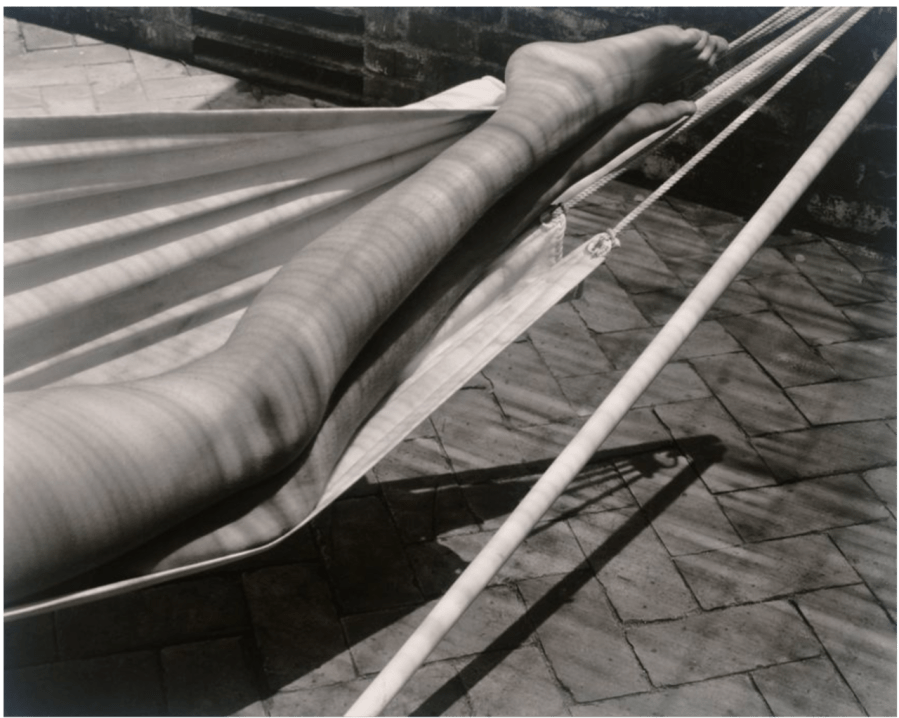
Animals

By Brock Guthrie

Featured Art: Leg in Hammock by Edward Weston

One is what one looks at—well, at least partially. —Joseph Brodsky

All morning in my hammock burning
a tight one, poised with pencil and notebook
and seven-week beard, I look to the pines
outside my cabin, seeking inspiration
from the birds and the squirrels
whose singing and foraging, whose
exclamations, no, arguments, reflect
my inner my inner my inner . . .
and every so often my cousin Ricky returns
from hunting rabbits on my four-wheeler
to tell me he’s thought of a new way
to beat off: Anywhere around here to buy
watermelons? Even his camo flannel
can’t conceal that Superdome belly
and I hate to think how long
since anyone’s seen his diminutive dangle
so I tell him in all seriousness, my sympathy
sincere, You might be on to something,
but after he tokes and rides away
I get inspired, realize I should’ve said
Go drive around these country roads, man,
look for signs!
and even Ricky would’ve
nodded with a look of feigned profundity
like he’s posing for an author photo
but I let that moment go

Read More

Pelicans

By Robert Cording

Featured Image: “Australian Pelican” by Elizabeth Gould

Last evening, another sunset party:
drinks, laughs, ironies, hidden desires.
All of us tanned and glowing, we exchanged
jokes and gossip, fresh and stale, self-conscious
that something larger was missing
when we turned to best watches, shoes, cigars.

So much time is lost trying to agitate
the envies of others and monitor one’s own—
the thought that crossed my mind as I watched
six pelicans rise and fall with the water’s flux.
The winds had quieted, and just before the sun plunged
below the sea, the pelicans rose in a wind-hung line

and flew off, silent as a council of gods
in the pinkish sky. Palm trees scratched
their cuneiform shadows on the sand.
I wanted to say something about the pelicans,
who I knew, for no known reason, choose to live
their lives as near total mutes, as if they’d decided

simply to be done with the fecklessness of speaking,
but I kept quiet, the light draining from the sky,
the others going inside. I felt like a child in hiding,
alone on the deck, made fearful and alive
by the darkened Gulf, the stretch of beach
now entirely empty, the palm trees,

the sliver of moon rising directly opposite
of where the sun had set. If I had been called
to come in, I would have kept silent.


Read More

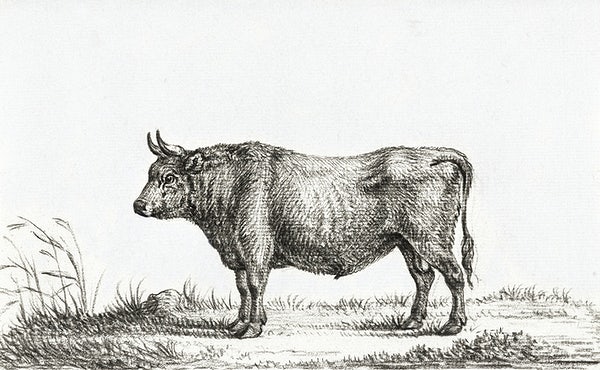
Tauromaquia

By Deborah Casillas

Featured Image: “Standing Bull” by Jean Bernard

The days dragged on, steady ticking of the clock.
My mother’s cancer; surgery, injections, drugs.
Long afternoons I sat in my grandfather’s library
looking at books. Shelves of books about bullfighting—
la lidia, combat; la corrida, the running of the bulls.
Books on Manolete, Belmonte, Joselito,
his copies of The Brave Bulls, Blood and Sand,
Death in the Afternoon. Books aficionados collect,
those fanatic followers of the taurine subculture.
I stacked volumes beside me, looked at pictures
of the black bulls, studied their deadly horns,
the ritual sacrifice. Here were portraits of the famous
matadors, their lives venerated like the lives of saints.

Read More

When It’s That Time for Piranhas

by Michael Derrick Hudson

Featured image: Utagawa Hiroshige. Swallow and Wisteria, mid-1840s. The Metropolitan Museum of Art.

Everything has already blossomed: my neighbor’s wisteria
has gone hog-wild across the ragged frontier of
our mutual fence, the soft green tendrils
of it violating international borders

and breaking treaties. Achtung! So let me tell you about

my neighbor’s wife: she’s delicious! And every morning
I hear all the birds in Fort Wayne, Indiana, go

Yippee-yee! Yippee-yee! Which is how spring jibber-jabbers
while her husband blows the leafy detritus

off their depilated lawn. Something’s missing. I want to be
indigenous with her, something somehow prehistoric—

I want her in Brazil. I want a quiver full of spindly arrows
to fetch our breakfast’s blue-tailed skink or

supper’s three-toed sloth. I want ritual scarification, coherent
rites of passage. I want grandpa’s thighbone
whittled down to a splinter

and dangling around my neck.
I want to help her stitch banana leaves, scorch
grubs against a rock. I want her to smile at me like a jaguar,

each incisor filed to a point. I want poisonous frogs, seashell
currency, enemies who make sense, a copper
plug through my lip. I want

a shameless squat. I want mumbo-jumbo witches to shun and
screeching ghosts to appease. I want her to take me

down to the river where we’ll knot and
inch our way across. I want her to trust me to be the lookout

for piranhas. I want to know when it’s that time for piranhas.


Read More

A Mile In

By Julie Hanson

Selected as winner of the 2011 New Ohio Review Poetry Contest by Nancy Eimers

Feature image: Claude Lorrain. View of Delphi with a Procession, 1673. The Art Institute of Chicago.

The snow had been with us for awhile
and was dingy and not well lit.
But the sun promised to come out.
The light fog lifting
against the skinny tree trunks
and the grounded limbs they’d lost
and the thick, half-detached vines
would lift off,
dissolved, by the end of our walk.
We’d taken the footbridge
across the creek and followed the bend
away from traffic and toward the west ridge.
We’d gone a mile in,
to where usually I begin to listen to
our progress in the twigs and gravel of the path,
and past this, and past my own
periodic reminders to the dog
to the short, uncomplicated songs
of winter birds. And there,
near the spill of rocks in the creek
where the fog was still passing through branches
and a little farther and to the right
where a stretch of tall grasses
received a wide gift
of sunlight and several cows,
the air that stood still
between the trees and shimmered
over the grasses filled with sound—
a big voice moving through
a hundred thousand habitats—
and it said, “Attention in this area.
The following is a regular monthly
test of the Outdoor Warning System . . .”
It spoke from the west first,
sounding closer than it could be.
And it spoke from the southeast next.
“This is a test,” it said, “only a . . .
“This is a test . . . ” it began again
from somewhere else.
The dog returned to me, cowering.
I’d wondered before
without much curiosity,
where were those speakers housed,
were they towered, did they revolve?
Ordinarily heard in the yard
while I stood pinning laundry to the line,
the broadcast soon plunged and sank
into the noise of passing cars
and blown and rolling garbage cans
and faded like the little ringing
that emanates from construction sites.
But here, it seemed full minutes long
before my breath was back again in my chest,
and my dog’s breath,
steady and rough, was back in hers,
when the voice had left the air
between the trees, as had the fog.
At last a bird sounded from a twig.
At last a squirrel came down
and sent the dog. And then,
made up of other sounds
I could not have singled out,
a normalcy rolled in.
Infinitesimal bits is all it was
—quick beaks breaking up the peat,
the slow collision of a leaf landing, scooting
half an inch along a big flat rock,
a splat of excrement in white,
a flinch, a flap, a flick. But as it came it felt
to be a counter-vigilance. Or like
the sound of consciousness. The is.


Read More

Fly

By Joyce Peseroff

Featured art: Street Musicians by Eugène Atget

A small fly hung around my kitchen mid-October.
It didn’t buzz. Outside wet shape-shifted, drop to
flake: knock-knock of rain, a who’s there of snow.
The fly tiptoed on the meat-cutting board where I aimed
to smash it like a head of garlic. It bounced wall to wall to
wall, baby trapped in the balloon that was a hoax.
Was it my mother’s perturbed spirit warning me that blood
stains? Of course not. Last of its kind, Robinson Crusoe landing
on a kitchen island, the fly needed to be warm.


Read More

A Giant Bird

By Kevin Prufer

Its great heart pounded like the distant sea
wounding itself against the cliffs.

+

We lived in its shade.

Sometimes, my daughter ran her fingers along that part of the breast
that swagged low over our camp.

It’s beautiful, she said, smoothing a feather’s twig-like barbs,
gazing past our mountain toward the burning cities.

+

What kind of bird is it?
                Some feathers were tawny, others tinged a perfect white.
Is it a sparrow?
                It may be a sparrow.
Is it an owl?
                I can’t see its face.
An eagle? I think it’s an eagle.
                                We often played this game.

Read More

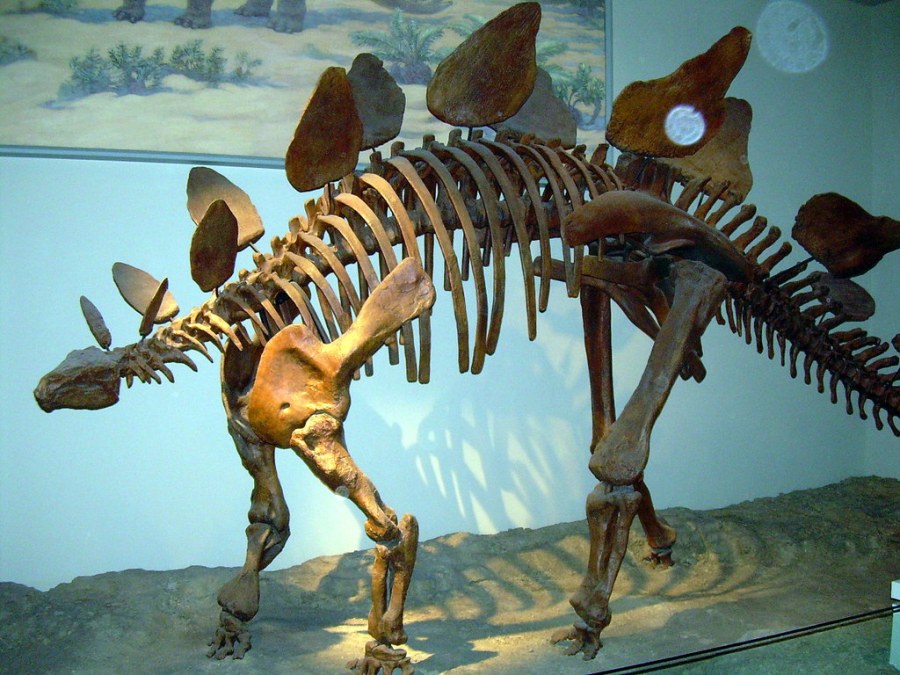
Feeling Sorry for Myself While Standing Before the Stegosaurus at the Natural History Museum in London

By Michael Derrick Hudson

Oh yes my friend, I’ve been there; the insects battering at
the armored lids of your yellowish eyes

the moment you pecked your way out of that rotten shell
and dug out from your sandpit nets . . .

And I’ve experienced the thud thud thud of your days,
the indigestible monotony

of everything’s spiny orangy-green husk. How the sun
gets daily whiter and hotter and just

a little bit closer. The week spent gobbling down your

own weight’s worth of whatever. One stumpy
footprint after another, tracking the trackless, squelching

across last night’s marsh into a volcano-spattered today
hip-deep in ash and yawning

a muzzleful of sulfur. Swishing through stiff fronds,

we drag an unbearable load of tombstones on our back
and a fat lugubrious tail, shit-smutched and

spiked. The flattening of the razor grass. The forgotten
clutch of eggs. Our shrill yaps

and groans. That tiny gray walnut
for a brain and the fat black tongue tough as a bootsole . . .

They’ve explained us away a dozen times: some passing
meteorite or anther, the rat-like mammals

eating our pitiful young, all kinds
of new weather. Issueless, but far too stupid to be forlorn,

we trundle along the pink quartz shore
to sip at the lukewarm edge of yet another evaporating sea.


Read More

Disintegration of Purpose at Cocoa Beach, Florida (Part 1)

By Michael Derrick Hudson

A pelican divebombs the same shimmery-shammery silver stripe
of the horizon. The pale yellow and presumably

bloodless crabs scuttle to their holes, terrified by my shadow

all over again. Again! They’ll never figure it out,
but of course every moment for them is nothing but the fretful

expectation of imminent death. They’re expendable. Fecund.

Edible. Fuck ’em. So where’s my hero? My old conquistador
my Castilian grandee terrible with purpose . . .

Señor! Over here, por favor! But what if he did come, feverish

and bedraggled, this Spaniard wading hip-deep through the surf
cumbered by his mildewed ruffles

and waterlogged boots, in silver salt-pitted
spurs and a rust-bucket helmet? He’d spout nonsense, bragging

about the usual claptrap: solid gold wigwams, diamonds bigger
than pumpkins and an obsidian-eyed princess

festooned with raccoon tails. There’d be those outrageous lies,

poison darts tinking off his armor while tramping the Everglades
and living these five hundred years fetched

off death’s front stoop by a few quavering, toothless sips from

the Fountain of Youth. With the point of his cutlass he’d scratch
the beach with treasure maps and schemes, telling tales

of the cannon-shattered fo’c’sle and those desolate, bone-littered
passageways. I’d put up with it for as long

as I could. ¡Hola! History stops here, Señor! Everything does!

Read More

The Businessman Cleans a Mermaid for His Supper

By Michael Derrick Hudson

Yeah I snagged her, I snagged her good and then I shucked her
out of her shimmy, killed off that last twitch

of hers in the sink. And those labials, all of her wet slobbery

labials I reduced to a dried-out oxygen-starved O. I flensed
her down to the bone and chopped

away her emerald green flukes. I got wet to the elbows in her
and scraped at her dime-sized translucent scales

until they spangled the tops of my greasy boots
and clogged the drains. But her filets were worth it, redolent

of ambergris with a tincture of seaweed. In her eyes I found

tiny discs of abalone, the secret of their weird yellowish glint
like a cat’s in poor light. And then I brought her

to a resinous sizzle. But what a fight! Such fabulous breaches

How she resisted my hooks and gaffs, the vast tangle and bulge
of my nets. She couldn’t believe the multitude

of knots I’d mastered or these chains and rudders and screws or
my hand-over fist desires and

the way I whistled at my work. Or my inevitable appetite . . .


Read More

Valuable Lessons Learned on Delaware Bay After the Horseshoe Crabs Came Ashore to Spawn

By Michael Derrick Hudson

They look like the Devil’s codpiece.
They look like the Shield of Achilles.
They look like George Washington’s last boot heel.

Oh sure, noggins get cracked, the meat tweezed out

in a glut of shrieking seagulls. Always sun-vexed
throughout their frantic scrabblings

they suffer the dried-out gill, the blotted eye,
the heartbreakingly feeble clench

of an expiring mouthpart. But still they deposit
what they can of their sorry clutches,

their dabs and globs of purpose, spotting the world
with their gluey yeses. Satiated,

doomed, happily they nibble
at their own nutritious backwash, feel around with

their feelies. Tipped-over. Busted. They look like
The Battle of Berlin. They look like the Last Days
of Brontosaurus. But they persist.

You know, they persist.


Read More

Listen

By Eric Schwerer

Featured Image: Sunset, Oxford by George Elbert Burr 1899

Here every evening a woman
strides into her backyard calling
her rabbit which raises an ear when she sings:
Peppermint’s eyes’re red, His fur’s so white, Oh
where’s Peppermint gone tonight? When she sees him
she relaxes and lingers in twilight
as fireflies make brief green slashes
and the blacktop ticks with the heat
it’s digested all day. Then in her grass
while the light collapses I watch her daydream
a portion of the dusk away. I mean
I imagine she daydreams as through my screen
I watch her stride about shoeless, her rabbit
nibbling the lawn going gray. In a clean blouse,
fresh from a shower, with night coming on,
she might think of marriage. The lace
curtains in the windows of her house
are drawn. In my own still air and losing light
I stare at her, her curtains, her rabbit’s white hair.
Downstairs at the sink in my darkening kitchen
a glass of iced water is crying a ring—
Has he hopped the gate?
Left me again? Peppermint please
She continues to sing, though it’s not
wandered and would not ever leave.


Read More

Sparrow

By George Bilgere

On the bricks of the patio
A sparrow is struggling with a used tampon
It half-flew, half-dragged here
From a dumpster across the street.

The tampon resembles a wounded rat.
Those of us enjoying our coffee
And New York Times in the spring morning
Pretend to ignore it.

But all the suns in all the galaxies,
And all the planets around our own paltry star,
Are turning on the same invisible pulleys
That drive the sparrow
To build a cozy little crib
In the eaves under somebody’s gutters,

And to find, sooner the better,
Another sparrow who hears
The same music of the spheres.

You can’t argue with that.

And though some of us on the patio might believe
That what the sparrow is wrestling with
Is the blight man was born for,
The curse Adam fell for,

For the bird
It’s an engineering problem: the tampon’s
Too stubbornly stitched together
For a tiny beak to tear apart,

And too heavy
With human blood to carry off
Into the blue air of the future.


Read More

At the Dinner Party

By Stephen Dunn

Featured Art: A Family Meal by Evert Pieters

As usual, we were trying to please each other,

so Ryan told a story about a water buffalo,

a lion, and a crocodile, which reminded

Julie about a coyote and a groundhog, and

I could not help but offer my favorite of

this kind—involving the tarantula

and its natural enemy the digger wasp. The

problem was that each story was true,

therefore that much more difficult to tell,

and each had in it an element of the fabulous,

and therefore the promise of a moral.

Linda, the contrarian, asked us if we had heard

the one about the priest and the rabbi,

but was booed, and kept quiet for a while.

In each story an animal was in danger, one

always slightly more sympathetic

than another. The water buffalo rescued

her injured calf from first the crocodile

then the lion, the coyote got bored

with the groundhog and returned to the woods,

and the tarantula just stood there, frozen,  while

the digger wasp dug its grave.

Ryan and Julie selected their details well,

paced and arranged them, as I hope I did,

and it wasn’t that our intent was to avoid

a moral, but that there was none to be had,

this being nature we were talking about

with its choiceless whims and atrocities.

Linda, of course, said she forgave none of it.


Read More

Little Bird

By Lawrence Raab

Featured Art: Seascape by Pierre-Auguste Renoir

One cloud was following another
across a blue and passionless sky.
It was the middle of summer, far enough
from December for a man to feel indifferent
to the memories of cold, not yet close
enough to autumn to be caught up
in all its folderol about death.
Neither cloud looked like a whale
or a weasel, or any kind of fanciful beast.
All morning I’d felt my life dragging me down.
The view from my window refused to lift my heart.
The sight of a blank piece of paper
filled me with sadness. I wanted to set
my life down in a comfortable chair, tell it
to take a long nap, and walk away as if
I were somebody else, somebody without a house
or a family or a job, but somebody who might
soon feel with a pang precisely the absence
of everything I had. A cool breeze lifted
the curtains in the room where I was sitting.
A bird was singing. Had it been singing for long?
Far off there were mountains, but I didn’t
wish to go there. Nor did I yearn
to be standing by a lake, or walking
beside the tumult of the sea.
The little bird kept repeating itself.
I filled a glass with water and watched it tremble.


Read More

The Last One

By Bruce Weigl

Featured Art: Two Plant Specimens by William Henry Fox Talbot

The anonymous brown song bird
        is annoying in her insistence
             on repeating the same three syllables
in exactly the same way, endlessly.

        She must know something
             about inevitability,
                       to sing so long,
        no one else in sight.

        The persistence of nature;
         the blind and infinite dedication to a thing
                       in the face of emptiness and silence
        that won’t let you believe that you are the last.


Read More

Chicken

By Stephen Cramer

Featured Image: For Sunday’s Dinner by William Michael Barnett

At the festival when we were celebrating
harvest with pumpkin tarts & cider,
an older farmer asked what I was into
& maybe my answer was muffled a bit
from the cider’s tang because he started
talking passionately not about his favorite poet
or the use of weather in haiku
but about his chickens: White Leghorns,
Silkie Bantams, Rhode Island Reds,
Plymouth Rocks, how, in Corporate Agriculture
the birds are bred so big that their legs
cripple beneath them & isn’t that a shame.
I tried to break in, to tell him he misheard.
But he shook his head & held up his finger.
That’s not the case with his birds.
When his hens are laying he puts oyster shells
in their grit to give them extra calcium
for their own shells. His birds are free range—
not debeaked & stuffed two dozen
to a pen. No, his birds can go anywheres they want
from the barn to the bog & even in the house.
Read More