I propose we worship the mud dauber

by Jessica Pierce


The female in particular seems worthy.
She carries mud in her jaws to make her nest
one mouthful at a time, setting up
in a crevice or a corner. One egg,
one chamber. One egg, one chamber.
It’s better to keep them apart, as larvae don’t
know the difference between food and
a brother or a sister. They aren’t wicked,
just young and hungry. She has pirate
wasps to battle—they want her young
to feed their own offspring—and she does this
alone, drinking flower nectar to keep
herself going. Let’s just try

and see what happens when we raise up
this winged thing who will hover by your feet
without attacking. Covered with dense golden
hair and sometimes described as singing while
she works, all she wants is bits of damp dirt.
She has a slender thorax and two thin
sets of wings to carry her and
her earth. She is exactly strong enough
for what she needs to do. She doesn’t burn
or proclaim or fill your head with visions
as she hunts crab spiders and orb
weavers and black widows. Yes, let’s ask

her to pray for us as she stings
a black widow, brings it to its knees,
and sets off to feed her children,
singing as she holds up the world. Read More

The Dog in the Library

by Catherine Stearns

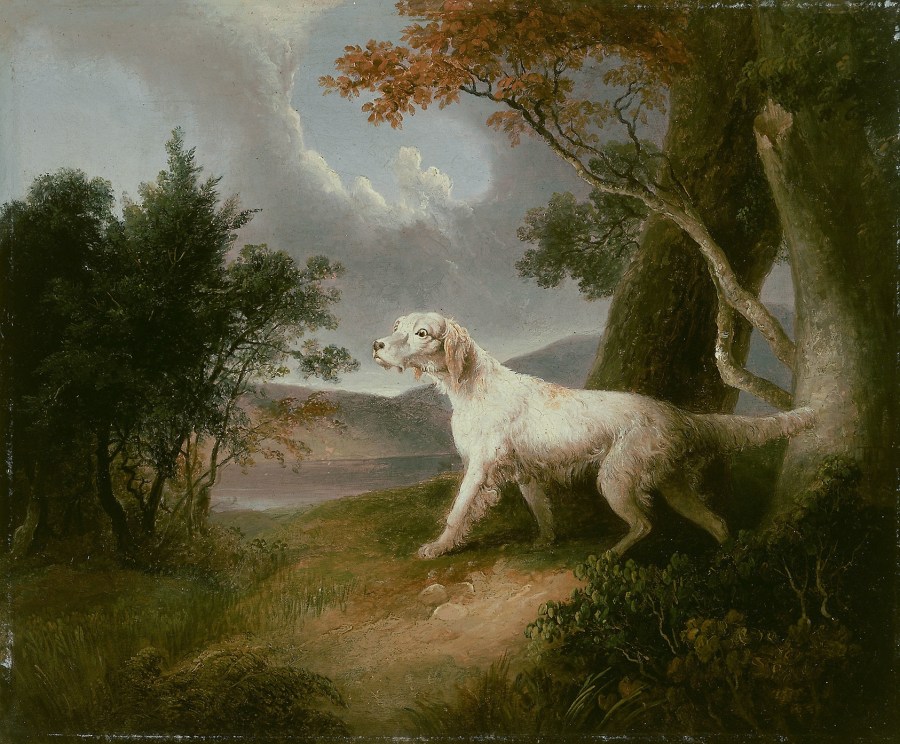
Featured Art: Landscape with Dog by Thomas Doughty


“We may be in the universe as dogs and cats are in our libraries, seeing the books and hearing the conversation, but having no inkling of the meaning of it all.”William James


On sunny, cerulean days I go all the way
to eleven when I stretch and sniff among the leaves,
whereas you stay inside, hunched over
your moral universe. Old girl, if you
stopped trying to decipher those fossil bird tracks,
you might see the thermal-gliding hawk above
or that zaftig possum gnawing on fallen
persimmons under the window. I’m just saying
your preference betrays a certain fear
of your own nature. Remember
last summer when you left me in the car
to pick up a book they were holding for you,
and a page or two in you recognized
your own penciled and may I say
obsessive marginalia, although you had
no memory of the text itself?
Whatever made you think your mind
could be disenthralled with words?
As a pup, I once took Mark Strand’s
injunction in “Eating Poetry” to heart,
devouring one or two slim volumes,
but soon realized I prefer the raw
material of life, what e e cummings
calls “the slavver of spring”: smells
of fresh earth, the ghostly scent of
rabbits, even the mounds of dirty laundry
piled up on your bed. If you found answers
to your questions, do you truly believe
those answers would transform you?
So many of your species seem
susceptible to revelation. We’re all
browsers, old girl, without an inkling,
waiting by the door for a treat or to be forgiven
until our unleashed immortal part bolts
for that hit of dopamine. Then
all good dogs go to heaven.

Read More

Ekstasis

by Erika Brumett

Featured art: Summer: Cat on a Balustrade by Théophile-Alexandre Pierre Steinlen

                       “One by one—in convents across medieval Europe—nuns began to believe they were cats.”

                          –Michael Garerda (Shared Hysteria: Group Madness and the Middle Ages)

Happened after mass
last sabbath.  We broke
fast (curdmilk, cabbage),

sat rigid in our hair-
shirts and worship. But heard
then—urgent as prayer

by the dais—a purr-
purring rise from Sister
Mary Iris.  Since then, Read More

The Problems of the Wild

by Abby Horowitz

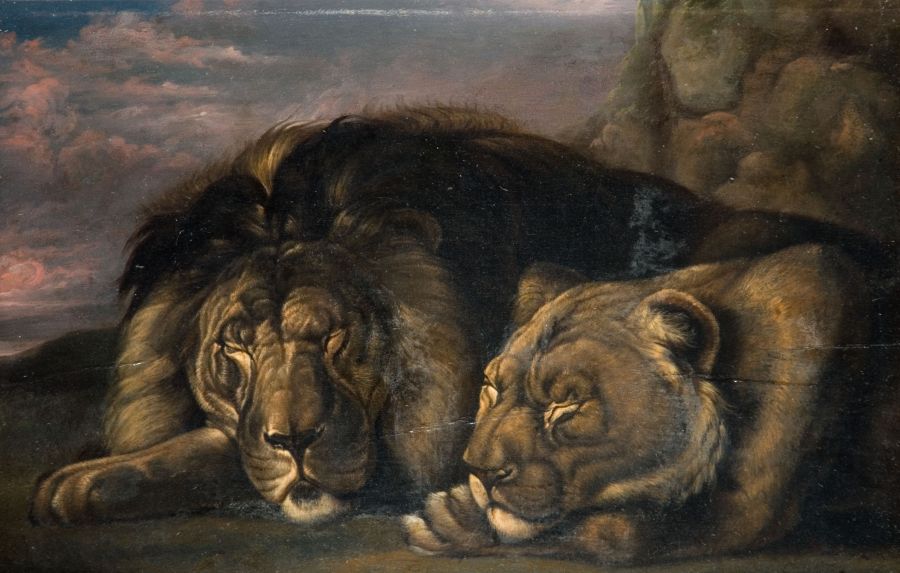
Featured Art: Sleeping Lion and Lioness by Samuel Raven

I am trying to tell Francine about the new babies in my life. They’re lions, baby lions, and they have fur the color of corn flakes and little ears that look straight off a teddy bear and they turn my heart right to butter. But here is the kicker: their mother is dead. Something weird must have happened when she birthed them because a little while later, they found her stretched out in the dirt up front by the viewing glass. The father lion was roaring on his big rock, with his mane standing on end, while the cubs were kneading their paws into the mother lion’s white underbelly and gnawing at her black teats. But no dice, that lioness would roar no more and now things do not look good for those little cubs. Because they’re not taking well to the fake milk they’re getting now or the plastic nipples they’re getting it from, and the father lion keeps pawing around with an evil  look on his face that is making the zoo staff nervous. Read More

Octopus on Ecstasy

by Geneviève Paiement

Featured art: from A Picture Book of Practice Sketches by Rinsai Ōkubo

-In September 2018, Johns Hopkins University neuroscientist Gül Dölen
published a scientific study wherein she dosed octopuses with MDMA
to see if they would react like humans and become more cuddly. They did. 


She hypothesizes that humans are more closely related to octopuses
than we think. Fills a tank with ecstasy. Plunks in us two octopuses.

Just five hundred million years of evolution between us, she muses.
Surely what MDMA does to humans it will do to us octopuses.

Surely we’ll break out in the same cold-sweat/hot-flash, will twist-grind
our visceral humps, bump beaks, squish-entwine our fellow octopus.

Oh wow. I’m at the other’s central axial nerve pump in a house beat,
sucker-to-sucker, lights-out smoke machine to my sister sextapus. Read More

Dune Cat

by Winnie Anderson

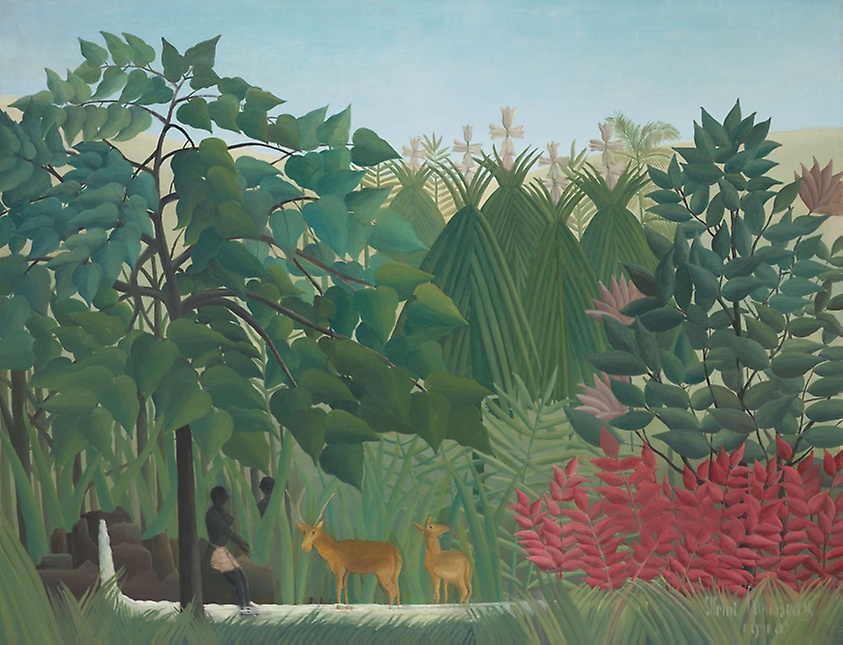
Featured Artwork: The Waterfall by Henri Rousseau 

Eons ago, during the Pleistocene Epoch, the jaguar left his home and traveled across the cold arid grassland: his resolve set. The floods were coming again. If he stayed, the land would either be covered with water or be broken into land pockets, from which there’d be no escape. The time was now. He had to go.

In him the jaguar carried echoes of history, tens of millions of years’ worth of heat spikes, ice ages, tectonic upheavals, and mega-explosions. Time swirled uniquely around him. He felt two trajectories at once—like a stone cast into the deep lake of time, sinking down to the bottom where all life may have begun, as well as the outward rippling cat’s paw upon its surface. History. Present. Future. All there, his for the grappling. Read More

Critical Insect Studies

by Tom Whalen

Featured art: Still Life with Poppy, Insects, and Reptiles by Otto Marseus van Schrieck

One more step and we are out of the circle and have entered the domain, equally delineated and autonomous, of a different species.
—Vladimir Nabokov, “Father’s Butterflies”

My wife departed on the day I began in earnest my Critical Insect Studies. Before this date, I had only jotted down a few thoughts and titles, cut and pasted a few class papers, nothing more, but I was sure, as much as I had ever been sure of anything, basking in my certainty like an oiled blonde in Cannes, that I had found, at age twenty-seven, the subject on whose wings my career would soar from campus to campus, lecture hall to lecture hall around the globe, sometimes Sam coming along, though increasingly, I imagined, taken up with his own concerns. Perhaps we would have had children by then, or new avatars, I didn’t know, or perhaps we would have drifted apart, he wanting nothing to do with me or my fame. Read More

Birds in Cemeteries

by George Kalogeris

It must be the shade that draws them. Or else the grass.
And it seems they always alight away from their flocks,

Alone. It’s so quiet here you can’t help but hear
Their talons clink as they hop from headstone to headstone.

Their sharp, inquisitive beaks cast quizzical glances.
The lawn is mown. The gate is always open.

The names engraved on the stones, and the uplifting words
Below the names, are lapidary as ever.

But almost never even a chirp from the birds,
Let alone a wild shriek, as they perch on a tomb.

And then they fly away, looking as if
They couldn’t remember why it was they came—

But were doing what our souls are supposed to do
On the day we die, if the birds could read the words.


Originally appeared in NOR 11

In the Second Month of Parched Land

by Daiva Markelis

Featured art: Two Camels by John Frederick Lewis

We came across the camels every time we picnicked that merciless autumn, huge herds grazing on sparse vegetation. Camel comes from jamal, the Arabic root word for beauty. From a distance they did look lovely, their curvy silhouettes mimicking the contours of the dunes. Up close, however, they seemed slightly ridiculous, like bad female impersonators, batting their Scarlet O’Hara lashes to keep the sand out of their eyes, their long necks sloping towards us, then coyly withdrawing. Read More

Monarch

by Kathleen Radigan

Featured Art: Abstraction on Concrete by Howard Dearstyne

In the garden I cup a hand
before you, strain my wrist,
willing you to perch.

A nearby woman grips her cane.
“Young lady. If you touch them,
they die.”

Born again from a gauze
coffin, you’re blackwinged,
fragile on a wax leaf. Read More

The Last Litter

by Melissa Cistaro

Featured art: A Farm in Brittany by Paul Gauguin

1975

My mom pours the warmed milk from the stove into oversize plastic bottles, then pops on the giant caramel-colored nipples.

“Do you want to feed one of the little ones down in the calf barn?” she asks.

I cannot contain my smile. My Keds are on in three seconds.

I follow her down the grassy path, holding the warm milk bottles against my chest and trying to copy the sway of her hips. She explains how the calf barn is the holding place for the young Holstein calves who are being weaned from their mothers’ milk.

“Roger likes to wean them young,” she tells me, “so that the mother cows can get back to their job of being milk cows.”

The calves cry and bleat like goats when they see us with the milk bottles. A black-and-white calf shoves his head through the wood slats of the stall and stares up at me with his big polished eyes. I put the rubbery nipple close to his mouth. He grabs and tugs fiercely at the bottle.

“Hold on tight,” my mom says. “That guy is a tough little sucker.”

My calf slurps as he drinks, then yanks at the nipple like he’s mad at it. Milk splatters across his soft black face. When he’s done with the milk he wants to keep chewing and sucking on the rubber tip, but my mom says that will put too much air in his stomach.

“Just stick two fingers in his mouth,” she tells me from across the aisle.

“What?” I say.

She walks over to my calf and sticks her middle and pointer finger right into his mouth. He latches on and starts making sucking sounds.

“There are no teeth in there, just gums,” she says.

I hesitate. I am not certain about this. She grabs my hand and pulls it toward the calf’s mouth. He latches onto my two fingers with such force that I am startled. His mouth is strong and smooth inside. I feel his tongue, like fine sandpaper polishing my fingers. I start to laugh. My mom laughs. I don’t want this to stop. I want to learn as much as I can about living on a farm in case I ever get to live on one. I take my other hand and rub the calf’s face, swirls of
thick black velvet, a perfect white diamond on his forehead.

My mom says she’s got a few chores to do back up at the house, and I ask if I can stay here in the calf barn for a while.

“I like it here,” I tell her.

“I’m glad,” she says. She smiles at me, pushes an unlit cigarette into her mouth and gathers up the empty milk bottles.

My fingers get a little sore from staying in the calf’s mouth so I pull them out. The calf seems okay because after a minute he buckles down on his wobbly legs and flops onto the straw floor. I decide to do a little exploring around the barn. There are dusty bird’s nests tucked all around the rafters and small birds like starlings that swoop down to gather bits of straw from the ground. I find a place to sit in the feed room where there are burlap sacks filled with
cracked corn and molasses-covered oats. I push my hands deep into the open sacks and pull the molasses oats close to my nose. It smells good enough to eat.

I take a walk to the far end of the barn aisle where the calf stalls are empty. There are two tall white buckets with lids on them, the plastic kind that painters use. They look out of place to me for some reason, like maybe they were set down there and forgotten. I pry the lid off the bucket closest to me. There is no particular smell.

I am not sure if what I am seeing is right or true. Kittens. Piled up to the brim. Clean white fur. Brown, black, tan, orange. Small paws with fleshy pads as soft as apricot skin. Wiry tails. Tiny pink noses. Whiskers, as fine as fishing line, almost transparent.

It is not a dream. I push the lid back on. I think there must be more than a dozen piled up in there. I pry open the other bucket only because I want it to be something different. But it’s not. One all black, one striped orange, one smoky gray, more colors underneath. Soft triangle ears, thin as potato chips. I want to stop staring but I can’t. A small calico kitten lies across the top of the heap. Its eyes are closed, but the shallow part of its belly moves—barely, up and down like it’s in a deep sleep. I want to touch it, but I am afraid. I don’t know what to do. I put the lid back on.

I walk back up the hill toward the farmhouse, my heart pounding underneath my yellow T-shirt, the tall wet grass soaking the bottoms of my jeans. When I open the screen door, I see my mom at the table with her New York Times crossword puzzle, her coffee and a cigarette. She’s smart with words. I’m not. I’ve got a throat full of gravel that usually keeps me from saying what I want to say.

But I know what my question is.

“Why are all those kittens in the white buckets?”

She keeps looking down at her crossword puzzle like she’s just about to figure something out. Her dark bangs hang like a frayed curtain across her forehead. For twenty seconds, I don’t even think she’s going to answer my question.

“Oh, that,” she says with a frown. “You weren’t supposed to see that.
Roger was supposed to dump them.”

I wait for her to say something more.

“I’m sorry you had to see that, darlin’. It’s the way of the farm here.”

She smashes the clump of soft ashes down with the filter of her cigarette. There is sparkly pink polish on her fingernails. I hate it when she’s so matter-of-fact.

“There were just too many kittens.”

“What do you mean too many?” I ask.

“Those were feral kittens, wild and inbred—just the ugly ones. Believe me. I can tell the inbred ones right away, their eyes are wide-set and slightly askew. Their heads are oversized.”

“But how did they die?”

My mom gets up from the table with her ceramic coffee cup, and goes into the kitchen. I can tell she doesn’t want to listen to my questions.

“Chloroform is what Roger said to use.”

She measures out a heaping spoonful of sugar into her cup.

“But power steering fluid works just as well. It’s very quick. They don’t suffer.”

I feel my throat tighten up like a fist. My legs are as wobbly and uncertain as the calves down in the barn.

“Mom, I saw one breathing on the top, a calico one, not an ugly one, but a long-haired calico.”

“There were no calicos,” she says, slamming the garbage can lid down. “And, you did not see any kittens breathing.”

“I did, Mom. I definitely saw that one on top.”

“None of those kittens were breathing, you understand?”

I am strangely afraid of her. She knows how much I love kittens. I try to stop the image of her hands pushing those kittens into the white buckets. I know there was a calico. I know that she killed them.

She heads out the screen door, says she’s got to grab a few fresh eggs and she’ll be right back.

I watch her outside the window, walking through the tall grass. I recall what I once overheard her say—that she thought about drugging my brothers and me when we were small because she didn’t want us to suffer. She had an emergency plan in case there was an awful natural disaster. She would give us all sleeping pills. We wouldn’t suffer. But I am almost ten now. I am too big to trick like that.

I wait at the window for her to come back. I wait because I want to feed the calves with her again. I wait because I want to swirl the sugar and cream into her coffee and breathe in her L’Air du Temps perfume. I don’t know when the next time I’ll see her will be. I scratch my fingernail along the thin white paint that covers the window sill. I remind myself that there are things I am not supposed to talk about or remember. I am not supposed to remember the day she drove away in her baby-blue Dodge Dart. Everyone tells me that I was too young to remember. But I remember everything. “Too many,” she said. I know this phrase. I heard her screaming it late one night before she left my brothers and me.

I reach into my jean pockets and I push the secrets in as far as they will go. Between my fingers I roll around a soft piece of gray lint. I don’t want anyone to know that my mom killed those kittens. I push my hands into my pockets even deeper. I make room for the kittens, because they are a new secret.


Originally appeared in NOR 7
Roost

by Janice N. Harrington

Featured Art: Crows in a Tree by Charles François Daubigny

Circling above bare limbs, like Dalí’s wild and articulate capes,
black wings undulate. Raucous hundreds settle and splat
their stench. A murder of crows, a give-a-fuck mob,
stirs the air above ash and oak and hackberry, milling
and loud with news: day heralds, unwelcomed Cassandras.
Dawn light pinched by a crow’s beak, pieces of light falling
everywhere, bright meat that the crow pecks, strips away.

The crows know my neighbor’s face. Knowledgeable birds,
they know the way I hurry each morning, the way my eyes try
to read their dark signs: articulate smoke, curtains
of a confession booth. Blessing? Pardon? Mercy?
The stories say that crows suffer scorched wings, that they
are cursed for stealing from the gods. But the stories, as always, err,
wind-running, wings wide, a-glide on a slide of air,
black bodies, bituminous-black, cosmos-black rising to soar.
There is no damnation in their dizzying speed, the break-wing
improvisations of their flight. God–blessed and black,
their sharp notes strike my skull like hailstones or chunks
of sky, dark bodies that lift my eyes and scorn gravity, a lesser law.

Read More

crows

Delectable Hazards at the Animal Dive

By Michael Chaney

By the time the cow set down the samosas, covering the spot where he’d earlier hooved his name, Fox seemed different to Pig.

“Simply marvelous,” Pig said with an air, trying to play it off.

Fox coughed. “May I have more water?” Annoyance puckered her auburn snout.

“Not a problem,” said the cow. “Mind if I brag about our wines?”

“Please do, darling.” Fox had a lovey-dovey way of talking. To Pig, she was not so different from the elegant junk in herringbone patterns on the walls: bugles, radios, troughs, collars, toys, and white puffy gloves. Read More