Lunatic, Time

By Rachel Rinehart 

Featured Art: Trees on a Rocky Hillside by Asher Brown Durand

Sometimes, seeking desperately the measure
of her weeks, she dresses now for church
on Tuesdays or Saturdays, slides sideways
into the slick interior of the Oldsmobile.

So familiar the route, the car seems to know it,
nosing its gentle way like some peculiar
land-bound fish, and she leans in its belly
as it makes its one wide turn before the church.

But dim, the sanctuary withholds its promise.
She sits in the pew, hymnal poised, waiting
for the organ to thunder out
of its immaculate, peepless slumber.

Churchgoers flit in her periphery,
but she cannot fix them. The long dead
lingering beside her flee when she turns
to greet them. Even the eyes of Christ

flash impenetrable in the soft flush
of stained glass. Lunatic, time loops and tangles,
doubles back on itself. Somewhere in the hours
the pastor appears, or the woman

who fills the candles. They call up her son
to collect her. Behind the scrim at her windows
she baffles in the horrors of her dotage.
Someone has moved her husband’s truck.

It has been only days and decades since he slumped
dead against the dash in a hay-flecked shirt.
The chicken coop, too, is missing, the pasture fence.
Vagrant memory, like livestock loosed over the plain.

Always night obliterates. In the morning
she will gather her pocketbook and go again
to church, searching still for some low-lit beacon
to mark her faltering way toward the long home.


Read More
Horseplay

By George Bilgere

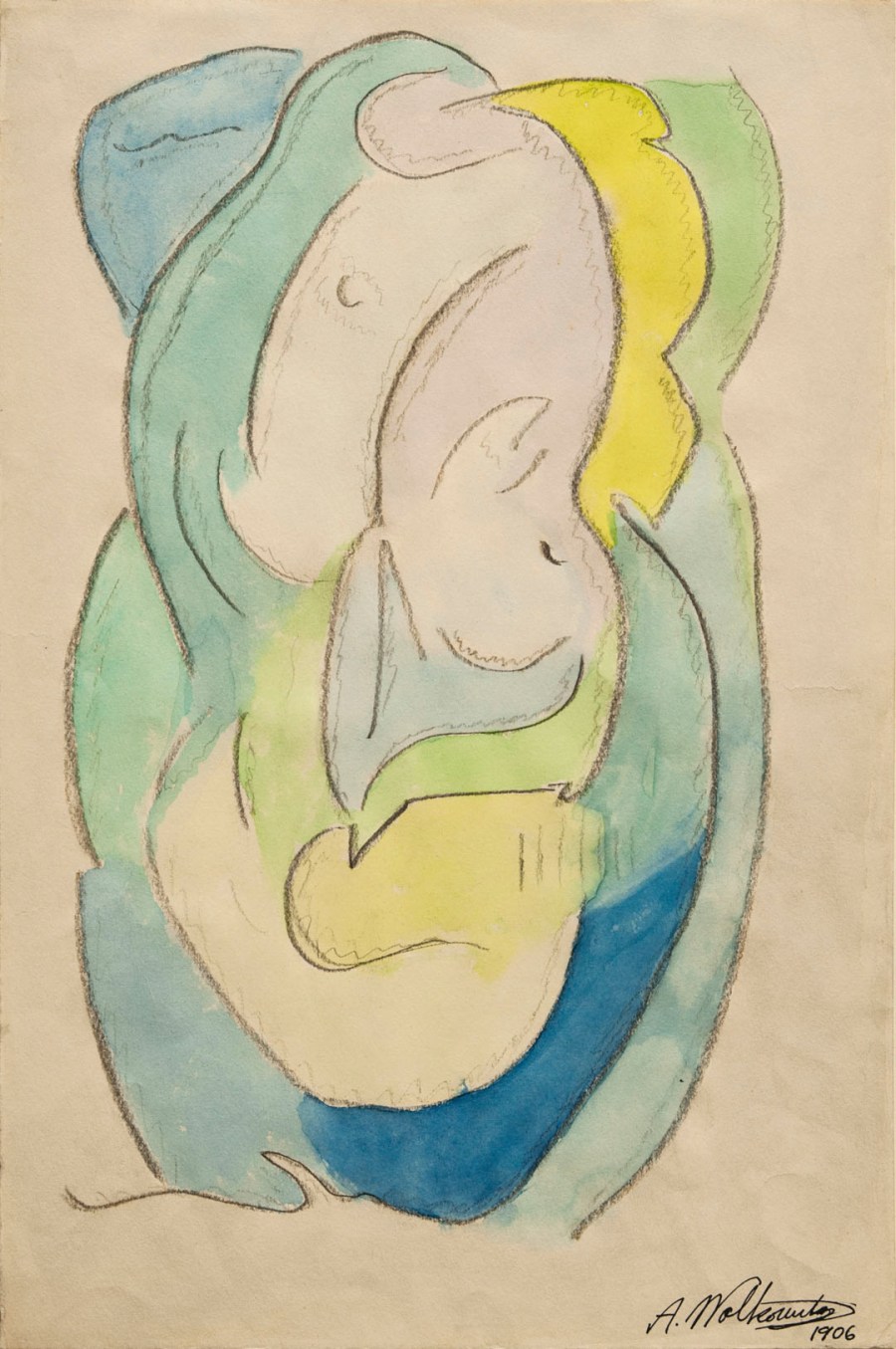
Featured Art: Abstraction, 1906 by Abraham Walkowitz

I am floating in the public pool, an older guy
who has achieved much, including a mortgage,
a child, and health insurance including dental.

I have a Premier Rewards Gold Card
from American Express, and my car
is quite large. I have traveled to Finland.
In addition, I once met Toni Morrison
at an awards banquet and made some remarks
she found “extremely interesting.” And last month
I was the subject of a local news story
called “Recyclers: Neighbors Who Care.” In short,
I am not someone you would take lightly.

But when I begin to playfully splash my wife,
the teenaged lifeguard raises her megaphone
and calls down from her throne, “No horseplay in the pool,”
and suddenly I am twelve again, a pale worm
at the feet of a blonde and suntanned goddess,
and I just wish my mom would come pick me up.


Read More

Serenity Room

By Linda Hillringhouse

Featured Art: Buste van een oude vrouw by Anonymous

There are five recliners in a circle,
each with a spongy blanket.
The lights have been dimmed,
but an aide has left behind her walkie-talkie
and it sounds like it’s ready to lift off.
My mother is in one recliner, I’m in another,
an easy way to spend time now that she’s afraid
of the color red and distrusts windows
as if the glass weren’t there and the fingers
of the dwarf palmetto would reach in
and pull her down into its dark center
to cut out the last cluster of syllables
huddled beneath her tongue.

I look over to see if she’s sleeping
and her eyes are open as though
she’s forgotten to close them. Maybe
she’s on some dusky street where half-drawn
figures drift and sounds almost blossom
into meaning. Maybe she opens a door
and her aunts from Brooklyn are there
and clutch her to their mountainous breasts
where she could stay forever.

She tries to inch out of the recliner but an aide
intercedes with a cup of apple juice
which my mother examines closely
for poison and studies her hand as if it’s
screwed to her wrist. Then she brings the cup
to her lips as if it’s the last thing left
from the world when she was Shirley
and carried keys, lipstick, cash.

And I hope that the cold, sweet liquid
brings a moment’s pleasure, but how can it be
that it comes to this, that at the end you get
thrown in the ring for one more brutal round
without enough stamina to put on your shoes
or enough strength to say Thank you or Go to hell.


Read More

Good for What Ails You

By Elton Glaser

Featured Art: Winter, Monadock by Abbott Handerson Thayer

                                                                                                  He too would live: like the rats among the ruins,
                                                                                                     but nonetheless alive.
                                                                                                                                  —Antal Szerb, trans. Len Rix

It’s the first fresh day
After a winter so hard
I disappeared inside myself,

Nothing out there but cardinals
Like drops of blood against
The creamy desecrations of the snow.

Ah, there’s the shit we need,
And the shit we don’t need,
And the shit we end up with.

I seem to be returning to
Some form of infantile intelligence,
On the sloppy side of the brain:

Mumblings over the oatmeal, nights
Broken by clumsy sleep, hands
At the mercy of small machines.

We come out of nowhere, and we go
Into nowhere. Should I stick
My fingers in my wounds,

Like a good little Dutch boy?

Even in the barren precincts
Of the cold, there must be love,

Though love does not travel well—
It needs its own terroir,
A discipline of flinty soil where

The roots struggle, where they work
Hard in the hot sun, until
Deprivation makes the fruit sweet.

And what wine will I have?
Here, at the open edge of things,
I’m like a spruce that hugs itself

Against the ice and the night wind.
But sometimes there’s comfort
In the certainties of burlap, and more

Sure footing on grit than marble gives.
And even a thin sun feels warm
After three dead months deep below zero.


Read More

Aesthetics to Change the Way You Live

By Sally Bliumis-Dunn

Featured Art: The Burning of the Houses of Lords and Commons, 16 October 1834 by Joseph Mallord William Turner

“Aesthetics to Change the Way You Live”
—Growth Magazine

For instance wabi sabi,
a Japanese view of life
that celebrates the imperfect,

the light-hearted sound
of the two words
like figures balanced on a seesaw,

behind them, cloudless sky,
and in the spread, the photograph
of nicked and tarnished silver spoons

arranged in rows on lilac velvet—
how perfectly imperfect.
But separate from the printed page,

the air around me darkens—
and then the sound
like thunder pressing closer

as I think of my own flaws—
and then they all
come charging toward me

like a herd of bison,
so dense it’s hard to see
from all the kicked-up dust.

So loud I cannot think.
How much easier to be won over
by a living room’s worn rug,

the reds and blues, faded,
even threadbare in those places
I have most often stood.


Read More

New Regs

By James Lineberger

Featured Art: Card Rack with a Jack of Hearts by Jack F. Peto

I’d never seen her before that day when
she came knocking on the door and I thought at first
I must owe postage on the package in her hand
but no, she said, this was an official visit to advise me
that unless I stopped parking the Malibu in our circular drive,
I would have to mount a new mailbox out on the street
rather than the one by the door that we’ve been using since
the house was built back in the Fifties.
“Say what?” I said,
“excuse me lady but that is my drive not yours.”
But she was not to be dissuaded,
advising me that new regs from the Postmaster General
would not permit her to put her Jeep in reverse
and turn around in the drive,
and she only shook her head no when I said,
“Look, okay, if we mounted it out there on this dead-end street
you would still have to back up
when you get to my neighbor’s house next door
because hers is on the front porch too same as this one
and you have to pull in her driveway to get there, and tell me
how you’re going to get out, and besides,
the reason we park the car out front here is because
my wife broke her hip and had to have screws put in it
and she’s still not too certain on her feet, not to mention
she’s got Alzheimer’s, unless you’ve got regs about that too
but the regular carrier never told us anything like this
and he doesn’t seem to mind backing up at all.”
“Well, sir,” she said, “that is him, this is me,
besides which where is your handicap placard?”
and walked away even as I was saying
“Just you wait lady, we’ll see about this.”

Read More

One Solid Chassis Among Us

By Susan Blackwell Ramsey

Featured Image: Giant Magnolias on a Blue Velvet Cloth by Martin Johnson Heade, 1890
Courtesy National Gallery of Art, Washington

We praised the gray car for being a good little mule
the day before it roared demands. The labs
for my sister’s knee surgery came back showing dual
heart chambers out of whack. And right-left jabs
of exploding joints and breast removal for me
came one year after both my husband’s eyes
lost cataracts, gained corneas. The knee
still needs to be replaced, of course. So why
not buy a new car? Certainly we could
transport our patchwork selves in our patchwork car,
all very apt, and prudently get the good
of what’s left. Or, while granting how things are,
we could fling cash, climb in with gleeful smiles,
and ride shiny the remaining miles.


Read More

My Mother Comes to Dinner

By Sally Bliumis-Dunn

Featured Image: Green Plums by Joseph Decker, 1885
Courtesy National Gallery of Art, Washington

We leave the dining room and she remains
alone at the table; the plates need washing,
we prepare dessert. I still wait for her

questions, half-buried in dish-clatter,
her broken tones in the hot kitchen air,
though these days she sits mostly silent.

And larger than the room and yellow walls, her silence—
as though it were strung to the sky,
to the air that too has been washed and washed

like a bed sheet in the relentless sun,
colors and patterns mostly faded

like all the meals enjoyed then washed
from these brown earthenware plates.


Read More

Gun on the Table

By Eric Nelson

My favorite scene in Body Heat has nothing
To do with the intricate plot
That William Hurt and Kathleen Turner
Devise to kill her rich, oppressive husband.
My favorite scene, maybe ten seconds long,
Shows Hurt getting into his car as an antique
Convertible drives by, a fully costumed clown
At the wheel, waving. Hurt stares, slightly
Bewildered, while the clown passes and disappears.
That’s it. Cut to Hurt and Turner in another
Sweaty sex scene and post-coital planning,
The foregone noir conclusion closing in. Meanwhile,
Since we know there are no meaningless details
In art, we keep expecting the clown to reappear
Or at least figure indirectly yet clearly in the action.
Like Chekhov said—if there’s a gun on the table
In act one, it had better be fired by act three.
But no, the clown is random, there and gone, an odd,
Unrelated moment like any of the ones that pass us
Every day and we barely notice
Because life isn’t art, isn’t revised for coherence,
Not until our lives collapse around us
Like a circus tent in flames
And we begin to look for the alarm we missed.


Read More

Activity Room

By John Bargowski

My mother wants nothing to do with the puzzle
two other residents,
whose wheelchairs have been rolled up
to a folding card table,
are trying to put together—
a west side shot of the New York skyline
broken up into a thousand pieces,
the stubborn morning smog
she could see from the apartment
she had to give up photo-shopped out,
the OT insisting Mom join in the fun,
taking my mother’s stroke-locked hand
and guiding it to
a corner piece that’s an easy fit,

Read More

Sitting in a Simulated Living Space at the Seattle Ikea

By Abby E. Murray

Finalist, New Ohio Review Poetry Contest

To sit in a simulated living space at Ikea
is to know what sand knows
as it rests inside the oyster.
This is how you might arrange your life
if you were to start from scratch:
a newer, better version of yourself applied
coat by coat, beginning with lamplight
from the simulated living room.
The man who lives here has never killed.
There is no American camouflage drying
over the backs of his kitchen chairs,
no battle studies on the coffee table.
He travels without a weapon,
hangs photographs of the Taj Mahal,
the Eiffel Tower above the sofa.
The woman who lives here has no need
for prescriptions or self-help:
her mirror cabinet holds a pump
for lotion and a rose-colored water glass,
her nightstand is stacked with hardcovers
on Swedish architecture. The cat who lives here
has been declawed, the dog rehomed.
There are no parking tickets in the breadbox,
no parakeets shrilling over newspaper
in the decorative cage by the desk.
When you finish your dollar coffee
and exit through the simulated front door,
join other shoppers with chapsticks
in their purses and Kleenex and receipts,
with T-shirts that say Florida Keys 2003
and unopened Nicorette blisters in their pockets,
you will wish you could say this place
is not enough for you, that you are better off
in the harsh light of the parking garage,
a light that shows your skin beneath your skin,
the color of your past self,
pale in places, flushed in others.


Read More

Whatever I Might Say

By Sydney Lea

Though to touch its flame would surely be as painful as when it burned brighter, the candle’s low now. On the table, just prior to guttering after dinner, it vaguely illuminates friends.

The glow takes me to Creston MacArthur, one son’s and one grandson’s namesake, and to our many evenings as a campfire ebbed. Just now I’m remembering a particular night, the two of us seated next to a favorite river, swapping stories. His were better.

A bleakness sinks into me despite the patent pleasures of this later interlude with other people I care for and admire. I’ve long savored their camaraderie, their conversation, their gifts for wit. The lateness of the hour has turned our talk to rote murmuring, something like the water of that river, which always flows right below my consciousness.

I should do more now than merely prattle with these good companions, just as I should have said more to Creston, gone almost forty years, and perhaps he to me. Or maybe not: deep in the woods, barred owls started to chatter that night. “Like a good pack of hounds,” Creston said, and that woodsy locution seemed perfect, seemed pinpoint accurate.

Still I’m unsettled. It’s as though I were looking on these people here, on my children, on my children’s children, on my past—I’m looking from above. Having failed to put the right words together, I’ve risen over our group like smoke. The chill in my spirit has something to do with feeling removed, and feeling removed because I’m tongue-tied, tongue-tied for fear that any speech of mine will sound formulaic.

It’s late. The guests will leave. The candle’s wick whispers. I must hope I’ve found a way of being with loved ones that’s better than any talk I could grope for, than any I craved as those old fires grayed, a way that bespoke me better than whatever I may have said, whatever I might say now.


Read More

Patina

By Mark Cox

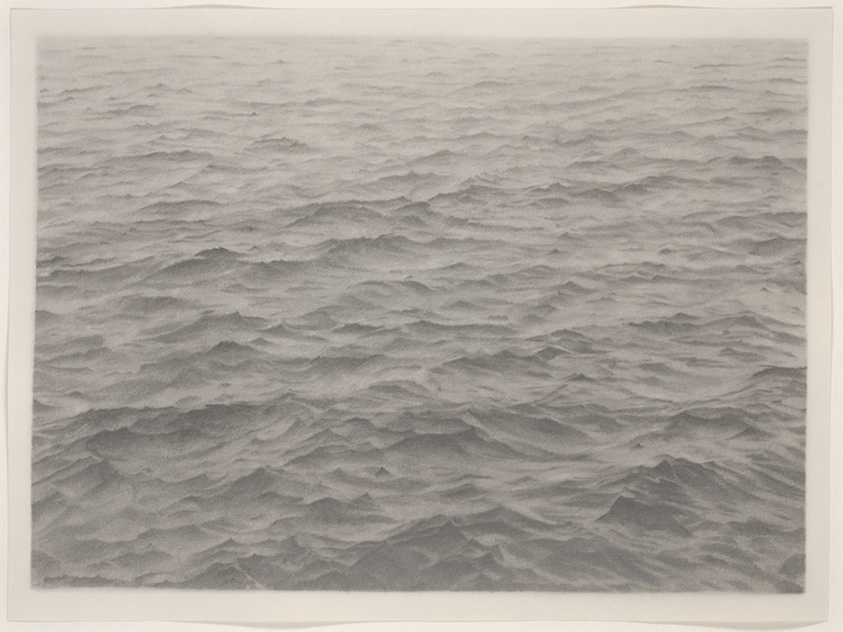
Featured Art: Untitled by Vija Clemins

In your prime, shape presents itself first,
the angle and curve of one thing,
the size of something else,
or the way her hair flows volcanically

along each subtle slope and swell.
It is crazed, intense, super-heated,
even the soles of your boots feel sticky,

because she’s entered you, you know this,
she charts the very map of your blood,
and that eyelid twitch you have going,
they’ll claim is stress and dehydration,

but it’s her, pal, all her, she floods places
you’ve never named in yourself,
she proffers the pulse, the duende, the élan,
that jackhammer of lust
outside the Fiesta Ware outlet. . . .

But one day, it just happens,
a man’s eyes cloud and change,
you don’t feel with the same ardor
the way she moves, her confident posture,

no, suddenly it is color you notice,
the grays, the yellows, the bruised surfaces
tinged with a silver-green, almost a tarnish,
as if her skin were a metal,

and not such a precious one, either,
more like pewter or the common alloys
of soot-smudged medieval artisans,
something to be re-shaped, hammered thin,
become useful and used.

Read More

The Museum of Might-Have-Been

By Anne-Marie Fyfe

Featured Art: Art Institute of Chicago by Thomas Struth

Opens its doors one Sunday a month
in winter. The queues back up for decades.

If you’re lucky and your number’s called
you can have any tour: Your Charmed Life,
Your Regrets, The Prodigal You, every second
slip-road at the intersections of the possible.

The exhibits are stark and infinite
under strip neon, long hallways
of lost opportunity, slow clocks,
stopped clocks, rooms where even now
a thought might wither: the attic storeroom
is out-of-bounds to all but the curators,
though artifacts are still donated by the hour.

Standing in line is no guarantee
of admission: some days
word spreads that when you
reach the queue’s head, pass through
the double doors, it’ll be stripped out,
even lightbulbs, with only packing materials
and discarded drapes left. Yet critics insist
The Multiple-Choice Foyer, The Roads-Not-Taken
Gallery, The Back Burner Café
are stunning.

Every room’s a tasteful shade of apple-white
apparently. Waxworks and living statues
rehearse at intervals for The Balcony Scene,
The Shining City, The Reconciliation
, over
and over, night by night. As in the finest operas.


Read More

My Grandmother the Mohel

By Barbara Hamby

Featured Art: Study of a Baby by Fredrick Goodall

When I tell my mother that a man I know pickets the local hospital
              about what his wife calls “his topic” that is, circumcision
and its evils, she tells me this was my grandmother’s specialty
              as a nurse, and I say, “You’re kidding.” “No. The doctor
she worked for couldn’t stand it, so she did all his circumcisions.
              She loved it!” Loved it? I think—cutting the tips off
boys’ penises? Loved what? The precision? The power? The cries?
              I remember sitting with my mother and grandmother
when I was seven or eight, pretending to play, so I could listen
              to them talk in front of my grandparents’ house
in Washington, 328 Maryland Avenue, and down the tree-lined street
              you could see the Capitol dome looming. A couple
were walking on the sidewalk, and they waved at my grandmother,
              who smiled and waved back. “Are they married?”
my mother asked when they passed. “No,” my grandmother
              answered, “they’re just shacked up.” The cups of my ears
gathered around those words like ravenous Venus Fly Traps,
              because this was just what I had been waiting for,
though I had no idea what it meant, and I knew I couldn’t ask
              or my doll dressing and tuneless singing would be exposed
for the subterfuge they were, and I’d be exiled into the house,
              and this was before my grandfather died, who didn’t think
a woman should drive, but my grandmother taught herself,
              her two little girls in the back seat screaming
as the car jerked over the dirt road behind their house in Kentucky,
              and then after he died, she went to school and became a nurse,
but fifty years later I’m chatting with a man on a plane, who’s returning
              home after spending the day in New York because
he is a mohel and has made this long trip to snip the tip off
              some little boy’s penis, and I think of Mantegna’s painting
of the circumcision of Christ at the Uffizi and kosher laws which
              forbid eating crustaceans, which would mean a sacrifice
of gumbo, boullabaisse, cioppino and fish soups the world over,
              and it was the fried Apalachicola shrimps that broke
the back of my vegetarianism, what in Louisiana they call
              “sramps,” and I’ve heard them called “pinks,” “prawns,”
and sometimes when I’m standing over the stove making a roux
              my life seems to be a kind of gumbo, and if you don’t burn
the water-and-flour paste, then it doesn’t much matter what else
              you throw in, but okra is a must and a couple dozen
oysters, andouille sausage, all your dark mistakes mixed in
              with the brilliant medals and diamond tiaras,
and my grandmother told me she went to her wedding
              in a horse and buggy, a seventeen-year-old girl,
probably a virgin, and little did she know where that road
              would lead her, from canning tomatoes and corn
to snipping the tips off thousands of penises to the nursing home
              where she died, shacked up with all her selves,
that particular gumbo stewing in a body withered by 93 years,
              not knowing anything but that she’d rather be eating
ice cream, driving to Memphis, frying chicken, mashing
              potatoes, baking a cake with blackberries
her daughters picked that morning before walking to school.


Read More

Aftermath in Brine

By Elton Glaser

Featured Art: Parking Lot, from The Plain of Smokes by Kenneth Price

I can’t stand here all day, glands in a wrangle,
Like some brimstone preacher
Beating the bejesus out of his ratty Bible.

Parvenu and undermensch, slave to enabling vices,
I’m lost in a lanky rhetoric,
Simplicities on the fritz.

But you can’t make laws for monkeys, or poems
From some eruption in the nuts,
Every complication its own Vesuvius.

Poems: or as the Chinese warn,
Disasters that come from the mouth.
Sometimes there’s no wild honey at the end of the beeline,

Only these terse tercets
With no mercy on the rubes
Or the lithe appreciators of gilded tea sets.

There’s always some bother in the Balkans,
And tantrums among the voluble Italians. There’s always
A dent in the fender where the force fields meet.

Read More

June

By Michael Bazzett

Featured Art: The Sick Child I by Edvard Munch

Stray hair is pulled from the lapel of her favorite
wool coat years later in a secondhand shop, drawn
free in a quick, definitive gesture that could only
be called thoughtless. It settles on the worn carpet
while another woman’s hand holds the hanger and
drapes the coat across her chest—she eyes it

in the mirror with an air of cold appraisal, breath
rising and falling, her chest plumbed with valves
pulsing mindlessly, the forgotten hair underfoot
still holding the map and code of everything
another woman was: the face with the furrowed brow
that could fold and break into a lightning smile,
a woman with a knack for contentment and
quick anger that dispersed as clouds over hills.

An arm slips in and she feels the cool silk lining
on her bare skin. It is June. She does not need a coat
but her mind craves autumn and being wrapped
in well-wrought layers. She slips the other arm in
and hugs herself, snugging the coat to her waist,
wrapping it like a kimono, Yes, she thinks, seeing
an older version of herself walking through a park—
the image comes suddenly, like rain from nowhere.


Read More

Rituals

By Suzanne Carey

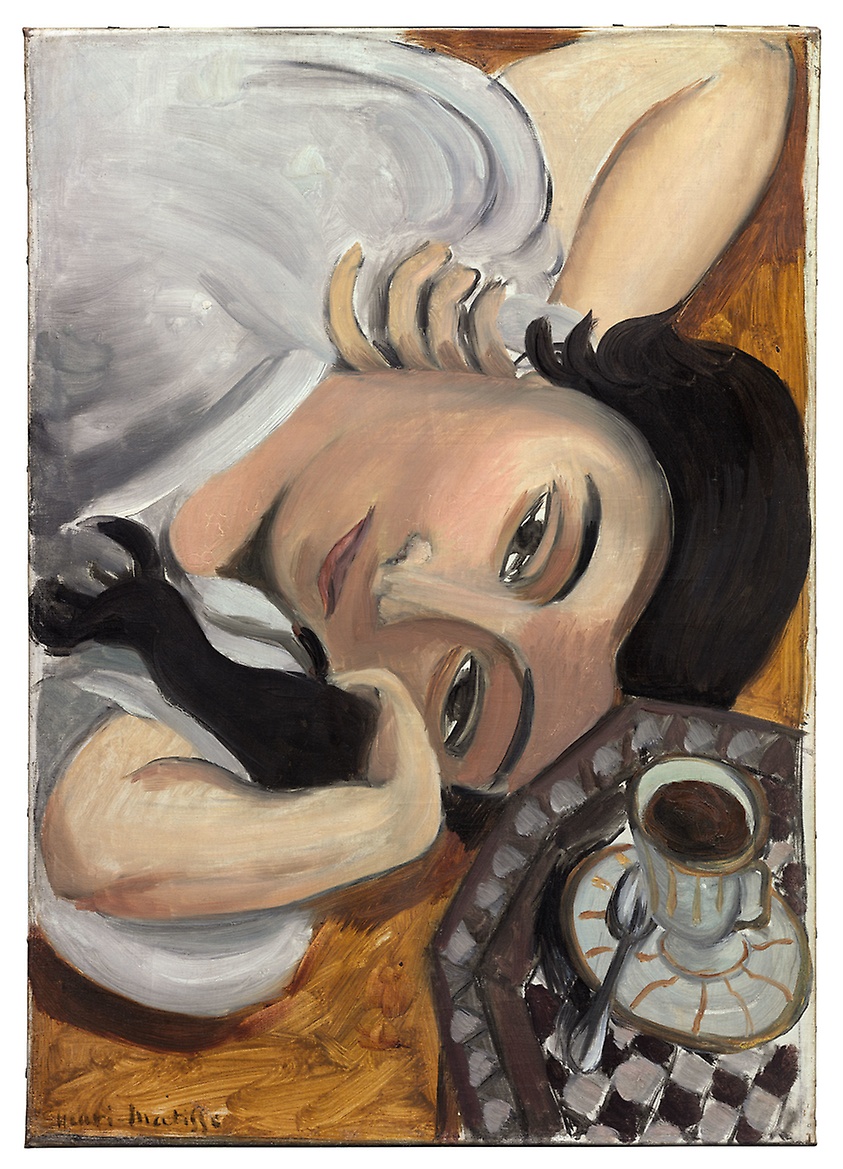
Featured Art: Lorette with a Cup of Coffee by Henri Matisse

After my swim, I sit at a small table at Peet’s
with my medium sugar-free, low-fat, vanilla freddo
that the barista started as I walked in.
I push the whipped cream deep into the cup and worry

about my daughter, who drives
a perilously small car on the freeway,
and my son in New Orleans, too poor to drive,
whose illness frightens me most of all.

My father worried about us until the day he died.
When I came home from college, he insisted
I take the dog or my ten-year-old brother with me
when I drove at night. At eighty-six, he called me daily

from the nursing home to make sure I was okay.
I remember how my mother savored
half a nickel-box of licorice bits and a single cigarette
as she read each evening, waiting for us to come home,

and years later, how she devoured the Hershey bars
and Cokes Dad brought her every afternoon,
long after she had forgotten us all.


Read More

My Father’s New Woman

By Fleda Brown

Featured Art: Fruit and Flowers by Orsola Maddalena Caccia

My father has a new woman. He’s 93, the old one is worn out.
They used to hold hands and watch TV in his Independent Living
cottage, but now there is the new one, to hold hands. The old
one is in Assisted Living not 50 feet away but barely able
to lift herself to her walker. He sits in her room after dinner,
her mind wandering in and out. What if she escapes
and comes over while my father is “taking a nap”
with this new one? My mother is two miles away beneath
her stone, relieved. I bring artificial flowers to her with my sister,
who likes to do that when we visit. I am not much for
demonstration. I would just stand there and say, oh, mother,
he’s at it again. And she’d say, I am sleeping, don’t bother me
with him anymore. And we’d commune in that way that knows
well enough what we’re not saying. And I’d be lamenting
my self-righteous silence in the past, my smart-aleck-motherjust-
go-to-a-therapist talk. What I should have said was, was,
was, oh, it was like a tower of blocks. Pull one out and all
would fall. She would get a divorce and a job and marry some
balding man like her father, who would be my ersatz father
and would take her dancing and let her wear her hair
the way she wanted, and she would cut it short and get it
permed and life would quiet down and my father, to her, would
morph into the handsome and funny Harvard Man he was
in the old days, the way he posed her for his camera, tilting
her head to the light with his devouring-passion fingertips
and her days would begin to feel like a succession
of pale slates to scribble on and erase before the new husband
came home from work, while my father would spin off
after whoever would “put up with him,” as he says,
and would follow his new one around carrying her groceries
and complaining that she spends too much, but biting his tongue
and thinking how soon she would let him, well, you know,
and I would be, what? The same as now, writing this down
so that none of the shifting and sifting could get away
cleanly without at least this small consequence.


Read More

Yet

By Eric Torgersen

Featured Image: “Study for “Le Bain”: Two Women and a Child in a Boat” by Mary Cassatt

You’ve got to act, and soon, but you don’t dare yet.
There’s one big load you don’t think you can bear yet.

You chose to dive this deep; it’s not for me
to tell you why you can’t come up for air yet.

You had big plans. You’re running out of time.
There’s no excuse to contemplate despair yet.

All that time and trouble spent on you.
For all the rest, you don’t have much to spare yet.

The world should find some meaning in your work?
You haven’t shown us why we ought to care yet.

Don’t give me that I-don’t-get-it look.
Sixty-five, and still not self-aware yet.

You might just want to start to pack your bags.
You may not have enough to pay the fare yet,

but that doesn’t mean the taxi’s not on its way.
Look out the window. No, it isn’t there. Yet.

Call it what you will, but thank something, Eric.
There’s one stiff suit you haven’t had to wear yet.


Read More

Remembered Grace

By Jim Daniels

My mother rolls her walker through the rug
like pushing a dull reel mower through high grass.
She cannot see, so maybe the simile should be sound instead—
like bad jokes from a dull boor. The brittle thread of escape
snapped long ago, sewing kit trashed, needles only and constant
from pain—knee/back/hip. Blurry edges of God rim
her miraged vision. She burns a sandwich on the grill
but not herself—thrill enough to earn a pill. Today
she’s skipping church, and it’s just next door. She calls me
from the kitchen to carry her cup back to her chair—no free
hands. She must watch where she lands when it’s all freefall
and whiffs of Jesus not happy with her. I’m a tourist
with a bad map. She’s a local with time. She waves her hand
as she talks, one graceful thing. She flirts with air.


Read More

At the Mall

By Carl Dennis

Featured art: Youth by Frederick Carl Frieseke

It’s a long time now since the cedar tree
That you and Martha Spicer inscribed
With your twined initials was reduced to shingles
For a house later torn down to make way
For the Northtown Mall, the very mall
You walk now on rainy mornings.
In a few more weeks of the exercise program
Prescribed by your doctor, you should feel the strength
Lost with your triple-bypass finally returning.
Then you’ll confront the years still left you
With the zeal they merit, or the fortitude.
Be sure you’re in line when the mall doors open,
Before the aisles fill with serious shoppers
Intent on finding items more sturdy
Than their bodies are proving to be.
Could Martha Spicer be among them?
What you felt for each other back then
Didn’t survive the separation of college,
Though now it seems careless of you
Not to have kept in touch. Maybe you’ve passed her
Unrecognized as she’s looked for gifts
To make her grandchildren curious
About the world they live in, a book, say,
Devoted to local trees. On the cover
A cedar stands resplendent, the very kind
She carved her initials in long ago
With a boy whose name may be resting now
On the tip of her tongue. Try to imagine her
Hoping he hasn’t wasted his time on wishes
That proved impractical, like her hill house
Bought for its vista that proved in winter
Inaccessible to a snowplow. If he made that mistake,
Let him move back to town as she did
And focus like her on keeping her windows open
So a fragrance blown from afar can enter
When it wants to enter, and be made welcome.


Read More

Superman at 95

By Gregory Djanikian

Featured Art: The Collector of Prints by Edgar Degas

It was never a question of age, finally.
Time for him had always moved
too slowly, wasn’t he faster than time,
outrunning it whenever he wished?
Even now, he could hear the sound
of every second before it clicked.

Oh, he was powerful enough,
still wildly aerodynamic, able
to leap imagination itself.

But he’d grown weary of it all,
the adoring looks, the caped crusading
in the name of righteousness and truth:
hadn’t it frayed a little, lost
its gleam through the turbulent years?

Nothing had changed really,
annihilation, ruin, the horsemen
of every apocalypse still riding through
like bad cops and pestilence,
knowing where everyone lived.

And his own life, emptier now
with so many friends gone
or on the way, Jimmy, Lois,
doddering in their last stages
in a metropolis of fear.

Read More

Penny Red

By Maura Stanton

Art Attribution: “Untitled (Hourglass)” by Mary Vaux Walcott

I found a cancelled English penny stamp
Stuck in a library book, and pinched it up,
1909, October 8, 6:50 p.m.
Somebody must have licked it right before
They posted a letter, and left their DNA
Stuck to the glue, and somebody else
Unpeeled it, saved it, stuck it between the pages
Of a book that later got shipped abroad. Read More

Early Life

By Sydney Lea

All the pastor’s years of serving God
and humankind—they’re nothing now.
His congregation has long resigned itself
to anecdotal, meandering sermons.
But how forgive his mixing the liturgy
of welcome to a new church member
with the ceremony—however it may be related—
of baptism? The poor young parents

blush and fidget while veteran members feel
something between impatience and rage.

The minister and infant, robed and sleeping,
appear serene, above it all,
the one too young, even awake, to know
what’s going on and the other unable
to keep intact his thinking. Painful pauses.
Autumn rain on the roof like gunfire.

Read More

Whirlpool

By George Bilgere

In the morning, after much delay,
I finally go down to the basement
To replace the broken dryer belt.

First, I unbolt the panels
And sweep up the dust mice and crumbling spiders.
I listen to the sounds of the furnace
Thinking things over
At the beginning of winter.

Then I stretch out on the concrete floor
With a flashlight in my mouth
To contemplate the mystery
Of the tensioner-pulley assembly.

And finally, with a small, keen pleasure,
I slip the new belt over the spindle, rise,
And screw everything back together.

Later, we have Thanksgiving dinner
With my wife’s grandmother, who is dying
Of bone cancer. Maybe,
If they dial up the chemo, fine-tune the meds,
We’ll do this again next year.

But she’s old, and the cancer
Seems to know what it’s doing.
Everyone loves her broccoli casserole.
As for the turkey, it sits on the table,
A small, brown mountain we can’t see beyond.

That night I empty the washer,
Throw the damp clothes into the dryer.
For half an hour my wife’s blouses
Wrestle with my shirts
In a hot and whirling ecstasy,

Because I replaced an ancient belt
And adjusted the tensioner-pulley assembly.


Read More

Faculty Lounge

By George Bilgere

There’s my friend Miles, reading the paper.
Looking at him, you’d never guess
He’s a world-class ichthyologist.

And there’s Graciella, still attractive,
Letting herself go gray. I remember
All the fuss about her groundbreaking treatise
On neutrinos created back in the early nineties.
She’s reading a book entitled, simply, Neutrinos.

And there, of course, is Marty. He’s always here,
With his flip-flops and his laptop.
His cappuccino and his shorts.
He’s the number one guy,
In this hemisphere, anyway,
In antimatter. What Marty doesn’t know
About antimatter isn’t worth knowing.

He’s talking with Lewis
Who is sweeping the floor.
Lewis knows his back hurts
When it’s going to storm. He knows
We don’t have any pitching this year,
And he’s right about that
And Marty knows he’s right
And there’s no point arguing about it.


Read More

How She Lost Her Mind

By April Lindner

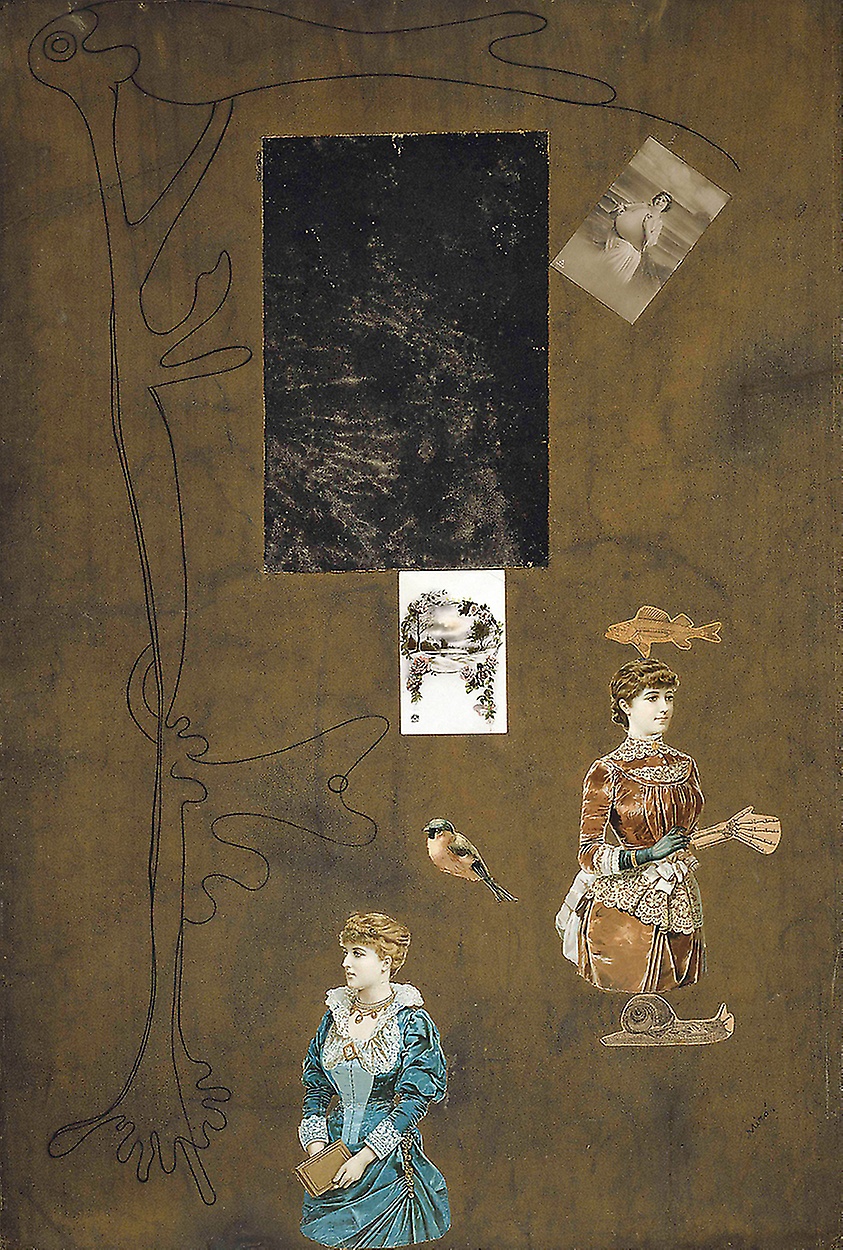
Featured Art: Drawing – Collage by Joan Miró

Slowly at first, the arteries
in the brain’s finely spun net
narrow one by one
_____________to dead ends;
like the hand’s delicate motion,
__________a series of strokes

erase what took decades to write.

Difficult tasks forgotten first:
_______________how to merge onto a highway,
___________________knit a sweater,
_______________________buy a stamp.
Then the simpler ones,
___________________how to turn on an oven,
_______________________what goes in a cup.

Read More

’69

By Kathy Fagan

Featured Art: Alfred Sisley by Pierre-Auguste Renoir

If it’s been ten times it’s been forty-five
I’ve checked the man out in the car behind
mine, teeth bared, laughing in my rearview.

I cannot stop myself from watching him,
sun full on his face. He’s all alone—
we are, among our fellow rush commuters—

and then it dawns on me: it’s Mr. Cahill
from sixth grade, my first male teacher (heart, be still!),
who taught sex ed to us in ‘69,

in Catholic school, till someone narked and he
was gone for good. Those days, we venerated
the venereal, reciting sex words right

Read More

My Life

By Jack Myers

Featured Art: October Day by Jean Charles Cazin

was never large enough even for a B movie
though I think I’ve felt as deeply as Brad Pitt.
No one I grew up with ever became famous
or notorious on that spit of land that ended in the sea.
But we became as adept at reading storm warnings
in the muscle and color of water as we did in a face.

In the cold-war doldrums of the 50s, all my teachers
hated teaching. We were such little shits back then
I thought who could blame them, and became a teacher
so I could show these younger versions of myself
how to open their hearts and enter into a different,
richer kind of darkness that exists in them.

We were an obstinate desert people given a single animal
which we rode and milked and roasted and skinned.
The stories strangers told us about fabulous places
we’d never get to taught us how to open a door in rock
and go inward, how to widen our hearts with longing
and a song and bang along on a drum skin and a string.

Read More

Plans

By Jack Myers

Featured Art: Houses of Parliament, London by Claude Monet

I thought of my soul as something like a scent,
like an air of kindliness. That my selfish heart
would grow enormous in battle. I thought I could help
the troubled because I was troubled. I wanted my humility
to be large, to float like a balloon above the parade I was in.

But you know how it goes. My epic turned out to be
a miniature self-portrait painted on a brick from a wall
in me that had fallen in. My oxen were small as bugs.
My arrows that I imagined shredding the sky like black rain
in a Japanese ink print melted back into brushstrokes.

So it’s good to feel small once more, to bow at the end
of a long line of becoming everything again. No more
struggling to fit in after wind-light sweeps me up or a dying
ember takes me in as easily as I thought my life should have been.

Or maybe what’s next will be harder or nothing or I’ll be
totally surprised without there being a me. I always felt like
that anyway. But the place in me where all of this is missing
has turned sacred over time. That’s the best explanation I have
for why we aren’t allowed to know even the simplest things.


The History of Forgetting

By Lawrence Raab

Featured Art: Eve by Lucas Cranach the Elder

When Adam and Eve lived in the garden
they hadn’t yet learned how to forget.
For them every day was the same day.
Flowers opened, then closed.
They went where the light told them to go.
They slept when it left, and did not dream.

What could they have remembered,
who had never been children? Sometimes
Adam felt a soreness in his side,
but if this was pain it didn’t appear to
require a name, or suggest the idea
that anything else might be taken away.
The bright flowers unfolded,
swayed in the breeze.

It was the snake, of course, who knew
about the past—that such a place could exist.
He understood how people would yearn
for whatever they’d lost, and so to survive
they’d need to forget. Soon
the garden will be gone, the snake
thought, and in time God himself.

These were the last days—Adam and Eve
tending the luxurious plants, the snake
watching from above. He knew
what had to happen next, how persuasive
was the taste of that apple. And then
the history of forgetting would begin—
not at the moment of their leaving,
but the first time they looked back.


Read More

Degeneration

By Stefi Weisburd

Featured Art: Stoke-by-Nayland by John Constable

Through the forest’s dark persistence, hugging
the relentless road, you search the inevitable
for the sad address, then find yourself paused

in front of the driveway, just
before your halogens startle the dim
windows, the porch out of joint, in that moment

before you are knotted irrevocably
to the future, to her avocado refrigerator whining
like a beast, its gullet full of Ice Age ice cream and the odd

trap-sprung mouse in a Ziploc, before the legions
of art magazines piled in solemn cairns and the Old Countries
purpling her arms, her throat’s

dry drapery and the keys to abandoned
rooms clutched
like a crucifix. In that moment

before her body slips
out of itself and she dampens the floor, before
her ears traffic in the static of her dead

father’s scolding, before her dull
doe eyes fever with fury and shadows hunch like Dante,
before she calls you “Mother,” demanding

you wipe her ass, before her heart cherries and
Tolstoys, in that moment, turned in the driveway, before
all that, back out. Gun it.


Read More

Reunion

By Bruce Weigl

Featured Art: Woman at Her Toilette by Edgar Degas

Now, as the popular girl walks among us with the microphone,
most of the stories are about loss,
or include exquisitely precise medical and pharmaceutical details,
as if the words could suture the wounds, or save us even one last breath.
I came here to dance with the Puerto Rican women
of my class of 1967, and to remember a few pals lost in the war,
who had been so beautiful, you were happy just to look upon them,
and one more
lost to his own drunken wildness
under a moon who doesn’t remember us.
It’s not a going back we long for, but a staying still
for one incomparable moment, all the lost loves’ faces
spinning in the mirrored ball.