Aftermath in Brine

By Elton Glaser

Featured Art: Parking Lot, from The Plain of Smokes by Kenneth Price

I can’t stand here all day, glands in a wrangle,
Like some brimstone preacher
Beating the bejesus out of his ratty Bible.

Parvenu and undermensch, slave to enabling vices,
I’m lost in a lanky rhetoric,
Simplicities on the fritz.

But you can’t make laws for monkeys, or poems
From some eruption in the nuts,
Every complication its own Vesuvius.

Poems: or as the Chinese warn,
Disasters that come from the mouth.
Sometimes there’s no wild honey at the end of the beeline,

Only these terse tercets
With no mercy on the rubes
Or the lithe appreciators of gilded tea sets.

There’s always some bother in the Balkans,
And tantrums among the voluble Italians. There’s always
A dent in the fender where the force fields meet.

Read More

June

By Michael Bazzett

Featured Art: The Sick Child I by Edvard Munch

Stray hair is pulled from the lapel of her favorite
wool coat years later in a secondhand shop, drawn
free in a quick, definitive gesture that could only
be called thoughtless. It settles on the worn carpet
while another woman’s hand holds the hanger and
drapes the coat across her chest—she eyes it

in the mirror with an air of cold appraisal, breath
rising and falling, her chest plumbed with valves
pulsing mindlessly, the forgotten hair underfoot
still holding the map and code of everything
another woman was: the face with the furrowed brow
that could fold and break into a lightning smile,
a woman with a knack for contentment and
quick anger that dispersed as clouds over hills.

An arm slips in and she feels the cool silk lining
on her bare skin. It is June. She does not need a coat
but her mind craves autumn and being wrapped
in well-wrought layers. She slips the other arm in
and hugs herself, snugging the coat to her waist,
wrapping it like a kimono, Yes, she thinks, seeing
an older version of herself walking through a park—
the image comes suddenly, like rain from nowhere.


Read More

Rituals

By Suzanne Carey

Featured Art: Lorette with a Cup of Coffee by Henri Matisse

After my swim, I sit at a small table at Peet’s
with my medium sugar-free, low-fat, vanilla freddo
that the barista started as I walked in.
I push the whipped cream deep into the cup and worry

about my daughter, who drives
a perilously small car on the freeway,
and my son in New Orleans, too poor to drive,
whose illness frightens me most of all.

My father worried about us until the day he died.
When I came home from college, he insisted
I take the dog or my ten-year-old brother with me
when I drove at night. At eighty-six, he called me daily

from the nursing home to make sure I was okay.
I remember how my mother savored
half a nickel-box of licorice bits and a single cigarette
as she read each evening, waiting for us to come home,

and years later, how she devoured the Hershey bars
and Cokes Dad brought her every afternoon,
long after she had forgotten us all.


Read More

My Father’s New Woman

By Fleda Brown

Featured Art: Fruit and Flowers by Orsola Maddalena Caccia

My father has a new woman. He’s 93, the old one is worn out.
They used to hold hands and watch TV in his Independent Living
cottage, but now there is the new one, to hold hands. The old
one is in Assisted Living not 50 feet away but barely able
to lift herself to her walker. He sits in her room after dinner,
her mind wandering in and out. What if she escapes
and comes over while my father is “taking a nap”
with this new one? My mother is two miles away beneath
her stone, relieved. I bring artificial flowers to her with my sister,
who likes to do that when we visit. I am not much for
demonstration. I would just stand there and say, oh, mother,
he’s at it again. And she’d say, I am sleeping, don’t bother me
with him anymore. And we’d commune in that way that knows
well enough what we’re not saying. And I’d be lamenting
my self-righteous silence in the past, my smart-aleck-motherjust-
go-to-a-therapist talk. What I should have said was, was,
was, oh, it was like a tower of blocks. Pull one out and all
would fall. She would get a divorce and a job and marry some
balding man like her father, who would be my ersatz father
and would take her dancing and let her wear her hair
the way she wanted, and she would cut it short and get it
permed and life would quiet down and my father, to her, would
morph into the handsome and funny Harvard Man he was
in the old days, the way he posed her for his camera, tilting
her head to the light with his devouring-passion fingertips
and her days would begin to feel like a succession
of pale slates to scribble on and erase before the new husband
came home from work, while my father would spin off
after whoever would “put up with him,” as he says,
and would follow his new one around carrying her groceries
and complaining that she spends too much, but biting his tongue
and thinking how soon she would let him, well, you know,
and I would be, what? The same as now, writing this down
so that none of the shifting and sifting could get away
cleanly without at least this small consequence.


Read More

Yet

By Eric Torgersen

Featured Image: “Study for “Le Bain”: Two Women and a Child in a Boat” by Mary Cassatt

You’ve got to act, and soon, but you don’t dare yet.
There’s one big load you don’t think you can bear yet.

You chose to dive this deep; it’s not for me
to tell you why you can’t come up for air yet.

You had big plans. You’re running out of time.
There’s no excuse to contemplate despair yet.

All that time and trouble spent on you.
For all the rest, you don’t have much to spare yet.

The world should find some meaning in your work?
You haven’t shown us why we ought to care yet.

Don’t give me that I-don’t-get-it look.
Sixty-five, and still not self-aware yet.

You might just want to start to pack your bags.
You may not have enough to pay the fare yet,

but that doesn’t mean the taxi’s not on its way.
Look out the window. No, it isn’t there. Yet.

Call it what you will, but thank something, Eric.
There’s one stiff suit you haven’t had to wear yet.


Read More

Remembered Grace

By Jim Daniels

My mother rolls her walker through the rug
like pushing a dull reel mower through high grass.
She cannot see, so maybe the simile should be sound instead—
like bad jokes from a dull boor. The brittle thread of escape
snapped long ago, sewing kit trashed, needles only and constant
from pain—knee/back/hip. Blurry edges of God rim
her miraged vision. She burns a sandwich on the grill
but not herself—thrill enough to earn a pill. Today
she’s skipping church, and it’s just next door. She calls me
from the kitchen to carry her cup back to her chair—no free
hands. She must watch where she lands when it’s all freefall
and whiffs of Jesus not happy with her. I’m a tourist
with a bad map. She’s a local with time. She waves her hand
as she talks, one graceful thing. She flirts with air.


Read More

At the Mall

By Carl Dennis

Featured art: Youth by Frederick Carl Frieseke

It’s a long time now since the cedar tree
That you and Martha Spicer inscribed
With your twined initials was reduced to shingles
For a house later torn down to make way
For the Northtown Mall, the very mall
You walk now on rainy mornings.
In a few more weeks of the exercise program
Prescribed by your doctor, you should feel the strength
Lost with your triple-bypass finally returning.
Then you’ll confront the years still left you
With the zeal they merit, or the fortitude.
Be sure you’re in line when the mall doors open,
Before the aisles fill with serious shoppers
Intent on finding items more sturdy
Than their bodies are proving to be.
Could Martha Spicer be among them?
What you felt for each other back then
Didn’t survive the separation of college,
Though now it seems careless of you
Not to have kept in touch. Maybe you’ve passed her
Unrecognized as she’s looked for gifts
To make her grandchildren curious
About the world they live in, a book, say,
Devoted to local trees. On the cover
A cedar stands resplendent, the very kind
She carved her initials in long ago
With a boy whose name may be resting now
On the tip of her tongue. Try to imagine her
Hoping he hasn’t wasted his time on wishes
That proved impractical, like her hill house
Bought for its vista that proved in winter
Inaccessible to a snowplow. If he made that mistake,
Let him move back to town as she did
And focus like her on keeping her windows open
So a fragrance blown from afar can enter
When it wants to enter, and be made welcome.


Read More

Superman at 95

By Gregory Djanikian

Featured Art: The Collector of Prints by Edgar Degas

It was never a question of age, finally.
Time for him had always moved
too slowly, wasn’t he faster than time,
outrunning it whenever he wished?
Even now, he could hear the sound
of every second before it clicked.

Oh, he was powerful enough,
still wildly aerodynamic, able
to leap imagination itself.

But he’d grown weary of it all,
the adoring looks, the caped crusading
in the name of righteousness and truth:
hadn’t it frayed a little, lost
its gleam through the turbulent years?

Nothing had changed really,
annihilation, ruin, the horsemen
of every apocalypse still riding through
like bad cops and pestilence,
knowing where everyone lived.

And his own life, emptier now
with so many friends gone
or on the way, Jimmy, Lois,
doddering in their last stages
in a metropolis of fear.

Read More

Penny Red

By Maura Stanton

Art Attribution: “Untitled (Hourglass)” by Mary Vaux Walcott

I found a cancelled English penny stamp
Stuck in a library book, and pinched it up,
1909, October 8, 6:50 p.m.
Somebody must have licked it right before
They posted a letter, and left their DNA
Stuck to the glue, and somebody else
Unpeeled it, saved it, stuck it between the pages
Of a book that later got shipped abroad. Read More

Early Life

By Sydney Lea

All the pastor’s years of serving God
and humankind—they’re nothing now.
His congregation has long resigned itself
to anecdotal, meandering sermons.
But how forgive his mixing the liturgy
of welcome to a new church member
with the ceremony—however it may be related—
of baptism? The poor young parents

blush and fidget while veteran members feel
something between impatience and rage.

The minister and infant, robed and sleeping,
appear serene, above it all,
the one too young, even awake, to know
what’s going on and the other unable
to keep intact his thinking. Painful pauses.
Autumn rain on the roof like gunfire.

Read More

Whirlpool

By George Bilgere

In the morning, after much delay,
I finally go down to the basement
To replace the broken dryer belt.

First, I unbolt the panels
And sweep up the dust mice and crumbling spiders.
I listen to the sounds of the furnace
Thinking things over
At the beginning of winter.

Then I stretch out on the concrete floor
With a flashlight in my mouth
To contemplate the mystery
Of the tensioner-pulley assembly.

And finally, with a small, keen pleasure,
I slip the new belt over the spindle, rise,
And screw everything back together.

Later, we have Thanksgiving dinner
With my wife’s grandmother, who is dying
Of bone cancer. Maybe,
If they dial up the chemo, fine-tune the meds,
We’ll do this again next year.

But she’s old, and the cancer
Seems to know what it’s doing.
Everyone loves her broccoli casserole.
As for the turkey, it sits on the table,
A small, brown mountain we can’t see beyond.

That night I empty the washer,
Throw the damp clothes into the dryer.
For half an hour my wife’s blouses
Wrestle with my shirts
In a hot and whirling ecstasy,

Because I replaced an ancient belt
And adjusted the tensioner-pulley assembly.


Read More

Faculty Lounge

By George Bilgere

There’s my friend Miles, reading the paper.
Looking at him, you’d never guess
He’s a world-class ichthyologist.

And there’s Graciella, still attractive,
Letting herself go gray. I remember
All the fuss about her groundbreaking treatise
On neutrinos created back in the early nineties.
She’s reading a book entitled, simply, Neutrinos.

And there, of course, is Marty. He’s always here,
With his flip-flops and his laptop.
His cappuccino and his shorts.
He’s the number one guy,
In this hemisphere, anyway,
In antimatter. What Marty doesn’t know
About antimatter isn’t worth knowing.

He’s talking with Lewis
Who is sweeping the floor.
Lewis knows his back hurts
When it’s going to storm. He knows
We don’t have any pitching this year,
And he’s right about that
And Marty knows he’s right
And there’s no point arguing about it.


Read More

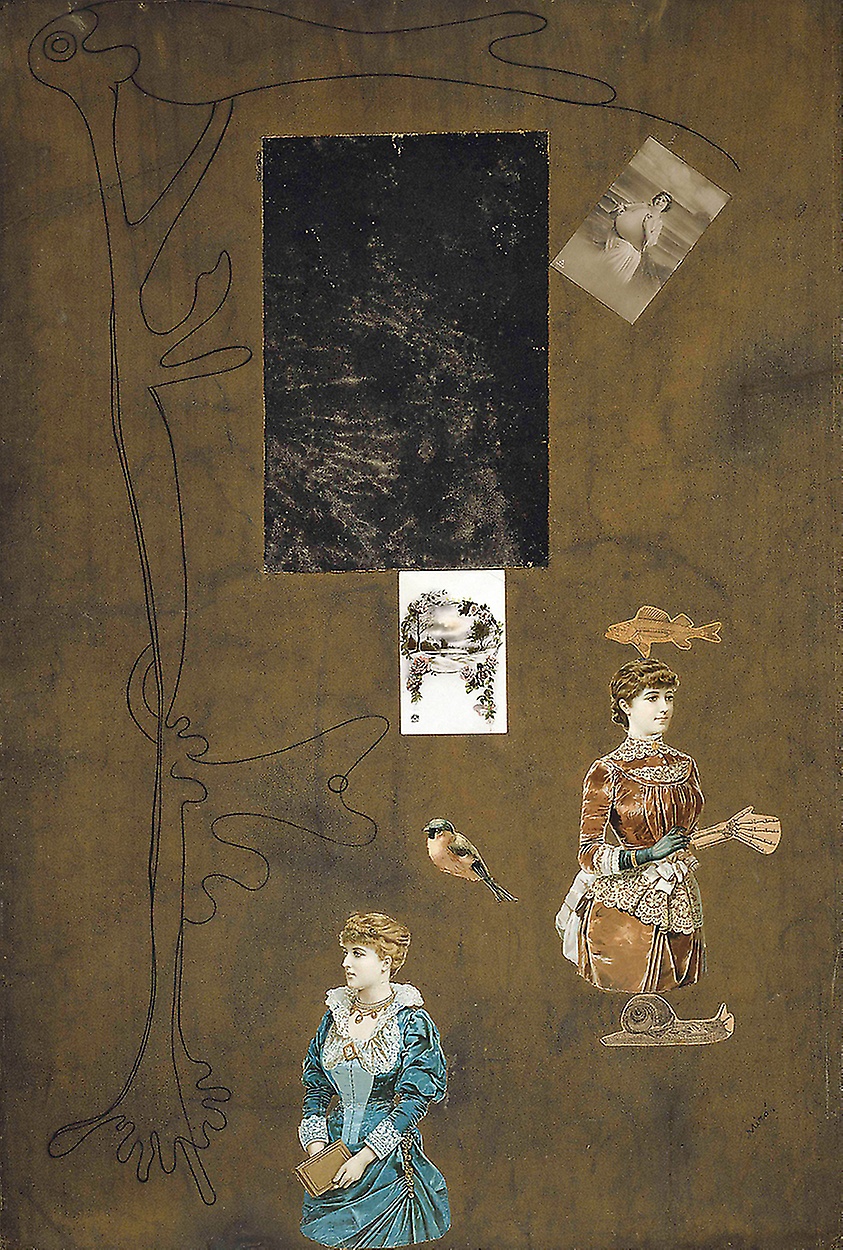
How She Lost Her Mind

By April Lindner

Featured Art: Drawing – Collage by Joan Miró

Slowly at first, the arteries
in the brain’s finely spun net
narrow one by one
_____________to dead ends;
like the hand’s delicate motion,
__________a series of strokes

erase what took decades to write.

Difficult tasks forgotten first:
_______________how to merge onto a highway,
___________________knit a sweater,
_______________________buy a stamp.
Then the simpler ones,
___________________how to turn on an oven,
_______________________what goes in a cup.

Read More

’69

By Kathy Fagan

Featured Art: Alfred Sisley by Pierre-Auguste Renoir

If it’s been ten times it’s been forty-five
I’ve checked the man out in the car behind
mine, teeth bared, laughing in my rearview.

I cannot stop myself from watching him,
sun full on his face. He’s all alone—
we are, among our fellow rush commuters—

and then it dawns on me: it’s Mr. Cahill
from sixth grade, my first male teacher (heart, be still!),
who taught sex ed to us in ‘69,

in Catholic school, till someone narked and he
was gone for good. Those days, we venerated
the venereal, reciting sex words right

Read More

My Life

By Jack Myers

Featured Art: October Day by Jean Charles Cazin

was never large enough even for a B movie
though I think I’ve felt as deeply as Brad Pitt.
No one I grew up with ever became famous
or notorious on that spit of land that ended in the sea.
But we became as adept at reading storm warnings
in the muscle and color of water as we did in a face.

In the cold-war doldrums of the 50s, all my teachers
hated teaching. We were such little shits back then
I thought who could blame them, and became a teacher
so I could show these younger versions of myself
how to open their hearts and enter into a different,
richer kind of darkness that exists in them.

We were an obstinate desert people given a single animal
which we rode and milked and roasted and skinned.
The stories strangers told us about fabulous places
we’d never get to taught us how to open a door in rock
and go inward, how to widen our hearts with longing
and a song and bang along on a drum skin and a string.

Read More

Plans

By Jack Myers

Featured Art: Houses of Parliament, London by Claude Monet

I thought of my soul as something like a scent,
like an air of kindliness. That my selfish heart
would grow enormous in battle. I thought I could help
the troubled because I was troubled. I wanted my humility
to be large, to float like a balloon above the parade I was in.

But you know how it goes. My epic turned out to be
a miniature self-portrait painted on a brick from a wall
in me that had fallen in. My oxen were small as bugs.
My arrows that I imagined shredding the sky like black rain
in a Japanese ink print melted back into brushstrokes.

So it’s good to feel small once more, to bow at the end
of a long line of becoming everything again. No more
struggling to fit in after wind-light sweeps me up or a dying
ember takes me in as easily as I thought my life should have been.

Or maybe what’s next will be harder or nothing or I’ll be
totally surprised without there being a me. I always felt like
that anyway. But the place in me where all of this is missing
has turned sacred over time. That’s the best explanation I have
for why we aren’t allowed to know even the simplest things.


The History of Forgetting

By Lawrence Raab

Featured Art: Eve by Lucas Cranach the Elder

When Adam and Eve lived in the garden
they hadn’t yet learned how to forget.
For them every day was the same day.
Flowers opened, then closed.
They went where the light told them to go.
They slept when it left, and did not dream.

What could they have remembered,
who had never been children? Sometimes
Adam felt a soreness in his side,
but if this was pain it didn’t appear to
require a name, or suggest the idea
that anything else might be taken away.
The bright flowers unfolded,
swayed in the breeze.

It was the snake, of course, who knew
about the past—that such a place could exist.
He understood how people would yearn
for whatever they’d lost, and so to survive
they’d need to forget. Soon
the garden will be gone, the snake
thought, and in time God himself.

These were the last days—Adam and Eve
tending the luxurious plants, the snake
watching from above. He knew
what had to happen next, how persuasive
was the taste of that apple. And then
the history of forgetting would begin—
not at the moment of their leaving,
but the first time they looked back.


Read More

Degeneration

By Stefi Weisburd

Featured Art: Stoke-by-Nayland by John Constable

Through the forest’s dark persistence, hugging
the relentless road, you search the inevitable
for the sad address, then find yourself paused

in front of the driveway, just
before your halogens startle the dim
windows, the porch out of joint, in that moment

before you are knotted irrevocably
to the future, to her avocado refrigerator whining
like a beast, its gullet full of Ice Age ice cream and the odd

trap-sprung mouse in a Ziploc, before the legions
of art magazines piled in solemn cairns and the Old Countries
purpling her arms, her throat’s

dry drapery and the keys to abandoned
rooms clutched
like a crucifix. In that moment

before her body slips
out of itself and she dampens the floor, before
her ears traffic in the static of her dead

father’s scolding, before her dull
doe eyes fever with fury and shadows hunch like Dante,
before she calls you “Mother,” demanding

you wipe her ass, before her heart cherries and
Tolstoys, in that moment, turned in the driveway, before
all that, back out. Gun it.


Read More

Reunion

By Bruce Weigl

Featured Art: Woman at Her Toilette by Edgar Degas

Now, as the popular girl walks among us with the microphone,
most of the stories are about loss,
or include exquisitely precise medical and pharmaceutical details,
as if the words could suture the wounds, or save us even one last breath.
I came here to dance with the Puerto Rican women
of my class of 1967, and to remember a few pals lost in the war,
who had been so beautiful, you were happy just to look upon them,
and one more
lost to his own drunken wildness
under a moon who doesn’t remember us.
It’s not a going back we long for, but a staying still
for one incomparable moment, all the lost loves’ faces
spinning in the mirrored ball.