The Word Committee

By Maria Dylan Himmelman
Featured Image: “Through the al-Nil” by Ryan Davis

In January 1896, The Word Committee
conducts its annual séance in order to pull
from Beyond the year’s new words
The Committee head channels Ape-man
and Guttersnipe; the vice, Unicycle and Firebug
There is some discussion of Béarnaise Sauce
and Beef-Steak Tomato before all agree 
on Actuary. There are not yet words for what
happens next, a small boy in the gloom
chasing rats through the alley, a torch burping
smoke like shots on the battlefield, the music
of breaking glass. There’s no sense really
in calculating the odds. It’s already
dark outside 


Read More

Roaming the Labyrinth—Review

By Claire Eder

When encountering a new poetic voice, especially one that reaches me in translation, I often find myself flipping frequently between the main text and the notes section in the back of the book, grasping for purchase. Once the poems have drawn me in, I want more. I’m nosy and I desire at least some of the crucial details about this person: what was their childhood like? Why does the image of an orange slice keep reappearing? What is this geopolitical conflict, not obvious to a twenty-first century American reader, that they’re referencing in certain poems? While endnotes in academic texts can be dry, I find the notes in volumes of poetry can often be juicy, giving little peeks behind the curtain. 

For this reason, I am enthusiastic about the format that Christina Cook has created in Roaming the Labyrinth with Marie-Claire Bancquart (Aim Higher, 2025), and I’d be happy to see other works in translation adopt such a structure. Roaming the Labyrinth essentially takes the notes section, expands it, and plops it into the main text. The poems are nested in between prose sections offering analysis, context, and personal reflection. (The book also has actual endnotes with helpful material.) Through this unique structure, we get a rare glimpse into the translator-poet relationship, in this case a friendship that lasted many years, until Bancquart’s death in 2019. We come to understand certain choices that Cook made in her translations, and we get a true portrait of the remarkable, generous writer at the center of the text (labyrinth). What’s more, we are privy to a conversation between the translations and Cook’s own poetry, as she includes a handful of her poems that were shaped by her relationship with Bancquart. 

Read More

Review: Bill Hollands’ Mangrove

By Evan Green

Bill Hollands’s debut collection, Mangrove (published by ELJ Editions, 2025), takes readers through poems of nostalgia, grief, and family, primarily set against the lush backdrop of Florida. Raised in Miami, Hollands paints vivid images not only of the Floridian environment, but also the losses that he has faced. Hollands’s poetry also teems with references to the famous faces of his youth, all while he explores those personal memories. Combining this grief, and references to bygone 70s TV, Mangrove is a moving reflection on a queer life lived to the fullest. In tender and reflective poems, it guides readers through personal transformation and transformations in our televised culture.

From the beginning of his collection, it’s clear how large an impact both television and the natural environment had on Hollands as a child. Recurring images of verdant plant life alongside references to stars from the 60s through the 80s paint the picture of a childhood perched at a sliding glass door between the light of the outdoors and the glow of the television screen. The collection evokes feelings of nostalgia for that late-twentieth century moment—in all its velvet.

In the first section, Hollands dwells on a queer childhood, artfully reminiscing on a time full of new experiences and personal hardships. The second section focuses on Hollands’s family as he ponders the loss of several loved ones with bittersweet remembrance. Finally, the third section reflects on Hollands’s life as a whole, touching on emotion-filled moments from both his childhood and present-day life as a partner, parent, and teacher.

Read More

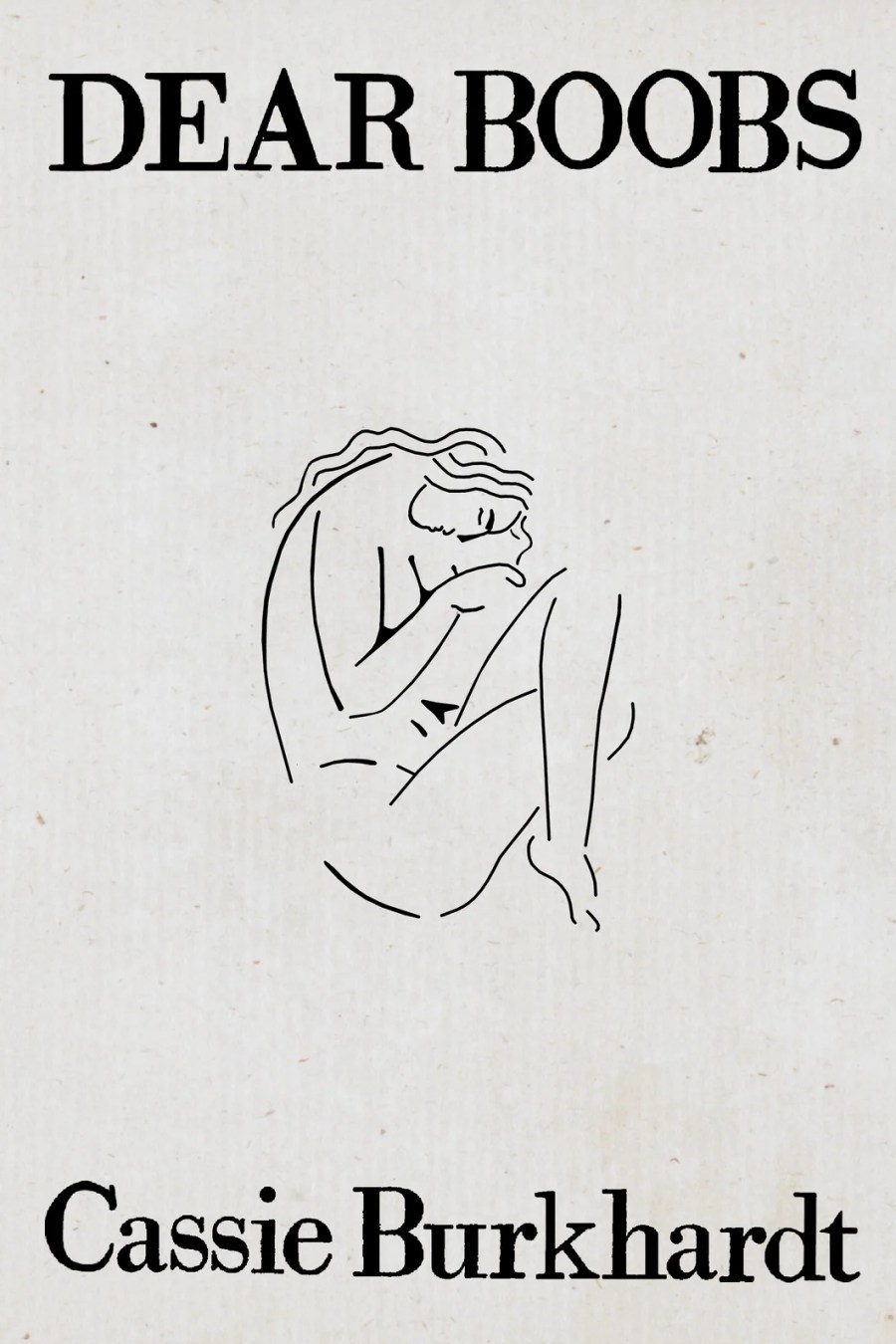
Review: Dear Boobs by Cassie Burkhardt

By Tyler List

Cassie Burkhardt’s collection, Dear Boobs (Bottlecap Press, 2025), is a linked collection of well-crafted poems that deal with motherhood and a longing for love. Despite its comical title, Burkhardt’s poems take the reader into the life of a mother trying to get through the day while simultaneously raising her children and maintaining her own sense of self. The tone of many of these swings from chaotic, poetic maximalism to peaceful wisdom, mimicking the rhythms of the speaker’s domestic life. We learn from the poems that Burkhardt is the mother of three kids with her husband, a brain surgeon, and that she’s worried about becoming invisible.

Each poem deals with its own individual, episodic-like story, jumping between images of the speaker herself, her husband, or her kids—Burkhardt’s good at showcasing a feeling of daily life passing by, as she also wrestles with self-doubt, the joy of motherhood, and the excitement of circus school—a hobby she has picked up to reclaim some sense of herself as an individual. Burkhardt’s skill is in knitting together the various styles that arise from describing these activities. She comes across as a disheveled, excitable, bold person—a full human being!—as she addresses what it means to be a mother (and more).

Read More

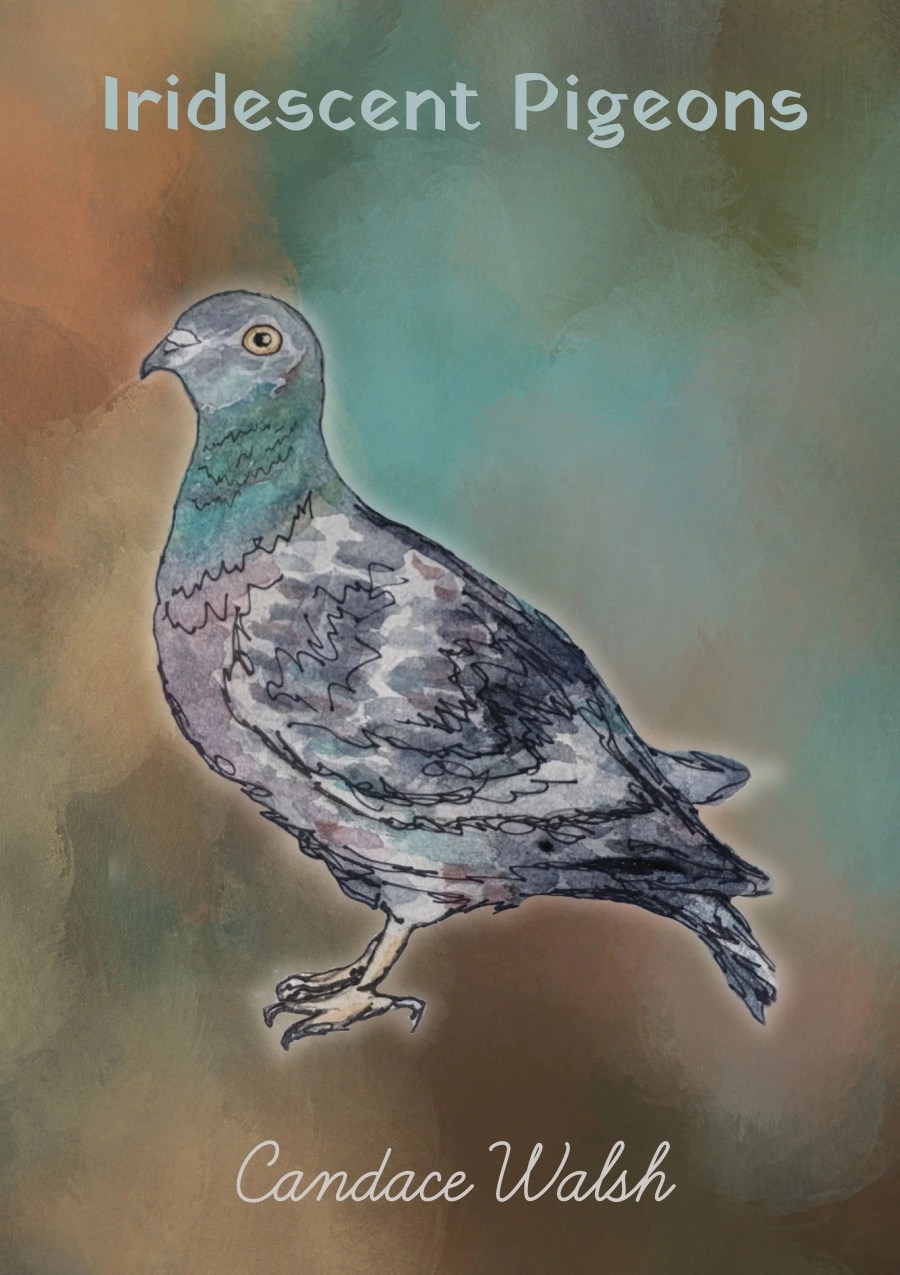
Review of Iridescent Pigeons by Candace Walsh

By Nicholas Skaldetvind

Candace Walsh’s Iridescent Pigeons (Yellow Arrow Publishing, 2024) pulses along the spectral tide of memory, braiding the intimate with the mundane, creating a textured meditation on love, familial bonds, and personal reclamation.  Her language weaves everyday objects from lemons, dogs, seaweed into a resonant web of at-once connections and separations, echoing Gerard Manley Hopkins’ sensuous attention to form and rhythm: “Glory be to goddesses of heft— / The plush, broad, soft, round, thick.”  Walsh’s adroit application of stylistic devices, with an ear keyed for language, illuminates the “sensuous beauty of everyday life” through a lexicon that recalls the lyrical introspection of Woolf’s The Waves and Bishop’s careful rendering of the physical: “I split the lemons crosswise twice, packed salt into the creases, / and stuffed them in the jar until their blood became their brine.” 

In the book, Walsh ranges from the cento and Sapphic stanzas to free verse, showing a marriage of form and emotional breadth. This reconciliation of form and freedom allows the collection’s overarching themes to come out more clearly; each poem inhabits spaces of queer eros, domesticity, and the unresolved. In poems like “Bowed Beauty,” the lyrical voice works with the corporeal as Walsh channels Hopkins’ “Pied Beauty,” creating an ode to the fullness and shape of bodies. And in “Dogs and Their Lesbians,” she captures a feverish excitement that resists society’s prescribed containment: “When we could finally pounce, / how hot it surged, / or hardly stirred—so deeply stilled. / We know how much it costs / to cut it off. I’d rather clean up blood.”   

Read More

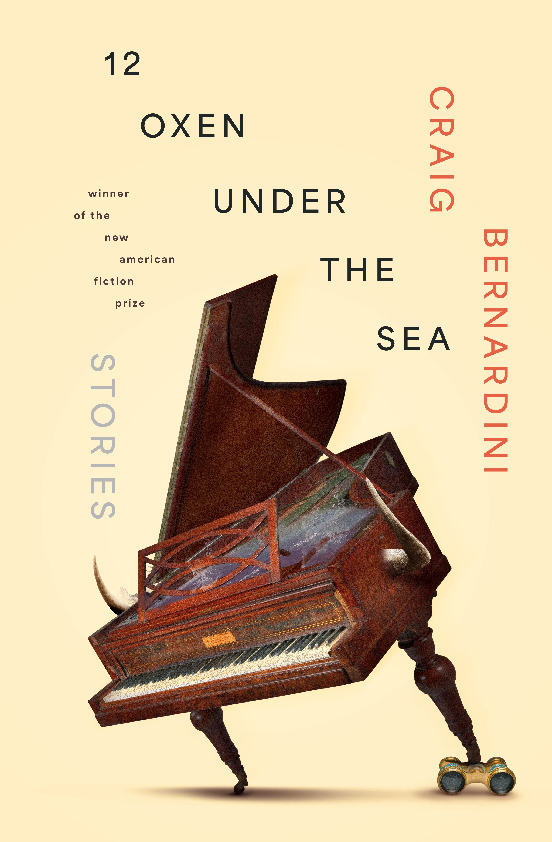
Review: 12 Oxen Under the Sea, by Craig Bernardini

By Jenna Brown

In a blend of magical realism and surrealist technique, Craig Bernardini’s intrepid short-story collection, 12 OXEN UNDER THE SEA (New American Press, 2025), masterfully meshes domestic concerns with the absurd. In twelve idiosyncratic narratives, Bernardini contemplates death, isolation, parenting, sea creatures, guys named Carl, marital tensions, trauma, and the supernatural. Each story successfully asks us to suspend our disbelief as we encounter: a grieving father turning aquatic in his son’s pond and finding his previously dead wife in its depths; an extravagant hotel continually catching fire for increasingly arcane reasons; a revival house’s playing of Rachmaninoff causing phantasmagoric hallucinations. Or, in 16th century England, the occupant of an inn has his furnishings move due to an inexplicable poltergeist-like disturbance.

What makes Bernardini’s writing so effective is his ability to deftly make the uncanny a part of our world. His literary realms are absurdist, but only to a point. While the stories can be nonsensical, normal rules still apply—there are still bowling balls, bikes, and breakfasts. A child in a Manhattan Italian restaurant can burst into an eternal flame, but the characters themselves still order chicory salad from a menu. But even so, his worlds are not simple and tangible with only one odd thing jarring us. His stories never hinge on that single anomaly, and they hardly ever have a pat conclusion. Almost every time, we are still left in a joyously ambivalent place, thinking, “What just happened??”

Read More

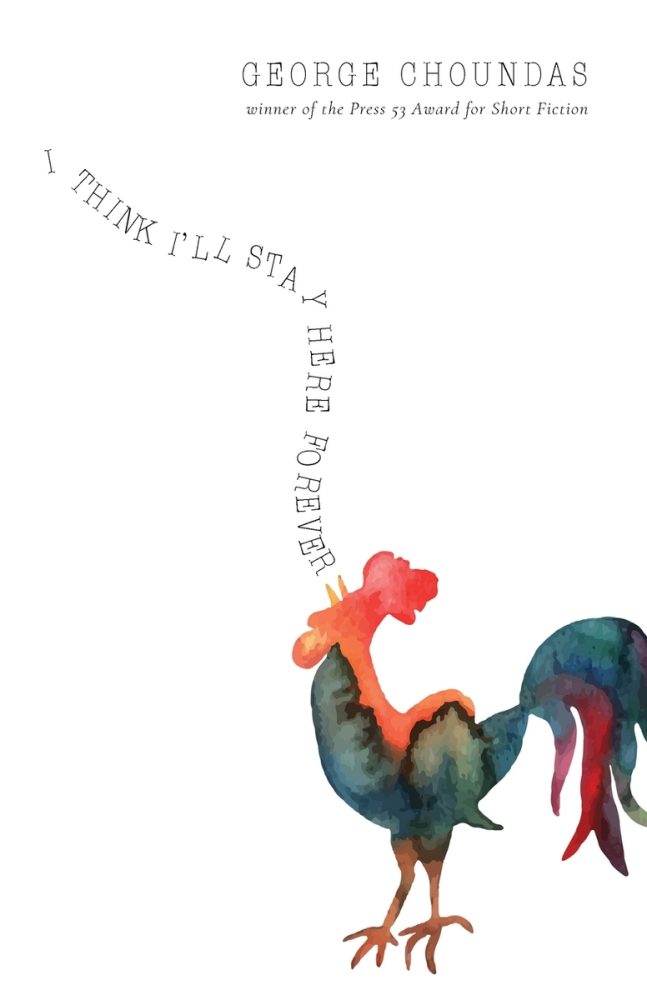
Review: George Choundas’s I Think I’ll Stay Here Forever

By Grace Cooper

George Choundas’s short story collection I Think I’ll Stay Here Forever, winner of the 2025 Press 53 Award for Short Fiction, explores the uncanny ways we navigate loss, hardship, and change. Across twelve stories packed with molasses ships, fighting roosters, and persnickety aunts, Choundas explores the way we don’t necessarily have a complete fix on our identities. He’s a mesmerizing storyteller of our growing and shifting experiences.

Halfway through the collection we have the joy of reading “The Sisters Jeppard,” a story previously published by New Ohio Review. In that story, the narrator talks about their cousin’s first and second wives and develops that idea of unfixed identity. The first wife was loved very deeply by her mother and two aunts, otherwise described as “the three sisters.” The narrator seems almost judgmental of the care and attention the three sisters gave the first wife, describing her “upbringing” as “so different from how the hard world handles a person.” The first wife tragically passes away and, following her death, the narrator discusses the death of other loved ones that they’re seemingly much closer to, such as their cousin and the cousin’s second wife, who becomes her best friend. The family relationships are complicated, almost ornate, and Choundas wants us to get enmeshed in the strange way connection builds and grief lingers. After losing all these people, the narrator thinks back and reflects on the three sisters’ love with a new perspective:

Read More

Review: A Preponderance of Starry Beings by Samantha Edmonds

By Emilie DeOreo

Samantha Edmonds’s newest short-story collection A Preponderance of Starry Beings tackles the tensions between childhood egocentrism and the vastness of the worlds—both literal and metaphorical—beyond us. As children, the egocentrism stage is pivotal for our development, shaping how we understand our place in the world through our own limited perceptions. Yet the suggestion that something might exist beyond our physical planet allows some children to grasp, however faintly, that the world extends far past their immediate experiences and the boundaries of their own bodies. In space, they are merely singular specks of dust among the ever-expanding cosmos. A Preponderance of Starry Beings gives its readers a chance to realize how deeply connected we all are to the boundless unknown of the universe, and Edmonds’s characters, whether on Earth or elsewhere, act as a bridge between the ordinary and the extraordinary, showing how even mundane experiences can carry an otherworldly resonance that links us to the larger cosmos. 

Some of Edmonds’s stories are explicit in their relationship between normal everyday domesticity and galactic happenings, such as “The Adventures of Starboy and Earthgirl,” which follows two girls in the late 90s, their passion for all things Spock and Captain Kirk, and their love for each other. Other stories are more subtle about the cosmos connection, such as the impressively linked pieces that feature Ruth Emerson, a late-adolescent character Edmonds returns to multiple times, whose eyes are pointed toward heaven, but whose faith in a larger purpose is tested. Edmonds’s collection as a whole transforms the infinite landscape of space into a mirror for human emotion, demonstrating that no matter how small or isolated we may feel, our identities and experiences are inextricably linked. Whether her stories are about queer coming-of-age or spiritual unraveling, Edmonds shows us that connection (like starlight) travels faster than we could ever imagine, seeming to reach even those who believe they are completely alone. 

Read More