Grief in the Potting Shed

By Allisa Cherry
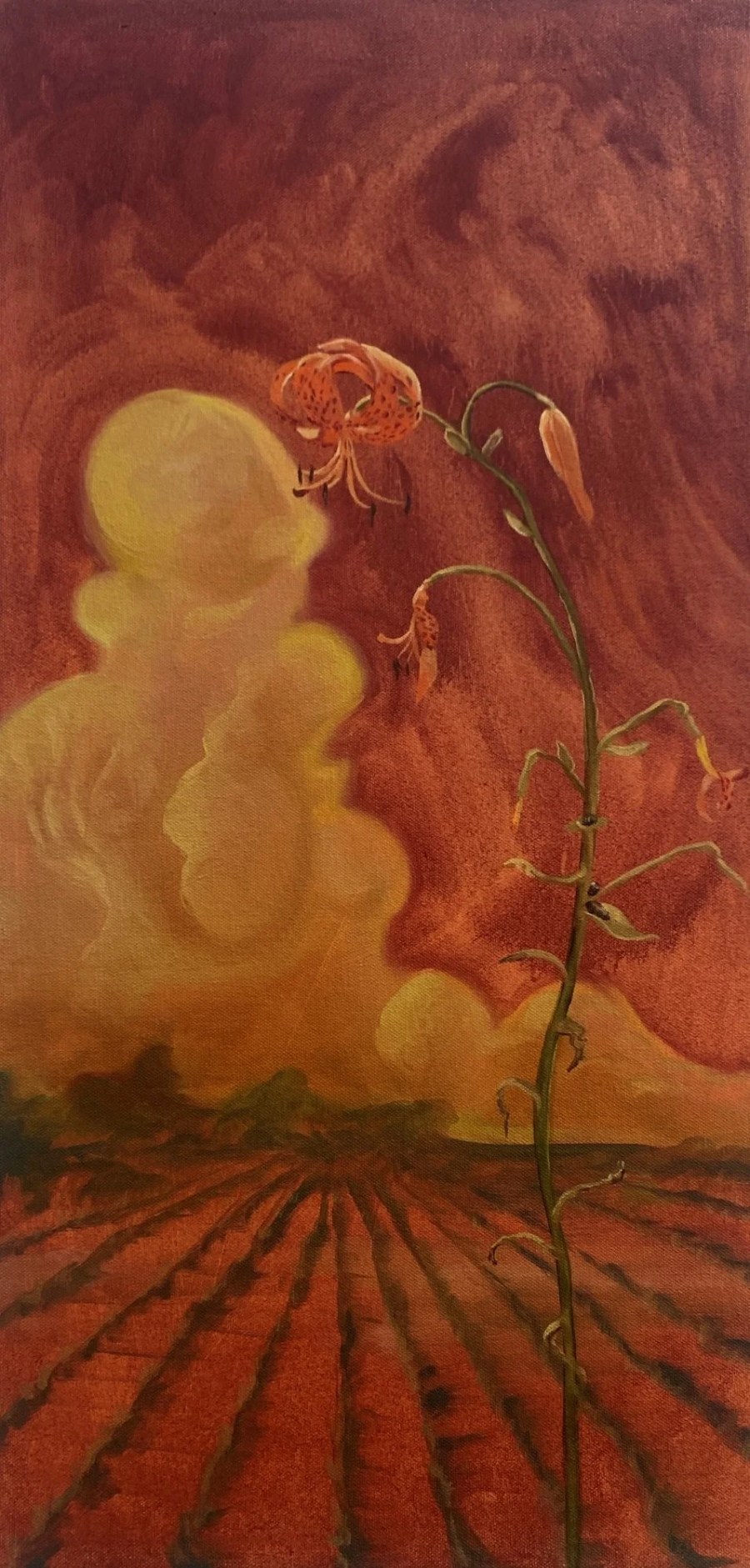
Featured Art: “Lily, Out of Breath” by Mallory Stowe

I startle a deer mouse 
squirreling straw into a pile of burlap.  
It freezes then returns to its instinctive labor 
caring for its litter of pups–still deaf and blind. 
Each as small and pink as a baby’s toe.  
How miniscule my reflection must be,  
turned upside-down in the gloss of its dark eye. 
At the beginning of the war in Ukraine 
a woman approached a Russian soldier, 
gave him a handful of seeds,  
and told him to carry them in his pocket  
so when he died on Ukrainian soil  
at least sunflowers would grow where he fell.  
At least. No matter how great the devastation,  
it requires a small act of resistance for scale.  
Consider those moments Roland Hayes  
stood in a resolute silence while members  
of the Nazi party booed and cursed 
his blackness. Alone under a spotlight on stage  
in a concert hall buzzing with hatred.  
And still his throat softened  
and a song—Du Bist die Ruh—rose  
from his throat until every fascist heart  
had been stroked by the finger of its beauty.  
But I have never been brave.  
I’ve only ever waited out the clock  
in those moments when I was afraid.  
So, when my older sister asked me 
—the apostate daughter—to help her  
dress my mother’s dead body  
in her temple robes, tie the fig leaf apron,  
fasten her bonnet and veil, I couldn’t  
take in the tenderness of her heresy  
all at once. Instead, I narrowed my focus  
to the industry of my fingers, 
half expecting them to snap into flames  
as I pushed each pearl button  
through its braided hoop.  


Read More

Kids Running After a Car

By Hee-June Choi

after the Korean War

Asphalt covered half the street; the rest was
overgrown with sunberries we ate. At the sound of a horn,
we ran to the car; in its bluish smoke, we saw
our future like a 3-D film. When my friend

JC tied his feet to the back bumper of a jeep
to sneak a ride, its engine started;
market people screamed as his bleeding head
was dragged for a hundred yards.

Our most daring venture was to the mountain cave
to dig out bullets for spinning tops’ axles.
But we had to cross locals’ territory––my forehead
still bears the scar of a thrown stone.

These road brawls ended when someone
in the cave shouted: Corpses!—soldiers in a mass grave.
Yet, those were carefree days. Dropping by any house
at mealtime, I ate with them if they laid me a place

—if not, I played next to their dinner table.
House doors were left unlocked:
what thief would steal an empty bag of rice?
In summer, we slept in the public pool’s storage shack,

no parents looking for us.
It was the children’s utopia: what we didn’t have,
we didn’t need. Even now, walking my suburban street
late at night, I snoop around for remnants of those days:

that sour tailpipe smoke must be a shimmer
in the air somewhere on Earth.


Read More

Partition

by Carolina Hotchandani

Featured Art: Fissure, by John Schriner


In your version of the story, people butter their fingers 

with notions of God, splitting India into a smaller India, 

a new Pakistan. The way a single roti’s dough 

is pulled apart, the new spheres, rolled in the palms, 

then flattened. The idea of God—the destroyer of human bonds, 

you will say in the diatribe I know well—the reason for new 

borders, new pain to sprout on either side of a dividing line. 

You’ll go on. I’ll picture the edges of your words blurring 

to a hum as I think of how to wrest your rant from you. 

A rolling pin barrels over dough, widens the soft disc, 

makes it fine. You are fragile. Like a story that stretches 

belief. Like a nation. Like a thin disc of dough that sticks 

to a surface, tearing when it’s peeled back. I don’t know 

how to part the story from the person and keep the person.


Read More

In a Year of Drought, I Drink Wine in a Los Angeles Hot Tub

By Christopher Kempf

Selected as runner-up in the 2015 New Ohio Review Poetry Contest by Robert Pinsky

Featured Art: Interior of the Pantheon, Rome by Giovanni Paolo Panini

So too on Troy’s final afternoon
the doomed children of the city sang. Such
      was their joy, Virgil tells us, such

was their simple awestruck wonder
at the great beast even
      the Achaeans, cramped, standing

on each other’s shoulders inside
the close wood, wept. What
      he means, of course, is that inside

of the other’s suffering, one
can imagine always aspects
      of a wild beauty refusing

negation. Or no. Not
that it exists, this
      beauty, but that

it can be made so. Rome
Virgil says, springing
      from Ilion’s ashes. Elsewhere

Orpheus. This
is not my home. Here
      for the weekend only, I float

out into the hot tub’s bubbling, bleach-
& salt-scoured water. I watch
      the few stars the city permits

still flicker on, the long
avenues of light below them—Cienaga
      & Sunset, Ventura—burn

& spangle in the mountains’ dark bowl. The bottle
of La Marca prosecco sweats. To secure
      for their desert metropolis water

enough to nourish all this, city
developers—circa
      the arrival, reports suggest, of something

Read More

Feeling Sorry for Myself While Watching a Really Bad World War II POW Movie on TV

Selected as winner of the 2013 New Ohio Review Poetry Contest by Barbara Hamby

By Michael Derrick Hudson

The rest of them pinwheeled out of the dirty sky somewhere
over Schweinfurt. They burned as I clung

to my shroud lines huffing in a panic through the slobbery
fog of my oxygen mask, the frost stiffening

my collar’s wet fur. Three years later, what have I to show
for my long time in the bag? Bleeding gums,

a hacking cough, another button sewn? I thumb silk maps

and compasses that’ll tuck into a nutshell, learn to curse
in tunnel-rat’s German: Achtung, Fünf!

Dummkopf! Amerikaner Schweinhund. Schnell, buddy . . .

Not once did I try to make it over the wire, into the forest
and its perils where the beautiful Slovak partisan

lugs basketfuls of her beer bottle grenades
hip-deep through the snow. I never spent the night thawing

my boots while she sang old peasant songs and poked a rag

down the bore of her revolver. Ach du! The tarnished brass
of my captain’s bars will never in the firelight

glint for her! She’ll never grant me tomorrow’s password
or love me in my Army Air Corps leather, sleeves

scorched and pockets stuffed with the chocolate
I’d toss godlike and American to all the kids in her village . . .

Damn all my Switzerlands! Damn all of these neutral years!


Read More

Scooter

By David Rivard

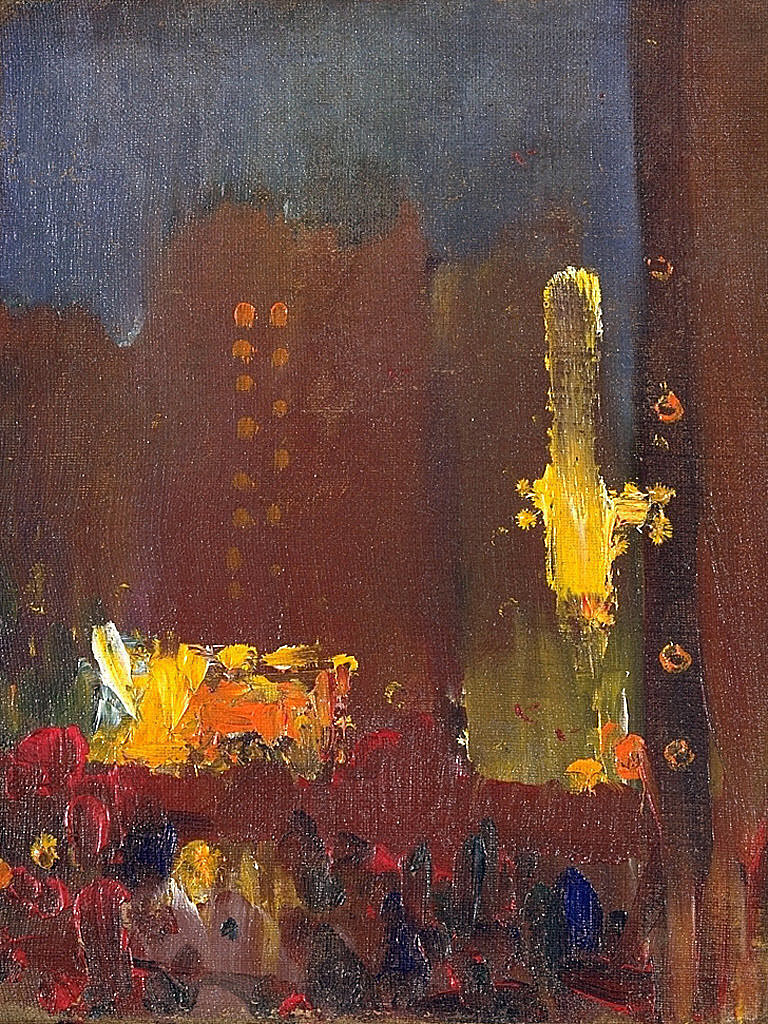
Featured Art: City at Night by Arthur B. Carles

Phil Rizzuto, shortstop, the Yankees’
Scooter & play-by-play announcer & The Money Store’s
man of a certifiably trustworthy nature,
but invented for me first in war stories told
by my father—
on a South Pacific island naval air station
maybe it’d be fun to put Scooter
in the game, brass thinks
a sports star visitor to war zone
great theater of operations P.R.—
but basketball, not
civilization-beating baseball, basketball
my father’s game—
“I could take him,
he couldn’t get by
me”: sayeth Norman
Rivard, testimony of
a former All-State point guard
1942 season Mass state champs
team captain
Durfee High School Fall River;
his torpedoed destroyer sunk
by a two-man Japanese sub
(a sake brewers’ assistant & an Imperial War College ensign?),
a few days earlier their suicide mission
had sent my father
to the base, rescued
just in time for Scooter’s morale boosting
visit, the two together on an asphalt court
in cosmic time Holy Cow!
an immortal, lucky accident—
but will, pride, intensity
count more for Norman—“don’t depend on luck
OK, why don’t you just apply yourself?”
my father’s question, frustrated by
his distracted, blurry
son—
apply yourself, stay on track,
stick to it, that’s the thing,
you’ll adhere
successfully to whatever you want
(not sure I know what the wanting is for even now),
you can be
an architect, trial lawyer, oncologist, surveyor,
if only you apply yourself—
like a wing decal on the model
of a Mustang P-51 Fighter
or whiskey dried in a glass-sized ring
on a liquor cart?—
skim the ear wax off your eardrums,
Dad—here is your poet, & here
is your poem.


Read More

Disintegration of Purpose at Cocoa Beach, Florida (Part 1)

By Michael Derrick Hudson

A pelican divebombs the same shimmery-shammery silver stripe
of the horizon. The pale yellow and presumably

bloodless crabs scuttle to their holes, terrified by my shadow

all over again. Again! They’ll never figure it out,
but of course every moment for them is nothing but the fretful

expectation of imminent death. They’re expendable. Fecund.

Edible. Fuck ’em. So where’s my hero? My old conquistador
my Castilian grandee terrible with purpose . . .

Señor! Over here, por favor! But what if he did come, feverish

and bedraggled, this Spaniard wading hip-deep through the surf
cumbered by his mildewed ruffles

and waterlogged boots, in silver salt-pitted
spurs and a rust-bucket helmet? He’d spout nonsense, bragging

about the usual claptrap: solid gold wigwams, diamonds bigger
than pumpkins and an obsidian-eyed princess

festooned with raccoon tails. There’d be those outrageous lies,

poison darts tinking off his armor while tramping the Everglades
and living these five hundred years fetched

off death’s front stoop by a few quavering, toothless sips from

the Fountain of Youth. With the point of his cutlass he’d scratch
the beach with treasure maps and schemes, telling tales

of the cannon-shattered fo’c’sle and those desolate, bone-littered
passageways. I’d put up with it for as long

as I could. ¡Hola! History stops here, Señor! Everything does!

Read More

There Was a War

By Andrew Michael Roberts

Featured Art: I Saw it, plate 44 from The Disasters of War by Francisco de Goya

and it wasn’t ours because we didn’t believe in it, but they shot at us anyway because we stood somewhere in the middle of them killing each other. What could we do but lie down and wait? We lay a long time, thinking, the grass like trees shooting into the sky. Bullets like birds shooting across it. Too many hours of sun in our eyes. We were thinking: if we had guns we’d use them to get the hell out of the middle of this war.

Read More