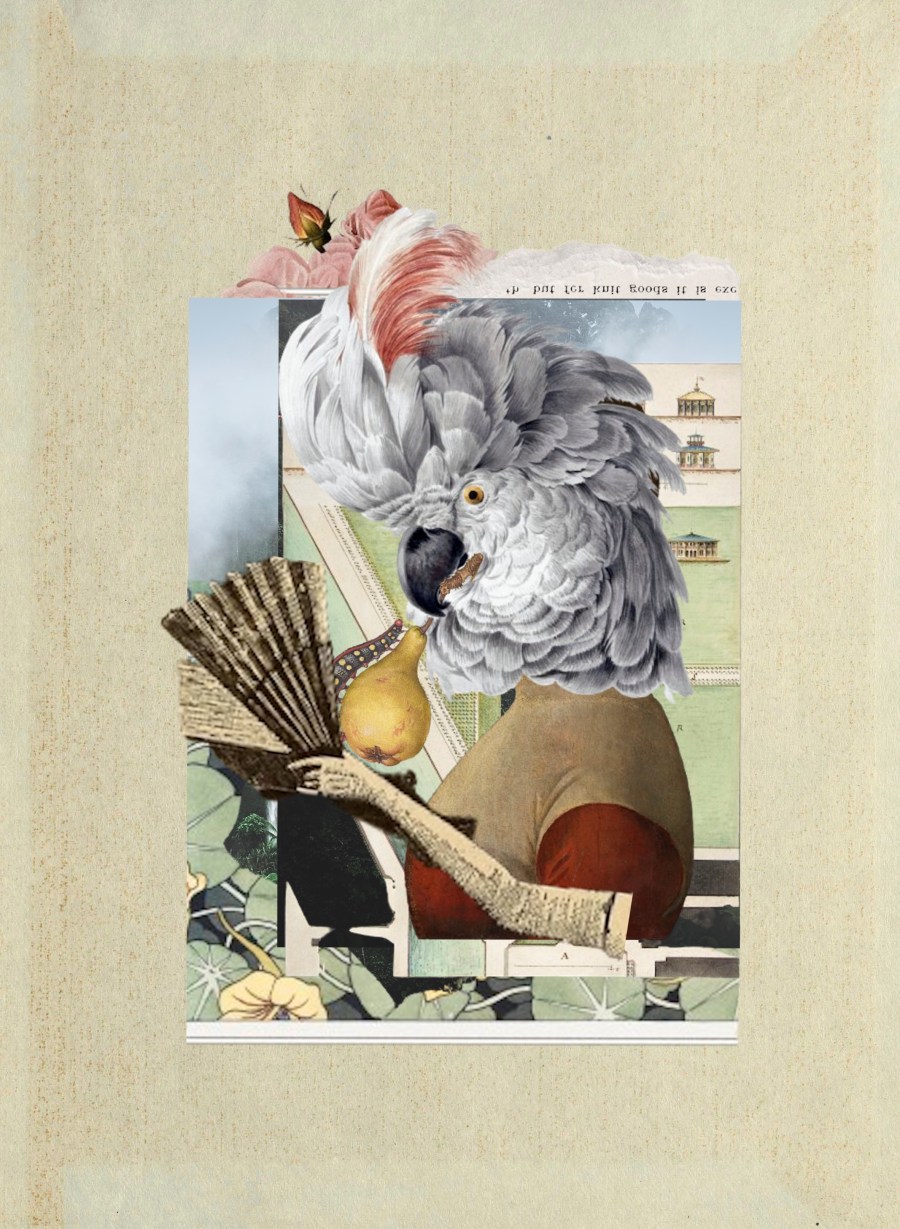
By George Bilgere Featured Art: “Lady Perroquet” by Ana Prundaru
I love this picture of Michael and Alex on our visit to Scotland, what, three, four years ago? Alex is missing his front teeth, so I think that makes him four, or five.
They’re standing with my wife before a palace in what I now realize is Düsseldorf, not Edinburgh, although it might also be outside Lyon, I forget the town’s name and the name of the palace,
but an 18th century king built it as a gift for his wife, who was mad—or no, the king was mad, or possibly they were both mad, although it could be I’m thinking of a palace we saw in Copenhagen,
as I recall there was something about the way the turrets were constructed, or the battlements, that identify it as Danish, I forget what century, but I do remember
the cozy little restaurant we stopped in afterwards, how cold the wine was, how delicious the mussels,
back when the boys were little and we were all together that sunny, long-ago afternoon in now I’m thinking Amsterdam.
Sometime last century in Kharkiv, father and I fled the melting August pavement, bribed the conductor of a sold-out train. He jammed us in the luggage racks, and we took off to the Black Sea.
The moving furnace spat us out somewhere in Kerch, the easternmost town in the Crimea two hundred miles from sandy beaches, magnolias, and pine trees, streets lined with vendors selling buttered corn charred shish kebabs and chacha. Predawn Kerch
was drab and empty, last night’s drunks scattered on the streets like seals in their puddles, seagulls feasting on rotting fish. At the port we made a deal with a captain of a cargo bulker Father paid the fare with his life stories, and kept the crew awake.
I sat 12 hours next to the cockpit staring at the horizon changing colors from pink to blue to pink again to black
till the evening Yalta embraced us like an old friend at the party: a little tipsy, a little horny, determined to dance all night under shooting stars
* * *
An arctic snowy owl arrived in the south of France last Wednesday 3000 miles away from home. Her baffled face was captured by the paparazzi. British scientists as their rituals dictate, had offered an explanation:
It’s all about the lemmings: The owl was following the lemmings The spike in the lemming population had lured the hungry bird
There is one person who really knows what happened— the captain of the Greenlandic freighter the stowaway had boarded, heading south
Featured Art: Polar Chroma Midnight by John Sabraw
“Tickets, please,” he calls out, “Tickets!” and I think, Hang on, I know him, the conductor who shuffles toward me down the aisle, this big guy, pink- cheeked, coppery buttons on his dark blue suit, his blue cap with a short sharp brim jammed down over reddish hair, shirt collar disappearing
beneath his curly red beard, look how he keeps his feet set wide like a sea captain, sways in the nonplace of our constant motion, as I heard a French philosopher call it, the steady-as-she-goes of this racketing NJ Transit train, his ticket nippers going click-click, click-click, poor morning light catching
the pixie dust of ticket snips sprinkled behind him as he calls out again, “Tickets, tickets,” coming closer now, not asking but naming what he wants, and there’s something I want to tell him after this shock of recognition, startled awake by a world made strange again, but is this
really the place to say, You know, you look just like Joseph Roulin the postman, Van Gogh’s friend, his neighbor he painted five or six times back in 1889 and you can go see down in Philly at the Barnes, then relate how Roulin sorted the mail each day at the train station in Arles where Van Gogh used to go to send
paintings home to Theo, how Roulin cared for him when he cut himself, wrote letters to his family, welcomed him into his own, made Van Gogh’s life a little better, probably a little longer, though the conductor I imagine is not a son of Arles, though maybe of Manalapan, but up close I see
his badge says JOE, his sapphire eyes are filled with delight, filled with deep light, just the way Van Gogh painted them, as I’d like to tell him in this moving moment we share when he says “Tickets” once more and then—Click-click—punches mine and then—“Here you go”—hands it back
since I’ll need it to board the AirTrain at Newark, but because this train keeps rattling along, he keeps walking, calls out again, clicks his nipper once, twice, just because, and that’s when I spot it, there at his coat hem, how it glints and burns in the dusty light, that smudge of sunflower yellow.
By the third martini, he’ll ask her to marry him. She’s a tourist, he’s a captain, home by chance. I stand at the window, watching. I want to walk into that bar, order an ouzo, and tell them that, together, they’ll create a new generation of pain. I want to tell him to court the island girl, the one who, forty years later, will see him, run to the restroom, and return with a fresh coat of lipstick. I want to tell my young mother, in the words of the great North American philosopher, Pamela Anderson, “Never get married on vacation.” But this is long before Pam and Tommy Lee, before I existed. Before Reagan reigned over his long line of wreckage, and couples shot themselves, together, in their cars. The Vietnam War has ended, but here I am standing at the window, watching while they meet, both oblivious of wars they’ll wage. They’ll move from Greece back to the Midwest—she’ll drink, alone, in her kitchen. He’ll return to the island every chance he gets. When he’s back in Illinois, he’ll stare into the aquarium and long for water. She’ll look at him, frozen, behind her highball glass. Still, I stay at the window of the bar, wanting to use Pam’s biting wit. But this is long before Baywatch, and they’re gazing at the bay. I tap the glass like Morse code. Sealed in my own tank of silence, I say, Please let go. But as they take each other’s hands, I softly touch the pane and turn away. Because they, too, have the right to plunge. Even if they’ll swim out too deep: holding onto each other until death.
In Denver all days end standing up packed like dried fish dry-humping each other on the H Line. Some passengers in their drunken wobble or even in their haze of sobriety pull down hard on the rubber handles, the ones meant for standing, the ones that swing dumbly above our heads. They think this action stops the locomotive but the train is automated, stopping itself at Broadway then Osage, Lincoln Blvd. Since the train, as it always does, stops— the travelers learn to keep tugging & I can’t help but think this is how prayer works. Like when I prayed to a god I don’t believe in that your morphine drip might soothe the wounds that chemotherapy would not & how I swear it worked sometimes but didn’t others & yet in my drunken sobriety I believe that it was me who eased your pain, that it was my failed pleas that bleached your blood.
Featured Art: Two Human Beings. The Lovely Ones by Edvard Munch
Not the zebra but the horse; not buffalo but cows, maybe camels, who traded the wild for the stable, a stall lined in straw, the house with wee gables and eaves, their name over the door— Biscuit, Coco. Snowball, Ranger. Traded the hunt for the daily bowl and dish, predators for owners, collar and leash; agreed to be a tool—plow or cart or confidant—to breed in captivity.
So when the man in the elevator at the Venetian holding his cardboard tray of coffees and muffins heading back to his room says to no one in particular, but most likely to the other man, the three of us strangers, I better get something in return for this, he means fetching breakfast so his wife can sleep, I better get something for all of this, gesturing with his head, meaning the hotel, the dinners and shows, I think about women who prowl the midnight streets in their staggering heels, breasts like missiles because they’d rather be feral than kept. And about men who gave up wilding to name their offspring, their known code continuing on forever.
I’m carrying my own tray of coffees and muffins, will soon press the card against the lock, open the room, rip off my clothes, throw back the three hundred thread-count sheets, waking my husband. He’s met someone new and now wants both of his lives at once. He can sleep later. These untamed weeks, we’re savaging, flesh against flesh, ravishing our marriage.