Nativity

By Theo Jasper

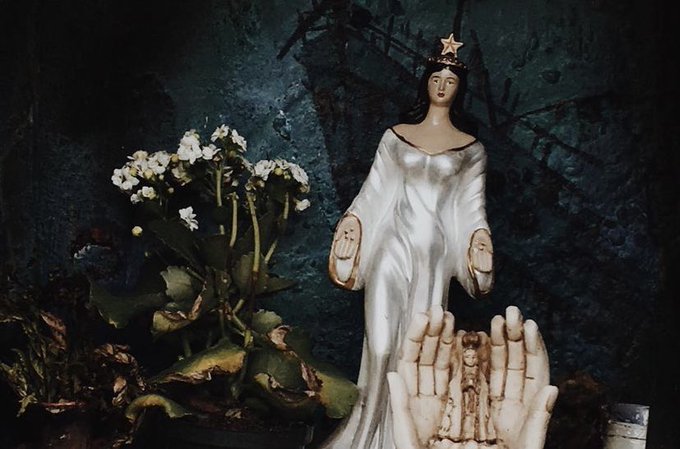
This morning in January, the men on the street were  
wheeling one of the Wise Men into a truck, on a dolly,  
just like that. 

And I remember two weeks ago, Christmas Eve,  
a man in front of the Nativity almost backed into my car 
and his immediate anger was infuriating, his middle finger,  
as if it were my fault for being where I had been all along, 
and I wanted to do something but remembered danger,  
saw his son’s eyes watching me  
from the backseat. 
 
His anger flashes in my mind while the men wrap God in bubble wrap, 
banging his head against the roof of the truck, how it probably 
dissipated after a minute or two, then maybe regret for this display  
on Christmas Eve, the severe eyes of Christ, and maybe a drop or two of anger  
left over, or only quiet sacredness.  

A man drops a lamb on the sidewalk. The sky threatens  
to break open. And the child was scared. 
And the child was scared.  

Give me the plaster eyes of an angel,  
the eyes of anyone who might stop the car and see this, 
horns honking now, see this birth of Christ, St. Gabriel delivered the news 
to always look where we are not wanted, to await our annunciation 
as virgins and sheep among the teeth of Shepherds, 
holy men, good men, packing up their religion, 
sweeping dust and myrrh and the shattered bodies of those 
who will continue to go unnamed. 


Read More

The Church of the Dermatologist 

By Amy Miller
Featured Art: “Pony Up” by Alex Brice

I wonder if she says a prayer before
she bustles into the room, all smiles and sweet
accented English, tongue a rolling horse
in a field of Russian consonants. My feet  

or scalp or inner thigh might pronounce
a sentence on my life: she incants
asymmetry, border, color in three rounds,
four, the marketeer’s or pastor’s chant.  

She’s here-and-now, no penance crap to pay,
no questions of the beach, my tans, my youth,
for everybody’s sinned already, way
too late to rein those horses in. Truth: 

I did my praying driving here. Lord,
let her eye be ruthless. Thorough. Bored.  


Read More

A PRAYER

By S.J. Stover

Daily bread’s gone blue
as a tulip.  

Kitchen’s a bust—
wizened potatoes 

stacked like luck
rocks, 

beans, knobbly
as prayer beads,  

an onion’s thin
green talon.  

One cannot not live
by bread alone you say.  

Okay, so
I will live by  

sentences, tenuous,
precious, line by line, 

one rhyme
at a time.   

I will live by God’s
thin smile, hung 

crooked from
a dogwood tree. 


Read More

SELF-PORTRAIT AT THIRTY-THREE 

By S.J. Stover
Featured Art by Rachel Hall

Jesus never looked so jittery— 
jacked up on caffeine and testosterone,  
sporting a backyard haircut and home-sewn mask.  
I walked the same two-and-a-half-mile circuit 
every day: up Sunrise to McCombs, McCombs 
to Radnor, Radnor to Wingate, Wingate to Antioch, Antioch 
to the Bi-Rite grocery and Our Lady of Guadalupe 
and back down Sunrise again.   
The blue blooms of the hydrangeas and the pink blooms  
of the dogwoods came and went.  
I played “Losing My Religion” on repeat. I voted.  
I went to bed each night with yesterday’s cold  
coffee ringing the coffee table. 
I crucified time. 


Read More

Miracle-Proof

By Emma De Lisle

A few of the stories were good: Lazarus, Cana, the adulteress. Who doesn’t love a stoning? Or picturing him balancing on that dark sea, feet peeping over the waves that some hand ground down out of those purples and black-blues, phthalo blue, and Egyptian, something iridescent crushed in to sign what you can’t see below. Nacre, maybe. Like a salamander in a flash-photo. Oil on the water like skin. Or like that pearly interference stretched over a raw muscle, its meat-cells cut against the grain. Light-struck. Divided. And the angel. I can hear it. Not a swishing sound, like you’d expect, or a rushing, or anything with such a shhhh. Hush. We’ll be interrupted. I’ll be hyperextended and impossible—this strange star of limbs and hinges like something that could stand up on its own, yanking double-handed on all my cords and tendons, yellow-white if you bite into them, popping, those rickety rubber stalks full of the code that makes me go. Code that opens my mouth. Speaks me. Is it miracle-proof? God sent a messenger to say, Believe her. And would do it again, would do it in a heartbeat. All we do is stay in the foreground, we bend low, we write it down.


Read More

Ichetucknee

By J.D. McGee

Featured Art: Stephen Reichert, Untitled, 2013-2014. Oil on canvas, 12″ x 12″. “Cirlce” series.

Archaeological exploration has discovered the site of a 17th century Spanish mission, San Martin de Timucua, next to a short tributary connecting Fig Springs to the Ichetucknee River.
Florida Dept. of State

i.
In needy dawn’s tabula rasa, shred
through breaches in the birch like candleflame
refracted, flung through flashed glass and calms,
as Ichetucknee disrobes habits of mist,
I splash the slim canoe, a floating pew.

The mind creates liturgical vestments;
they vex, featherless chicks pecking for feed.
A broken heart paddles strangely: it bleeds
blood, needs blood. It begs, a feckless and cracked
flask that prays for shape of spring water

ii.
Although the spring is just a thing. It flows
from aquifer, hyaline through bedrock pits.
The parable of trees on the banks preach the chase
of sun and soil; the verse of dragonflies
incants the atom need to procreate and feed.

If it was only just the heron’s sweep,
the otter’s slip, indignant turtle glare,
quiescent flow, supplicant fawn and doe.
This hush, is it within or without me?
Is it scrub jay songs or songs of myself?

iii.
We sat in plastic circles, yellow rooms,
desperate to deserve salvation, told
to find a Higher Power. Fine. But, God,
what grace for nicotine thumbs, DT feet?
Alone, breakfast:
       I once was lost but now

Am found.
    They sang in church when I was young.
Was the hymn an echo, my voice right now,
or welled from other springs? A coffee trick,
perhaps, compelled halation through the blinds,
wrought mosaics inlaid with my cracked glass.

iv.
It may be how, like mouths open to pray,
the stream invokes river, or a wood stork
sainting; it may have been the want of me,
the open wound or suckling, skies precise
and rare as sapphire, oak monk robes of moss.

It may have been wonder, childlike awe,
primordial immanence in my tear ducts;
or, maybe just the child who needs to know,
who breathes dreaming into the world he floats.

What befell may have already been there:
in my bowels, in clear imagined depths
where mullet twine like a child’s friendship braid.
The child’s ease for tears: it may be these springs
are my tears, maybe the tears of angels;

maybe, there is no other god for me.

v.
If I could speak, articulate, shape words;
or, I’m just cursed, repeating all I’ve heard,
a mouthpiece forever, slowed to stone and root.
What self beyond reflection? Stare and yearn,
burnt and burning, to waste away and drown?

I fall into the mirror, the boreal shock,
and deep in the headspring’s gaped mouth I see
a blackness stretched back, but a rush of life,
flawless as the first breath, sharp as a spring sunrise,
bored into bedrock, black, back, the spring of myself.


Read More

Nazarene Dream

By Joanne Dominique Dwyer

I’m walking in the forest with the mythic and shirtless Nazarene.
He juts out his chin, orienting me to birds in the sky.
He does not name them, but says Mira, they are inside you.
Next, he gestures toward the silver fish glinting in the stream,
     also nameless, incandescent, gilled.
He is wearing capri-length drawstring pants and prison crocs,
admonishes me not to trust experts.

I am looking for signs of scars on his back, when he staggers
and trips on a rusted can in the switchgrass.
He confides he is saddened priests have lost the proclivity
    for contemplating constellations and cultivating orchids.
Says how pathetic it is that he has seen priests sitting at slot machines
    chain-smoking, looking more like saturnine wax figures
than supraliminal men (at or above the threshold of consciousness).

Jesus senses my hearing is waning and moves closer to me.
Close enough that I feel strands of his hair brush against the bones
of my cheek and the lobes of my ear as he says, Most humans
are unaware that seed pods make a pact with the wind
to aid in the proliferation of beauty. And semantics relates
not only to semen, but to the spinning of hand-dyed yarn.

As I walk behind him, I stare at the contours of his sweat-luminous,
bark-colored calves as he climbs over barren boulders.
No one in their right mind should expect much
    from marriage to another human being, he adds.
Then, straightaway, we are standing in a grove
of chokecherry, the velocity of the wind is mounting;
    afternoon shadows are lengthening. 

Together, we ingest handfuls of wild cherries.
They look like oxblood marbles or the bloodshot eyes of martyrs.
    I’m getting cold in the high altitude.
I ask him how to safeguard against incessant rupture.
    Unhobble the horses and sing the old songs, he replies.
And how to forgive a priest?
He does not swivel his body to me, seems isolate.
A soundless blackout ensues.

And just before the dream extinguishes,
Jesus wipes the smudged mascara from the cage of my face—
angles his torso down like a four-legged animal
pawing the earth and unlaces my combat boots.
Then re-laces them tighter, as if to protect
    my ankles on the descent.


Read More

Heaven

By Michael Derrick Hudson

Almost everything got in. Even the dinosaurs stomp around
the hot tubs and gazebos, haloes shimmering over

their massive intelligent skulls, grunting Alleluias. Atheists

made it too, although they have to wear little red beanies so
we know who to gently tease for corporeal

hopelessness and infidelity: Cheer up, Christopher Hitchens!

After a while, you grow used to the bliss: not once twanging
the wrong note, lathering and shampooing

each other, sexless, in tepid frothy pools of serotonin, loving

equally each one of my great-great-great-great-grandmas and
second cousins twice-removed and each one

of my dead cats taking turns to rub, purring,
against my hairless ankles. Princess! Plato! Hodge-Podge!

Rubber mice. Mandatory self-esteem. Beauty locked
in perpetuity. The standard-issue smile. The perfect Boss . . .

So mostly I like it here. The reassurance
of the unambiguously blameless, the expulsion of froideur

and doubt. It’s perpetual sunrise over a greeny-green garden
where our only lion pads by, obliged to nuzzle

our celestial lamb chewing its celestial cud. But no flyblown
scat, no blood-stained tooth. No hangovers.

No broken hearts. Sure, sometimes I miss a liony feral glint,
an unappeasable urge, the gross sentimentality

of loss. Sometimes I just want something careworn, regretful,
dilapidated, or stupid. Sometimes you just want

to fuck with them. Today, I got a demerit for goofing around
when ordering lunch: scorched coffee, black as hell,

a day-old chocolate donut with sprinkles, a quart of rye, and

a very specific spring lamb on a skewer, half-raw
half-charred. Not funny! But in Heaven records get expunged.

There’re no penalties, no parole. There’s nowhere else to go . . .


Read More

The World as It Is

By David O’Connell

Some believe the new math
proves reality is actually

a hologram. And who am I
to argue when I don’t know

the language? I speak pig math.
At times, finger count. Failed

this week to help my daughter
with her fractions. Don’t worry,

you’ll never use it in real life,
remember? But now it seems

this math has always been
presiding over smoke-filled

back rooms of the universe,
invisible mover and shaker

knowing what we want
are answers, and that we want

them now. Outside, the street
is darker for the light rain,

and I’ve cracked the window
to catch the scent of earth

kicked up by water falling
back to us. Nothing is lost,

explained the talking head
last night, asking that we picture

clapped erasers raising
clouds of dust. The math

he detailed says it’s possible
for every molecule of chalk

I smacked out in angry
plumes beside St. Mary’s

one afternoon in 1982
to reverse and gather again

upon the board—faint, then
clearly remaking each mistake

I’d scrawled that day in class.
Implausible, but not. An act

the nuns would’ve taught us
wasn’t math but miracle

on par with the angels
that appeared—like, what?

if not holograms—to trumpet
what they knew was right.


Read More

Alcobaça in Autumn

By Patricia Colleen Murphy

I’m one five-euro monastery away
from skipping our port tour on the Douro

to bury my head in a novel. It’s the point
of the trip where Do you need a tissue?

means Blow your goddamn nose!
and no one’s had a decent BM since PHL.

The weather is so 13th century. We’re
on vacation. Would it kill you to kiss me?

I think of the monks in the cloister
dusting the coat-of-arms.

If I’m going to make you fall in love again
should I start by telling you that I came from

a difficult family, that I once dated
an All-Star from the Cincinnati Reds?

By now we’re seventeen years in. I’ll wear
a dress and you’ll wear a tie. I’ll lie

close to you, even when you’re asleep,
because I love so much to soft-tickle your skin.

I think of the monks in the chapter house
still as baroque statues. The monks in the refectory

whose black robe-sleeves dip into their mushy salt cod.
They who spend night after night in rows.


Read More

The Mouse

By Michael Pontacoloni

I watch him drop from the pinch-thin slot
above the dishwasher, scale the tube-steel legs
of the baker’s rack, skirt the sink’s slick edge
and grow brazen: sortie over the runner
by noonlight, champion of bagged bread,
banana, pizza crust. At night I trap him
with a paper-towel tube and peanut butter,
whisper apologies and name him Jeff,
then knowing nothing of care release him
into a brush pile at the edge of the park.
I hope against owls and foxes, pray
that he finds the dark brownstone basement
of Saint Joseph’s Church and lives forever
on the unblessed wafers loose in cabinets.
At the rehearsal of my first communion
Father Las Heras declared them worthless,
tossed handfuls at us like tiny frisbees,
slid them across the floorboards where he
crushed them under his old black Reeboks,
and spun one neatly into the chest pocket
of my first white button-up dress shirt.


Read More

Annual Business Trip

By Michael Pontacoloni

We skitter about the hotel lobby,
high-ceilinged and dim and full

of surprising trees lime-bright in the wide fan
of so nice to see you again and yes let’s.

Strings of light over 7th Avenue. Fingertips
on my forearm. My first cigarette in a year.

After dinner a pair of dolphins splash in the bay.
Midnight at the marina we spirit a manatee

from a floating plastic bag, our eyes
break into the cabin of a motor yacht,

and I forget that it’s snowing a foot back home
in Hartford. Surely my girlfriend

has worn my sweatpants all weekend,
double-checked the door locks, boiled a pot of tea.

And surely Sunday morning she’ll take down
the plastic clock above the kitchen sink

to skip an hour ahead, surely find the palm cross
hidden behind it, dry little relic of prevention

kept anywhere I live, folds cracking and the newly
splintered edge sharp enough to split a fingertip,

which it will, minutes after I get home
and feel in the dark to prove it’s still there.


Read More

The Chaplain

By John Bargowski

Don’t pat me on the back,
my heart wasn’t any softer,
or bigger than those other kids’
walking home from school that day,
but when he called over
to me from the crosswalk
I put my books down to help
after I saw the pastor’s palsied
hands trying to re-knot the laces
of his spit-shined black oxfords.
I’d heard the talk around the table
about the old warrior come home
with a shrapnel limp, the vet
of Korea and, not long ago,
our big brothers’ green hell,
here to soldier our parish
through the end of the Sixties.
And when I bent down
to retie the knot I got a whiff
of the same stale cigar smoke
that seeped past the confessional
screen the days Sister marched
us in to tell our puny sins
to this man who spent years
hearing the last words
of the wounded, then after
knotting the loops of his laces,
still kneeling on one knee
I tried to eyeball the ridges
and swirls on his right thumb
everyone swore were stained
with blood from hundreds of GIs
and the sacramental oil
of our brothers’ last rites.


Read More

Pantoum

By Maria Martin

There’s no need to be unpleasant on a Sunday afternoon
when we have all had such a nice time.
He isn’t here to defend himself, and besides,
he is a father, and besides, he is a man of the cloth.

We were all having such a nice time,
but what you’re saying is very serious.
He is a father, and besides, he is a man of the cloth.
He has always been nice to me,

but what you’re saying is very serious
which is why I am concerned you are mistaken.
He has always been nice to me.
It’s like you want to destroy his reputation

which is why I am concerned you are mistaken.
You come out of the woodwork
like you want to destroy his reputation
when you never said anything before.

You come crawling out of the woodwork,
and we are all supposed to believe you
when you never said anything before.
Do you know what everyone has been saying about you?

And we are all supposed to believe you?
You never stop, which is why I am telling you now
what everyone has been saying about you
since you were seven years old.

You never stop, which is why I am telling you now
that everyone has been walking on eggshells around you
since you were seven years old
which is why no one has called to apologize.

Everyone has been walking on eggshells around you.
We know you will use our words against us
which is why no one has called to apologize
and besides, we did apologize, and besides,

we know you will use our words against us,
you are never satisfied,
and besides, we did apologize, and besides,
what do you want us to apologize for?

You are never satisfied.
I see you’re becoming emotional.
What do you want me to apologize for?
I have only ever loved you more than anyone has ever loved you.

I see you’re becoming emotional.
I am not surprised. I have done nothing wrong, but I am not surprised.
I have only ever loved you more than anyone has ever loved you.
Some people see the worst in everyone.

I am not surprised. I have done nothing wrong, but I am not surprised.
You have been like this since you were a child.
Some people see the worst in everyone, but
there is no need to be unpleasant on a Sunday afternoon.


Read More

The lone wild goose sticks out his tongue at me

By Joyce Schmid

half-heartedly, not like the one last April— fierce,
protecting pear-green goslings. But this year, no little ones.

It’s been so long since I have seen a baby—
even seen one—not to speak of holding one,
or watching a tiny face reflect my smile.

I’m not demented yet, not like the woman who begged to see
her stolen babies as they loomed above her, grown.

I’m not asking to be young again, back in the tent
with everyone asleep but me and the baby at my breast—
warm baby in the chill of night— or in the back seat

of my daughter’s Ford Escape— the “baby-whisperer” she called me
as I gentled her son to sleep.

I tell myself there are advantages to being old:
no longer wondering

if God exists, or what life’s meaning is
(He does, there’s none),
acquiring bits of wisdom

such as everything takes longer than you think
except your life.


Read More

Self-Portrait as Someone Not Supposed to Be Here

By Brad Aaron Modlin

Because of a clerical error for which the temp agency sincerely apologizes,
today I’m a tour guide at “Jimmy’s Sistine-Chapel Warehouse Replica

and Gift Shop!” where I try to avoid laser-pointing to the Biblical genitals while children
and art critics ask about pigment-to-egg ratios of contemporary fresco restoration.

These people saved for weeks for a tour with an eloquent expert named
Albert, and I won’t tell them they got me instead. Though my father warned,

“Don’t trust someone who never says, I don’t know,” when the critics question if I’m sure
the panel overhead is titled “Then God Makes a Red Planet,” I think not of my father,

but of confident, informed Albert and shout, “Contrapposto!” which is a word
I remember from art appreciation class. “Why is that naked man building a boat?”

a child asks about Noah, and I say, “God wanted a re-do.”
When I point to Samson’s rippling thighs, I am embarrassed I wore shorts.

How often have I wished to exchange body parts—legs, stomachs—with a passerby?
One who could walk tall surrounded by all these fearless nudes.

The children are confused about God
ready to touch his index finger to Adam’s, assembling him from dirt.

“God should have used gold or rubies,” a blond boy says, “but who am I to criticize?”
A girl asks, “So Adam is our great-great grampa?” “If so,” I say, “Our great-great-great grampa

is earth.” The critics point at me, and I point at the ceiling, where, as usual,
the divine and the human point at each other.


Read More

Lucidity

By Ken Holland
Selected as winner of the New Ohio Review Poetry Contest by Kim Addonizio

Featured Art: Unresolved by Lucy Osborne

It’s not that the sane are sane
and we need talk no more about it . . .
it’s more the question of how insanity hasn’t run rampant.

Please, if I may be an example:

If I were given the choice to suffer in poverty,
or suffer fleeing that poverty,
I would simply say, No thank you.

Or this: if, as the animists believe, even stones have souls,
you’d be mad to think about chain gangs
and what they do with sledgehammers.

More so, if there’s just one god then someone
please explain the saints to me.

Here’s a longer thought: I cannot forget the bands
of feral dogs roaming the streets of Cairo—their
physical kinship, the tawny slope of their haunches,
the wasted musculature. And it seems to me
God was himself conceived in hunger.
But not his own.

Madness is the muzzle of a dog that’s been muzzled
and left with no way to eat.

But it’s not as if the animal can’t breathe.
Even I can smell what’s coming from the kitchen.
The mutterings of sanity are like gospel,
while the mutterings of insanity
bear the stigma of an invasive species;

though some believe the inverse to be true—

as if it were impurities that make water lucid,
that still sadness into the near-notes of a
nearly sung song.

This is perhaps the way dissonance
sometimes resolves into a minor chord.

This is perhaps the way insanity feels
when it is most composed.


Read More

Dear Austin,

By Brian Builta

A year after your death we keep receiving college brochures
telling you how nicely you’d fit at certain institutions, under a
pine I guess, or next to a Doric column. The earth would bear
you up. In youth group one of the leaders reads about Jesus
raising Lazarus from death. Lazarus’ sister says to Jesus, If you
had been here, my brother would not have died. Your sister leans over,
says Same. She may be pissed for some time. Sometimes we
think of you as Judas, hanging there, unused coins scattered at
your feet. For a minute it helped to think that God also lost
His son, but then, you know, the resurrection. I’ve been
assured by Fr. Larry Richards you are not in hell. Something
about full consent of the will. The way you made your grandma
heave, though, I’m not so sure. Still, I said a few hundred
thousand Divine Mercy Chaplets for you, so by now you
should be on some beach in Costa Rica blowing through a
palm toward a new day, rising.


Read More

If the manufacturer’s promise holds true, the new roof will outlast my father

By Jessica Pierce

And he admires that probability. It’s far more likely
than the chance of us being here as who we are; someone calculated that
as about 400 trillion to one. He admires this, too, and how the sun

sits on our shoulders right now. Under the eaves of that sturdy-as-hell roof,
the common ariel hornet tucked her nest for the summer.
I was about to describe the season as brief,

but that is only how my stuttering synapses
process time. So, I assure myself that my father will live damn close
to forever, with a quick sidestep to knock on the closest tree and shush

any wisp of a god still hovering nearby. The bit of sun moves,
so we move. Dolichovespula arenaria probably notes
where our ungainly grounded bodies take up space

Read More

Futility

By Riley Kross

Featured art: Untitled by Sue-Yeon Ryu

                                          – for Fr. Daniel Logan

After the chainsaw, the priest

continued carving up

a small portion of the dogwood stump

with a chisel and pocketknife,

but being only a priest

and not a carpenter,

the task was beyond his expertise.

Still, he sweated and labored

and managed “by God’s grace”

(as priests are prone to say)

to fashion his own rough cross. Read More

Second-Hand Tongue

By Tamara Miller

Once I bought a beautiful tongue at a second-hand store. It was an impulse buy; I probably paid more than it was worth, if it was even worth anything at all. After I got it home I felt a little ashamed and regretted my purchase. What did I need a second tongue for while my own just wasted away in my head, unused? But the thing about this new tongue was that it liked to wag. When my god-given tongue locked down tight against my teeth, this second tongue would start in, first about righteousness and then about salvation, until I realized something terrible: my new tongue had caught religion. It was a preaching kind of tongue, silvery and sly as the devil. I tried to silence it, with candy and pride and fear, the way you do with tongues, but it would not deviate from the path of righteousness it liked to march up and down my esophagus like a parade of Stormtroopers. Shut-up, I called with my other tongue. Please. Shut-up before someone hears us. Before someone realizes we are not who we say we are.


Read More

Walker County Rites

By Cheyenne Taylor

Featured Art: Flea by Jason Douglas and Wendy Minor

One average night you catch yourself 
combing summer’s stour through your hair,

cutting the moon like fruit with a pocketknife.
The night undoes the hooks behind her back

for you, white freckles tossed across her skin.
Before the massless hoots of barred owls hail

you back to camp—your wet, unbaptized body
bruised by testing instinct—you’re convinced

that something’s watching. Fatwood fatigues. 
You loom up to the fire, trusting heat. You say

I sort-of think, and I would like to pray,
and marvel at the coal barge hauling

light between banks. When someone thanks
the Lord for camp potatoes, aluminum foil,

rootstalks spread for tortoises, a mammal howls,
and you want all the earthly knowledges.

You steel yourself with whiskey for the river.
You plant yourself ashore and eat the dirt.


Read More

Wind & Sand & Stars

By Matt Prater

Featured Art: “Bull and Bird” by Madara Mason

There was a roaming troubadour in the years of maille & sword

who lunched on wild strawberries,

communing with the Lord.

But his creed was not dogmatic, & he didn’t bow the knee;

so found himself impaled by a roaming soldier, eventually,

when he would not sing the praises

of the ravenous Crusades. He held G-d

was the father of Muhammad & the Moors,

so went to Heaven softly, whispering amor.


There was a normal generation, for a while, between the wars–

chicken paprika & the Bauhaus & the post-impressionists.

None of life is automatic. France was big and France was grand

& France could claim Picasso. But France still didn’t stand.

But France survived, I can hear France say.

(J’ai vu le cinema verité, mais j’ai aussi vu que J’accuse!)

And that may be. But from what I know,

I am searching for Charles de Gaulles.

You can see it as I can see it. Something old was about to fall.


There is an awkward silence every time we talk.

The pattern seems half-broken. The thread is gone.

We tiptoe around each other. We are raw. We might come to blows

if we said what the other was thinking, or half

of what we know. There’s a cat on my warm porch,

sleeping so soundly I thought it had died. de Saint-Exupery,

perhaps, wrote his book Le Petit Prince, in the calm before

the end of things, during a summer slow as this.


Read More

Poem Beginning with “My Father”

By Craig van Rooyen

Featured Art: Ancient Roman Ruins by Giovanni Paolo Panini

Rome

1.

My father fills a syringe with insulin,
pushes the needle through his shirt into belly skin,
looks through the window at his dying lawn.
He writes a note to me: Summer’s early here, bud.
Your mom’s still on me to lay off the Snickers.
She means well, of course.
The oak tree’s about to go—groans all night long.
Caravaggio is one of my favorites. A sensitive scoundrel.
Go see Conversion On The Road To Damascus.
All is of Grace, Dad.

2.

Four lions stick out hollow tongues
in the middle of Piazza del Popolo.
Each tongue spews water—spilling down
stepped plinths into four collection pools
whose surfaces are mildly disturbed
but never overflow. With their perspective of stone,
the lions have remained unmoved for 200 years.
How, I wonder, can they gaze without weeping
at the sun-burned stoner strumming a distorted
“Stairway To Heaven.”
I stumble from one to another,
dropping coins until my pockets are empty.

3.

When he baptized me, my father’s robe floated
up around him like the wings of a manta ray,
revealing the soft skin of his shins to the believers.
We stood in a glass tank, with nothing to hide.
He covered my eyes with a handkerchief,
dipped me backwards into new life.
I trusted his strong arms
more than God.

4.

Fountains fill my photographs: pissing cherubs,
horses with fish tails. Granite seashells emerge
amid glistening mermaids—
breasts taut in the exquisite way
stone has of lying about flesh and time.

Read More

The Boy on the Ridge

By Michael Pearce

Featured Art: Precarious Glimmering, a Head Suspended from Infinity, plate 3 of 6 by Odilon Redon, 1891

I rode my bike down from Pilgrim Hill
toward the river that splits our town.
Along the way I waved to Sheriff Roy
and Mildred Floss, then wondered what
they were saying about me and my family.

It was fall and the road was littered
with goose shit and hyena shit and
shit-shadows shrinking in the rising sun,
and Estelle was bringing milk and muffins
to Mayor Bob’s bedside and pretending
his soul was alive inside its doltish husk
and my Noni was sitting in the bathtub
like a pile of wet clothes while Grappa
lay in bed dreaming of blood-hungry Cossacks
cruising the Steppe on thundering horses
and the town was still quiet enough
that you could hear the river’s bashful giggle.
I was headed to my shop
to build a desk for McElroy.

Up on Pilgrim Hill my mother’s voice
had spoken to me from her grave
in the Jewish section, had told me
about a little boy of few delights
and many sorrows who roams the high ridge
where Dorsell Quivers chases fox and deer.
My mother’s voice said only she
can see that little boy right now,
but he’ll saunter down and climb into
the belly of a comely maiden
as soon as I’m ready to be his dad.

I don’t want a boy of many sorrows,
I was such a boy and my heart
isn’t big enough to bear another,
to blaze the cul-de-sac of his youth
or watch his terror of his own hungry body
and the other demons of his undoing
hound him from his destiny.

Read More

Pie

By Micheal Chitwood

Featured Art: Main Street, Montreal by Louis Wiesenberg

That his old Impala still ran
was a miracle. The blue puff of exhaust
and the way the engine rattled on
for a minute or two when he turned off the ignition.
A miracle. He shaved maybe once a week.
And his clothes. The wrinkles and stains
held them together.
But he came to the diner every Tuesday.
Where he got money no one knew.
He would nurse his black coffee
and have a piece of pie.
He wanted to talk about God,
mostly to the county deputies having lunch,
who talked to him as a way of keeping an eye on him.
“God’s grandeur is in his silence,” he told them.
“And the silence is immense and not all that quiet.”
He looked into the bowl of a spoon
as if he was looking into a river.
The deputies joshed with him.
They told the waitresses he was harmless
if a bit ripe.
There was plenty of coffee.
Sometimes a waitress would give him another wedge of pie,
cold lemon, warm apple with a dollop of whipped cream.
The deputies paid, winked, and left.
The leather of their holsters squeaked.
Outside, the afternoon filled the sky.


Read More

After the Funeral

By Holly Day

Featured Art: A Funeral by Jean-Paul Laurens

When my father was ten, his mother died
and he went outside into the street after her funeral and screamed
at God. He said, “Take me,
you fucker!” to God, and his younger brother, my
uncle, was so scared he ran
into the room they both shared and hid. Later, when
my father came back, my uncle asked him what Hell was like,
why God had let him come back, if he had seen
their mother, what she was wearing.


Read More

The History of Forgetting

By Lawrence Raab

Featured Art: Eve by Lucas Cranach the Elder

When Adam and Eve lived in the garden
they hadn’t yet learned how to forget.
For them every day was the same day.
Flowers opened, then closed.
They went where the light told them to go.
They slept when it left, and did not dream.

What could they have remembered,
who had never been children? Sometimes
Adam felt a soreness in his side,
but if this was pain it didn’t appear to
require a name, or suggest the idea
that anything else might be taken away.
The bright flowers unfolded,
swayed in the breeze.

It was the snake, of course, who knew
about the past—that such a place could exist.
He understood how people would yearn
for whatever they’d lost, and so to survive
they’d need to forget. Soon
the garden will be gone, the snake
thought, and in time God himself.

These were the last days—Adam and Eve
tending the luxurious plants, the snake
watching from above. He knew
what had to happen next, how persuasive
was the taste of that apple. And then
the history of forgetting would begin—
not at the moment of their leaving,
but the first time they looked back.


Read More