My fourteen-year-old daughter lounges atop the Queen-sized bed wearing pink nylon hiking shorts, woolen socks, and nothing else. Torso, out. Boobs, out. I’d been in the bathroom for three minutes and now, somehow, this. Arms folded behind her head, she smiles, a sly tilt in her expression that signals danger. My husband faces the wall of the cramped hotel room, his back to her, like she ordered him to stand in the corner. Whatever this is, he’s losing. Lately, we’re all losing.
Jake pivots to me. “Try to convince her that wearing a shirt in front of her father isn’t too much to ask.” As though he’s the only one being victimized here.
Emma studies her nails like a Cartel boss deciding our fate. “You don’t have a shirt on. You never have a shirt on. Why should I have to wear a shirt when it’s hot out? You have nipples, do you not?” Her father is, indeed, shirtless.
By Kent Nelson Featured Art: “Close Up – Spatial Neighborhoods” by Alex Brice
Henry shoved his drift boat from the trailer into the river, unhitched the winch line, and wedged the anchor into a crack in the cement ramp. He drove his Tundra and boat trailer up the ramp to the parking lot. He’d already loaded his gear into the boat—fishing rod, all-time favorite foods, stove, lantern, camping crap. He put his parking permit on the dash, locked the cab, and pocketed the key—no sense letting people steal what his daughter could use. He’d sent Catherine the spare key and a note that said the truck was at the Spring Creek put-in on the South Fork of the Snake River, which, given his habits, wonts, and desires, was the place he loved most in the world.
The note went out in the mail Wednesday morning, August 17th, from Idaho Falls. Catherine wouldn’t get it in L.A. until at least Friday or Saturday, if she checked her mail, but probably Monday. The truck wasn’t going anywhere without a driver.
Featured Art: Stephen Reichert, Untitled, 2014. Snow in alley, Baltimore. “Cirlce” series.
It was a cold Thursday in April and frozen leaves slipped along the ground. Easter was over, the southern hemisphere was descending into winter, we were hunkering down for the darker, colder months. I was walking around the lake, like I did most days, wondering if I should visit my mother that afternoon. My father had been dead for six weeks and I had only seen her once since the funeral. The sun was cold but golden. Currawongs sang their pyramid of song, the soundtrack to every morning of my life.
The man was standing at the back of the toilet block. The ground was dirt around his feet. He was standing with his hands in his pockets, his eyes on the ground, but not on the dirt. He wasn’t contemplating the lack of grass. His eyes were on the body.
She was on her stomach, legs splayed, greyed hair splayed, fingers splayed. She was splayed. He was standing. He was staring. The sun had risen fully and offered light but no heat.
The graffitied brick of the toilet block had hidden the sound of my approaching footsteps. Frozen leaves were scattered at my feet and I didn’t move, afraid of their crunch.
He crouched near one splayed foot. He ran a finger along the inside arch. When he whistled, the currawongs paused for a moment, then restarted with gusto. He looked into the branches of the surrounding trees and whistled again. Again, they called back. The splayed woman didn’t move.
I inched my phone from my pocket and dialled triple-0 without looking. His finger was tracing the arch of her foot, his head was back, his whistle faltered.
‘I’ve already called the police,’ he said. He could have been speaking to the splayed woman. ‘They’re on their way.’ He stood, his hands sliding back into his pockets. The currawongs’ calls were growing louder, more ferocious, like they were distressed by the absence of his whistle. ‘She’s been here all night,’ he said.
By Jodie Noel Vinson Excursion to St. Fé—Thistle Beds—Habits of the Bizcacha—Little Owl—Saline Streams—Level Plain—Mastodon—St. Fé—Change in Landscape—Geology—Tooth of extinct Horse . . . Flocks of Butterflies—Aeronaut Spiders—Phosphorescence of the Sea—Port Desire—Guanaco—PortSt. Julia—Geology of Patagonia—Fossil gigantic Animal . . . Causes of Extinction
(Charles Darwin, Voyage of the Beagle)
Tongue crimson in morning ulcerated—stomach constricted dragging—Feet coldish—Pulse 58 to 62—or slower and like thread. Appetite good—not thin. Evacuation regular and good. Urine scanty (because do not drink) often much pinkish sediment when cold—seldom headache or nausea.—Cannot walk abv ½ mile—always tired—conversation or excitement tires me much
(Charles Darwin, note to Dr. Chapman)
Charles Darwin had “taken the horizontal,” as he would have put it as a seasick young man on board the Beagle. He lay in bed, snowy beard cascading over the coverlet that shrouded his six-foot frame. Emma could see her husband was in so much pain he was “longing to die.” Their daughter Henrietta, hovering bedside, lamented how “this terrible nausea still goes on.” Darwin, before passing away on that April afternoon in 1882 at age seventy-three, answered with the equanimity of one who has lived in daily discomfort: “It is not terrible. But it is nausea.”
At this point, Darwin had been ill for over half his life. “I was almost quite broken down,” he described his chronic ailment in a journal, “head swimming, hands trembling and never a week without violent vomiting.” The naturalist took copious notes on his malady over the years, during which his stomach caused him “incessant discomfort, I may say misery,” as he once wrote to his cousin William Fox, predicting: “I shall go to my grave, I suppose, grumbling and growling with daily, almost hourly, discomfort.”
Excursion to St. Fé—Thistle Beds—Habits of the Bizcacha—Little Owl—Saline Streams—Level Plain—Mastodon—St. Fé—Change in Landscape—Geology—Tooth of extinct Horse . . . Flocks of Butterflies—Aeronaut Spiders—Phosphorescence of the Sea—Port Desire—Guanaco—Port St. Julia—Geology of Patagonia—Fossil gigantic Animal . . . Causes of Extinction
(Charles Darwin, Voyage of the Beagle)
Tongue crimson in morning ulcerated—stomach constricted dragging—Feet coldish—Pulse 58 to 62—or slower and like thread. Appetite good—not thin. Evacuation regular and good. Urine scanty (because do not drink) often much pinkish sediment when cold—seldom headache or nausea.—Cannot walk abv ½ mile—always tired—conversation or excitement tires me much
(Charles Darwin, note to Dr. Chapman)
Charles Darwin had “taken the horizontal,” as he would have put it as a seasick young man on board the Beagle. He lay in bed, snowy beard cascading over the coverlet that shrouded his six-foot frame. Emma could see her husband was in so much pain he was “longing to die.” Their daughter Henrietta, hovering bedside, lamented how “this terrible nausea still goes on.” Darwin, before passing away on that April afternoon in 1882 at age seventy-three, answered with the equanimity of one who has lived in daily discomfort: “It is not terrible. But it is nausea.”
At this point, Darwin had been ill for over half his life. “I was almost quite broken down,” he described his chronic ailment in a journal, “head swimming, hands trembling and never a week without violent vomiting.” The naturalist took copious notes on his malady over the years, during which his stomach caused him “incessant discomfort, I may say misery,” as he once wrote to his cousin William Fox, predicting: “I shall go to my grave, I suppose, grumbling and growling with daily, almost hourly, discomfort.”
Petrified wood is a lesson in belief, not so much a belief in what you see but in what you feel. Touching it, rubbing your fingers over its impossibly stony skin, you have to remind yourself that what it once was has changed entirely. A sequoia transformed into a rock wall. The language of trees turned to silence. Given the right conditions, the elements moving perfectly into place, it’s only a matter of time.
The Wild
I met Pete the summers I spent working in West Yellowstone, Montana, the tiny town situated just outside the west entrance to Yellowstone National Park. I was a freshman in college and had never lived away from home. A senior in high school, he hadn’t either. I’d also never had a boyfriend. Pete tied and sold flies over at Jacklin’s Fly Shop and dreamed of being a fly fishing guide one day. More experienced outdoors than I was, he naturally held a youthful energy for the place while developing a kind of wisdom I always envied. Each time we drove through Yellowstone Park, he recited to me the scientific names of the wolves, elk, and buffalo, those gorgeous Latin words decorating our conversations: Canis lupus, Cervus canadensis, and the comically redundant Bison bison, which always made me laugh. He even knew the scientific name of the lichen growing on the rocks (Pleopsidium), and older fishermen remarked to me how adept he was on the river, especially for an eighteen-year-old. I was proud, of course, of finding someone so unique. Instead of flowers, he brought me the best flies he’d tied for the week, and I stuck them in my ball cap and wore them all summer, woolly buggers and caddisflies flapping against my head in the breeze.
Selected as winner of the 2023 New Ohio Review Nonfiction Contest by Barrie Jean Borich
My housemate sleeps all day, makes art all night, and paints giant bees. “I want people to feel my paintings,” she says, stroking the palm of her hand against a still dripping head-to-toe canvas.
I keep my hands in pockets. We’ve only been at the art residency for a week, and she has already transformed her garage studio into a whimsical world of texture and wonder and touch. My art is trapped inside me. Weighs down my womb with rocks.
By Julia Strayer Selected as the winner of the 2022 New Ohio Review Fiction Contest by Madeline ffitch
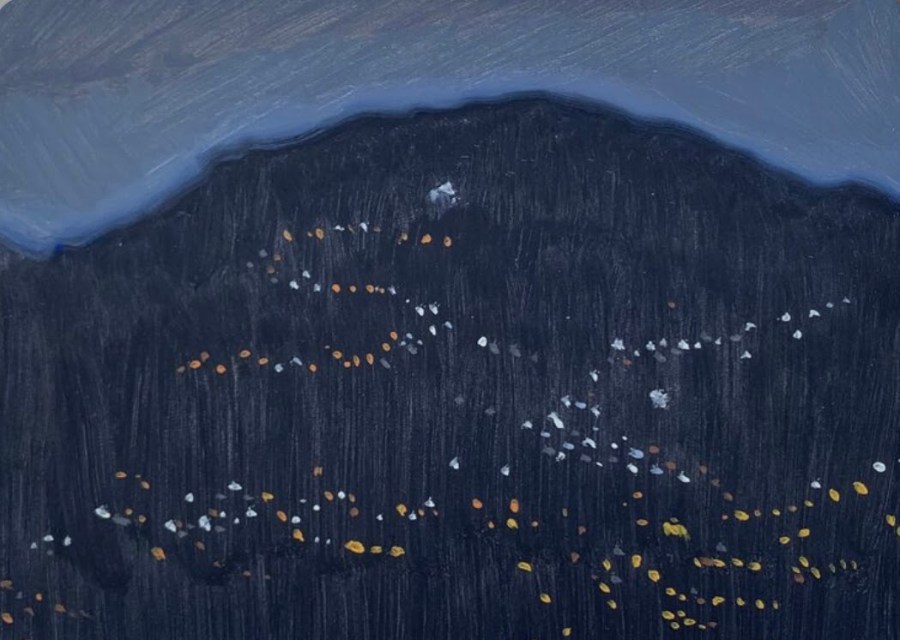
Featured Art: Monte Constantino, Night by Alex Spragens
I lost her the night of the squalls, when wind raged hard enough to rip trees from the ground—my husband helping neighbors with a collapsed roof, and me with blood that wouldn’t stop and wouldn’t stop. I carried her for four months. I had imagined her face.
I walked the dark house alone, not wanting to sit, hearing crying that wasn’t mine while the moon trailed after me. I searched out the front window for my husband’s headlights because it wouldn’t feel real until I could tell him, but my breath fogged the glass, and I couldn’t see. Finally, I slept because I was too tired to do anything else.
Empty and quiet. My body. The house. Except for the walls, which were run through with mice and scratching.
They say children choose their parents. What does that say of me? What does that say?
In the wild, a wolf mother will carry a dead pup around in her mouth, showing the body to the rest of the pack, before she buries it.
I didn’t want to live on Sonoma Mountain. I was busy in San Francisco, with my job and my children, our friends and activities. Cities had always been my preferred environment; I like the noise and jostling crowds. But Jim needed more room and fewer people, country vistas and wide-open spaces. He wanted privacy and verdure, bike paths and hiking trails. So I agreed to look for them with him, first in Carmel Valley and finally, one afternoon, by myself in Sonoma county.
The real estate agent selected a few houses that fit our careful budget, and pointed to the first on a map, three miles up Sonoma Mountain from the valley floor.
“That one,” I said, “is too remote.”
“Don’t worry,” she assured me, “we won’t stay long.”
A dark shadow lifted off the sand and floated forward.
“Sting-ray!” she thought, and reached up to pull her goggles down over her eyes. They had seen several rays during their dives that week. She hoped this would be a spotted eagle ray. Velvety black beneath an ebullience of crisp white dots, the spotted eagle rays had been her favorites. She ducked below the surface.
And saw that it was not a spotted eagle ray.
It was not a ray of any kind.
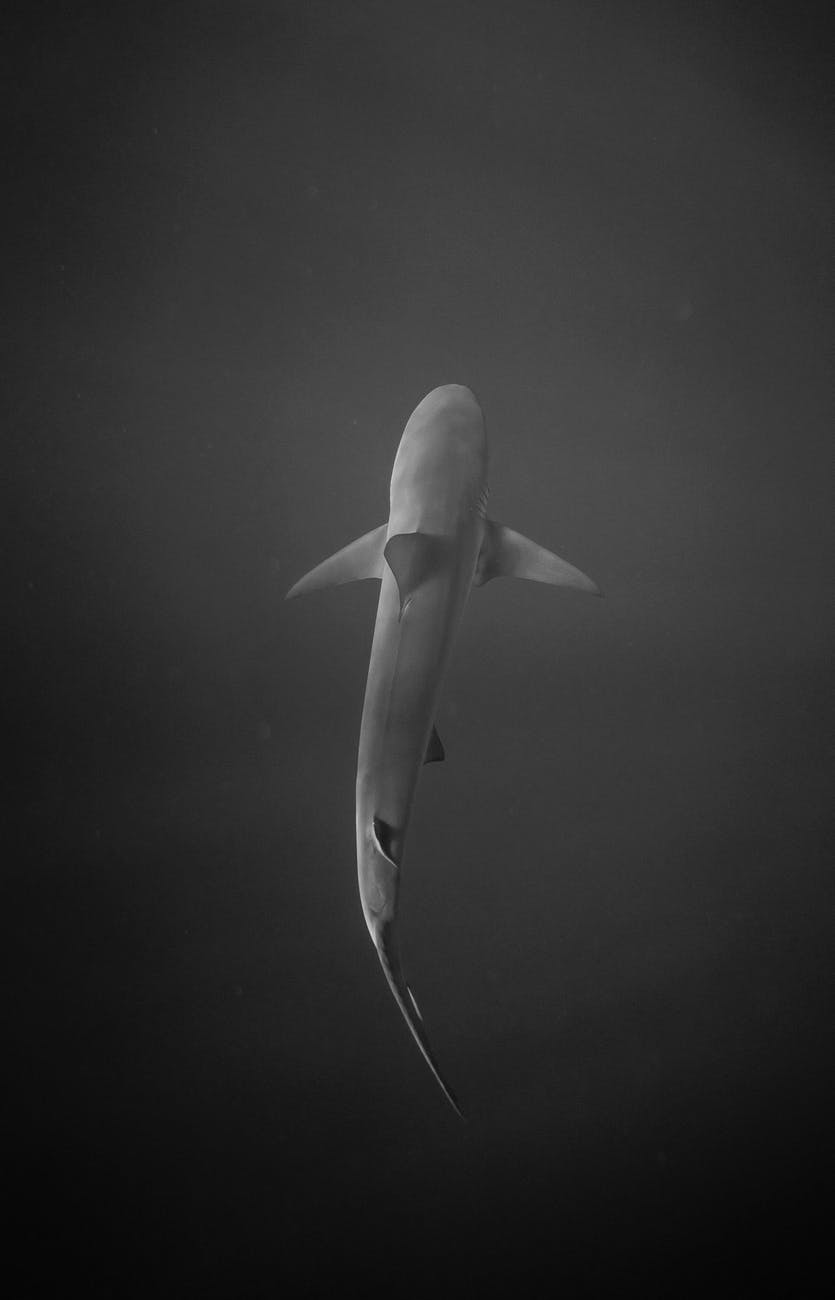
It was a shark.
She had never seen a shark before. Of course she’d seen a shark before: in a movie, in an aquarium. But that was the sensation: I’ve never seen a shark before, but I know one when I see one, and that shape swaying through the not quite crystal-clear water, that is a shark. It felt primal: ancient, encoded, instinctive recognition of predator.
We are walking along the dunes at Corn Hill Beach with my grandfather, Baba. The sun is broiling our backs, and there aren’t any clouds. We smell like suntan lotion and laundered clothes. Baba breathes heavily as he walks. He wears clean sneakers with white socks pulled halfway up his calves. I have a new pair of flip-flops in one hand, my toes seeping into the sand. My brother runs ahead, an inflatable red lobster tucked under his arm.
We were supposed to leave the Cape a week ago to go back home to our mother, but we are still here. At night, after we’ve been bathed and fed, my grandparents fight about what to do with us. The day camp with the dreadlocked artist has ended; neither of us did well with tennis.
Wyatt is eight, and I am ten. We sleep in bunk beds in my grandparents’ renovated wing. When I close my eyes, I hear large ice cubes fill my grandmother’s glass, the freezer open and close. We have a whole dresser of new clothes they’ve bought us, some colorful toys in a wicker basket. If they yell at each other loudly enough, Wyatt sniffles and cries. “Be quiet,” I try to tell him, but he doesn’t understand. On my back, I lie as still as I can be in the top bunk, pretending I’m frozen in glass. If my grandmother hears my brother cry and peeks into the room, she’ll think that I’m asleep.
“Over here,” Baba says, and we move toward the water. He’s packed a cooler with Goldfish and Milano cookies, juice boxes, and cans of Coke. His white hair sneaks out the back of his baseball cap. Wyatt throws his shirt off and runs into the water, thrashing wildly in the waves. Baba takes off his shoes and socks carefully. He looks far out into the ocean, his soft skin glistening in the sun. The waves crash onto the sand, and the wind twirls through my hair.
Last week, when I asked my grandmother why we weren’t going back home to our mother, she wouldn’t give me a straight answer. “Your mother is busy,” she said. She was staring at herself in the mirror of her bathroom, fluffing her hair. “She’s writing a paper for her Statistics class.” My grandmother sprayed perfume on her wrists and then rubbed them together. Her gold bracelets slid down her arm. “She needs more time.”
“Don’t you want to go in the water?” Baba says.
The truth is I am afraid of swimming, but I get up and walk slowly through the thick sand, sitting down at the water’s edge. Wyatt is pretending to be a shark, flapping his hands like fins and growling. We are two different islands; we almost can’t see each other.
By the time Nicole arrives at the clinic, the parking lot is already full of folks waiting to drop off their pets before hightailing it out of town, out of the path of the hurricane. All morning she’s been battling that crampy twinge in her hand—dystonia, Dr. Epstein calls this, involuntary muscle contractions—and she hoped that she would be able to spend most of today hiding in her office. A foolish hope, considering that all of the pet-friendly hotels within a 100-mile radius have already sold out. Unlocking the front doors, she marshals a smile as the sleepy-eyed clients slump into the lobby with their cat carriers and their leashed dogs.
Inside, she leaves the receptionist to check everyone in while she goes around the building flicking on lights. In the kennel at the back of the building, she feeds and waters the dozen or so animals already boarding and begins taking the dogs outside one by one. Technically, this is a job for the assistants, but as owner Nicole takes a sheepish sort of pleasure in micromanaging. A canopy of clouds hangs low in the sky, the wind already churning ominously. By tomorrow afternoon, the rains will be here, thick and driving. Initial projections had the hurricane cutting west, into the Gulf of Mexico. Perhaps Nicole shouldn’t have been surprised when the projections abruptly shifted, the storm now expected to hook northeast, right through the Carolinas. That’s her life in a nutshell, isn’t it? A sudden change in trajectory, something to brace for. You’re just feeling sorry for yourself, her mother might scold, caustic old bird that she was, and she would be right. But her mother is long gone, and so who cares if Nicole is feeling a little morose this morning? It’s her clinic, she can feel whatever she wants.
She waits until all the other dogs have been walked before taking out the rottweiler that Animal Control dropped off yesterday. It was found near the airport, a scrawny female with patchy fur and a missing chunk of ear. Upon being hustled into the van, the animal bit one of the officers on the hand. “Fucker cost me three stitches,” the fellow said when he dropped the dog off, holding up his bandaged hand for Nicole to see.
I didn’t want to walk out the door with the letter that morning either. I didn’t want to shut off Ken’s 5:45 AM alarm and find his side of the bed empty. I didn’t want the lingering cologne in the bathroom and the trail of beard tips tapped from a razor along the sink’s edge. But what I wanted was beside the point.
This is how we lived during our separation, coming and going through the house we still shared. Ken avoided me, and I tracked his traces like a botanist searching for a rare species of plant. I tracked him to the coat rack where his bomber jacket was missing, and there he disappeared, destination unknown. Read More
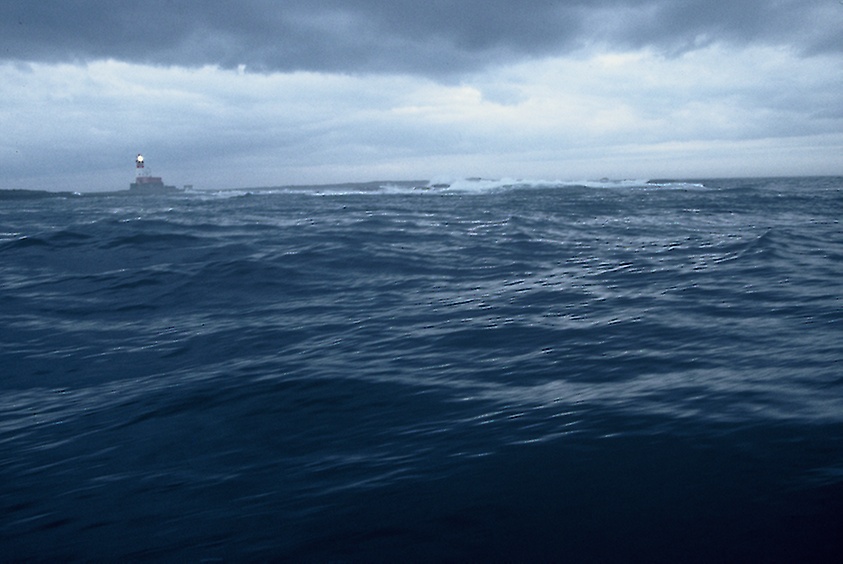
Featured art: Disappearance at Sea II by Tacita Dean
for Esperanza Duque
I came to Guerrero because they told me my father had been here, once when he was my age, and later, when he fled. But we came to Pie de la Cuesta for Tía Juana. I couldn’t tell her no while she was sitting there with her blouse still unbuttoned down to her waist, and those lines folded sideways through her armpits. The right side had been more complicated during surgery, so the scar splayed from her chest almost to her back. Seeing me dressed for the beach all week reminded her of what she had lost years before: Pie de la Cuesta, a needle of coastline only she remembered. Adán drove us here so she could show me. And now we were here and Tía Juana was far behind us, alone, almost buried in the sand. Read More
Donna forgot about the cat. She had promised to take care of it when her sister went on another one of her vacations. But the cat slipped to the bottom of Donna’s to-do list until he was barely hanging on, his presence barely noticed and left to his own devices, roaming her sister’s home on his lonesome. Donna did not want the cat staying in her own home, choosing to sacrifice the time it would take to drive to her sister’s to feed it every other day rather than let its fur coat her hardwood floors.
She woke early that morning and decided to take advantage of the rare combination of a day off and unusually warm October weather to tackle the overgrown landscaping surrounding the house. At the beginning of summer, she paid a neighborhood kid to pull weeds and lay mulch, but the upkeep fell to her, and she hadn’t been particularly diligent about keeping the crab grass at bay. Her husband suggested hiring the kid again, but Donna refused. Everyone else in the neighborhood either cared for their yards themselves or hired professionals who drove around in logo-covered trucks that hauled riding lawnmowers, hedge trimmers, and leaf blowers. None of them cheaped out and hired a teenager to do a half-assed job to save a few dollars. It was embarrassing that they even hired him in the first place, like they couldn’t afford to do any better than that. Ella, who lived across the street, would have never done such a thing. Donna was sure of it.
Feature image: Winslow Homer. Breaking Storm, Coast of Maine, 1894. The Art Institute of Chicago.
Itchy in November, right before Thanksgiving. It was my first winter sober, when you were living on the top floor of that six-story apartment building overlooking the river, back before the neighborhood was converted into condos.
“Hurricane season,” you said when you saw me looking out your window in that blank way. “When the temperatures drop, us drunks get restless.”
Your hands got busy stacking up wood in the fireplace. I’d seen people who had come into the same meetings every week suddenly stop showing up, seen the way that the ones who did come back would raise their hands, announcing their day counts, differently this time. “I’ve got five days.” “Nineteen days.” “I’ve got forty-one days back,” they’d say, the “back” added to show that this wasn’t their first time at the rodeo. It didn’t look like it was any easier, though: their hands shook like any newcomer’s, their eyes wandered the rooms the same way, rabid.
Winner of the 2009 New Ohio Review Prize in Fiction (selected by Peter Ho Davies)
By Christine Nicolai
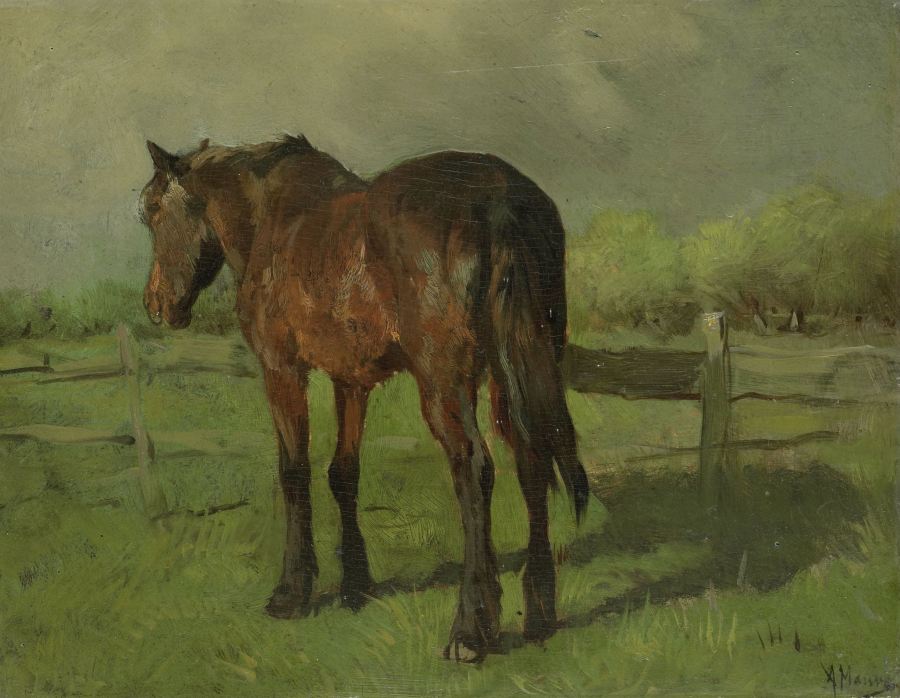
Featured Art: Paard by Anton Mauve
It was close to midnight when Vic heard a shotgun echoing somewhere nearby. If Sue were still around, he’d have put on his boots and stomped out to the porch in his bathrobe, scanning the front yard and street in the twilight. If she were here, he’d have seen that it was all clear and come back to bed where she’d have been frozen under the blankets, breathing those shallow, rabbitty breaths, like she was flattened in a clump of weeds, waiting for the fox to move on. Without Sue, Vic told himself it wasn’t a shotgun he’d heard, because shots at midnight usually meant someone was doing something they shouldn’t.
This was midsummer, humid and hot. Even though it was long after the fourth, the noise could have been an M-80 or Salute, picked up from the reservation. Every couple of weeks one of the guys at the restaurant complained about kids lobbing cherry bombs into front lawns and tearing off down the street, yelping at the stars. That was an explanation he could almost hold in his hand, except that he knew it was the sharp-edged sound of a shotgun that had crackled through the night. His jeans were on the floor. He put them on in the dark and went to check the doors, sticking his head out the back, trying to make out more than just the outline of the barn against the dark sky. The gate leading to the back pasture appeared to be shut, which meant that Toby, the gelding Sue had left behind, should be all right. He closed the door.