A Note

By Wisława Szymborska
Translated from the Polish by Joanna Trzeciak

Life—the only way,
to grow over with leaves,
catch a breath on the sand,
soar on wings;

to be a dog,
or to pet one;

to tell pain apart
from everything that isn’t pain;

to fit into events,
to vanish in vistas,
to search for the minutest of errors.

It’s an excellent opportunity
to recall for a bit
what was talked about
with the lamp turned off;

and if only once
to trip over a rock,
to get drenched in the rain,
to lose keys in the grass,
to follow a spark on the wind;

always not knowing
something important.


Read More

Little Bird

By Lawrence Raab

Featured Art: Seascape by Pierre-Auguste Renoir

One cloud was following another
across a blue and passionless sky.
It was the middle of summer, far enough
from December for a man to feel indifferent
to the memories of cold, not yet close
enough to autumn to be caught up
in all its folderol about death.
Neither cloud looked like a whale
or a weasel, or any kind of fanciful beast.
All morning I’d felt my life dragging me down.
The view from my window refused to lift my heart.
The sight of a blank piece of paper
filled me with sadness. I wanted to set
my life down in a comfortable chair, tell it
to take a long nap, and walk away as if
I were somebody else, somebody without a house
or a family or a job, but somebody who might
soon feel with a pang precisely the absence
of everything I had. A cool breeze lifted
the curtains in the room where I was sitting.
A bird was singing. Had it been singing for long?
Far off there were mountains, but I didn’t
wish to go there. Nor did I yearn
to be standing by a lake, or walking
beside the tumult of the sea.
The little bird kept repeating itself.
I filled a glass with water and watched it tremble.


Read More

So Near Yet So Far

By Angie Estes

Featured Art: The Holy Family with the infant Saint John by Valerio Castello

At the edge of the apparent
        disk of a celestial body, known

as its limb, is the border
        between light and dark, there

and not. First a gradual dimming,
        then small crescent shapes appear

on the ground under trees as
        the temperature sharply drops

and birds become quiet, the stars,
        visible: when the sun and moon

come face to face, small beads
        of sunlight shine through the valleys

Read More

Here Lightning Has Been

By Angie Estes

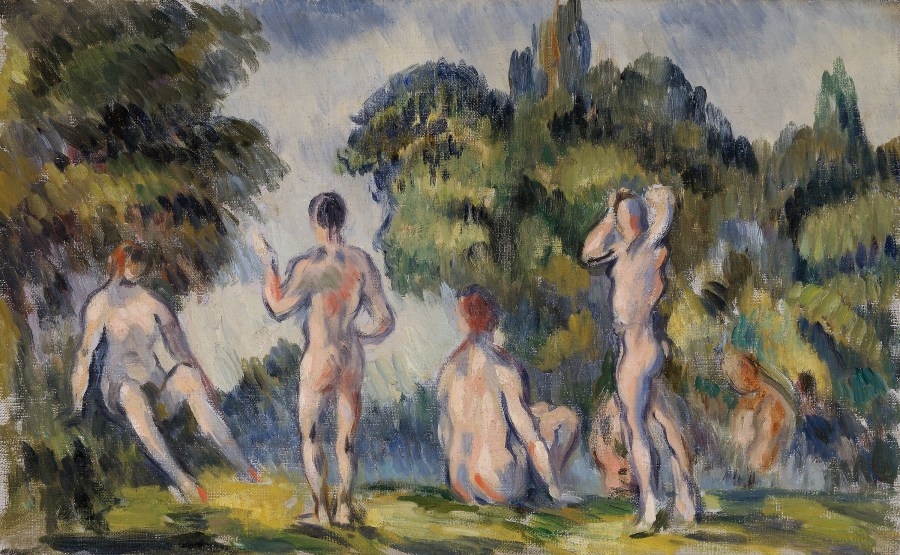
Featured Art: Bathers by Paul Cézanne

buried across the barren plateaus
of Provence, where stone altars
chiseled with FVLGVR CONDITVM
mark the point where lightning entered
the ground. Around each site, a wall
remains to keep the divine
fire of Jupiter’s signature within
the shafts and passageways
of the earth. According to Plutarch,
whoever is touched
by lightning is invested with divine
powers, and anyone slain by
its bolt is equal to the gods, their bodies
not subject to decay because
they have been embalmed
by celestial fire. Light,
                                         when it leaves
the air, is the color of blood
that has entered a vein:

Read More

Anderson Inside the Hurricane

By Stefi Weisburd

Featured Art: A Vagabond Walking Along a Lane by Alphonse Legros

The wind has come to remind us of our wings — Mississippi artist Walter
Anderson, who tied himself to trees in order to experience hurricanes

Lashed to the mast, ears thrashed
             by sirens in the eyewall, Anderson
is the squall’s canvas, ravaged
             by wind that wants to strip
his skin from skull
                          and howl.

      Only yesterday he sank
                             to hands and knees
to understand the guano of green heron, to paint
                        the violet frog. Lying by a quiet
      lagoon, inking a white-throated
                        sparrow, he saw cadmium and red madder happily
flare in foliage. In the slash pines of Horn Island
where imagination fills the space between trees, art
     defers the evil moment. Contour of bark
     or butterfly is ballast; it calms the

                   gale within him, bulrush pool, always a balm until

     a storm makes land.
                             Then it froths and spits, rain
         needles him, ankles deep in the surge.
         How will he paint the sting
                    of maddened sand, the batter of root
    torn from loam, blue strafed from
                               sky? Titanium whitecaps throttle
the mangrove beach. All around him, palms
                                flash and flinch like broken
              umbrellas in brash light, the shed
                                       in shivers under

         the blotted sun. A locomotive
                  in his ear, wind
                                    wrenches his breath from
                           its palate, whips
         him beyond himself, out
                  of his sleeve of pain, sopping

                                          and so close, so
                                 close to capsizing . . .
                        Something in the cyclone
        cries out.

                        Something wheels

                                                 and sings.


Originally appeared in NOR 4
Travel: Choler

By Neil Shepard

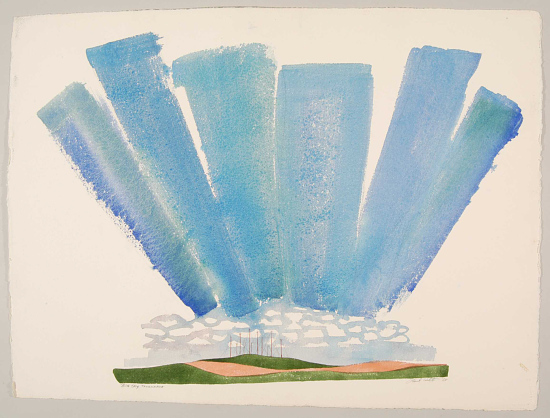
Featured Image: Old Sarum by David Lucas

For Robinson Jeffers

We had come to the Great Wall’s end
in the desert of Jiaguyuan. Our tempers flared
across the crumbled battlements, out into the red heat.
There were weeds, thorns, a few hard-
shelled bugs. Love reduced to a black
carapace, under which a stinger,
a biting mouth, a reflex, a poison.

Heat withered our patience. Our bowels,
stung by a virus, made us say words we’d regret—
peevish, pernicious—wo yao, wo yao,
I want, I want, and nothing else.
We both stormed off—“stormed”
could have brought some moisture
to this desert, but no, this storm

was a hot wind, stinging sand
in the face, chipped sandstone
from the last outpost, that would cut
and bury us. Wei guoren. Barbarian.

Read More

The Reversal

By Billy Collins

Featured Image: The Annunciation by George Hitchcock

It’s so beautiful outside today
and we’re all going to die,
especially me,

is an observation that drenches
the pages of every anthology of poetry.

The trees are brilliant in crimson,
and I am one day nearer the grave
would be one way to put it.

Red and white tulips are swaying
in a mild breeze this morning,
and just look at the dark gullies under my eyes
would be another.

So many variations,
you have to wonder how would it be
if the picture were flipped the other way

and poets never tired of declaring
in poem after poem
that the world is a mound of ashes
and that they will never die.

How crummy the flowers look!
How well I feel!
How hideous the mountain range!
How handsome I will always be!
How fine to live forever in the midst
Of such relentless and unspeakable ugliness!
Which brings us to the question:
how much more of that would you have to hear
before you longed for
a bead of dew on the tulip
and that cough that will be your undoing?


Read More

Nothing Stays Buried, Hector Flores

By Andrew Michael Roberts

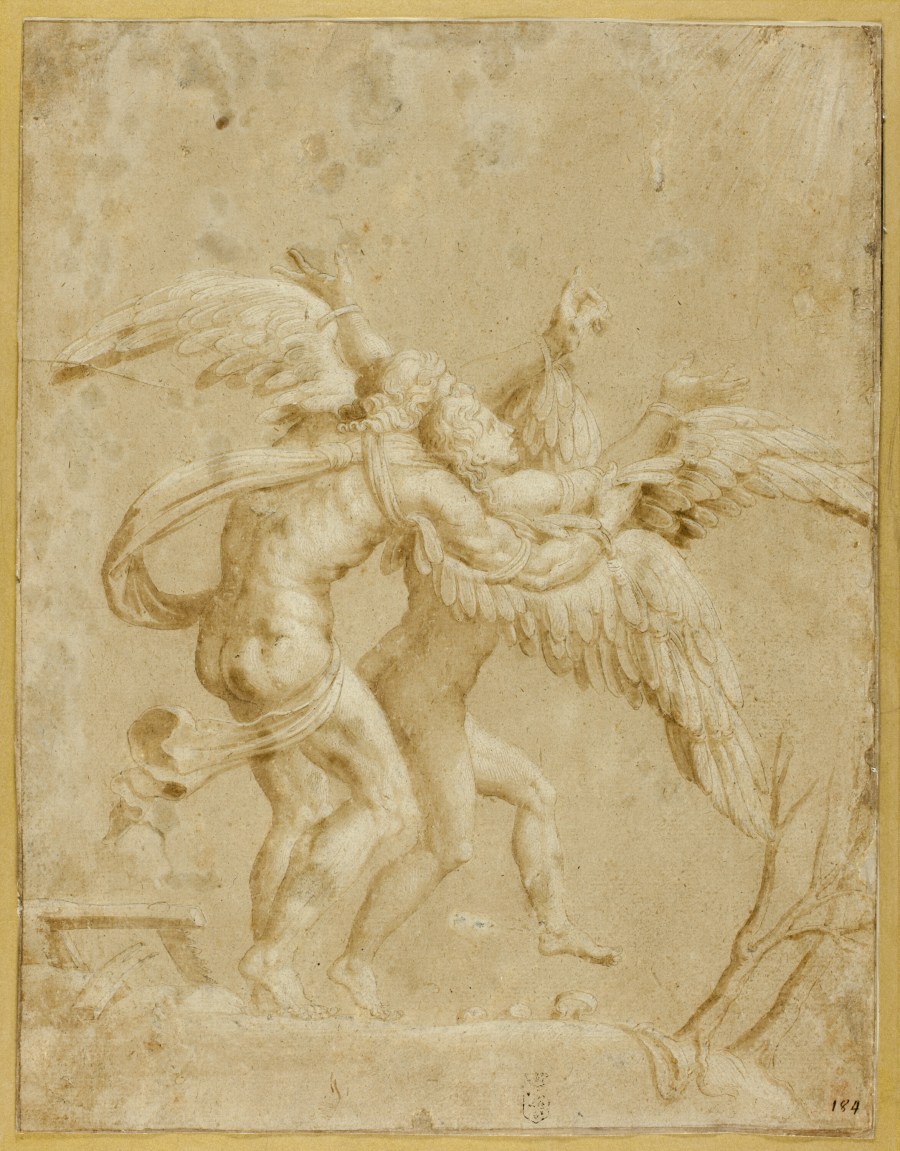
Featured Art: Daedalus and Icarus by Giulio Romano

Not your sad little sister nor the boy of your youth some doors down who shot himself twice. Not even dirt. It churns for years and surfaces as something alive. We name it old names we know by their taste on our tongues. Humus and bone, a song in the blood. Hector, we’re all descendants of conquistadors and graveyards. If you were thrown a sword, you’d know how to hold it. Know which tombstones to walk behind, whistling. Which mountain to climb and when to take flight. How heavy your tired arms. Hector, look down on us tenderly before crossing over and descending into the desert. Remember us as the sand swallows and sings you. Before the sun takes you, cast your winged shadow across it. We are the grains in your grave. We are buried there with you.

Read More

There Was a War

By Andrew Michael Roberts

Featured Art: I Saw it, plate 44 from The Disasters of War by Francisco de Goya

and it wasn’t ours because we didn’t believe in it, but they shot at us anyway because we stood somewhere in the middle of them killing each other. What could we do but lie down and wait? We lay a long time, thinking, the grass like trees shooting into the sky. Bullets like birds shooting across it. Too many hours of sun in our eyes. We were thinking: if we had guns we’d use them to get the hell out of the middle of this war.

Read More

Dunes

By Mark Cox

Featured Art: Sand Dunes, Harlech, North Wales by George Elbert Burr

Despite the curvatures adapted each to the other,
The slackening skin that in sleep feels lost without that other’s;
Despite the slatted fencing that marks their yard from others’,
And the offspring at play within, their testament to others;
Despite all the others they have embraced and refused;
Despite all otherness between them
They’ve acknowledged and recused;
They can no longer in mystery come to each other,
With the quickening and total surrender to another
That both empties each and fills the other.
And so they go on, because each goes on, despite the other:
To each their own wind-ironed waters,
To each their own bruised sky and horizon,
Their own shames, their own redemptions,
Awakening to each night’s newly shifted sloping,
Each day by unremitting day’s abiding,
Without need for another day or lover,
They endure side by side, in their time, no other.

Read More