Told You So

By Craig Bernardini

If I had a choice
between being wrong
and the world dying—
you know, the oceans
turning into lemon juice, the air
to Lysol, the forests
cinder, tundra
swamp, shipping lanes
jammed with dead
polar bears, Manhattan
a gondola, the world,
a Gondwana of dengue—
I would, of course, choose
the latter.
And maybe, just maybe,
clinging to the last
antenna of the last
skyscraper to be swallowed
by the waves, pointing
my big fat finger
at the dead world,
and at all the mother-
fuckers who did it,
shouting, Told you so,
Told you so—maybe,
as the water was closing
over my mouth, I’d understand
how we got into this mess
in the first place.


Read More
Aphorisms for a Lonely Planet

By Lance Larsen

1

Conception, gamete meeting gamete, cells dividing and differentiating. Who wants to imagine themselves coming into the world this way? Instead think of your parents as amateurs lying down in the enchanted dark and rising up as seasoned weavers of light.  Picture fire, with sparks flying off. One was lucky enough to catch—and now pulses inside you.  Listen to yourself breathe.

2

Like a rolling billiard ball we touch the world one green millisecond at a time.

3

A good story possesses its own magnetic north, to which every vibrating sentence must point.

4

To live is to doubt.

5

At the exit of the Paris catacombs, which houses the remains of six million sleepers, the guard looked me over, then fanned a flashlight into my backpack: Any bones, any bonesNo, I said, then smuggled my skeleton into the morning.

6

Should I read Descartes or listen to Motown? Depends whether I want to interrogate my doubts or slap them on my feet and dance them under the table.

7

The young are young. The old are young and old at the same time. You have to be old to know this—that’s the problem.

8

Seek labor which both tires and renews.

Read More

If Your Spouse Dies First

By Stephanie Johnson

Featured Art: Lady Lilith by Dante Rossetti

Option One

              Move to a different country.
              Take a new spouse.
              Make beautiful different-country babies
              with soft, different-country hair

and only speak your old-country language
late at night in between dreams.
Your new husband will ask the following morning
who this person is; you keep repeating his name.

              Oh, you say, in your new language.
              Don’t worry about it. Just an old friend.

Option Two

Build a house. Bake your late spouse’s remains
into the walls. Like the spectrophiliac Amethyst Realm,
feel paranormal hands on your legs and back
as you rub yourself on the corners of the foyer.

              Moan the name
              your ears haven’t heard
              since you reopened the coffin
              and saw silver bones.

Option Three

              Meet a woman with dark hair
              and patience longer than yours.
              Tell her a lie:
              you’ve never done this before.

                             She’ll grin and say, “Sure you haven’t.”
                            Later, in her shower, pressed against
                            the pink tile wall, you can’t help but notice
                            she uses his same shampoo.

Read More

Near the Campo Aponal, on My Father’s Birthday

By David Brendan Hopes

Featured Art: A Rocky Coast by William Trost Richards

De Sandro’s café with the orange tablecloths
wades into the one stone street
without tourists, all the Venetians pushing
their big delivery carts at first of morning.
From what I understand of it,
the shouting is voluble,
happy, glad to be alive, almost never
without reference to anatomy.

Nine years after your death it is still your birthday.
I’m treating you to cappuccino and showing off
my lacework of Italian.
Ecco, I cry, pointing to the beautiful faces,
the beautiful things.

Everything was outlandish to you. Nothing is to me.
In that way balance is achieved across the long years.

But I think you would like these people.
They would pull out the orange chairs, sit down,
listen to what you have to say. You would be old
and wise in a city old and wise, and that would be
enough.

I’d better think of something else before the mood
turns heavy and hard to carry over the Rialto Bridge
with the shops just opening.
All those selfie-taking children,
all that brightness bearing down.

Happy birthday, I want to say,
from the last place on earth, where the earth dissolves
and the crazy towers lean out over
watching for what comes—sinuous, flowing,
unexpected—next.


Read More

Hilltop Cemetery

By Brendan Cooney

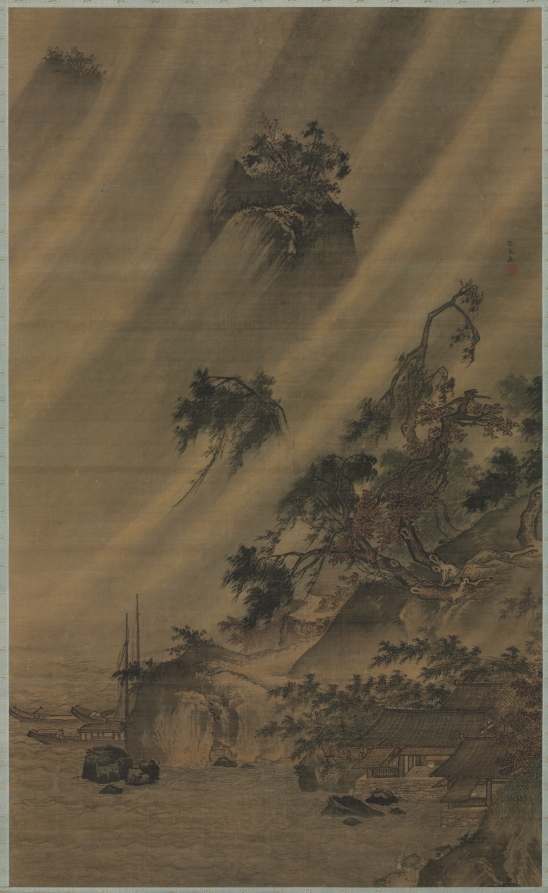
Featured Art: River Village in a Rainstorm by Lu Wenying

How many of you said,
“How I prayed for the day to pass quickly.”

How many said,
“I didn’t care about the result
even if I did achieve it.”

How many of you said,
“I dreamed of making them like me,
if only for my elevation of thought
and unmistakable wit.”

How many of you said,
“I was ridiculously exaggerating the facts,
but how could I help it?”

How many said,
“I could not control myself and
was already shaking with fever.”

Who said,
“Then followed three years of gloomy memories.”

Did anyone say,
“If it’s gonna be shame, bring it;
if it’s gonna be disgrace, I’ll take it;
if it’s gonna be degradation, welcome;
the worse it is, the better.”

How many of you said,
“Strangeness is not a vice.”

How many said,
“I needed a friend, so much.”


Read More

I Tie My Shoes

By George Bilgere

Featured art: ‘Sorrowing Old Man (At Eternity’s Gate)’ by Vincent Van Gogh

I’m walking home late after work
along Meadowbrook Road when I realize
the guy half a block ahead of me
is Bill, from Religious Studies.
I recognize his bald spot, like a pale moon
in the dusk, and his kind of shuffling,
inward-gazing gait. Bill walks
like a pilgrim, measuring his stride
for the long journey, for the next step
in the hard progression of steps.

And while I like Bill, and in some ways
even admire him (he wrote something important
maybe a decade ago on Vatican II),
I slow down a little bit. I even stop
and pretend to tie my shoes, not wanting
to overtake him, because I’m afraid
of the thing he’s carrying, which is big
and invisible and grotesque, a burden
he’s lugging through the twilight, its weight
and unwieldiness slowing him down,
as it has for five years, since a drunk
killed his teenaged son, and Bill’s bald spot
dawned like a tonsure and his gait
grew tentative and unsure, and his gaze
turned inward as his body curled itself
around the enormous, boy-shaped
emptiness, and the question
he spends his days asking God.

And if I caught up with him
and we walked together through the dusk
he would ask me about my own son,
who is three, and the vast prospect of the future
onto which that number opens, involving
Little League and camp-outs and touch
football in the backyard would hang there,
terrible and ablaze in the autumn twilight,
and the two of us would have to slog
down Meadowbrook Road like penitents,
adding its awful weight to the weight of his son
on our backs, our shoulders, and so I fail
Bill, and stop and pretend to tie my shoes.


Read More

Detective Story

By James Lineberger

Featured Art: by sir Edwin Landseer

When I worked as a janitor at the courthouse
I met a detective in the Sheriff’s department
whose son, I learned, had committed suicide
some months earlier. Having lost a son myself
in a car-train collision, I tried to offer my condolences.
“Your boy kill himself?” the detective asked bluntly.
“We never knew,” I replied. The detective grunted
noncommittally and opened his desk drawer to take out
a photo of his son, a young man in his twenties, kneeling
and embracing a dog as he grinned for the camera.
“Two days before it happened,” the detective said.
“About the same age as our son,” I said.
The detective stared at the photo for a moment.
“You got a dog?” he asked.
“Two,” I said.
“Thing about a dog,” he said, “a person can screw up
a hundred ways, and his dog will love him when he can’t
even love his self.”
“Our son’s dog still sleeps at the foot of his bed,” I said.
The detective turned the photograph over on its face
and glanced up at me, his eyes as cold as stars.
“Ain’t his dog,” he said. “It’s mine.”


Read More

The Pale Man

By Michael Pearce

Featured Art: We Both Saw a Large Pale Light, plate 2 of 6 by Odilon Redon, 1896

Last time I saw my dad was at
the cemetery on Pilgrim Hill,
pale as a ghost but he wasn’t dead.
He stood over the grave of his grandfather,
the hero of our family.
I called out to him and waved and
he turned my way—he looked sad
and then he looked ashamed and
I felt bad for him until I understood
that his shame was directed at me.

No point in pondering his disappointment,
I know I’m a failure in his eyes and
there’s no way back to the sunshine of his pride—
the boy of great promise is long dead and here I am.
And there he was—he turned away from me
and peered right through the gravestone
and into a glorious dream of the past
where a brave man stood against the mob
and brought reason to our torn-up town.

I tried to smile because I love him so much
and because I know he’ll be the next to go—
that’s why he was there on Pilgrim Hill
and in fact as I stood there watching
he got even paler and I could see
the silhouette of a fencepost behind him,
dim x-ray of a thick dead spine.

A full moon rose in the afternoon sky.
Oh Daddy, said the scream inside my head,
oh Papa, please don’t go without giving me
your blessing, the sweet sneeze of your blessing.
And then I knew that he didn’t have it in him
and never had, that he was too faint and frail
and too scared to issue blessing or curse.
And I forgave him, I did my best to forgive him
and when I wake up on these fullmoon nights
that’s what I do, I forgive him as best I can
because now I can’t see him anymore
that’s how pale he’s gotten but I know
he’s alive and still walks this town.


Read More

Little Red Book

By Jeffrey Harrison

Featured Art: Le Code Noir by Pierre Prault

I unearth it while cleaning up my office,
The Little Book of Common Sense Investing
that my father sent me two years before he died,
its bright red cover like an accusation,
a yellow Post-it bearing his cheerful
half-script still attached: “Jeff—even if you read
only the first part of this book, you’ll get the gist.
Return it some time, no hurry. Love, Dad.”
I chose to place the emphasis on “no hurry”
and hadn’t cracked its little crimson spine
when, a year later, he asked me what I thought.
When I told him I hadn’t gotten to it yet,
he said he wanted it back, so he could lend it
“to someone who might actually read it.”
“But I might still read it,” I said half-heartedly.
“No, you won’t.” Which made me all the more
determined not to read it, so I said fine,
I’d send it back. But I never did—and then
he got sick, and our investment
in that particular contest seemed pointless.

But here it is again, this little red book
so unlike Mao’s, as if my father were making
a move from beyond the grave. Okay, my turn.
Is it because I need to prove him wrong
even now, or that I want to make amends
belatedly for disappointing him yet again
that I open the book and begin reading?
Or am I doing it in his honor? And is he
still trying to tell me I invested
in the wrong things?—poetry, for instance.
“Counting angels on a pin,” he said once.
Which is just the kind of cliché I find in the book.
Later, though, he claimed to like my poems,
the funny ones at least. And if we drew a graph
of our relationship over his last decades
it would look a lot like the Dow: a steady ascent
with several harrowing jagged downward spikes.
The little red book says nothing about those,
though it does advise not getting too caught up
in the market’s dramatic nose-dives.

Unless, perhaps, you’re trying to realize
your loss—another topic that the book,
with its rosy perspective, blithely avoids
as it enthuses on “the miracle of compounding.”
But instead of getting annoyed I feel an odd
joy: my father could have written this book.
He too was an optimist who liked to talk
about money, and so I used to ask him questions—
What’s the best kind of mortgage to get? Is life
insurance a good idea?—and those led
to some of our least fraught conversations.
That’s why he gave me the book. And he
was right: I get the gist after two chapters.
And the suggestions seem helpful, if limited—
I even underline a few sentences.
Still, that other book, the one about losses,
would be more complicated, and harder to write,
its author finally coming to understand
that, no matter what the future brings,
he won’t be able to ask his father’s advice.


Read More

We Remember You for Now

By Stephanie Rogers

Featured Art: Figurative Abstraction by Unknown

Now when my heart beats, it sounds like
crunched leaves skittering, the revving up

of a broken-down Honda. I can’t visit him
at a cemetery, or even the park. Scatter

my ashes there, he asked, and then injected
god knows how much, enough to warrant

a coroner call. Hahaha. Joke is Heather said nope,
stuffed and stored him in the back

of our mother’s closet. He lives there now,
sucking up the radiator heat. Joel, damn,

man. Come back and lick the spilt fizz off
the Budweiser can again. No one here

is going anywhere if I have a say, and how
didn’t I have a say with you? You plunged,

you syringed, each time needling—gentle,
I hope, as my grandmother crocheting

a winter hat for your oldest girl. I won’t
for long torture myself for you, I thought,

biting into a string of candy hearts around
my neck, your kid insisting, eat it, the sick-

sweet sticky hands of a two-year-old with
a dad resting inside a shoebox next to

a bowling ball. You did it. Congratulations.
I’m elated. I’m devastated. I’m a copycat

singing your songs to your girls to sleep.
Listen, creep: we remember you for now,

but now is a ragged dog, dragging its bum
leg along the buzzing halls of a new house.


Read More

Believe that Even in My Deliberateness I Was Not Deliberate

By Gail Mazur

Featured Art: Butterfly by Mary Altha Nims

Believe that even in my deliberateness I was not deliberate
—The end words form this line from Gwendolyn Brooks’
poem, “the mother”

We’d be calm, we’d be serene, as long as we could believe

in the blue dragonflies and balletic monarchs that

hovered near us in a kind of peaceable kingdom even

while my love’s illness menaced the peace in

the summer yard, in the fragile house, in the air I breathed in my

deliberateness. My only stratagem, deliberateness:

to accept our lot in that pathless time. I

thought I’d know what he’d want; what I’d want was-

n’t any different. Wouldn’t it be, wouldn’t it finally be, not

to consider how finite our August? Not to deliberate?


Read More

After the Funeral

By Holly Day

Featured Art: A Funeral by Jean-Paul Laurens

When my father was ten, his mother died
and he went outside into the street after her funeral and screamed
at God. He said, “Take me,
you fucker!” to God, and his younger brother, my
uncle, was so scared he ran
into the room they both shared and hid. Later, when
my father came back, my uncle asked him what Hell was like,
why God had let him come back, if he had seen
their mother, what she was wearing.


Read More

BBC

By Mike Wright

Featured Image: View of Toledo by El Greco, 1599-1600

I leave the World Service
on at night, snoozing through
the British iteration of gang rape
and kidnapping. I’ll stir sometimes
to hear a few moments of economic
collapse, but it’s really white noise,
blanching the laughter of drunks outside.
Sleeping to tragedy helps tamp down
my father’s last days, his morphine speech,
how my mother sent me to Kentucky
Fried Chicken with a coupon
for his last meal, and how shame
drove me to throw the coupon out.
If his death were broadcast in the night,
his of thousands of dying fathers,
and you slept well, how could
I begrudge you a night of rest?


Read More

The Egg

By Eric Nelson

We’re sitting at the table the way people do
When a family member dies and a stream of well-wishers
Arrive with sympathy and food.

Everyone is concerned for the widow, 70, tough, wiry,
Who now seems weak and befuddled, staring at people
She’s known for years without answering,

Rising and walking out the back door, staring at the woods
At the far end of their land.
Returning to the table without a word.

We’re all thinking how often one spouse dies
Soon after the other, dies of nothing
But lack. Because we are surrounded by guns, her husband’s

Sizeable collection—pistols in glass cases, rifles
In racks and corners—talk turns to their value, the merits
Of revolvers versus semi autos, plinking, protection.

Now, for the first time, the widow speaks, remembering
That she went to the coop this morning and found curled
In a nesting box a snake, unhinged mouth filled

With a whole egg, disappearing a swallow at a time.
She walked back to the house, pulled her .410
Off the rack, returned to the coop and blew its head off.

A hog-nose, she says. A good snake. But I had to.
She shrugs her shoulders. I had to. Glancing
At each other, we nod in agreement, relieved.


Read More

Dialing The Dead

By Mark Kraushaar

I’d never call.
First of all, I’d be intruding, and besides
I can see my dead friend with all his dead friends
even now, translucent, weightless, winging
through a cloud or sitting in a circle
on some creaky, folding chairs—
Hello, my name is Peter and I’ve
been dead ten years, car wreck.
Hello my name is Edith and I’ve
been dead a week, pneumonia.
Hello, my name is Frank and I’ve been . . . .

Oh, I know they’d all be friendly but even
dialing later when I guess he’d be alone
I’d have too many questions:
If you’re nowhere now and nothing
is this the same as everywhere and everything?
And, Peter, do you sleep in heaven?
Do you eat up there?
What’s the weather anyway?
And that tenderness of heart we try so hard
to keep a secret: in heaven we’re
wide open, aren’t we?
Stay in touch.
No, don’t.


Read More

Fear of the Bird Migration

By Darren Morris

Featured Art: Bird by Peter Takal

I was attempting
the old familiar,
the regular slog,
when I slipped into
missing her again,
the child my wife and I
would never have.
Sometimes she was
a girl and sometimes
a boy. But like heaven,
I held her there
in my mind, a place
of light where nothing
is done, but all is felt.
She was a multitude.
The great uncapturable
plasm of love. Often
she was only
a finch’s thin line across
a rice-paper sky, tearing
through all stations of life.
The way she might
have worn her hair,
or adorned the surprising aspect
of surface-self for appeal.
Or how the supremacy
of personality might emerge,
wriggling out as it does.
Or the first run-in with
terrible, terrible sexuality.

Read More

Finality

By Mark Cox

Featured Art: Jonny Dunn’s Sandwich Shop, Paducah, Kentucky by Walker Evans

She did not fit her body anymore—
she was lost inside it—
not like some punished child
wincing in the corner of a vast room—
not, either, like a ring fitted snug in its box—
more like the single yellow pill
in her white medicine cup—
that’s how she was, waiting—
carving precise cubes
from a thin lamb chop, chewing
with such listless fatigue,
I feared she might never finish,
and so pretended that by looking away
I was preserving her dignity.

Chewing and swallowing—
that’s how I remember her—
not as a face or even sequence of faces,
but as a complex montage,
a simultaneous superimposition
of every face she’d worn since birth. Read More

Saying Goodbye to Dad

by Kate Fetherston

Feature image: Pierre-Auguste Renoir. Near the Lake, 1879-1880. The Art Institute of Chicago.

My dad died alone in a VA hospital
as July sun beat without mercy into the raw

seesaw of breath busting seams between
each cell. Third spacing doctors call it

when cell walls no longer sustain
boundaries with integrity, fluid

sluices into interstitial no-man’s
land and overpowers whatever little

plans were made for a garden and some
trees. When my brothers and I got

the news and flew in from the various
places to which we’d fled, I’d just split

on my first lover after years of her
threatened suicide, bouts of drunken

depression, and refusals to take
her medicine too numerous

to recount. Her view: I’d been trained
strictly for fixer-uppers, too stupid

or stubborn to leave, but, waxing
romantic, she’d croon, “You’ll do me

for a rough old mate.” The day she smashed
my stuff into the carpet and poured

ten pounds of flour over
everything, I might have stayed for

more of the same, but I threw
crumpled clothing into my pack,

startled when she whispered, “I’m
just like your crazy

old man, aren’t I?” I didn’t
answer because we both knew

Read More

One Day Your Parents Confess You Have a Twin

by Todd Boss

Feature image: Ugo da Carpi. The Sibyl and a Child Bearing a Torch, 1510-1530. The Art Institute of Chicago.

who was given up for adoption early on, when it was
clear they couldn’t manage him. It was, says your father,
the worst decision they’d ever made. (It’s you and your
parents at the kitchen table. Between you, the steam
from the teapot uncurls in a kind of breathing statuary.)
He was your inverse, your yin: When you went to sleep,
that’s when his terrorizing of everyone would begin.
He went from home to home to group home, and then
to prison, half mad, a drug-addled teen, with your name
tattooed over the veins in both forearms. “That’s when
we moved to Minnesota,” says your mother, but of course
he found you here, at the end of an abbreviated sentence,
and slit your throat while you slept. This was last year.
You’ve been dead ever since. We know this must be hard
for you to hear: but you don’t exist. You’re your own twin
brother’s obsession with you. (Can it be? Instinctively,
you reach to touch yourself about the shoulders, the neck,
but everything’s . . . identical.) It’s like a mad dream—
yes, the recurring one you’ve had since you were a child,
in which you go from door to door, trying to trade
your life for another’s, but nobody will trade, and you go
on and on, pounding, until, impossibly, you finally find
someone willing, and you wake. Your mother reaches
through the figure of steam to lift the teapot and pour
from out its only portal a little stream into her cup, her
husband’s cup, the cup in front of you. She sets the teapot
down, and now there are four apparitions dwindling there,
silken, gesturing. One of them says, We love you the same.
But you can hardly hear them as you push up your sleeves
—one at a time—and read, and reread, your name.


Read More

House on the Lake

By Liz Robbins

Featured Image: Greenwood Lake by Jasper Francis Cropsey 1875

When Dad was dying, everyone wanted
to take care of him, no one
wanted to.

We sent flowered cards, everyone wanted
the easy parts.

His cancer was a quiet purple flower
that grew too familiar when it took
over the bed.

The purple wanted the easy parts,
the purple wanted the hard parts, the liver.

We all went one way, then another.
We were the roots, we scattered.

We couldn’t compete, that’s all we could
do. We wanted to sit around and stare
at the clouded sky and drink.

His IV was clear, the only thing.

He had ten months, ten years.

We walked around Lily-Pad Lake,
where hordes of trout wriggled
to breathe.

Read More

Objective Correlative

By Ann Keniston

Featured Art: The Letter by Alice Pike Barney

All I could do was think of her face.
Or not think of it, the way
after receiving her letter I felt
relief, gratitude, and then
lost the actual note she wrote,
the tiny, lovely photograph
of her children I’d vowed to cherish.
And then I saw: my grief was
the objective correlative, a hook
on which I could hang all the scraps
of whatever other sadnesses
I was more frightened of. And the grief,
like a person, like her in her solicitude,
almost prevented me from seeing this


Read More

Tool Box

By Maura Stanton

Under the rusting red metal lid we’re waiting for you—your father’s tools.
We always knew you weren’t going to build a doghouse or repair the stairs or
tighten a bibcock faucet, but we wanted to be of use as in the old days. Ah, the
old days! When we heard your father’s tread on the basement steps, we were
thrilled. The hammer clenched its head, the bubble trembled in the level, the
pliers stretched its jaws. But after your father died it was worse than we ex-
pected. You carted us out to your car, left us for months in the trunk, and then
stuck us on the floor of this hall closet next to the vacuum cleaner. Now the
hacksaw’s teeth are rusting, the file’s worn down, and the measuring tape sags
beside the plane. The poor jackscrew, no longer attached to a work bench, has
grown forgetful, and thinks it’s really a micrometer caliper. All you care about
is duct tape these days, tearing off flashy shreds to cover your botched work
while the tough little nails languish. So watch out! All of us in here are fed up
with your disregard for some of mankind’s oldest inventions, so if you ever do
open this lid you’re going to get hurt.


Reunion

By Bruce Weigl

Featured Art: Woman at Her Toilette by Edgar Degas

Now, as the popular girl walks among us with the microphone,
most of the stories are about loss,
or include exquisitely precise medical and pharmaceutical details,
as if the words could suture the wounds, or save us even one last breath.
I came here to dance with the Puerto Rican women
of my class of 1967, and to remember a few pals lost in the war,
who had been so beautiful, you were happy just to look upon them,
and one more
lost to his own drunken wildness
under a moon who doesn’t remember us.
It’s not a going back we long for, but a staying still
for one incomparable moment, all the lost loves’ faces
spinning in the mirrored ball.