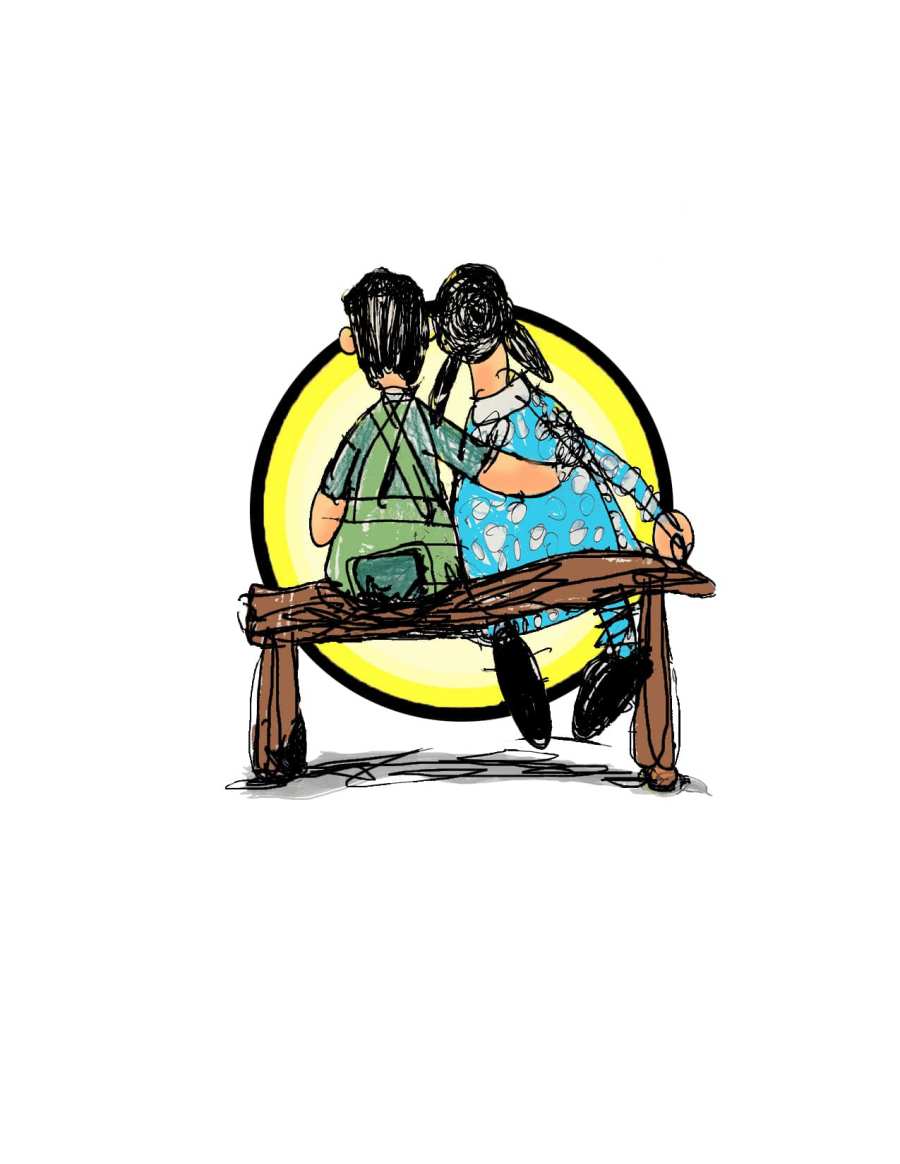
Essay: Far From a Mother 

By Madeline Simms
Featured Art: “Eye of Horus” by Ryan Davis

It is a Wednesday when I ask for help in the kitchen, a Tuesday night for my mother.  Winter flirts with spring as she sends a photo of the Monkey Bread recipe across the Atlantic. It reaches me and my dry bones in the wet grey of Ireland. I am looking for anything sweet—  

She sends a good night text when I send Good morning, alongside a picture of Rian and Jonah climbing over my groggy body. We laugh countries apart. Day or night, it is winter-dark wherever we are. I send her a video of the boys licking my face as if they are dogs, and we laugh counties apart. Our well-wishing is a promise of rising, be it the sun, the bread. I think of the day ahead of me filled with Hot Wheels, dropping off the boys at school, picking them up, snacks, spills, a likely tear or two—author unknown.  

During the past few months as an au pair, I’ve grown closer to my mother. She sends me suggestions for sneaking veggies onto the boys’ picky tongues, fun games to fill our long days together. I can’t help but wonder if she feels this too, comradery despite the distance. 

Read More

Essay: Original Sin

By Anna Davis Abel
Featured Art: “Self-Portrait” by Rachel Hall

“You’ve got to be feeling better!” 

Kim, the nurse practitioner I see every month, beams at me from across her desk, framed by a fortress of file folders and half-drained pens. A congealed yellow mass perches in the corner of the tabletop, leering at me like an inside joke I no longer find funny. This is what ten pounds of fat looks like! she’d said once, jiggling it between her hands. You’ve lost four of these! 

“I do feel better,” I lie, curling my lips into the smile I know she loves. 

I am her only eating disorder patient—a peculiar case in a weight loss clinic that masquerades as a wellness program. They market health here, but the waiting room tells a different story: anxious bodies perch on plastic chairs, flipping through pamphlets promising transformation. The air smells faintly of antiseptic and desperation. 

“You’re a real success story, Anna,” Kim says, slipping the reading glasses from atop her head. Her fingers dance over the laptop keys, scrolling, scrolling—pausing. A satisfied hum. “Looks like we’re only twelve pounds away from your BMI goal! And how long has it been since a binge?” 

I aim for optimism. “Three months.” 

Read More

Essay: Acres of Gold

By Katharine L. Wiegele

Dear Friend, it began. 

Around the last week of April in 1944, farmers around the country received a letter from the DeKalb Ag seed company. 

Twelve common kernels of corn would mean nothing to you, but the kernels in this envelope are far from being common. In fact, they are special seed kernels of a new DeKalb hybrid variety. […] Put them in safe keeping until you plant corn. This seed will produce a hybrid which neither you nor your neighbors have ever seen. 

Stapled to the letter was a small envelope containing twelve seeds. 

* * * 

A seed is an embryo. Every farmer and gardener since the Mesopotamians chose seeds to save and replant the following year. This allowed people to stop roaming around looking for food in the wild. We passed seeds from hand to hand every year in a chain of nearly 450 generations. Parents and grandparents died, but the seeds continued. If the seed was lost, we were lost.  

Read More

Fritura Sunday

By Diego Arias

I sat at a Taco Bell reading a book about cultural marxists, contraception, and immigration. Someone gave me this book and told me it would define the election, but all I could gather was the author yap on and on about country clubs and labor unions and working-class business practices and shoestring budgets. I very much wanted to dump the book in a garbage can and never read anything about it again, but I was waiting for someone and had nothing else to do. I looked up from my carne asada steak taco and watched a man in the corner enjoy a soccer game on his phone and take savage bites out of a large, engorged chalupa. As he bit into the fried casing’s manila envelope colored flesh, a bright red sauce squirted out and spread across the table. Holy Cucamonga, this was a wild, satanic place. Men with the legs of flamingos and heads like snakes from Central American jungles rummaged through middle American taco concoctions like a teenager in a 1950’s drive-in theater parking lot. They fondled these damn tacos and burritos in uncomfortable, godless ways. What sort of place was this? What kind of man visits a Taco Bell in the middle of the afternoon and orders twelve of these grease torpedoes only to consume them in one twenty-minute sitting? What sort of liver processes that kind of modern nutritional content?  

Read More

The Mentor

By Lexi Pandell

Selected as winner of the 2022 Editors’ Prize in Fiction by Patrick O’Keeffe

Featured Art: When Lunches Synch Up by Mallory Stowe

In a shingled house at the edge of the Berkeley Hills—near campus with its bulletin boards covered in smeary flyers for an upcoming Angela Davis lecture and another of a white woman toting a machine gun, and close enough to the Greek Amphitheater that the roar of a concert reverberated through the thin windows—Jane Gardener sat with six other women at a kitchen table. This was a dinner party. She’d forced herself to go with the intention of socializing. Yet she couldn’t stop thinking about how, though Lori said these dinners were about learning from other women in the restaurant industry, her presence felt like a charity. The stench of feet persisted despite the hand-dipped incense wafting in the corner. How could Lori purport to care about food, yet burn out her nose with cheap nag champa?

All of them were restaurateurs, except for Eartha, the German woman Jane employed as sous-chef at Dîner, whom she had invited to help her survive the affair.

“Isn’t spending time with friends supposed to be enjoyable?” Eartha had asked.

They weren’t her friends, though. Not really. Once, there had been more women in this coterie, some she’d actually liked. But, one by one, they had married and turned their attention to their home lives.

Read More

Prime Cuts

By Lara Palmqvist

Their fights had always been drawn-out and passionate, thrilling in their possibility. The subjects of their arguments ran the gamut; Malcolm and Clare could employ almost anything as flint to spark the heat between them, setting their hearts leaping and their sharp tongues running wild: the empty soda can rolling around the Subaru, the knife marks grooved in the laminate countertop, the lack of remaining hot water in the morning, or that time, years ago, when the dog bowl had been left dry on a sultry day. The rhythm to their relationship was marked by peaks of tension, a pulse that proved their marriage was still alive—unlike those of some of their friends, whose flatlined politeness was so painfully false, resentment straining up beneath pert compliments and cute smiles. Malcolm and Clare were authentically in love, four years married and still willing to weather the turbulence of melding two lives together. Yet it was also true their latest fights seemed rote, their jibes more personal. The cause was lack of material, Clare felt. She blamed their unchanging surroundings.

“Your manner of blinking,” she said, interrupting Malcolm as he sat reading the golf report in his favorite recliner one February morning. “It’s bothersome.”

He glanced up, eyes fluttering, bewildered. “Excuse me?”

Clare set her turmeric milk on the coffee table. “There’s some kind of stutter to the way you blink.” She flicked her fingers off her thumb in two short bursts. “Like this,” she said. “I’m not sure you’re aware. It’s making me anxious.”

Clare spoke from her heart—she was genuinely bothered by Malcolm’s mannerisms, more so with each passing day. He’d developed a habit of repeatedly clearing his throat in the mornings that made her grab fistfuls of her dark hair and pull until her scalp felt strained. Just last week she’d noticed new strands of gray growing in along her part.

“I see,” Malcolm said. He creased the paper, eyes now flat and focused, strained wide.

Clare didn’t want this—she didn’t want him to suffer.

Read More

Fourteen Meals

By Stephanie Early Green

Featured Art: Happy Couple Jason Douglas and Mallory Valentour

The first meal we share is ribeye steak with scalloped potatoes and three wilted strands of asparagus cowering on the side of each plate. He takes one bite of potato. I pretend to cut my steak but don’t eat any. I don’t want to ruin my lipstick, or get steak-fat caught in my teeth. We talk about our families, and how we both value the concept of family, and how we both hope to have families of our own someday. We agree that we have a ton in common. We find out that we both enjoy country music and have corny senses of humor. We tell each other knock-knock jokes. Mine are better, but I laugh at his, while still trying to look pretty. It’s difficult to laugh out loud and not look a little ugly, a little wild. The trick is to keep your eyes open, and gently scrunch your nose, but not open your mouth too wide, so as not to expose your gums. When a man sees a woman’s gums, he is put in mind of a horse, or a chimpanzee. That’s what my grandmother always said, anyway, and she was a smart woman.

After dinner, we kiss. His breath tastes like white wine and scalloped potato. I hope my breath smells minty fresh, since I snuck a breath-mint while no one was looking. When the date is over, I’m ravenous. I go to my hotel room and order a burger, no bun. It comes with French fries, even though I didn’t order them. I eat the burger with a fork and knife while sitting on the vast hotel bed. I watch a trashy reality show in which women drink and cry and hug and scream. I would never make such a spectacle of myself on television, shrieking and clawing, mascara running down my cheeks. I’d sooner die. As I take the last bite of hamburger, a blotch of ketchup falls on my white hotel bathrobe. Later, I fall asleep with the television on, and have strange dreams. When I wake up, there’s a French fry on my pillow, curled sweetly next to my cheek.

Read More

Delectable Hazards at the Animal Dive

By Michael Chaney

By the time the cow set down the samosas, covering the spot where he’d earlier hooved his name, Fox seemed different to Pig.

“Simply marvelous,” Pig said with an air, trying to play it off.

Fox coughed. “May I have more water?” Annoyance puckered her auburn snout.

“Not a problem,” said the cow. “Mind if I brag about our wines?”

“Please do, darling.” Fox had a lovey-dovey way of talking. To Pig, she was not so different from the elegant junk in herringbone patterns on the walls: bugles, radios, troughs, collars, toys, and white puffy gloves. Read More

The Mixer

By Leslie Daniels

Featured Art: Cock and Hen by Kawabata Gyokushō

When I was a child of two and my mother was mixing my birthday cake, she let me pull my pants down and sit in a plate of cake flour. I remember the paper plate on the floor, and her pretty ankles going between countertop and stove. She was a child psychologist and she understood that you need to feel things to know them. The bottom test was my own invention. I remember the exquisite sensation, and the hum of the mixer.

Many years later I was the mother making the birthday cake, the oven preheating, mixing with an electric mixer. It was the morning of the party and I was making All-Occasion Downy Yellow Butter Cake from The Cake Bible. It’s the only cookbook I own for which I have too much respect to mess around with the recipes. I don’t care much about cakes, though they are a good meeting place of butter and sugar, but to other people in my life—my daughter who was turning three—cake is important.

Read More