Somewhere, Anywhere

By Kathleen Lee

Bought a bus ticket to the wrong village
and the next morning wandered in circles
before finding the internet place where I read
in an email that my old friend P was dead
and all this time—a few years or more—
I’d imagined his healthy happy life,
his love of Scotch & his daughter,
his dark wit, the way he considerately
blew his cigarette smoke away from others—
while actually he’d been entangled in illness,
occupied with dying, and now—in a dingy
basement surrounded by boys slumped asleep
over their keyboards—I reckoned with how wrong
I was and when I emerged onto the dirt road
which I would never again walk in this life,
I couldn’t tell if the road was flat,
ascending, or descending and although the sun
was up and the air warm it felt like dusk
and it’s true I might never have
seen P again even were he alive
though I’m wrong about so much
(where I am, the correct way to pronounce
cesuo, how to live), a fact which
made me sad and irritated and free.


Read More

Miracle-Proof

By Emma de Lisle
Featured Art: “PBSF Wi” by Thad DeVassie

A few of the stories were good: Lazarus, Cana, the adulteress. Who doesn’t love a stoning? Or picturing him balancing on that dark sea, feet peeping over the waves that some hand ground down out of those purples and black-blues, phthalo blue, and Egyptian, something iridescent crushed in to sign what you can’t see below. Nacre, maybe. Like a salamander in a flash-photo. Oil on the water like skin. Or like that pearly interference stretched over a raw muscle, its meat-cells cut against the grain. Light-struck. Divided. And the angel. I can hear it. Not a swishing sound, like you’d expect, or a rushing, or anything with such a shhhh. Hush. We’ll be interrupted. I’ll be hyperextended and impossible—this strange star of limbs and hinges like something that could stand up on its own, yanking double-handed on all my cords and tendons, yellow-white if you bite into them, popping, those rickety rubber stalks full of the code that makes me go. Code that opens my mouth. Speaks me. Is it miracle-proof? God sent a messenger to say, Believe her. And would do it again, would do it in a heartbeat. All we do is stay in the foreground, we bend low, we write it down.


Read More

[Philosophy Is a Way to Find Out . . .]

By William Archila

Philosopy is a way to find out god left long time ago. Correction.

Philosophy is a way to catch on we are the only gods left. Death
is an endless war against philosophy. Correction. Death is a reminder
we’re already dead. Is history what we forget but are reminded
again & again? Is religion a different method to talk to our future
selves. Darkness is a joy to find out anything is better in the dark.

Colonization is to put the land in a casket then sell it to another cop.
Let me try again. My professor says colonization is what colonizers
did to his mama. A migrant caravan is a ship of settlers seeking land
& jobs. Repeat. A migrant caravan is a ship with white sails seeking
a bed & a good shower. Americans are anyone born in the continent
named after Amerigo Vespucci. Yes, Nicaraguans are Americans, too.
Disappearance is to live inside a skull that is too small for the mind.

There are people very good at that. I don’t know what else to tell you.


Read More

Not too bad either

By Ada Lowenthal

Of course I’m grateful for positive things—sunflowers’ petaled, oversized eyes, my size
on the rack at TJ Maxx, the surrealist lyrics of Beck’s “Hotwax”—but even on a Monday,
I say ¡Olé! for negatives, which aren’t too bad either: my non-criminal children, my non-
biting dog, my non-stick pan frying drunken noodles, my chronic kidney condition
remaining non-fatal. One page of my dictionary boasts six tiny-font columns of “non-”
words that are, in fact, words. So it’s a non-issue. And certainly I’m safer with a non-
slip mat in the bath, probably healthier with non-fat milk in my glass, and undoubtedly
thankful for non-addictive Wellbutrin and all classes of statins. When I spell non sequitur,
you know I speak French, non-toxic masculinity is tender and trenchantly fresh, inspiring
plaudits for non-violent protests, despite repeat beatings, concomitantly saluting brave
U.S. non-coms, like my late (toxic) father, and though Connecticut’s steeples skew Protestant,
on non-denominational town greens non-combatants hallow the fallen with monuments,
and at heaven’s gate, with the gods non-committal, maybe my mother won’t need to reproach
me, if at least, just this once, I’m non-confrontational, while on the far side of the yard rise
furious rows of sunflowers, each green stalk a tall cluster column, each potent head
richly stippled with seeds, sundials under the sun.


Read More

Samsara

By Matthew Williams

My students wear the name Nirvana and don’t know the band.
I didn’t know Kurt Cobain chose the name for its pretty sound
and, when I was younger, revered him as a tortured genius
until my brother found my mother unconscious
and all the medicine bottles empty. They say
he didn’t want the band’s name to sound angry.
One of my students who loves his Nirvana shirt
lost his mother. He stands and shouts at everyone
and no one and pushes out the classroom door. Despite
my mother becoming a self-avowed Buddhist who listens
to Thích Nhất Hạnh audiobooks and smokes marijuana
for chronic nausea and pain, I still know little of Nirvana
beyond what I’ve gleaned from a few movies and books:
transcendent detachment, cosmic oneness, unbeing.
And yet, with what little I knew, after
the bell rang, after the students
moved through the long hallways
that shook then stilled
as they emptied of their laughter,
I looked for him. I did.
I looked for that boy. 


Read More

Dedication for a Plot of Ground

     after William Carlos Williams 

By Matthew Williams

This plot of ground facing the gaze
of unrelenting California sun
is dedicated to the living presence of
Charlotte Elizabeth Williams
who laid down in South Carolina,
before boycotted busses with a son
still in her stomach, was forced to move
with her husband and children to Hawaii,
lost that husband to Vietnam, flew
back across the Pacific with her sons
to become the second black family
in a Sacramento suburb, surviving
a stalker who stabbed her seventeen times
and scarred the hands she used to drag
the abusive second husband onto the lawn,
pull the knife from his back, defend from him
the family who, on her single salary, she ensured
saw plays, ballets, foreign shores, afforded new clothes
for new schools—knowing enough of the old school
to keep five black boys from trouble, to fight
against the expectations of pale neighbors,
against the recklessness of their youth,
against driving I-80 ninety miles an hour
and the dour white face that sounds the siren. 

She often spoke of God, prayed daily,
became a Senior Olympian as if to hint
at a dignity deities and mountains alone
can achieve, and in her final days
attained a holiness we can only call
human, as her body was still here,
when she began traveling
in that other world, and—

if you can bring nothing
to where she sleeps
but your body, rotten
with its easy living,
keep out. 


Read More

Joy Riders

By Michael Mark
Featured Art: “Lost Moment” by Mallory Stowe

My 98-year-old father steals cars
every day. It’s not uncommon
for him to take another at night, too. 

Sometimes he slips the keys
from an aide’s pastel pink scrubs
while they’re tying his shoes or,  

he tells me, he picks the pockets
of visitors of other residents—he sneers
saying that word. Most times, though,  

he steals his own—he’s been prohibited
from driving by his ophthalmologist,
audiologist, cardiologist, children,  

the State of New York. Often he’ll filch one
he sold last century or one he’s wrecked—
the green woody station wagon. He winks  

telling me he hot-wired his old man’s
‘31 yellow taxi cab. Lunch mostly
is when he makes his getaways. The food’s crap  

at The Home—more sneers, punctuated
with a dry spit—cold, mushy, same grey
thing over and over. He brings the cars back,  

tank filled to the exact spot
on the gauge as when he heists it. So nobody’s
tipped off. Weekday or weekend, 

makes no difference, he always ends up
at the same Burger King. On the way
he swings by the cemetery, picks up mom.  

She loves their nuggets.                                                     


Read More

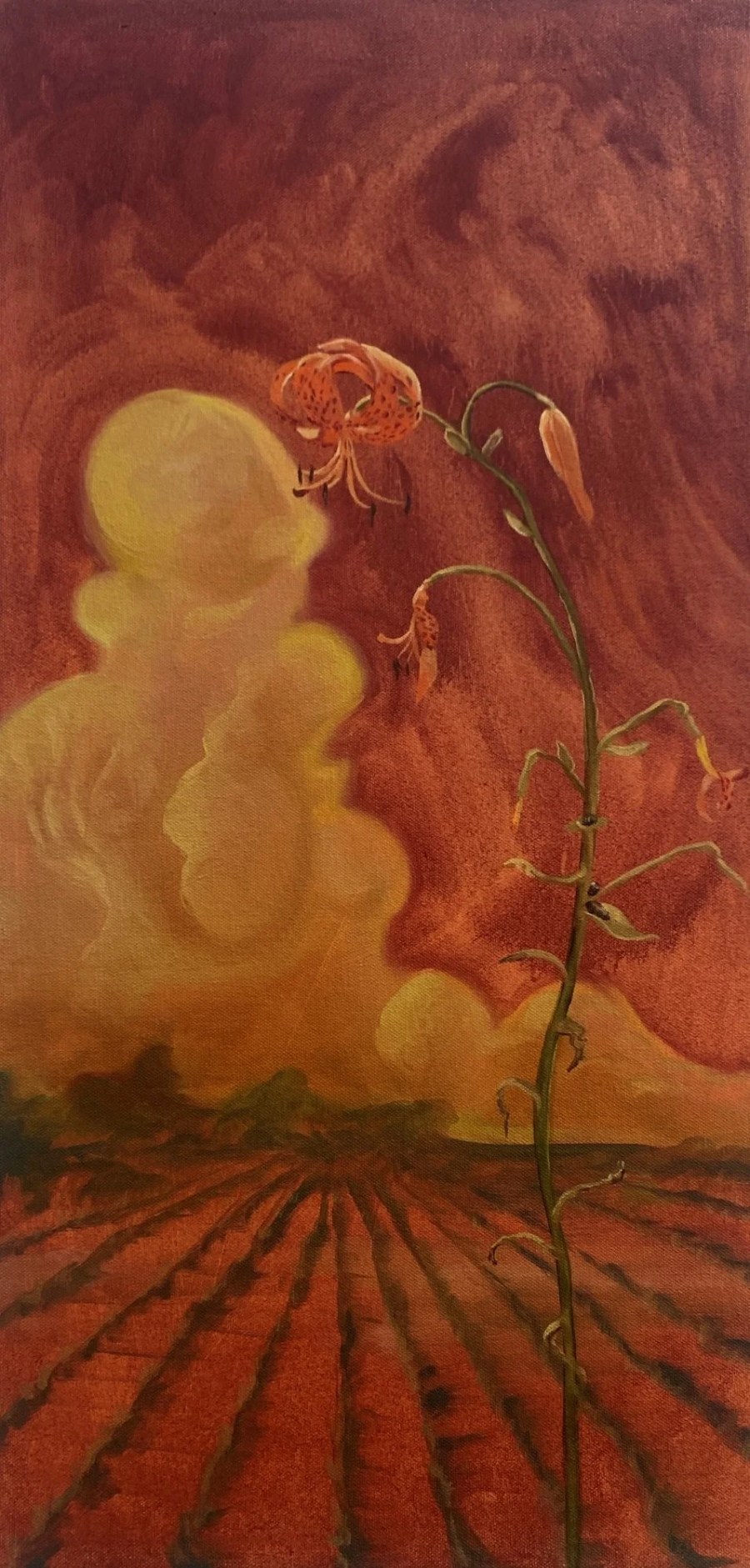
Grief in the Potting Shed

By Allisa Cherry
Featured Art: “Lily, Out of Breath” by Mallory Stowe

I startle a deer mouse 
squirreling straw into a pile of burlap.  
It freezes then returns to its instinctive labor 
caring for its litter of pups–still deaf and blind. 
Each as small and pink as a baby’s toe.  
How miniscule my reflection must be,  
turned upside-down in the gloss of its dark eye. 
At the beginning of the war in Ukraine 
a woman approached a Russian soldier, 
gave him a handful of seeds,  
and told him to carry them in his pocket  
so when he died on Ukrainian soil  
at least sunflowers would grow where he fell.  
At least. No matter how great the devastation,  
it requires a small act of resistance for scale.  
Consider those moments Roland Hayes  
stood in a resolute silence while members  
of the Nazi party booed and cursed 
his blackness. Alone under a spotlight on stage  
in a concert hall buzzing with hatred.  
And still his throat softened  
and a song—Du Bist die Ruh—rose  
from his throat until every fascist heart  
had been stroked by the finger of its beauty.  
But I have never been brave.  
I’ve only ever waited out the clock  
in those moments when I was afraid.  
So, when my older sister asked me 
—the apostate daughter—to help her  
dress my mother’s dead body  
in her temple robes, tie the fig leaf apron,  
fasten her bonnet and veil, I couldn’t  
take in the tenderness of her heresy  
all at once. Instead, I narrowed my focus  
to the industry of my fingers, 
half expecting them to snap into flames  
as I pushed each pearl button  
through its braided hoop.  


Read More

THE KNOT

By Sarah Suhr
Featured Art: “Aria” by Mallory Stowe

   for Patty 

you broke your mother’s ribcage trying  
to revive her bones like a goldfinch 
do not cry daughter oh wisp of breath  
she speaks from beyond her tomb  
keep chrysanthemums & coneflowers  
in each corner of our house & console  
your father with a nightcap westerns &  
puzzles  
        still he cries each year  
that passes & you oh daughter carry  
bouquets & his weight across  
threshold after threshold till he can  
no longer hold a spoon to his mouth 
so you petal chowder to his tongue  
& every swallow is a strangulation 
that stones your heart to silence   
               you 
no longer know where your fingertips 
end & his begin if the sun has risen 
or descended oh daughter are you 
in darkness or light he says this is it 
i am done after dialysis & within days  
his head wilts cold into your palms 
you clear his books from your shelf &  
reshelve poetry found in a storage unit  
your hands hold a collection called  
reclamation but you can’t recall  
how it came to you 


Read More

Fly on the Wall 

By Wes Civilz

The threadbare jacket that I wear is made of 
Woven catastrophe. The car I drive  
Is powered by a liquid I’m afraid of 
(Fluid Apocalypse). There is a sound I’ve 
Heard now and then, soft buzz, a background hum 
Of slow disaster . . . and disaster is  
The word that means the stars have come undone, 
So I can’t sail among them with Osiris 
At death, as planned, so while I live I’ll try 
To drink each tall cool glass of loss, cooled more 
By colder cubes of void, and force-feed pies 
Of difficulty with misfortune’s fork, 
      And be a boss of shock, a bird of woe, 
      A watching fly upon a wall of bone. 


Read More

Miracle-Proof

By Emma De Lisle

A few of the stories were good: Lazarus, Cana, the adulteress. Who doesn’t love a stoning? Or picturing him balancing on that dark sea, feet peeping over the waves that some hand ground down out of those purples and black-blues, phthalo blue, and Egyptian, something iridescent crushed in to sign what you can’t see below. Nacre, maybe. Like a salamander in a flash-photo. Oil on the water like skin. Or like that pearly interference stretched over a raw muscle, its meat-cells cut against the grain. Light-struck. Divided. And the angel. I can hear it. Not a swishing sound, like you’d expect, or a rushing, or anything with such a shhhh. Hush. We’ll be interrupted. I’ll be hyperextended and impossible—this strange star of limbs and hinges like something that could stand up on its own, yanking double-handed on all my cords and tendons, yellow-white if you bite into them, popping, those rickety rubber stalks full of the code that makes me go. Code that opens my mouth. Speaks me. Is it miracle-proof? God sent a messenger to say, Believe her. And would do it again, would do it in a heartbeat. All we do is stay in the foreground, we bend low, we write it down.


Read More

AND THAT WAS IT

By Jeff Worley

Featured Art: Stephen Reichert, Untitled, 2013. Oil on canvas, 12″ x 12″. “Cirlce” series.

—East Lawn Palms Cemetery, Tucson
(for Mike & Steve)

My brothers and I stood under the tent
with our mother’s ashes. I had flown
the bundled urn from Lexington.

We waited for Alice Lewiston,
the Family Service Coordinator,
to meet up with us.

She had told me I couldn’t bury
the ashes myself.
There were legal procedures.

I unwrapped the gray vase decorated
with smiling cherubs. It weighed nearly nothing.
When Alice came, I handed her the vase.
She’d told me that Mom’s ashes would be lowered
into the cylindrical hole above Dad,
directly above his chest.

My brothers and I listened as pitchforks of lightning
lit the sky and rain pocked dirt around the tent.

Then she slid the vase down and secured the lid.
Now Mother was snug in the Arizona soil she loved,
Dad in his plush bed.

What else after all those years with them was left
for us to do?  We loved them for what they’d done
for us.  We must have had some words
we could chisel into the electrified air
to mark the moment.

We stood there saying nothing, not looking
at each other, our hands pocketed. I took out
the poem I had brought.

Mom, Dad, there are no words . . . , the poem began.
The poem I didn’t read.


Read More

Wolf Moon Blues

By Johnny Cate

    This one’s so lit it gives the sun
  a run for its money—Wolf Moon
on the come-up, shadow-casting

    past midnight, mouthing lesser light who?
  The fanged fox skull I found beside the dry
creek bed cries for the rest of its body

    and the back-to-black Winehouse
  mountains flex like the scapulae
of a gaunt predator on the prowl.

    You could sell me hell before the idea
  these trees’ll ever be green again—
the two-toothed insomniac who

    clerks the Tractor Supply could check
  me out, laser this barcode burned
on my heart. I’ll pay in exact change.

    I’ll total up, honey, howl
  silhouetted against that albino dime
in the sky. I’ll hunt Winter’s young, throttle

    each day til something hot starts
  running, steaming in the beam-spill
through the stripped boughs. Everybody’s

    chalking their fallbacks up to Mercury,
  but I’m talking time’s blood to coat
the throat, talking apex killer energy—

    this freezing hemispherical spell’s worst
  nightmare: me as Summer’s ghost, lupine and
loose where I sure as shit shouldn’t be.


Read More

Infinity

By William Olsen

Nancy and I had been talking with him about whether infinity is, or
is only mathematical delusion? Like, say, between irrational numbers,
where nothing is too small for infinity. And whether mathematics itself
will end in a last, absolute prime number that won’t be divided. All
we could say, though, was this, that the universe has a finite life and,
while the light of the stars knocks about for another 40 billion years,
a finite ghost-life. We put it simply when there is no simple. Finite
like us. It will die like us. Isn’t that weird? His face lit up despite
the Never Again. He cried out in joy, “the universe is an ANIMAL!”


Read More

On My Sister’s Buying Twin Plots for Herself and Steve in Greenwood Cemetery Not Far from Elmore Leonard

By Nancy Eimers

You say you like the thought of graves being visited.
As the older sister I fear I won’t be available.

But I’d want to go on leave, take a trip back down or up
or away from the utterness of being gone

twice, in a way, since you will be gone too, we gone from each other,
I’d want my being gone to imagine you having company

and allow me to visit the little graveyard near where you lived,
though maybe I’d find myself standing there—hovering?—

in a sort of bewilderment: what was the reason, does grief
even remember me, remember having a body,

and did I want to make it my business to say something
to you—over you—(quietly

in case one of the nearby houses was listening)
or maybe sing some little song we knew, that the silliest part

in each of us might have been comforted, or confronted
by who knows how far apart we have traveled and when

or if we arrive (from ariver, “to come to land”).
But it touches me, even so, to think of you wanting

graves to be visited (though maybe not as strangers visit
Elmore Leonard, Dickens of Detroit, on Greenwood’s public tours)—

that sense of somewhere to go, small space marked on a map
of a park-like place with houses all around.


Read More

Hospital in Blue Dark

By Deborah Allbritain

Featured Art: “Estuary” by Mateo Galvano

All things said at the end have been said.
Her wool beanie pulled over her ears.

Horizonal bones laid out on the bed nearly
prehistoric, she is.

How do I get out of here, she keeps whispering to no one
and I think of the artist Richard Diebenkorn

who said that the aim is not to finish, but oh
great bonfire, I keep losing my train of thought.

Night-blooming jasmine is fertilized at night.
Can you smell it yet?

The little bear in her arms is still.


Read More

IN THE DAYS OF CHILDHOOD AND VIOLENCE—

By Shelly Cato

        One Morning Before School

A tricorn hook pierced a night
       crawler before
       entering a boy’s
       thumbnail—
       the bone

At the same moment
      a grain of grit shifted
      into his mother’s left eye
      which remained to stick—
      twitch

On her cutting board
       apple peelings wilted—
       and the hound
       outside jowled
       ham fat 

Behind a shed
       seldom used for skinning
       the boy waited  
       for his school bus—
       nursed blood

from his thumb—believed
       in the way his mother
       arranged his lunchbox—
       believed he would live
       to open his lunchbox

that day


Read More

IN THE DAYS OF CHILDHOOD AND VIOLENCE —

By Shelly Cato

Featured Art: Notes and sketches from “Life as distraction as practice as discovery” by Zelda Thayer-Hansen

⠀⠀⠀⠀⠀⠀⠀⠀⠀⠀⠀⠀One Morning Before School

A tricorn hook pierced a night
       crawler before
       entering a boy’s
       thumbnail—
       the bone

At the same moment
      a grain of grit shifted
      into his mother’s left eye
      which remained to stick—
      twitch

On her cutting board
       apple peelings wilted—
       and the hound
       outside jowled
       ham fat 

Behind a shed
       seldom used for skinning
       the boy waited  
       for his school bus—
       nursed blood

from his thumb—believed
       in the way his mother
       arranged his lunchbox—
       believed he would live
       to open his lunchbox

that day


Read More

We Were Talking About Words We Didn’t Like

By Jessy Randall

We were talking about words
we didn’t like. One of us
was making a list, and we all
wanted our words on it.

“Leverage” came up, and the
overuse of “awesome.”
(We were distracting ourselves
from the reason we were together—

or not distracting, exactly, but
giving ourselves a breather
from grieving and thinking about loss.
We were in town for a funeral.)

My turn came and I didn’t
want to say, didn’t want my mouth
to make the word, but I screwed up
my courage and said it: “meatball.”

The others laughed, not at my word, I think,
but at the face I made when I said it.
The conversation turned to social justice,
but “meatball” had been said aloud

and it imbued the rest of the visit,
for me, with ridiculousness, and maybe,
much as I hate “meatball”—my god—
with hope.


Read More

Visiting the Natural History Museum with My 97-Year-Old Dad

By Michael Mark

In the photograph that my father has
             me take of him with the woolly mammoth,
he’s pointing to himself. He asks

to see the selfie. I don’t correct
             his terminology. Next, the triceratops, then
the sabertooth tiger. He takes the same stance

throughout the Extinction Exhibit. With the 4000-
             year-old beetle, 300-million-year-old coelacanth,
the dodo. She was beautiful,

he sighs at the butterfly, and I get the sense
             he’s thinking about Mom. Earlier, in his kitchen,
he posed with a jar of mayonnaise

with the expiration date from 1998, also pointing
             to himself. At the cemetery, he stands on his plot,
next to my mother, because I refuse to let him

lie down. Back at his apartment, he says it’s nice
             to have some company. I know
he’s referring to his defunct card game, so we go

down to the game room. He sits at their once
             regular table and points around the empty chairs,
Billy, Dick, Harold, Nat, Frank, hey Joe. He deals

them in. I take the picture of him squinting at the cards, fanned
             tight to his chest. He tosses a chip to the center
of the felt. In the shot, it really looks like

he’s waiting for someone to call his bet.


Read More

You Must Act as Though You’ll Live

By David O’Connell

You must act as though you’ll live,
though you will not live

and can imagine when you’re gone
the few stories that will be told

about your life, each a bright thread
that, in time, will fade

until all that’s said about your life
is genealogy, your name

or only your initials
beside those of the ones you love

and call by name
and struggle to understand.

It is for them that you must trust
when there is so little to win your trust

that it matters. Not just this rain
you feel falling

but knowing it’s fallen before
far from here under this same sun.


Read More

Keats

By Robert Cording

After my son died in October, I lived
with Keats’ Autumn in my head—
not the relish of lingering summer warmth
in mid-fall, but his one-line imperative:
Think not of the songs of spring.
I watched summer’s hummingbirds
fly off, then the gold of finches turn
dull green. But I couldn’t live with
the music of fall. I heard only those
first words—think not—which I did very well.
How much more Keats had demanded
of himself. And how many more falls I had
yet to undergo before I could hear,
just outside my door, hedge crickets sing.


Read More

Driveway Toad

By Rob Cording

A year after my brother died,
I told my daughter about
the toad that once lived
in the hollowed-out knot
of an apple tree
in the center of my childhood
driveway. My brothers and I
liked to visit it after school,
but the tree came down
in a snowstorm, and my parents
graveled-over that spot.
When my daughter
asked what happened
to the toad, I explained that
it probably moved
under a rock, or to the woodpile
along the side of the house. “Or,”
she responded, “it died.”
Then, she skipped into the house
and left me outside.


Read More

Old Black Water

By Dion O’Reilly

Suzie, I want to tell you
how frequently I pass the apartment
behind the supermarket
where we street-danced
to the Doobie Brothers,

light shifting as the fog
lifted, front-yard roses
iridescent in the salt-gray
seaside morning.

You died, what, ten years ago?
Not at once, really, though pills
took you quickly. It began, I think,
when we were children: without
knowing why, we wanted out

of that rural beauty—the narrow
valley and gleaming stream,
summers spent diving off
crumbling cliffs, as if nearness
to death was the closest
we came to leaving

your stepdad’s beery fingers,
my Mother who loved
to touch the sweaty chests
of her daughters’ teenage lovers.

Nowadays, everything
is a different kind of dangerous:
rain stays away. June mist
sucks away too soon,
sunlight breaks through
before it should.

What I want to say, Suzie,
is a moment, gone
fifty years, is just a moment,
but you’re still here, unfleshed
in brightness—elfin, jittery, wan—

our arms looped as we turn
tight circles, round and round,
your eyes locked on mine.


Read More

Obituaries

By George Franklin

My mother used to say that only old people read them.
Now, I get an email about a classmate from high school,
Someone I might not have recognized over fifty years ago,
Much less today. I could call my friend Richard to ask,
Who was the guy who just died? And, Richard could tell me.
But the truth is that I don’t want to keep track of acquaintances
Beneath the ground—or above it. The cemetery in Shreveport
Was just down the block from a drive-thru liquor store that
Didn’t ask for IDs. The ability to turn the steering wheel and
Press the gas pedal was apparently good enough. On the same
Street, a fried chicken place sold onions pickled in jalapeños
And vinegar. They went down well with Jack Daniel’s
On summer weekends when we’d play penny-ante poker
In someone’s garage. Back then, almost none of us were dying.


Read More

Any Single Thing

By Meryl Natchez

A week past the twenty-ninth anniversary of your death
I read Seamus Heaney’s poem about the kite,
and my first thought is to show it to you.

So I stumble again
into the hole death leaves,
unfillable.

Another morning
of a day that promises
to be beautiful
without your presence
except for this faint ache
because you loved kites,
their unpredictable dialogue
with the wind
transmitted to your hand.

That hand gone
and gone again
each time
I reach for it.


Read More

My Dental Hygienist Confides in Me

By Rose Zinnia

& I in her—at least, as much as I can with my mouth
a cave like this chanting yuh yuh yuh every now

and again, some humdrum monk—affirming her confessions—
our eyes two pairs of headlights pouring into each other, a starless

oblivion, below and ahead forever—for I too have a face
patina’d thick with loss’s microbiome, too have known addicts

of every degree & desperation, & so can understand her
family—become chosen. She lifts her teal mask

while scraping my enamel of its gunk to make sure
I am hearing her clear. Her eyes crack open like eggs.

I did everything. I could. Her father first, then her little brother,
folded into hushed echoes of their lives, two rot teeth

she couldn’t repair or replace. I still don’t know why
it happened. The stats say two in one family is near

unprecedented.
& I swear: her whispering is in the same
timbre my activist friends & I used when we planned

our direct actions against the state, huddled like owls
in a dinky co-op kitchen, feasting on dumpstered melons

with the dog & the pig & the rats & the cats & the squirrel
who we enlisted in the coming (surely, soon) class war.

& maybe this is why we are here together, now, whispering
about taking your own life under the guise of a tooth preening—

there is nary a day I don’t think about my loves & if they will be
here tomorrow. & I too: know shame’s wending & distending

of the body, its chiseled scepter piercing into our thrashing
animal. & I too: have sung surreptitiously into the purple twilit

sweet gums secrets no longer houseable in the little tally
my body makes from the days, built ordinarily of elements,

lest I bloat into shapes I was never meant to stretch into or brave.
In Cleveland, we pulled our bandanas down around our necks—

like she does her mask, now, here—our not-yet-smartphones
wrapped in a blanket outside the room, so the state couldn’t listen

so they couldn’t tell us the world we longed for was not possible:
that our trying would never be enough to fill all this ever-metastasizing

loss. Flossing me she says she keeps a recording of her brother
singing on four different hard drives locked up in two separate safes

so she won’t ever lose his voice again.


Read More

Go, Went, Gone

By Sara T. Baker

Communication, never our forte:
in the ER, I tell you you will be admitted
upstairs for observation. You let out
an anguished cry worthy of the London stage—
This is it, Sara, I’m going upstairs!
Your forefinger points up as you give me that knowing eye.
It takes me a minute. Not that upstairs!
But you swear, this is it, your curtain call,
your swan song, the end of your road,
your bucket kicked. Still, once on that heavenly
floor, you cow the nurses, charm the doctor,
vacuum up every last crumb
of hamburger and fries.


Years later, on your actual deathbed,
you turn red-rimmed eyes to me, barely
managing to mouth, I have to go!
You can go, Mom, we rush to assure you.
Leaning over, I whisper, We’ll be okay.
Your face gathers into the shadow of a glare
as you try to swing your legs out of bed.
The toilet, you gasp, not having the strength
to say you idiot. But we can’t let you out of bed;
we’ve become de facto jailers, your most private
functions now public property, input and output
duly recorded, your dignity the last casualty
of this war. You give no easy victory
to thieving death; not used to losing,
you snatch back the breath we think
has left you. Laboring for days,
your sunken chest rises again and again,
while we, your children, fall around
you, exhausted. Then you are gone,
giving us the slip at the devil’s hour.
As we wash your cooling body,
your hazel eyes pop open like a doll’s,
as if you want to see, as if to insist
you are still a part of things.


Read More

The Grandmother Tree

By Pam Baggett

My sister named this venerable maple
growing at the edge of the mountain’s gravel road,
main trunk long broken, pocked with holes,
a once-mighty tree now slowly failing.
She’s lost her apical dominance, I say, meaning
that when the top broke off, side branches
shot up past the injured trunk like raised arms.
On the left, one wide kind eye, an open mouth
framed by credible lips. Step right, a second eye
squinted shut, mouth twisted up, as if she’s yelling
at us the way our father’s mother did: imagined slights,
our insufferable rudeness, which she thought
should be spanked out of us. Mom never laid a hand,
which says a lot about her mother, gone too soon
for my sister and me to have known. Grandma Baggett
and her snarling chihuahuas gone, too, when our parents divorced.
No wonder my sister imagines a tree could be a grandmother;
she’s been hiding in stories since we were small.
I anchored to the safety of science, to cold fact: Trees break.
A grandmother can call you Sugar one minute,
rage at you the next. Can die without you ever once
hearing her voice.


Read More

A Small Room Off To The Side

By Ockert Greeff

Featured Art by Karen Renee

He will come to live with you
Make him feel welcome 
My mother says 
Her eyes turning away from mine 
Before I can search for the meaning 

I imagine I might have a small, empty room off to the side 
With a reddish glim 
That might bother him at night 
When he takes off his thick, black-rimmed glasses 
And his eyelids become soft and white 
Butterflies in his leathery face 

I would have to get a night-side table for his glasses 
And his teeth 
And his cowboy book 
So that he feels welcome when he comes to live with me 

I think that old single bed will be fine 
Now that he is alone 
He wouldn’t want more anyway 
But I will get new sheets 
For his old, pale body and his tanned forearms 
And maybe a soft, new pillow for his sunken cheeks 

I will ask my sister for that old painting 
With the open plains and hazy blue mountains 
So far, far in the distance  
The one she took when he died 

So that he has something to look at 
And so that he feels welcome  

When he comes to live with me, in me 
In a small room off to the side of my heart 
So very far from the plains where he grew up.


Read More

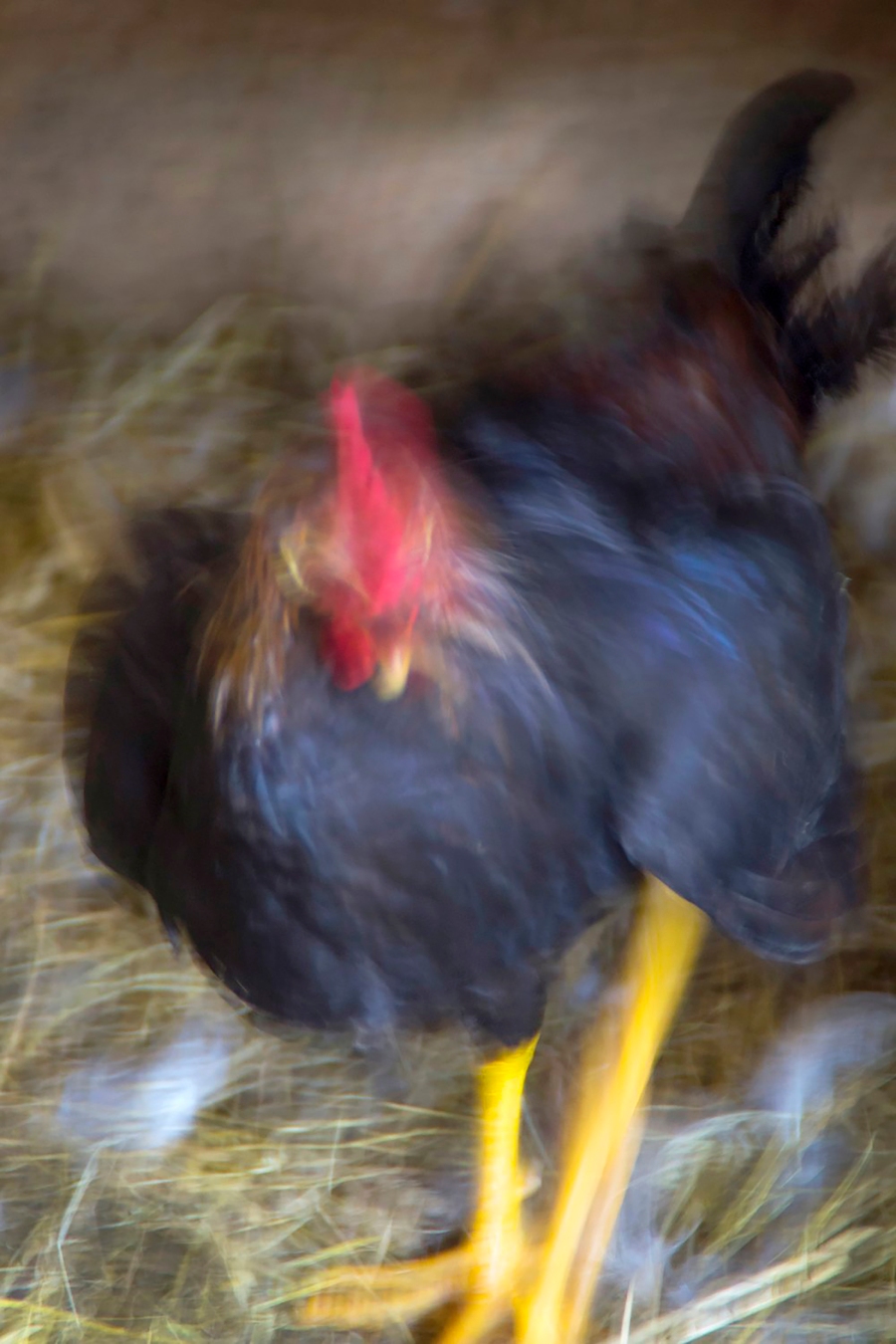
HEN

By Steven Winn

Featured Art by Gary Cartwright

Somehow inside this wire-walled farrago,
Its strutty discombobulation half
Parade of plume and barrel-bottomed flank
And half a mad stampede for any door,

She stands apart, her neck up-stretched and target
Eyes aimed off somewhere, and stands her ground,
Each step a claim on just that spot, the way
Her spindled claw alights to clutch at sand

While high above, a royal in a bulbous
Ornamental coach, she barely takes
It in, crown swiveled to and from the broody
Babble of the mob, their rancid screams.

Something percolates, something like thought
That makes her beak beat down magnetic to
A speck of grain then up again to bring
The morsel down her rippling throat, a throat

That then becomes a spectacle, engorged
To twice its size, complete with guttering
Sound effects, one wing flexed out to show
She can and on another whim retracted,

Head turtled in and out and torqued so fast
She nearly does a full-on Linda Blair,
As if to advertise the fact that she’s
Detachable, a thing of separate parts.

A haze of downy silt hangs in the flock.
Tail raised and primly twitched, she ambles off,
A countess in her gown with time to spare
Before she hears the ax head split the air.


Read More

Fortune Cookie

By Brad Aaron Modlin

Featured Art: Emaciation by Brooke Ripley

Yes, everyone says to add “in bed” to end
everything with sex, but all I think of is
the deathbed. Your hard work
will soon pay off
in bed. Great surprises await
in bed. Your experiment’s results
will reveal themselves
in bed. When I Christmas-visit
my parents, who love me in ways I
can’t understand, they say,
“We don’t want to leave you
a lot of junk to sort through
[when we die],” so when they dial
Chinese takeout, I suggest pizza.
No cookies.
I think about it all January. It’s still
that January, I think, I’m only in the middle
of it. If you say you’re in the middle,
you assume you know the end date,
that’s why religious Southerners say, “Lord
willin’” when making plans.
In a college poem, I made
the Gingerbread Man pickup lines about lic-
orice. I was afraid to rhyme cookie
with nookie, embarrassed by words
that might be 40–90% crass?
Afraid to expose myself
to danger: our Shakespeare
professor defined la petite mort.
I was afraid to talk about
death. My Brit Lit professor
angered me by saying,
“It’s all sex, death,
and madness,” so I yelled,
“People fully clothed
and alive under rainbows of sanity!”
Even I didn’t realize at the bar
the Gingerbread Man was flirting
with the fox.
No matter who writes the story,
everyone dies. I am too old
to find this so surprising.
Too young to keep repeating
the crassest word.
Too waste-averse to ask the fortune
teller to flip my cards
on her front porch. Congratulations!
You are on your way
in bed. All your troubles will pass quickly
in bed. Stormy seas ahead
in bed. You will find bliss
in bed. Love is around the corner
in bed. Love is around, love is.


Read More

On Our Way Home

By Jill Michelle

Selected as winner of the 2023 NORward Prize for Poetry by a panel of previous poetry contributors

We speed down the expressway in funeral-thick silence
miles increasing between us

and the hospital, its doctors and nurses
our son, his too tiny body.

Lost in a one-way argument with a god
I can’t quite believe in anymore

flinging how-could-you, how-could-you-nots
at the windshield’s low-slung clouds

I don’t hear my husband ask at first
Where would you like to go?

and when it registers, picture the baby
things, waiting on our dresser at home

that rubber ducky hat I couldn’t resist
the stack of bunny onesies, Christmas presents.

Anywhere but there, I think but ask instead
How about the Starbucks drive-thru by work?

And that is how I end up a grenade
at the intersection of MetroWest and Kirkman

biting my pin of a tongue
while Neil slides into the straight lane

instead of the more efficient left-turn one.
We toddle past the corner BP, take a left

at the tire shop, another left onto a feeder street
where I see what I wouldn’t have

if we’d gone my way—
Meaghan, the Comp. II student from Valencia

the one who’d answered the icebreaker question
one thing she’d do on her last day on Earth

Kiss my son’s ultrasound picture,
tell him, I’ll see him soon.


There in the Starbucks window
where I didn’t know she worked

was the only woman I knew who’d lost her baby
after twenty weeks

who knew without me saying a word
wrapped me in her arms on sight

and while it was far from the miracle we wanted
it was the one we got.


Read More

Twenty-pound flower

By Mike Santora

Featured Art: I Will Be Gone, But Not Forever by John Sabraw

O Rafflesia, why so down
in the canopy?
Let’s see anything else
toil for nine months
in the Sumatran jungle and come out
smelling like a rose.
You, cater the tree shrew cotillion.
Just ask the sly monks in Thailand.
Whether your medicine is gospel
can be argued in a lab until
pencils snap,
but in peninsular Malaysia,
you clot the bloodbath
after another girl handles
a birth by herself.                        
           Where were the roses then?
I know that I am petal-less
but what are you doing
for the next Millenia?
You could have me,
if you’d have me.
After I’ve died,
you can attach yourself to my breast.
I’d like to wear my last parasite
on the outside, like a corsage.    
   Or is it that you
       are wearing me,
               and it’s my turn
to live something
              like a flower?


Read More

Love is a Kingdom of Obsidian

By Andrew Hemmert

So now my neighbor’s twelve-foot skeletons are all-season haunts,
this February morning holding huge pink balloon hearts
and grimacing against the freezing fog. I like them
this way, memento mori-ing my Tuesday commute,
though who really needs to be reminded of their own death
these days? In the shed we found a mouse corpse hollowed out
by weather and time. The body otherwise left intact—
a kingdom of obsidian abandoned in a jungle.
Love, I think, is a kingdom of obsidian I have
thus far refused to abandon to death’s jungle, though there
of course is time for everything to go wrong, or more wrong,
or wrong enough. Ice on the road, another driver running
the red, the sky a white sheet over my body. Until then
the skeleton in me is offering you its balloon heart.


Read More

Scavengers

By Mark Neely

I could do without these turkey buzzards
hunched like crash victims
                      on the water tower’s whitewashed railing

                                                       red skulls

             poking from the ratty blankets
             of their wings. A county over

two taxidermied buzzards hang
from another tower. Their sickly talons
sway in the breeze—

            the only thing we’ve found that really works
            says the mayor in the local paper.

September. Heat rises in shimmery waves
from the asphalt. The black holes of their eyes
trail me as I sweat through a sluggish run.
They don’t stir, don’t so much as turn their heads.

                                    A few frayed feathers shiver against the sky.

                                                Remember newspapers? They were useful
                                                when we lived with the delusion
                                                we might need each other—under city
                                                bridges the destitute spread
                                                them over heating grates.

             I’m guessing water towers will last longer
             and vultures, who only eat the dead. I read somewhere
             their stomach acids allow them to ingest
             meat so rotten it would kill another animal. Like poets

                                                 I said, though no one else was there.

I’m always reading things, storing them away
for later. I’m always
chasing down my youth. So far he’s unimpressed.
He prances along in sleek shoes, pays me about as much
mind as groups of jostling teenagers pay me on the street.

             I fear these old birds
             have a thing or two to say, like grandmothers
             warbling behind screen doors. One drops

                                    flaps twice, rides a thermal
                                    traces three wobbly ovals
                                    over the train tracks where the road crumbles
                                    into gravel. I remember the lines
                                    from “At the Fishhouses,” about the seal who visits

                                                       evening after evening

              a playful opening
              in the vast, inhospitable sea.

              He shrugs off Bishop’s silly hymns, vanishes,
              reemerges elsewhere, making it clear
              he’s in his element. Here

streets run down toward the river, houses shrink
their porches falling in
until they finally collapse. My buzzard veers
over the dog groomer’s, the green-shingled nursing home
the Bahá’í temple—no more than a rundown ranch house—
then swoops high above the dentist’s billboard, a fearsome maw
of gleaming teeth. Earlier, Son House came on the radio:

                        woke up this morning feeling so sick and bad
                        thinking ‘bout the good times I once had had

I could see him banging his foot
on the juke joint floor, then withering
in a seedy hospital.

                                           Well, we got that over with,
                                           my mother-in-law likes to say
                                           after the parade winds down
                                           or the last guest pulls away.

You like to run? she asked me once, baffled
by any exercise that isn’t useful. I like to have run
I answered, stealing a line from a novelist I heard once, talking
about his labors, the endless straining for the right word

as opposed to the almost right one, which Mark Twain said
was the difference between the lightning bug
and the lighting. A few cars flash in the distance
as I cross over onto the greenway, a gray path
winding along the river like Ariadne’s thread—

                                    she helped a man who didn’t love her
                                    find his way. Sound familiar?

              Sometimes I catch myself
              wishing the day would end. Or try to leap
              whole years, even as they spool away.

                                             We used to call this human nature.

Bishop thought of knowledge
as a kind of suffering
a dark expanse
we can only skirt the edges of…

                                    Inside the tower’s globe, an ocean
                                    waits for another emergency—
                                    metallic, unthinkably heavy
                                                        drawn impossibly into the sky.

            One morning I watched three buzzards
            huddled by the road, tearing at the pink entrails of a possum
            knocked into the ditch as it scuttled through the night.

                                                Curious, bathed in blood
                                                incapable of mercy, they bowed like monks
                                                over the body.

As they tore at the animal, one fixed me
in her stare.

                                   Look here, she seemed to say.

            I wanted to conflate carrion
            and carry, to imagine an airy chariot
            ascending from the corpse.


A delivery truck rattled around the corner
and startled the birds into flight, where they joined the host
swirling above.

                                   Carnal, of course
                                   is the word I was looking for—


Read More

To Save a Life

Co-Winner of the Movable / New Ohio Review Writing Contest

by Kari Gunter-Seymour

Featured Art: Aperture, by John Schriner

We did what we could,
hid the bottles, drove what
was left of him deep
into the yawning hollow,
built a campfire, drank water
from a long-handled gourd,
a galvanized bucket.

We set up tents for triage,
counted his breaths, worried
over irregular heartbeats,
sweats, persistent vomiting,
his jacked up adrenal system.

We waited. Listened for a canvas
zipper in the night, each long slow
pull a call to duty, our legs folding
over duct taped camp stools,
tucked tight around the fire,
his gut-punch stories, stenched
in blood and munitions,
overpowering the woodsmoke’s
curling carbons.

Read More

Dear Austin,

By Brian Builta

A year after your death we keep receiving college brochures
telling you how nicely you’d fit at certain institutions, under a
pine I guess, or next to a Doric column. The earth would bear
you up. In youth group one of the leaders reads about Jesus
raising Lazarus from death. Lazarus’ sister says to Jesus, If you
had been here, my brother would not have died. Your sister leans over,
says Same. She may be pissed for some time. Sometimes we
think of you as Judas, hanging there, unused coins scattered at
your feet. For a minute it helped to think that God also lost
His son, but then, you know, the resurrection. I’ve been
assured by Fr. Larry Richards you are not in hell. Something
about full consent of the will. The way you made your grandma
heave, though, I’m not so sure. Still, I said a few hundred
thousand Divine Mercy Chaplets for you, so by now you
should be on some beach in Costa Rica blowing through a
palm toward a new day, rising.


Read More

Prayer for Reconciliation

By Kelly Rowe

In the study that a child playing hide and seek
once called the messy room,
in a drawer, in a manila envelope, still sealed,
I’ve filed the police report on how you died.
It will stay put: it will age, though you don’t.
I’ll open it today.
I’ll never open it.

Here, photographs spill out of boxes, and you
return, a small boy perched on a stoop
in tiger pajamas. You grin, flashing
little white cub teeth; you claw at the blue sky
beyond a black and white world.
You are about to climb a tree, to grow
feathers, to rise, to become cloud.

Read More

I Was Startled It Was Death

By David O’Connell

Featured Art: Figure with Guitar II by Henry Fitch Taylor

I was startled it was death
I’d been singing all morning
under my breath, scrambling
the eggs, steeping Earl Grey
for breakfast with my wife, death
I’d been carrying like a jingle
or Top 40 chorus, its melody
infinitely catchy, insistent,
vaguely parasitic, its lyrics
surfing rhythm, slotted into
rhyme, over and over, a half
hour or more, all Saturday
ahead of us, the morning sun
shining when Julie protested
with a quick laugh, though
wincing too—no, please,
I just got that out of my head
.


Read More

Love Song

By David O’Connell

Featured Art: Morning Haze by Leonard Ochtman

Oh, that’s right—because I’m going to die.
Sometimes I forget. More often than not.
And then, that’s right! I’m going to,
sometime. Because . . . I’m going to. Forgetting,
but only sometimes, that’s how this works
more than not. And then we wake to snow,

                              *

quite unexpected, the whole neighborhood quite,
you know. And you say to me, yes, that’s right,
cream, two sugars. Sometimes I forget. Or
these days, more often, because, you know,
that’s how this works. And now I remember
we’re going to. Both of us. And there’s the car

                              *

snowed under, looking so unlike itself. It takes
an easy faith to see it. What it truly is. I believe
this morning the whole neighborhood is a fact
refuting last night’s forecast. I’m predicting
this icicle by evening will stretch down past
the window, which reminds me—yes, that’s right,

                              *

last night, 2 or 3 a.m., I woke to the whole house
moaning in the wind. And I felt warmer beside you
surrounded by this sound, our house, and maybe
the whole neighborhood, the neighborhood houses
and the neighborhood trees all moaning. It was snowing,
but I didn’t know. Sometimes, I forget this

                              *

is how it is with us. Just as I, at times, forget
I, we, are going to, you know. They’re saying now
more is on the way by evening. It almost hurts
to look out there’s so much sun. I’m going out
to prove the car’s still here. You remind me,
yes, of course, coffee. How could I ever forget?


Read More

Icarus

By Robert Cording

After our son died, my wife found him
in coincidences—sightings of hawks, mostly,
at the oddest of times and places, and then
in a pair of redtails that took up residence,
nesting in a larch above our barn, and how
their low, frequent sweeps just a few feet above us
before rising over our kitchen roof
made it seem as if they were looking in on us.
In a way, it all made sense, our son so at home
in high places—the edges of mountain trails,
walking on a roof, or later, after he became
a house painter, at the top of a forty-foot ladder.
So many mornings we woke to the redtails’
jolting screeches and, even if I was a casual believer,
their presence multiplied my love
for the ordinary more every day. We never thought,
of course, any of those hawks was our son—
who would ever want that?—but, once,
watching one rise and rise on a draft of air,
I thought of Icarus soaring toward the sun—
as if an old story could provide the distance
I neededwaxed and feathered, his arms winged,
and remembered a babysitter’s frantic call
to come home, immediately, after she’d found
our ten-year-old nearly forty feet up
in an oak tree. I can almost hear him again, laughing
high up in the sky, throned on a branch,
his feet dangling, knowing nothing but the promise
of heights as he waved to me—
and I must have looked very small
calling up to him, staying calm
so falsely as I pleaded with him
to come down, to come down now.


Read More

Anachronism

By Therese Gleason

One week after
the clock in your chest
clenched and froze forever
at half past fifty,
a crow careened through the door,
grazing my temple
like a stray bullet.
In the aftermath
of shock and startle,
irony registered
bitter in my craw.
I used to think a bird
crossing the threshold
was a harbinger of death,
but by the time
this transgressor
cut a crooked line
through the living room,
our windows
were already draped
in black crepe.
The old wives,
their feathered omen
arrived late, clucked
their tongues
and rent their garments.


Read More

Something Implausible

By Gregory Djanikian

Death in his dark cowl is testing his scythe
against the roses in my garden named Hope-to-Be.

He says there is a mountain within you
that is shifting and the river is slick with feathers
.

He says the way inward is always more frightening
than any simple migration.

Sometimes I don’t know what he means.
He is all nuance and innuendo.

Sometimes he grins, showing his lighter side
as if he’s told a once-in-a-lifetime joke.

Sometimes he makes a sad face, pursing his lips,
his fingers sliding down his cheeks like imaginary tears.

I’ve spotted him driving around the neighborhood
in his rattletrap with a cracked windshield

and a bumper sticker that says
My second car is always available!

I’ve seen him rummaging through garbage cans
picking out slices of pizza.

I’ve seen him dining at Chez Philippe
sipping mignonette sauce from an oyster shell.

When my father lay curled on his bed,
he was there, spooning him, his body being of two bodies.

Once, I found him lying by my mother, cooing,
until she woke and swatted him off with her cane.

Read More

The Measuring

By Veronica Corpuz

Featured Art: Vintage notebook among photo cameras on table by Rachel Claire

A married life is measured:
each grain of rice, coffee bean, and tea leaf,

ice cubes crackling in a glass of water upon the nightstand,
even the pinheads of steamed broccoli,

every hour of sleep lost when the baby is born
each hour you slept in before him,

the time you say, I am going to remember this walk forever
the neon color of lichen after a long, hard winter,

how your son wobbles, falls down,
how you swoop him off the ground.

Until you walk into the Social Security office,
until you see the words printed in dot matrix—

the date your marriage begins, the date your spouse dies—
until you see what you did not know declared in writing,

then, you have new language for this feeling—
how your heart has become a singularity:

Your marriage has ended in death.


Read More

sisters

By James Lineberger

Featured Art: Children Playing on the Beach (1884) by Mary Cassatt

As I get you down from the closet shelf
and unwrap the brown shipping paper
to the square white box inside
I lift the lid for the first time and stick my fingers
deep inside you /
What does she feel like Barbara says and I say go on
see for yourself but she shushes me
and leads the way out back
to where the creek used to run
and we just do it quickly without any words
because words are a foolish way of asking forgiveness
for these five years we’ve left you
up there stacked amid the empty shoe boxes
and children’s playthings /
But now with both hands
I swing the box like sand in a pail
and scatter you
into the overhead cave of the old Judas tree
where your tiny parts
glow for a flickering moment
like early snow /
And Barbara whispers
yes Patsy I know
still trying to find your way home again
just like the whole rest
of your life
without somebody’s arm to hold on to


Read More