Lesson Plan

By Kim Farrar
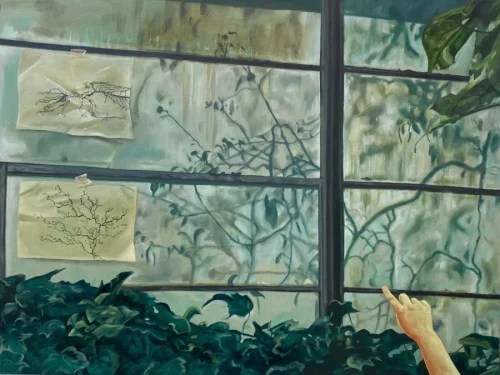
Featured Art: “Greenhouse” by Mallory Stowe

What is your name’s botanical source? 
I see mangroves and root forests whenever I pronounce it.   
Tell me about your superpowers.  Tell me about being small and frightened. 
What do you stare at to disappear?  
Describe the sound of a push broom on stairs.  
Describe your hair.   

Do you draw those hatch marks on your notebook as a nervous habit 
or is it a trapdoor to your mind’s netherworld? 
I like to pretend my brain is a landscape 
with silt, snow drifts, and an aurora borealis. 
I like cartoons where a lion sees a man’s head turn into a giant ham steak. 
I love it when the aroma becomes a beckoning finger.
 
What three adjectives would your friends use to describe you? 
Use a thesaurus.  Use it like a Ouija board, 
run your divining fingers down the page. Feel the grain. 
Instead of answering—let’s call out fun words to say, 
like schlep or kerfuffle

What is your favorite book? Why? 
I’ll confess my least favorite book: 
Wuthering Heights.  There. I said it.  
I didn’t read it once in high school and twice in college. 
Heathcliff was a candy bar. 

What is your dream job? 
Mine is describing the universe in mathematical formulas. 
What about staring? So undervalued in today’s marketplace.

What qualities are most important to be a successful student? 
This is a trick question because our hope is the same: 
to get some credit in the face of our limited choices. 
None of the above is never, rarely, sometimes, often, 
always the best answer. 


Read More

The Skater

                                                                                                                                    —for Bam Margera
By Johnny Cate

Modus operandi: grace cut with chaos, every
drop-in a death sentence he’d somehow
skirt and skate off to nollie another day. 

If we got our hands on a burned Bam DVD
we’d play it until the player was hot to touch,
until every trick was etched into the mind’s 

fish-eye and we were sketched up
with strawberries trying to land one like him.
The kids who by high school couldn’t hit  

a heater pitch for shit or cared to run suicides
found a home in the sheet metal half-pipe,
a new American pastime and a hero in  

an unhinged prodigy. Jackass came later—
what mattered first was the skating, each
varial and crooked grind a live creative act 

that left like a vandal Michelangelo, bank
rails marked with paint, curbs darkened
with candle wax. But the rebellious aesthetic 

was just that—aesthetic. A sly disguise for the
same glory, the guttering flame of a single
God-breathed second. Under Bam’s feet,  

the deck spun like a plywood electron,
elemental and holy: 360 degrees of don’t-care
that would carry him to self-destructive stardom. 

Now, hardly a day goes by that TMZ wouldn’t like
to eat him alive, so I’m pulling up the tape,
posted by a stranger, just to see what I saw  

years ago on those long-gone discs: a man
risking blood and bone with total nonchalance,
his soul sliding recklessly, breathlessly diagonal. 


Read More

Should You Choose To Accept It

By Emily Blair

I couldn’t wait to leave town when I was young.
After that, I’m not sure I have much of a story.
It’s true I met someone. We had a child together.
In between I walked across a frozen lake.
I drove over a frozen mountain.
I ran up a hill to find a pay phone.
I closed down the city for extended action scenes
to the tune of 290 million dollars. No—
I’m thinking of the latest Mission Impossible movie
with Tom Cruise. I get confused.
I should be writing domestic poetry,
but I don’t want to. What more do you need to know?
Our family of three live in a third floor apartment.
Sometimes we also meet up outside. I guess leaving town
is still the most exciting thing I’ve done. The other day
I asked another mother on the playground how to clean
bathroom grout. I said Stephanie, what’s your secret?
Then we ripped off our latex masks,
revealing our true identities. No—
that mask thing happened in the first Mission Impossible movie,
the one I saw with my friend Michelle. I leaned over
to say something snarky, but she was fast asleep.
It must have been the whirring of the helicopter blades.
There’s nothing duller than an overblown action sequence.
The secret to having an exciting life is the people you meet.
The secret to battling a helicopter in a tunnel
is explosive chewing gum. The secret to cleaning grout
is a magic eraser from Mr. Clean.


Read More

Jetson Whirr

By Louise Robertson

The Prius should make a noise
as it creeps behind school children
scattering across the road,
sunlight and leaf shadows waving
around them.
It should be, as one petition
suggested to Toyota,
the sound of the Jetson car,
a whirr and a dapple of a sound.
But Toyota has done nothing — nothing.
The cars glide out each year,
shark silent.

When I was 11, at the school trip to Kings Dominion,
standing next to a plastic statue of George,
Maria Framingham declared she
had lost a $10 bill and so of course I checked my back pocket
and of course my $10 bill slipped out. Maria
picked it up and said she found her
$10 and I made no sound
and slunk away, my inner petitioner
demanding, “Hey, make a noise!”
And my inner Toyota doing nothing — nothing.

Read More

I Said Maybe

By Allie Hoback

Featured Image: Untitled by Tanner Pearson

I can’t stop listening to your dumb wonderwall cover
that I asked for as a joke. I don’t know what you did
to make it sound all distant and a little haunted
but I want to projectile vomit when you giggle through the reverb
miss a chord and sing alltheroadsanananasomething.
Why do people hate this song and why do people only
ever play it on acoustic, it’s so good on electric or maybe
I just like you—oh fuck, do I like you? During sex I asked
how long you had wanted to do this for and you said
within the first ten minutes of meeting you and I said same
if not even longer, maybe before I met you, does that make sense?
Am I making sense? Should I seek professional help
if a fucking joke cover of wonderwall makes me want to grin
at every blank-faced stranger in a gas station, makes me want to stitch
your name into my underwear, makes me want to backflip
into the Atlantic Ocean where you are treading water—
and I don’t think that anybody feels the way I do about you now.


Read More

Reading the Ancients

By Matthew Tuckner

What Sappho calls 
the desiremind or the couragesoul  
I call the swirling Chesapeake Bay 
of my brain and sure
you could call the tugboat 
trawling through the brackish waters 
desire and yes 
you could call the striped bass 
sourcing speed from the tugboat’s wake 
courage and sure 
you could call the crushed beer can 
scything the surf the mind and yes
the soul looks like a blue crab
when I close my eyes to picture it 
aquamarine claw    olive-green shell
I can’t quite place 
the bird tipping its beak into the bay
to capture an absent worm 
absent because fields 
of eelgrass are emptied daily 
by giant pesticidal blooms 
heaps of dead fish 
falling upwards
towards the surface 
but in placing the bird
a red knot    a piping plover
one could easily mistake it for 
the faculties of the soul 
particularly the appetites
so many Plato doesn’t even bother
to tally them though he does
warn of their penchant for battle
the appetites who are hard to see 
when they stand still 
like the piping plover for whom 
they are often mistaken 
yes I’ve been out combing
the waters for a new bird 
one whose bright rusty throat 
and striped back better represent
those flightier emotions
not even Sappho 
has the words for 
is it the tundra swan 
with ass upended and neck submerged
searching for the eelgrass
that isn’t there 
the tundra swan that birdwatchers 
who don’t know better
call suicidal ideation 
maybe the tawny-throated dotterel
is the one for me 
if I cover my left eye 
and squint my right the bird looks like 
the dysmorphia that keeps me 
out of the view of most mirrors
just look at this dotterel
can’t you see the pointed beak
that just screams 
I want to be your worst best friend
a voice that sings
come breach that little bay
of yours come tie the sky together with
us birds a pointed beak that’s just dying 
to be the Orpheus
to your Eurydice the kind of bird
that wants to kickstart
your katabasis a word
that if I’m reading the Greek correctly
can be widely defined as a descent 
of any kind such as moving downhill 
the sinking of the sun
a military retreat 
clinical depression
a trip to the underworld
or a journey to the coast


Read More

The World

By Hannah Marshall

Featured Image: Randy Gals by Ellery Pollard

The world is a broken thing, a paper doll from my grandmother’s childhood. On the farm in Wisconsin, she cut  

the world carefully from a magazine. On the back of

the world was a recipe for drop biscuits. Men in New York City streets planned

the world for this girl to cut into shape,

this world which she dressed up in a red dress, in a white apron and little blue pumps,

this world which is brittle now to crumbling, and torn.

The world was designed to be temporary.

The world was made of dead trees and smeary ink. My daughter sets

the world and its old clothes in a line across whitish carpet. She props

the world against bent tin furniture the size of my thumb.

The world is a broken thing, and so she handles it carefully.

The world opens from its paper breast. We try to become what

this world has made us to be. We carry

the world with us in the bottom of a purse, scribble notes about

the world and carry them tucked up our sleeves, like used tissues.


Read More

My Daughters Sometimes Dress as Ladybugs

By Brian Simoneau

Featured Image: Untitled by Tanner Pearson

and I hope they won’t
outgrow it—little heroes
flitting leaf to leaf
in their polka-dotted suits
of armor, their vicious
pursuit of the feasting
pest that destroys what
beauty these days still lives.


Read More

As Always

By Robert Lynn

on the first not quite warm day of March the park filled with the delusion of spring       

our friends napped by the half dozen against a tree           dogs gathered loose             

bikini tops from sunbathers made maenads by 53 degrees          we gave time away        

in handfuls to the ducks              pairs of men emerged from winter to wave lures        

at the water an excuse to love each other without looking       I read your        

cheekbones’ anger at how I got more time than you before the good earth was       

over     fed you grapes the closest I could get to an apology for something I didn’t         

choose      someone sitting at our tree and very high asked Is this the Golden        

Hour?    and the light answered with yellow silence the way it does all questions        

so obvious       later walking you home I told a story how my parents fell in love       

first drunk then again sober only after I existed              I didn’t think you were         

listening until the moment you stopped mid path mid sentence a way of making       

me turn around        you told me There isn’t time to do anything twice        How        

come?     you let the light give its yellow reply      I don’t want the world to end        

you said     when it does I will remember it this way     the sun picking mulch from        

your backlit hair      your fresh burnt shoulders making the gesture for All this?        

and I give up at the same time       this last first day before the good earth was done        


Read More

The Helms Man

By Kathryn Jordan

Featured Art: Creative Abundance Flower by Wendy Minor Viny

The Helms Man, we called him. I mean the man in white

baker’s trousers who drove the Helms Bakery van

around our bright California cul-de-sacs and streets —

coastal hills carved to asphalt, tract, and pink ice

plant that we broke open to write on sidewalks.


He drove slowly down our block, stopping to open

wide temptation’s door, inviting adolescent girls in

to view his wares:  jelly and glazed doughnuts,

cinnamon twists, sparkling crystal sugar.  We ponied

up quarters for paper bags of treats, to be consumed

out of sight of perfect mothers, lying out in lawn chairs,

all Coppertone and Tab gleam, who gave us Teen Magazine,

left us to banana and milk diets, vertical stripes, and scales.


Left us to ripe womanhood and the gaze of men,

to shape and flavor we could never taste ourselves. 

To motherhood and stretching of skin, joint loosening,

the joy of being food.  Then cronehood with arroyo

of wrinkle, slump of breast, lump of belly.


Each one alone now sees herself in hollow mirror,

flattened chest, belly bulge assessed, while outside

the window, teenage girls parade in short cutoffs,

long legs supple and smooth.  And our long-gone

mothers watch us watch them.  We, who still hear

the van coming and run, hurry, to be ready, radiant

and thin for the helmsman, just turning the corner.


Read More

Learning

By Kelly Michels

Featured Art from rawpixel.com

A new cure is invented every day,
along with a new disease
because every miracle needs a disaster
to survive, and there is no shortage
of disaster, the sparrows have learned
to eat anything under the slash-and-burn
of the sun, and the children have learned
how to weave plastic buttercups into bracelets
between the alphabet and spoonfuls of NyQuil
their mothers give them before bed
where they dream of the swish of scar tissue
behind their teacher’s glass eye.

We tell them: There is horror. There is pain.
There are people wedged between bullets
and mud floors, between cracked river ice
and broken elevator shafts. But not here.
Never here.

Now, we sit still as an Eames chair, and the children
will never know the bridge of a song the rain spells
out in the sand on an October morning.
It is safer behind closed doors and windows, safer
where the wheat and ragweed and daisies
can kill no one.

We tell them: We have seen the grim amoeba of lake water,
the blizzard of ocean waves lashing against the curved spine
of coast, the blue-eyed grass raising itself like a rash toward
the swollen ache of sun, the sting of salt, grazing the long arm
of a bluff. We have lived it. We know better now.
We have knelt at the rim of a cliff and looked down.
We have fallen, felt the pulse of the sea pull at our hair
and it was not kind.

Child, put your ear to the conch shell and listen.
This is enough.


Read More

Midnight at the Anaconda Wire and Cable Company

By Sandy Gingras

Featured Art: Position Interplay: Midnight by Samia Halaby

The building is boarded up, but we know how to get in.
It’s the end of summer and we’re seventeen. We don’t have a car
and there’s nowhere to go in this town except down

the huge hills gliding our bikes past the A&P,
the Ben Sun store where my mother buys my gym uniform, past
the funeral home and the corner bar where Eddie’s father sits

in the same chair every afternoon. The air is humid,
and the stars look stalled out in the sky. Maybe they’re waiting
for us to try something or to grow up already like my mother tells

me to do. A train goes past and faces stare out of the fluorescent lights.
My flip-flops ring on the metal stairs. Eddie puts his shoulder on
a board, and we’re through. It’s just the way it always is—

the way they left it. Eddie sweeps his flashlight across
the cables and cogs and steel beams, the stacks of papers
next to the stapler. This place is leaking

PCPs into the Hudson River, my mother says, but we don’t know
what PCPs are. All I know is, this is where my father worked
before he left my mother. Eddie and I grew up two brick houses

away from each other. Tonight we’re here to take one last look at
the muscley machines. I’m leaving for school tomorrow.
See, some things last, Eddie says to me. I don’t tell him different.


Read More

My Life

By Jack Myers

Featured Art: October Day by Jean Charles Cazin

was never large enough even for a B movie
though I think I’ve felt as deeply as Brad Pitt.
No one I grew up with ever became famous
or notorious on that spit of land that ended in the sea.
But we became as adept at reading storm warnings
in the muscle and color of water as we did in a face.

In the cold-war doldrums of the 50s, all my teachers
hated teaching. We were such little shits back then
I thought who could blame them, and became a teacher
so I could show these younger versions of myself
how to open their hearts and enter into a different,
richer kind of darkness that exists in them.

We were an obstinate desert people given a single animal
which we rode and milked and roasted and skinned.
The stories strangers told us about fabulous places
we’d never get to taught us how to open a door in rock
and go inward, how to widen our hearts with longing
and a song and bang along on a drum skin and a string.

Read More