Featuring stories by Barbara Ganley, Kate Wisel, Laura Jok, and Alan Sincic: an essay by Kay Gram; poems by Francesca Bell, Dan Clark, Janice N. Harrington, Matt Prater, James McKee, Kathryn Jordan, Adam Tavel, Jacqueline Balderrama, Katie Pynotek, Maria Nazos, and Kerry James Evans. With art by Madara Mason and others.
Because it’s Thursday, nearing five o’clock, Lucie is well into a doozie of a headache. Every week at this time little Jenny Baker hands her one as they sit side by side in the dining room and Jenny busily tortures the piano. She’s a narrow slip of a thing with a distracting, gum-baring smile made stranger today by a drift of tiny metallic stars sweeping across her cheeks like cosmic freckles.
Her orange high tops smack the stool’s taloned feet bapbap as she bludgeons the keys in an apparent heavy-metal version of “Long Long Ago.”
The piano, old and patient, takes it. Lucie, who is neither of those things, says, “A bit slower and softer now. See if you can find the melancholy.”
She uses her hands to play a phantom keyboard floating in the air. She must look ridiculous. “Sing the words if you like. I find that helps.” She is ridiculous.
Jenny, clearly having the same thought, grins at the keys, speeds up and hammers away. She doesn’t sing. She never sings.
What ten-year-old doesn’t sing?
But of course Lucie is confusing children with birds, Jenny with Bacchus, her grandfather’s sidekick and belter of sea shanty and Broadway schmaltz. Since moving back home, she has learned far more about thirty-year-old African grey parrots than about ten-year-old humans. Prefers them, too, if truth be told, even if they do bite. Lucie understands that people would find that small of her. But this ten-year-old human next to her couldn’t care less. A look of near madness flashes across the girl’s starry face. Her thin hair switches about her neck like an agitated tail. She’s seeing herself onstage, adoring fans at her feet. Next she’ll be peeling the stars from her face and tossing them to the crowd.
What I did was held my hand out like a gun and sprayed. I was supposed to be wiping down tables. But there was something about walking through the pink mist, I can’t tell you the feeling. That clinical smell that clung to my neck like antiseptic perfume. At that time and that time only, I liked doing the opposite of what I was told.
I was breathing in the rinsed air when this guy wandered in and crouched down at the end of the bar. He was in a white blouse with one of those dog-chain gang-rape necklaces gleaming down his neck. I watched him, a bold move that made him turn to me as he tapped his combat boot on the leg of the stool.
“What are you doing?” he said. I set the cleaner down.
“What are you wearing?” I came back with. I contemplated his soft-spoken British accent, his inflection so authentic I thought I could hear it in a voiceover. He just sat there looking like someone from the past, like Steven Tyler, the pouty-lipped version from my mom’s old and broken records. I started wiping beer puddles with a stiff rag across the laminate, afraid I might actually get in trouble this time.
“Tell me, who’s in charge here?” the guy said.
I glanced at my boss, the manager of Bukowski Tavern, this nice kid named Larry who sat on a bar stool by the door. Not to check ID’s but strictly just to stare out the window like a lapdog. His hair was going prematurely wispy and he kept one leg on the floor with the visible outline of his penis through his gray sweatpants. I grimaced.
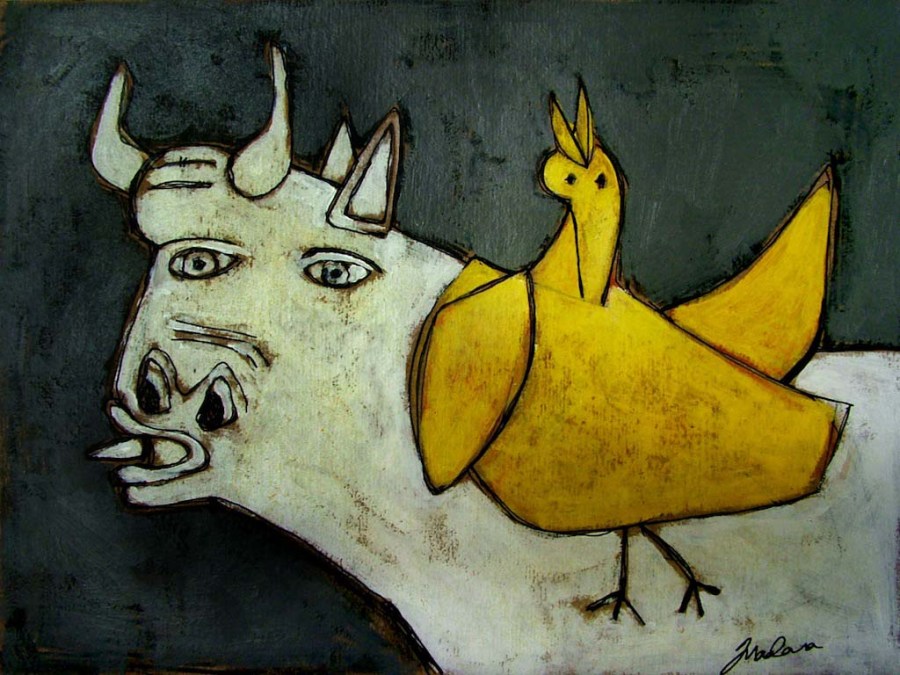
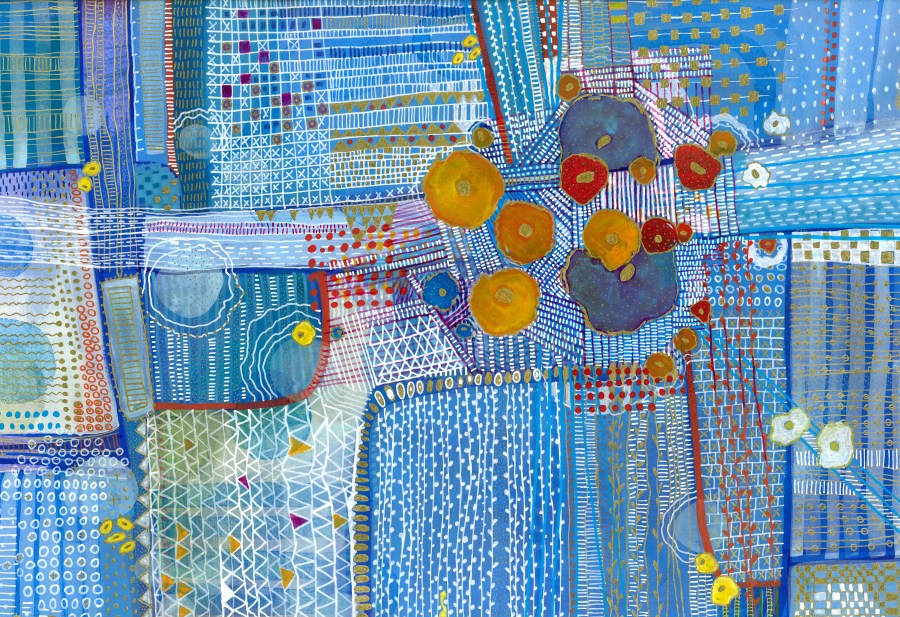
Featured Art: “Cradle of Kleptocracy” by Madara Mason
[arms & legs]
Be my arms and legs. You’re strong. You can do it! Mom would say. Mom’s body was small, fragile, needed time to move, moved differently than other bodies. I always thought she was beautiful. She was—blonde, blue eyed, narrow nose, all symmetrical. Mom had a determined presence that demanded respect and she had mastered the performance of a Eurocentric female beauty. Outfits were planned, makeup was worn, perfume was sprayed. We were late to everything. Sometimes she fell down.
* * *
Mom was diagnosed with Limb Girdle Muscular Dystrophy, a rare and incurable neuromuscular disease, when she was thirty and pregnant with me. In our life together, she wasn’t able to lift heavy objects, things like pots or pans or dog food bags, her own body. She couldn’t run or dance or move very fast. She used a brown wooden cane, shiny wood, golden handle. When walking was too much, a wheelchair. I was her arms and legs. Elle was her arms and legs. We were good at being Mom’s limbs. Sometimes she held onto us when she walked and we took turns pushing her wheelchair. When she fell, we helped her back up. We loved Mom, her body, went to her for comfort, to cry, to laugh, for attention. Who could listen better? Care more about our days, our lives, our futures. Of course I miss her. She haunts me. Or her pain does.
You are twenty-six. Donald Trump is running for president. The company that you consider your current employer sees you as more of a friend. The insurance plan that you bought for yourself is hilarious. There is a hole in your back molar about which you are not thinking, which is growing, about which you are not thinking, and you are in love with a stranger who can always be replaced, should he turn out to be a disappointment. You teach other people how to do their jobs like you are some kind of expert.
A lowly contractor, you design employee training programs for companies too apathetic to do it themselves. You produce modules: scripted lesson plans, slides. You shoot instructional videos, for which you lure desperate actors. When resources are scarce, you narrate the training, play it back and edit. It does not sound like you: more like someone who knows what to do. You fall into this habit of talking to yourself.
The name of your company is an acronym that no longer stands for anything. In India, where the parent company is based, it is illegal to call anything unaffiliated with the government “national.” About this point in particular, the Indian government is exceptionally litigious. The closet between the green room and your cubicle is filled with worn-out fatigues left over from the last contract with the U.S. Army. When the bigwigs are on a call with Mumbai, you rub the fabric between your fingers. It is not synthetic. It is the real thing.
You used to be a promising costume designer: made it to Off-Broadway, became too disaffected to continue. It isn’t that you weren’t as good as you hoped. It is that no one is as good as you imagined.
The subject matter experts provided by the clients dodge your calls and lie to you. One is in the hospital recovering from a massive coronary and is under no circumstances to be disturbed. Another asks that you arrange your content acquisition calls around his daily psychotherapy sessions. A third prefers to communicate by copying and pasting chunks of text from Wikipedia into the bodies of emails. Every SME wants only one thing: to retire. To get rid of you, they need only pretend that what you are asking for does not exist.
“Look at you, boy.” Cochrane gave his junk another shake, stuffed it back into his Levi’s. “You trying to tell me you could lift—we’re not even talking carry here—lift a quarter ton of bacon?”
“I been training,” said Barnett. The pudgy frame, the warble in the voice, the baby-fat of the face all pocked with rivets: we nobody believed he was old as he said he was. Fifteen? Sixteen maybe?
“Training?” said Cochrane.
“Dynamic Tension,” said Barnett, parsing out the syllables in the verberant tones of a preacher.
We laughed. We pictured the ads in the back pages of Gun Molls and Flying Aces and Popular Mechanics. Charles Atlas. The guy in the skivvies with the strapping chest and the husky, solid fighting muscles that every man should have.
“You mean bacon in a barrel,” said Joe from behind a tree, “so you could roll it.”
No sirree. No,” said Barnett. He rocked from side to side, careful not to back-splash off the azalea and onto his bare feet. “We’re not talking about a barrel. Like I said. We’re talking about bacon. Bacon by the slab. Four hundred pounds.”
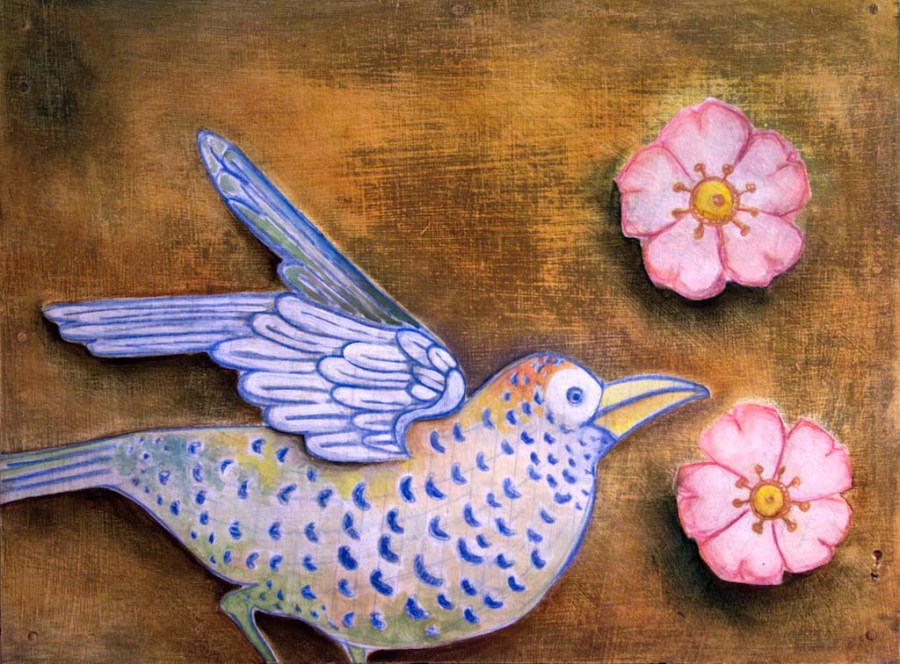
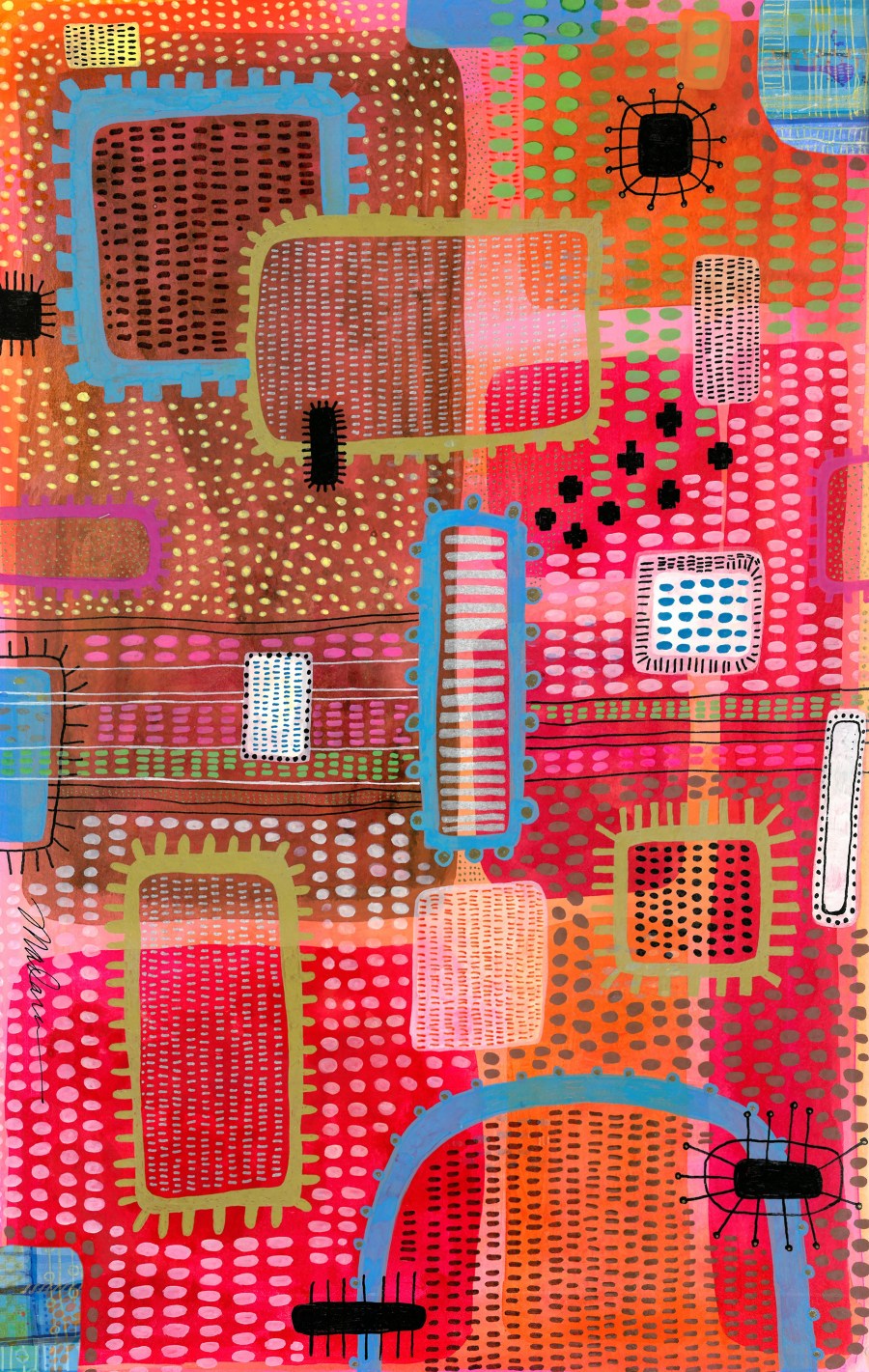
Featured Art: “Noise in the System” by Madara Mason
for my sons
This one has concentric frames that on close inspection are pink strips of floss. This one swims inside itself, three shades of blue. This one’s stripes are dead calligraphy: R.I.P. Abuela, R.I.P. Cousin Juan. This one grows bored and morphs into a sketch of a cartoon baseball twirling its handlebar mustache. This one begs God Bless. This one has sticker pistols saying BANG. This one’s wrists wear broken chains. This one is lost inside the glitz of caked-on glitter gold. This one is impasto red on red that bled on everything it touched. This one has forty macaroni stars and this one has the husk of a dragonfly where stars should be, its glue-gobbed wings unstitching from the corpse.






 New Ohio Review