Newohioreview.org is archiving previous editions as they originally appeared. We are pairing the pieces with curated art work, as well as select audio recordings. In collaboration with our past contributors, we are happy to (re)-present this outstanding work.
Selected as runner-up of the 2014 New Ohio Review Fiction Contest by Aimee Bender
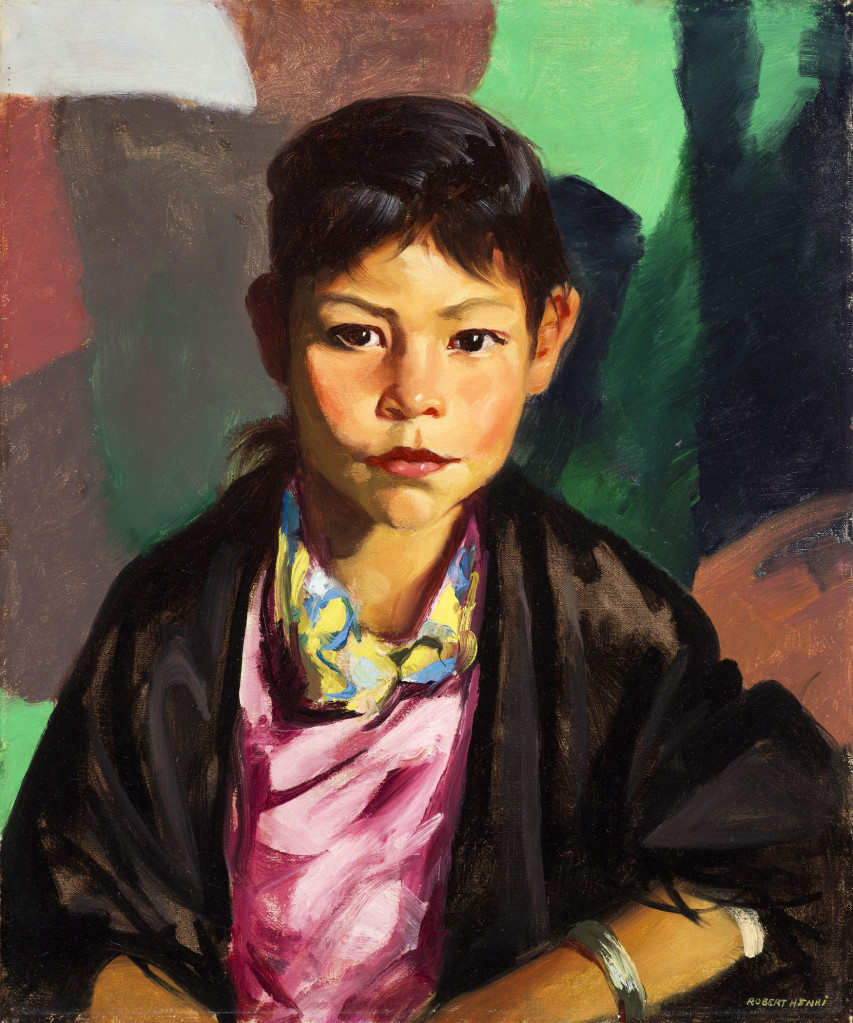
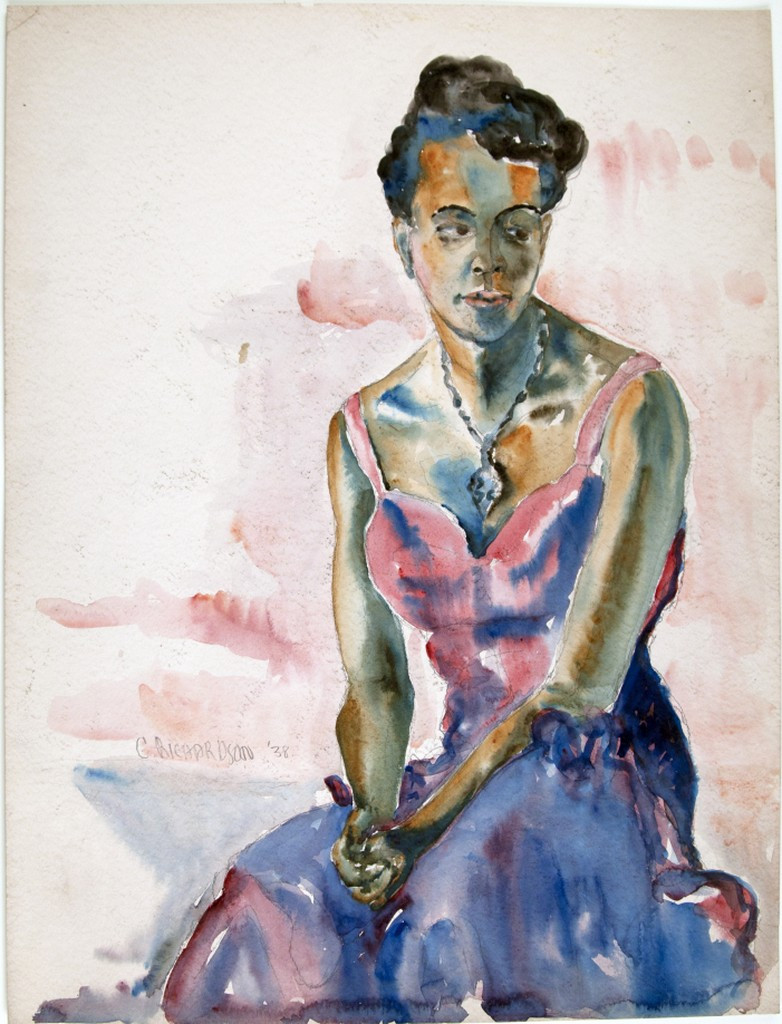
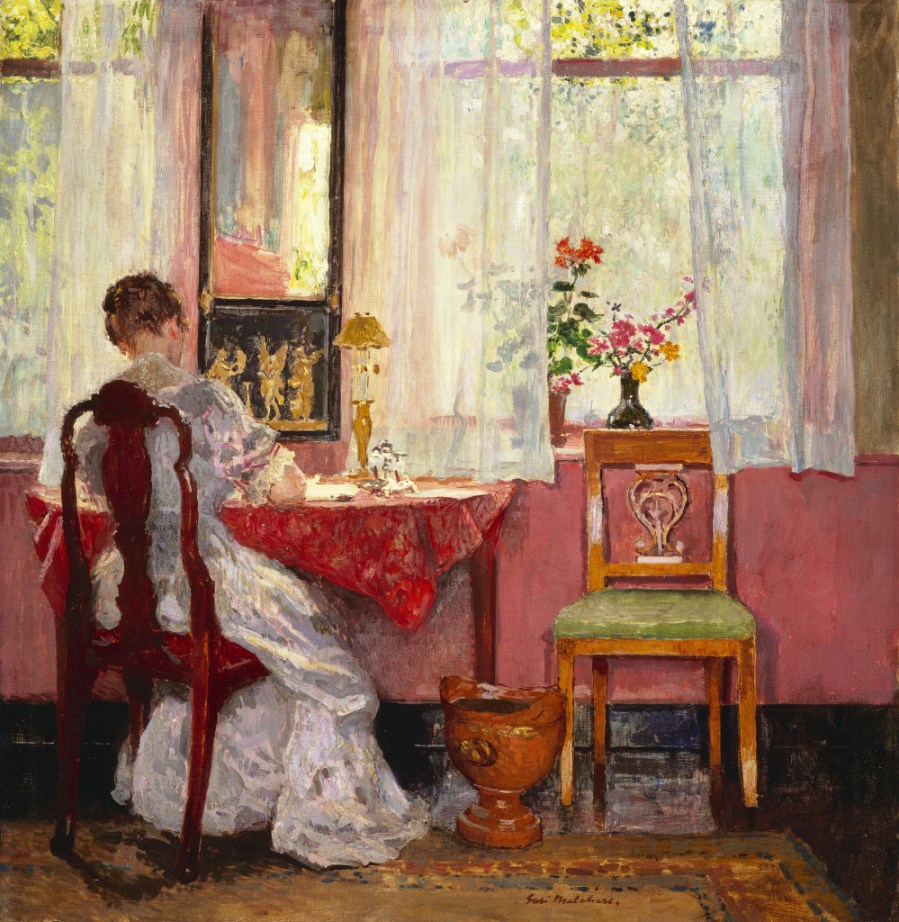
Featured Art: Pepita by Robert Henri
The small boy says to his big sister, “Why did we kill all the Indians?”
They’re in the basement playing a video game. Both of them are white.
“We didn’t kill them,” says his big sister, “our ancestors did.”
“Why did our ancestors kill all the Indians?”
“Okay, not really our ancestors because Dad’s family came in the 20s and Mom’s in the Sixties and the Indians were already totally dead by then, mostly.”
“Why did ancestors kill all the Indians?”
“But I guess you could say it was us, pretty much, because today we’re basically the same culture as the culture of the people who killed the Indians back then. And it’s ‘Native Americans,’ not ‘Indians.’ ‘Indians’ is ignorant.”
The small boy says to his angry stepmom, “Why did we kill all the Native Americans?”
They’re returning from the grocery store in hardly any traffic. Plastic bags stuffed with food rustle in the back seat.
I work the night shift at the light factory. The gears of the conveyor belt slip silently, and emptiness goes by me one segment at a time. I have to take the dark in my gloved hands and make something of it, then connect it to something else. Someone further along the line bends it, I think. Nobody really knows much about the other guy’s job here. We just do our part.
There are no windows in this factory. The air is like milk, and they pump in music that has a beat, so we don’t fall asleep on the job, but we still do. My mother says I should get a real job, make something solid out of my life. “There’s enough light as there is,” she lectures me. “There’s the sun and the stars,” she says, as if I don’t know this already.
“What do you DO in there?” she asks. I don’t want to tell her how much we joke around, tell stories, talk about men. “I can’t really describe it,” I tell her. “I do it mostly by feel.” Sometimes, I bring one of the seconds home with me after my shift. They don’t like it when you do this, but everyone sneaks some. I go home at dawn, put it on my dresser next to the open window, watch it fan out like a wild thing into the pink sky. I don’t know why it feels so good to let it go.
My mother wants her head to be frozen after she dies. I’m against it, but there’s no talking to her. She has a brochure.
On the cover, there’s a picture of a white building with no windows. I tell her, I go, “I’m never gonna visit you there.”
She says, “Fine, fine,” the way she does. She reads me the whole brochure. She’ll be maintained at something-something degrees
until they come up with the technology to defrost her. The, she says, “POOF. It’ll be like being microwaved.” I go, “Think about
what happens to popcorn.” She keeps on reading about how they’ll just fiddle around with her DNA, and she’ll grow a whole new body. I don’t get that part.
I go, “What if they can’t grow you a body, and you’re stuck being an alive head forever.” She says, “Then you’ll have to carry me around.”
Selected as winner of the 2014 New Ohio Review Fiction Contest by Aimee Bender
Sometimes the day after Mom’s miscarriage, a chemistry teacher with chin-only stubble interrupts class to tell you he is dying. There were so many reasons not to be anywhere. I, Dr. Watermelon, convened everyone at the abandoned house, which I insisted on calling the sketch house, on account of the Etch A Sketch I had found in a toy chest. My buddy Filbert plopped himself down on one of the oyster chairs; the air clouded with dust mites and dried skin. “Finders, keepers,” he said. We demanded answers of the Harris family from phone bills and colanders, from the oregano scent of the bathroom cleaner, from a postal sack half-full of gas caps. The throat to the fireplace was choked; perhaps a bird’s nest. Rob and Ron each kept one eye perched on the doorless front door, wary of the patriarch Dustin Oskar Harris barging in to reclaim what he once owned. They thought the sketch house itself was sketchy, as if its waxy kitchen linoleum had been responsible for mawing open and swallowing its former occupants. Ron suggested that we get sizzled on the freon from the fridge. Rob agreed; they were repurposers. “Highly toxic,” Filbert said, reluctantly we transitioned to flicking matches at the shelves—flyfishing magazines, nautical books – knowing damp, expecting sulfur, anticipating cartwheels of burn through the air. Filbert, nicknamed for the teratomic testicle lodged like a moon above his kidney, had a talent for fire: me, not so much. I was a Pisces; I went as long as I could underwater.
Filbert’s lit match flew through the air and landed on my crotch. I didn’t want to move. I felt crowned, blinkered by a halo of marsh fog. I observed the flicker of little flame, a prickle of warmth on my jeans. “Huh,” I said. That was my best eloquent admiration for the trajectory of heat and light.
We’re sitting at the table the way people do When a family member dies and a stream of well-wishers Arrive with sympathy and food.
Everyone is concerned for the widow, 70, tough, wiry, Who now seems weak and befuddled, staring at people She’s known for years without answering,
Rising and walking out the back door, staring at the woods At the far end of their land. Returning to the table without a word.
We’re all thinking how often one spouse dies Soon after the other, dies of nothing But lack. Because we are surrounded by guns, her husband’s
Sizeable collection—pistols in glass cases, rifles In racks and corners—talk turns to their value, the merits Of revolvers versus semi autos, plinking, protection.
Now, for the first time, the widow speaks, remembering That she went to the coop this morning and found curled In a nesting box a snake, unhinged mouth filled
With a whole egg, disappearing a swallow at a time. She walked back to the house, pulled her .410 Off the rack, returned to the coop and blew its head off.
A hog-nose, she says. A good snake. But I had to. She shrugs her shoulders. I had to. Glancing At each other, we nod in agreement, relieved.
My favorite scene in Body Heat has nothing To do with the intricate plot That William Hurt and Kathleen Turner Devise to kill her rich, oppressive husband. My favorite scene, maybe ten seconds long, Shows Hurt getting into his car as an antique Convertible drives by, a fully costumed clown At the wheel, waving. Hurt stares, slightly Bewildered, while the clown passes and disappears. That’s it. Cut to Hurt and Turner in another Sweaty sex scene and post-coital planning, The foregone noir conclusion closing in. Meanwhile, Since we know there are no meaningless details In art, we keep expecting the clown to reappear Or at least figure indirectly yet clearly in the action. Like Chekhov said—if there’s a gun on the table In act one, it had better be fired by act three. But no, the clown is random, there and gone, an odd, Unrelated moment like any of the ones that pass us Every day and we barely notice Because life isn’t art, isn’t revised for coherence, Not until our lives collapse around us Like a circus tent in flames And we begin to look for the alarm we missed.
1 In the glow of a fluorescent, I sit leaning over a table to sort through parts of a jigsaw puzzle, working hard to recreate a picture displayed on the box I purchased while outside great pines have moved in the darkness down the ridge to surround my house, many of the trees taller than the roof. A fierce wind causes the pine trunks to sway, their limbs churning the dark in wild and pitiless gestures.
2 Pines thrive in arid soil, mostly sand, little else will grow in. These trees regard cedars who love the damp, who must be surrounded by relatives,
as gloomy, phlegmatic, timid. Cedars, according to pines, are simple-minded about safety, suffusing themselves with water
as protection from fire. Cedars might as well be, pines jeer, a fern. Whereas pines only reproduce in the heart of a blaze, their cones needing the insatiable rage of flames to climax, open, release.
3 No matter how many nights, months, decades I pore over my jigsaw the one piece that remains to be found is a pine.
My mother wants nothing to do with the puzzle two other residents, whose wheelchairs have been rolled up to a folding card table, are trying to put together— a west side shot of the New York skyline broken up into a thousand pieces, the stubborn morning smog she could see from the apartment she had to give up photo-shopped out, the OT insisting Mom join in the fun, taking my mother’s stroke-locked hand and guiding it to a corner piece that’s an easy fit,
I left, not looking back. I was afraid. I left the things he bought me, just in case. I had to close my eyes to find the road.
I carried names and numbers, tucked inside a pocket in my purse, and not much else to leave and not look back. I was afraid
of corners, entryways, store windows, hid and dodged whole neighborhoods, memory’s curse. I had to close my eyes to feel the road.
Nights, phone off, lights on, I stood guard on the balcony, wrapped in please. Worse than leaving, is not looking back. I was afraid
he’d come slash my tires, stage his suicide or mine, since I refused to witness his. Sometimes I closed my eyes to see the road.
I’m still ashamed to say how much I lied to make him step away, give me the keys so I could leave, not look back though I was afraid. I closed my eyes to walk the open road.
When, years later, I learn Kevin Miller, the boy who grew up next door, is in jail for drugs and a stolen car and a gun, I think of eighth grade: Kevin with his buck teeth and buzz cut always getting into fights, Kevin suspended once for carving the F-word into a church pew during Wednesday Mass, then again for slinging walnuts against the windshield of Mrs. Sabatino’s car. And that one time, on the field at the end of the street, where the boys gathered after school to pick teams, Mark McGarity said, We don’t want the retard, meaning my brother— and Kevin said, What the fuck, man, and Mark said, Well then prove he can catch a ball, and when Kevin shrugged and said Fine, and told my brother to go out for a pass, and my brother did, but did not catch the ball— when it bounced twice off the ground, and my brother looked down at his sneakers, and Mark told Kevin, Yeah dude, there’s no way, and all the other boys stood in a sort of ring, and waited for someone to hurt someone else— but instead, Kevin thumped my brother on the back and said, Let’s go. And my brother— who may not ever be able to memorize equations or read, but knows when a man risks himself for another— he followed Kevin home to our back yard, where Kevin threw my brother the football, and though the ball passed again and again through my brother’s hands, Kevin kept throwing, telling my brother where to move and when, and I can picture, now, my brother’s face so serious and filled with concentration— and Kevin, throwing until their shadows fell long over the yard.
I heard this morning my old lover died, and I cannot say I loved him, though I may have said it at the time, cannot say he was a good person or lover or anything other than a man who called me in the small hours, driving back roads drunk in his Ferrari, when I was 23 and he was 50, who bought me books and a Lalique clock that’s been broken 20 years, who was the dumbest smart person I ever knew, crying in his car at 4 in the morning, wearing a coyote skin coat that reached to his shoes, and I didn’t want his money or his cocaine or to be his 7th wife, and I’ve seldom thought of him except to remember a dark animal crossing his driveway at night, and the 2 staircases in his grand house, going up, going down, and how I held him, deep in my body, and he made a small, sad sound.
I’d never call. First of all, I’d be intruding, and besides I can see my dead friend with all his dead friends even now, translucent, weightless, winging through a cloud or sitting in a circle on some creaky, folding chairs— Hello, my name is Peter and I’ve been dead ten years, car wreck. Hello my name is Edith and I’ve been dead a week, pneumonia. Hello, my name is Frank and I’ve been . . . .
Oh, I know they’d all be friendly but even dialing later when I guess he’d be alone I’d have too many questions: If you’re nowhere now and nothing is this the same as everywhere and everything? And, Peter, do you sleep in heaven? Do you eat up there? What’s the weather anyway? And that tenderness of heart we try so hard to keep a secret: in heaven we’re wide open, aren’t we? Stay in touch. No, don’t.
Each night, after work, we changed our names. We were trying on new identities, seeing which ones fit. Serena and I would throw off our aprons and get undressed in the car, wiggling into tight black pants and shirts thin as napkins. Sometimes we wore red lipstick, sometimes eye glitter. Then we’d find a new bar with the same tattered barstools we were used to balancing on, the same veil of smoke and low light that felt like home. To the men who approached us, we turned into different girls, ones who knew how to charm even without the promise of making a tip.
Our new names were decided on the spot, never the same name twice. They were names we’d once used for our baby dolls, names we’d wished our moms had given us: Isabel, Deanna, Lily. Everything else came later—our stories, our new personalities—fueled by beer and tequila, a practiced game of improvisation. Sometimes men invited us home or out to their car. Sometimes the night just fizzled and we’d stumble out to the street in the wrong direction, too lost to even know it. We’d stop to eat greasy pizza and compare notes, our throbbing feet the only part of us that wanted to give up.
To sit in a simulated living space at Ikea is to know what sand knows as it rests inside the oyster. This is how you might arrange your life if you were to start from scratch: a newer, better version of yourself applied coat by coat, beginning with lamplight from the simulated living room. The man who lives here has never killed. There is no American camouflage drying over the backs of his kitchen chairs, no battle studies on the coffee table. He travels without a weapon, hangs photographs of the Taj Mahal, the Eiffel Tower above the sofa. The woman who lives here has no need for prescriptions or self-help: her mirror cabinet holds a pump for lotion and a rose-colored water glass, her nightstand is stacked with hardcovers on Swedish architecture. The cat who lives here has been declawed, the dog rehomed. There are no parking tickets in the breadbox, no parakeets shrilling over newspaper in the decorative cage by the desk. When you finish your dollar coffee and exit through the simulated front door, join other shoppers with chapsticks in their purses and Kleenex and receipts, with T-shirts that say Florida Keys 2003 and unopened Nicorette blisters in their pockets, you will wish you could say this place is not enough for you, that you are better off in the harsh light of the parking garage, a light that shows your skin beneath your skin, the color of your past self, pale in places, flushed in others.
Let me clarify some things about the game. First rule: think about the game, you’ve lost. No tiles, cards, currency, whirling dials: all pieces
are included, space has been cleared at the table. Join in. Your turn. Kids learn the game in school corridors, score it in red along their forearms,
new staves on old. It doesn’t end when the day ends: race for the stairs, dodging the geeks and slow kids, thunder of fists on lockers, last push to the streets.
The old hands they become play all night, by daylight a winner still in doubt. Friction Ridge, Lake of Enclosure, Dot and Spur: its variants can wear a pencil to its nub.
Wedded to the game, couples bop to the Heart-Flip, the Mind-Winder, later to lie on sheets deliberately left blank. Who invented the game? Who made up
the jokes passed from laugh to laugh? Black suit for weddings, same for the funeral. In between, quick as a nail sparks an Ohio Blue Tip, it fixes in its sights
the boy who puffs, walks; leaves in a down of frost crushed beneath his feet. At the ridge he’ll climb, sun warms the girl expecting him, curve of her hand
moist to take him. When he comes, the game beats in his heartbeat thumped by the wallop of her heart beating against his; and like a spider tumor, spins
webs in his brain, in love now with how it’s played.
Selected as runner-up of the 2014 New Ohio Review Poetry Contest by Alan Shapiro
In the museum of sex, the video loops its cycle of common bonobo behavior: penis fencing, genital rubbing, whole groups
engaged in frenzied pairs, their grinds and shrieks playing for the edification of each patron passing through the room. We all summon
our best poker faces. One woman speaks softly, reads from the sign that describes all the various partner combinations,
the multitude of positions, how relations lower aggression, increase bonding within tribes. We linger over this way of making peace,
wonder to each other if we would cease our litany of guns, bombs, missile strikes if we spent more time in wild embrace.
The exhibit doesn’t mention our other cousins, chimpanzees, who form border patrols, chase strangers in their midst, leave mangled bodies as lessons. That’s the story we already know
and want to forget through the release of these erotic halls, where we seek the thrill, the bliss
of these animals who hold us captive while we lament what traits we’ve found adaptive.
Selected as runner-up for the 2014 New Ohio Review Poetry Contest by Alan Shapiro
All he found when he came looking for us was the home my mother wanted to leave behind: newspapers stacked knee-deep in the hallways, every corner redolent of cat piss, linoleum caked with dried mud and dust, tangles of hair matted to the tub, dried scabs of meals coating plates and bowls piled high in the sink, on counters. Everywhere: the stink, the rot and mold, the great heaps of unwashed clothes, all the filth my mother never let anyone see. No friends allowed inside. Even her dates didn’t get in the door. She spent her nights at their dubious dens, leaving me alone to toss hamburger wrappers and soda cups on the living room floor, our one trashcan so full I couldn’t empty it. My father, finding all this mess, assumed the worst, took photos, jotted notes, thinking the house had been ransacked, that we’d been robbed, killed or kidnapped, though police assured him there were no signs of struggle. How she’d let the house go, he couldn’t imagine. Before the divorce, I heard her shout: I’m no one’s maid. Years later, when my father asks how we lived in such squalor, I tell him I never noticed at the time, though once I did: My best friend, Heather, and I were playing outside when a sudden shower drove us to huddle under the eaves. Soaked, I took pity, opened the door, disobeying my mother’s one rule. Inside, Heather didn’t ask questions about the mildew, the crumpled paper bags she had to brush aside to sit. She refused the towel I handed her to undo the work of the rain. I saw it then: tatty, gray, stained. Heather left, and later, when my mother found the couch still wet, I told the truth. Her face flushed; I tried to bolt. She reined me in with one hand, unfastened her belt. If they see this, they’ll take you from me, she screamed through the volley of blows. My back grew a rope of welts. They’ll call me unfit. Is that what you want? I tell my father none of this, judge it best not to show him the last bits of how his ex fell apart once they were unhitched. I don’t say how I, too, was the mess, tether she yearned to slip, so she could careen unimpeded through life, how I held tight as she zoomed away, raced toward a place where she’d be no one’s mother, no one’s wife.
The sign on the door says: Children Under 18 Not Admitted to the Chemotherapy Suite Under Any Circumstances.
They call it a suite, this room at St. Luke’s Roosevelt Hospital where chemotherapy is administered, as though its occupants were members of some elite group, which in a sense I suppose they are. For reasons that elude me, the chemotherapy suite is located on the same floor as maternity services, and the elevator is often crowded with an odd mix of cancer patients and pregnant women. The cancer patients are generally hairless, elderly, their skin ashy, their bones prominent. The pregnant women are all flesh and smiles.
On Jeff’s first day of chemo, three months earlier, a couple made out during the entire ride to the eleventh floor. Teenagers practically, they wore tight jeans, cropped vinyl jackets. Her back hard against the elevator rail, her distended belly pressed into her partner. They made little moaning noises as they kissed. I tried to give Jeff my “What the fuck is this?” look, but he was too preoccupied—or maybe too polite—to notice. The other passengers looked away. I watched them not watching and then I stared at the floor.
My uncle calls from the wharf; his freighter is in; he’s walked to the nearest food and I find him in a crab shack at a table by the window. Waitresses carry crabs on trays, whole piles of them— stiff, blue, dead—and the restaurant patter crackles with the brittle speech of small mallets on their shells. Elena, his wife—she’s from Colombia, my age— wants a divorce. She’s living in Miami with some Cuban, he says; she’s got his TV and his car. When his crabs come, I order grilled cheese, tell him about karma, how I’ve removed myself from the chain of suffering and he says, shit, picks up a crab and whacks it squarely on the back. He tells me about winters on Superior, ice boats cracking a path through December until the solid freeze of January, how he shoveled iron ore from the hold until the red dust rose in clouds from his clothing, rinsed from his body in the shower like a gallon of blood; and before that, how he went to Vietnam while my father went to college, how he bombed the jungle beneath him without ever looking down while my father dropped out of college without ever looking ahead; and before that, before the war, how the two of them hit a tree one night while driving on River Road. You’d have thought we wanted to be that tree, he says. It broke the car, broke seven of his ribs, nearly broke my father’s heart but in the end it just broke his spleen and ripped him open from shoulder to hip. My great aunt—the whole family tells the story now— came from Kansas and prayed him back from the dead.
Marlene and Ralph walked up Kaanapali Beach about half a mile from their hotel. They sat in a corner of an outdoor restaurant with a floor of sand. Each of the small, round tables was shaded by an umbrella made of palm leaves. A row of tropical greenery, punctuated with orange and red hibiscus, separated the restaurant from the boardwalk. They could hear the waves hitting the sand about forty feet away.
Marlene slipped off her sandals and wiggled her toes in the cool sand as she looked over the menu. Mahi was her new favorite; however, she’d eaten it two days in a row and thought she should try something else. Up next to the bar, a local singer was nearing the end of his lunchtime set. He took a slug of water, traded his guitar for a ukulele, and began crooning the popular island version of “Somewhere Over the Rainbow.” Marlene wasn’t all that hungry. A shrimp cocktail and a Diet Coke might do the trick. Her husband had his cell phone out on the table in front of him, checking their reservation for the dinner cruise out of Lahaina harbor. He had decided before he left the hotel that he would order a burger; he was tired of fish already.
Though to touch its flame would surely be as painful as when it burned brighter, the candle’s low now. On the table, just prior to guttering after dinner, it vaguely illuminates friends.
The glow takes me to Creston MacArthur, one son’s and one grandson’s namesake, and to our many evenings as a campfire ebbed. Just now I’m remembering a particular night, the two of us seated next to a favorite river, swapping stories. His were better.
A bleakness sinks into me despite the patent pleasures of this later interlude with other people I care for and admire. I’ve long savored their camaraderie, their conversation, their gifts for wit. The lateness of the hour has turned our talk to rote murmuring, something like the water of that river, which always flows right below my consciousness.
I should do more now than merely prattle with these good companions, just as I should have said more to Creston, gone almost forty years, and perhaps he to me. Or maybe not: deep in the woods, barred owls started to chatter that night. “Like a good pack of hounds,” Creston said, and that woodsy locution seemed perfect, seemed pinpoint accurate.
Still I’m unsettled. It’s as though I were looking on these people here, on my children, on my children’s children, on my past—I’m looking from above. Having failed to put the right words together, I’ve risen over our group like smoke. The chill in my spirit has something to do with feeling removed, and feeling removed because I’m tongue-tied, tongue-tied for fear that any speech of mine will sound formulaic.
It’s late. The guests will leave. The candle’s wick whispers. I must hope I’ve found a way of being with loved ones that’s better than any talk I could grope for, than any I craved as those old fires grayed, a way that bespoke me better than whatever I may have said, whatever I might say now.
Mid-way through my freshman year at college, my roommate, Roger, asked if I would read a poem he’d written and tell him what I thought. I was pleased to be considered a literary person whose opinion might be valued. And my roommate, who would major in geology, had previously shown no interest in poetry. “Of course,” I said.
The subject of the poem was the death of Roger’s father, and I felt a small shock in reading it, since no one I knew had yet lost a parent. Unfortunately, Roger’s poem was a very bad poem. I don’t now remember the various ways in which it failed, but there seemed no doubt in my mind. Given the subject, however, what kind of criticism would be appropriate or bearable?
I began by expressing my condolences, and Roger interrupted quickly to say, No, his father hadn’t really died. That was just the subject of the poem. “But you can’t do that!” I exclaimed. Perhaps I didn’t actually exclaim, or even say it directly. But it was what I felt. This was wrong, a violation of some rule or code. You couldn’t do it, or you shouldn’t.
Maxine Kumin’s poem “Encounter in August” describes a standoff between gardener and black bear over a crop of beans:
Inside the tepee that admits sunlight to the underpart he stands eating my Kentucky Wonders. Downs pod after pod, spilling the beans, the ones I’d saved for shelling out this winter, thinking soup when he’d gone deep, denned up.
The speaker stands ten feet from the bear and watches him devour her beans. The bear doesn’t notice her while he polishes off the season’s yield. The danger to the gardener goes unstated; mainly, we feel her indignation and loss. The encounter ends with the bear’s oblivious departure and the speaker’s effort to make peace with what has happened:
At last he goes the way the skunk does, supreme egoist, ambling into the woodlot on all fours leaving my trellis flat and beanless and yet I find the trade-off fair: beans and more beans for this hour of bear.
Frankly, I have no idea why this should be any sort of problem. I love discovering that a reality, or what I experienced as a reality, is invented, that a world has been contrived to provide context for a set of perceptions, or for a voice that is almost by definition other than the poet’s in some way. Pretty much nothing I write is literally true, and very little is borrowed from someone else’s stories, which seems to me immoral. A voice presents itself and around that voice events form. I love this in fiction and assume it In poetry. Otherwise we’d all be hopelessly limited.
All good poems must be truthful, but the truthfulness they embody is not that of accuracy to historical fact but fidelity to what might be called the facts of the human condition. In the service of discovering and expressing fundamental attitudes toward life, poetry is allowed, with some qualifications, a license similar to that accorded to fiction and drama: the freedom to substitute imagined materials for those it finds ready-made in the world. Poetic license means that William Wordsworth would have been free to write a poem about meeting a leech-gatherer even if he had never met one in the flesh, that Matthew Arnold would have been free to write a poem about standing on the beach at Dover with his sweetheart without ever having been to Dover, that Robert Frost would have been free to write a poem about picking apples even if he had never picked apples, if, say, a bone spur in his left foot had made it too painful for him to use a ladder. The demands of the poem itself are allowed to take precedence over any demand for strict autobiographical accuracy.
Like almost every other MFA graduate then and since, I couldn’t get a teaching job in 1972 after I earned my degree. My teachers—Marvin Bell and Donald Justice—kindly offered to let me stay and work on The Iowa Review if I enrolled in the PhD program and thereby qualified for graduate student support. So I did. The magazine was staffed mostly by workshop students like me and to entertain ourselves we tacked on the office bulletin board particularly psychotic submission cover letters. My favorite was a five-page letter handwritten in red ink whose salutation was “Fuck you, Iowa Review Pig” and went on from there with further compliments about the quality of our magazine and our excellent judgment concerning previous submissions that we had declined to publish. I’d go into the office a couple afternoons a week and screen poems. There were a mountain of them (the magazine was already getting thousands of submissions a year). After a few weeks of this, I developed the skill to reject poems based on cover letters ranging from the aforementioned “Fuck you, Iowa Review Pig” to “I enclose some Christmas verses my pastor enjoyed so much.”
I still remember opening an envelope that contained no cover letter at all and this poem:









 New Ohio Review