That slender, dusty volume. When I was a student Roaming the poetry aisles in search of a voice, And never again so moved to open a text— If only because its hundred-year-old pages Had never been cut. That minor British poet. So minor I can’t remember his name, though I took His book home, and parted his late Victorian poems, One by one, with the edge of a razor blade.
Nameless shade, I can’t unseal your lips— But decade by decade, and ever more fervently, You speak to me from the gloom. Not even the epic Poets, returning from the underworld, Know what it means to be mute. Then back you go In your slender jacket that couldn’t keep off the dust.
My preacher brother free-climbs and fishes the ocean in small boats. Once, in a kayak, he caught a young blacktip shark. The two of them thrashed like an angel wrestling with flesh and my brother’s thigh was wounded. A hook in the mouth hurts, too. He knew the angel in the story wasn’t him. He felt the weight of original prayer in his hands and released it. My brother doesn’t run from pain. Holiness hurts sometimes, he says. Just enough to wake you. To make you remember you swallowed a spark on the day you were born. We are light, chasing light. Follow the hawk that follows the sparrow. We are called to walk with all that hums and howls and crows on the earth. Joy is not made gently. Imagine the fury and beauty of flight. Imagine swimming in warm, dark bodies of water with stingrays and cottonmouth snakes. My brother has done this and more with his sons. He touches the holy and the holy touches him. Nothing that lives can dig the divine from its heart. I have a picture of my brother on a climb where he came very close to falling. He hung there, fear and wonder alive in his eyes, laughing over the black- foot daisies and butterfly weed four hundred feet down. Dangling from the face of God.
The Italian smells of mint and chocolate, but when I blink my eyes open there is only the Midwest sun. While it’s dawn here, it’s siesta for him. Champagne bubbles up my spine—I’m sure a message awaits me.
In my sleep I had kicked off the sheets and thrown my T-shirt off. Rob doesn’t believe in air conditioning. It lets you go on as if there aren’t seasons. The humidity in our bedroom has the weight and press of a crowd without the fun and excitement of a concert. I blink at the thought of smashing into and exchanging air with strangers. While the initial lockdown lifted in June, the world has largely stayed on pause.
I roll over to watch for the slight rise and fall of Rob’s chest. Nothing. I pull a feather from the duvet he sleeps with and hold it under his nose. No quickening. Julie tells me, in our daily calls, that I’m crazy. But I swear he has no heartbeat either. I design cardiac medical devices for a living, and Rob’s vital signs baffle me.
In graduate school, Rob and I raced our bikes around city lakes. We’d fall into the grass and make out. I pressed my head to his chest, delighting in the booming announcement of him over and over. Now we ration flour and toilet paper. The least important of supply chain problems, but the most immediate in our house.
The hallway is dark, and I feel my way through the house. I expect the air on the deck to be fresh, but it is like stepping into an open mouth. The heat will build until we reach the right level of violence when, finally, the sky darkens, tornado sirens shriek, and, as if punctured by a bullet, the humidity shatters into a crackling light show. Most of summer is build up—the dramatic storms are rare moments of punctuation.
By Ken Holland Selected as winner of the New Ohio Review Poetry Contest by Kim Addonizio
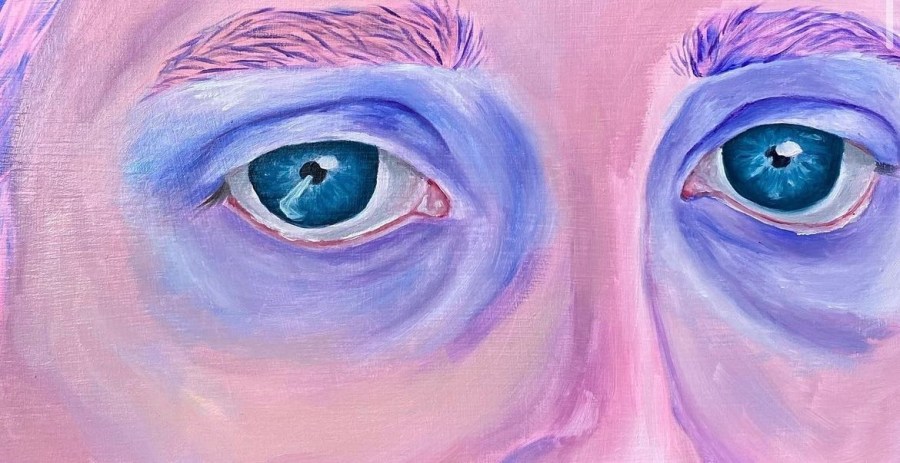
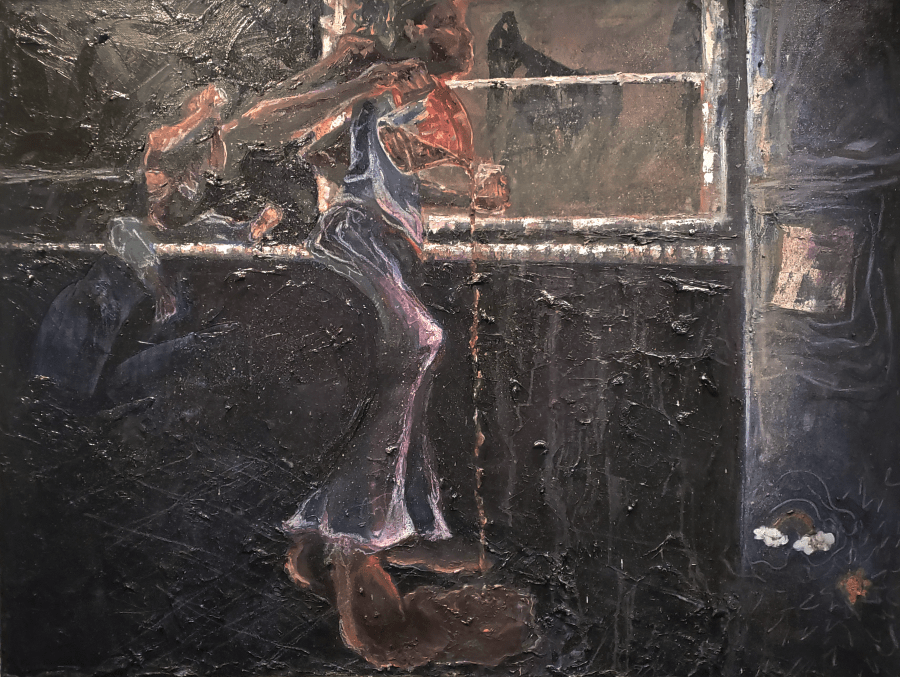
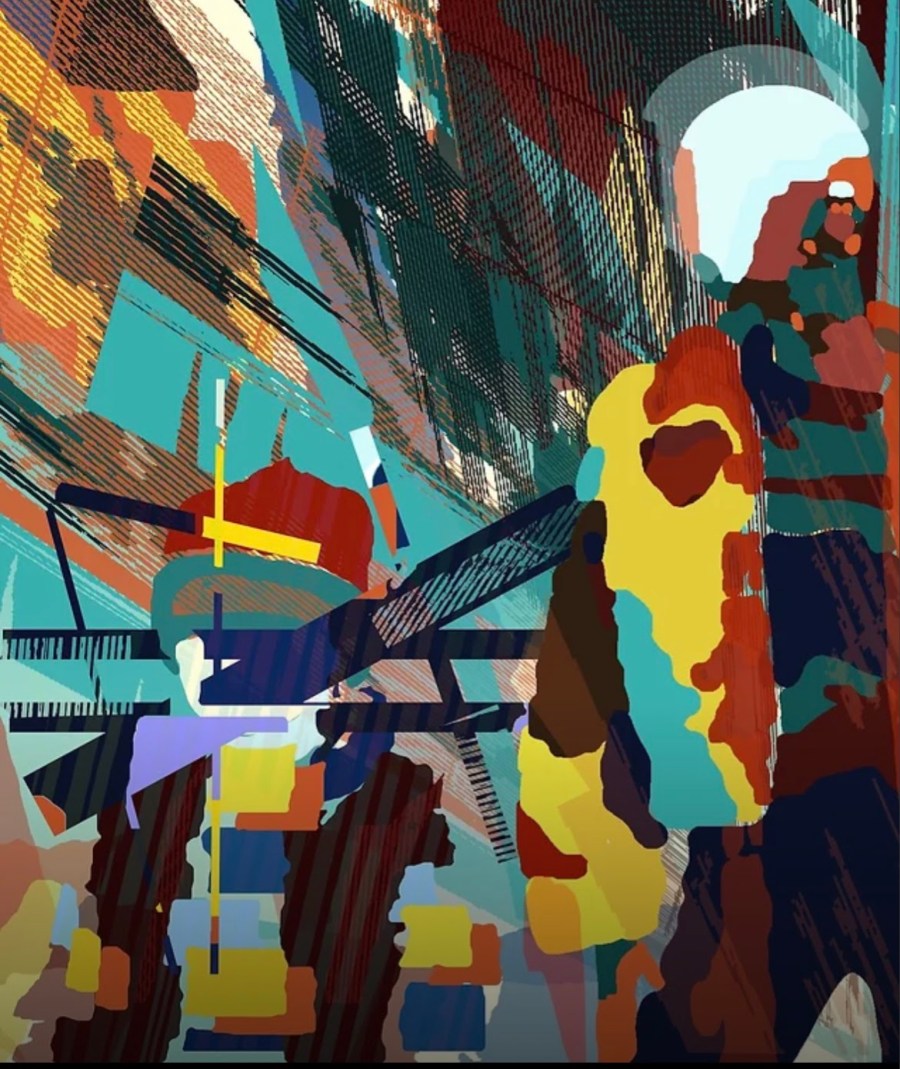
Featured Art: Unresolved by Lucy Osborne
It’s not that the sane are sane and we need talk no more about it . . . it’s more the question of how insanity hasn’t run rampant.
Please, if I may be an example:
If I were given the choice to suffer in poverty, or suffer fleeing that poverty, I would simply say, No thank you.
Or this: if, as the animists believe, even stones have souls, you’d be mad to think about chain gangs and what they do with sledgehammers.
More so, if there’s just one god then someone please explain the saints to me.
Here’s a longer thought: I cannot forget the bands of feral dogs roaming the streets of Cairo—their physical kinship, the tawny slope of their haunches, the wasted musculature. And it seems to me God was himself conceived in hunger. But not his own.
Madness is the muzzle of a dog that’s been muzzled and left with no way to eat.
But it’s not as if the animal can’t breathe. Even I can smell what’s coming from the kitchen. The mutterings of sanity are like gospel, while the mutterings of insanity bear the stigma of an invasive species;
though some believe the inverse to be true—
as if it were impurities that make water lucid, that still sadness into the near-notes of a nearly sung song.
This is perhaps the way dissonance sometimes resolves into a minor chord.
This is perhaps the way insanity feels when it is most composed.
My friend and I stopped in a bar we maybe shouldn’t have stopped in, but we were on the way from here to there and decided to pull off the road somewhere in-between.
Somewhere in-between has its own charm being a space where letters don’t get written, and bills don’t get paid, and old lovers just get older for all the time you get to ignore them.
A beer and a little space in-between you and your friend who’s in the same in-between space as you are, ignoring all the same things you’re ignoring.
And the jukebox is lit and a record is spinning beneath the needle but really what you’re listening to is all the solitude inside your head, one beer gone, another in its place and you barely noticed the bartender’s hands.
The thoughts you’re having are of the breed that pull up to the edge of a precipice and make you wonder if anyone’s yet laid claim to the dark acreage that lies below
what the asking price might be
just how much does the abyss go for these days
and your friend doesn’t even look when you reach over to pick up the loose change lying next to his beer. You already know which tune he next wants to hear. It’s the one in-between the one that just played and the one you’ve yet to decide upon,
as if there’s no moment more merciful than the one you’re edging toward. The quarters in-between your fingers clicking like tiny castanets on the brink of rhythm.
The house, my mother’s house next door lay fallow over two years—the inner air still and musty, grass carpeting the gravel drive. What happens to a house where no people move about inside, breathe its air, circulate its dust? It exists as a museum of quarters suddenly vacated—blankets on the bed, water in the kettle, dishes left to be put away, mail to be opened. Two years ago my mother had a spinal implant for pain that went wrong. Her pain multiplied. She couldn’t walk at all, so she went from hospital to nursing home to assisted living. And the house languished. The carcasses of ladybugs littered the upstairs. Reluctantly I discontinued the phone, cancelled the cable TV. Her house, next door to mine, haunted me like a ghost.
The Russian
The sun shines hot on this last day of June, but a terrible, shattering thunderstorm tore through just a few hours earlier. Waiting outside the mall for my husband to drive around with the car, with a heavy boxed microwave at my feet, I watch a huge thundercloud gather over the Hudson River. Lightning flickers down like tongues of fire while the blue, air-filled balloon figure advertising Sears tools blows about wildly waving its arms until a worker comes out and turns it off. He packs the sagging figure neatly into the silenced machine while the storm roars. I make it into the car just in time. We sit in the car while several inches of water deluge the lot in a rain that blows sideways. The tortured dancing balloon figure still writhes in my head when we pick up Tatiana on the train from Brighton Beach.
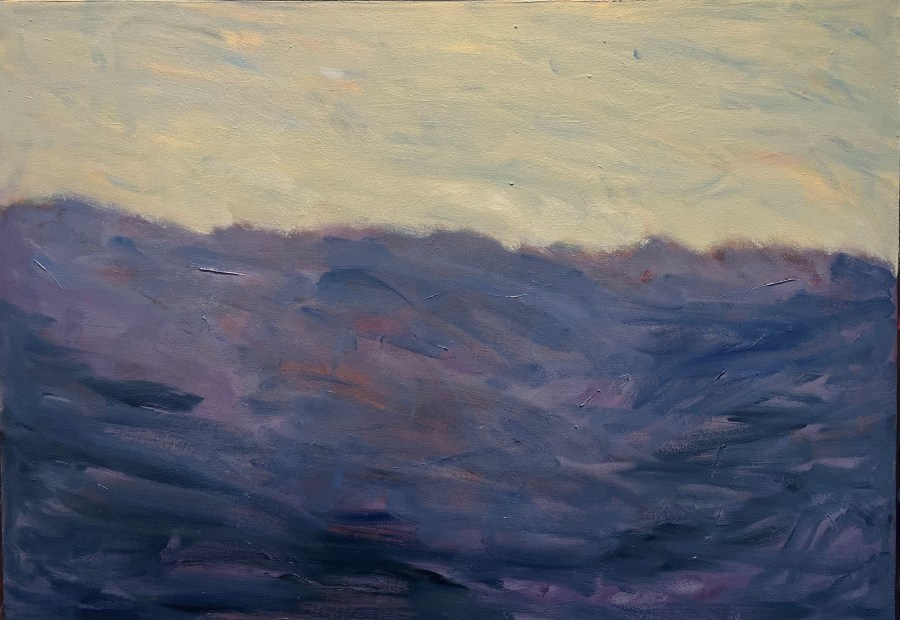
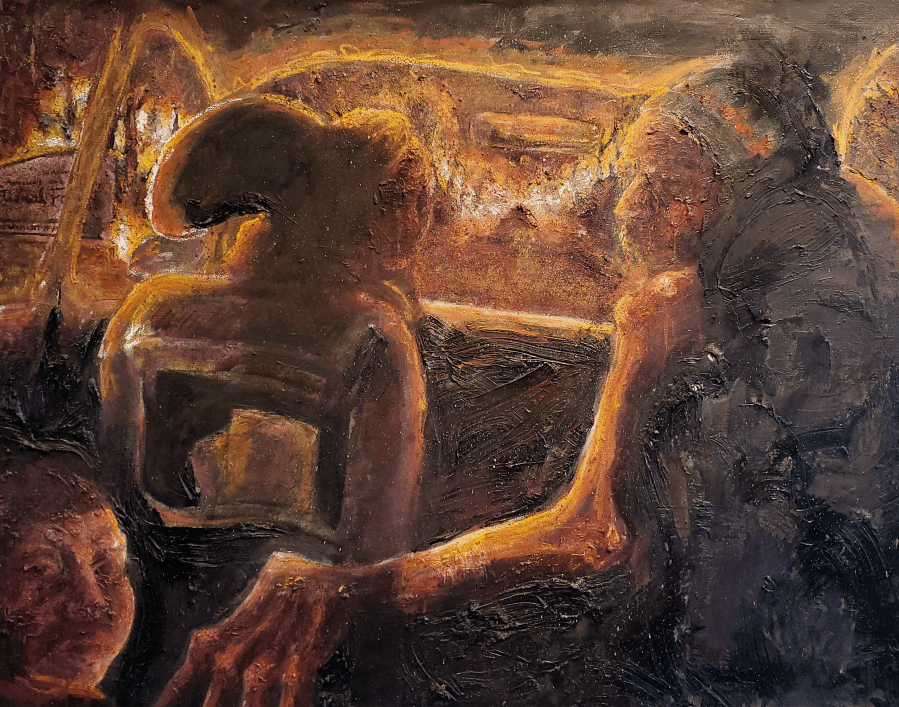
Featured Art: First and Never-ending Painting by Connaught Cullen
Once the ferry to Provincetown cleared the neck, the headlands decorated with lighthouses, and it whipped along at some impressive number of knots— I do not know how much speed is in a knot but let’s just say she carried me at a spate of knots— toward some dark shape in the middle of the ocean no island to be seen, it finally resolved: a lighthouse spitless, standing alone in the roil searching the ocean on her one long and rusted leg.
I had assumed all lighthouses were mothers come to call their children in, leaning on their rocky fences, waiting, getting cold, muttering It’s an island—how far could they possibly get?
Far. And who would keep looking. I do not know what kind of hope I’m allowed.
I am exhausted by my confusion, wary of sudden fires, but dandelions, it seems, have dug in for the long haul, and to them I offer 10,000 bows— I witness the indignities they endure, the insults (weed, useless stem, filthy stalk). I admire their stand against savagery, poisons, brutal mowing; stalwart resistance of the taproots. I lie among them, listen to their whispers: we will not be moved.
You are slightly shorter than a Boston Whaler but just as difficult to park. When we’ve piled three kids in you and Frozen II’s going on the DVD, we might as well head Into the Unknown, which is what every day of parenting feels like anyway.
You are so roomy my children could Irish stepdance comfortably inside you, and so filthy cheddar Goldfish could spawn from your cupholders or several strains of bacteria from their stinky feet, socks thrown at me while I’m driving. You are useless in cities, rain and snow. In fact, you cannot drive over a single snowflake without completely breaking down into a ditch two feet from the sledding hill.
When your automatic doors slide open, people line up for bao buns from what looks like a popup restaurant, but instead, out fall woodchips and half-eaten lunches, an entire soccer team, faces smeared with chocolate ice cream ready to decapitate the other team with their ponytails.
O minivan, your behemoth shape is literally the definition of uncool and people burst out laughing when they see you in relation to me—someone who used to be cool—someone who went to NYU, once stayed up past ten, wore tight jumpsuits to underground clubs in Paris circa I can’t remember and yet, you fit seven humans comfortably. We wedge scooters, coolers, suitcases, relatives, boogie boards, hopes and dreams, pets, stick collections, and an entire folded-up trampoline in you on a pretty regular basis.
You are a superior flu-season-nose-blowing-bunker.
One seat of you is removable to allow for side-of-the-road dining, a triage room, parking lot naps, breastfeeding marathons, poop diaper explosions and mental breakdowns.
Your front headlight? Smashed into an innocent column just minding its own business in the parking garage where I park every day because I was drinking coffee and throwing apple slices into the backseat while driving.
You have been keyed.
Just kidding, that was me again. I swiped you against a metal post upon exiting the environmental center while queuing a Cookie Monster song on Spotify.
(Did I mention this van is a boat?)
Did I mention we have survived three fender-benders, the soul-sucking school dropoff procedure, that you have popcorn and sand in every crevice, that being a mom is so underrated and hard and thankless and infinite, but also kind of hilarious, even noble if you just embrace it?
That maybe minivans are magic carpets and the horizon is getting closer.
You are a so-called Sport version of nobody cares. You are a complete and total embarrassment. And when I say I hate you, you know what I mean.
I can’t imagine life without you. I can’t wait for life without you. My next car will be a vintage Porsche Carrera, or a slim Italian bicycle, or a speck of dust.
With my sister, a lean, hard girl who looks like our mother, I discuss my trouble. When I’ve said it all, we talk about money.
“Just let me help,” I say.
“You are helping,” says my sister.
“Let me help more,” I say.
Now my sister fishes a roach out of a tiny bowl from which I, as a little girl, ate ice cream, and says, “You’ve changed the subject.”
“Have I?” I say.
“Yes,” she says. “We were talking about you. Whenever we talk about you, you try to talk about me instead.”
“I don’t think that’s true,” I say. “But very well. What about me?”
She asks me whether I will do a certain thing about my trouble.
“Oh, I don’t know,” I say.
In truth I will not do this thing, but I will come close. I will come so close that I cannot speak of this thing, even now.
My sister lights the roach and draws a gentle breath from it, leading it back into this life. Then she offers the roach to me.
“But should I?” I say.
“Probably not,” says my sister.
“I must warn you,” I say, accepting the roach, “that this will make me a mite dreamy.”
When we are both afloat my sister tells me of the business with her landlord, a bad situation she has only made worse by taking him to bed. I ask her how much she pays now. She tells me.
“For this?!” I say, but in truth, I adore this little place, with its seasoned hardwood and its hideous angels sculpted into the cornices.
twisted silver-streaked strands into a knot, pinned at the tip of her crown, draped her bird-bones in crossback aprons cut from calico, sewn on a pump pedal Singer, bought brand-new just after the war,
baked flaky scratch biscuits from White Lily flour, spoonfuls of lard, a pinch of salt and sass, danced the flatfoot clog around an old wringer washer, employed on Mondays without fail,
wielded a scythe and hoe good as any man, grew cabbages big as watermelons, drew us maps, where we came from, patchworks of bloodroot, furled fierce along the face of the Appalachians,
orphaned us, laid out under a pine branch blanket, a rough-chiseled stone. Daffodils regretted their unfurling. Redbuds wept purple pearls, the fields so bare they grew voices.
While bodily autonomy and individual privacy are phrases commonly associated with the current discussion of reproductive rights in the U.S., the key term for understanding the culture of abortion starting in the late nineteenth century is knowledge, according to Kristin Luker in Abortion and the Politics of Motherhood. As legal exceptions to the ban on abortion rested on a physician’s determination of medical necessity, abortion became the privileged ground of the doctor whose medical license gave him the sole ability to decide when abortion was medically justified. In other words, by the late nineteenth century, abortion became a question of who could lay claim to this specialized knowledge, and who could exercise their authority based on it. Luker calls this era from the 1880s until Roe v. Wade in 1973 “The Century of Silence” because while the medical community determined the necessity of abortion care, they also dominated the public narrative about abortion.
Other critics, however, point out that this was not a complete silence. In her book When Abortion Was a Crime: Women, Medicine, and the Law in the United States, 1867-1973, historian Leslie Reagan notes that women did “speak of their abortions among themselves and within smaller, more intimate spaces.” One such “intimate space” (which is paradoxically also very public) is within published literature. Abortion was a recurrent plot element in literature published in the early decades of the twentieth century; as Meg Gillette points out in “Modern American Abortion Narratives and the Century of Silence,” from “1910 to 1945, more than seventy abortions were contemplated or had by characters in modern literature.” This literature reveals a struggle that is firmly embedded in the narrative of knowledge and authority. In two of these texts, Edith Wharton’s 1917 novel Summer and Edith Summers Kelley’s 1923 novel Weeds, the question of knowledge is bound up with issues related to class, privilege, and connection—specifically the way the medical takeover of reproductive health care transformed the prior networks of knowledge shared among women.
In his review of Frankenstein, Sir Walter Scott defended the novel’s “philosophical and refined use of the supernatural.” Here was a novel that altered “the laws of nature” not to “[pamper] the imagination” but to illustrate “the probable effect which the supposed miracles would produce on those who witnessed them.” The reviewer for Knight’s Quarterly Magazine agreed. “Frankenstein is, I think, the best instance of natural passions applied to supernatural events that I ever met with. Grant that it is possible for one man to create another, and the rest is perfectly natural and in course.”
This way of stating the novel’s premise—“Grant that it is possible for one man to create another”—can seem, like the novel itself, to elide the fact that Victor Frankenstein is reinventing a wheel. To be sure, there are distinctions: this is an asexual reproduction process that depends on the spare parts from the dissecting room and slaughterhouse, and the new being isn’t an infant but an adult of gigantic stature. But despite his size, the Creature starts off, in mind and spirit, as an infant, a blank slate to be written on by his experiences.
Despite what might seem an obvious analogy for reproduction and birth, it would take until Ellen Moers’s work in the 1970s for Frankenstein to be widely interpreted as a “birth myth.” For evidence, Moers pointed to the material of Mary Shelley’s lived experiences: Shelley knew that her own birth had caused the death of her mother, she became pregnant at sixteen after running away with Percy Bysshe Shelley, and, during her time with him (before and after their official marriage), she was continually dealing with pregnancy, miscarriage, childrearing, and the loss of children. Despite these parallels, it had taken around 150 years and a couple waves of feminist thought for Frankenstein to be read as a Gothic analogy for pregnancy, childbirth, and the aftermath.
When I consider being pregnant myself, I imagine Sigourney Weaver from the original Alien: a wet head emerging, its teeth bared, as I scream and scream. What for others may evoke joy and anticipation for me evokes fear. In Gretchen Felker-Martin’s 2021 horror novel Manhunt, pregnancy itself becomes a kind of body horror as testosterone turns people into sex-crazed zombies bent on cannibalism. A fertility specialist explains the process to a wealthy patient: “When they [the changed men] impregnate a victim, the baby is XY. No variation. It undergoes viral metamorphosis in utero and eats its way out of the mother at three or four months. A few hours later, it can hunt for itself. In a year, it’s sexually mature.” Gossip tells of “a woman in Vermont whose boy twins had eaten their way out of her.” In this science-fiction world, pregnancy is not only dangerous for all the usual reasons, but also because a zombified fetus might eat its way through the abdominal wall (just like in Alien). Abortion access saves lives. To abort, in this world, is to avoid being eaten from the inside out. Yet in the post-apocalyptic world of Manhunt, as in the twenty-first century United States, abortion access varies widely and depends on the pregnant person’s financial and social resources.
Under-resourced people undergo the brunt of pregnancy-related collateral damage in Manhunt, just as they do in real life. In the novel, a wealthy “bunker brat” impregnates a dozen women with her zombified boyfriend’s sperm to see if she will be safe trying to have a baby with him. Eleven women die; one gives birth to a girl infant. Yet, as seems to be the result of abortion bans everywhere, no one keeps close track of what happens to the infant once alive: one of the characters tries to convince herself, with no knowledge to support it, that “someone must have taken her. Kept her safe.” The desperate desire for a perfect infant at any cost leads, during the novel’s climax, to the death of the bunker brat at the hands of her wannabe baby daddy as well as the annihilation of the bunker, which was previously a walled garden for the wealthy. Class-based critique underpins the novel’s attitudes toward reproductive rights, as a safe pregnancy is a privilege only afforded to the richest people remaining.
For men, it’s almost always about solving a problem. “We’ll be fine afterward. Just like we were before,” the male character in Hemingway’s “Hills Like White Elephants” tells his girlfriend Jig. In Matt Klam’s 1997 short story, “There Should Be a Name for It,” the male narrator says of his girlfriend’s abortion, “This was her show. Soon it would finally be over.”
Of course (though maybe this isn’t as obvious as it should be), for women, it’s not over once the pregnancy is terminated. There are the lingering effects on the body as it recovers, days lost from work, stress from lies told to family or friends. There’s the money needing to be earned to replace the money the abortion cost. There might be ways the abortion shifted the woman’s relation- ship with her boyfriend or husband, or ways she was affected if the man who constituted the other half of the act that led to pregnancy wasn’t a boyfriend or husband. She might not have known or liked him very much. He might have raped her. And then there’s the cultural taboo against abortion; that, too, is in bed with the woman as she recovers.
Looking back into the two abortion stories written by men in the context of the Supreme Court’s overturning of Roe v. Wade, I noticed in ways I hadn’t before how insistent both the male characters in these stories are about getting the abortion behind them, getting back to normal. Further, neither man has the slightest ability to empathize with or help the female character, emotionally or otherwise. Hemingway’s character is classic Hemingway: a man of few words who imagines himself entirely in control of the situation. Klam’s narrator, a 24-year-old man-child, is wholly incapable of comforting his girlfriend Lynn, and during the actual procedure, implores the reader, “Is there a way to describe how much I wanted to get the fuck out of there?” This pretty much sums up how much of a help he turns out to be.
Dystopian novels for teens, who are “trying to understand their world and their place in it” are written with gripping plots and first-person narration that “may have the potential to motivate a generation on the cusp of adulthood,” write Balaka Basu, Katherine R. Broad, and Carrie Hintz in their introduction to Contemporary Dystopian Fiction for Young Adults. It’s not a coincidence, I don’t think, that a “plethora” of these texts were published in the post-9/11 era of the mid-2000s, culminating with what John Green called an “explosion” in 2007-2008 that included the first installment of perhaps the most successful of all the franchises, Suzanne Collins’s The Hunger Games trilogy. With the commercial success of this burgeoning market, YA writers created fictional worlds to warn teens about too much surveillance, like in Little Brother; the dire consequences of obsession with unattainable standards of beauty, in Uglies; and damaging conformity, like in the Divergent series. Although dozens and dozens of realistic YA novels deal with teen pregnancy, abortion, adoption, and other matters related to reproductive healthcare, not as many dystopian novels do. But Unwind, by Neal Schusterman, is an exception.
One question scholars ask of YA dystopian novels—a particularly relevant question when considering abortion—is whether the text espouses radical political change or masks an inner conservatism (Basu, et al.). Schusterman’s Unwind, published in 2007, is set in a futuristic world where the United States has fought a Second Civil War: this time about abortion. After years of deadly conflict, a treaty was signed that satisfied both Pro Life and Pro-Choice armies. The premise of this treaty—as well as other moments of didacticism—seems to reveal the “inner conservatism” of the text. (A note on the language: while I prefer to use the term “anti-choice,” Schusterman uses “pro life”; thus, throughout this essay, I will use the linguistic terminology set forth by the author to avoid any confusion.)
Motherhood was not what I was expecting. I thought I had prepared myself—I read countless articles online, learned a myriad of soothing techniques, watched videos of women’s birthing experiences. But there had been no way to know what it would be like for me. And my experience was not at all like what I had been told to expect.
I was told any woman could give birth naturally if she breathed deeply enough, if she believed in herself. My daughter’s head was stuck on my pelvis, though, and in the end, it didn’t matter how much breathing or believing I did; I needed an emergency C-section.
I was told it’s a baby’s instinct to seek out the nipple and suck, but my baby only screamed at my bare chest.
I was told every mother had instincts that would guide her in how to care for her baby. But when my daughter cried for hours on end, my instincts told me nothing about what she needed, how to fix her problems.
Before my daughter was one-week old, I already felt like a complete failure as a mother.
Mothers and would-be mothers are told a lot of lies. “Motherhood is the best job in the world” is one. “Mothers put their children first” is another. These are lies, or at least certainly over-simplifications, because they imply that women stop being separate people once they become mothers, that they suddenly lose any ambitions they had for their own lives and think only about what is best for their baby. But mothers are people, and just like any other person, they have wants and needs. And flaws.
Tove Ditlevsen’s The Copenhagen Trilogy (published in Danish from 1969-71 and available in English in 2022) tells the story of the author’s childhood, youth, and dependency. Her ultimate dependency occurs after her second abortion. During the procedure, she describes the injected anesthetic as “a bliss I have never before felt spread[ing] through my entire body.” Following this abortion experience, Ditlevsen struggles with addiction. Eventually she would succumb to it, dying by suicide.
Even before her abortion, though, dependency was Tove Ditlevsen’s birthright. As an ambitious woman, Ditlevsen was exposed to unspeakable sorrow in a world shaped by systemic sexism. It wasn’t abortion that turned Ditlevsen into an addict; it was her lack of agency that left her alone with her own pain.
In the first volume of Ditlevsen’s memoir, she describes a fraught relationship with her mother in childhood. Her mother was lonely and frustrated because she, too, lacked independence and choice, confined at home alone all day with her children while her husband went out into the world. Her “dark anger always ended in her slapping my face or pushing me against the stove,” Ditlevsen writes. In the absence of maternal nurturing, Ditlevsen turns into herself, in introspection and rumination, finding an outlet for expression in the written word.
Still, she feels compelled to conceal her writing, even as an adult: “for me, writing is like it was in my childhood, something secret and prohibited, shameful, something one sneaks into a corner to do when no one else is watching. They ask me what I am writing at the moment, and I say, Nothing.” Ditlevsen learns early that any use of voice or demonstration of need could be used against her—and so she practices concealing and repressing her passions.
I first heard Lucille Clifton’s “the lost baby poem” when I was nineteen years old listening to some Napster download of a warbly and far away Ani DiFranco reciting it onstage: “the time i dropped your almost body down . . .” That year, although emergency contraception had recently hit pharmacies, a long holiday weekend in Ohio found me saved instead by a friend in my dorm who carefully counted out pills from a blister pack until they added up to the amount of ethinyl estradiol and norethindrone that would resemble a morning-after dose. To be clear, this was not an abortion. But I found myself thinking about the potential baby. I counted the months—it would have been a Pisces. I read Diane di Prima: “how am I to forgive you this blood? / Which was [. . .] to grow, and become a son?” Still, as I finished up a spring semester Incomplete and made an appointment to get on birth control, I knew I was lucky to be able to move on so smoothly.
Of two abortions she had as a young woman, Ani DiFranco—who would go on in mid-life to give birth to two children—writes in a 2019 LitHub essay: “I used to periodically count the ages that my first two children would’ve been if they had entered the world as such. [. . .] It was an exercise in the terrifying math of the near miss. Your life as you envisioned it could have effectively ended three, five . . . ten years ago. Just imagine. What kind of shell of your former dreams would you be now?”
“Two years ago the United States Congress ratified the Personhood Amendment, which gives the constitutional right to life, liberty, and property to a fertilized egg at the moment of conception. Abortion is now illegal in all fifty states. Abortion providers can be charged with second-degree murder, abortion seekers with conspiracy to commit murder. In vitro fertilization, too, is federally banned, because the amendment outlaws the transfer of embryos from laboratory to uterus. (The embryos can’t give consent to be moved).” —Leni Zumas, Red Clocks
When I was in graduate school, a friend and I were invited to write a “docu-drama” about abortion access before 1973, when Roe v. Wade enshrined it in federal law. The project was a collaboration between the Women’s Studies, History, and English departments. History grad students supplied us with nearly a thousand pages of research, and we sifted through testimonials from people who’d sought illegal abortions, interviews with the Jane Collective, sobering statistics about how common it was before Roe for women, especially those who were low-income and not white, to be injured or to die from illegal abortions. Somehow, we gathered all these voices and patched together a draft of the play, after which one of the faculty sponsors invited me into her office. The draft was too cavalier, she told me. She let me know how important it was to emphasize that getting an abortion is never an easy choice. She shared with me that she’d had an abortion, and that although she believed strongly that her right to choose should be legally protected, ending her pregnancy was the most painful decision of her life, as it was for most women. To make it seem otherwise would be playing into the hands of the other side.
I eat it to feel alive, a man confessed to me, teeth crunching through a golden reaper so hot, my eyes watered to be near. When did he feel alive? Lazarus, I mean, after he died and then came back again. We talk about him like a firebird, crumbling to ash and shaking off the coals to rise once more. But it must have been something, you know? Waking from four days of death, frankincense cloying the air, linen bandages unraveling. Did it feel good, like stretching after a days-long nap or did it sting like capsaicin, dormant limbs burning from lack of use? My father once ate a ghost pepper whole. First came the sweat, then vomiting. I think I’m dying, he told me, my life is flashing by my eyes. And that’s another question—what did he see, between? The glow of seven stars in a pierced right hand, a double-edged sword emerging from his mouth—perhaps the world tilted in resurrection like from a devastating concussion, swirling around his sisters’ grief-creased faces. Sometimes I leap from cliffs, cling to bridges, swim with sharks, but I’m not brave enough to suck a devil’s tongue, weep into a pile of sliced scotch bonnets, try to grill another chocolate habanero. Maybe the question I most wish I could ask Lazarus is which hurt more—the fever that burned him to death from the inside, or the rush of God, like a Trinidad Scorpion, like ten million Scoville shocking him alive to the face of a friend?
During the pandemic, after I told you— speaking up never easy—I was lonely for you, your kids, and your husband, you sent me tulips. Just like that, you sent tulips. I wondered, though: did I deserve them? I am sorry I was a drunk when you were a kid. Thank you for not hanging up when I call. The tulips arrived in a creamy box; your note tucked in tissue paper. I am sorry I could not keep your father around or try very hard to stop him when he said he was leaving. I am sorry I did not love him enough. Thank you for choosing such a nice, funny guy for a husband. I am sorry I pursued such a crazy boyfriend after your father left—the shouting, the slamming phones and slamming doors, the walking out, the coming back. The tulips are white and iridescent purple. Thank you for your brown eyes. I believe they are still flecked with green, although sometimes, even now, I am embarrassed to look you in the eye. I am sorry I was so sick from drinking, throwing up, and dizzy. Once, I could not take you to your dentist appointment because I felt shaky and kept falling. You cried, you said nothing works, nothing happens, everything falls apart. Thank you for your clarity. Thank you for your red face, your bursting, when you were born. Thank you for your anger when your stepfather and I screwed up the car seat as we drove the baby around the city, looking after her while you were at your conference. Boy, that woke us up! I am sorry you fell out of your stroller when you were a toddler because I was hungover and forgot to buckle you in. I don’t know if you remember. Now you know. Thank you for the tulips. You sent so many I filled three vases: one big, two small. Thank you for insisting you wanted hipster vegan donuts at your wedding instead of a white cake. That one threw me over the handlebars—drama, etc. Your stepfather was kind and calm throughout and wrote the checks. He loves you. He says, later you get all the money, no one else. In the end, I was a good sport, admit it; the donuts were delicious. You were a delicious baby.
Selected as winner of the 2022 Nonfiction Contest by Melissa Febos
1.
I dream I am teaching and it is not going well. I still have these dreams though I retired a year ago. Counting grad school, I taught 38 years so this particular nightmare is hardwired into my nervous system. In my usual dream, I am talking, then shouting, at students who are talking to each other and not paying any attention at all—something that never happened in real life, unless a dream counts as life. In this dream, though, it is the students who are yelling at me. I can see their mouths open, their tongues wagging, every one of their white teeth, remarkably straight after years of expensive orthodontia—but it is a silent movie. I touch my ears, a reflexive movement to check if my hearing aids are there. Yes, but somehow they seem to have swollen, tripled in size, and to be plugging my ears like fat kids’ fingers, making sure all I hear is the sounds of my body, heart, lungs, that we hear without using our ears at all.
“I felt free and therefore I was free” – Dharma Bums, by Jack Kerouac
We pooled money and food stamps, bought the largest turkey we could afford, also, cigarettes, baking potatoes, a baggie of reefer, a bottle of Jack Daniels and Mateus, because those bottles made cool candle holders. Someone had a blue and white enamel pot, and since the bird was frozen, we kept the lid on. Someone else said turkeys were best roasted slow, so we set the oven at 300 degrees, put in potatoes, set the table for four. Four hours, five hours, the room started to smell like dinner, though with each stab we saw the bird had refused to thaw. The potatoes were good and hot, and off we shot into the icy night, streetlights solemn and glazed, the whole silent city tucked behind parked cars and glowing blinds. On the swings in a playground beside some railroad tracks, we passed the bottle of Jack, gazed up at Orion, Betelgeuse, the glow of Bethlehem Steel edging the southern sky orange. Back home, the turkey was bronze, the wine was sweet, WBFO swung red-hot jazz after midnight, and we played scrabble until the sun rose over the Trico plant, letters and words strung across the board like an epic yet to be told, a cluster of constellations.
not a spark but a blaze, not a welding torch but a glass furnace molten and glowing, heat like an express train across the tongue down the throat, not Chet Baker or Stan Getz, but Arnett Cobb, Pharoah Saunders not Ringo but Gene Krupa, Buddy Rich, a box set of surprises, better to surrender. Hot enough for you? my neighbor asks. No, of course not. Give me ghost peppers, Carolina reapers, keep that Frank’s off the table, kiss with your teeth.
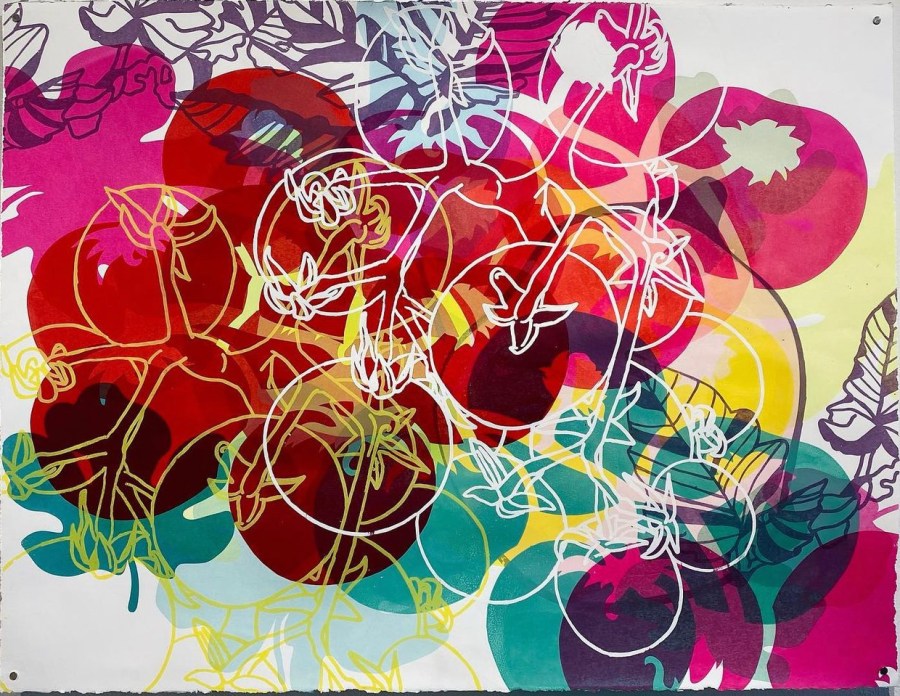
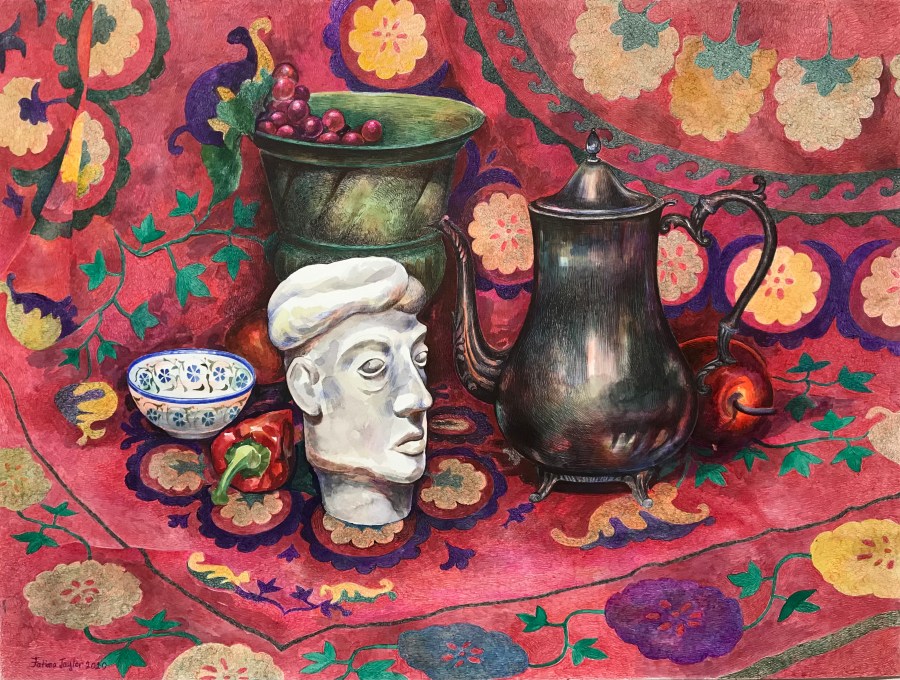
Featured Art: Fruits and Vegetables by Bright Kontor Osei
you sit down to dinner with your mother an ape appears in the kitchen and begins poking around i’m looking for the other ape he says the ape pulls out a frying pan and places it on your head he asks you if there is another ape under the frying pan you and your mother tell him no and little black hairs wriggle out of your arms and your face wrinkles like a dried apricot and your knuckles rap upon the floor no that’s wrong the ape says the other ape isn’t like that
the ape finds an empty seat at the table with an empty plate and an empty cup i love pork chops and applesauce he says and coincidentally this is what you are eating but i’m not hungry at the moment you seei am much too missing the other ape you understand him the hairs on your arm grow thicker and blacker you ask the ape if he would like to say grace the ape bows his head and says god tells bad jokes
you all open your eyes to an angel immaculate and chrome stuffing its face with pork the angel licks a glob of fat from its metallic lips and says god does not- but the ape holds up a hand and says no that’s wrong the other ape isn’t like that and crushes the angel like a sardine tin in his leathery fist the ape turns to your mother she nods and little black hairs wriggle out of her arms you all three settle in to eat but no one is hungry don’t worry says the ape it’s normal it’s all too normal everything in the room settles at this you hear the softness of footsteps upstairs wanting only to tell you all about who they spoke to today
Incredible to me now, how long I went without it. Palm, nape, arch. Shoulder blade, collarbone, top of knee. Weeks. Months. Not one for manicures, too old for club scenes.
Noting the daily ways we stop just shy of it: coins dropped into a waiting palm, elbows cased in thick wool in crowds, on trains the shared heat of covered thighs.
I moved my wrist along the cheap satin slide of drug store scarves, rubbed the budding tips of weeds, grabbed brass doorknobs still warm from the hand before.
To the skin-starved, the world’s a frisson of substitutes. If you know this, and you hear a knock, answer. I won’t stay long; you can leave the tv on. I’ll use
a fine-tooth comb or soft-bristle brush, my fingers through your hair. Let me do this. Let me make amends to my old loneliness. Your scalp’s sudden aria
flooding the studio apartment, the high-rise, the whole city sky sighed with airliners, then farther out, the dark plains with their small, hidden lives that pause to listen
and your roaming selves, returning now to the paddock of your skin. You will dream tonight, and wake up human.
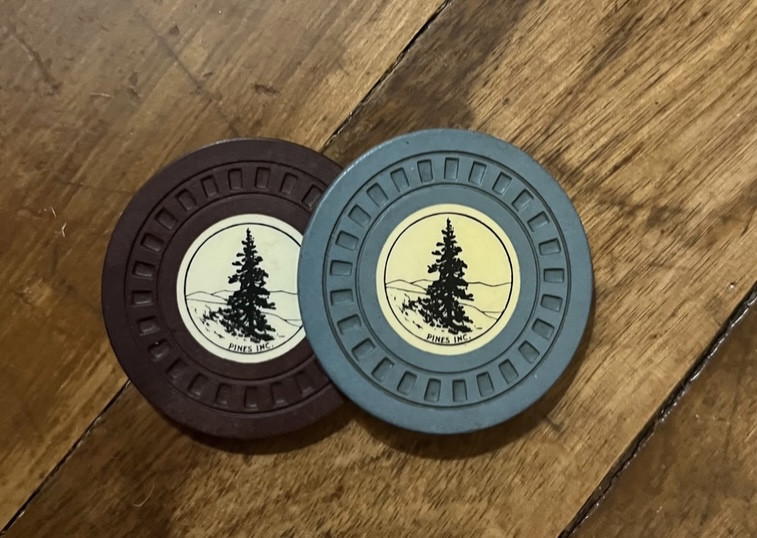
When Daddy was a boss at the telephone company we lived at the big house backed up to the railroad. There was a sliding board, a sandbox, a goat we could harness to a little cart, and a live-in nanny, Henrietta with her twisted arm. We had indoor plumbing and a great big car. When Maymie wasn’t sick we went to Daddy and Uncle Gus’s club: the plushest roadhouse in southern Indiana perched at the top of Floyd’s Knobs with only one road out and one road in where pretty dancers gave me and Kotzie fizzy drinks with paper umbrellas and a Maraschino cherry. The rooms were full of smoke and music, ladies with black stockings and red lips men in double-breasted suits hair slicked back clinking glasses tinkling with ice cubes, revelers who had crossed the Ohio after sundown to play cards and craps. Upstairs Daddy’s man sat at the window on top of the toilet with a rifle between his legs overlooking the 80-foot drop, scanning the highway’s seven hairpin curves for feds and cops, roulette wheels spinning, fortunes turning all night long. Once, when no one was looking I pocketed a chip: cream-colored, printed with a dark green pine. Good thing Maymie had stashed a suitcase of cash under the four-poster before the Crash, the handcuffs, the raid, before Daddy got the dropsy and we moved in over grandpa’s store, before me and Kotzie woke up one morning to find Henrietta cold and dead lying in bed between us.
The man with the yellow hat dragged his monkey out onto the balcony and locked it inside the wire-walled kennel. He’d reached desperation. The monkey he’d named George had finally followed his curiosity to disaster. The monkey had nearly killed a man. From behind the sliding glass door, he studied the monkey’s stillness, wondered what terrifying curiosity he could be conjuring now: a swing from the powerlines, steak knives chucked from their sixth-floor apartment.
Cool fingers trailed up the back of his neck, bumping down his hat brim. “Don’t you think he’s learned his lesson?” the scientist, his girlfriend, whispered into his ear. She joined him at the glass door.
The man clenched the syringe in his pocket. After two years of fostering, the man had become certain that the monkey he’d named George couldn’t be trained. The scientist imagined the man kinder, so much more patient. But there was a frailty he hid just as carefully as his balding scalp under the hat. His patience, his compassion for defenseless animals, was rubbed threadbare. So, he carried a fatal needle for the monkey, the quick solution, finally. She was wrong about him. Everyone was wrong.
and the White Pages, to the Switchboard, Rotary Dials and Dial Tone. To the Answering Machine, to Not Being Home to Pick Up the Phone, to Being Afraid of Being Found Out You Were Home Alone. To “Voigts’ Residence,” and “Can I Take a Message?” To Forgetting to Tell Mom Someone Called. To Busy Signals and Collect Calls and Call Waiting. To Long Distance, and Listening In On the Bedroom Cordless. To the Phone Tree, Caller ID, and the Red Cross Asking for Dad’s Blood Again. To the Do-Not-Call List. To Hotlines, Nine-Hundred Numbers, Star-Six-Nine, the Pound Sign, the Operator. To Having to Ask Your Girlfriend’s Parents If She Could Talk. To My First Cell Phone, and How It Didn’t Work the First Time I Turned It On. To its Tiny Screen, and the Animated Panda We Watched There That Meant We Were Roaming Even When We Were at Home. To Dropped Calls, Low Bars, and Family Plans. To the Call Mom Got On Our Way to the Beach Telling Her That Her Mother Was Gone. To the Quiet Afterwards in Our Rental Car, Just Her Crying, and How the Seaweed Lay in the Sand Like Tangled Cords. To Numbers No Longer in Service. To the Number That Was My Grandparents’ for Decades, The Last Four Digits Their Anniversary. To Whoever Would Answer If I Dialed It Now. To My Father, Who Will Go to His Grave Never Owning a Cell. To My Mother’s Voicemails About Christmas and My Sister and Computer Problems, The Messages I Save for When She Won’t Be There to Answer, When They’ll Be All I Have Left of Her Voice, The First I Ever Heard.
The last remaining sycamore on our suburban road was a playtime shelter; its roots, fairy council seats, its hollows, a dormouse school. For developers with an interest in the spare acre, it was an inconvenience.
The men with chainsaws came, met a ring of steel-eyed children, spanning the centuries-thick trunk. I wore my favourite coat for the occasion, a hand-me-down ski jacket— across my chest, a burnished sunrise patched above a flat-earth horizon. Hope was a four-foot thing in nylon.
We shook placards, posed for photos, made the front page of the local paper, before being called in for our supper. They came again in school hours, left nothing but a stump, hillocks of saw dust, dormice scrabbling for their copy books through the still-warm crumble.
Remind them, a word is the hardest thing to lose and practical as a kettle: there is nothing you cannot make with a word, nothing it will not hold. Start with despair. Add boiling water: tea for your throat, soup for your bones. Now add a crust of bread, some fat, mercy, this is the science of naming, a descendant of breathing, carried deep behind the eyes or within the eardrum or beneath the skin, and it cannot be stolen or surrendered at the threshold of any cell, refuses to be turned away, demands to be used even when you have no will for warmth or food. You cannot help it. So long as you have thought to think you’ve lost it all, you must call language what it is: more to live for.
The first time I told a man of my desire for sterilization, my intent to cut off the monthly ovum’s quiet passage through my uterine tubes, he silenced me.
)
The no spoken for almost all his gender, though I did not know so then.
)
“Let’s not discuss that,” he interrupted. His voice sliced the pathway of my unformed words as they traveled from the lungs to the larynx, before they could be birthed by my tongue. “You might change your mind,” he said.
I want you to become utterly inconvenienced by my past, present, and plans, and I want to have no awareness of your suffering. By all means, continue telling me you love me— every day, many times— but I want you to commit yourself to a mobius strip list of tedious chores that need doing several times a day, in perpetuity—namely laundry, cooking, and cleaning while cultivating kind and grateful children. You will need to prioritize. I want you to find everything our family wears no matter where we disrobe and I need you to wash our clothes in soaps that don’t irritate my skin, then you must line dry certain items while tumble-drying others; keep in mind that I alternate line/tumble drying depending on the item and how many times I’ve worn it and where I wore it and how much I like it. I will be very upset if you forget. Naturally, you’ll need to sort, fold, deliver, and hang clean clothes, but I’d like you also to tell me where they are in a way I can remember, when I feel up to listening. I will still ask you to help me find them again, when I need them, but I like to feel included, you know? Please remember to change the sheets on Fridays. Should you ask me for help and I am available to oblige, I promise never to learn how you’ve done any of this, staining and shrinking expensive items which I then fold into tiny cubes, the way my mother did. If you want to convince me you love me, I want you to create a weekly menu each Sunday to be posted on our fridge, and based on that menu, I want you to draft a list of supplies needed from various pharmacies and grocery stores, then you must drive to those places, find the supplies, buy them, bag them, drive them home, sort them, put them away. I will come with you to keep you company but I prefer not being sent to stores alone. While we’re out I will want to talk about traffic and the price of toilet paper in a loud voice. Let’s do this every weekend, forever. I’ll thank you later. I’ll likely get home from work just before dinner is served so you’ll have to make it. There will be nothing I can do about that— I’ll remind you. Please get excited when you hear the key in the lock. Maybe you can work remotely during the day? Maybe I can buy you a gym membership? I think you’d get better results at a gym. When you cook, I will describe my feelings about each dish, using terms like endlessly frustrating and pointlessly complicated and weird. In exchange, I will learn to make miso soup so well it becomes the only thing I can possibly contribute to any meal, ever. I want you to develop an interest in baking, desserts especially, so that when you follow a New York Times two-day recipe for miniature fig and cherry pies, I can remind you how much I was hoping for plain chocolate chip cookies— nothing fancy. I want you to become a vegetarian for reasons informed by your own childhood trauma, the kind you still feel down to the molecules of sweat that sprawl on your palms today, and I want you to raise our daughter as a vegetarian too so that when she asks for a real Mcnugget I can tell her no because you don’t want her to have delicious snacks while you sit there remembering that video of soldiers laughing at a headless chicken as it ran in circles, a sprinting font of blood until it died and became dinner. If you want to convince me you love me, you must keep the floors clear, make all our appointments, coordinate transportation and care for our pets— you will need to admit that you’re the one who wanted them, after all. You’ll need to sweep, mop, scrub, disinfect, diagnose, find, collect, stack, reorder, pay, mail, return, schedule, follow up, call and leave a message. I want you to be on time for doctor’s appointments that enter you. Don’t worry, I’ll be here to say I told you so. You will need to manage the household’s medications, illnesses, and symptoms. You’ll need to coerce us to heal. Aren’t we darling? Just look at our daughter. I think she has dandruff. If you want to convince me you love me, please teach her how to wash her hair properly and also she is struggling with her multiplication tables so if you get a minute you should address that because you get through to her better than I do, I don’t know why. And you know what, go ahead and get a PhD. I want you to study what you love most. I will complain about how little I see you for four years, I will become a well of mother’s guilt, does that help? I want you to publish, I want you to only accept jobs that pay enough for me to respect them (if you don’t, I’m not sure how I can discuss anything else when we have company) and while this might be difficult considering how often we relocate for my job I trust you to figure it out. If you want to convince me you love me, you will figure it all out. I know you don’t cry much but once every five times you break down sobbing in the bathroom I promise to look at you while you say things to me. I will buy you a coat, I will buy you a watch, I will tell you you’re just a better person than I am, maybe it’s genetics. I promise you, as always, to be easily convinced by your love; in fact, all I need is about twenty years of these requests fulfilled, and remember, you have a beautiful smile, you’re so smart, I liked your hair better when it was longer.
It is a brisk sun-swept morning, two days before Mardi-Gras, and I am eating paçzki, pronounced pounch-key, from a stubby Parma bakery that sells it in red, white, and blue flavors like Piña Colada or S’mores. As I pour my coffee, caramel-creamed, I watch boys who look like my brother die on television.
ii.
War is grey playgrounds and Cyrillic on faded billboards, letters I used to trace out in notebooks — Now I can read my name, nothing else. Slava Ukraini, heroiam slava. It’s not my language anyways, not my patch of once-Russian earth that’s thrashing like a sick dog before the shotgun. Still, I should cry for it. My mother does. She’s cut from Youngstown cloth, bread-lines for bedtime stories, so curses follow — Blood grudges bubbling, burning over after years in suburban veins. The tanks roll in after sunset.
iii.
I should learn Polish in solidarity, or attempt Lithuanian. I should clip in the too-blonde extensions and glittered plastic eyelashes, Sell the girl that American men like to order online. I should ask Nana about her family and write down the answers, tie a square scarf on my head, learn to bake kolache. I should stop making death half the world away about myself, for God’s sake — Take up smoking, or Lenin, or going to Mass.
iv.
My friends spend lunch giggling. They would dodge the draft, of course, in case you were wondering. World War Three before winter formal? It’s just too much! It’s funny. I laugh myself to tears.
I don’t know how to be a vessel. When my mother’s father drank himself to death, she was a day’s bus ride away at school, got the news by telegram. Today, in the yard, the trees are disappearing into fog so blank you could forget they had ever been there. In the 60s, along the Mississippi, bulldozing for I-64, workers dug up beads, shells, remains of Cahokia, a city as large in the 13th century as London was— plazas, mounds, courtyards, towers. Imagine getting to work with your backhoes, blueprints, your federal funding only to find that someone got there first. My father’s grandparents, eighteen, already three years married, left green Tennessee, headed west. I don’t know why they forsook Eden for the wind-raw Texas plain. Great grandmother vowed never to cross the Mississippi again. And she never did. That’s how the old ones said it— and she never did. I can’t explain how I wound up here, so close to the farm where she was born. At the end of her life my mother’s mother exacted a promise: keep the stacks of funeral visitation books, proof the ancestors had been somebody. My own mother dead, and thinking of my daughters, I snapped a photo of every page and threw them into the dumpster with her mouse-ridden sofa. In Cahokia, the Mississippians built a woodhenge to mark the sun’s solstice. Now, the sun is burning away the fog and across the valley, Flat Top Mountain smolders in autumn light. I don’t know where in these woods the copperheads are readying their dens for their long winding sleep, where the wild turkeys are fattening on acorns, their long necks ratcheting down and up. If I knew how to tell you that, I would.
A few years back I observed a class by a then-new colleague of mine at Ohio State, Marcus Jackson, a young Black poet from Toledo who’d studied with Philip Levine at NYU. He was teaching a handful of poems he called “Poems With and Without Zip Codes,” and one of the poems was Phil’s “Soloing,” from toward the end of What Work Is; it’s the poem about the John Coltrane dream that the elderly mother tells her visiting adult son. He’s driven over the Grapevine with roses from Fresno in the backseat, and he almost didn’t come at all—but there they are, thinking of Coltrane’s music together in the heaven they both, separately, believed California would be.
And there Marcus and I were, long-ago and not-so-long ago students of Phil’s, listening to a mutual student of ours read Phil’s poem aloud, far from California, much closer to Detroit, in the frigid gray of a Columbus, Ohio, winter. That’s what it’s like now—for me. With Phil in neither New York nor California, he’s everywhere instead: in a piece of music, a red carnation, a Lewis Hine photo, a classroom filled with his grand-students. It seems to me only trauma, love, and art abide with us this way.
Live long enough and you’ll have a few if you’re lucky. Take me, for instance— when my son crossed the street and the car’s tires screamed and his body arced into a C. Or once in the doctor’s cold office when the air froze into a word.
Or maybe it’s a choice—your choice, the other person’s, doesn’t matter. You sit on the edge of the bed in the hotel room, run your hand over the quilted bedspread and wait for the answer. It’s not much really, not much that determines a life.
In the deep end of August, the sun oozes over Jackie Onassis Reservoir. The air is dense, crickets set to simmer. The sidewalk steams.
Over Jackie Onassis Reservoir, a chemical rainbow rises. The sidewalk steams. Cockroaches fly in the streets.
A chemical rainbow rises. Taxis shimmer. Shirts cling to breastbones. Cockroaches fly in the streets. From three long blocks away, I can smell the city pool.
Taxis shimmer. Shirts cling to breastbones. The sun tattoos a cipher across silver rooftops— from three long blocks away, I can smell the city pool. The rich people vanish. The heat sticks.
The sun tattoos a cipher across silver rooftops: One down: suffuse desire; Across: quiver boombox. The rich people vanish. The heat sticks. In the distance, the grid is viscous.
One down: suffuse desire; Across: quiver boombox. We chase our shadows down the avenue. In the distance, the grid is viscous —borders fading, partitions coming undone—
we chase our shadows down the avenue speeding toward the promise of night —borders fade, partitions come undone— the city exhales, releasing its secrets.
Speeding toward the promise of night, in the deep end of August the city exhales, releasing its secrets and I am falling in love with everyone.
Maybe it was hot, I was out of work & the car actually started, maybe I didn’t even think to bring a towel, just drove & walked into the water, walked in & let my feet rise, floating in salt & seaweed, fishlike, minnows darting below me, maybe that’s why I got to lie like I belonged in a horizon of water smooth as the sky, a rich silk luxury of blue, early evening in Paris blue, the blue of the Comtesse d’Haussonville’s opera dress, not the way it was, trapped in fabric, but how Ingres painted it, the way it still looks even in the print in my room, faint ripples flowing smooth in reflection, the kind of blue you’d wear & your bank account would never run low or maybe if it did you wouldn’t notice, or wouldn’t care, that rich Comtesse blue ferrying me seaward, blurring the smells of suntan lotion & fries, the echoes of men loud on phones, into the holiday happiness of striped umbrellas & beach chairs & who knows, maybe the Comtesse herself sunbathing right here at Sandy Neck, floating in time, sure, just a day at the beach like any other day, maybe, the way if you didn’t look, you might think the water was just blue.
Jim Dahlberg was eating a bran muffin and reading The New York Times when he saw that Lucas Bloy had won the Joslyn P. Fish Award for New Conceptual Art. Jim put his muffin down. He wondered if there had been some mistake—not that he was an expert in the field necessarily. He wasn’t an artist, or a critic, or a scholar. He didn’t know the first thing about the Josyln P. Fish Award. He did, however, know a thing or two about the recipient. Lucas had been his nemesis.
Years earlier, Jim had entered a sandwich shop in Madison, Wisconsin. He was in his third year of law school at the time and had just completed a lengthy exam on copyright litigation. Whenever he finished a big exam he liked to eat a roast beef sandwich slathered in tangy hot sauce. It was, for him, a kind of joy. And so he was deeply touched when he saw that Joanne Neier—by far the prettiest girl he’d ever seen at Ralph’s—chose the same condiment. On the basis of this connection, he was able to score an impromptu date.
Life is astonishing, he thought. One minute you’re biking through town with a roast beef sandwich on the brain, and the next minute you’re sitting across from a beautiful stranger with hazel eyes, convinced that all your days on Earth were prelude to this fluke encounter. There had, of course, been one or two highlights. Kissing Natalie Finchbaum at the Cineplex was a clear triumph. Receiving his law school acceptance letter—and the scholarship it came with— had opened his life to dewy pastures previously unfathomed. And there had been that interesting brush with nature during a baseball game when he was sixteen. He’d been grazing in a trickle of meadow along the left-field foul line—his team, the Borlyn Reds, were playing in Ripon, Wisconsin, home of the Tigers— sniffing his glove and watching Trent McGinnis mow down batter after batter, when all of a sudden the wind picked up and sent the trees into a frenzy, and he was able to recognize—though he couldn’t say exactly how—that trees are in a struggle against the heavens, just like the rest of us. But between that night on the baseball field and the moment he and Joanne Neier shared the corner booth at Ralph’s, it seemed that very little had happened.
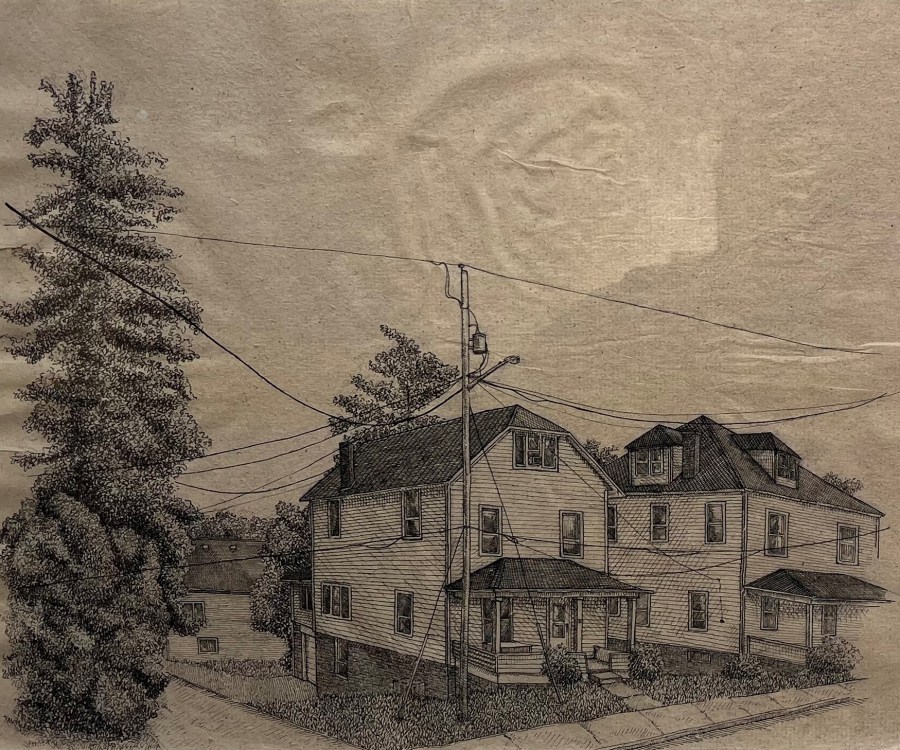
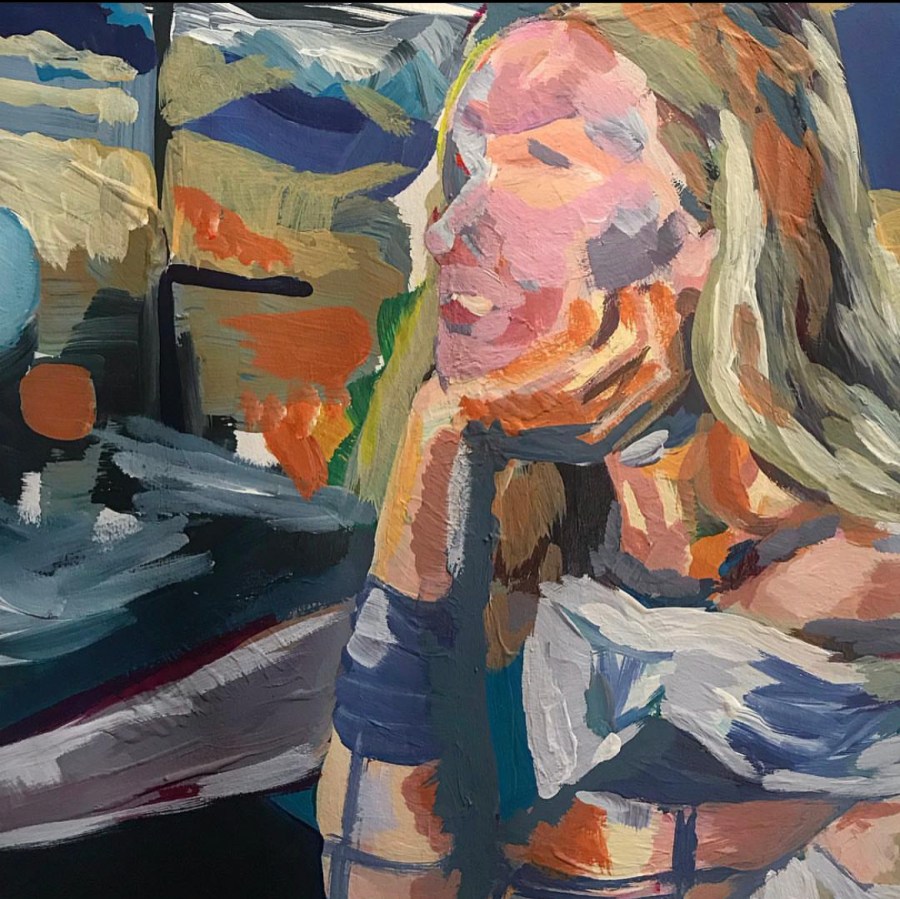
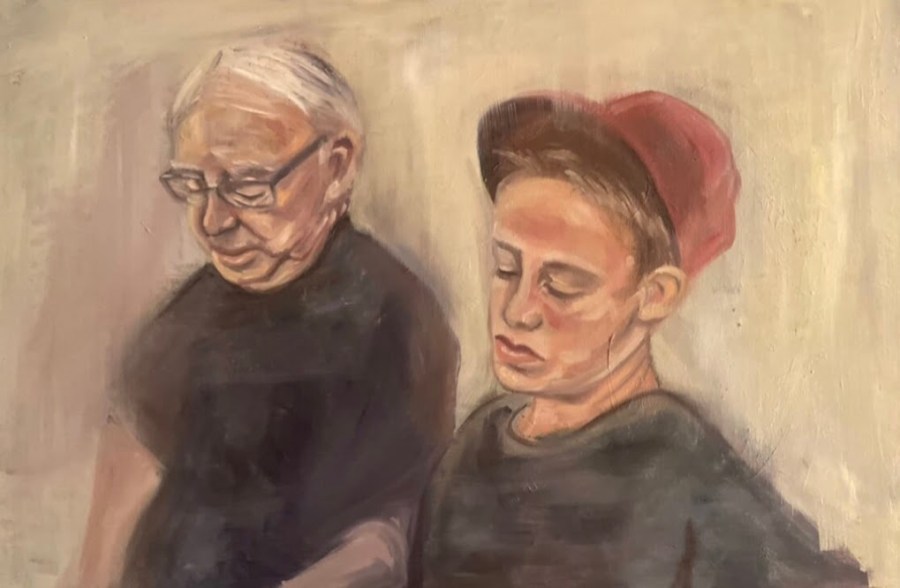
Featured Art: Portrait of Kaitlyn (2018) by Erin Dellasega
Each generation learns from the previous so said my mother who never left the house. She would close herself up in her bedroom for days, only to emerge in a wig and a dress made of paper on which she had sketched vague faces and landscapes with fat pieces of charcoal and spit. Once I thought I saw her in the street, a fur hat and hooped earrings, eyes vacant and no response to my call. Doppelgänger she would say later, like the thick-boned villager who helped load the trains with mothers and daughters and turned to the camera to swear it wasn’t her.
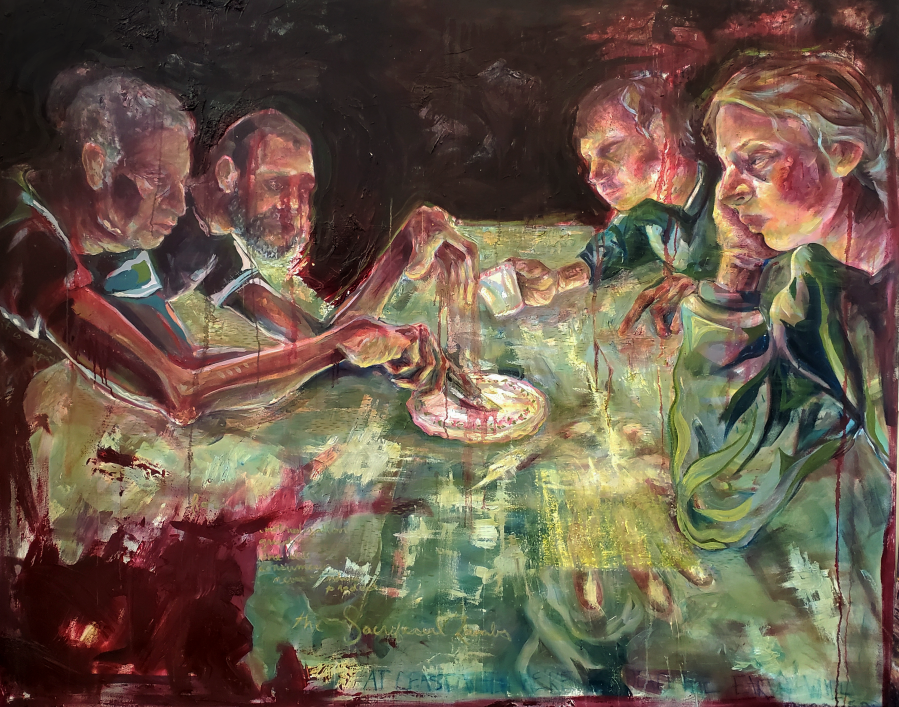
Featured Art: The Sacrificial Lambs by Brooke Ripley
The stores have closed early even though it is the middle of the week. The cathedral begs forgiveness, promises to open tomorrow. No reason is given. At an intersection, two women ask for directions to the town square. They only venture a couple of feet before they consult their phones, are given the same instructions: Walk down that street. It’s not like it is a large town. If this were a Western, there’d be tumbleweeds. Despite recent warnings of a thunderstorm, it hasn’t rained in over a month. Six years ago a 300-year-old bridge washed away for good. There have been three floods in seventeen years. The two women are still looking for the town center, stop in the middle of the street to look west, then east. And it’s clear they’ll never find the center even though all they need to do is look up. In the square, employees from a supermarket chain are camped out in booths. They carry trays of cubed cheese and melon that smells like cold cuts. It is too hot for cheese. The city is building a new wall to fight future flooding. Does it matter that the shiny metal gates rest against centuries-old stone? Back in the town square, a mime on stilts waves coupons in the faces of passersby, bends down to gauge their response. No one accepts the coupons. The supermarket employees suddenly appear at every side street, each dressed in a matching red shirt, ambushing anyone who dares get close, calling after them: Excuse me. Excuse me.
Most people find a trip to the pillow museum so exhausting that afterward they need a long nap to recover from experiencing all the dreams the display items have absorbed from their original sleepers.
Theoretically, anyone could navigate the museum according to taste, steering clear of, for instance, the homicide pillow, the fetish pillow, and the arson pillow, as well as the pillows of Arnold Schoenberg, Charles Manson, and all those dental hygienists and IRS attorneys. Theoretically, one could choose only the pillows of the confectioner, the Olympic surfer, the dolphin-whisperer, and so on, but nobody does this, since it’s common knowledge that every shunned pillow takes offense, vengefully suctioning out a single breath from the visitor’s lifespan as they pass it by on the micro-sleep tour—a tiny, insignificant portion until you start adding up all the individual penalties over the years.
Nevertheless, not only does everyone return frequently, especially when hosting out-of-town guests (the museum is our only tourist attraction), but most of us are employed here as well, sanitizing, repairing, plumping, positioning, and working as docents or gravity-adjusters—there are also the soothers, wakers-and-shakers of visitors, members of the custodial, managerial, and administrative staffs, and the guards who protect the pillows from theft, vandalism, and all possible forms of dishonor.
The octobered sky. The overarching evolution of your abdomen. The salutatious relove we do once we’ve forgiven our mommas. Let’s go arachnid and eat our mommas or ok we can just wrap each other in silk. O yes I am an aprilfaced king. O yes I am a uterus genius. O yes I bleed while I walk down Seventh. O yes & yes & yes I have made such a snow of your hands, an astronomy of your syntax, an ambulance of your eyes, and I’ve decided that I have no issue with meeting your mother next Tuesday. Wait. I can wear a green coat like Chalamet in Little Women or a red tie like a coach. I should practice my little voice in my little mirror hi my name is how are you impressive charming not at all o yes afraid
the day gathers up in a blonde geometry and we drive out to turn phantom on DeSalvo’s dock because we can because DeSalvo went dead and left his pond unattended so we come here and watch the moonback like maybe it might turn around and make us real to somebody sometimes I wish I could throw her up in the air and watch her spin forever she’s like yawning during the pledge and missing indivisible or picking scabs during catechism you see I am stupid as the weather when she says Please like a field waving itself into the blade when she rubs her thumb in circles in the middle of my palm I am honest to god adjacent to me or ajar there is no halo like leaving yourself ajar you become a room so danced it thumps violet or you become ready for another room to enter you back she is a room too asking me if this is alright like she can’t see my face already decided under this light we call our space juice because we drink it we pray for no spoon in the persimmon we sit down scared like substitute teachers we learn how to love with one hand and we scrape our backs on this wood like we’re rubbing off velvet or making the muscles in our traps to fight and we know this house is a gift even if invisibled
If my heart breaks loose and darts across a lawn—if, stopped at crossroads, my heart pries my ribs apart, takes wing through the open car window—if my heart gets away from me— help me bring it back. Walk with me, hedge to hedge, with a butterfly net, a baseball glove, a sauce pan. We’ll crunch over cicada husks, duck the sprinklers, race the coming dusk. When we spot it, cupped in a daylily or tangled in chain link, by then, relieved and grass-stained, we’ll be laughing and crying and the streetlights will be just starting to sputter above us.
Our move to Halloween Street was one of necessity, not choice. Following the death of my wife, Sylvia, the home we had rented was sold. The new owners gave us nine months to vacate. And this place, situated on a leafy and wealthy street in the town’s eerie historic district, was the only thing available within walking distance of my daughter Claire’s school. So I took it, despite the steep rent commensurate with the austere economic laws of Supply and Desperation.
An energetic and put-together neighbor tells me I will need somewhere between three and four thousand pieces of candy, treated out one piece per kid, as well as gallons of a stiff grog for parents, to get me through the hours-long Halloween night here on Halloween Street. Based on some simple arithmetic and plot-pointing along a mental timeline, starting with the next paycheck, I have just enough pay periods between now and the end of October to buy a total of four thousand pieces of candy. Or eight hundred pieces of candy each payday, all totaling in the end approximately six hundred American dollars. Candy. For one happy motherless night for our only child more than two months hence.
Houses on a bluff; below them, off-limits to construction, a few acres of watery woods. A clear simmering of spring water glazes bright moss and gravel, slows to a bog, where a marsh wren reveals its single note. Slow growths of mistletoe on thick-gnarled limbs of elm and oak.
I’m here with my two wolves— my daughter and her friend, both twelve, who’ve tied to their waists lush tails. They prowl among the folded smells of leafmold unleashed by winter sun. They run, they fade behind trees. From the woods I hear long high howls.
Is it only make-believe? Each day, they feel an approaching metamorphosis. They’re at an age for trying things on: clothes, hair, such baubles that dangle from pierced ears, language fanged to affront their parents—whose worst fear remains the child might be no predator, but prey.
But these two wolves are at play. Are they too old for this? In Finland, my daughter tells me, teenage girls ride stick-horses, in organized events. It’s like dressage, except the living and too expensive horse is assumed into the girl herself. Spine and head convey
the rider’s attentive, upright carriage, while legs perform the horse’s measured moves. It’s ignorant to presume an animal will share a human’s feelings in a human way; just so, I can’t presume to think I know the nature of these wolves, or cultivated horses the Finnish girls become, as if to say
what’s best might just be something else than human. The houses crowding the edge of bluffs know nothing of these changelings, who bark and bay, wander the unruled ways of the leftover woods, and in becoming, renounce. Unless these houses breed them too.
There is always someone who suggests that his poems would be far better than yours if he’d only bothered to write them. What’s more, he would have handled the whole enterprise with more grace and aplomb than you ever did had he chosen to write those poems instead of making a killing in investment banking. And yet you keep going, even in the knowledge that the poems you are writing are not as good as his poems, the ones he didn’t write . . .
and, for that matter, not even as good as the ones you didn’t write. “Your poems would be better if you didn’t write them” is either a Zen koan, a quip by Yogi Berra, an insult, or just nonsense, which is why no one says it. I hate the idea that any poem written down is somehow inferior to a poem that does not exist. Yes, plenty of bad poems have been written, but out of all the poems that have gone unwritten, there’s not a single one I love.
I got an email from Tony just now though he’s been dead for a year and a half, and in the instant before my rational brain told me it was spam, I felt the thrill of seeing his name pop up in my inbox, the dopamine rush that he was writing me from beyond the grave. And when I clicked on his name to open the message, the body of the email consisted only of my first name followed by an exclamation mark (as though he was excited to be writing me) and, under that, a compressed link in the electric blue that indicated it was live. My giddy finger slid the cursor over it, to see what Tony was sending me—maybe instead of infecting my computer with malware that would harvest my data and require me to pay a huge ransom in cryptocurrency, the link would take me to a web page where I could find all the poems Tony has written since he died. I paused a moment and thought about what those poems would be like, but my imagination failed me. Then I clicked “delete,” and went into my trash and deleted the message again, which made me feel timid and puny, as though, like D. H. Lawrence and his snake, I’d missed my chance with one of the lords of life.
My cat’s corpse is in my dad’s garage. She died four years ago, November of 2017. There was a tumor somewhere in her brain that pressed outward against one of her eyes quite horribly in the end, according to my dad. I had moved to New York by then, a five-hour drive from his northern New Hampshire home, and could only listen, powerless, to his news over the phone. She did one of those animal things where she grew very sick very fast but refused then to just die, prolonging us all in the anxiety of her suffering and the knowledge that we would, finally, have to choose which day she would go.
In some ways, it was okay—she was old. My parents brought her home to surprise me when I was eight (after we had to condemn our last elderly cat the month before), and I was twenty-three at the time of my dad’s solemn phone call. But there’s something undoubtedly terrible about scooping an animal into a carrier, taking them from their home for the last time, telling them, “It’s okay,” as they panic, like on all the trips to the vet before, but knowing that this time it is not.
He called me again after it was done. He said, “They gave me some options on what to do with her.” Cremation and eventual return of remains in a commemorative urn, which cost money; burial out on their farmland gravesite behind the office, with visitation opportunities; or self-disposal at home.
After you left the party someone’s dog picked a fight with the resident ancient hound and big human hullabaloo ensued followed by talk of infectious diseases, tricks for making perfect piecrust, the battle of Waterloo. Literature was avoided (too controversial), as was real estate (too dull). The Sanskrit scholar refused to recite a poem we yearned to hear called Remembrance of Songs of the Future. Everyone wanted to know the truth about you so I spun one tale after another about lost items, Cochabamba (remember the awful soup we ate every single day?), and the exigencies of soul retrieval. They toasted your future with pretentious cocktails while I sat on my heart to keep it quiet. Without you, my partner in all things stealthy, I couldn’t slip away early. Then it was late, dark and windy. I stepped outside to gaze into the vastness overhead and the cosmos was as it ever is— persistent and forgettable.
Sitting at a corner table on the patio of a Lebanese restaurant, I watched Hank Nguyen chew viciously on a hangnail until a sliver of skin came loose. A flash of blood appeared on his teeth before it was wiped away with a brisk dart of his tongue. “You are the worst kind of tourist,” he said, with an elaborate eye roll.
I was working through a mouthful of flatbread and hummus. “I just don’t think it looks that tall.”
Behind him the Burj Khalifa rose into the night sky, glittering intermittently, so large that I had to roll my neck back to behold it. The action reduced it to parts, made it digestible and no longer grand. This was the Dubai Mall, and I knew that if I had marveled at what lay around me—the swarms of tourists, the extravagant fountain show every half hour, the way everything gleamed in the perfect sharpness of fluorescent light—Hank would have mocked me for that, too.
“You’re impossible to please, Berenice,” Hank said. “I take you to the center of the world and it’s not enough.”
“Okay, okay, I have an idea,” I said. “What if they made it taller?”
Featured Art: Peony – side yard by Kayla Holdgreve
In Tang verse classics, lonely wives rebuff the orioles that flirt amidst their flowers; they’d rather climb steep observation towers and, wrapped in tragic shawls atop a bluff, command a view of miles on miles of rough terrain uncrossed by human forms for hours than lean into the softness of spring showers, breezes, birdsong, and such sensual stuff. Or so the male bards of the Tang portrayed them when writing verses in a female voice; I cannot blame them for it. Simple boys, they merely wanted someone back at home to miss them in their absence, to upbraid them for being gone, to love them through a poem.













 New Ohio Review