It’s Like This Every Night

By Sally Rosen Kindred

Featured Art: “Acequia” by Mateo Galvano

Waiting for the elevator, you hear
the dark floors chime, you
hand over her pocketbook
and put on your gloves, you try
to convince her to get on
when it comes. You’re with me,
you say, and this is the only way
to get down to the ground
.
She doesn’t believe you,
probably because this
is not her blue coat and she knows
she is dead, which you’d know too
if you’d just wake up.
But you go on sleeping
like the fool
you are, folding your body
close to itself under
the heavy sheets, your hand
touching your own
sleeve, understanding
it’s hers, waiting for the doors
to open, waiting
quietly, like she taught you,
to go down and out the lobby
together into the
blue-white city
to see the snow.


Read More

This is It

By John Hodgen

Suffice it to say we’re all that we have. We’re tagged. We’re it,
despite the occasional monoliths that pop up in Nevada deserts
begging us to believe we host astral visitors or nascent iterations
of ourselves. All in all it’s pretty clear. It’s just us who keep showing
up, and who, given enough time to gather the shards and bits of our
thoughts, are trying, albeit admittedly, intermittently, to figure it out,
the it being this-messy-business-fix-that-we’re-in, this requisite
dog and pony miracle show. It’s in all our next breaths, our Where
did it go?, I had it right here
, the it that we’ve lost, that we held so tight
in the palms of our hands the way the prophet Isaiah says we are
held. The it long gone now, like eternity, like Puttin’ on the Ritz,
the itsy-bitsy spider, the Iditarod without snow. Heavy hits there,
though we know (do we not?) that children hold the half-lit world
in their eyes each night, holding out for one more Stuart Little,
one more peep out of us before drifting off in little candle boats,
planes and canoes, as if they’re in some children’s edition of Casablanca
in Sanskrit, with their letters of transit to infinite, immaculate sleep.


Read More

Poem For Emily Dickinson, Referenced Twice in Sophie’s Choice, and for Sophie, of Course, Hounded, Tormented on the Train Platform at Auschwitz by the Nazi SS Commandant into Deciding Which of Her Two Children She Has to Give Over, Consign to the Gas Chambers in Order to Save the Other, How She Chooses, as She Must, as Any of Us Would, Despite What We Say, for Saving One at Least From the Flames, Thinking, Cold, so Cold, the Glaciers, the Rivers of Our Lives Suddenly Shifting; and for Sophie’s Nameless ESL Instructor at Brooklyn College After the War, Saying at the End of Class Soon You Will All be Speaking English in Your Sleep, and Quoting Emily’s Poem About Death Kindly Stopping for Us; and for Sophie’s Classmate Whom Sophie Asks to Tell Her the Poet’s Name Again, Who Says, “Émile, Émile Dickens”; But Most of All, This Poem is Not For, is Decidedly Against the Assistant Librarian, the Shame of All Librarians, the Condescending, Supercilious Prig Who Tells Sophie She Must Mean Charles Dickens, the 19th Century British Novelist, That There is no Such Poet as Émile Dickens, Causing Sophie to Faint Dead Away on the Library Floor

By John Hodgen

Plead with me, pray for the real Émile Dickens, unknown novelist/poet/autodidact, that he be found,
culled, called from the lost regions of the unimagined dead, with all due speed, by acclamation. May he be
remembered for saying that truth and death are a woman disrobing in heaven and also in hell. May he be
hailed as laureate, as Sophie’s last choice. May his every word be revered, his magnum opus rediscovered,
The Chosen One, each word a new child with a soup bowl only asking for more. May he know no shame
nor dereliction. May his ranks never close. May he have all new clothes. May he be lauded for leaving
his bleak house, his hard times, for enduring all of our twists, for exceeding our greatest expectations.
May Death itself die like John Donne, like bloody Keats, hapless Chuzzlewit or faithful Micawber.
May it be that Death’s heartless heart yearns. May Death die in a library sumptuous, vast as Parnassus
among copper fields and forests of urns. May he die hearing there’s no such author as Life, that Life
is pure fiction, a story, a poem, that he must venture alone into a book depository, where presidents
and dreams are killed, where everything burns. May there always be a poet named Emily or Émile,
waiting at a train station, another train coming in, how it chuffs and begins, how one might glance
out a window for just a moment askance to see someone feverishly and forever beating the dickens
out of a poem the way Dylan dropped the lyrics to “Subterranean Homesick Blues” on oversized
hand-lettered cards with Allen Ginsberg standing in an alley in London outside the Savoy Hotel
where words and worlds coincide with everyone we’ve ever loved and everyone who’s died,
carriages pulling up to the station outside, hundreds of them, millions, on which we can ride.


Read More

Fruiting Bodies

By Rose Skelton

I meet Conor in the spruce forest. He whistles his whereabouts; I return his call. It’s mid-July and a mild summer wind breathes through the trees, a low moan that envelops us in the cool island gloam. I follow the sound and scour the ground for what mushrooms might be growing: summer chanterelle, puffball, deceiver. It’s the kind of forensic looking that I begin in July and don’t give up until the trees are naked and the hills are the color of rust. A fast, careful, sieving of images—birch leaf, tree root, crisp packet, coin—a longrange and close-up searching for the gifts of this Scottish island: the edible, the poisonous, the one in a million. The friend that took me two years to meet, though we lived in the same small town. The mushrooms he taught me how to find.

It is the first year of the pandemic and we have fled Texas where my wife, Nomi, has a job at a university, for the Hebridean island that is—was—my home. Nomi desperately wants a baby, has done for a decade, long before we met. She and I have been fighting about it for four years, as long as we’ve been together. But we are thirty-nine and forty-one now and it is probably too late. What do I want? I want not to argue about it anymore, not to have to go through the high-cost, low-chance medical procedures that I fear will rip us apart. I want not to have to choose sperm from a roster of men who claim to look like Tom Hanks. I want not to bring up a child in America.

Read More

Bloodstain on Storm Door

By Jeffrey Harrison

Featured Art: “Storm Window” by Mateo Galvano

That’s my blood, I’d wager, dried
on the white lower panel of the storm door,
having dripped from some small cut
as I came in from working in the yard.
Who knows how long it’s been there,
or how the drop became a mark
more singular and graceful
than any I could have made on purpose,

yet seems (as I bend down
to look more closely) considered
and spontaneous at once—
two quick strokes, one curving up,
the other down, like a figure rendered
by a calligrapher’s brush, with ink
from my own body, as if beauty might come
from even the slightest wound.


Read More

Spider Hands

By Tim Craven

Rare and degenerative, the condition arrived
without warning: a Tarantula for an index finger,
its swollen mocha abdomen fused to the knuckle
as though the lines embossed across my palm
were the net of its silk-spun web.
Then a Huntsman where I’d last seen
my right thumb. Doctors counted the eyes,
plucked legs for biopsies;
an experimental ointment was prescribed.
I made do with my hands stuffed in my pockets,
opening jars in an elbow’s crook.
I almost forgot my plight until two small Sheet Weavers
busied themselves replacing my pinkies.
Then the Trapdoor, the Wolf, the Brown Recluse.

Why me? Why not the neighbor’s son?
I’d chop off my arms were I able to grip
the necessary instrument.
My only solace comes at night
when the inquisitive pointed fingers
of children are tucked up in bed.
I drink whiskey and ginger through a straw
and telephone a friend whose own suffering
makes me feel as though I’ve won a prize.
She has experts stumped: an inoperable alligator
is wrapped around her intestines and any day now
its merciless jaws will snap shut for good.


Read More

Featured Art: “Internal Velocity” by Mateo Galvano

The Smoker

By Johnny Cate

One kid named Ryan got so mad when he struck out
he pounded his forehead on the dugout wall until he bled—
there was a sticky red globule on the green cinder block.
His mother chain-smoked and paced every ball game,
screaming through each season from the bleachers.
By the time we were too big for Little League, her vocal cords
had corroded and only a rasp remained, like an HVAC
on the fritz. That final year, you could still hear her, stomping
in her acid-washed mom jeans, gravel cringing beneath her feet
as a toothed breeze blew through her ragged throat.
It always seemed appropriate her name was Tammy.
  After every game,
    we’d line up at concessions to get a soda—
in odd vogue then was a concoction that mixed all the syrups
into one super-flavor we kids affectionately called a suicide.
Once, sipping my suicide, I walked behind the stand to find
Tammy having a coughing fit against the bricks. One hand
on the wall, one in a fist in front of her mouth, she hacked and
trembled as her cig’s orange-red ember did a pissed-off glisten.
When she turned her eye to me, her pupil was constricted
to a black prick, a period of fear in its bloodshot context,
and I felt my youth being drawn out of me like a drag.
I neither moved nor broke Tammy’s gaze until she broke mine—
in the oasis of a clear breath, she looked up into the night sky.


Read More

Wolf Moon Blues

By Johnny Cate

    This one’s so lit it gives the sun
  a run for its money—Wolf Moon
on the come-up, shadow-casting

    past midnight, mouthing lesser light who?
  The fanged fox skull I found beside the dry
creek bed cries for the rest of its body

    and the back-to-black Winehouse
  mountains flex like the scapulae
of a gaunt predator on the prowl.

    You could sell me hell before the idea
  these trees’ll ever be green again—
the two-toothed insomniac who

    clerks the Tractor Supply could check
  me out, laser this barcode burned
on my heart. I’ll pay in exact change.

    I’ll total up, honey, howl
  silhouetted against that albino dime
in the sky. I’ll hunt Winter’s young, throttle

    each day til something hot starts
  running, steaming in the beam-spill
through the stripped boughs. Everybody’s

    chalking their fallbacks up to Mercury,
  but I’m talking time’s blood to coat
the throat, talking apex killer energy—

    this freezing hemispherical spell’s worst
  nightmare: me as Summer’s ghost, lupine and
loose where I sure as shit shouldn’t be.


Read More

Mothers in the World Above and Below

By Abby Horowitz

Featured Art: “Persona-03” by Mateo Galvano

Your mother haunts the hardest; that’s what Selah’s told whenever she starts to whine: why hasn’t she come yet to pick me up?

Her mother haunts the hardest, so Selah is at the care center the whole day long, so long that Ms. Drae takes pity on her and gives her second servings of afternoon snack. The other kids trail after their parents up to the parking lot and off to home and there’s Selah again, all alone in a playground full of nobody, or at least nobody that she can see isn’t it possible that she’s got her own ghosts? Oh, get out of your head and get onto those swings, Ms. Drae tells her; then her eyes sink back down to her phone.

Selah swings, she jumps, she slides. Lady-like, please, Ms. Drae calls when Selah’s robe slips up by her thighs, but Selah ignores her. Let the world see her underwear; if only there were someone to look. She takes a clump of dirt and rubs it onto her leg. Look! she says, running up to Ms. Drae, A bruise! But Ms. Drae only rolls her eyes and shoos her away rather than tell her (again) what of course she already knows: you can’t have bruises if you don’t have blood.

Read More

Commuting

By Michael Carlson

The whiteboard was blank, leaning against our elm tree. I uncapped my marker and wrote: “Broke and Craving Pancakes.”

Our red tent had broken zipper teeth. The nylon flap hung open, curled like a sick tongue. I ducked inside, knelt by Shay wrapped in a sleeping bag, and rubbed his shoulder until he woke. Purplish-brown eyes, low-stubbled jaw. Long black hair splayed across a thin pillowcase.

I smoked a cigarette in my rocking chair. Shay emerged into the honeyed light, scratching the back of his head. He took forever with his tan work boots, the gum-soled ones I had lifted from Walmart. Mouth open and laces in hand, Shay watched a robin striking dirt.

“Come on, I’m hungry,” I said, handing him a cigarette.

Read More

Stay

By Robin Rosen Chang

My memory wanders like a dog,
searching for treats and looking for balls,

but my mother’s memory
never lost track of anything,

like the time I didn’t call her
in the hospital after her surgery
when I was thirteen,

or the time I told her I wanted
to live with my father
and his new wife,

or the time the police questioned me
after someone torched a neighbor’s fence.

I wish I could’ve told her I’m sorry
but her memory slunk away.

My memory fetches old bones, reminders
I strayed. Across a border,
I smuggled dope. I swallowed
unprescribed prescription pills,
was careless with sex.

Is it worse to recollect or forget?

I wonder if this dog will get lost.
Will it skulk from yard to yard
or stand at the fence, yelping
and howling at nothing?


Read More

Dream

By William Olsen

Driving in rising fog to my fading father, I’m surrounded
as if by a mind of erasure, turning trees into apparitions,
so they look dead in fog, even the young ones, especially
dead-looking are the young ones receding in staked lines
into the absence where still other trees have already receded,
the stubble fields are no more, houses are no more,
no more human memory, and the straightaway road
drops away with the seeming duty of reaching my father—
released are the proximities and distances of eyesight,
yet the usual dread, holding the wheel, is not stopping at all,
a shallows of headlit asphalt always just ahead,
a highway of missing fields, fog risen from the unseen—
too everywhere to have an end or a beginning,
the car lights have no past—no place on earth—


Read More

Father Sleep

By William Olsen

Featured Art: “Sleep to Dream” by Mateo Galvano

Walking away after watching over sleep, sleep having
   claimed my
father, sleep now having the face of my father,
having put on that face all of his life and now
sleep must know that he’ll fall beyond sleep,
father sleep seeming to want more from him,
father sleep will never be happy long,
father sleep that almost never withheld itself and when it
did he’d call us, and forget he ever called us,
he’d call us sixty times in one night
until we stopped answering.


Read More

Infinity

By William Olsen

Nancy and I had been talking with him about whether infinity is, or
is only mathematical delusion? Like, say, between irrational numbers,
where nothing is too small for infinity. And whether mathematics itself
will end in a last, absolute prime number that won’t be divided. All
we could say, though, was this, that the universe has a finite life and,
while the light of the stars knocks about for another 40 billion years,
a finite ghost-life. We put it simply when there is no simple. Finite
like us. It will die like us. Isn’t that weird? His face lit up despite
the Never Again. He cried out in joy, “the universe is an ANIMAL!”


Read More

Questions

By William Olsen

Julie. Jaimie. Maya. Clayton with a reputation for being the
least far gone has fallen on the floor again. Missy with her
ever sour face and her rare bursts of humor. Or the nameless
woman in Memory Care who’d come out of her room at the
end of the hall naked for anyone, her face with the beam of
having accomplished something nobody even dreamed before.
Marilyn cradling the doll that puzzles her in a quieting way.
Dick a World War II vet with Sansabelt pants always asking
after his belt. He’d sidle up to me because I knew his name.
Always smiling. And Jerry, a Colonel who served in Vietnam
brazenly stealing from his lunch mates, right off the plate,
or pounding the locked metal door every day right about
noon, and, no matter why, ready to demote the lot of us.


Read More

Carls

By Craig Bernardini

Featured Art: “Rainbow Gravity” by Mateo Galvano

My husband and I have two neighbors named Carl. One Carl lives in the house next to the house next to ours. The other lives seven houses away in the opposite direction, on the other side of the street. The nearer Carl—Furtive Carl—bikes around the neighborhood on an old Schwinn five-speed with an orange flag clipped to the seat. We’ll hear him coming before we see him, because he likes to ring his bell, as if to say, Carl’s here! He seems to ring it whenever it suits him; we’re never sure if he deliberately rings in front of some people’s houses, but not others’, and if so, what it means.

This bike-riding and bell-ringing would be tolerable enough if Furtive Carl didn’t fire up his excavator in the middle of the night to perform some ambiguous labor in his backyard.

We never see Furtive Carl outside his house except on his bike—never see more than the elbow of his excavator over the fence a house away. Gregarious Carl, on the other hand, spends entire days in his front yard, wearing nothing but Bogs and longjohns, hacking away with trowel or hoe. His work seems to involve the endless, tormented carting of wheelbarrows full of earth between one part of the yard and another. As he grunts and sweats, he caterwauls away to the opera that blares from speakers pushed up against his window screens. If anyone passes by, he calls out, loudly enough that he can be heard over the music, and waves his arms over his head, as if to fend off a buzzard that had mistaken him for carrion.

Read More

My College Boyfriend Is at Bolt Coffee

By Julie Danho

I see him while brushing past—
bird’s-nest blond, raggedy
goatee, the striped hoodie

rough as burlap—but when
I open the bathroom door,
I look at myself and laugh

because I’m forty-five,
and so, somewhere, is he,
and the man-boy out there

with his latte and Nietzsche
must be in his early twenties,
the same as Adam in my dorm

about to play me the Pixies,
holding the disc by the edges
like a diamond, wearing

on his wrist a cafeteria spoon
that matched the one (where
could it be?) he’d just given me.


Read More

Western Mount

By Madalyn Hochendoner

I didn’t know what quality
over quantity meant

a buck knife you win
at the auction?

skin mount the ten-point
western mount the rest

all I knew was I wanted
to be endless

stuff me full of salt
keep me on ice

me and my shadow
in the alien field

low shrubs
and no topsoil

what would it take
call me a coward

stuck between the river
and the lightning

all sky


Read More

Here I Am Participating

By Madalyn Hochendoner

in the longstanding practice of reading
on the train

and it reminds me of other solo pursuits:

pogo-sticking to the end of the driveway
and back,

buttoning up the front of a shirt, then
tucking it in,

ordering the bowl of clams

body popped open

like a compact, like a flip phone

like a hand motioning—blah blah blah

trying to still-life it

to still-love it


Read More

Still Life

By Kaitlin Roberts

SUMMER

He pushes me in the shopping cart and we hurtle down Wühlischstraße, blasting Morrissey on a speaker and swerving past old men collecting bottles and past Berghain kids, who suck on vapes. I’m twenty-seven and high on speed with a boyfriend who’s too young to rent a car but old enough to push me on four rickety wheels through a heat wave, going nowhere.

We blaze through crosswalks and thunk-thunk over sidewalk cracks, and I don’t make sure he’s looking both ways. I shut my eyes, cover my ears. I don’t want to find out what’s next.

We’ve been going fast all summer. We wear trash black clothes from Humana and drink Rotkäppchen straight from the bottle. We skip club lines and go to bathrooms that smell like three-day-old piss. With the student card of the university where I’m enrolled but never go, we cut fat lines of Calvin Klein on a cracked phone screen and make them disappear, and it’s magic on the dance floor, where we thrash under hot red lights and sweat with strangers, best friends we’ll never see again. Then we’re back in the bathrooms, where sometimes it’s a hahaha-amount of drugs and sometimes so much our brains hurt and we have to bum hand-rolled cigarettes, and hast du Feuer? And when we finally come down, teeth-grinding and mascara running, we leave wincing at the sunlight and shielding our ears to drown out the birds—because we hate the birds, black hooded crows that eat garbage and gossip on car hoods. They say it’s daytime, high noon, that we’ve been fooled, that nothing is magic, but mostly they say we’re fuck-ups. You hear them? Fuck-up, fuck-up, fuck-up, they call from the trees where they’re the high ones now.

Read More

Featured Art: “Questing” by Mateo Galvano

Spring Cleaning

By Emma Wynn

My mother-in-law is upside down ⠀⠀⠀⠀in the dumpster
rooting, somewhere ⠀⠀⠀⠀under the urine-soaked towels
and splintered wood there is a magazine ⠀⠀⠀⠀she hasn’t read
a stained jacket three sizes too small ⠀⠀⠀⠀she knows
she’ll wear again ⠀⠀⠀⠀my partner and I have flown cross-country
to shake mouse droppings ⠀⠀⠀⠀out of her blankets
scrape dirt off the floors ⠀⠀⠀⠀with a putty knife, trash
the medicine tubes ⠀⠀⠀⠀expired before I was born
there’s only one twin bed for us to share ⠀⠀⠀⠀no real food
in the fridge just chutneys on every shelf ⠀⠀⠀⠀every room
a warren of narrow passages ⠀⠀⠀⠀walled with books
about to avalanche ⠀⠀⠀⠀and bury the dogs
barreling in and out ⠀⠀⠀⠀the broken doors
the L.A. dust sifts in everywhere ⠀⠀⠀⠀as if the desert
wants to erase us, she says ⠀⠀⠀⠀I want to take everything beautiful
from her ⠀⠀⠀⠀her son, her broken antiques, the organ
in the living room she can’t play ⠀⠀⠀⠀your mind, she says is
a narrow room ⠀⠀⠀⠀shuttered and cold, an artist
would see ⠀⠀⠀⠀how the room of old newspapers
is only waiting to unfold ⠀⠀⠀⠀into a flock of birds and lift off
through the hole in the roof ⠀⠀⠀⠀I see her dying in a fire
and haul them in stacks to the curb ⠀⠀⠀⠀where she’s dumpster-diving
for the treasures she’s lost ⠀⠀⠀⠀my partner staggers down the path
with another load ⠀⠀⠀⠀sneezing black mucus
and spitting grit ⠀⠀⠀⠀and I need them
to set everything down ⠀⠀⠀⠀give me just a breath, see
we’re the precious rubbish ⠀⠀⠀⠀that has been here all along


Read More

I Just Wanna Be Somebody

By Nancy Eimers

Night and the City (1950, dir. Jules Dassin)

Harry Fabian, stop running across the screen and into the distance
made of alleys and doorways, streets crisscrossing streets
of neon signs with their loops of the cold light any city knows—
stop, because you will have to run again at the end of the movie
that ends you by throwing your body into the river and having a cigarette
flicked after it. How traitorous your flapping coat and trousers and
your comical two-toned shoes. And yet you believed them.
Critics say this movie is modern because it is tough on its characters,
Harry having a “slimy glee,” and yet how his horsy teeth protrude pathetically
when he smiles, how his face sweats each time nobody lends him money,
how the dapper suit comes unbuttoned and gapes and dirties as he runs
toward the end and his eyes look horrified as if he’d found himself beneath a bridge
beyond which it is night and the city burning. This man could push his girlfriend down
in the street and leave her there—in the layers of grays and grims, no white—
or maybe terror is pitiable beyond mercy just for a moment,
maybe each alley is a doorway hoping St. Augustine would even now say brother,
let us long, because we are to be filled
…. Longing has one ending,
longing has another. In one, the girlfriend is comforted by a friend,
in another the hiss of a cigarette tossed into water has the final say. Could Harry be said
to have a soul, even his clothing tries to make the man, and he inside
now frightened now upbeat, the and in one and two and three and four
has him running a last little while, if only as far as the bridge.


Read More

On My Sister’s Buying Twin Plots for Herself and Steve in Greenwood Cemetery Not Far from Elmore Leonard

By Nancy Eimers

You say you like the thought of graves being visited.
As the older sister I fear I won’t be available.

But I’d want to go on leave, take a trip back down or up
or away from the utterness of being gone

twice, in a way, since you will be gone too, we gone from each other,
I’d want my being gone to imagine you having company

and allow me to visit the little graveyard near where you lived,
though maybe I’d find myself standing there—hovering?—

in a sort of bewilderment: what was the reason, does grief
even remember me, remember having a body,

and did I want to make it my business to say something
to you—over you—(quietly

in case one of the nearby houses was listening)
or maybe sing some little song we knew, that the silliest part

in each of us might have been comforted, or confronted
by who knows how far apart we have traveled and when

or if we arrive (from ariver, “to come to land”).
But it touches me, even so, to think of you wanting

graves to be visited (though maybe not as strangers visit
Elmore Leonard, Dickens of Detroit, on Greenwood’s public tours)—

that sense of somewhere to go, small space marked on a map
of a park-like place with houses all around.


Read More

Hospital in Blue Dark

By Deborah Allbritain

Featured Art: “Estuary” by Mateo Galvano

All things said at the end have been said.
Her wool beanie pulled over her ears.

Horizonal bones laid out on the bed nearly
prehistoric, she is.

How do I get out of here, she keeps whispering to no one
and I think of the artist Richard Diebenkorn

who said that the aim is not to finish, but oh
great bonfire, I keep losing my train of thought.

Night-blooming jasmine is fertilized at night.
Can you smell it yet?

The little bear in her arms is still.


Read More

Dirt

By Maria McLeod

Featured Art: “Reservoir” by Mateo Galvano

In the weeks and months preceding attempts to rescue me, I had become increasingly despondent. I had developed an urge to dig. It was a fantasy of detachment: asexual, dark, isolated. I took to it the way a person may take to a new job or a new house in a faraway state where they hope to reemerge unrecognizable. I wanted to burrow, to wriggle my way through the murky water table, to traverse the ruins of ancient civilizations, to eat through the slick layers of slate, granite, limestone, and, deeper still, to find the Earth’s hot core, to finally come to rest along the perimeter of that core and to fall into a deep sleep wrapped in ashes, to bake as if in a Dutch oven, a slow kind of smoldering, until my sleep turned into an endless coma, until my flesh melted away from the bones and the bones themselves, thoroughly stewed, went rubbery.

There was no exposed or available land surrounding my apartment, so I went to the lawn of the church next door and dug with my hands. I didn’t penetrate very deeply, but I did dig up enough to fill a rusty lunchbox. The smell of that dirt was the smell of a childhood lived outdoors. My stolen portion—special thanks to Our Lady of the Immaculate Conception—included a fragment of Styrofoam cup, countless dead insects of an indecipherable origin (at least to the naked eye), three live earthworms, and a bug which resembled, on a very small scale, an armadillo. And, of course, there was the dirt: black damp topsoil which, when pinched together, stuck. It was the type of soil gardeners of drier states might worship, but it was spring in Michigan, and this was the kind of soil one expected and didn’t think to celebrate.

I kept that dirt in an old Gallo wine jug next to my bed. Things grew, or tried to, but I thwarted their efforts by intermittently shaking the jug, turning the world upside down and back upon itself. I squashed what life I could and tried to keep the bottle out of the sun. Mostly, I used the dirt as an inspiration for my fantasies, as a portal to an unworld, the place I sought, without let up, at every opportunity. Prior to my fantasy sessions, which could be best described as a depressive brand of meditation, I eked a bit of that dirt out, and, like communion, took a dollop upon my tongue, careful not to chew. The first time was a bit shocking and not at all pleasant. I was careful not to include anything visibly living and tried not to think about the possibility of insect or worm excrement. Eventually, I let my saliva do its duty of breaking it down, dissolving and transforming it into a digestible form. That is, at some point, I swallowed it.

Read More

IN THE DAYS OF CHILDHOOD AND VIOLENCE—

By Shelly Cato

        One Morning Before School

A tricorn hook pierced a night
       crawler before
       entering a boy’s
       thumbnail—
       the bone

At the same moment
      a grain of grit shifted
      into his mother’s left eye
      which remained to stick—
      twitch

On her cutting board
       apple peelings wilted—
       and the hound
       outside jowled
       ham fat 

Behind a shed
       seldom used for skinning
       the boy waited  
       for his school bus—
       nursed blood

from his thumb—believed
       in the way his mother
       arranged his lunchbox—
       believed he would live
       to open his lunchbox

that day


Read More

Paprika

By Lory Bedikian

Not every song on the radio is a great song. Usually
it airs because someone knows someone knows someone.

There are most likely a million songs that will never
make it to any Billboard top chart ranking yet will

kick the amp, graze the sound factor with tonal bliss.
I like calling it phenomenal. To give examples would be

dangerous. So instead, one could say, a song needs
to be a bit like paprika. Before we go there, let’s imagine

a punk band named Paprika. Perfect. Even better,
a vocal artist who goes by just: Paprika. Catchy.

We never really knew where it came from. Maybe
just another ground red pepper, but it was what

we always fell back on. Sometimes spicy, sometimes
smoked, sweet. Music. It’s what we are all looking for

all of our lives, just in different incarnations.
Let’s forget the song or I’ll never tell you the story

of how paprika was my mother’s diva and crooner both,
the spice she believed, with all her soul and lashes,

could save any cooked dish from ruin. Paprikah tuhrehk!
Meaning “put paprika on it!” However, in Armenian

addressing you in the second-person, plural, formal,
sounds like, although only two words: all of you, listen to me,

before it all gets thrown out, get the paprika, sprinkle it on, damn
you all!
My mother. A woman who saved nothing,

but thought almost anything could be saved from ruin.
Mended socks, shortened the cocktail dress because

she never went anywhere really, but shorter she could
wear it to work, to her job selling formaldehyde-filled

furniture at Montgomery Ward, waited for commission
checks, came home late because it was her turn to close

the register, waiting for her between asphalt and neon
lights. Almost forgot we were talking about the belief

that one could save things from ruin. Last night I almost
forgot that my mother was dead, gone for four months now.

I know paprika is not my style. At least as a spice. Just as
I’m certain that there are too many songs not being heard

because someone’s got to know someone and someone
else has got to close the register before the walk home.


Read More

Thinking About My Father’s Erector Set from 1948

By Jen Siraganian

Rarely, my father speaks of the slow rubble piling,
before months sped hotter than his parents expected.
They thought it would pass, unaware of what aches
appear later. He was eight. This was before
walls, checkpoints, talk of two states.

Let’s focus on one wound at a time. I can only tell
a story diluted. I’ll try more softly—my father had toys,
then he didn’t. He had a childhood, then he didn’t.

Here is me at a sunlit kitchen table in California,
doubling as American and something like coarse salt.

How often I hear “it’s complicated” when I mention
my father grew up in Palestine, went to school in Palestine,
immigrated to the U.S. as a Palestinian refugee.

His voicemail last week—don’t post anything online.

For years, he lived in no-man’s-land, and I,
half-Armenian, half-daughter of a man
from half of a land that is half of me.

When I visited, could I call the wall beautiful, but only
the painted side? My grandmother’s friend spit on
for shopping on the wrong street in Jerusalem.
Jews walk on one, Muslims the other.
She’s neither. I started paying a man to do the errands.

Seeing my father’s childhood home, its walls
adorned with sniper fire and a gravity of collisions.
It consumed me, bullet holes as common as commas.

In the Armenian Quarter, the pottery store owner
said he would close before things worsened.
Palestine his home, until it wasn’t. Truths stitched
into my grandmother’s embroidery. Did I tell you
she left that too? Here is an echo no one asked for,
singing of a home in Jerusalem before Armenians evaporated.

At the airport, I, though not yet vapor,
say nothing to the Israeli passport agent.
Not telling him I visited Palestine. Not asking
for the return of the toys my father left behind


Read More

Survival of the Unfit: A Retrospective

By Jodie Noel Vinson
Excursion to St. Fé—Thistle Beds—Habits of the Bizcacha—Little Owl—Saline Streams—Level    Plain—Mastodon—St. Fé—Change in Landscape—Geology—Tooth of extinct Horse . . . Flocks    of Butterflies—Aeronaut Spiders—Phosphorescence of the Sea—Port Desire—Guanaco—Port St. Julia—Geology of Patagonia—Fossil gigantic Animal . . . Causes of Extinction

(Charles Darwin, Voyage of the Beagle)

Tongue crimson in morning ulcerated—stomach constricted dragging—Feet coldish—Pulse 58 to 62—or slower and like thread. Appetite good—not thin. Evacuation regular and good. Urine scanty (because do not drink) often much pinkish sediment when cold—seldom headache or nausea.—Cannot walk abv ½ mile—always tired—conversation or excitement tires me much

(Charles Darwin, note to Dr. Chapman)

Charles Darwin had “taken the horizontal,” as he would have put it as a seasick young man on board the Beagle. He lay in bed, snowy beard cascading over the coverlet that shrouded his six-foot frame. Emma could see her husband was in so much pain he was “longing to die.” Their daughter Henrietta, hovering bedside, lamented how “this terrible nausea still goes on.” Darwin, before passing away on that April afternoon in 1882 at age seventy-three, answered with the equanimity of one who has lived in daily discomfort: “It is not terrible. But it is nausea.”

At this point, Darwin had been ill for over half his life. “I was almost quite broken down,” he described his chronic ailment in a journal, “head swimming, hands trembling and never a week without violent vomiting.” The naturalist took copious notes on his malady over the years, during which his stomach caused him “incessant discomfort, I may say misery,” as he once wrote to his cousin William Fox, predicting: “I shall go to my grave, I suppose, grumbling and growling with daily, almost hourly, discomfort.”

*

Read More

On Seeing Quail While Hiking in the Arastradero Preserve

By Joyce Schmid

Featured Art: “Garment Gold” by Mateo Galvano

for my husband

The little plumplings strut across the chaparral,
now fly off, fast and low.

I haven’t thought of quail for years—
not since the damp December
when your father died.

You’d grown up in that San Francisco house,
a child in the same twin bed he was to lie in
asking “Am I still alive? My heart still beats?”

Afterward, you had a can of quail eggs
as a birthday gift for me.

I pictured how you left the bedside,
woozy from the world of dying,
trudged down Noriega to the stores

and saw that jewel-green can
with Chinese characters and quail eggs on it,
luminous as South Seas pearls,

each egg a single cell—
instructions to create a life.

The covey lands again,
goes back to scratching in the weeds,
each small head nodding yes with every step.

You say you have no memory of quail eggs.
But you do remember leaving
in the middle of your father’s

dying to find
the perfect present.


Read More

Birdcall

By Kelan Nee

It woke me, the high slung
pitch & swoop of sound.
Someone told me once
that a cardinal holds a soul
of someone lost: red, tufting.
& every day for two years
cardinals descended
on the locust tree,
the only one in the backyard.
More than I could count.
& I learned their songs. I
learned how they sing.
Until I moved. Now I know
a man who lost his son.
He rides his bike & sees
his boy in robins. He told me
I don’t believe it’s the spirit
of my son, but I see them
& I think—& I like it.

& there you are today:
careless, sitting on the peak
of the wooden fence, blazing.
The sky today is too blue,
cloudless, for this kind
of stillness. Sometimes
I make your noise
back to you with my mouth.
Most times I watch
the feathers fill & deflate,
count their creases
like a well-worn face.
& today, at least, I like it.


Read More

The Kingdom

By Charlie Schneider

The Big Man was to walk five iron steps up to the linoleum ante-level behind the curtains; someone was to hold out a cup of water if he was thirsty. He was to turn left, flashing trademark alligator-print sock, then walk three paces into the danger zone near the edge of the camera’s eye, then look at the sign that said PAST THIS POINT YOU ARE ON CAMERA so he could adjust himself in any sense before seducing the millions, or trying to. There is a better world, folks, he was to say, where we meet the crawling deserts with a trillion trees, where we shake hands after work worth doing, where money’s just confetti for the grand opening of a high-speed train-line, where there’s meatless meat on every plate, local and delicious, where guilt is optional, a novelty, et cetera.

Trouble was, I didn’t tape around a single sniveling ruffle of carpet. Did the Big Man trip? He did. Did he fall? He did. Knee fractured, image dented. My job? Way gone. Three months later the primary draws near, and all I’m doing is plundering my savings and rollerblading. I’m the champion of Bleloch Street; I know all its heaves and divots. The larches in my apartment complex’s court- yard whisper: now is the time, get your job back, stop moping, call Tricia, find another candidate, get back in the ring, don’t forget us, call Tricia.

Read More

Frank Buys Groceries

By David Dodd Lee

Featured Art: “Nectar” by Mateo Galvano

Frank thought pork chops, the way they were
cut and packaged these days,
looked an awful lot like excised angels’ wings.
But he also sometimes just
got light in the head. He was adamant—
I am as fit as a mountain range!
Though Frank may have suffered mania
from too much weightlifting.
Frank bullied his moods.
If he woke up feeling angry at the world
he rowed the demons out in his kayak
or went a few rounds with the heavy bag.
He was so dialed-in sometimes!
A deer fly could make him throw punches in the air.
If he walked to the gym he’d listen to the cars
flying past, how they stuck to the asphalt a little,
asphalt trying to suck up rubber. It was annoying!
Now he heard the fluorescent lights pinging,
lording it over the T-bones and bundles of asparagus.
The natural color of food—
the blood red of the beets, for instance—
seemed to be fading, as if color
were an essence weakly subservient
to manufacturing and chemical abuse.
Red meat, drained of blood, whimpered
from where it was stacked in the meat section,
bloated red by carbon monoxide infusions.
Frank tightened his grip on his grocery cart.
Cans of kidney beans are destined
to be left standing on store shelves
for centuries after the apocalypse,
in which each person will have long ago
been torched from their bone marrow
on outward. When the pleasant checkout clerk said
“Thank you for shopping at Schaeffer’s,”
Frank thought, You don’t know the half of it, sonny,
but said, “My pleasure” instead.
He knew the boy was just a tool, cheap labor,
a cog in something too sinister for words.


Read More

High Tide and Full Moon in Paradise

By Ken Holland

Featured Art: “Fear Bridge” by Mateo Galvano

I’m waiting for the rain to grow tired enough
to put itself down.

The rivers are flooded with ill-will and
shopping carts freed from Walmart servitude.

People stop talking about the apocalypse
the moment it becomes one.

People stop taking out the garbage
when they see what’s floating in their backyard.

Outside my window, the rivering street rivers
to the left, while my neighbor across the way

sees the street rivering to the right
and refuses to understand how it could be the same river.

I’m reading a book on the means and methods
of early seafarers.

I’m reading my DNA for trace elements
of Polynesian blood.

My orchid has pinned a tropical flower above its ear.
My Persian is stalking the mirage of a dry oasis.

I’ve come to enjoy the mystery of dinner
once the labels have long soaked off,

while my wine still has the grace notes
of the last vintage blessed by drought.

My neighbor swims over and asks if he can borrow
a cup of mercy.

My neighbor swims back with my gun
which his lawyer will use to execute

his last will and testament, as a jury is convened
to bear witness that no one’s yet pled guilty

to living in a state of innocence.


Read More

As Is

By Susan Blackwell Ramsey

That house on the corner is for sale
again. Last week it flaunted SOLD

over the gap-toothed retaining wall,
the sparse weeds in the barren beds,

the desiccated hedge. And now
the sign is gone. So are the weeds.

The fallen bricks are balanced back
into the wall, and near the steps

someone has mulched the beds halfway,
as far as a single bag goes.

I laugh, it feels so personal.
I recognize the scramble up

that gravel bank, repair instead
of maintenance—my housekeeping,

my teeth, my spine, my charity,
all after-patched, too little too late.

My mental double-entry weighs
regret against effort and expense,

while sloth and wishful thinking keep
both thumbs on the scale. I have two friends

who silently agreed to let
their house disintegrate, then sold

“As Is” and walked away content.
Bad for a body or realtor, still

I nod companionably at that mulch.
Maybe too little will be enough.


Read More

In the Midst of It

By Gregory Djanikian

Featured Art: “Titania Dreaming” by Mateo Galvano

The woodpeckers are making holes
in the eaves of my house,
destroying some small part of it
while I count the wood chips
falling from the sky.

Isn’t it lovely that the natural world
can be so companionable,
keeping me frazzled and deeply alert?

Yesterday afternoon, the sky turned gray
as if it were going to thunder and rain
though it never did,
what a turnaround.

Sometimes it’s all you need,
a little reprieve, a surprise
to make you think
it’s not all ruthless
even as the shots ring out
in the heart of the city.

It’s the life we’re given
the pulpit managers say,
some of us having more life than others.

The woodpeckers are still at it,
doing what they are born to do
and I’m throwing tennis balls at them,
I’m squirting a jet stream
of water from my hose.

They disappear, then cheerfully come back.
There’s no manual that says
everything will stay as it is.

Look at the sky.
It’s as clear as day.

In another hour,
I might have to bolt the doors and windows
against the hurricane onrush of all that keeps me weathering away

from those long expansive afternoons
when I was young
and the wind was a feather in my hair.


Read More

“Chucking the One Hip Out”: Dance as Joy and Resistance

We asked ten writers to comment on the use of dance and dance imagery in poems. The following feature includes:

  • Sara Henning on Ross Gay’s “Burial”
  • Sarah Nance on Lucille Clifton’s “untitled” (1991), “God send easter,” “spring song,” “homage to my hair,” “my dream about being white,” “untitled” (1996), “the poet,” “from the cadaver,” “amazons,” “in salem,” and “1994”
  • Christopher Kempf on Frank Bidart’s “Ulanova at Forty-Six at Last Dances Before a Camera Giselle”
  • Hugh Martin on Yusef Komunayakaa’s “To Have Danced with Death”
  • Jesse Lee Kercheval on Gerald Stern’s “The Dancing”
  • Jennifer Schomburg Kanke on Annie Finch and The Furious Sun in Her Mane
  • Bonnie Proudfoot on Rainer Maria Rilke’s “The Spanish Dancer”
  • Therese Gleason on Anne Sexton’s “How We Danced” and “The Wedding Ring Dance”

Subsequently, we added six essays to an online expansion of this feature. Those are:

  • Lisa Bellamy: “‘The Dancing’, by Gerald Stern”
  • Maya Sonenberg’s “Dada Dance”
  • Karen Hildebrand’s “Blinded by Love”
  • Jocelyn Heath’s and Joanna Eleftheriou’s “girls/all night long: (re)constructing sappho”
  • Renée K. Nicholson’s “Sur Les Pointes”
  • Victoria Hudson Hayes’s “why,it is love”

My Mother, Baryshnikov: Dance as Joy in Ross Gay’s “Burial”

By Sara Henning

My mother never took formal dance lessons, but that didn’t stop her from hanging a large portrait of Mikhail Nikolayevich Baryshnikov in our living room. Saturday afternoons, I’d sometimes catch her, bare feet and leg warmers, leaping across the kitchen floor or spinning like a top, MTV blaring. She danced without form or technique and since I, too, was not a dancer, I had neither knowledge nor language for the magic she created with her body: jeté, pirouette. What mattered was that I saw my single mother joyful in the kitchen of our small duplex. I saw my mother—same woman forced to bury my father a handful of years before—exuberant. I didn’t know how important these small moments of joy would be when my mother was diagnosed with stage 4 colon cancer at the age of 59, how I would hold onto them when bilirubin from a failed liver turned her jaundiced, how I would hold them even harder as she was moved to hospice, my desperate daughter’s clutch becoming vice grip as she took her last breath in May of 2016.

Shortly after my mother passed away, I encountered a copy of Ross Gay’s gorgeous collection of poems Catalog of Unabashed Gratitude (2015), which I devoured in one sitting. It was during this time that I discovered his remarkable poem “Burial,” a poem I would turn to constantly during the throes of my personal mourning.

Read More

“dancing the syllables”: Lucille Clifton and Dance as Poetic Practice

By Sarah Nance

Featured Art: “Alluvium Variations 25” by Mateo Galvano

“when i stand around / among poets,” Lucille Clifton writes in an untitled poem from her 1991 collection quilting, “sometimes / i hear [ . . . ] one note / dancing us through the / singular moving world.” Here, Clifton configures a communal space for poets where some adjoining strand—what she calls a “single music”—transforms their ordinary path through life into a dance. In drawing a connection between dance and poetry, Clifton evokes a long poetic tradition (consider how villanelle, as one example, comes from the Italian word for “dance”) and forges an association she both troubles and expands in other work. Over the course of her forty-five year poetic career, Clifton takes what are on the surface simplistic references to dance—something one does for joy, praise, or worship—and crafts nuanced claims about embodiment, writing, and Black resistance.

In Clifton’s early work, dance is configured at first as a kind of religious ecstasy, such as in “God send easter” from her 1972 collection good news about the earth. There, the poem’s subjects “dance toward jesus” as they:

Read More

The Many Ghosts of Pomona

By Christopher Kempf

Featured Art: “Wanderer” by Mateo Galvano

The first time I encountered it—in the June 2007 issue of Poetry, alongside work from the late Craig Arnold and Claudia Emerson, and just before I entered the MFA program at Cornell—I understood neither the first nor last word in the title of Frank Bidart’s magisterial long-poem “Ulanova at Forty-Six at Last Dances Before a Camera Giselle.”

The former, as it turns out, is Russian ballerina and Stalin favorite Galina Ulanova, the Bolshoi’s prima ballerina assoluta for sixteen years from 1944 to 1960.

The latter is the classical masterwork Giselle, a tragedy of star-crossed love between its eponymous peasant girl and a disguised nobleman, its doomed romance steeped in the paranormalia of nineteenth-century Gothic; after Giselle dies of heartbreak, for instance, she is resurrected by an occult fairyhood known as the Wili, the ghosts of betrayed women who avenge themselves by dancing men to death-by-exhaustion. Though Freud likely never saw it, Giselle anticipates those notions of “hysteria” on which he would elaborate, since Giselle’s frantic dancing was perceived at the time as a symptom of silent—and problematically sexualized—madness. Bidart glosses this etiology midway through the poem:

Read More

Rocking, or Rolling, on Silent Chrome Coasters

By Hugh Martin

If “America is,” as John Updike wrote, “a vast conspiracy to make you happy,” then one might look—though, for awhile, you couldn’t look—at President Bush’s 1991 blanket ban on photographing coffins carrying dead American soldiers. Maybe the ban didn’t ensure “happiness,” but it did conspire to make sure the American public wouldn’t be bothered with images which might, perhaps, provoke unhappiness, or at least some discomfort.

In Yusef Komunyakaa’s poem, “To Have Danced With Death,” from his 1988 collection Dien Cai Dau, the narrator recounts returning alongside other soldiers from Vietnam, and then trying to exit the plane as two hearses arrive. As the speaker waits in line, he describes how their return gets halted, abruptly, when a “black sergeant first class . . . / stalled us on the ramp.” Shattering any warm and fuzzy feelings about homecoming, the speaker quips that this sergeant “didn’t kiss the ground either.” From there, the bleakness intensifies: “ . . . two hearses sheened up to the plane / & government silver-gray coffins / rolled out on silent chrome coasters.” Bizarre as it sounds, these hearses appear to provide brand-new coffins for the bodies of soldiers, probably in body bags or other containers, still on the plane.

Read More

The Dancing

By Jesse Lee Kercheval

Gerald Stern’s “The Dancing” included in This Time: New and Selected Poems (W.W. Norton & Company, 1984) begins like this:

      In all these rotten shops, in all this broken furniture
      and wrinkled ties and baseball trophies and coffee pots
      I have never seen a postwar Philco
      with the automatic eye
      nor heard Ravel’s “Bolero” the way I did
      in 1945 in that tiny living room
      on Beechwood Boulevard, nor danced as I did
      then, my knives all flashing, my hair all streaming,
      my mother red with laughter, my father cupping
      his left hand under his armpit, doing the dance
      of old Ukraine . . .

When I read this poem I see a child-sized version of the adult Gerry Stern I knew, dancing, spinning in circles. I see him as he was in 1984 when I took a class with him at the Iowa Writers’ Workshop, his bald dome framed by unruly dandelion puffs of gray hair. He was 59 then, but young in the time he had spent in poetry world. His second book, Lucky Life, the one that turned the world’s eye his way, had been published just seven years earlier in 1977 when he was already 52.

Read More

The Echo of Meter: On En-Rhythming and The Furious Sun in Her Mane

By Jennifer Schomburg Kanke

I went to a party once during my doctoral program where I noticed a man weaving back and forth as he chatted up some of the young women in the program. It wasn’t full on creepy, just sort of . . . odd. As I got closer to the group, I noticed that his speech was also a bit off, but in a mesmerizing way. He didn’t seem drunk. He didn’t seem on the make (or at least not more so than many other people there). But what was going on here? When I asked a friend about him, she said, “Oh, that’s his thing. Dude comes to every party talking in iambic pentameter like it’s 1606 or something.”

Was it an intentional flex? Maybe. But another possibility is that it was just the aftereffects of his intense study of early modern English literature. He might have been inadvertently engaged in what feminist poet and critic Annie Finch has called “en-rhythming.” In her book How to Scan a Poem, Finch defines en-rhythming as “the process of accustoming one’s ear and body to the sound of a particular rhythm in preparation for writing, reading, or scanning that meter.” According to Finch, the process can work by reading poems out loud, making music with a drum, or dancing in time with the desired meter/rhythm. Could it have been that all of his exposure to Shakespeare and Donne left those iambs so stuck to his soul that he couldn’t even engage in small talk without the echo of blank verse in the wings?

Read More

Beneath Her Feet: Rilke’s “The Spanish Dancer”

By Bonnie Proudfoot

It’s a warm spring evening on La Rambla, a street leading from the Port of Barcelona into the main city, a wide avenue lined with trees, shops, and restaurants, thin lanes of traffic, and a center island full of people strolling or dining outdoors. It begins to drizzle as we join a group on a narrow sidewalk. The queue flows forward, bottlenecking at a doorway leading into a foyer, barely wide enough for a ticket-taker and a sandwich-board sign advertising featured performers. We are at Tablao Flamenco Cordobes. Photos and reviews line the walls, and our group heads upstairs into a small, crowded, circular theater, arched stucco walls stenciled with Moorish motifs, rows of wooden chairs arranged between pillars around a small stage (tablao). We are offered a glass of sweet, dark sangria. The house lights dim.

And so, it begins. Two male guitarists and two percussionists whose wooden sticks rhythmically strike the floor are seated under an archway at the rear of the tablao. Just out of sight, a tenor (el cante) begins to sing. His tones rise and fall, stretching out syllables as if his vocal cords merged with the vibrato of a violin, as if he is almost weeping. As the song concludes, from behind the archway, a woman with long dark hair steps forward. She wears a tight, sleeveless, bodice, a fringed, knotted shawl, ruffled skirt slightly raised in the front. In deliberate, high steps, clapping her hands as if to gather both the tempo and the audience, she circles the stage, skirt flaring, boot heels accenting the percussion. It is impossible to look away.

Read More

“Doing the Undoing Dance”: Anne Sexton’s Brutal—and Brave—Struggle for Agency

By Therese Gleason

Featured Art: “Persona-1” by Mateo Galvano

Dance imagery abounds in Anne Sexton’s ouevre, but the waltzes and allusions to fairy-tale-inspired ballets in her poems are characterized by compulsion and madness like that of the girl in “The Red Shoes” whose feet “could not stop” doing “the death dance.” In this and other archetypal tales interwoven in Sexton’s poems, danger—a wolf, a witch, a dark wood—lurks beneath the choreographed steps of the perilous rites of passage to womanhood, especially marriage. As Sexton’s truth-telling, taboo-shattering work attests, breaking destructive intergenerational cycles to chart a new path—symbolized by the amputated feet in the red shoes that “went on” and “could not stop”—is an ongoing, even violent struggle.

In her 1971 collection, Transformations, Sexton reinterprets and revises stories such as “Cinderella,” “Briar Rose,” “Rapunzel,” “The Maiden Without Hands,” and “The Twelve Dancing Princesses” with a personal (and female/ feminist) lens. (Notably, a number of the fairy tales in Sexton’s poems are also classical ballets with famous waltzes, such as Tchaikovsky’s The Sleeping Beauty and Swan Lake.) Yet Sexton’s preoccupation with these themes transcends just one collection, permeating her entire body of work. In particular, marriage, as an institution—and as a reflection of dysfunctional relationships in the family of origin—is dissected under Sexton’s brutally honest and psychologically astute gaze in numerous subsequent poems, including “How We Danced” (number two of six parts in the poem “Death of the Fathers” (The Book of Folly, 1972) and “The Wedding Ring Dance” (in the posthumously published 78 Mercy Street, 1978). These mirror-image poems expose cycles of abuse and oppression at the hands of the father (both literal and symbolic), and they articulate the struggle for female selfhood and self-expression.

Read More

“The Dancing” by Gerald Stern

By Lisa Bellamy

Over decades, the late Gerald Stern crafted an exuberant, talkative, and highly-performative narrator. His first-person narrator’s consciousness—his loves, memories, opinions, and passions (personal, literary, intellectual, and spiritual) —is itself the true subject of the poems. External activities, objects, and other characters, in constant interaction, offer an opportunity for the narrator to react, explore, and reveal himself and his world.

“The Dancing,” like so many Stern poems, is a poem of largesse: very much in the lyric mode, existing outside conventional, linear time. The core scene in “The Dancing” is a family of three simply dancing together, in a spontaneous, joyful moment. It is a scene of heightened, intimate intensity, against forces of evil and inequality.

The narrator’s consciousness broadens past the moment, though: space is elastic, in motion. The narrator is active, mobile, depicting a mother, father, and child dancing in 1945 Pittsburgh, even—as noted with irony, and underlying sadness and horror—there is “other dancing,” thousands of miles away in Poland and Germany.

Read More

Dada Dance

By Maya Sonenberg

In May 1968, the Merce Cunningham Dance Company premiered Walkaround Time, their homage to Marcel Duchamp, that grand Dadaist. The idea for this work had been ignited the previous winter at the sort of dinner party one can only imagine taking place in the New York City artworld of the time, with Duchamp and his wife Teeny, composer John Cage (Cunningham’s life and artistic partner,), and painter Jasper Johns (the company’s artistic advisor) in attendance. While Cage and Teeny played chess, Johns sidled up to Cunningham and asked if he’d be interested in “doing something with the Large Glass,” Duchamp’s famous artwork more formally called The Bride Stripped Bare by Her Bachelors, Even. “Oh, yes,” Cunningham replied immediately, and Duchamp agreed, as long as someone else would do all the work.[1] Johns took on the job of creating the set, consisting of seven clear plastic boxes silkscreened with motifs from The Large Glass. Several of these stood on the stage, while others hung from the rafters. Composer David Berman was enlisted to create the score, titled … for nearly an hour….

Much has been written about the specific ways this dance responds to The Bride…, and Cunningham himself noted that he placed numerous references to the work in his choreography. In the following, I’d like, instead, to consider how Walkaround Time aligns more generally with principles of Dada visual art and poetry, ideas reflected, of course, in Duchamp’s work and in The Large Glass and, most importantly for this essay, in the poetry of Tristan Tzara and Hugo Ball.

Read More

Blinded by Love

Poet Lynn Emanuel’s “Blonde Bombshell” meets Café Müller by choreographer Pina Bausch.

By Karen Hildebrand

An elegant light-filled space inside the São Luiz Theater in Lisbon resembles the marble terrace of a palace. A Botticelli style mural fills the wall behind the stage. As I enter, a commemorative plaque catches my eye:

Pina Bausch
Dancou Café Müller
Pela Ultija Vez Em Maio De 2008
No Teatro São Luiz
[trans. Pina Bausch danced Café Muller last time in May 2008 at the São Luiz Theater]

It’s 2017. I’m in Lisbon to attend a literary festival—on vacation from my job in NYC, where I work for Dance Magazine. In a matter of minutes, I will stand on this stage and read my poems—the same stage where the storied choreographer Pina Bausch once performed a dance work I adore. After twenty years of deep engagement with both poetry and dance, it seems I’ve arrived at the literal intersection of my two artistic paths.

Read More

girls/all night long: (re)constructing Sappho

By Jocelyn Heath and Joanna Eleftheriou

This essay alternates between Jocelyn’s voice and Joanna’s, beginning with Jocelyn’s and changing after each section break.

I first heard Sappho as an undergrad when Rosanna Warren, our visiting writer, recited a few lines in Ancient Greek for our workshop. I didn’t need to match word with sound to love the insistent, rhythmic press of syllables rising and falling. The fluidity of a waltz with the intensity of a tango. Lines that spoke what I could not yet understand.

Like the odd-numbered beat of the sapphic stanza, 11-11-11-5, I felt at odds with an even-beat, rise-and-fall meter of the world I lived and wrote in. Something felt incomplete, rather like the fragments I would later learn made up our record of Sappho. But something in these ancient rhythms stirred a familiar step, and like Sappho, I knew “I would rather see her lovely step/and the motion of light on her face” than so much else.

Read More

Sur Les Pointes

By Renée K. Nicholson

It happened well into my thirties, over a decade since I’d last performed, and only a few years from publishing my first full-length collection of poems, Roundabout Directions to Lincoln Center. I’d said the words thousands of times—En pointe. In French, it means “pointed,” as in, “to make a pointed argument.” It can also mean “cutting edge.” Yet, I’d heard this terminology used by dozens of ballet instructors to describe the action of rising up on the toes in pointe shoes—en pointe—and I’d read it hundreds of times in newsletters and marketing materials from ballet companies and schools all over the world. En pointe. Never once had I stopped to consider whether the term was correct or not; my rudimentary French never prompted me to question it.

I was sitting in Studio Nine at American Ballet Theatre, surrounded by other aspiring ballet teachers, some who had been accomplished dancers, in the cavernous space. We applied, we were accepted, and traveled across the country and across the globe to learn how to translate our experience as ballet dancers into teaching proper technique.  For me, it was easier to get a position teaching ballet than finding one teaching creative writing.

Raymond Lukens, one of the coauthors of the ABT National Training Curriculum and an internationally renowned pedagogue, wasn’t imposing perched on a tall stool at the front of the class. He was often warm and funny. Still, he was intimidating.  He’d traveled to all the major schools, studying the methods of the best ballet teachers in the world.

Read More

why,it is love

By Victoria Hudson Hayes

but if a living dance upon dead minds
why, it is love;[1]

Camille Saint-Saëns’ Danse macabre, Op. 40, opens with a D struck twelve times for midnight, inviting death to emerge from its grave and dance.[2] Its earliest iteration, for orchestra and voice, featured the text of a poem by Dr. Henri Cazalis — Zig zig zig on his violin/The winter wind blows and the night is dark[3] — but audiences objected on the grounds that it made them feel weird, so Saint-Saëns replaced the voice with a violin, Franz Liszt transcribed the piece for piano, and pretty soon it was 1929 and Walt Disney’s skeletons were absolutely cranking it all over the cemetery.[4]

Danse macabre has since scored figure skating routines, whiskey commercials, and a short scene in the first episode of “What We Do in the Shadows.” You can catch it near the end of Shrek the Third and install it as your vehicle’s horn in Grand Theft Auto Online under the title “Halloween Loop 2.” In 1872, it was an appeal: remember death. Now it’s the quintessential spooky jingle.

but at the earliest spear
of sun perfectly should disappear
moon’s utmost magic, or stones speak

Read More

Announcing the Winter Online Exclusive

The latest winter online exclusive from New Ohio Review is now available! Scroll down to read.

The issue includes art by Leo Arkus, Jordyn Roderick, and Zelda-Thayer Hansen; poems from Baylina Pu, John A. Nieves, Matthew T. Birdsall, Elisabeth Murawski, James Lineberger, Johnny Cate, John Wojtowicz, Shelly Cato, Joanne Dominique Dwyer, Erin Redfern, Dustin Faulstick, Madalyn Hochendoner, Michael Derrick Hudson, and Annie Schumacher; fiction from Mary Cross, Ellen Skirvin, Matt Cantor, Noah Pohl, and Teresa Burns Gunther; essays from Jill Schepmann and Lesa Hastings; reviews of work by Anna Farro Henderson, Ron Mohring, Betsy Brown, and Matthew Cooperman by Jenna Brown, Kate Fox, Tessa Carman, and Sarah Haman; and interviews of Jodie Noel Vinson, Joanne Dominique Dwyer, Allegra Solomon, Johnny Cate, Dustin H. Faulstick, Arya Samuelson, and Noah Pohl conducted by Clare Hickey (Vinson, Solomon, and Samuelson), Rachel Townsend, Cam Kurtz, Parker Webb, and Shelbie Music.

We hope you enjoy.

Thanks for reading,

-The Editors

SHASTA GIRL 

By Noah Pohl

Featured Art: “Bumblebee” by Leo Arkus

(March 27) 

Today, I came to work eleven minutes late. My co-worker Lenny said he didn’t know if he could cover for me, even though he thought I was “cool” and “down to Earth” and “pretty for twenty-four,” whatever the fuck that means.  

Lenny is sweaty. He sweats near the hot dogs sometimes, and that’s not cool. I try to avoid Lenny when he’s in one of his moods. He cries loudly in the Target bathroom because of his impending divorce, but he’s also extremely hairy and his eyebrows are out of control. Since his wife left him, he kind of resembles a giant, lumbering piece of sage. I know because I smudged my apartment last night to keep the bad spirits away. 

I also made sure my Target Pizza Hut uniform was clean ’cause I dumped Alfredo sauce on myself yesterday like a total dope. It smelled like hot garbage. Then I got quarters from one of the girls at the registers so I could do my laundry. No more free laundry.  

I mean, I feel like that’s a metaphor for something, I just don’t know what. 

Read More

Flying into Darkness 

By Mary Cross

Featured Art by Jordyn Roderick

Sometimes in the middle of the summer when it was so hot that the tar on the road stuck, like Juicy Fruit gum, to the bottom of my tennis shoes, I’d see a mirage in front of me and think of my grandmother—imagine her a painting. She loved the heat in the summer, and she told me that she even chewed a hunk of tar when she was a little girl. I’d imagine her head was a wide stripe of white across a green-colored canvas, and her hips were shimmering shades of red and caramel; but the craziest of all were her lips—they were yellow buttons, the same kind on my spring coat. At night in our room we shared, I’d think of this painting when I’d watch her remove her Junior Petite coffee-colored stockings, rub her shins with the clinical expertise of a practiced masseuse at the Y, then rest her feet in a bucket of Epsom salts, while I studied the gap between my front teeth with her compact mirror. She’d repeat the story about her sixteen-year-old daughter who died; “Molly, there is nothing worse than losing a child.” She kept a lock of her daughter’s hair in the second drawer of her dresser, along with fortunes from Ray’s Chinese takeout. On the night table, her top teeth sat in a jelly jar painted with the outline of Fred Flintstone. Without her dentures, she sounded as if her tongue were swollen. 

Read More

Featured Art

Detail of “I Carry Our Weight: Artifact” by Zelda Thayer-Hansen, photo by Bee Huelsman

Flights

By Jill Schepmann

Featured Art: “Spring Returns and So Do I” by Leo Arkus

I walk out of class, my mis-spoken and fragmented explanations of the day racing. A greatest hits of my unworthiness as a teacher. I think of earlier in the day, walking around the lake with a friend. The building I’ve just left is called Lone Mountain, which stands on a hill, in a city of hills, dramatic, grand. And I trick myself again into believing that I belong here. Sometimes, Lone Mountain makes me witness the fog coming off the Pacific to swallow San Francisco’s avenues. Sometimes, the glass buildings downtown. Once, on a rainy, windy day, I looked out my classroom window to see two giant cypress trees grown as one split and fall away from each other, their branches pointed skyward until they came to rest in sudden-found angles, fossilized insects on their backs. 

As I descend the mountain, I think of going home to my new girlfriend in Oakland. Oakland is also new to me. Susannah is making pasta for us. This caretaking, too, is new. I walk a little quicker thinking of the way she comes to unlock the door when I’m too long finding my keys. Her warm lips. Cupping her elbow in my palm. Her cheek resting against mine. I quicken. I quicken. 

Read More

Baby Shower 

By Annie Schumacher

Featured Art by Jordyn Roderick

We drive six hours to a San Diego swimming pool.  
A padded bikini top adorns a deer  
trophy, buoys balance on the mantle.  

Blue balloons, stuffed pheasants  
in a fishing net. I place a gift bag 
on a blue tablecloth. After rehab,  

my brother smiles with ease,  
skewering meat on the other side 
of a screen door. Star spangled   

diaper cake, blue M&Ms in a wide- 
mouthed jar, gun safe in the bedroom.  
Kitchen towels from Camp Pendleton. 

Proud USMC Wife, Proud Mother,  
Proud Unborn Baby, Proud Australian Shepherds.  
My hair in the frosting,  

my hair in the fishing net.  
I follow the nameless dogs  
through blue wrapping tissue, 

decide on divorce with 
a paper plate in my hand.  
The baby, a murmur,  

folded in his mother.  
He will be named after a type of metal.  


Read More

Interview with Jodie Noel Vinson: Author of “Survival of the Unfit: A Retrospective”

By Clare Hickey

Read the essay here!

Clare Hickey: What was the moment you knew that Charles Darwin needed to be a part of this story? Were you familiar with him at all before?

Jodie Noel Vinson: Yeah, I love that you ask about the origins of this essay ’cause. I feel like it really became an exploration of origins. The essay really started with me in the early pandemic. Looking at, you know, this protester who was holding their sign sacrifice the week and kind of realizing I was one of the weak, maybe that they wanted to do away with and thinking, OK How did we get here? You know, and then kind of looking backwards and reflecting and Darwin’s story came into that. To kind of help me explore that question in my own life.

I really knew very little about Darwin’s life when I started the essay. He had been just this kind of iconic, almost stereotypical, even cartoonish, figure in my mind. And one thing I’ve learned in writing and researching, looking at the lives of of folks through the lens of illness, is that it kind of opens up kind of their humaneness and their vulnerabilities. It was really rewarding to learn about him in a more nuanced way. I think it was just really learning about the fact that someone who had studied and talked about and thought about survival of the fittest might himself be unfit. That kind of was the spark for the essay.

Read More

An Interview with Joanne Dominique Dwyer: Author of “Hymenoptera” and “Irish Traveler’s Writers Block”

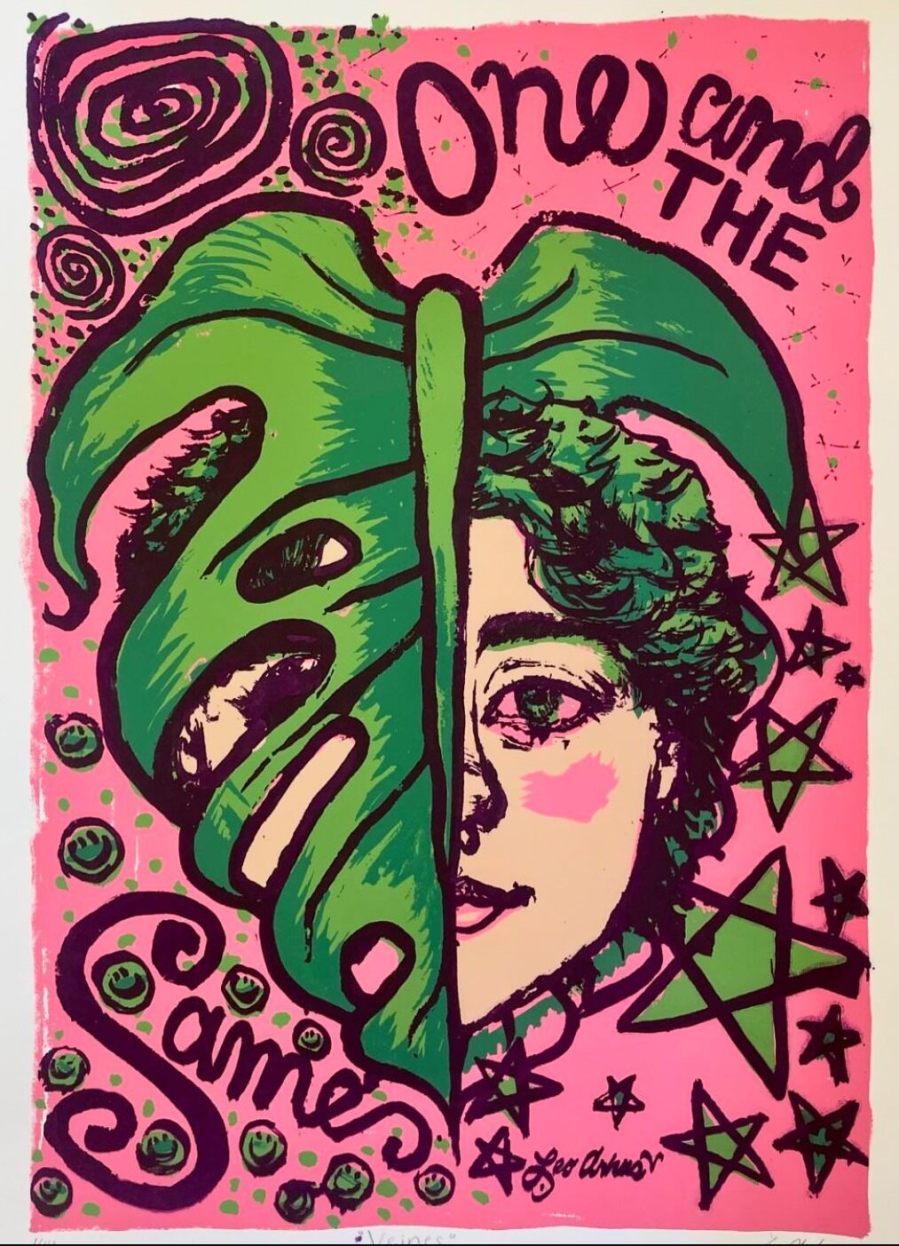
Featured Art: “Veines” by Leo Arkus

Read “Hymenoptera” here!

Read “Irish Traveler’s Writers Block”

Interview conducted by Rachel Townsend

Rachel Townsend: Thank you so much for doing this, Joanne!

Joanne Dominique Dwyer: Thank you for asking!

RT: Let’s get started! So, you grew up in Queens, New York, and you now live in New Mexico—that’s a dynamic change of scenery. I was wondering if you find that coming across in any of your writing. I read your poem “Snow” in Belle Laide, and there’s so much cold imagery—the man with a shovel, the beavers clawing at the ice—associations that you make that are so powerful. Can you recall that shift happening in your work? Or perhaps your favorite things about both places?

JDD: I was born in Rockaway Beach Hospital, Queens, NY, and lived there from birth to three years old three houses away from the Atlantic Ocean. I left at three years old. I don’t have concrete memories of that time of course, but the ocean is a very primal influence. Even after we moved up to Rockland County, about 30 miles north of New York City, where my childhood home had a forest behind it, and a horse farm about a mile away, the ocean remained a constant throughout my childhood along with the forest.

When I was eight or nine years old, my mother signed me out for riding lessons through a town recreation program. After those lessons expired, I worked at the horse farm as a child in exchange for lessons.  I was exposed not just to caring for animals 20 times my weight—cleaning stalls, feeding, brushing and catching ponies in the back field—but to many types of human beings, including the staff of grooms who were predominately ex-cons. It was a rich early childhood. My parents descended from Irish immigrants, their parents were working-class people in New York City. But my mother was adventurous and she decided she and my father would learn how to ski and before long they became volunteer ski patrollers—so my brothers and I skied as children. So I do think that snow, water, birds, horses, mountains, and trees appear in my work. I don’t think there was a shift, really, because I didn’t really start writing until I was in New Mexico.

Read More

Interview with Allegra Solomon: Author of “Seeing It Through” and Pushcart Nominee

Read the Story here!

Clare Hickey: I just want to start by telling you I love “Seeing It Through” so much. I think it actually did make me cry. I’ve read versions of this story before that maybe don’t have a happy ending and they don’t reconcile. It was really beautiful to see a story where that did happen and they really realized how much they loved each other. What inspired you to write a story like that?

Allegra Solomon: Well, thanks for saying that. I watched Eyes Wide Shut for the first time in 2022. After I watched it I got really interested in the idea of a couple that watched it and then somehow and inadvertently ended up having the same argument that Tom Cruise and Nicole Kidman have in the story. But, I didn’t really know how to do it or how I wanted to go about it or anything. So I sat on it for a little while and then in 2023, I watched all of Richard Linklater’s Before (Before Sunrise, Before Sunset, Before Midnight) movies. I was unemployed at the time so I was watching a lot of movies, and I watched them all back-to-back in one day. I think something about watching the evolution of that relationship as well as watching a very dialogue-heavy movie inspired me. I’d been wanting to write a dialogue-heavy story, but I didn’t know how to go about it and so something finally clicked. Right after I finished watching the third movie, I just opened my computer and started writing this story. 

Read More

Pyrotechnic Poetry: An Interview with Johnny Cate

Interview conducted by Cam Kurtz

Cam Kurtz: When was the first time that you were published as a poet?

Johnny Cate: Well, the first time I count was actually not that long ago. I believe it was like last year. It was kind of mid-summer last year. I had three picked up randomly before that, but I’d never read them to anybody, I would never perform them for anybody. It was a small press in Portland or something, but I don’t really count that. I think that was sort of like a fluke thing. So I count my official history of publication as beginning last summer basically. I think it was like last April that I got my first poem picked up.

I started to try [to get published] because I was coming to the end of my MFA, so I was like, okay, I’m going to start transitioning from the work of writing this book or this thesis, into the work of publishing. And that’s when I seriously started to find opportunities and push them out and really get going.

CK: What has it been like as your first year as a published poet?

Read More

Interview with Dustin H. Faulstick: Author “The Registry”

Read the Poem Here!

Parker Webb: So, tell me a little bit about “The Registry,” just like a little overview. Anything you’d like to share about it?

Dustin Faulstick: Yeah, I like talking about this prose poem because it has a kind of story behind it. You know, sometimes ideas just spring from our minds, but more often, they don’t. In this case, there was this interesting thing that happened.

It started with my partner’s sister. She was going to a wedding and looking at the registry and saw that one of the options was a kitchen organizer. She was like, “What even is that? I don’t know what that is.” The funny thing is, unbeknownst to her, her partner decided to buy it for the couple. That’s what he got them—the kitchen organizer.

She found it hilarious because she didn’t even know what it was, and her partner had already ordered it online. I haven’t looked it up myself, so maybe kitchen organizers are incredibly useful and indispensable kitchen tools. But in my mind, it just sounds like one of those Little Tikes toy playsets for toddlers with fake eggs, a tiny spatula, and so on.

I thought it was an interesting little story. My partner did, too, and we started bouncing ideas back and forth about how something like this could escalate. Not for them—they’re happy; I think they’re totally fine—but we took the idea in a different, more dramatic direction.

It was fun to use this story as a starting point and to collaborate with my partner, whose sister is the person the story came from. We imagined a scenario with two people—one who wants this thing and one who doesn’t. That’s sort of how the prose poem was born.

Read More

Interview with Arya Samuelson: Author of “I Am No Beekeeper,” notable in Best American Essays 2024

Read the essay here!

By Clare Hickey

Clare Hickey: Congratulations on your essay “I Am No Beekeeper.” It’s been out for a little while now, but it just won Notable in Best American Essays. Has your relationship to the story changed at all since writing it or publishing it?

Arya Samuelson: Yes, definitely! I just read the essay a few weeks ago as part of a performance piece, so it’s fascinating to kind of relive that story all over again – especially with the recent Best American Essays nod. One of the really beautiful things about having this story in the world has been hearing people’s responses. Many people have shared about their own abortion experiences, some of which shared deep parallels to mine and some of which were completely different, but all of which carried a similar kind of lingering potency, especially because we had been carrying these stories in secret.

Since publication, I’ve had the pleasure of being invited into many reading and collaboration spaces centered around subversive motherhood. It’s been so powerful to witness such a spectrum of experiences surrounding the complexities of motherhood and to deliberately bring abortion into that conversation.

Read More

Interview with Noah Pohl: Author of “SHASTA GIRL”

Read the story here!

Interview conducted by Shelbie Music

Shelbie Music: How did you get into writing? What did that journey look like for you?

Noah Pohl: So I started writing in middle school, it was kind of a creative outlet for me. I was always a big reader growing up and if I had an opportunity to use creativity in something, I would try to do that. I had some really encouraging teachers who helped kind of nurture that. It’s funny ’cause I originally was more into screenwriting than I was into fiction. And when I was growing up, I would buy published screenplays off Amazon and I would just read them and study them. And I later pivoted into fiction. It’s been a long journey, but I like the fact that I can kind of bounce between the two mediums.

Read More

A Kind of Terroir: Anna Farro Henderson’s Core Samples

By Jenna Brown

Amid a climate crisis—hurricane after hurricane in the Gulf Coast, flooding in the Sahara Desert, and bleaching coral reefs—Anna Farro Henderson’s Core Samples (University of Minnesota Press, 2024) attempts to redefine our interconnectedness with the Earth in its intimate writing style.

Published in late-2024, Core Samples follows Henderson’s experience as she balances motherhood, writing, work as a climate scientist, and her time as an environmental policy advisor to Minnesota Senator Al Franken and Governor Mark Dayton. Weaving together scientific findings, stories of misogyny in the science field, and anecdotes of foibles in governmental systems, Henderson creates a captivating memoir that screams at the top of its lungs, “carpe diem” (but also “fuck carpe diem”).

Henderson begins her narrative with a notebook, the “first tool” she obtained as a scientist. “While some people see art and science as opposites,” she writes, “for me, they are a braided river, each strand and flow an approach to wonder.” Climate change primarily has not been a main political concern, her writing implies, because of the inaccessibility of climate science literature (i.e. scholarly publications, journals, and studies). Through memoir, Henderson makes the climate crisis approachable, framing our interaction with the Earth’s systems as a relationship, an ongoing story.

Read More

Review: The Boy Who Reads in the Trees by Ron Mohring

By Kate Fox

In a 1967 interview with Time magazine, Elizabeth Bishop said of the Confessional Poets, who were her contemporaries, “You just wish they’d keep some of these things to themselves.” Having secrets of her own, she kept her own poems cool and distant, cerebral and succinct. What is interesting, though, is that she didn’t use the term “confessional” to describe these poets. Instead, she referred to the work of Sylvia Plath, Anne Sexton, W. D. Snodgrass, her close friend Robert Lowell, and others as the “School of Anguish.” After reading Ron Mohring’s The Boy Who Reads in the Trees (The Word Works, 2024), I would place these poems firmly in that category. 

“Confessional” implies that someone needs to confess—that they’ve done something wrong or shameful. Bishop seems to have sensed that the term was all wrong. These poets weren’t confessing things they’d done; they were in anguish about things that had been done to them: Bullying. Neglect. Homophobia. Physical, emotional, and sexual abuse—and the depression, alcoholism, addiction, suicidal thoughts, and other mental maladies that might naturally result from such treatment.  

Read More

Review of City Nave by Betsy Brown 

By Tessa Carman

A good guide welcomes her charges into a new building, book, or idea, and prepares them for encounter, perhaps struggle, and for unexpected delight. She pulls open doors previously locked, unveils portraits, and leads the group up balustrades, through vaults, and up turret stairs, peering into transoms, calling attention to cornices and corbels and rayonets. But she never gets in the way of the encounter; she arranges, interprets, but ultimately steps aside so that they can see for themselves. 

A good teacher is a guide, who has also been the seeker, the asker of questions, and remains so, even as she becomes someone who inspires others to see, to seek and question, and then to make their own songs, sculptures, portraits, craft. 

Betsy Brown is that kind of docent, and her debut poetry collection, City Nave (Resource Books, 2024), is structured like a cathedral, comprising four sections: “Stairs” leads us to the “Narthex,” a sort of waiting room before entering the sanctuary, the “Nave,” at the center, within which we find the “Altar.” 

I love showing Betsy Brown’s poems to my students. There’s a quality to the poetry that makes it an especial joy to share her with young people on the cusp of adulthood. Hers is a wise and winsome voice that has that golden quality of a good teacher. She respects the intelligence of her students, her audience. And she passes on the fruits of her own keen attention, inviting them in to see better—sometimes by asking them with her lively language to stand on their heads while they look.

Read More

Review of the atmosphere is not a perfume it is odorless by Matthew Cooperman

By Sarah Haman

Maximalist and sprawling, the atmosphere is not a perfume it is odorless (Free Verse Editions, 2024) by Matthew Cooperman captures feelings of familiar contemporary anxiety on the state of the world. Filled with nostalgia for objects of childhood and poetry from the 60s, Cooperman crafts prose that exudes confidence and love for country and culture. Most impressive are the many lyrical odes containing individual anxious obsessions on growing systemic issues including gun violence, ecological disaster, and other national issues that he consciously contrasts with the Whitman-inspired long-form songs celebrating humanity. 

In the first lengthy poem in the collection, “No Ode,” Cooperman develops a familiar three-section ode that includes an anxious speaker growing in confidence, and the poem ends in a song of the self, perhaps more accurately a song for humankind. In part one, the stanzas are more controlled and conversational, reminiscent of a 1970s Robert Pinsky that slowly unravel into a more lyrically fragmented, nearly surreal imagery a la Dean Young: “Come toward me now, my no generation, the image of less // from space // as we’re moving // away // | // So goes mercury into the fist, so plummet the man from a cliff.” The despair in the lyric moves playfully down the page as the anxiety of the speaker leads to fragmentation then to a lack of language. The first section of the ode ends with the speaker clarifying that “the impulse to deceive is a fear of perfusion, / my soluble membrane, your rage, / what’s missing in a poem.” 

Read More

Survival of the Unfit: A Retrospective

By Jodie Noel Vinson

Excursion to St. Fé—Thistle Beds—Habits of the Bizcacha—Little Owl—Saline Streams—Level Plain—Mastodon—St. Fé—Change in Landscape—Geology—Tooth of extinct Horse . . . Flocks of Butterflies—Aeronaut Spiders—Phosphorescence of the Sea—Port Desire—Guanaco—Port St. Julia—Geology of Patagonia—Fossil gigantic Animal . . . Causes of Extinction

(Charles Darwin, Voyage of the Beagle)

Tongue crimson in morning ulcerated—stomach constricted dragging—Feet coldish—Pulse 58 to 62—or slower and like thread. Appetite good—not thin. Evacuation regular and good. Urine scanty (because do not drink) often much pinkish sediment when cold—seldom headache or nausea.—Cannot walk abv ½ mile—always tired—conversation or excitement tires me much

(Charles Darwin, note to Dr. Chapman)

Charles Darwin had “taken the horizontal,” as he would have put it as a seasick young man on board the Beagle. He lay in bed, snowy beard cascading over the coverlet that shrouded his six-foot frame. Emma could see her husband was in so much pain he was “longing to die.” Their daughter Henrietta, hovering bedside, lamented how “this terrible nausea still goes on.” Darwin, before passing away on that April afternoon in 1882 at age seventy-three, answered with the equanimity of one who has lived in daily discomfort: “It is not terrible. But it is nausea.”

At this point, Darwin had been ill for over half his life. “I was almost quite broken down,” he described his chronic ailment in a journal, “head swimming, hands trembling and never a week without violent vomiting.” The naturalist took copious notes on his malady over the years, during which his stomach caused him “incessant discomfort, I may say misery,” as he once wrote to his cousin William Fox, predicting: “I shall go to my grave, I suppose, grumbling and growling with daily, almost hourly, discomfort.”

*

Read More

Welcome! Submissions for our annual NORward Prizes are now open.

Portions of NOR 37, our latest print issue, are available online below. The book is available for purchase here.

Happy to feature: An interview with New York Times bestselling author (and former contributor), Caro Claire Burke about her novel, Yesteryear.

New Ohio Review is a national literary journal produced by Ohio University’s Creative Writing Program. Now in its twentieth year, NOR has been the recipient of a National Endowment for the Arts grant and support from the Ohio Arts Council. Work from our pages consistently appears in the Best American series and the annual Pushcart anthology.

Issue 34 Now Available!

Issue 34 issue tackles themes ranging from grief to adoption to parenting to queer love, and it features the NORward Prize-winning poem “Reading Shackleton During My Husband’s Cancer Treatment” by Michele Bombardier.

In this issue, there is new poetry from Sara Baker, John Bargowski, Eben E. B. Bein, A. J. Bermudez, Megan Blankenship, Billy Collins, Robert Cording, Rob Cording, Steve Coughlin, Sara Fetherolf, Charlene Fix, George Franklin, Mary Jo Firth Gillett, Ockert Greef, August Green, Ted Kooser, Veronica Kornberg, Mark Kraushaar, Becca J. R. Lachman, Michael Mark, Maria Martin, Jen McClanaghan, Patricia Colleen Murphy, Meryl Natchez, David O’Connell, Dion O’Reilly, Lea Page, Seth Peterson, Michael Pontacoloni, Jessy Randall, Stephanie Staab, Alan Shapiro, Kenneth Tanemura, Chrys Tobey, Jaya Tripathi, and Rose Zinnia. 

Included in Issue 34 are essays written by Jess Richardson and Sunni Brown Wilkinson and stories by Adrienne Brock, V. F. Cordova, Shaun Haurin, Bruce McKay, Alan Sincic, Allegra Solomon, and Eliza Sullivan.

The Features in this issue include reviews of Carrie Oeding’s If I Could Give You a Line, Abigail Rose-Marie’s The Moonflowers, Jaswinder Bolina’s English as a Second Language, , E. M. Tran’s Daughters of the New Year, John Gallaher’s My Life in Brutalist Architecture, Katie Berta’s Retribution Forthcoming, and Zoë Bossiere’s Cactus Country from Claire Bateman, Apoorva Bradshaw-Mittal, Denise Duhamel, Gwen E. Kirby, Kevin Prufer, Erin Redfern, and Nicole Walker.

We hope you enjoy Issue 34, which you can order by visiting our online marketplace.

Thanks for reading,
-The Editors

We Were Talking About Words We Didn’t Like

By Jessy Randall

We were talking about words
we didn’t like. One of us
was making a list, and we all
wanted our words on it.

“Leverage” came up, and the
overuse of “awesome.”
(We were distracting ourselves
from the reason we were together—

or not distracting, exactly, but
giving ourselves a breather
from grieving and thinking about loss.
We were in town for a funeral.)

My turn came and I didn’t
want to say, didn’t want my mouth
to make the word, but I screwed up
my courage and said it: “meatball.”

The others laughed, not at my word, I think,
but at the face I made when I said it.
The conversation turned to social justice,
but “meatball” had been said aloud

and it imbued the rest of the visit,
for me, with ridiculousness, and maybe,
much as I hate “meatball”—my god—
with hope.


Read More

Just

By Charlene Fix

I don’t remember her name.
It was Adrienne.
She lived with her parents
in an apartment on Cedar,
the road that split school districts.
So when she threw a party,
she invited kids from both.
Feeling shy in her crowded
living room, I sat on Mark
Shore’s lap while he sat on
the lap of a comfy chair.
We laughed and laughed,
my giddiness netting me
two new boyfriends I didn’t
want or seek and whose interest
waned anyway as soon as they
found I was fun only when
perched on Mark Shore’s lap.
I loved abstractly then, all in
my head, divorced romantically
from anyone real. Mark and I
were just friends, with all of
just’s implications. So we remain,
though he passed away a while ago.
That night I felt protected on his lap
where I could gaze upon the social sea
secure, even when he worked
his arm up the back of my blouse,
until his hand emerged at my collar
waving to those in the room
and, in this ebb-time, to you.


Read More

Visiting the Natural History Museum with My 97-Year-Old Dad

By Michael Mark

In the photograph that my father has
             me take of him with the woolly mammoth,
he’s pointing to himself. He asks

to see the selfie. I don’t correct
             his terminology. Next, the triceratops, then
the sabertooth tiger. He takes the same stance

throughout the Extinction Exhibit. With the 4000-
             year-old beetle, 300-million-year-old coelacanth,
the dodo. She was beautiful,

he sighs at the butterfly, and I get the sense
             he’s thinking about Mom. Earlier, in his kitchen,
he posed with a jar of mayonnaise

with the expiration date from 1998, also pointing
             to himself. At the cemetery, he stands on his plot,
next to my mother, because I refuse to let him

lie down. Back at his apartment, he says it’s nice
             to have some company. I know
he’s referring to his defunct card game, so we go

down to the game room. He sits at their once
             regular table and points around the empty chairs,
Billy, Dick, Harold, Nat, Frank, hey Joe. He deals

them in. I take the picture of him squinting at the cards, fanned
             tight to his chest. He tosses a chip to the center
of the felt. In the shot, it really looks like

he’s waiting for someone to call his bet.


Read More

The Cost of Living

By Mark Kraushaar

With the thumb and first finger make an L.
L is for loser.
It’s a thing anymore.
Now think of 8th grade.
There was King of Detention Jimmy Ramish.
There was Too Tall Eunice Bugg, plus
Kitchen Tom plus Clyde Skopina
who’d said his father was an astronaut—
he was lying and Brenda
Kleefish let him know we knew it too.
Glide, she’d called him, meanly,
Glide away, she’d say and wave.
There was dummy Aldo Krull
and there was fatso Mitchell Beacham,
Beachball, he was called, of course.
And Annie Friebert?
Annie’s winter colds
were worst and left a criss-crossed
slug trail up her parka sleeve.
Achoo we’d say, achoo, achoo.
Hey Annie drop your hankie?
Ha, ha, ha, ha-choo.
She was a neighbor and our folks were friends.
But with Clyde Skopina came a certain desperation,
nothing anyone could name, leastwise not me—
it’s just I wish I’d looked out a little for him.
In the lunch line once, believing we
were friends, touching my arm,
and smiling hard to trick the facts,
he said, My dad can lift a car.


Read More

Magnets

By Mark Kraushaar

I’m watching the pinball
champ of Wisconsin: super flipper work,
perfect balance, both arms fully extended
excepting a slight bend at the elbows.
He’s playing Pop-A-Card, and Highway Patrol
and when he stops for a bite of his fries
I think, Yes, eating must be different for him
but I mostly mean different for the famous in general
and not only eating but reading, breathing, seeing, swimming, etc.,
because, and I’m guessing now, enhanced or diminished,
filtered, shaped or inflated, for there must be
something not the same.

I think, Immortality experienced from within
must be . . . must seem . . . must . . . or just . . . what is it exactly?
Plus he looks so totally focused
(which at the Barneveld Bowl-A-Drome
on league night with the TVs and the glitter
and glare, the clinking drinks and crashing pins
is no mean trick) but when his last ball bounces
off the lower left bumper and dives
straight down the gobble hole which is,
ask anyone, like a tiny dose of death
and he doesn’t get a bonus ball or free game
or even a match he looks just the way you or I might
suddenly look: sullen and shaken,
and then, pausing and perplexed he says,
he says because I’m watching and I hear
how softly his words reflect
a particular reticence,
Magnets man, magnets.


Read More

The Year Time Capsules Started Showing Up

By Seth Peterson

it happened fast. Suddenly, everyone had Rubik’s cubes
& Game Boys.

All day, their eyes & hands were busy, waving sepia Polaroids,
lining up kaleidoscopes.

They felt an easing in their hearts, a silence they couldn’t place.
At night, they noticed these things

could still glow, these new old things, humming in their own way.
Humming

the way a mother hums to her child. A wrecking ball revived these things.
A confederate statue

had its head hacked off at midnight. No one could find it, & for months
it stood there, headless,

haunting all their dreams, until everyone agreed to tear it down.
Beneath the concrete

horse hooves, the elaborate part of the monument, was a hollow-slotted base.
There were murmurs

as the steel crashed into it. They remembered the capsule at its heart.
They remembered

what it was to be a child again. They remembered piñatas & birthdays.
The clap of steel

on concrete sent out a splash of color. A Cabbage Patch Kid.
A Walkman.

A pair of hot pink leg warmers. Each one humming like a memory.
The point is,

these were things they wanted to remember. & it happened
everywhere,

all across the country, all at once. & their hearts were eased.
Some boys, soon after,

claimed to have found the statue’s head. It was covered by wintercreeper
in the woods, they claimed.

It was haphazardly spattered with peat moss. The rumor is,
it’s still there,

absorbing knives of moonlight. They say its mask is ghastly.
It is ghastly.

You think it’s gone, but things can change.


Read More

The World as It Is

By David O’Connell

Some believe the new math
proves reality is actually

a hologram. And who am I
to argue when I don’t know

the language? I speak pig math.
At times, finger count. Failed

this week to help my daughter
with her fractions. Don’t worry,

you’ll never use it in real life,
remember? But now it seems

this math has always been
presiding over smoke-filled

back rooms of the universe,
invisible mover and shaker

knowing what we want
are answers, and that we want

them now. Outside, the street
is darker for the light rain,

and I’ve cracked the window
to catch the scent of earth

kicked up by water falling
back to us. Nothing is lost,

explained the talking head
last night, asking that we picture

clapped erasers raising
clouds of dust. The math

he detailed says it’s possible
for every molecule of chalk

I smacked out in angry
plumes beside St. Mary’s

one afternoon in 1982
to reverse and gather again

upon the board—faint, then
clearly remaking each mistake

I’d scrawled that day in class.
Implausible, but not. An act

the nuns would’ve taught us
wasn’t math but miracle

on par with the angels
that appeared—like, what?

if not holograms—to trumpet
what they knew was right.


Read More

You Must Act as Though You’ll Live

By David O’Connell

You must act as though you’ll live,
though you will not live

and can imagine when you’re gone
the few stories that will be told

about your life, each a bright thread
that, in time, will fade

until all that’s said about your life
is genealogy, your name

or only your initials
beside those of the ones you love

and call by name
and struggle to understand.

It is for them that you must trust
when there is so little to win your trust

that it matters. Not just this rain
you feel falling

but knowing it’s fallen before
far from here under this same sun.


Read More

A House So Vast

By Adrienne Brock

Featured Art: “Autumn Window” by Scott Brooks (Passion Works Studio)

Before her father died, Amanda’s daughter used to crawl up onto the big bed and draw dramatic imaginative landscapes with her mother: tiny-shaped figures escaping from aliens using elaborately constructed slides or hot-air balloons. Immediately after the day of his funeral, they had tried to continue the tradition, but rather than adding onto each other’s fantastical scenarios, these two could only manage coloring bland shapes, inert and unanimated. Síomha had never been cuddly, not even as a baby, but in the middle of filling in a green rectangle with bright purple marker, the seven-year-old had pulled her mother’s arm around her and clung to it until her breathing slowed in sleep. Puffed breaths passed through the girl’s lips as if the child had summoned her father’s spirit to hold him in place on the Earth.

Before, Amanda had noted, warmly if resentfully, the uncanniness of her daughter’s unconscious impressions of her husband. She was ambivalent, taking a kind of painful joy in all of the ways in which Síomha literally embodied her father. But when they were out together, she felt the urge to scream to passersby, “I swear she’s my kid!” Or watching father and daughter play effortlessly, their humors and interests almost identical, Amanda felt as if she were watching her friend win a promotion for a job she’d wanted herself. On bad days, there had been a feeling that father and daughter were aligned against her. Now, it was immediately apparent that this feeling had been not only a result of her own stupid, stubborn inability to feel really at home, but it had also been a waste of time. A missed opportunity. Instead of vaguely threatening, these little ways in which Síomha resembled her father transmuted for a while into the only animate containers of his presence. His things remained in the house but were inert. His coffeemaker never needed to be cleaned anymore. A book was left on the bedside table, but the bookmark didn’t move, nor did the book travel around the house as it would have before, finding itself deposited in random locations on a sightseeing tour of their rooms, its owner calling out for the location of the lost tourist. At the side of their bed, her husband’s clothes hung suspended from wire hangers in the wardrobe. When someone walked quickly from room to room, the clothes would move slightly, and glancing in from the corridor, Amanda would have an illogical glimpse into what might have been: her husband had just taken something out of the wardrobe. He must be getting dressed. They were on their way somewhere together, and she would go so far as to open her mouth to speak, to ask what time it was, if he had rung the sitter. For weeks following the funeral, Tom’s phone would buzz with reminders about upcoming bills, and Amanda would feel the absence of a hand that might have reached for it, the absence of the sound of him upstairs, the absence when she returned home after work of smells from the kitchen from some experiment that would have become dinner.

Read More

The Cardinal

By Billy Collins

They say a child might grow up to be an artist
if his sandcastle means nothing
until he brings his mother over for a look.

I’m that way with my wife.
Little things that happen don’t mean much
until I report back from the front.

I ran into Rick from the gift shop.
The post office flag is at half-mast.
I counted the cars on a freight train.

Who else in the world would put up
with such froth before it dissolves in the surf?

But early this morning
while I was alone in the pool,
a Vatican-red cardinal flashed down
from the big magnolia
and landed on the deck
right next to where I was standing in the water.

Here was an event worth mentioning,
but I decided that I would keep this one to myself.
I alone would harbor and possess it.

Then I went back to watching the bird
pecking now at the edge of the garden
with the usual swivel-headed wariness of a bird.

I was an unobserved observer
of this private moment,
with only my head above the water,
at very close range for man and bird,
considering my large head and lack of feathers.

A sudden rustling in the magnolia
revealed the vigilant gray-and-pink female,
the mate with whom he shared his life,

but I wouldn’t share this with my wife,
not in the kitchen or in bed,
nor would I disclose it as she made toast
or worked the Sunday crossword.
Indeed, I would take the two cardinals to my grave.

It was just then that she appeared
in a billowing yellow nightgown
carrying two steaming cups of coffee,
and before she could hand one to me,
of course, I began to tell her all about the cardinals,

he pecking in the garden,
she flitting from branch to branch in the tree,
as if we were the male and female birds,
she with the coffee and me in the pool,

leaving me to make sure I divulged
every aspect of the experience,
including the foolish part
about my plan to keep it all a secret,
and that really dumb thing about the grave.


Read More

Oatmeal

By Billy Collins

Many of us poets have been asked
to go someplace, often somewhere
we have never been, nor would ever think
to go, to read our poems out loud.

Audiences gather in these places
to hear us read our poems out loud
and to see what we are wearing,
which is often part of the disappointment.

Someone said that professors get paid
to read, but poets get paid to read out loud.

Julian Barnes said: they don’t come
to hear you read your work.
They want to know what you had for breakfast.

I think it’s a little of both,
as in Galway Kinnell’s poem called “Oatmeal,”
which is both beautiful and informative
regarding what the poet likes for breakfast.

It’s about having breakfast with John Keats
and he must have read that poem out loud
many times and in many places
where he had never been before

because we have only a handful of good poems,
so we read the same ones time after time,
if only to please the crowd,

and the poems come and go,
repeating like the painted animals
on a carousel, only without the up-and-down music.

And the audiences watch them go by,
the oatmeal poem coming around again
and one about a man in a hammock,
and a poem with an uncle in a single-engine plane.

And here’s the white horse again
with the orange plume and the wooden teeth,
as all the decorative little mirrors make their rounds.


Read More

Keats

By Robert Cording

After my son died in October, I lived
with Keats’ Autumn in my head—
not the relish of lingering summer warmth
in mid-fall, but his one-line imperative:
Think not of the songs of spring.
I watched summer’s hummingbirds
fly off, then the gold of finches turn
dull green. But I couldn’t live with
the music of fall. I heard only those
first words—think not—which I did very well.
How much more Keats had demanded
of himself. And how many more falls I had
yet to undergo before I could hear,
just outside my door, hedge crickets sing.


Read More

Driveway Toad

By Rob Cording

A year after my brother died,
I told my daughter about
the toad that once lived
in the hollowed-out knot
of an apple tree
in the center of my childhood
driveway. My brothers and I
liked to visit it after school,
but the tree came down
in a snowstorm, and my parents
graveled-over that spot.
When my daughter
asked what happened
to the toad, I explained that
it probably moved
under a rock, or to the woodpile
along the side of the house. “Or,”
she responded, “it died.”
Then, she skipped into the house
and left me outside.


Read More

If I’m Honest

By Jaya Tripathi

this cheery fever feels
like a temporary insanity         I was safer
in the country of control         doling out small pleasures
to myself          like a wily jailer            like a loosie peddler
like a guppy’s sphincter           this morning
I washed tiny newborn bloomers          there were no fates
scuttling in the washing machine          no sheep livers
on the drying rack                     later in the shower when I felt her
moving like a bag of cats           between my hip bone
and my heart              I painted a cobweb of Silly String
around my fat belly   cupped my veiny breasts
and crowed     not long ago I grew my certainty
fresh every day like a liver       asked the doctors to look deep
at the pieces of my child sparkling in my blood
her stars            her tattoo      I hummed a boy scout
is always prepared        my daughter heard me
through my navel and laughed                lying
slathered in aspic I clutched at every skeletal preview
each glimpse of augury             fading too fast
a stick of incense on a dark stair           I always wanted
to be a mother but I thought I’d be
an armory          a phalanx        her stillsuit
in a gray shitty world                 instead
I see her hiccup on a monitor
and I break open into sunshine
completely


Read More

Evicted

By Mary Jo Firth Gillet

Before the suck and stutter of the first breath, even
before the first cells hook up for an amniotic float in
if not primordial bliss then something just this side of it,
there was the want, the desire that begat the pre-child
then stuck in a world impossible to remember, impossible
not to feel sorrow mixed with joy over my newborn’s
eviction from her Eden, her tenderest of faultless flesh
now to know the endless hunger, the deep cold of alone,
the body a riot of wants, wants unto the last gasp
of my mother’s four-foot-nine-inch fierce frame, every inch
railing railing against the bait-and-switch trickster’s scythe,
her only wish the hunger for more days, more life, and so
someone from hospice calls me to come get this inconvenient,
angry woman who will not go gentle into that good night.


Read More

Old Black Water

By Dion O’Reilly

Suzie, I want to tell you
how frequently I pass the apartment
behind the supermarket
where we street-danced
to the Doobie Brothers,

light shifting as the fog
lifted, front-yard roses
iridescent in the salt-gray
seaside morning.

You died, what, ten years ago?
Not at once, really, though pills
took you quickly. It began, I think,
when we were children: without
knowing why, we wanted out

of that rural beauty—the narrow
valley and gleaming stream,
summers spent diving off
crumbling cliffs, as if nearness
to death was the closest
we came to leaving

your stepdad’s beery fingers,
my Mother who loved
to touch the sweaty chests
of her daughters’ teenage lovers.

Nowadays, everything
is a different kind of dangerous:
rain stays away. June mist
sucks away too soon,
sunlight breaks through
before it should.

What I want to say, Suzie,
is a moment, gone
fifty years, is just a moment,
but you’re still here, unfleshed
in brightness—elfin, jittery, wan—

our arms looped as we turn
tight circles, round and round,
your eyes locked on mine.


Read More

Obituaries

By George Franklin

My mother used to say that only old people read them.
Now, I get an email about a classmate from high school,
Someone I might not have recognized over fifty years ago,
Much less today. I could call my friend Richard to ask,
Who was the guy who just died? And, Richard could tell me.
But the truth is that I don’t want to keep track of acquaintances
Beneath the ground—or above it. The cemetery in Shreveport
Was just down the block from a drive-thru liquor store that
Didn’t ask for IDs. The ability to turn the steering wheel and
Press the gas pedal was apparently good enough. On the same
Street, a fried chicken place sold onions pickled in jalapeños
And vinegar. They went down well with Jack Daniel’s
On summer weekends when we’d play penny-ante poker
In someone’s garage. Back then, almost none of us were dying.


Read More

Any Single Thing

By Meryl Natchez

A week past the twenty-ninth anniversary of your death
I read Seamus Heaney’s poem about the kite,
and my first thought is to show it to you.

So I stumble again
into the hole death leaves,
unfillable.

Another morning
of a day that promises
to be beautiful
without your presence
except for this faint ache
because you loved kites,
their unpredictable dialogue
with the wind
transmitted to your hand.

That hand gone
and gone again
each time
I reach for it.


Read More

Seeing It Through

By Allegra Solomon

The young couple was leaving the theater and walking to a nearby bar. Behind them, the marquee read: Eyes Wide Shut—One Night Only. They’d gone with some of their friends and co-workers from the library. It was an independent theater with only two show rooms, and the couple frequented it to the point of the cashiers and ushers knowing their names. On the theater’s Instagram, they noted that every Friday in February they would play a different romance film in the spirit of Valentine’s Day. The Friday before was a special triple feature of Richard Linklater’s Before Sunrise, Before Sunset, and Before Midnight. The Friday before that, Love & Basketball, and the Friday before that, In The Mood for Love. Why they chose to end on Eyes Wide Shut, the man couldn’t understand. He said this as he threw out the woman’s empty Sprite cup. She’d hardly noticed it left her hand.

It’s so funny, the woman said. Seeing them get all riled up like that. Cruise and Kidman. And they were married at the time. You think they ever argued like that?

God, no, the man said. Never. Either never, or all the time.

Read More

LinkedIn Said Your Dad Visited My Profile

By Chrys Tobey

Maybe he wanted to ask about our cats
and dog. Maybe he was curious about how many
colleges I now teach for, curious about my job prospects
as a poet in a pandemic. I didn’t send him a message—
didn’t tell him I saw you on the beach this summer
walking with your new partner, didn’t tell him how
you looked somewhat happy, how I felt excited for you—
I almost ran up to say hi, but I was in my bathing suit
and it was our anniversary, or what would have been
our anniversary, anyway. Maybe I should write
your dad, I’m okay. I don’t know if he would care that our
old man cat is dying, that I give him IV fluids, or that I finally fell
in love with someone, but she broke like the coffee
cup I once threw on the kitchen floor in front of you.
Perhaps he’d like to know that I had a biopsy in my vagina
and even though I felt like a plank of wood was on my chest
with someone standing on it while I waited for the results,
it came back fine. I could share how some days
I feel this sadness that can make it difficult
to bake a potato or how, once, I almost burned your ear
with a wax candle or how I still think about the time
you gave me a bag of socks with grips on the bottom
because I kept falling down our bedroom stairs.
You were so afraid I’d break my leg or hit my head
or worse, especially after I bruised my butt purple,
but love, I knew then what I’d tell your dad now—I’ll be all right.


Read More

The Morning I Turn Forty-Five, I Wake Up

By Chrys Tobey

with two new creases in my forehead. Deep creases.
The night before, my hair stylist tells me
she wants to get some lift because a man
once told her she would not have to worry
about lines. Just gravity. So I think about the
dermatologist who said Now you look so young after he
convinced me to treat some scars when I was twenty-four,
when I looked fourteen. I fall asleep reading a poem by a woman
who mourns her youth and another elegy nostalgic for beauty
someone fears she’s lost. My girlfriend hates her lines. Hates
her freckles. She asks me to dye the gray from her hair before
she confesses she got Botox before our first date. I eat dinner
with a friend in his early forties; as he sips some whiskey, I remind
him he’s attractive and he smirks, That ship has sailed.
Another friend is going through a divorce
and she’s afraid no one will want to date her.
Later, I google the poet who feels men don’t want
her anymore because she’s no longer young.
She’s gorgeous. During my birthday weekend,
I sheepishly share some photos from my twenties. I see a sad
young woman struggling to smile perfectly
for the disposable camera. If that’s the ship,
let it float away. I’ll blow it kisses while I walk
to the coffee shop. I’ll blow my beautiful friends kisses. I’ll
blow the lamenting poets kisses. And here is a kiss
for our poor brains. And this kiss is for my heart
when the barista smiles and says, It’s on me.


Read More

Alcobaça in Autumn

By Patricia Colleen Murphy

I’m one five-euro monastery away
from skipping our port tour on the Douro

to bury my head in a novel. It’s the point
of the trip where Do you need a tissue?

means Blow your goddamn nose!
and no one’s had a decent BM since PHL.

The weather is so 13th century. We’re
on vacation. Would it kill you to kiss me?

I think of the monks in the cloister
dusting the coat-of-arms.

If I’m going to make you fall in love again
should I start by telling you that I came from

a difficult family, that I once dated
an All-Star from the Cincinnati Reds?

By now we’re seventeen years in. I’ll wear
a dress and you’ll wear a tie. I’ll lie

close to you, even when you’re asleep,
because I love so much to soft-tickle your skin.

I think of the monks in the chapter house
still as baroque statues. The monks in the refectory

whose black robe-sleeves dip into their mushy salt cod.
They who spend night after night in rows.


Read More

Pockets

By Stephanie Staab

I hate you now, of course, but still there are times when I’m hungry
for a certain kind of calm.

Coffee didn’t keep you awake, gin didn’t get you drunk.
You were watertight against bodily concerns, especially love.

I’ll fall in love with the bank clerk if she sorts the bills in a pleasing way.
A bus driver, if he asks why I’m always on the 6:16.

I’m all hearts, no other organs. My heart purifies toxins from a glass of champagne.
My heart sheds its lining once a month. It searches strangers’ faces in a crowd.

So, if we meet again that way, in a throng
there’s something I’ve been wanting to ask you.

It’s yellow. It creeps.
I have a hair in my mouth when I try to say it.

I want to know what greeting you would choose for a chance
encounter on the street in a random city. What sign of peace.

I would stand ill-mannered while you decide
no tilt forward, no arm outstretched, no demure offering of a cheek.

A nod? A handshake? Perhaps you’d place a hand over your heart and bow.
This, the tenderest in the lexicon of human gestures.

What I really want to know is this:

What is in your pockets now?
Who cuts your hair?


Read More

The Hair Cutting

By Ockert Greef

The boy is sitting backward on a cheap plastic chair
His shoulders bowed under a faded orange towel

Behind him stands a shirtless man
His belly drooping over bright blue running shorts

They are on a roofless cement stoop
At the back of a small, dull house
With one window and one door
A large tree leans over them
Letting the sun through to draw yellow lines
Across the stoop, the boy and the man

In front of the boy on the cement is a radio
And behind it, a big engine on a rusty metal stand

The big-bellied man lays his index finger
On the crown of the boy’s head
Bending it forward and down

With a thick hand he moves a pair of clippers up
Against the back of the boy’s head
Hair falling on the faded orange towel

He moves the clippers slowly
Up and down
Flicking the clippers every now and then
To send small flocks of hair flying

Now he stops
Tilts his head
Stares past the boy in the direction of the radio

He stands just like that, frozen
Speckles of dust circling his index finger
On the boy’s bowed head
A lost piece of hair drifting down

The boy’s eyes are closed
His face so relaxed, he could be sleeping

And behind him, the big-bellied man’s eyes close
Just for a moment
And then open.


Read More

A word

By Eben E. B. Bein

for 天野 

I am sitting on a lozenge-shaped couch
in the waiting area of a Cartier,
wrinkling my nose at the etched perfume
and the fake-looking straight couple
on the #CartierStoriesByYou poster,
sending you snaps of the Panthère collection
with hammy voiceovers and there is no reason I,
who have never and will never again enter a Cartier,
should be so completely myself except I know
you will say yes.
                             And being so sure makes me
nervous since you bought the band yourself
years ago, convinced you would never meet someone,
and just this morning handed it to me:
Engrave something. Nine characters or less.
Surprise me
. And to make matters worse, I,
who have vacillated for decades on a word,
knew instantly what it would be.

Yes. You’ve got me
so diamond clear, so fit to burst, so chest
full of yes compressions that when the sales associate
messes up your pronouns a third time
I just give a watery thanks and duck out

onto the street where actual people are,
and two of them, maybe a couple,
are laughing, like, with their actual bellies
at what must have been a stupid joke
and I didn’t hear a word of it but
now I’m laughing as well as crying,
so completely at yes with myself,
walking home so fast I’m almost running
because I can’t wait to tell you about it.


Read More

Refuge

By Lea Page

Featured art: “Jungle Gathering” by Fred Cremeans, Tiffany Grubb, and Wendy Minor Viny (Passion Works Studio)

No such thing
as an unseasonable storm
here on the high plains,
but winds were horrific,
temperatures plummeting.
A rescue call went out—
migrating waterfowl,
sheltering on a local pond,
were trapped in ice—
not literally frozen in place
but without enough open water,
they couldn’t take off.
People flocked to the rescue,
chopped open a path,
then leaned on their axes and mauls
to watch the birds go.
That shrinking window,
our collective responsibility,
but for this one moment,
let us be heroes.


Read More