Interview with Jodie Noel Vinson: Author of “Survival of the Unfit: A Retrospective”

By Clare Hickey

Read the essay here!

Clare Hickey: What was the moment you knew that Charles Darwin needed to be a part of this story? Were you familiar with him at all before?

Jodie Noel Vinson: Yeah, I love that you ask about the origins of this essay ’cause. I feel like it really became an exploration of origins. The essay really started with me in the early pandemic. Looking at, you know, this protester who was holding their sign sacrifice the week and kind of realizing I was one of the weak, maybe that they wanted to do away with and thinking, OK How did we get here? You know, and then kind of looking backwards and reflecting and Darwin’s story came into that. To kind of help me explore that question in my own life.

I really knew very little about Darwin’s life when I started the essay. He had been just this kind of iconic, almost stereotypical, even cartoonish, figure in my mind. And one thing I’ve learned in writing and researching, looking at the lives of of folks through the lens of illness, is that it kind of opens up kind of their humaneness and their vulnerabilities. It was really rewarding to learn about him in a more nuanced way. I think it was just really learning about the fact that someone who had studied and talked about and thought about survival of the fittest might himself be unfit. That kind of was the spark for the essay.

Read More

An Interview with Joanne Dominique Dwyer: Author of “Hymenoptera” and “Irish Traveler’s Writers Block”

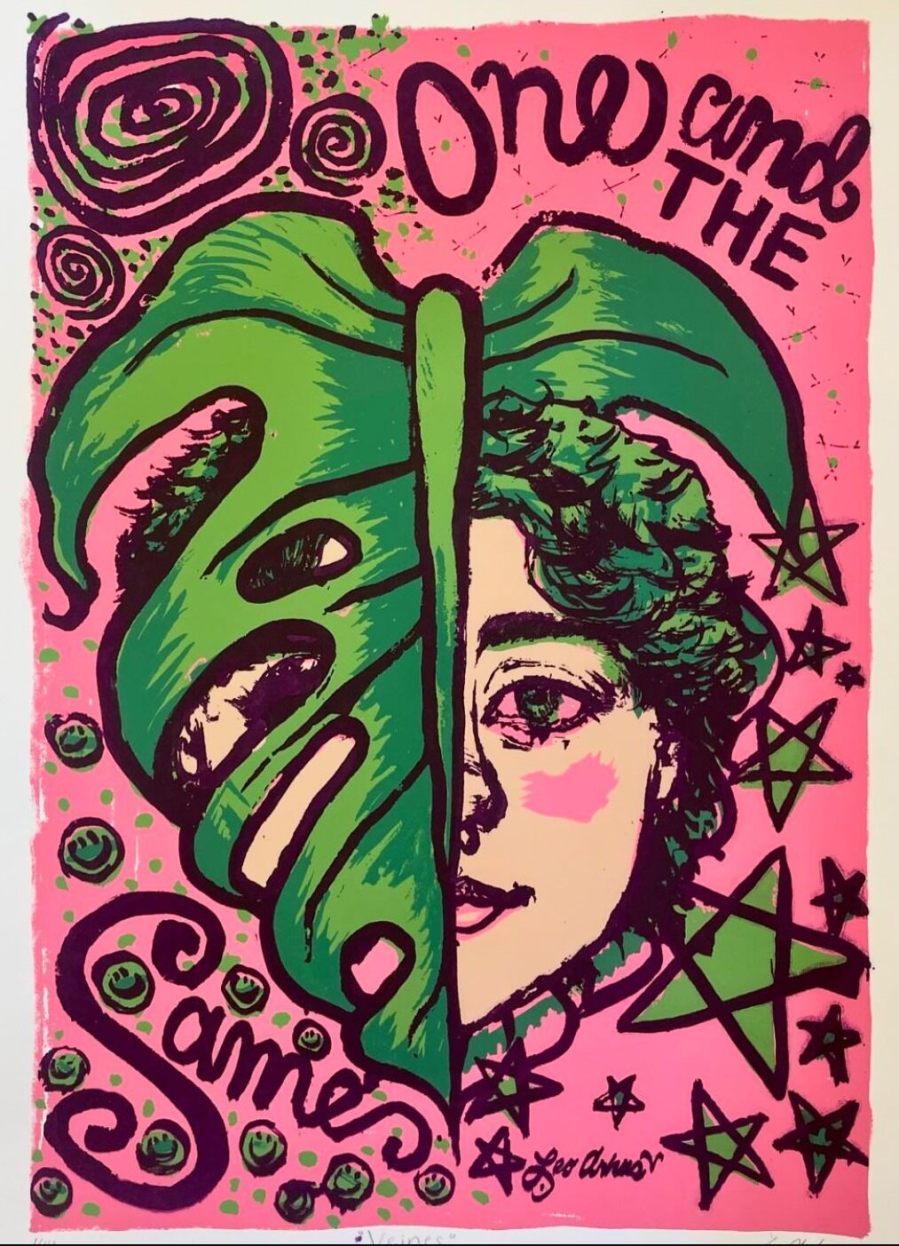
Featured Art: “Veines” by Leo Arkus

Read “Hymenoptera” here!

Read “Irish Traveler’s Writers Block”

Interview conducted by Rachel Townsend

Rachel Townsend: Thank you so much for doing this, Joanne!

Joanne Dominique Dwyer: Thank you for asking!

RT: Let’s get started! So, you grew up in Queens, New York, and you now live in New Mexico—that’s a dynamic change of scenery. I was wondering if you find that coming across in any of your writing. I read your poem “Snow” in Belle Laide, and there’s so much cold imagery—the man with a shovel, the beavers clawing at the ice—associations that you make that are so powerful. Can you recall that shift happening in your work? Or perhaps your favorite things about both places?

JDD: I was born in Rockaway Beach Hospital, Queens, NY, and lived there from birth to three years old three houses away from the Atlantic Ocean. I left at three years old. I don’t have concrete memories of that time of course, but the ocean is a very primal influence. Even after we moved up to Rockland County, about 30 miles north of New York City, where my childhood home had a forest behind it, and a horse farm about a mile away, the ocean remained a constant throughout my childhood along with the forest.

When I was eight or nine years old, my mother signed me out for riding lessons through a town recreation program. After those lessons expired, I worked at the horse farm as a child in exchange for lessons.  I was exposed not just to caring for animals 20 times my weight—cleaning stalls, feeding, brushing and catching ponies in the back field—but to many types of human beings, including the staff of grooms who were predominately ex-cons. It was a rich early childhood. My parents descended from Irish immigrants, their parents were working-class people in New York City. But my mother was adventurous and she decided she and my father would learn how to ski and before long they became volunteer ski patrollers—so my brothers and I skied as children. So I do think that snow, water, birds, horses, mountains, and trees appear in my work. I don’t think there was a shift, really, because I didn’t really start writing until I was in New Mexico.

Read More

Interview with Allegra Solomon: Author of “Seeing It Through” and Pushcart Nominee

Read the Story here!

Clare Hickey: I just want to start by telling you I love “Seeing It Through” so much. I think it actually did make me cry. I’ve read versions of this story before that maybe don’t have a happy ending and they don’t reconcile. It was really beautiful to see a story where that did happen and they really realized how much they loved each other. What inspired you to write a story like that?

Allegra Solomon: Well, thanks for saying that. I watched Eyes Wide Shut for the first time in 2022. After I watched it I got really interested in the idea of a couple that watched it and then somehow and inadvertently ended up having the same argument that Tom Cruise and Nicole Kidman have in the story. But, I didn’t really know how to do it or how I wanted to go about it or anything. So I sat on it for a little while and then in 2023, I watched all of Richard Linklater’s Before (Before Sunrise, Before Sunset, Before Midnight) movies. I was unemployed at the time so I was watching a lot of movies, and I watched them all back-to-back in one day. I think something about watching the evolution of that relationship as well as watching a very dialogue-heavy movie inspired me. I’d been wanting to write a dialogue-heavy story, but I didn’t know how to go about it and so something finally clicked. Right after I finished watching the third movie, I just opened my computer and started writing this story. 

Read More

Pyrotechnic Poetry: An Interview with Johnny Cate

Interview conducted by Cam Kurtz

Cam Kurtz: When was the first time that you were published as a poet?

Johnny Cate: Well, the first time I count was actually not that long ago. I believe it was like last year. It was kind of mid-summer last year. I had three picked up randomly before that, but I’d never read them to anybody, I would never perform them for anybody. It was a small press in Portland or something, but I don’t really count that. I think that was sort of like a fluke thing. So I count my official history of publication as beginning last summer basically. I think it was like last April that I got my first poem picked up.

I started to try [to get published] because I was coming to the end of my MFA, so I was like, okay, I’m going to start transitioning from the work of writing this book or this thesis, into the work of publishing. And that’s when I seriously started to find opportunities and push them out and really get going.

CK: What has it been like as your first year as a published poet?

Read More

Interview with Dustin H. Faulstick: Author “The Registry”

Read the Poem Here!

Parker Webb: So, tell me a little bit about “The Registry,” just like a little overview. Anything you’d like to share about it?

Dustin Faulstick: Yeah, I like talking about this prose poem because it has a kind of story behind it. You know, sometimes ideas just spring from our minds, but more often, they don’t. In this case, there was this interesting thing that happened.

It started with my partner’s sister. She was going to a wedding and looking at the registry and saw that one of the options was a kitchen organizer. She was like, “What even is that? I don’t know what that is.” The funny thing is, unbeknownst to her, her partner decided to buy it for the couple. That’s what he got them—the kitchen organizer.

She found it hilarious because she didn’t even know what it was, and her partner had already ordered it online. I haven’t looked it up myself, so maybe kitchen organizers are incredibly useful and indispensable kitchen tools. But in my mind, it just sounds like one of those Little Tikes toy playsets for toddlers with fake eggs, a tiny spatula, and so on.

I thought it was an interesting little story. My partner did, too, and we started bouncing ideas back and forth about how something like this could escalate. Not for them—they’re happy; I think they’re totally fine—but we took the idea in a different, more dramatic direction.

It was fun to use this story as a starting point and to collaborate with my partner, whose sister is the person the story came from. We imagined a scenario with two people—one who wants this thing and one who doesn’t. That’s sort of how the prose poem was born.

Read More

Interview with Arya Samuelson: Author of “I Am No Beekeeper,” notable in Best American Essays 2024

Read the essay here!

By Clare Hickey

Clare Hickey: Congratulations on your essay “I Am No Beekeeper.” It’s been out for a little while now, but it just won Notable in Best American Essays. Has your relationship to the story changed at all since writing it or publishing it?

Arya Samuelson: Yes, definitely! I just read the essay a few weeks ago as part of a performance piece, so it’s fascinating to kind of relive that story all over again – especially with the recent Best American Essays nod. One of the really beautiful things about having this story in the world has been hearing people’s responses. Many people have shared about their own abortion experiences, some of which shared deep parallels to mine and some of which were completely different, but all of which carried a similar kind of lingering potency, especially because we had been carrying these stories in secret.

Since publication, I’ve had the pleasure of being invited into many reading and collaboration spaces centered around subversive motherhood. It’s been so powerful to witness such a spectrum of experiences surrounding the complexities of motherhood and to deliberately bring abortion into that conversation.

Read More

Interview with Noah Pohl: Author of “SHASTA GIRL”

Read the story here!

Interview conducted by Shelbie Music

Shelbie Music: How did you get into writing? What did that journey look like for you?

Noah Pohl: So I started writing in middle school, it was kind of a creative outlet for me. I was always a big reader growing up and if I had an opportunity to use creativity in something, I would try to do that. I had some really encouraging teachers who helped kind of nurture that. It’s funny ’cause I originally was more into screenwriting than I was into fiction. And when I was growing up, I would buy published screenplays off Amazon and I would just read them and study them. And I later pivoted into fiction. It’s been a long journey, but I like the fact that I can kind of bounce between the two mediums.

Read More

A Kind of Terroir: Anna Farro Henderson’s Core Samples

By Jenna Brown

Amid a climate crisis—hurricane after hurricane in the Gulf Coast, flooding in the Sahara Desert, and bleaching coral reefs—Anna Farro Henderson’s Core Samples (University of Minnesota Press, 2024) attempts to redefine our interconnectedness with the Earth in its intimate writing style.

Published in late-2024, Core Samples follows Henderson’s experience as she balances motherhood, writing, work as a climate scientist, and her time as an environmental policy advisor to Minnesota Senator Al Franken and Governor Mark Dayton. Weaving together scientific findings, stories of misogyny in the science field, and anecdotes of foibles in governmental systems, Henderson creates a captivating memoir that screams at the top of its lungs, “carpe diem” (but also “fuck carpe diem”).

Henderson begins her narrative with a notebook, the “first tool” she obtained as a scientist. “While some people see art and science as opposites,” she writes, “for me, they are a braided river, each strand and flow an approach to wonder.” Climate change primarily has not been a main political concern, her writing implies, because of the inaccessibility of climate science literature (i.e. scholarly publications, journals, and studies). Through memoir, Henderson makes the climate crisis approachable, framing our interaction with the Earth’s systems as a relationship, an ongoing story.

Read More

Review: The Boy Who Reads in the Trees by Ron Mohring

By Kate Fox

In a 1967 interview with Time magazine, Elizabeth Bishop said of the Confessional Poets, who were her contemporaries, “You just wish they’d keep some of these things to themselves.” Having secrets of her own, she kept her own poems cool and distant, cerebral and succinct. What is interesting, though, is that she didn’t use the term “confessional” to describe these poets. Instead, she referred to the work of Sylvia Plath, Anne Sexton, W. D. Snodgrass, her close friend Robert Lowell, and others as the “School of Anguish.” After reading Ron Mohring’s The Boy Who Reads in the Trees (The Word Works, 2024), I would place these poems firmly in that category. 

“Confessional” implies that someone needs to confess—that they’ve done something wrong or shameful. Bishop seems to have sensed that the term was all wrong. These poets weren’t confessing things they’d done; they were in anguish about things that had been done to them: Bullying. Neglect. Homophobia. Physical, emotional, and sexual abuse—and the depression, alcoholism, addiction, suicidal thoughts, and other mental maladies that might naturally result from such treatment.  

Read More

Review of City Nave by Betsy Brown 

By Tessa Carman

A good guide welcomes her charges into a new building, book, or idea, and prepares them for encounter, perhaps struggle, and for unexpected delight. She pulls open doors previously locked, unveils portraits, and leads the group up balustrades, through vaults, and up turret stairs, peering into transoms, calling attention to cornices and corbels and rayonets. But she never gets in the way of the encounter; she arranges, interprets, but ultimately steps aside so that they can see for themselves. 

A good teacher is a guide, who has also been the seeker, the asker of questions, and remains so, even as she becomes someone who inspires others to see, to seek and question, and then to make their own songs, sculptures, portraits, craft. 

Betsy Brown is that kind of docent, and her debut poetry collection, City Nave (Resource Books, 2024), is structured like a cathedral, comprising four sections: “Stairs” leads us to the “Narthex,” a sort of waiting room before entering the sanctuary, the “Nave,” at the center, within which we find the “Altar.” 

I love showing Betsy Brown’s poems to my students. There’s a quality to the poetry that makes it an especial joy to share her with young people on the cusp of adulthood. Hers is a wise and winsome voice that has that golden quality of a good teacher. She respects the intelligence of her students, her audience. And she passes on the fruits of her own keen attention, inviting them in to see better—sometimes by asking them with her lively language to stand on their heads while they look.

Read More

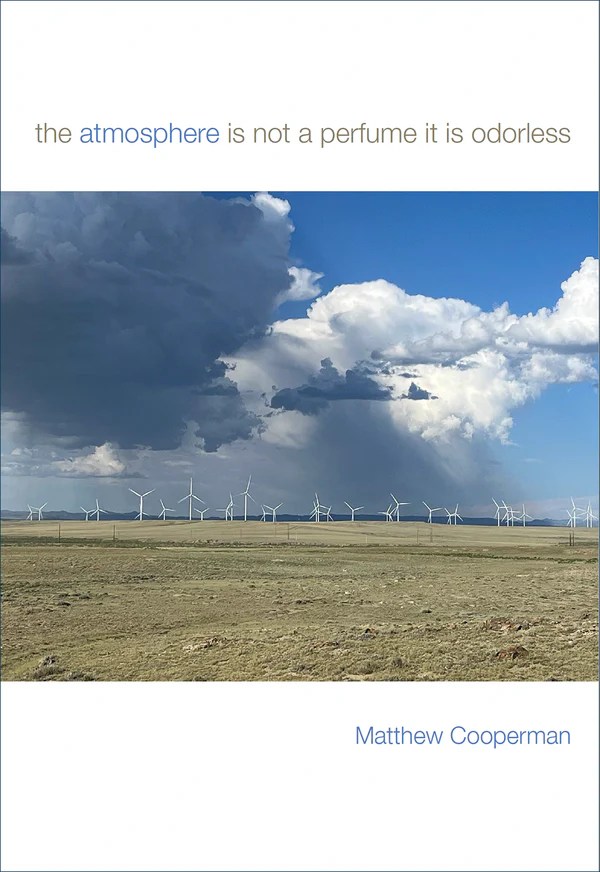
Review of the atmosphere is not a perfume it is odorless by Matthew Cooperman

By Sarah Haman

Maximalist and sprawling, the atmosphere is not a perfume it is odorless (Free Verse Editions, 2024) by Matthew Cooperman captures feelings of familiar contemporary anxiety on the state of the world. Filled with nostalgia for objects of childhood and poetry from the 60s, Cooperman crafts prose that exudes confidence and love for country and culture. Most impressive are the many lyrical odes containing individual anxious obsessions on growing systemic issues including gun violence, ecological disaster, and other national issues that he consciously contrasts with the Whitman-inspired long-form songs celebrating humanity. 

In the first lengthy poem in the collection, “No Ode,” Cooperman develops a familiar three-section ode that includes an anxious speaker growing in confidence, and the poem ends in a song of the self, perhaps more accurately a song for humankind. In part one, the stanzas are more controlled and conversational, reminiscent of a 1970s Robert Pinsky that slowly unravel into a more lyrically fragmented, nearly surreal imagery a la Dean Young: “Come toward me now, my no generation, the image of less // from space // as we’re moving // away // | // So goes mercury into the fist, so plummet the man from a cliff.” The despair in the lyric moves playfully down the page as the anxiety of the speaker leads to fragmentation then to a lack of language. The first section of the ode ends with the speaker clarifying that “the impulse to deceive is a fear of perfusion, / my soluble membrane, your rage, / what’s missing in a poem.” 

Read More

Survival of the Unfit: A Retrospective

By Jodie Noel Vinson

Excursion to St. Fé—Thistle Beds—Habits of the Bizcacha—Little Owl—Saline Streams—Level Plain—Mastodon—St. Fé—Change in Landscape—Geology—Tooth of extinct Horse . . . Flocks of Butterflies—Aeronaut Spiders—Phosphorescence of the Sea—Port Desire—Guanaco—Port St. Julia—Geology of Patagonia—Fossil gigantic Animal . . . Causes of Extinction

(Charles Darwin, Voyage of the Beagle)

Tongue crimson in morning ulcerated—stomach constricted dragging—Feet coldish—Pulse 58 to 62—or slower and like thread. Appetite good—not thin. Evacuation regular and good. Urine scanty (because do not drink) often much pinkish sediment when cold—seldom headache or nausea.—Cannot walk abv ½ mile—always tired—conversation or excitement tires me much

(Charles Darwin, note to Dr. Chapman)

Charles Darwin had “taken the horizontal,” as he would have put it as a seasick young man on board the Beagle. He lay in bed, snowy beard cascading over the coverlet that shrouded his six-foot frame. Emma could see her husband was in so much pain he was “longing to die.” Their daughter Henrietta, hovering bedside, lamented how “this terrible nausea still goes on.” Darwin, before passing away on that April afternoon in 1882 at age seventy-three, answered with the equanimity of one who has lived in daily discomfort: “It is not terrible. But it is nausea.”

At this point, Darwin had been ill for over half his life. “I was almost quite broken down,” he described his chronic ailment in a journal, “head swimming, hands trembling and never a week without violent vomiting.” The naturalist took copious notes on his malady over the years, during which his stomach caused him “incessant discomfort, I may say misery,” as he once wrote to his cousin William Fox, predicting: “I shall go to my grave, I suppose, grumbling and growling with daily, almost hourly, discomfort.”

*

Read More

Our December online edition is out now. Please scroll down to read!

New Ohio Review is a national literary journal produced by Ohio University’s Creative Writing Program. Now in its nineteenth year, NOR has been the recipient of a National Endowment for the Arts grant and support from the Ohio Arts Council. Work from our pages consistently appears in the Best American series and the annual Pushcart anthology.

Our print issues appear in the fall and spring, and issue 36 was released in November. It is available for purchase now. Portions of our last issue (35) can be read online here. We also feature online editions in June and December.

Issue 34 Now Available!

Issue 34 issue tackles themes ranging from grief to adoption to parenting to queer love, and it features the NORward Prize-winning poem “Reading Shackleton During My Husband’s Cancer Treatment” by Michele Bombardier.

In this issue, there is new poetry from Sara Baker, John Bargowski, Eben E. B. Bein, A. J. Bermudez, Megan Blankenship, Billy Collins, Robert Cording, Rob Cording, Steve Coughlin, Sara Fetherolf, Charlene Fix, George Franklin, Mary Jo Firth Gillett, Ockert Greef, August Green, Ted Kooser, Veronica Kornberg, Mark Kraushaar, Becca J. R. Lachman, Michael Mark, Maria Martin, Jen McClanaghan, Patricia Colleen Murphy, Meryl Natchez, David O’Connell, Dion O’Reilly, Lea Page, Seth Peterson, Michael Pontacoloni, Jessy Randall, Stephanie Staab, Alan Shapiro, Kenneth Tanemura, Chrys Tobey, Jaya Tripathi, and Rose Zinnia. 

Included in Issue 34 are essays written by Jess Richardson and Sunni Brown Wilkinson and stories by Adrienne Brock, V. F. Cordova, Shaun Haurin, Bruce McKay, Alan Sincic, Allegra Solomon, and Eliza Sullivan.

The Features in this issue include reviews of Carrie Oeding’s If I Could Give You a Line, Abigail Rose-Marie’s The Moonflowers, Jaswinder Bolina’s English as a Second Language, , E. M. Tran’s Daughters of the New Year, John Gallaher’s My Life in Brutalist Architecture, Katie Berta’s Retribution Forthcoming, and Zoë Bossiere’s Cactus Country from Claire Bateman, Apoorva Bradshaw-Mittal, Denise Duhamel, Gwen E. Kirby, Kevin Prufer, Erin Redfern, and Nicole Walker.

We hope you enjoy Issue 34, which you can order by visiting our online marketplace.

Thanks for reading,
-The Editors

We Were Talking About Words We Didn’t Like

By Jessy Randall

We were talking about words
we didn’t like. One of us
was making a list, and we all
wanted our words on it.

“Leverage” came up, and the
overuse of “awesome.”
(We were distracting ourselves
from the reason we were together—

or not distracting, exactly, but
giving ourselves a breather
from grieving and thinking about loss.
We were in town for a funeral.)

My turn came and I didn’t
want to say, didn’t want my mouth
to make the word, but I screwed up
my courage and said it: “meatball.”

The others laughed, not at my word, I think,
but at the face I made when I said it.
The conversation turned to social justice,
but “meatball” had been said aloud

and it imbued the rest of the visit,
for me, with ridiculousness, and maybe,
much as I hate “meatball”—my god—
with hope.


Read More

Just

By Charlene Fix

I don’t remember her name.
It was Adrienne.
She lived with her parents
in an apartment on Cedar,
the road that split school districts.
So when she threw a party,
she invited kids from both.
Feeling shy in her crowded
living room, I sat on Mark
Shore’s lap while he sat on
the lap of a comfy chair.
We laughed and laughed,
my giddiness netting me
two new boyfriends I didn’t
want or seek and whose interest
waned anyway as soon as they
found I was fun only when
perched on Mark Shore’s lap.
I loved abstractly then, all in
my head, divorced romantically
from anyone real. Mark and I
were just friends, with all of
just’s implications. So we remain,
though he passed away a while ago.
That night I felt protected on his lap
where I could gaze upon the social sea
secure, even when he worked
his arm up the back of my blouse,
until his hand emerged at my collar
waving to those in the room
and, in this ebb-time, to you.


Read More

Visiting the Natural History Museum with My 97-Year-Old Dad

By Michael Mark

In the photograph that my father has
             me take of him with the woolly mammoth,
he’s pointing to himself. He asks

to see the selfie. I don’t correct
             his terminology. Next, the triceratops, then
the sabertooth tiger. He takes the same stance

throughout the Extinction Exhibit. With the 4000-
             year-old beetle, 300-million-year-old coelacanth,
the dodo. She was beautiful,

he sighs at the butterfly, and I get the sense
             he’s thinking about Mom. Earlier, in his kitchen,
he posed with a jar of mayonnaise

with the expiration date from 1998, also pointing
             to himself. At the cemetery, he stands on his plot,
next to my mother, because I refuse to let him

lie down. Back at his apartment, he says it’s nice
             to have some company. I know
he’s referring to his defunct card game, so we go

down to the game room. He sits at their once
             regular table and points around the empty chairs,
Billy, Dick, Harold, Nat, Frank, hey Joe. He deals

them in. I take the picture of him squinting at the cards, fanned
             tight to his chest. He tosses a chip to the center
of the felt. In the shot, it really looks like

he’s waiting for someone to call his bet.


Read More

The Cost of Living

By Mark Kraushaar

With the thumb and first finger make an L.
L is for loser.
It’s a thing anymore.
Now think of 8th grade.
There was King of Detention Jimmy Ramish.
There was Too Tall Eunice Bugg, plus
Kitchen Tom plus Clyde Skopina
who’d said his father was an astronaut—
he was lying and Brenda
Kleefish let him know we knew it too.
Glide, she’d called him, meanly,
Glide away, she’d say and wave.
There was dummy Aldo Krull
and there was fatso Mitchell Beacham,
Beachball, he was called, of course.
And Annie Friebert?
Annie’s winter colds
were worst and left a criss-crossed
slug trail up her parka sleeve.
Achoo we’d say, achoo, achoo.
Hey Annie drop your hankie?
Ha, ha, ha, ha-choo.
She was a neighbor and our folks were friends.
But with Clyde Skopina came a certain desperation,
nothing anyone could name, leastwise not me—
it’s just I wish I’d looked out a little for him.
In the lunch line once, believing we
were friends, touching my arm,
and smiling hard to trick the facts,
he said, My dad can lift a car.


Read More

Magnets

By Mark Kraushaar

I’m watching the pinball
champ of Wisconsin: super flipper work,
perfect balance, both arms fully extended
excepting a slight bend at the elbows.
He’s playing Pop-A-Card, and Highway Patrol
and when he stops for a bite of his fries
I think, Yes, eating must be different for him
but I mostly mean different for the famous in general
and not only eating but reading, breathing, seeing, swimming, etc.,
because, and I’m guessing now, enhanced or diminished,
filtered, shaped or inflated, for there must be
something not the same.

I think, Immortality experienced from within
must be . . . must seem . . . must . . . or just . . . what is it exactly?
Plus he looks so totally focused
(which at the Barneveld Bowl-A-Drome
on league night with the TVs and the glitter
and glare, the clinking drinks and crashing pins
is no mean trick) but when his last ball bounces
off the lower left bumper and dives
straight down the gobble hole which is,
ask anyone, like a tiny dose of death
and he doesn’t get a bonus ball or free game
or even a match he looks just the way you or I might
suddenly look: sullen and shaken,
and then, pausing and perplexed he says,
he says because I’m watching and I hear
how softly his words reflect
a particular reticence,
Magnets man, magnets.


Read More

The Year Time Capsules Started Showing Up

By Seth Peterson

it happened fast. Suddenly, everyone had Rubik’s cubes
& Game Boys.

All day, their eyes & hands were busy, waving sepia Polaroids,
lining up kaleidoscopes.

They felt an easing in their hearts, a silence they couldn’t place.
At night, they noticed these things

could still glow, these new old things, humming in their own way.
Humming

the way a mother hums to her child. A wrecking ball revived these things.
A confederate statue

had its head hacked off at midnight. No one could find it, & for months
it stood there, headless,

haunting all their dreams, until everyone agreed to tear it down.
Beneath the concrete

horse hooves, the elaborate part of the monument, was a hollow-slotted base.
There were murmurs

as the steel crashed into it. They remembered the capsule at its heart.
They remembered

what it was to be a child again. They remembered piñatas & birthdays.
The clap of steel

on concrete sent out a splash of color. A Cabbage Patch Kid.
A Walkman.

A pair of hot pink leg warmers. Each one humming like a memory.
The point is,

these were things they wanted to remember. & it happened
everywhere,

all across the country, all at once. & their hearts were eased.
Some boys, soon after,

claimed to have found the statue’s head. It was covered by wintercreeper
in the woods, they claimed.

It was haphazardly spattered with peat moss. The rumor is,
it’s still there,

absorbing knives of moonlight. They say its mask is ghastly.
It is ghastly.

You think it’s gone, but things can change.


Read More

The World as It Is

By David O’Connell

Some believe the new math
proves reality is actually

a hologram. And who am I
to argue when I don’t know

the language? I speak pig math.
At times, finger count. Failed

this week to help my daughter
with her fractions. Don’t worry,

you’ll never use it in real life,
remember? But now it seems

this math has always been
presiding over smoke-filled

back rooms of the universe,
invisible mover and shaker

knowing what we want
are answers, and that we want

them now. Outside, the street
is darker for the light rain,

and I’ve cracked the window
to catch the scent of earth

kicked up by water falling
back to us. Nothing is lost,

explained the talking head
last night, asking that we picture

clapped erasers raising
clouds of dust. The math

he detailed says it’s possible
for every molecule of chalk

I smacked out in angry
plumes beside St. Mary’s

one afternoon in 1982
to reverse and gather again

upon the board—faint, then
clearly remaking each mistake

I’d scrawled that day in class.
Implausible, but not. An act

the nuns would’ve taught us
wasn’t math but miracle

on par with the angels
that appeared—like, what?

if not holograms—to trumpet
what they knew was right.


Read More

You Must Act as Though You’ll Live

By David O’Connell

You must act as though you’ll live,
though you will not live

and can imagine when you’re gone
the few stories that will be told

about your life, each a bright thread
that, in time, will fade

until all that’s said about your life
is genealogy, your name

or only your initials
beside those of the ones you love

and call by name
and struggle to understand.

It is for them that you must trust
when there is so little to win your trust

that it matters. Not just this rain
you feel falling

but knowing it’s fallen before
far from here under this same sun.


Read More

A House So Vast

By Adrienne Brock

Featured Art: “Autumn Window” by Scott Brooks (Passion Works Studio)

Before her father died, Amanda’s daughter used to crawl up onto the big bed and draw dramatic imaginative landscapes with her mother: tiny-shaped figures escaping from aliens using elaborately constructed slides or hot-air balloons. Immediately after the day of his funeral, they had tried to continue the tradition, but rather than adding onto each other’s fantastical scenarios, these two could only manage coloring bland shapes, inert and unanimated. Síomha had never been cuddly, not even as a baby, but in the middle of filling in a green rectangle with bright purple marker, the seven-year-old had pulled her mother’s arm around her and clung to it until her breathing slowed in sleep. Puffed breaths passed through the girl’s lips as if the child had summoned her father’s spirit to hold him in place on the Earth.

Before, Amanda had noted, warmly if resentfully, the uncanniness of her daughter’s unconscious impressions of her husband. She was ambivalent, taking a kind of painful joy in all of the ways in which Síomha literally embodied her father. But when they were out together, she felt the urge to scream to passersby, “I swear she’s my kid!” Or watching father and daughter play effortlessly, their humors and interests almost identical, Amanda felt as if she were watching her friend win a promotion for a job she’d wanted herself. On bad days, there had been a feeling that father and daughter were aligned against her. Now, it was immediately apparent that this feeling had been not only a result of her own stupid, stubborn inability to feel really at home, but it had also been a waste of time. A missed opportunity. Instead of vaguely threatening, these little ways in which Síomha resembled her father transmuted for a while into the only animate containers of his presence. His things remained in the house but were inert. His coffeemaker never needed to be cleaned anymore. A book was left on the bedside table, but the bookmark didn’t move, nor did the book travel around the house as it would have before, finding itself deposited in random locations on a sightseeing tour of their rooms, its owner calling out for the location of the lost tourist. At the side of their bed, her husband’s clothes hung suspended from wire hangers in the wardrobe. When someone walked quickly from room to room, the clothes would move slightly, and glancing in from the corridor, Amanda would have an illogical glimpse into what might have been: her husband had just taken something out of the wardrobe. He must be getting dressed. They were on their way somewhere together, and she would go so far as to open her mouth to speak, to ask what time it was, if he had rung the sitter. For weeks following the funeral, Tom’s phone would buzz with reminders about upcoming bills, and Amanda would feel the absence of a hand that might have reached for it, the absence of the sound of him upstairs, the absence when she returned home after work of smells from the kitchen from some experiment that would have become dinner.

Read More

The Cardinal

By Billy Collins

They say a child might grow up to be an artist
if his sandcastle means nothing
until he brings his mother over for a look.

I’m that way with my wife.
Little things that happen don’t mean much
until I report back from the front.

I ran into Rick from the gift shop.
The post office flag is at half-mast.
I counted the cars on a freight train.

Who else in the world would put up
with such froth before it dissolves in the surf?

But early this morning
while I was alone in the pool,
a Vatican-red cardinal flashed down
from the big magnolia
and landed on the deck
right next to where I was standing in the water.

Here was an event worth mentioning,
but I decided that I would keep this one to myself.
I alone would harbor and possess it.

Then I went back to watching the bird
pecking now at the edge of the garden
with the usual swivel-headed wariness of a bird.

I was an unobserved observer
of this private moment,
with only my head above the water,
at very close range for man and bird,
considering my large head and lack of feathers.

A sudden rustling in the magnolia
revealed the vigilant gray-and-pink female,
the mate with whom he shared his life,

but I wouldn’t share this with my wife,
not in the kitchen or in bed,
nor would I disclose it as she made toast
or worked the Sunday crossword.
Indeed, I would take the two cardinals to my grave.

It was just then that she appeared
in a billowing yellow nightgown
carrying two steaming cups of coffee,
and before she could hand one to me,
of course, I began to tell her all about the cardinals,

he pecking in the garden,
she flitting from branch to branch in the tree,
as if we were the male and female birds,
she with the coffee and me in the pool,

leaving me to make sure I divulged
every aspect of the experience,
including the foolish part
about my plan to keep it all a secret,
and that really dumb thing about the grave.


Read More

Oatmeal

By Billy Collins

Many of us poets have been asked
to go someplace, often somewhere
we have never been, nor would ever think
to go, to read our poems out loud.

Audiences gather in these places
to hear us read our poems out loud
and to see what we are wearing,
which is often part of the disappointment.

Someone said that professors get paid
to read, but poets get paid to read out loud.

Julian Barnes said: they don’t come
to hear you read your work.
They want to know what you had for breakfast.

I think it’s a little of both,
as in Galway Kinnell’s poem called “Oatmeal,”
which is both beautiful and informative
regarding what the poet likes for breakfast.

It’s about having breakfast with John Keats
and he must have read that poem out loud
many times and in many places
where he had never been before

because we have only a handful of good poems,
so we read the same ones time after time,
if only to please the crowd,

and the poems come and go,
repeating like the painted animals
on a carousel, only without the up-and-down music.

And the audiences watch them go by,
the oatmeal poem coming around again
and one about a man in a hammock,
and a poem with an uncle in a single-engine plane.

And here’s the white horse again
with the orange plume and the wooden teeth,
as all the decorative little mirrors make their rounds.


Read More

Keats

By Robert Cording

After my son died in October, I lived
with Keats’ Autumn in my head—
not the relish of lingering summer warmth
in mid-fall, but his one-line imperative:
Think not of the songs of spring.
I watched summer’s hummingbirds
fly off, then the gold of finches turn
dull green. But I couldn’t live with
the music of fall. I heard only those
first words—think not—which I did very well.
How much more Keats had demanded
of himself. And how many more falls I had
yet to undergo before I could hear,
just outside my door, hedge crickets sing.


Read More

Driveway Toad

By Rob Cording

A year after my brother died,
I told my daughter about
the toad that once lived
in the hollowed-out knot
of an apple tree
in the center of my childhood
driveway. My brothers and I
liked to visit it after school,
but the tree came down
in a snowstorm, and my parents
graveled-over that spot.
When my daughter
asked what happened
to the toad, I explained that
it probably moved
under a rock, or to the woodpile
along the side of the house. “Or,”
she responded, “it died.”
Then, she skipped into the house
and left me outside.


Read More

If I’m Honest

By Jaya Tripathi

this cheery fever feels
like a temporary insanity         I was safer
in the country of control         doling out small pleasures
to myself          like a wily jailer            like a loosie peddler
like a guppy’s sphincter           this morning
I washed tiny newborn bloomers          there were no fates
scuttling in the washing machine          no sheep livers
on the drying rack                     later in the shower when I felt her
moving like a bag of cats           between my hip bone
and my heart              I painted a cobweb of Silly String
around my fat belly   cupped my veiny breasts
and crowed     not long ago I grew my certainty
fresh every day like a liver       asked the doctors to look deep
at the pieces of my child sparkling in my blood
her stars            her tattoo      I hummed a boy scout
is always prepared        my daughter heard me
through my navel and laughed                lying
slathered in aspic I clutched at every skeletal preview
each glimpse of augury             fading too fast
a stick of incense on a dark stair           I always wanted
to be a mother but I thought I’d be
an armory          a phalanx        her stillsuit
in a gray shitty world                 instead
I see her hiccup on a monitor
and I break open into sunshine
completely


Read More

Evicted

By Mary Jo Firth Gillet

Before the suck and stutter of the first breath, even
before the first cells hook up for an amniotic float in
if not primordial bliss then something just this side of it,
there was the want, the desire that begat the pre-child
then stuck in a world impossible to remember, impossible
not to feel sorrow mixed with joy over my newborn’s
eviction from her Eden, her tenderest of faultless flesh
now to know the endless hunger, the deep cold of alone,
the body a riot of wants, wants unto the last gasp
of my mother’s four-foot-nine-inch fierce frame, every inch
railing railing against the bait-and-switch trickster’s scythe,
her only wish the hunger for more days, more life, and so
someone from hospice calls me to come get this inconvenient,
angry woman who will not go gentle into that good night.


Read More

Old Black Water

By Dion O’Reilly

Suzie, I want to tell you
how frequently I pass the apartment
behind the supermarket
where we street-danced
to the Doobie Brothers,

light shifting as the fog
lifted, front-yard roses
iridescent in the salt-gray
seaside morning.

You died, what, ten years ago?
Not at once, really, though pills
took you quickly. It began, I think,
when we were children: without
knowing why, we wanted out

of that rural beauty—the narrow
valley and gleaming stream,
summers spent diving off
crumbling cliffs, as if nearness
to death was the closest
we came to leaving

your stepdad’s beery fingers,
my Mother who loved
to touch the sweaty chests
of her daughters’ teenage lovers.

Nowadays, everything
is a different kind of dangerous:
rain stays away. June mist
sucks away too soon,
sunlight breaks through
before it should.

What I want to say, Suzie,
is a moment, gone
fifty years, is just a moment,
but you’re still here, unfleshed
in brightness—elfin, jittery, wan—

our arms looped as we turn
tight circles, round and round,
your eyes locked on mine.


Read More

Obituaries

By George Franklin

My mother used to say that only old people read them.
Now, I get an email about a classmate from high school,
Someone I might not have recognized over fifty years ago,
Much less today. I could call my friend Richard to ask,
Who was the guy who just died? And, Richard could tell me.
But the truth is that I don’t want to keep track of acquaintances
Beneath the ground—or above it. The cemetery in Shreveport
Was just down the block from a drive-thru liquor store that
Didn’t ask for IDs. The ability to turn the steering wheel and
Press the gas pedal was apparently good enough. On the same
Street, a fried chicken place sold onions pickled in jalapeños
And vinegar. They went down well with Jack Daniel’s
On summer weekends when we’d play penny-ante poker
In someone’s garage. Back then, almost none of us were dying.


Read More

Any Single Thing

By Meryl Natchez

A week past the twenty-ninth anniversary of your death
I read Seamus Heaney’s poem about the kite,
and my first thought is to show it to you.

So I stumble again
into the hole death leaves,
unfillable.

Another morning
of a day that promises
to be beautiful
without your presence
except for this faint ache
because you loved kites,
their unpredictable dialogue
with the wind
transmitted to your hand.

That hand gone
and gone again
each time
I reach for it.


Read More

Seeing It Through

By Allegra Solomon

The young couple was leaving the theater and walking to a nearby bar. Behind them, the marquee read: Eyes Wide Shut—One Night Only. They’d gone with some of their friends and co-workers from the library. It was an independent theater with only two show rooms, and the couple frequented it to the point of the cashiers and ushers knowing their names. On the theater’s Instagram, they noted that every Friday in February they would play a different romance film in the spirit of Valentine’s Day. The Friday before was a special triple feature of Richard Linklater’s Before Sunrise, Before Sunset, and Before Midnight. The Friday before that, Love & Basketball, and the Friday before that, In The Mood for Love. Why they chose to end on Eyes Wide Shut, the man couldn’t understand. He said this as he threw out the woman’s empty Sprite cup. She’d hardly noticed it left her hand.

It’s so funny, the woman said. Seeing them get all riled up like that. Cruise and Kidman. And they were married at the time. You think they ever argued like that?

God, no, the man said. Never. Either never, or all the time.

Read More

LinkedIn Said Your Dad Visited My Profile

By Chrys Tobey

Maybe he wanted to ask about our cats
and dog. Maybe he was curious about how many
colleges I now teach for, curious about my job prospects
as a poet in a pandemic. I didn’t send him a message—
didn’t tell him I saw you on the beach this summer
walking with your new partner, didn’t tell him how
you looked somewhat happy, how I felt excited for you—
I almost ran up to say hi, but I was in my bathing suit
and it was our anniversary, or what would have been
our anniversary, anyway. Maybe I should write
your dad, I’m okay. I don’t know if he would care that our
old man cat is dying, that I give him IV fluids, or that I finally fell
in love with someone, but she broke like the coffee
cup I once threw on the kitchen floor in front of you.
Perhaps he’d like to know that I had a biopsy in my vagina
and even though I felt like a plank of wood was on my chest
with someone standing on it while I waited for the results,
it came back fine. I could share how some days
I feel this sadness that can make it difficult
to bake a potato or how, once, I almost burned your ear
with a wax candle or how I still think about the time
you gave me a bag of socks with grips on the bottom
because I kept falling down our bedroom stairs.
You were so afraid I’d break my leg or hit my head
or worse, especially after I bruised my butt purple,
but love, I knew then what I’d tell your dad now—I’ll be all right.


Read More

The Morning I Turn Forty-Five, I Wake Up

By Chrys Tobey

with two new creases in my forehead. Deep creases.
The night before, my hair stylist tells me
she wants to get some lift because a man
once told her she would not have to worry
about lines. Just gravity. So I think about the
dermatologist who said Now you look so young after he
convinced me to treat some scars when I was twenty-four,
when I looked fourteen. I fall asleep reading a poem by a woman
who mourns her youth and another elegy nostalgic for beauty
someone fears she’s lost. My girlfriend hates her lines. Hates
her freckles. She asks me to dye the gray from her hair before
she confesses she got Botox before our first date. I eat dinner
with a friend in his early forties; as he sips some whiskey, I remind
him he’s attractive and he smirks, That ship has sailed.
Another friend is going through a divorce
and she’s afraid no one will want to date her.
Later, I google the poet who feels men don’t want
her anymore because she’s no longer young.
She’s gorgeous. During my birthday weekend,
I sheepishly share some photos from my twenties. I see a sad
young woman struggling to smile perfectly
for the disposable camera. If that’s the ship,
let it float away. I’ll blow it kisses while I walk
to the coffee shop. I’ll blow my beautiful friends kisses. I’ll
blow the lamenting poets kisses. And here is a kiss
for our poor brains. And this kiss is for my heart
when the barista smiles and says, It’s on me.


Read More

Alcobaça in Autumn

By Patricia Colleen Murphy

I’m one five-euro monastery away
from skipping our port tour on the Douro

to bury my head in a novel. It’s the point
of the trip where Do you need a tissue?

means Blow your goddamn nose!
and no one’s had a decent BM since PHL.

The weather is so 13th century. We’re
on vacation. Would it kill you to kiss me?

I think of the monks in the cloister
dusting the coat-of-arms.

If I’m going to make you fall in love again
should I start by telling you that I came from

a difficult family, that I once dated
an All-Star from the Cincinnati Reds?

By now we’re seventeen years in. I’ll wear
a dress and you’ll wear a tie. I’ll lie

close to you, even when you’re asleep,
because I love so much to soft-tickle your skin.

I think of the monks in the chapter house
still as baroque statues. The monks in the refectory

whose black robe-sleeves dip into their mushy salt cod.
They who spend night after night in rows.


Read More

Pockets

By Stephanie Staab

I hate you now, of course, but still there are times when I’m hungry
for a certain kind of calm.

Coffee didn’t keep you awake, gin didn’t get you drunk.
You were watertight against bodily concerns, especially love.

I’ll fall in love with the bank clerk if she sorts the bills in a pleasing way.
A bus driver, if he asks why I’m always on the 6:16.

I’m all hearts, no other organs. My heart purifies toxins from a glass of champagne.
My heart sheds its lining once a month. It searches strangers’ faces in a crowd.

So, if we meet again that way, in a throng
there’s something I’ve been wanting to ask you.

It’s yellow. It creeps.
I have a hair in my mouth when I try to say it.

I want to know what greeting you would choose for a chance
encounter on the street in a random city. What sign of peace.

I would stand ill-mannered while you decide
no tilt forward, no arm outstretched, no demure offering of a cheek.

A nod? A handshake? Perhaps you’d place a hand over your heart and bow.
This, the tenderest in the lexicon of human gestures.

What I really want to know is this:

What is in your pockets now?
Who cuts your hair?


Read More

The Hair Cutting

By Ockert Greef

The boy is sitting backward on a cheap plastic chair
His shoulders bowed under a faded orange towel

Behind him stands a shirtless man
His belly drooping over bright blue running shorts

They are on a roofless cement stoop
At the back of a small, dull house
With one window and one door
A large tree leans over them
Letting the sun through to draw yellow lines
Across the stoop, the boy and the man

In front of the boy on the cement is a radio
And behind it, a big engine on a rusty metal stand

The big-bellied man lays his index finger
On the crown of the boy’s head
Bending it forward and down

With a thick hand he moves a pair of clippers up
Against the back of the boy’s head
Hair falling on the faded orange towel

He moves the clippers slowly
Up and down
Flicking the clippers every now and then
To send small flocks of hair flying

Now he stops
Tilts his head
Stares past the boy in the direction of the radio

He stands just like that, frozen
Speckles of dust circling his index finger
On the boy’s bowed head
A lost piece of hair drifting down

The boy’s eyes are closed
His face so relaxed, he could be sleeping

And behind him, the big-bellied man’s eyes close
Just for a moment
And then open.


Read More

A word

By Eben E. B. Bein

for 天野 

I am sitting on a lozenge-shaped couch
in the waiting area of a Cartier,
wrinkling my nose at the etched perfume
and the fake-looking straight couple
on the #CartierStoriesByYou poster,
sending you snaps of the Panthère collection
with hammy voiceovers and there is no reason I,
who have never and will never again enter a Cartier,
should be so completely myself except I know
you will say yes.
                             And being so sure makes me
nervous since you bought the band yourself
years ago, convinced you would never meet someone,
and just this morning handed it to me:
Engrave something. Nine characters or less.
Surprise me
. And to make matters worse, I,
who have vacillated for decades on a word,
knew instantly what it would be.

Yes. You’ve got me
so diamond clear, so fit to burst, so chest
full of yes compressions that when the sales associate
messes up your pronouns a third time
I just give a watery thanks and duck out

onto the street where actual people are,
and two of them, maybe a couple,
are laughing, like, with their actual bellies
at what must have been a stupid joke
and I didn’t hear a word of it but
now I’m laughing as well as crying,
so completely at yes with myself,
walking home so fast I’m almost running
because I can’t wait to tell you about it.


Read More

Refuge

By Lea Page

Featured art: “Jungle Gathering” by Fred Cremeans, Tiffany Grubb, and Wendy Minor Viny (Passion Works Studio)

No such thing
as an unseasonable storm
here on the high plains,
but winds were horrific,
temperatures plummeting.
A rescue call went out—
migrating waterfowl,
sheltering on a local pond,
were trapped in ice—
not literally frozen in place
but without enough open water,
they couldn’t take off.
People flocked to the rescue,
chopped open a path,
then leaned on their axes and mauls
to watch the birds go.
That shrinking window,
our collective responsibility,
but for this one moment,
let us be heroes.


Read More

In Our Nature

By Sunni Brown Wilkinson

Petrified wood is a lesson in belief, not so much a belief in what you see but in what you feel. Touching it, rubbing your fingers over its impossibly stony skin, you have to remind yourself that what it once was has changed entirely. A sequoia transformed into a rock wall. The language of trees turned to silence. Given the right conditions, the elements moving perfectly into place, it’s only a matter of time.

The Wild

I met Pete the summers I spent working in West Yellowstone, Montana, the tiny town situated just outside the west entrance to Yellowstone National Park. I was a freshman in college and had never lived away from home. A senior in high school, he hadn’t either. I’d also never had a boyfriend. Pete tied and sold flies over at Jacklin’s Fly Shop and dreamed of being a fly fishing guide one day. More experienced outdoors than I was, he naturally held a youthful energy for the place while developing a kind of wisdom I always envied. Each time we drove through Yellowstone Park, he recited to me the scientific names of the wolves, elk, and buffalo, those gorgeous Latin words decorating our conversations: Canis lupus, Cervus canadensis, and the comically redundant Bison bison, which always made me laugh. He even knew the scientific name of the lichen growing on the rocks (Pleopsidium), and older fishermen remarked to me how adept he was on the river, especially for an eighteen-year-old. I was proud, of course, of finding someone so unique. Instead of flowers, he brought me the best flies he’d tied for the week, and I stuck them in my ball cap and wore them all summer, woolly buggers and caddisflies flapping against my head in the breeze.

Read More

In Praise of the Hand Tool

By Megan Blankenship

Resorted to, mostly, if remembered at all,
retiring into sheds and cellars, pillaring
cobweb palaces, inscrutable of purpose
to modern eye, called by sea
and smoke language as rare whiskeys are—
to be savored the utterances bradawl, froe,
chamfer plane, though as worthy
the guileless post hole digger,
the leprechaun spokeshave.
Let these fine things be loved again
for the simple works accomplished, each
according to ability, not asked too much of,
but trusted—more, at least, than motor.
Bless the place where handle narrows
to fit the grip, smoothed and oiled
against palms, generations of palms—yes,
the very word of satisfaction made flesh.
When a tool like that is taken up
in singleness of aim, it is a gospel.
As if you yourself were the relic barn
kneeling now, almost a heap,
lit wax-yellow in patchy beams
where shakes have rotted through,
having long outlived builder and all hope
of livestock, into which one afternoon
an unaccountable hand reaches
and from needles, nests,
and many other implements rusted
nearly past discernment, grasps
the necessary one, squares up,
and drives it once more into dirt.


Read More

Sanctuary

By Alan Shapiro

Early mornings as I turned onto the gravel road to the bird sanctuary,
you’d start panting, pacing in the back seat, whining,
impatient to be let out and hit the ground at a dead run,
head cocked slightly to the side as if to query the sight or scent
of what I couldn’t see or smell of what you never stopped believing you would catch,
and never did. Always ahead of me or behind but never stride for stride,

you plunged, rustling, into and out of brush, you barked or didn’t,
you sniffed the freshest rumors of what had happened there while we were gone.
When you’d disappear, I’d call. And you only reappeared when I’d stop calling—
you must have thought my Here boy, come here boy was how I told you
not to worry, take all the time you need. Which is to say,

we each had our own experience of the experience we shared.
Our separate truths grew up inside those finite mornings.
They leaned on each other. But the mornings themselves?
Nothing outside them proves our ever having once been in them,
traceless as the sound of my calling after you
who rustled only as far into the understory as my voice would reach.


Read More

Sleep Singing

By Sara Fetherolf

            You bring up
a detuned garble like a dear bone
unearthed from the garden
of your 2am sleep, upright
in bed, keyed
to your dream,
looking straight beyond
me as you sing.

            All spring
with your wah wah and distortion
pedal, I’ve heard you playing
the Stormy Monday
Blues in other rooms.
I have eavesdropped
on the breaks, counted up
the bills to your lord-have-mercies.

            If one of us
gets snake-bit, then,
it better be me. You’ll descend
with a five-bar
earworm to spring me from
the subterranean territories, blaze
trails through the lightless
pomegranate groves. No

god of death could fail to find
your full-throated tenor
convincing.
            Your skin
in the dark is a lyre
string I touch to stop
resonating, and you

look back, confused
in the new silence, then drop
to sleep. And I come
tumbling after, down that long
chute, the future, where
we wait in the aftermath
of your song (tears
on the cheeks of Spring) and know

it was perfect, and fear
what’s gone is gone.


Read More

The Museum of Death

By Sara Fetherolf

A week after our wedding,
in New Orleans, on our long way

to California, when the afternoon

turned thunderstorm (salt & river
& old stone smell &

the dripping awnings we ran under),

we came upon the door
to the museum. I wanted to see

the Victorian death masks, hair lockets, embalmer’s tools,

obituary clippings. I imagined
a museum of ordinary,

sentimental tchotchkes for marking loss.

I imagined shadowboxes full
of letters with laced black borders, penning in

the old grief. I wasn’t expecting

the serial killer memorabilia (a Gacy
clown painting, the sagging prison panties

Aileen Wuornos wore), crime scene photographs,

car-crash snuff films, blood green-white
in the dusty filmstrip light.

I walked through the displays, viewing

a type of death I had somehow not seen
coming, hearing your footfall

in the next exhibit room. I like the idea

there are many versions of us,
spread through many universes, and dying

in one sends our consciousness rocketing back

to a universe where the death never
happened, our still-living

variations drawing our dead

selves in like iron filings
to a magnet—meaning every near accident

or pollutant worrying the lungs, every bad fall, childhood

illness, &c.—it all
simply concentrates us, makes us more

ourselves than ever, the one who has survived

everything, flickering
against the dust. But I began to see

(walking the rows where I could lift

a black velvet curtain to look
at executions, botched surgeries, the Black Dahlia)

how one day I would rocket back

to somewhere you are not—more myself
than ever, and you more

yourself elsewhere, a partition in between.

Last week we had fed
each other cake, which ahead of time

we had not quite agreed to do. I’d joked, then,

how one of us will have to feed the other
someday, maybe, anyway, so might as well

practice in a gleaming still-young summer,

and I was angry, almost, that I had to worry now
about your universe slipping off

from mine. Honestly, I was still angry about it,

that honeymoon afternoon
in the museum of death,

where the murder photos glowed, rainlit

and old already, each of them holding someone
who, if I’m right, was still alive

in the universe where they are the one

who goes on forever. Maybe they were
even then in New Orleans, in that

rainstorm, having their fortune

read or browsing these walls that wee missing
their image. Before that day, I had

mostly felt, if not invincible, ready at least

to see what would happen next. And now
here I wasn’t. And outside the rain

had stopped like a watch. And never again

would the streets shine in that precise way.


Read More

The Ground Beneath the Bars

By Jessica Lee Richardson

Maybe it’s because I was born with my feet turned in and the doctor had to break them and stick me in casts as a little kid, but I’m always afraid I’ll lose a body part. Lately it’s my fingers. I wear double mittens and chicken-squawk them in my pits when it’s cold. My mom says I have to take them out when we’re shoveling shit from the rottweiler cages or else I drop the shovels too much. I like the rottweilers. I feel bad for them stuck in cages with their shit until we come, and they pant like crazy to see us. We complain about the dirty quarters, but it’s not like it’s clean anywhere else.

The dogs belong to my mom’s friend who plays the piano. I’ve never met him, but we go to his house and clean the shit, and I play his piano to warm up my filthy hands. It’s always dark in the house and I don’t know why we don’t turn the lights on. The only other person I know with a piano is my mom’s friend who goes to Puerto Rico in the summers and collects sea glass and jars of cherry Jolly Ranchers. She thinks she was taken aboard an alien spaceship, which my mom thinks too. I’m crazy for the cherry candies.

When I tell my friends about the spaceship, they say that’s impossible, but don’t look so sure. “Wow,” they say. “Do you think they did experiments?” I don’t think so, but I go with it, because these friends have pretty voices. I like listening to them sing in the school bathroom with the square tiles like hard pieces of gum. All I bring to the table are secondhand aliens and a talent for doing U.K. accents.

Read More

The Winners

By Alan Sincic

And get this. Winners may be invited to an awards ceremony. A gathering of persons. Chocolate. And punch. And puppies a possibility. Should they appear—red ribbon round the collar and powdered with talc and spritzed with Aqua Velva and the zest of the lime—greet them with a hearty aloha. Take a knee. Unlimber the limbs. Up over the bone of the ankle they paddle to lick the back of the hand.

Rumor has it the winners get a plaque, mahogany slab with a topper of bronze no thicker than a slice of deli ham. Winner it says, and Cock Of The Walk, and I Told You So. Onto the face of the plaque they Dremel the name of the winner. That’s right. The winner gets a name. And a rub-down. A vigorous scrubbing with the pumice and the salt to obliterate the name tattooed at birth upon the butt. Away with the stain of the semen, the squall of the suckling, the bloody sheet of the afterbirth. With a branding iron they burn, onto the brow of the winner, a better name. Tab or Rock. Meg or Bo or Liz or God.

A single syllable, see, so when you speak it, it pops. The bells in the tower ring, the buffalo stir, the river swells and the bank overflows and the salmon leap, up into the arms of the fisher folk leap, and onto the griddle and onward, onto the plate and into the belly of the Mayor with the key to the city in the palm of that salmon-scented hand of his. The key to the city! And flowers. And bushels of corn.

Read More

I Look for You

By Jen McClanaghan

Featured Art: “In the Garden” by Tina Moore, Tiffany Grubb, Alexis Rhinehart, Casey Collins, and Wendy Minor Viny (Passion Works Studio)

I look for you in travel plazas.
In claw machines. In corn husks, crank
shafts, coils and pumps, in funnels.
I look for you at breakfast
and again at dusk. I look in
weather, in dust, in bird song, in barking.
In the magnetic field of the wildflower.
In sockets, in closets, in strangers.
In Spanish, in rain’s silver fringe.
In the hawks that land to look at me.
In the splinter that entered my thumb
from a drawer that belonged to you,
could it be? I hold the cheap pens
in your purse. I spend money on shoes
to make myself feel like you.
I dreamt you were on my deck
with your eyes closed.
In your dresses I fold
for someone else, I see how tiny you were.
I watched the intern take your pulse
and wondered if he was shy or right
when he said you were gone.
On the form for your flight from ICU
to morgue to mortician to oven, to me,
I guessed you were a hundred pounds,
so light you could be made of helium.
You could be made of air
and be everywhere.
Of a world made of so many unlikely things,
of the mongoose’s ability to kill
the cobra, of consciousness,
of time before the beginning,
before the two of us, of death, I see you
enter the light above my shoulder
and read what I’ve written.
All this for you. This alphabet
you shed in June, this word
and the next and this final sentence
a fence of roses that can only be you.


Read More

Ode: Man in a Baseball Cap

By Steve Coughlin

We commend your anonymity—
how you move among us
on the subway
and up stairwells
of nondescript buildings.
We commend how you expect
nothing more
than to be an extra
in the background
of our lives
as we flee into restaurants
escaping the hustle of sidewalks
to be seated at important
tables reserved hours
in advance. At the summer concert series
you ask to be nothing
but the distant blurry face
in our pictures. And when our lives
devolve into arguments
at the park—when one of us
accuses another one
of us with words
that shatter—you’re the one
on your bike
who takes no notice
but moves through the day
with placid ease.
Oh Man in a Baseball Cap
thank you
for providing
necessary texture
to these moments of our lives!
And even more
thank you
for asking nothing of us
as we experience the treacherous depths
of human experience—
our conflicts and contradictions—
upon this stage
where we can’t stop believing
some audience
in some abstract way
observes us
and feels deeply
for our struggles
as you sit in the background
sipping a drink
hunched over a life without need.


Read More

Distant Shore

By Steve Coughlin

You remember the evening chill
of New Hampshire
in the middle of summer
and your parents
not fighting—your father
not packing a suitcase
to spend three months
among stained carpets
at the Willow Motel—
but sitting with your mother
on the front porch
of the small A-frame cabin
by Echo Lake
where the water was not dangerous
and the gathering clouds
remained rumbling
upon a distant shore
while from inside
a radio played big band music
as your father shuffled cards
and your mother tapped her foot
and you knew
as long as you sat
on the front porch swing—
as long as you continued rocking
with quiet ease—
there’d be no cracks
in the safety
of this feeling that promised
if you moved through life
so lightly—if you stepped
with care
upon the thinnest layers of discontent—
your parents’ shadows
gently cast by the porch light
would remain distinct
and real
and forever before you.


Read More

Unifying Theory

By Steve Coughlin

When John Coughlin sings
Joey and Steven are tigers
while driving the backroads
of Hingham, Massachusetts
it is of particular significance
because Joe has been dead
three years
and his name has not been mentioned
in any of John Coughlin’s
invented songs
with borrowed melodies
since his oldest son
was murdered.
But of similar significance
is that as John Coughlin
continues to sing
in the fading twilight
with his still-living son Steven
beside him
there’s a sudden understanding—
a distinct comprehension—
that if they keep driving
with the windows down—
if John Coughlin keeps singing
the names of his sons—
the winding road before them
will never end.


Read More

Who I Passed While Running

By Kenneth Tanemura

I ran after the siren’s light,
past retirees in bright tank tops
and tank dresses,

reclining on lawn chairs.
The woman in carefully
crafted beach body standing

in a bikini, parts of her spilling
out of it. She was looking
at the sea, past the kids bodyboarding

in the shallow surf. The kids stood
calmly in a calm pool unscathed
by the waves coming to shore,

then going in reverse.
They didn’t move outside
their zone to catch a wave

to the sand. Currents travel out
to the ocean faster than Olympic
swimmers, in Volusia County,

where the front desks at the hotels
lining the beaches don’t warn
the guests about high surf

and rip risks. I ran
in my touristy linen shirt, a white
affair I could wear

to a wedding. My arthritic knee
tightened. I saw my stepson
on his back, the young woman

pressing down on his chest,
searching for his pulse.
“Was he alone?” a shirtless lifeguard said.

“He was alone,” I said.
I shouldn’t have left the boy alone,
I thought. I was tired of watching

my tired, elderly parents
awkwardly stand on the beach like
they didn’t belong there.

It was hot and there was nowhere
to sit. It was boring to wait
and watch the baby

in the summer heat. A sheriff
noted my name
on a notepad, scribbled

‘stepfather’ on the thin line.
Go home and get your wife,
then head to the Halifax Hospital.

On the drive home a man
jogging passed me.
Someone walked her dog

on the trail by the Halifax River.
In the parking lot, Dezree
was showing an apartment

to a young couple
with Illinois license plates.
She waved to me

from the golf cart. My wife came out
when she saw our white
Sentra pull up.

In the lobby, a bored
security guard scanned
our IDs, a woman

behind us complained
she had to get another
pass to get upstairs?

Good lord. If it’s not
one thing, then it’s another.

A smiling nurse in blue

scrubs smiled. “We were waiting
for you, please follow me.”
The boy’s eyes jolted open.

The ventilator pumped
oxygen into his lungs.
There was nothing behind

his eyes. His pupils
didn’t move. My wife cried
beside the hospital bed. I put

my arm around her shoulder.
She did not lean into me.
The sheriff stood in the hall.

Behind him, someone walked
by, a cell phone pressed
to his left ear.


Read More

Grief Mentor

By Kenneth Tanemura

She dresses up anyway, the long blue
cardigan drapes her form. Finished
a bit of work, she snaps her fingers.
The boy she once bathed and changed, lost
to what? The surf? Is rip risk a thing?
Locally, everything changes. She lets
herself crave—noodles, a drive
around the neighborhood, Ella crooning,
Billie grieving. Is that it? Anguish,
or just some annoyance? Not that word,
not anguish. Describing anything is a stretch.
Palm trees and ghosts, full moon, skeletons.
Grand, the way she stood by the crematorium,
her body shaking. Deep sobs in the shower
like any creature. Primate mothers carry
their dead infants for days, weeks,
knowing what? The soul passed
into another realm?


That’s not it—less drama, less fanfare.
See what you can get away with
if you undercut yourself? She gives
a clownish smile to the surviving
toddler, holds her hands high,
palms open. The boy eats it up.
She shares the crazy inner thoughts
most keep to themselves: rebirth,
the soul hungry for burgers, waiting
in an intermediary space between here
and there. So many ways to split hairs
about there. Is that a secular stance?

She would make a grief therapist’s
eyes roll with her talk of the pure land.
Those eyes so used to performing
sadness to mirror grief. She doesn’t want
to blame anyone. Better to explain
as fate, design—master plan.
She plans with colored pens, makes
sense of the random—why do I want to say
‘Fall days,’ as if the season matters?
Monotony calms grief: write down every
word that starts with k, the counselor said.
Is anger better? Pin it on someone,
this boy’s drowning. She wants to.


The coffee drinks change with the weather.
She doesn’t say words a character
in a TV series would say. She kneels
before the altar, chants, thanks
her partner for putting his hands
together in prayer. No, she wouldn’t thank her
mother, who’s supposed to sit
cross-legged on hardwood. The man,
the husband, somewhere between stranger
and who?—blood relation?
She wears childish sweatshirts, makes
her feel closer to the boy she lost.
Or it’s another look—the grieving,
or past that. She stays with the one
who was supposed to watch
the boy in the surf. Supposed to
save him? Her ring catches
light. His ring a band
the saleswoman said a chainsaw
couldn’t cut through. She liked that,
something unbreakable.


Read More

My Body is a Cemetery

By Eliza Sullivan

In the shower, she moves my head under the water. Rinses the shampoo out and untangles the knots. An ant crawls out of the pink linoleum.

She’s cold, her wet chest pushes against my back. Her knees against the backs of mine. She’s always trying to talk about it.

Have you ever tried talking to anyone? she asked at dinner.

Is there anything I can do for you? she whispered in the theater.

I love you, she says, every day. I love you, do you know that?

And then she’s kissing me but he’s at the other end of the tub. Hairy legs spread. You’re supposed to hold your breath when you drive by cemeteries or lock your doors or something so you don’t invite ghosts and I don’t have a great relationship with my mother who gave me that advice but I can’t breathe.

She sees him too. Gently, she moves me away and back under the water. She sighs.

Read More