Everything Equal

By Joseph Holt

Featured Image: “Vintage European Style Key” by Paul Poiré

NOTE: When “Everything Equal” was posted to the NOR archives in Spring 2021, the author requested to revise and resubmit it to correct some issues of vulgarity and biased gender politics. His revision, titled “Futon Life,” appears below the original.

Three summers ago Ted Dexter flew standby to San Francisco with the vague intention of getting even with his ex-girlfriend. He and this girl, in only a couple months together, had argued, lied, cheated, had proven themselves in every way incompatible. Their final argument initiated with the most mundane of subjects—that he had worn “hideous, unstylish” carpenter jeans to the bars on a Saturday night—and escalated into a blowout that saw them thrown into the Cedar-Riverside streets, stumbling and shouting. At the sound of nearby sirens, Ted beat it back to his apartment and soon passed out drunk on his futon. He slept. The next morning he woke to find that sometime in the night this girl had come and gathered her belongings, most notably the blanket with which he had been covering himself. Sitting at the edge of his futon, slowly regaining his wits, he realized she had also gathered many of his belongings—his PlayStation, his baseball cards, his toaster, even the few bottles of Grain Belt from his crisper drawer. Also gone: his car. It would turn up several days later in Fargo, empty of gas and stripped of its stereo.

Read More

Should I Take it as a Sign

By Sue D. Burton

Featured Image: “Ancient of Days Setting a Compass to the Earth” by William Blake

that the Don’t Bore God note taped
to my desk just fell to the floor,
that I dreamt you gave me
a sandwich wrapped in a glove
& I ate the glove,
that I was mortified even
in my dream?
That the pony I always wanted
I never got. Piebald.
I would’ve called her Cowboy.
Was that the problem?
That I feel you sweating in the night
& I’m afraid.
That I’m afraid to tell you
in the morning.
That my friend Lewis says
my name in Mandarin
is shuōbùtōng, which
means talk no communicate.
That Samuel Beckett
& I have the same initials.
(Let’s go. We can’t. Why not?)
Both born April 13.
That my fortune cookie says, Bite me.
That I hear you crying in the night.
That a shaman in the Colombian rain forest
told my friend Megan,
I’ve been waiting for you.
That once a psychic told me
she saw piles of paper under my desk.
That once a guy at a bar said,
Don’t I know you from someplace?
That years after the funeral
my father says he misses me,
that I still see him
walking down the street.
His back always to me.
That the famous Lama said to Lar,
What took you so long?
God, I don’t want to bore.
Just give me some kind of sign.


Read More

The Suggestion Box

By Billy Collins

Featured Image: “Cupid Inspiring Plants with Love from The Temple of Flora” by Robert John Thornton

It all began fairly early in the day
at the coffee shop as it turned out
when the usual waitress said
I’ll bet you’re going to write a poem about this
after she had knocked a cup of coffee into my lap.

Then later in the morning I was told
by a student that I should write a poem
about the fire drill that was going on
as we all stood on the lawn outside our building.

In the afternoon a woman I barely knew
said you could write a poem about that,
pointing to a dirigible that was passing overhead.

And if all that were not enough,
a friend turned to me as we walked past
a man whose face was covered with tattoos
and said, I see poem coming!

Why is everyone being so helpful?
I wondered that evening by the shore of a lake.

Maybe I should write a poem
about all the people who think
they know what I should be writing poems about.

It was just then in the fading light that I spotted
a pair of ducks emerging
from a cluster of reeds to paddle out to open water,

the female glancing back over her russet shoulder
just in time to see me searching my pockets for a pen.

I knew it, she quacked, with a bit of a brogue.
But who can blame you for following your heart?
she went on.
Now, go write a lovely poem about me and the mister.


Read More

Collaboration

By Billy Collins

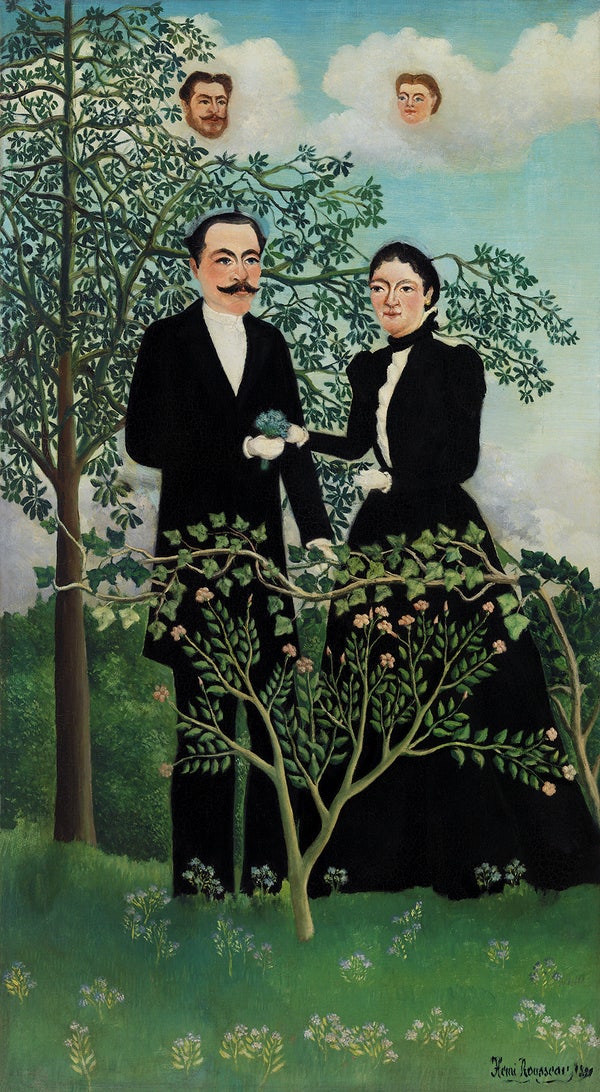
Featured Image: “The Past and the Present, or Philosophical Thought” by Henri Rousseau

The fox collaborates with the chicken.
The motorcycle collaborates with the tree.
The knife collaborates with the throat,
and you want to collaborate with me.

Your watercolors and my poems,
side by side for all to see.
You say it will be interesting and fun.
There you stand, ready to collaborate with me.

The lemming collaborates with the cliff.
The propeller collaborates with the manatee.
The wineglass collaborates with the floor,
and you’re all about collaborating with me.

Your photographs and my poems,
facing each other for all to see.
It will be experimental and fun, you say,
since the time has come to collaborate with me.

The hammer collaborates with the thumb.
The razor collaborates with the goatee.
The mousetrap collaborates with the mouse.
Are you sure you want to collaborate with me?

Your poems and my blurb,
together in a chapbook for all to see.
You say it would make you feel better.
I see why you want to collaborate with me.


Read More

Preface to Making It Up

By Ron Padgett

Featured Image: “Antique Illustration from The Grammar of Ornament” by Owen Jones

I don’t remember who suggested the idea of an evening of spontaneous poetry collaborations by Allen Ginsberg and Kenneth Koch, but I think it came up during a taxi ride the three of us took, six or so months before the event, in which Allen and Kenneth started joking about and even parodying each other’s work. This playful conversation culminated in their public performance of Wednesday evening, May 9, 1979, at the St. Mark’s Poetry Project.

As the date approached, both Allen and Kenneth—who had never taken part in such an event—started to express some misgivings, as did I. A month before the event, I wrote to them, “I’ve been wondering about some details of your May 9 extravaganza here, and I thought I would ask you about the format of the evening. Do you want to set any rules? Or would it be better to set none and just let fly?” Both poets thought it best to have some structure to work with, but they left it up to me. So I drew up a list of poetry “assignments” to surprise them with.

Read More

Some Remarks on Collaboration

By Tom Whalen

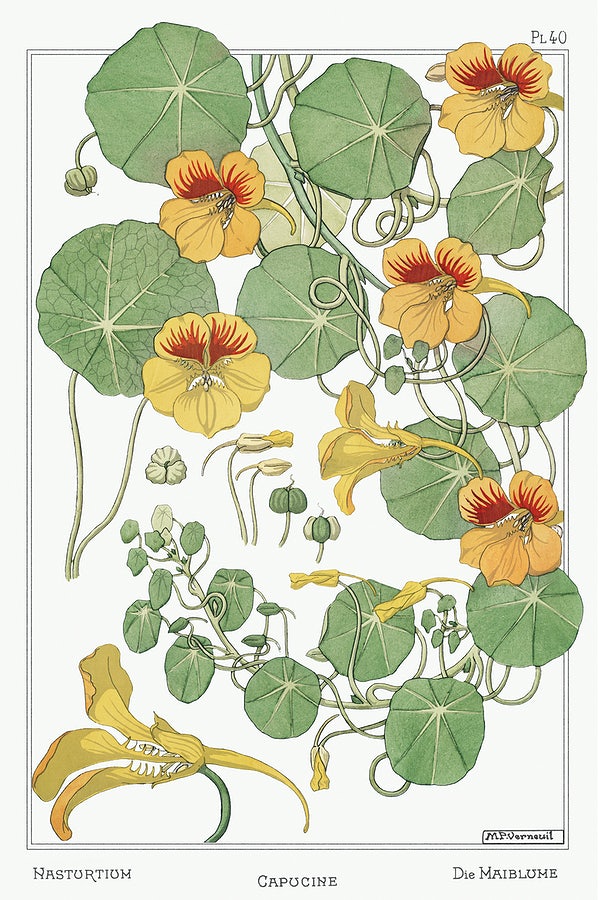
Featured Image: “Capucine” by Maurice Pillard Verneuil

  • I’m trying to think what isn’t a collaboration, but when nothing comes to mind, I wander about my Arbeitszimmer, scanning the shelves, lost in thought, before returning to my remarks concerning activities requiring, if not a multitude, at least one other mind.
  • “To be a fly on the wall,” thinks the narrator of a nonexistent novel on her way to her mother’s wedding to a fifth husband, clear indication the mother knows a thing or two about collaborations.
  • Translators raise their heads from dictionaries now and then to ponder how to translate, for example, a sentence by Robert Walser that I’m convinced demanded of him a close collaboration with nature: “Den Fischen fehlen die Arme.” Should I and my more experienced collaborator (Susan Bernofsky, in this case) choose the concise “Fish lack arms” or more closely mirror the music, e.g., “On fish one finds no arms”?
  • Proust in one hand, Ionesco in another, I strolled along the Champs-Élysées as if I were the saddest flâneur on the road to everything.
Read More

Collaboration Queens (Or How the Chapbook, ABBA: The Poems, Came to Be)

By Denise Duhamel and Amy Lemmon

Featured Image: “The Seasons” by Alphonse Maria Mucha

As we wrote “Class Action,” our first poem together (alternating one line at a time, on email), Amy noticed we were writing in abba rhyme, which gave her the idea of writing tangentially about ABBA, the pop group. This lucky association led us to begin a series of poems with two constraints: the stanzas had to be written in abba rhyme, with a mandatory mention of ABBA, the singing group, in each. As we built up our confidence, we sometimes added a third constraint. In one poem, each line had to end in a long “o” sound; and in another, each line had to contain a palindrome, as ABBA is a palindrome. Although we stuck with the rhyme scheme (with allowances for occasional, or more-than-occasional, slant rhymes), we liberated ourselves from metrical restrictions. While Denise is comfortable in the prose poem and free verse, Amy tends to write almost unconsciously in a loose iambic pentameter or tetrameter. But we didn’t insist on uniformity of rhythm. This gave us the leeway to go with the flow, quoting lyrics or song titles, creating dialogue between characters, and injecting other bits of pop culture into the poems.

Read More

Changing the Record: A Poetry Collaboration in the ’70s and ’80s

By Ron Horning and David Lehman

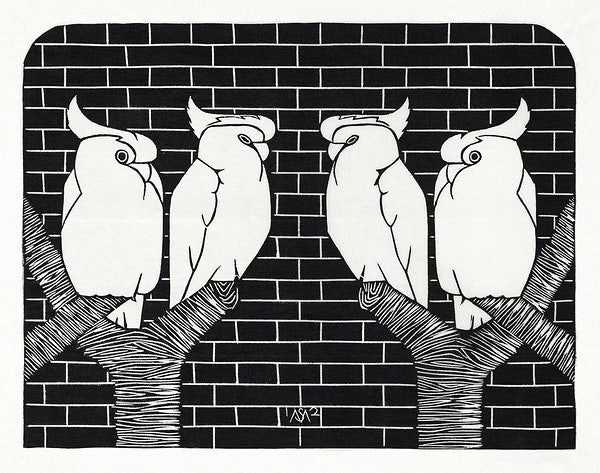
Featured Image: “Four Crowned Cockatoos” by Samuel Jessurun de Masquita

We met late in 1972, when we lived two blocks from each other on Riverside Drive. Though Ron’s room in his apartment was easily quieter than David’s room in “The Barracks,” thus named because of the decibel levels achieved by the inhabitants (David’s roommates were a jazz disc jockey and poet, a veteran of the Marine Corps just back from Vietnam, and a TV-watching, football-twirling specialist in East Asian studies) and their many guests, Ron’s room was also less private, more subject to interruption, and did not have its own bathroom. The first poem we wrote together was written at the Barracks, and so were most of the others in 1973 and 1974. From almost the beginning, the idea was to write a book of poems, but the book never really gelled, either because there were too many other things to think about or because we didn’t know what, if anything, the poems and lines we were typing and writing added up to. We had a working title, or at least we toyed with some candidates. (A Phone of One’s Own captured David’s fancy for a time.) Many poems we started were left unfinished, and even the attempt to write poetry together stopped abruptly in 1975, when we both married for the first time, David in January, Ron in July.

Read More

The Story Behind “Penguins”

By Patty Mitchell

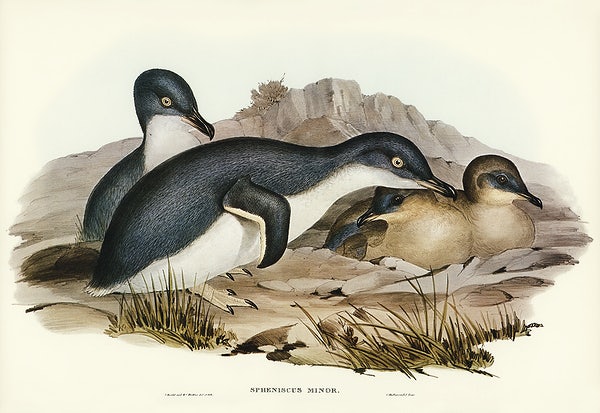
Featured Image: “Little Penguin” by Elizabeth Gould

Located in Athens, Ohio, Passion Works Studio supports collaborations between artists with and without developmental disabilities. The studio began as an experiment in 1996: what would happen if I set up a collaborative art studio within a sheltered workshop, a supported work place for people with developmental disabilities? A grant from the Ohio Arts Council allowed us to put the idea in motion, and through additional grants and sales a second professional artist was added to the staff, Wendy Minor. Wendy and I brought to the table our understanding of materials and our art process; the participating individuals brought with them their unique way of experiencing the world and a natural ability of fearlessly jumping into art-making. For fifteen years now, Passion Works has offered a relaxed and informative environment for people to collaborate and investigate ideas. The synergy of excitement and discovery is conveyed in the resulting artwork: playful, vibrant, unpredictable.

Read More

Where the Path Leads: Collaboration, Revision, and Friendship

By Lawrence Raab

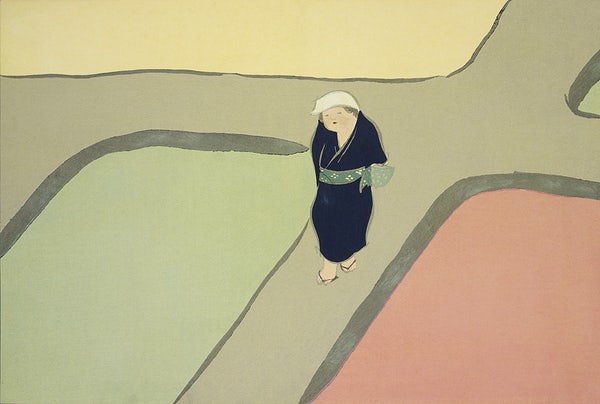
Featured Image: “Path Through the Fields from Momoyogusa-Flowers of a Hundred Generations” by Kamisaka Sekka

Many years ago—and I really don’t want to remember exactly how young we were—Stephen Dunn, a friend but not yet a collaborator, was traveling from New Jersey to Yaddo, the artists’ colony in Saratoga Springs, New York. He stopped for the night at our house. During the course of the evening I recall bemoaning the fact that I hadn’t written a poem—maybe not even tried to write one—in over a year. I had writer’s block, I announced, as if it were an identifiable disease. I had not yet learned the wisdom of William Stafford’s famous—or infamous—remark that there is no such thing as writer’s block; all you have to do is lower your standards.

Of course Stafford didn’t mean you ultimately aim for less. You just have to give yourself a break to get started, and accept whatever occurs to you because “something always occurs” to us, as Stafford says in his essay, “A Way of Writing.” Let the act of writing carry you beyond your first inevitably dull words, to better words, better sentences that may give you access to something waiting in your mind “ready for sustained attention.” This is the writer’s daily work—putting some words down, then rearranging them, adding, then subtracting, looking for a shape, a focus, “the poem’s informing principle,” as Stephen Dunn puts it in his wonderful essay, “The Good, the Not So Good.” If that’s inspiration— and I like to think so—it’s earned by the work of writing, not given as a gift of the gods, like an autumn leaf fluttering down significantly on the poet’s head.

Read More

New Ohio Review Issue 10 (Originally printed Fall 2011)

Newohioreview.org is archiving previous editions as they originally appeared. We are pairing the pieces with curated art work, as well as select audio recordings. In collaboration with our past contributors, we are happy to (re)-present this outstanding work.

The Last Speaker of the Language

by Carol Anshaw

Featured image: Fernand Lungren. In the Café c. 1882-1884. The Art Institute of Chicago.

All right. Here we go.

Darlyn teeters high on a swayback wooden ladder she has dragged in from her mother’s garage. From here she can reach around blindly on top of the kitchen cabinets. She has struck pay dirt—a tidy arrangement of small, flat bottles. She doesn’t have to look to know they will all be pints of 5 O’Clock vodka.

She backs down the ladder, finds a grocery bag, goes back up and tosses in every bottle she can reach. Then she moves the ladder further along the way and clears out the bottles above those cabinets. She pours the liquor down the drain in the sink. 5 O’Clock is not for the amateur drinker. When she has the presence of mind, Darlyn’s mother filters it through a Brita, then mixes it with lime juice and ice and ginger ale, her version of a Suffering Bastard. After a while, though, she drops the lime and the niceties and in the end skips even the glass.

Read More

Layover

by Erica Dawson

Featured image: Henri de Toulouse-Lautrec. The Englishman (William Tom Warrener, 1861–1934) at the Moulin Rouge, 1892. The Metropolitan Museum of Art.

I’ve half a mind to make a move.

I stayed in Archer City where
I made Larry McMurtry proud
by downing one too many shots
of ice-cold vodka, tumbler-sized,
then yelping all alone to “Sweet
Home, Alabama” while the band
reprised “Knockin’ on Heaven’s Door,”
packed up, and quit the Legion dance.

I thought I didn’t know that song.

I two-stepped with a cowboy, kissed
a Yankee (wrong), regretted it,
and found my cowboy once again:
the Yankee looking like a young
Paul Newman and the cowboy like
I’ll bed you, hard and hot in jeans.

What was it in the Texas air
that brought Delilah out of me?
Was it the quail and wild hogs?
The memorial on the Court House lawn?
The BBQ cooked from a cow
that tasted like a slaughtered cow?

What hiked my temperature? It climbed
the diving board and took its clothes
off, piece by piece, as if last May
were my last picture show, last chance
to sweat with strangers in a Spur
Hotel room, quaint with double beds
and Byron on the table, me
as Cybill Shepherd, starring in
her first movie as Jacy Farrow,
walking in beauty like a night
too much for such a little place
where the town Indian said she
was the town Indian; and, my
sweet cowboy said I gave him eyes,
said I was high-heeled trouble, said

I have the tendency to lead.


Read More

Entropy

by Tracey Knapp

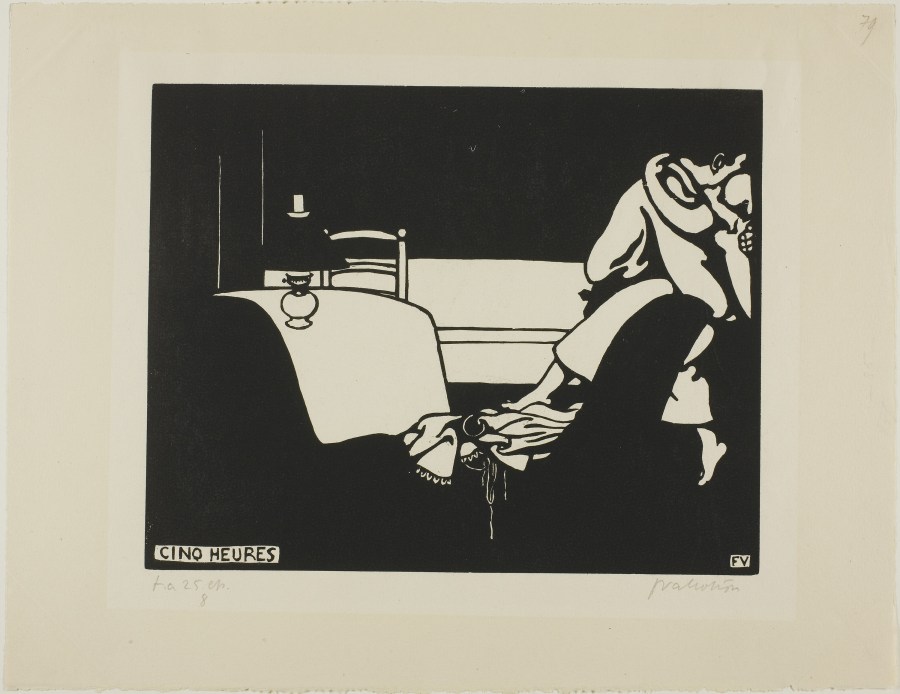
Featured image: Félix Vallotton. Five O’Clock, Intimacies VII (Cinq Heures, Intimités VII), 1898. The Metropolitan Museum of Art.

All those times I crossed the bridge to see you
and not one lap dance. We haven’t held hands
since that time in the rain forest, chanting Lord
knows what in Sanskrit. I saw my first wild boar there
but even he took off for the brush. Someone always ends
the moment. Another call dropped on your iPhone,
the cosmic forces at work. My dog sighs and stares
at my flip-flop from his pillow. At work, the office
is separated into orderly earth-toned cubes.
My friends, we gather here today
to sit exactly ten feet apart. I am exactly
one hour away from being drunk enough
to call my psychic in Tuscaloosa, two
commercials away from another headache
and Nova on TV. The universe expands, shifting
its contents accordingly. There was a time when
we were closer. Helen Keller learned to speak
by holding her teacher’s face, feeling the words form
and fall out of her mouth, the throat buzzing with thought.
I also like to touch people while they talk,
but not about professional sports. I love
and hate eye contact, don’t you? One glance
from the Girl Scout and I get the thin mints. I don’t get
all that crap about divine connection,
but there is something to be said about
a collective consciousness if you consider how
everyone likes vampires again. If I had a spirit
animal, I think it would be the wild boar.
We never talk about it anymore and I miss that
about us. The only thing that could prevent
a greater distance forming between two stars
hurtling though space would be some entropic net,
a giant wet towel. While you’re crossing
the state line on your last gallon of gas,
a streetlight deteriorates over the Safeway
parking lot. A shopping cart rolls
into my Dog Chow and the whole bag
splits open, the pellets skidding and colliding
across the pavement, two strangers scrambling
to gather them, to fill the bag together, to make it right.


Read More

Women’s College

by Kenneth Hart

Feature image: Antoine Watteau. Head of a Man, ca. 1718. The Metropolitan Museum of Art.

I didn’t think of myself as a sex offender
or as someone whose sex was offensive
until I walked across the campus
of the women’s college. I tried to be
as inconspicuous as possible, looking away
when someone jogged past with a scrunchy holding back her hair
and breasts bouncing just a little beneath a sports bra,
making believe I had some business there
by putting a purposeful stride in my step.
I know I carry the chromosome of hatchet murderers and rapists,
it’s no wonder my hands felt like mallets
at the ends of my arms.
After awhile I sat on a bench
and tried to look at the oval pond,
the trees and manicured shrubbery in front of the study hall,
as passing girls gossiped in the late-January sunlight,
some of them tanned from winter break, or slightly heavier
after a month of their mother’s cooking.
So I got up to leave,
making sure my shoulders looked slumped and unathletic,
a little afraid of myself now,
and massively unaware
that one of them might consider my presence
a welcome relief.


Read More

When It’s That Time for Piranhas

by Michael Derrick Hudson

Featured image: Utagawa Hiroshige. Swallow and Wisteria, mid-1840s. The Metropolitan Museum of Art.

Everything has already blossomed: my neighbor’s wisteria
has gone hog-wild across the ragged frontier of
our mutual fence, the soft green tendrils
of it violating international borders

and breaking treaties. Achtung! So let me tell you about

my neighbor’s wife: she’s delicious! And every morning
I hear all the birds in Fort Wayne, Indiana, go

Yippee-yee! Yippee-yee! Which is how spring jibber-jabbers
while her husband blows the leafy detritus

off their depilated lawn. Something’s missing. I want to be
indigenous with her, something somehow prehistoric—

I want her in Brazil. I want a quiver full of spindly arrows
to fetch our breakfast’s blue-tailed skink or

supper’s three-toed sloth. I want ritual scarification, coherent
rites of passage. I want grandpa’s thighbone
whittled down to a splinter

and dangling around my neck.
I want to help her stitch banana leaves, scorch
grubs against a rock. I want her to smile at me like a jaguar,

each incisor filed to a point. I want poisonous frogs, seashell
currency, enemies who make sense, a copper
plug through my lip. I want

a shameless squat. I want mumbo-jumbo witches to shun and
screeching ghosts to appease. I want her to take me

down to the river where we’ll knot and
inch our way across. I want her to trust me to be the lookout

for piranhas. I want to know when it’s that time for piranhas.


Read More

Sixteen in Vegas

by Anastasia Selby

Featured image: Edvard Munch. The Girl by the Window, 1893. The Art Institute of Chicago.

It’s Vegas and I’m sixteen years old. I’ve been playing in the arcade for hours; I’m leaning on the console of Mortal Combat, pushing the quarters my stepdad has given me into the slot one after another, wearing the tips of my thumbs down with their ridged edges. I’m bored as hell and my parents have abandoned me in this wasteland, I can practically see the tumbleweeds and hear western music as I walk across the patterned carpet. I pass all the men and women with their heads almost touching the bright lights of the slot machines, their hands like lobster claws around the levers, as if they’re waiting for the secrets of life to come pouring out when they hit the right combination. The secrets must be what they see on billboards, what they see in magazines. The arcade smells like the sweat of children and sounds like broken glass.

Starting at the Excalibur, a gaudy Disney imitation that should have been torn down years ago, I walk from casino to casino, reveling in the transition from air-conditioning to the surreal heat that cloaks everyone who ventures outside in a thin layer of plastic wrap. I stare back at the men who gawk at me on the sidewalk as I walk past them, men who are over twice my age and probably have daughters half my age. They must give their daughters baths and put them in their pajamas at night, patting their heads as they tuck them into bed. I can’t remember one time my father actually tucked me into bed. He left when I was two.

Read More

After Rosenkavalier

by Natania Rosenfeld

Featured image: Goya (Francisco de Goya y Lucientes). Lovers Sitting on a Rock; folio 24 (verso) from the Madrid Album ‘B’, 1796–97. The Metropolitan Museum of Art.

We talked about her,
the Marschallin, only
thirty-two, and her lover,
seventeen, though the singers
were fiftyish, and we ourselves
are approaching there, though our
lives have not reached their
pinnacle. Will we ever
roar with our whole voice
and soul, cry out that way
with all life crying through us,
or will we walk on, obedient
and tired in our traces, as the round
orange sun goes down
across the long, white prairie?

In our little warm car, we drive
into the pale arms of the fields,
leave behind the mall and
the Marschallin, return to the small
town to lie under the glassy moon
and dream of a gold curtain,
of young limbs entangled,
and renunciation clad in violet.


Read More
The Ante

by Rodney Jones

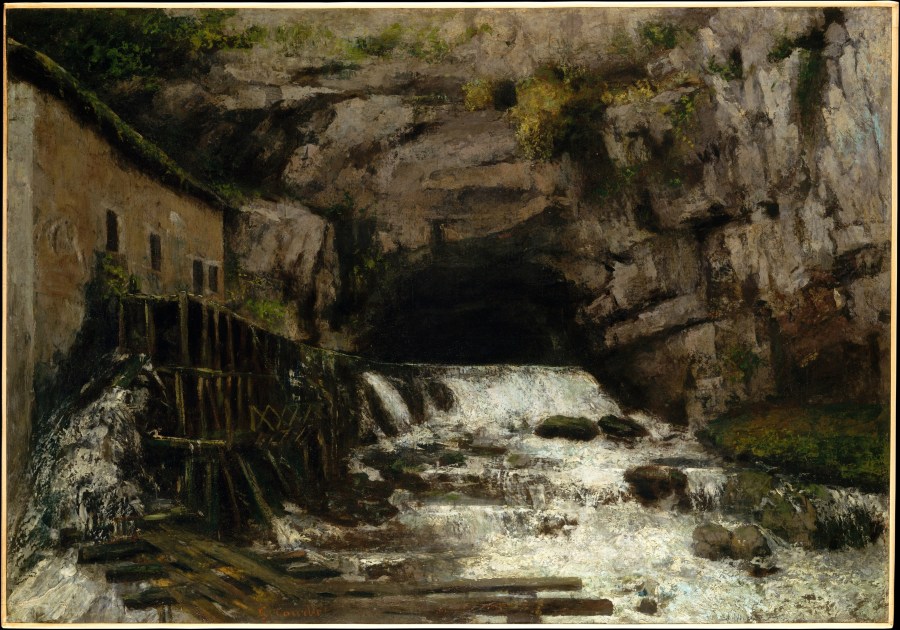
Featured image: Gustave Courbet. The Source of the Loue, 1864. The Metropolitan Museum of Art.

A few sonnets about nature and the Greek gods.
Many free-verse poems in all lowercase letters.
Huey wrote of madness, Maddox of possums.
John played the sadness of empty stadiums.
Two berets, one silver-tipped cane, tweedy blazers.
In most Natalie poems, she took off her clothes.
The year of the Tet offensive. Wallace in Montgomery.
We read James Wright, Richard Wilbur, Anne Sexton.
One Friday an ex-guidance counselor from Jasper
leapt through the window of the cafeteria, shouting
“I am the son of Jesus Christ! Behold the rapture!”
But nothing much happened in Poetry Writing 301
until Walter C. Avery wrote that a black swan,
born in the infralapsarian brain of a garbage dump,
would crack the codes of the Southern Baptists.
And for this jack-surreal, mildly apocalyptic truffle
was taken for near-genius material, practically
a second Edgar Allan Poe, until Sam Maisel
submitted his “Poem for The Worksheet Typist,”
which made everyone consider how scandalous
it must have seemed for her, a local woman,
a seamstress, and mother of Christian athletes,
to run across “I know you think you’ve seen it all before,
but this is duck rape, feathered love.” And some
in the critique afterward, praised the line-endings;
one person even mentioned “The Second Coming,”
which, admittedly, made me blanch with envy,
so I wanted to say something about how
sometimes the subject is not what you think
or the ones you imagine you are talking about
stand abruptly and begin to talk back to you,
but spring was bearing down on the workshop,
ripping out pages, grinding the opinions to nubs.
So much energy in the streets—demonstrations,
happenings, awakenings—so many instances
of sudden and involuntary enlightenment,
though mostly my friends and I spent our nights
on Sixth Street drinking beer at The Chukkar
or crouched in a huddle around a record player.
By the time I thought of Sam’s duck again,
May had slipped into June and June into July,
and what is poetry in a copper tubing factory?
A cloud would fan out around the tubes
as the crane lifted them from the soaping vats
after they had softened in the furnace.
My job was to crimp a point on each of them.
Then the next man would carefully run them
through a die. Down the line I could see
the process repeating: the furnace, the point,
the die—the tubes and men diminishing.
All night the saws screeched and whined.
The pointers clattered. The press roared.
That was the beauty of it. You could sing.
No one would hear. You could say anything.


Read More

The Rush of Losing

by Daniel Larkins

Selected as winner of the 2011 New Ohio Review Fiction Contest by Don de Grazia

Featured image: Henri de Toulouse-Lautrec. At the Moulin Rouge, 1892–1895. The Art Institute of Chicago.

10. The race is over before it ends.


7. Tim leans forward. His blue dress shirt is untucked, unbuttoned, and his stomach shoves the undershirt out of his pants. When he loses it’s like a win, because when he wins he doesn’t want to keep on betting. Losing answers the question, Why continue? When he loses, he likes to think he can parlay that into a victory, persevere to make up for the loss.

All the TVs are muted. In his shoes he can feel the rumble of Holland Tunnel traffic from a couple blocks away. His twin boys are twelve and his fingertips are black. His nails are short and dull. His wife Meg used to have monthly manicures and the designer kitchen she wanted, but no more would she get a stupid room for hanging pots and pans and whatever else she liked to hang from racks and nails.

Tim leans forward. He has a hangnail, and it bleeds and stings, and his left hand balls into a fist on his thigh and his other wraps around a rolled-up Racing Form. It’s a tool, a bat, a weapon.

Read More

Times Pieces

by Susan Morehouse

Feature image: Jean Charles Cazin. October Day 1890-1891. The Art Institute of Chicago.

My husband is walking out the door with an expensive watch, carrying it in the box it came in. “Are you getting it fixed,” I ask.

“I’m going to see what it’s worth at the pawnshop on Main,” he says. “You could just get a Timex,” I say, “if you want to know what time it is.”

“Sure,” he says, “or I have that watch you gave me. It just needs—”

“Batteries,” I say.

“Yeah,” he agrees, “and a band.”

The expensive watch was a gift from a man whose biography he wrote on spec, a book no editor has taken yet, even though Henry, the man behind the success of a major tabloid, implied it was a done deal. That was before the financial collapse. Henry gives these watches to anyone he needs a gift for. He buys them in bulk. Need something for a sheik? Here’s a Millage.

We’re broke.

Read More
On the Strand

by Dave Kim

Feature image: Edgar Degas. Beach at Low Tide (Mouth of the River), 1869. The Art Institute of Chicago.

My mother’s boyfriend was a man named Bang. I never learned his first name. He’d been an officer in the Korean army before coming to the States, and he would yank me out of bed at six-thirty every morning to do jumping jacks. I was a doughy nine-year-old and he was trying to make me leaner and tougher. If I got angry, he would dare me to hit him and stand up for myself, get it out of my system. On Sundays we’d go to his boxing gym to watch the men pound each other to pieces, which terrified me at first and then made me dream of days when I’d be big enough to put on gloves and whomp Bang in the gut. I needed a good ass-kicking, he would tease me in his throaty Korean. Anytime I wanted, I could challenge him. Mom didn’t get involved.

The three of us went to Santa Monica Beach one Saturday afternoon to ride our bikes on the Strand. Bang would take me fishing on the pier sometimes and when we rode past it that day, I thought about how much I would rather be out there with a basket of calamari and a cherry Icee, watching our poles nod on the railing. It was one of those perfect afternoons when the California coast looked way better in real life than on the glossy postcards they sold on the boardwalk. Couples were stretched out on the sand, half-hidden under candy-colored parasols. The sky was ablaze in orange light. But I didn’t care about the scenery. All I really saw was this endless bike path and its dashed yellow divider. The back wheel on my hand-me-down Schwinn was grazing the brake pad with every rotation and I lagged at least a hundred yards behind.

Read More

Saying Goodbye to Dad

by Kate Fetherston

Feature image: Pierre-Auguste Renoir. Near the Lake, 1879-1880. The Art Institute of Chicago.

My dad died alone in a VA hospital
as July sun beat without mercy into the raw

seesaw of breath busting seams between
each cell. Third spacing doctors call it

when cell walls no longer sustain
boundaries with integrity, fluid

sluices into interstitial no-man’s
land and overpowers whatever little

plans were made for a garden and some
trees. When my brothers and I got

the news and flew in from the various
places to which we’d fled, I’d just split

on my first lover after years of her
threatened suicide, bouts of drunken

depression, and refusals to take
her medicine too numerous

to recount. Her view: I’d been trained
strictly for fixer-uppers, too stupid

or stubborn to leave, but, waxing
romantic, she’d croon, “You’ll do me

for a rough old mate.” The day she smashed
my stuff into the carpet and poured

ten pounds of flour over
everything, I might have stayed for

more of the same, but I threw
crumpled clothing into my pack,

startled when she whispered, “I’m
just like your crazy

old man, aren’t I?” I didn’t
answer because we both knew

Read More
Home Movie

by Mark Kraushaar

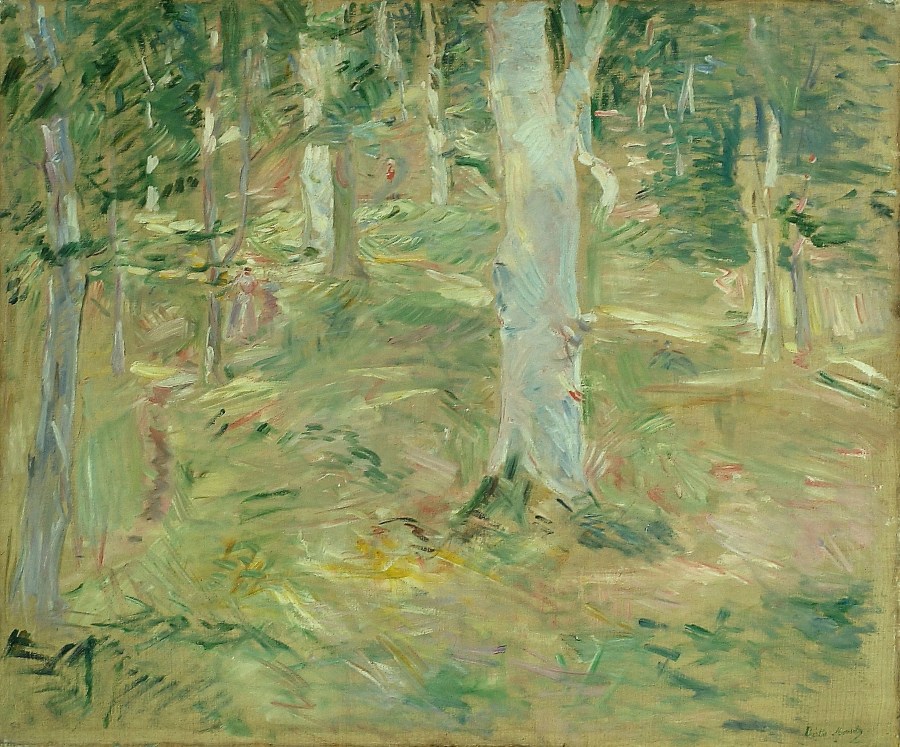
Feature image: Berthe Morisot. Forêt de Compiègne, 1885. The Art Institute of Chicago.

Saxophone, and trombone, trumpet,
trumpet, trumpet. And there’s Roxanne
and Dick, and Betty Mayfield and the Laurie girls.
And there’s George Betts on clarinet.
Of course, it’s so jerky and grainy though,
which is just as it should be,
and here we suddenly actually
are, or, and isn’t that
Malcolm Sproul and Claudia French and isn’t that,
or wouldn’t that be Dick Benck, and there’s
Kit Powell, and Kathy Frey.
And now, somehow, look,
someone in somebody’s yard,
a boy in a foot-deep plastic pool,
skidding sideways and pitching forwards,
euphoric in jaunty fedora, a giddy private eye
in blue shirt and shorts,
waves once and as his mother laughs
she turns, and with her, wistful, and trying,
and troubled by longings, here’s
Jim Jahovic with my best
friend’s strange father Dr. Callahan, and quickly
someone else, and someone and someone and then,
no, yes, that’s, that’s What’s-Her-Name,
judicious and afflicted, nice enough,
yes, and yet, there’s a way she tips forward,
or inwardly anyway, as if picking up the faintest
oracular tappings.
There’s the Roundies and the Levi boy.
And there’s that flirty, sparking Mrs. Archer—
and I want to run it all again.
Oh friends, where were we going
in that shaky dawn?


Read More

Maritime

by Mark Kraushaar

Feature image: James McNeill Whistler. Nocturne: Blue and Gold—Southampton Water, 1872. The Art Institute of Chicago.

My wife was nodding, Yes, sure, and, Yes,
and I was thinking of my parents, their sadness
and silence, their every evening’s weeping,
whispery buzz beside the stove.
My wife was nodding, Yes,
and leaning forward when the pastor said, You’re
like two ships passing in the night, and he seemed so
pleased I thought, So one’s a brig-sloop the other a tug?
Or one’s a tanker the other a trawler?
Troop ship and submarine?
Grain barge and gunboat?
I was quiet though.
It was August,
and there were two fans working,
and I thought of those salt-washed gray gulls
with their weird pink feet, and I thought of moonlight
shooting down the starways and cooling the decks.
I thought of two cruise ships next,
couples waving by the railings,
the faintest, farthest sounds of bands and laughter.
But there was nothing funny here.
He was talking or maybe she was, but
here we were, the two of us, our long, horizontal
journey almost over, no frenzied waves,
no reckless wind.
We were quiet, and she was crying,
or we both were, but we were perfectly still.


Read More
Hurricane Season

by Julia Jackson

Feature image: Winslow Homer. Breaking Storm, Coast of Maine, 1894. The Art Institute of Chicago.

Itchy in November, right before Thanksgiving. It was my first winter sober, when you were living on the top floor of that six-story apartment building overlooking the river, back before the neighborhood was converted into condos.
“Hurricane season,” you said when you saw me looking out your window in that blank way. “When the temperatures drop, us drunks get restless.”

Your hands got busy stacking up wood in the fireplace. I’d seen people who had come into the same meetings every week suddenly stop showing up, seen the way that the ones who did come back would raise their hands, announcing their day counts, differently this time. “I’ve got five days.” “Nineteen days.” “I’ve got forty-one days back,” they’d say, the “back” added to show that this wasn’t their first time at the rodeo. It didn’t look like it was any easier, though: their hands shook like any newcomer’s, their eyes wandered the rooms the same way, rabid.

Read More

Downloading the Meltdown

by Elton Glaser

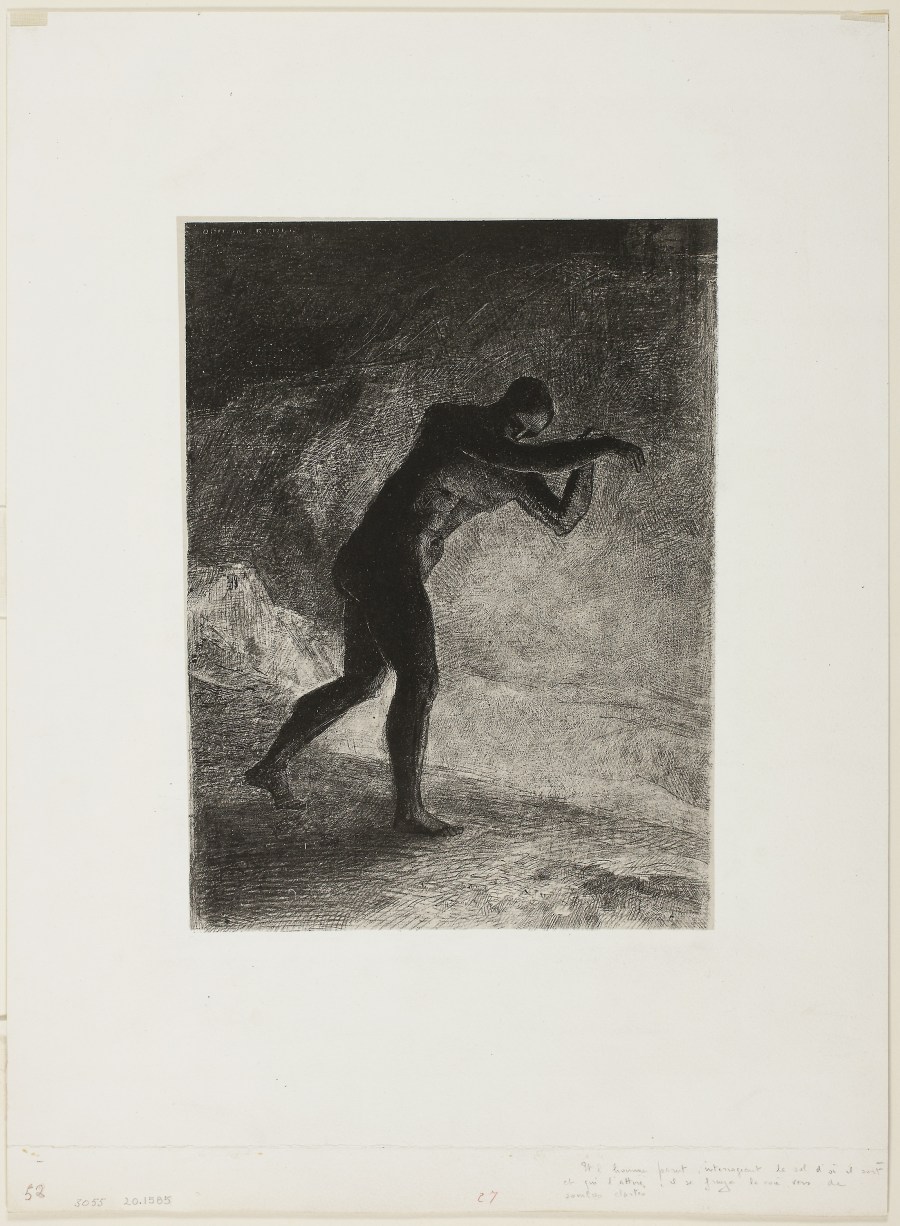
Feature image: Odilon Redon. And Man Appeared; Questioning the Earth From Which He Emerged and Which Attracted Him, He Made His Way Toward Somber Brightness, plate 8 of 8 from “Les Origines”, 1883. The Art Institute of Chicago.

Rumple of clouds at sunset, low and pink,
Underbelly of heaven in the summer slack, and me

Depressed as a backdoor detective on a case of slow clues.
I’m never lonely as long as I have my own body

To interrogate, my mind with its whips and pincers.
I buckle at the slightest threat; I confess

In the high pure pang of a choirboy singing
At some ceremonious occasion for the faint of heart.

And now the hot night, the moon cool as a bishop
In a boudoir. What you can’t get over,

You must get past. Through a haze of smoke and rum,
What’s left of me squints at the odds and ends.


Read More

In the Season of Early Dark

by Elton Glaser

Feature image: Claude Monet. Rocks at Port-Goulphar, Belle-Île, 1886. The Art Institute of Chicago.

1
The wind sassy and half mad,
The clouds knocked up with rain—
Another feral afternoon in the Midwest,
Fall, and the trees like Salome, ready
To ask, when the last leaf drops,
For my unresisting head.

2
I’m going to spring all the little traps
Set by silence
And call it mercy. I’m going to let loose
Every thought caught by its hind legs
And screaming for release.
Out of the jaws and sharp teeth,
The tongue comes, loving
The taste of its own blood, gush of words
Hurt into eloquence.

3
Gray day. Raincoat weather.
Raw wound that would weep over me,
Nasty stuff from so deep inside
It could make the scarecrows gag
Among the stooks and stubble.
Whatever I did to deserve this,
I deserve it.

4
All the numbers add up—
Mortgages, body count, Lincoln pennies
In a plaster pig my grandfather gave me.
And the years, too, though no one
Knows how many, not the saints,
Not the drugged and corrupt. I have these
Fingers to figure with. They tell me
The end is always at hand.

5
Misbegotten month
Rushing from bluster to bare bark.
The geese get out of town.
Even the seedy weeds die back,
Brittle slippage of the unloved.
I stack firewood against the stone wall
And plant the last tulips, bonemeal
In their shallow holes. Lights rise
From the windows and fall
On the dark grass, so black
My footprints sink down to the roots.


Read More

A Gift

by Patricia Ann Sanders

Feature image: Henri de Toulouse-Lautrec. The Passenger in Cabin 54—The Cruise, 1896. The Art Institute of Chicago.

It’s called the “verbal tip.”

You’re the greatest waitress we’ve ever had. We’re going to ask for you every time we come here. We had such a good time because you were our waitress. Yada yada.

Then they leave, like, three dollars on a thirty-dollar ticket.

Like I was going to call up the electric company and tell them they were the greatest electric company I’d ever had.


When I got divorced, my ex-husband was supposed to give me the Jeep. That’s what we agreed. My plan was to sell it if I couldn’t find a job right away in Phoenix. Instead, he wanted me to have the Acura. He was being generous, because it was a better car, practically new. Except that he never signed the title over to me. So I couldn’t sell it, and I couldn’t drive it, because I couldn’t afford insurance or gas. I was living in a godforsaken studio and buying food for one day at a time, stealing toilet paper from the bathrooms at the mall, with a twenty-three-thousand-dollar car parked under my window.

Read More

Solo in the Skeleton Key

by Elton Glaser

Feature image: After Gerard de Lairesse. Copies after Illustrations of Statues and Paintings (recto); Measurements for a Man’s Skeleton (verso). The Art Institute of Chicago.

Who would plant, in this stony ground, narcissus and love-lies-bleeding?
It’s too late to be young among the primitives. Winter withers the stalks.

The air reeks of it, decay and the odor of innocence gone to seed.
The time for riots and tattoos is over. Who dances the Dazzle now, or the Swerve?

Long before the armada and the asp, Antony must have tired of Cleopatra,
Those heavy breasts, that midnight skin, a name that thickened in his throat.

In the heat from eating an incandescent pepper, there’s neither passion
Nor apocalypse, just tongues in hell, just retching and the runs.

What honey comes from old drones? Forget the hoodoo and the holy water.
Pray only in Jerusalem, at the Church of Our Lady of the Spasm.

Love’s no trick of ecstasy, no lightning strike in the mind. Each new child
Struggles out, bloody and stunned, one more last chance to get it right.


Read More

One Day Your Parents Confess You Have a Twin

by Todd Boss

Feature image: Ugo da Carpi. The Sibyl and a Child Bearing a Torch, 1510-1530. The Art Institute of Chicago.

who was given up for adoption early on, when it was
clear they couldn’t manage him. It was, says your father,
the worst decision they’d ever made. (It’s you and your
parents at the kitchen table. Between you, the steam
from the teapot uncurls in a kind of breathing statuary.)
He was your inverse, your yin: When you went to sleep,
that’s when his terrorizing of everyone would begin.
He went from home to home to group home, and then
to prison, half mad, a drug-addled teen, with your name
tattooed over the veins in both forearms. “That’s when
we moved to Minnesota,” says your mother, but of course
he found you here, at the end of an abbreviated sentence,
and slit your throat while you slept. This was last year.
You’ve been dead ever since. We know this must be hard
for you to hear: but you don’t exist. You’re your own twin
brother’s obsession with you. (Can it be? Instinctively,
you reach to touch yourself about the shoulders, the neck,
but everything’s . . . identical.) It’s like a mad dream—
yes, the recurring one you’ve had since you were a child,
in which you go from door to door, trying to trade
your life for another’s, but nobody will trade, and you go
on and on, pounding, until, impossibly, you finally find
someone willing, and you wake. Your mother reaches
through the figure of steam to lift the teapot and pour
from out its only portal a little stream into her cup, her
husband’s cup, the cup in front of you. She sets the teapot
down, and now there are four apparitions dwindling there,
silken, gesturing. One of them says, We love you the same.
But you can hardly hear them as you push up your sleeves
—one at a time—and read, and reread, your name.


Read More

I Love Your Sunhat

by Patricia Foster

Feature image: Jules Pascin. Hermine David, 1907. The Art Institute of Chicago.

I didn’t know what to do with my breakfast tray. I’d gone through the line, had just spooned scrambled eggs onto my brisk white plate when I noticed two of the tables were already full and I’d have to sit alone. Alone. I’d only been at this artists’ colony for fourteen hours, but inevitably the old thought seeped in, “I’ll never be asked to sit with the popular group.” Now I stared not at the writers and artists dawdling over sectioned grapefruit and blueberry pancakes, but at the shiny surface of the coffee urn.

Nonsense! I nodded to my distorted reflection. What could really be wrong with eating your eggs alone at 7:30 in the morning at a table for eight? I’d eaten alone many times in the last ten years at my home in Iowa. And I was way too mature—too old, I didn’t dare say—for these sudden fits of inadequacy. I shifted my gaze to the window where light shimmered above the crepe myrtle, where, in the distance, horses grazed and cows lumbered across the driveway. As I turned to pick up a glass of orange juice, I heard a trill of laughter from one of the tables and all my newfound certainty slipped again: sitting alone was a curse.

Any normal person would have assumed that being “new” to the group, you should give yourself a few days to acclimate, to get to know people, to talk to the tall, gregarious composer dressed in plaid shirts and khaki shorts and the small, clever woman with red hair who spoke so softly. Any normal person would have plunged into small talk, would have laughed when others laughed. Instead, anxiety charged through my body, wreaking havoc with my girlish hopes for friendship while an abject loneliness loomed above the coffee cups. What would I do? How would I survive?

Read More

Elegance

by Fleda Brown

Feature image: After Luca Cambiaso. Sibyl in the Clouds, after 1570. The Art Institute of Chicago.

I thought I had hold of something elegant, a luminescent glow
on the lake, a flicker’s flash of headdress high on the tree.

I thought I heard a conversation from over water, someone saying
laissez faire, or Toulouse Lautrec, but it was only guys fishing,
a mishearing that came to me like a ray of light through stained glass,
a shimmer like a fine line of Milton’s, or a landscape by Monet,
applied in layers.

What I wanted was something privately
apprehended, something slowly and privately understood:
elite, yes, I admit it.

A pontoon boat came by and I remembered how old I am,
how I would rather be on one of those, studying the accommodating
landscape as if it were a museum, than on water skis, for example,
terrifyingly public and sudden, which is why I’m fond of

the Turneresque, or of an aspen leaf, half-unhinged over and over,
a sibilance of rhythm that works the atmosphere the way
Noah wavers the sailboat rudder back and forth to inch toward
the gust.

I don’t know the name for this maneuver.
And when the wind completely stops, there’s the small slurp
against the side of the boat that’s exactly what I mean,

the delicacy of the mundane, observed
and properly incorporated in service to the whole.

Another example at present: the gull has adroitly
caught in its beak the tiny bass Noah just tossed back,
and is carrying it flapping, sunward.


Read More

Spring Cleaning

by Laura McCullough

Feature image: Vasily Kandinsky. Houses at Murnau, 1909. The Art Institute of Chicago.

When we moved the couch
        we found the pumpkin,
        the tiny one we’d picked that day in the run-up to Halloween
        with the kids at the apple-picking farm.
It was small to begin with, smaller than an apple,
        and now it is desiccated
        though not as much as you might imagine;
it’s top-sunken, and wrinkled, the bottom flatter
        but the whole of it soft
        as if it might be full of rot or even of crème,
        as if you might pry it open
        along one of the long wrinkles or fissures,
        that autumn orange color gone pale,
        and out might come some wonderful and unexpected thing.

I don’t pry it open, but can’t bear to throw it out.
Instead I place it by the little handle of its stem onto the mantel.
        It is happy there, and I too feel happy,
        a little survivor, not blazing,
        but brilliant in my still-here-ness,
        a bit proud of myself.
In spring I can never remember fall
        and I talk myself through the laughing-at-you days of spring
        that never deliver what they promise.
        Only July gives you everything.
        Then August begins to take it away.
        And there’s not enough to lose anymore.

Which is why we always pick so many more apples
        than we could ever eat, bags and bags full,
        and why so many will go bad,
        that sticky odor coming up from the produce drawer,
        the ooze that always gets on your hand
        when you reach in without looking.


Read More

The Truest Thing

by Emily Nagin

Selected as runner-up of the 2011 New Ohio Review Fiction Contest by Don de Grazia

Feature image: Martin Johnson Heade. York Harbor, Coast of Maine, 1877. The Art Institute of Chicago.

In January, Nancy burst out laughing during the Shapiro funeral. She started laughing during a eulogy, though the eulogy itself was not funny. It was about deer hunting. The man giving it was stocky, red-cheeked, and blond, his buzz cut so close that from a distance, he looked bald. He spoke directly into the lectern, as if it had asked him to recall his father’s life. From her spot at the back of the chapel, all Nancy could see was the top of his head.

Her coworker, Lenny Faberman, sat across the aisle from her. Out of the corner of her eye, Nancy could see him fidgeting with his cufflinks. Last week, Lenny had caught Nancy crying while she embalmed an old woman. He’d stood in the basement doorway for a full minute, then said, “Did you know her?”

Nancy sniffed and wiped her eyes on her upper arm. She shook her head.

Read More

Traverse City

by George Bilgere

Feature image: Odilon Redon. Still Life with Flowers, 1905. The Art Institute of Chicago.

On my way to the conference in Traverse City
I drive by the toy lake where my family came
for summer getaways from steamy St. Louis.

The tiny cottages on the shore are still there.
There is the white sand where I played with my sisters
and learned how to swim from a teenaged lifeguard
whose beauty put my child’s mind in confusion.

My mother sat at a card table with her friends,
smoking and playing gin rummy. Weekends,
my father flew up from the mystery
of his job and his life without us.
My father dead now, my mother dead,
along with the friends she played cards with.

My sisters are middle-aged women,
children and divorces behind them.
I am older than my father ever was.

Yet there are the cottages and the beach
where we played with our buckets and shovels,
as the children on the sand are playing now.

No one can explain this.


Read More

Journal

by George Bilgere

Feature image: Paul Sérusier. The Beach of Les Grands Sables at Le Pouldu, 1890. The Art Institute of Chicago.

Now we’re on this tourist island and I am going to rent a golf cart.

That would be a good way, a very good way, to start a novel.
But this is not a novel, it’s my life.
It must be written down so that later, when I’m old,
barely able to walk around whatever fearful place
I finally end up in, I’ll look in my journal

and there will be my writing,
my own hand, bolder and darker than the trembling scrawl
age has dealt me. I will stand at the window
looking at the new kinds of cars—mostly Chinese, I’m guessing—
zooming past in a world I no longer get on any level.

I will think about the 58-year-old self
who rented a golf cart that day,
his beautiful young wife beside him
as he talked to a nice Mexican guy named Ernesto
about insurance and late-return policies,

and not one of us—my wife, Ernesto, me—
recognizing the enormity of this, the sorrow,
the hugeness of the moment
in all its beautiful ordinariness
as it leaned so temporally,
so irrecoverably against the void.

And I will stand there weeping impotently.
I can see it coming. Already I’m prone
to saccharine effusions, and it’s only going to get worse with age.

I write this down in my journal: saccharine effusions—don’t worry about them.
Which will make my 88-year-old self smile,
then weep all the harder.


Read More

Royalty

by George Bilgere

Feature image: Odilon Redon. The Beacon, 1883, reworked c. 1893. The Art Institute of Chicago.

So this young couple, overweight
and seriously tattooed, comes into the café,
and each of them is actually wearing a baby
in one of those tummy-papoose things,
and they have two enormous dogs
designed to kill elk and wolves,
not sit under the table at a coffee shop,
and as I watch them smile at their babies
which are now screaming bloody murder
while the great slobbering mastiffs
begin earnestly licking their own privates,
something terrible happens to me:
it’s like The Manchurian Candidate,
when Lawrence Harvey suddenly realizes
the reason he’s been acting so strangely
is because he’s been brainwashed by Soviet agents:

Read More

The Usual Way

by Sydney Lea

Feature image: Odilon Redon. Ophelia, 1906. The Art Institute of Chicago.

Our bus streaks bullet-fast by the soaring Crowne Plaza Hotel
and the sundry Hartford insurance companies’ towers
where millions of dollars are made and lost,
for all I know, in an hour.

I don’t care. I’m searching for something else as I cross
Connecticut for New York City to greet my daughter’s
newborn twins. We should think of a child

as constituting the highest form that spirit can know,
and I’m headed south to witness such spirit, twofold!
Still I’m petty, comparing myself to the mannerless
couple—young and loud—

who bellow laughter from a seat behind me, perhaps at the latest
YouTube clip. What can their futures hold?
But what, after all, of my own?

Read More

Fuchsprellen

by Rob McClure Smith

Featured image: Edouard Jean Vuillard. The Artist’s Mother Playing Checkers, c. 1890–91. The Art Institute of Chicago.

vulpes vult fraudem, foemina laudem—Publius Syrus, Fragments

It is claim’d that these little Pamphlettes which have passed from me formerly have got me some little Credit and Esteem amongst all of the Female Sex who delight in or be desirous of good Accomplishments. But there being so much time elaps’d since the last came forth methinks I hear some of you say “I wish dear Mr. Wooley would present some new Instruction.” To say the truth, I have been importun’d by divers of my Friends and Acquaintance to do so. To which end being very desirous still to serve you, I offer this Fuchsprellen, which I assure you worthy for the very precious things you will find there.

There are an hundred Divertissements harmless enough, which a young Lady may find suitable to her Inclination; but give me leave to find out one for her which hath the attendance of Profit as well as Pleasure that is a Toss. To speak the Truth, a Toss is a most excellent qualification for a Gentlewoman to exercise and please her Fancy therein and the best and readiest way to put the Body into a graceful Posture. The chiefest thing to consider is how to govern and behave your selves in this laudable and ingenious Art. For how will you blush when you come into a mixt Society, where each Person strives to shew her utmost Art and Skill, and you for the want thereof must stand still and appear as one whose Body wanted Motion, or a very Soul to actuate it. Yet the Mode and Humour of these times look upon it not only as a generous and becoming Property, but upon Gentility illbred if not thorowly acquainted therewith. Ladies, it is presumed you know the rudimentary grounds of Tossing, else your resort amongst wellaccomplisht gentlewomen would not only be improper but much hazard your Repute and good Esteem among them; and as you can toss, so I would have you learn other Formalities. By this Assistance, you will be enabled to give proper Directions for preparing every necessary Entertainment and be directed also how to act as Hostess in manner as befits your rank.

Read More

Slip

by Jeffrey Harrison

Feature image: Charles Émile Jacque. Seated Boy, n.d. The Art Institute of Chicago.

If I call my son by my daughter’s name
or vice versa; or if I call one of them
by the dog’s name, or the other way around—
all of which I have been known to do—
it’s funny, and only means I’m spaced out.

But when, while talking on my cell phone,
I walked past my new African-American colleague
and distractedly said hi, using the name
of another black colleague, it was stupendously
unfunny. It felt like I’d been punched

in the stomach, which is probably what
I deserved, even if he shrugged it off,
as he seemed to do when I caught up with him
and apologized too fervently,
my assumption that I’d caused him pain

itself a kind of racism, no doubt. It’s so
complicated!—though it doesn’t seem to be
for my teenage son and daughter,
and I’m glad of that, and admire their ease.
As for me and my colleague that day,

he absolved me with offhand grace,
doing his best to nudge me away
from my floundering shame, then
gently steered the conversation elsewhere
the way one does to protect a child.


Read More

Commuter Buddhist

by Jeffrey Harrison

Feature image: Alfred Stieglitz. Car 2F-77-77, 1935. The Art Institute of Chicago.

I’m learning to be a Buddhist in my car,
listening to a book on tape. One problem
is that, before I’ve gotten very far,

my mind gradually becomes aware
that it has stopped listening, straying from
the task of becoming a Buddhist in my car.

I’m also worried that listening will impair
my driving, as the package label cautions,
but I haven’t noticed that, at least so far.

In fact, I may be driving with more care.
There’s a sensation of attentive calm
that’s part of becoming a Buddhist in your car.

A soothing voice drones on until the car
is transformed into a capsule of wisdom
traveling at high speed, and you feel far

from anywhere but where you really are . . .
which is nowhere, really. The biggest problem
is getting the Buddhism out of your car
and into your life. I’ve failed at that so far.


Read More

Queenie

by Jeff W. Bens

Feature image: Johann Christian Reinhart. Lying Goat, from Die Zweite Thierfolge, 1800. The Art Institute of Chicago.

Dr. Frank Shire had never been down to Athlone before, hadn’t been back to Ireland to see the Kennelly brothers in the decade since he’d finished his fellowship at the University College of Animal Surgery, had seen them just the one time when they’d visited New York. The only American at the Fisherman’s Rest, the only American in all of Athlone for all he knew at that time of year, November, in the wet cold, driven straight to their father’s fisherman’s hotel by the Kennellys before he’d even had a chance to eat breakfast after the all-night flight to Shannon from JFK.

“She may be dying,” is all Robbie K said.

His brother Michael added, “She may be dead.”

Read More

A Mile In

By Julie Hanson

Selected as winner of the 2011 New Ohio Review Poetry Contest by Nancy Eimers

Feature image: Claude Lorrain. View of Delphi with a Procession, 1673. The Art Institute of Chicago.

The snow had been with us for awhile
and was dingy and not well lit.
But the sun promised to come out.
The light fog lifting
against the skinny tree trunks
and the grounded limbs they’d lost
and the thick, half-detached vines
would lift off,
dissolved, by the end of our walk.
We’d taken the footbridge
across the creek and followed the bend
away from traffic and toward the west ridge.
We’d gone a mile in,
to where usually I begin to listen to
our progress in the twigs and gravel of the path,
and past this, and past my own
periodic reminders to the dog
to the short, uncomplicated songs
of winter birds. And there,
near the spill of rocks in the creek
where the fog was still passing through branches
and a little farther and to the right
where a stretch of tall grasses
received a wide gift
of sunlight and several cows,
the air that stood still
between the trees and shimmered
over the grasses filled with sound—
a big voice moving through
a hundred thousand habitats—
and it said, “Attention in this area.
The following is a regular monthly
test of the Outdoor Warning System . . .”
It spoke from the west first,
sounding closer than it could be.
And it spoke from the southeast next.
“This is a test,” it said, “only a . . .
“This is a test . . . ” it began again
from somewhere else.
The dog returned to me, cowering.
I’d wondered before
without much curiosity,
where were those speakers housed,
were they towered, did they revolve?
Ordinarily heard in the yard
while I stood pinning laundry to the line,
the broadcast soon plunged and sank
into the noise of passing cars
and blown and rolling garbage cans
and faded like the little ringing
that emanates from construction sites.
But here, it seemed full minutes long
before my breath was back again in my chest,
and my dog’s breath,
steady and rough, was back in hers,
when the voice had left the air
between the trees, as had the fog.
At last a bird sounded from a twig.
At last a squirrel came down
and sent the dog. And then,
made up of other sounds
I could not have singled out,
a normalcy rolled in.
Infinitesimal bits is all it was
—quick beaks breaking up the peat,
the slow collision of a leaf landing, scooting
half an inch along a big flat rock,
a splat of excrement in white,
a flinch, a flap, a flick. But as it came it felt
to be a counter-vigilance. Or like
the sound of consciousness. The is.


Read More

Pretending to be Asleep

by Angie Mazakis

Selected as runner-up of the 2011 New Ohio Review Poetry Contest by Nancy Eimers

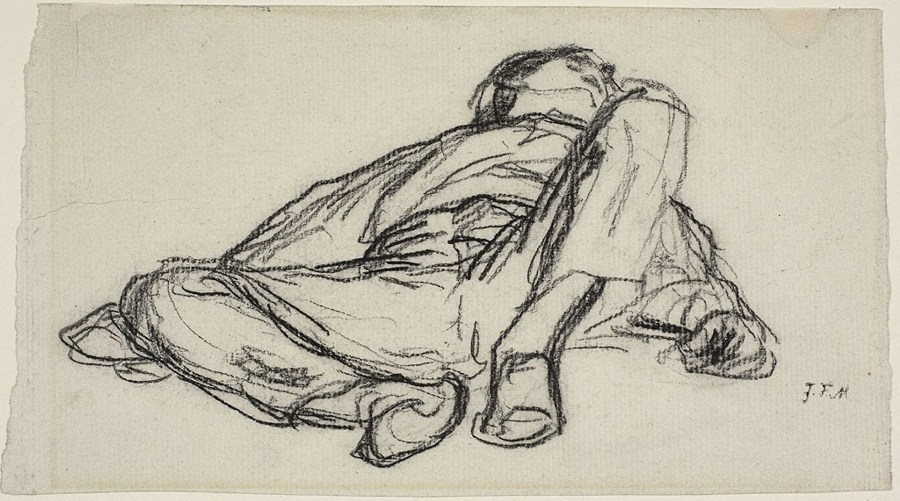
Feature image: Jean François Millet. Sleeping Peasant, c. 1865. The Art Institute of Chicago.

is like knowing exactly what you
are saying to me, but nodding,
yes, what else? anyway, as though,
I have never heard what you are saying before.

I have to purify from my appearance
appraisal and purpose,
my face distilled to stillness.
I have to guess when to genuinely tremble,
never having seen myself in sleep,
moving aimlessly beneath
awareness—I wager one
hand from the sheets,
toward nothing.
How does one believably breathe?

It’s like hearing words I was not
supposed to hear and just turning
in my chair as though I needed to reach
my arm this way, toward this phone,
toward anything, as if to say,
I am occupied; I was before.
It is all now exactly as I meant it.

Read More

Owen and Paul

by Angie Mazakis

Selected as runner-up of the 2011 New Ohio Review Poetry Contest by Nancy Eimers

Feature image: Sir John Everett Millais. Study for the Head of the Rescuing Lover in Escape of the Heretic, 1857. The Art Institute of Chicago.

It’s any two strangers’ conversation.
The proportions of the tall one’s face
make him look like an Owen.
The other one, easily a Paul.
Owen makes a face, a gesture—
his forced half-smile squints one eye,
as he barely shrugs in a way that falsely
means tentative, in a way that pejoratively
leans and says, I’ll give you that much,
a gesture which says entirely,
You know, it’s like this. Maybe I’m wrong,
but it’s something to think about.
The maybe I’m wrong suggested by some
softening of his eyes that kept him from
a face that said, nice try or dubious—
something he had to lose.

I catch my eye just beginning to imitate
the gesture, try it out, here in this coffee shop.
Maybe I’ll start wearing this look after saying things like,
Yeah, I’m pretty sure that’s the city rock ‘n’ roll was built on.
Or after anything ending in most people don’t know that.

Read More

Antonioni at Nineteen

by Jeffrey Harrison

Feature image: Adriaen van de Velde. Pastoral Landscape with Ruins, 1664. The Art Institute of Chicago.

I saw Antonioni’s The Passenger in September or October 1976, at the beginning of my freshman year at Columbia. It was the first “art house film” I ever saw, well before I’d heard that term. I was from Cincinnati, where apparently they didn’t have such things. I had just turned nineteen, or was about  to. I was taking a writing class with Kenneth Koch, discovering Frank O’Hara and Rimbaud, and doing everything I could to peel or dissolve the suburban Midwestern scales from my eyes. In that pursuit, this movie was as important as the LSD I would drop for the first time a few weeks later. Not that it was hallucinatory—just the opposite, in fact . . . though in both cases, perhaps, it was “the visuals” that I liked best.

The film was playing at an auditorium on the Barnard campus, and I remember walking over there alone, being completely amazed by what I saw, and hurrying back to my Spartan dorm room to write excitedly about it in a notebook that is now long gone. I don’t remember what I wrote, but I know it wasn’t focused on Jack Nicholson, who plays a television reporter disillusioned with his life and work. Nor did I write much about the plot involving switched identities, riveting though it was. If I wrote about these things at all, it would have had to do with the way Antonioni de-emphasized Nicholson’s movie-star status and took the weight off a plot that would have been handled ponderously in a Hollywood movie, accompanied by ridiculous, tension-building background music. (I’d seen Jaws just the year before, which suddenly felt like ages ago.)

Read More

Death, Cashews, and “No Country for Old Men”

by George Bilgere

Feature image: John Clerk of Eldin. Sheriff Hall, n.d. The Art Institute of Chicago.

I saw No Country for Old Men (Academy Award winner,  2008) ten times  on the big screen at close to twenty bucks a pop (including popcorn by the bushel and cola by the quart). If that ain’t obsession, to paraphrase Tommy Lee Jones’s oracular Sheriff Ed Tom Bell, it’ll do till the obsession gits here.

When the movie left the theaters I bought the DVD and raised my madness to a new level by slipping the disk into my stereo and listening to it. Cormac McCarthy’s dialogue, as adapted to the screen by the Coen brothers, has an understated lyricism and humor, thrillingly true to the laconic rhythms of the southwest (I lived in Oklahoma for a few years and I know my laconic rhythms). In fact, the soundtrack is one of the film’s most striking features, which is odd, given that there is no music whatsoever. Just the pitch-perfect dialogue and the silence of the plains, where the smallest sounds—the squeaking of a hinge, the unscrewing of a light bulb—acquire an ominous eloquence.

Read More

On Lubitsch’s “Angel”

By Lloyd Schwartz

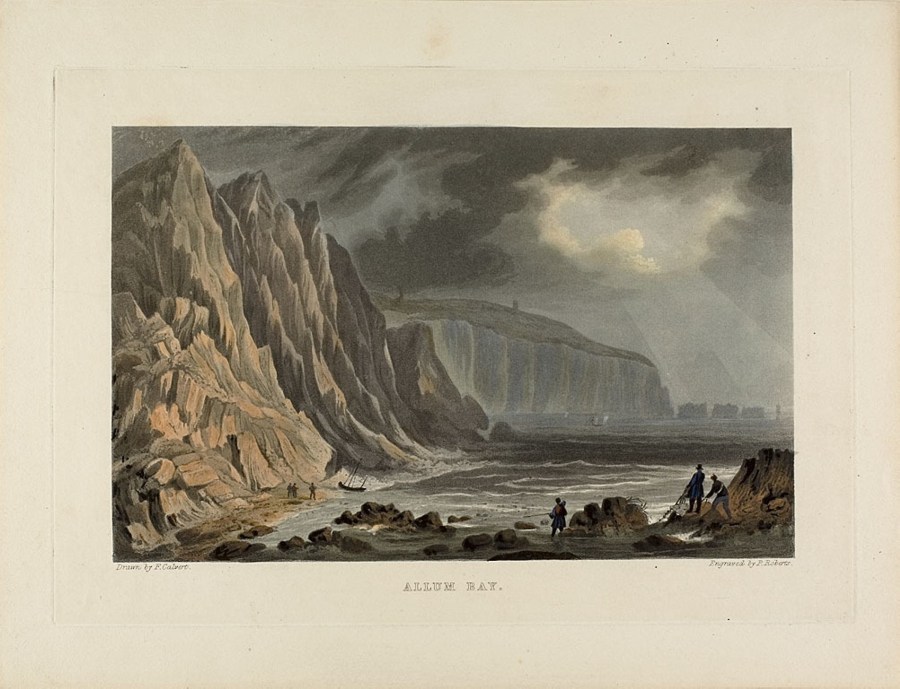
Feature image: P. Roberts. Allum Bay, c. 1794. The Art Institute of Chicago.

It’s probably hard to remember, but there once was a time when Hollywood took for granted from its audience a certain level of cultural knowledge. I mean high culture. Art. Literature. Classical music. My favorite example of this assumption occurs in a 1937 romantic comedy-drama called Angel, a generally overlooked film by the great German-born director Ernst Lubitsch, still admired for his inimitable “touch” in such stylish masterpieces as The Merry Widow, Trouble in Paradise, Ninotchka (“Garbo laughs!”), and The Shop Around the Corner. His earlier Lady Windermere’s Fan, based on Oscar Wilde’s play but without any of Wilde’s dialogue (just as my nominee for the greatest Shakespeare movie, Kurosawa’s Throne of Blood, hasn’t a line of Macbeth), might be the most sophisticated silent film ever made.

In Angel, the glamorous heroine, played by Marlene Dietrich, perfectly cast, is married to a British diplomat (the touchingly stolid Herbert Marshall) who devotes more time to the League of Nations than to his wife. She loves him, but is frustrated by how much his desire to save the world from war   has blinded him to his need to save their marriage. So she slips off to Paris to visit an old friend, a Grand Duchess (Laura Hope Crews—soon to be Gone with the Wind’s Aunt Pittypat) who runs a social (very social) club where people connect anonymously (there’s a delicate post-Production Code innuendo that Dietrich may have been an active member of this “private club” before her marriage). On this impulsive visit to Paris, she meets at the club Melvyn Douglas, who instantly falls for her. Hard. Since she refuses to give him her name, he calls her “Angel.” Their negotiation for their first rendezvous has some of the film’s most deliciously teasing double-entendres (screenplay by Samson Raphaelson). But Dietrich becomes frightened by the intensity of this fling and disappears, returning to London without even saying goodbye, leaving Douglas no way to reach her.

Read More

Acting the Truth

by Linda Bamber

Feature image: Circle of Giuseppe Cesari, called Il Cavalier d’Arpino. Angel Playing a Flute, 1580. The Art Institute of Chicago.

Angels

Beautiful slim girls dressed in gauzy white, hands touching, dancing around an invisible Maypole. High voices singing. The girls themselves are not to blame for their performance of perfect white womanhood; but what a handy excuse for all kinds of racist bullshit.

Cut to a man in the audience, watching. He has been gifted with every gene there is for male beauty, but by this point in Long Night’s Journey Into Day (2001) his expressionless face looks nothing short of criminally stupid. He is one of the Boer policemen who murdered four anti-apartheid activists in the rural town of Cradock, South Africa. Then he poured gasoline on their bodies and burned them. We have come to know two of the dead men’s wives pretty well. They are thoughtful, intelligent, sober and articulate; their suffering is unmistakable and intense.

Long Night’s Journey Into Day is a documentary about the Truth and Reconciliation process in South Africa. As an early inter-title explains, those who committed crimes under apartheid (mostly white) wanted amnesty when it ended. The Truth and Reconciliation Commission (TRC) was established  as a compromise, offering the perpetrators amnesty in exchange for the truth. Shockingly, eighty percent of those requesting amnesty were black. Where were the whites? Eric Taylor, the handsome Boer policeman, can at least be commended for cooperating with the process. But the wives of the “Cradock 4” opposed his request, and their lawyer caught him in a meaningful lie, so in his case amnesty was denied.

Read More

New Ohio Review Issue 9. Originally printed Spring 2011.

Newohioreview.org is archiving previous editions as they originally appeared. We are pairing the pieces with curated art work, as well as select audio recordings. In collaboration with our past contributors, we are happy to (re)-present this outstanding work.

Issue 9 compiled by Gryphon Beyerle.

Fly

By Joyce Peseroff

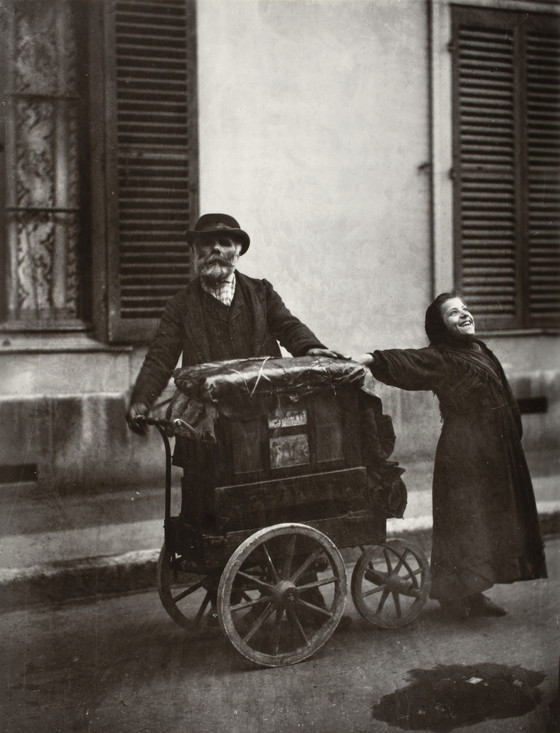
Featured art: Street Musicians by Eugène Atget

A small fly hung around my kitchen mid-October.
It didn’t buzz. Outside wet shape-shifted, drop to
flake: knock-knock of rain, a who’s there of snow.
The fly tiptoed on the meat-cutting board where I aimed
to smash it like a head of garlic. It bounced wall to wall to
wall, baby trapped in the balloon that was a hoax.
Was it my mother’s perturbed spirit warning me that blood
stains? Of course not. Last of its kind, Robinson Crusoe landing
on a kitchen island, the fly needed to be warm.


Read More

Happiness

By Ellen Bass

Featured art: Indian Mother with Her Child by Adam Clark Vroman

I had a student once who was so depressed
she wanted to die. She was a young single mother,
lonely, poor, watching other girls
go to parties and bars while she was home
cutting the crusts off peanut butter sandwiches,
reading The Berenstain Bears and the Bad Dream.
Then she collapsed with heart disease
and spent the next few years waiting for a transplant.
The strange thing is, now she was happy.
Every day, almost every breath, was semi-ecstatic.
She was a modern-day Chicana Rumi,
hanging out with the Beloved, grateful just to touch His hem.
I find I’m telling myself all the time now,
look how you lift one foot and then the other,
all the nerves and synapses firing together.
Look how you reach for a carton of blueberries
and eat each dusky globe, one by one.
Look at the spotted dog tied to the newsstand,
drops of saliva sliding off his tongue,
and the cracked Bic lighter in the gutter
shining a watery turquoise blue.
Even when your heart is a used teabag
you can lie down in a warm bed,
even though you cry half the night
with the window open a little
to let in the stars.


Read More

Solstice

By Maya Sonenberg

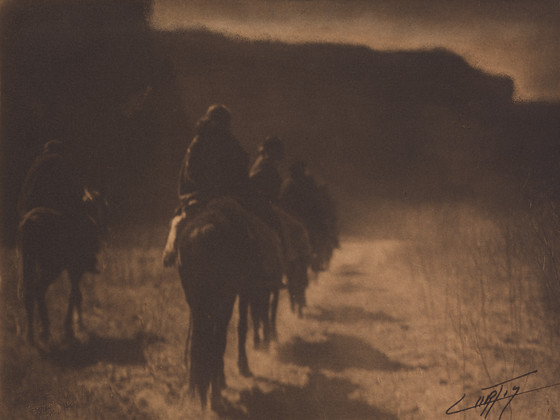
Featured art: The Vanishing Race (Navajo) by Edward Sheriff Curtis

Eight o’clock, nine o’clock, ten o’clock on a summer evening—it’s time to close the eyes, allow the breath to deepen, and sleep. The neighbor’s cat sleeps under the camellia bush and the neighbor’s baby has given up her screaming and sleeps in her crib; the hummingbird babies sleep in their nest perched on the Christmas-light wire strung across the porch ceiling; boys and girls everywhere put on their pajamas and brush their teeth; grandparents, all four of them, rest underground. In this house, though, the children call for glasses of water, kick off their sheets and pull them back up, ask for stories about the grandparents they’ve never met, count airplanes going in for a landing at SeaTac, their red lights blinking down through the trees, tell each other jokes through their open bedroom doors, and throw pillows at the back of any parent who dares suggest it’s time for sleep. Yes, darlings, you’re right: while light still fills the sky and the first star appears and then the others, and while your parents sit on the porch steps with their glasses of wine, trading stories, it’s impossible to think that this vast middle—life—will ever end, that anything will ever die. Now, before dark sets in, watch all the colors fade to gray: the last stripe of orange sunset in the west; the blue sky pulsating overhead; the cedar and eucalyptus and dogwood all dissolving into dark—a gray and then a darker gray that is the color of our house walls, headstones, and storm water rushing over Snoqualmie Falls. At the falls today, after playing in the hot sun and the icy rocky riverbed, attempting to catch minnows, you hiked the slowest hike in all creation back up the steep slope you’d run down an hour before, scuffing the gray dust with your toes, and moaning about your aching legs and parched throats and sweaty backs and lack of ice cream, but once we got back to the city, you decided you hadn’t had enough of the outdoors and insisted we stop in Volunteer Park where you, Ezra Jacob (grandson of Jack and great-grandson of Jake) and Phoebe Rose (granddaughter of Phoebe and great-granddaughter of Rose), sat side by side on the swings and pumped yourselves up and up and almost out over the fence separating the playground from the cemetery, out over blackberry bushes and hydrangeas, out over the chain link and then the short clipped grass and the monuments, so that if you’d let go, you would have sailed toward a waiting angel who would lift her stone arms and catch you, happy for the chance to save someone, happy for the reprieve from guarding a grave.


Read More

What Comes Next

By Maxine Scates

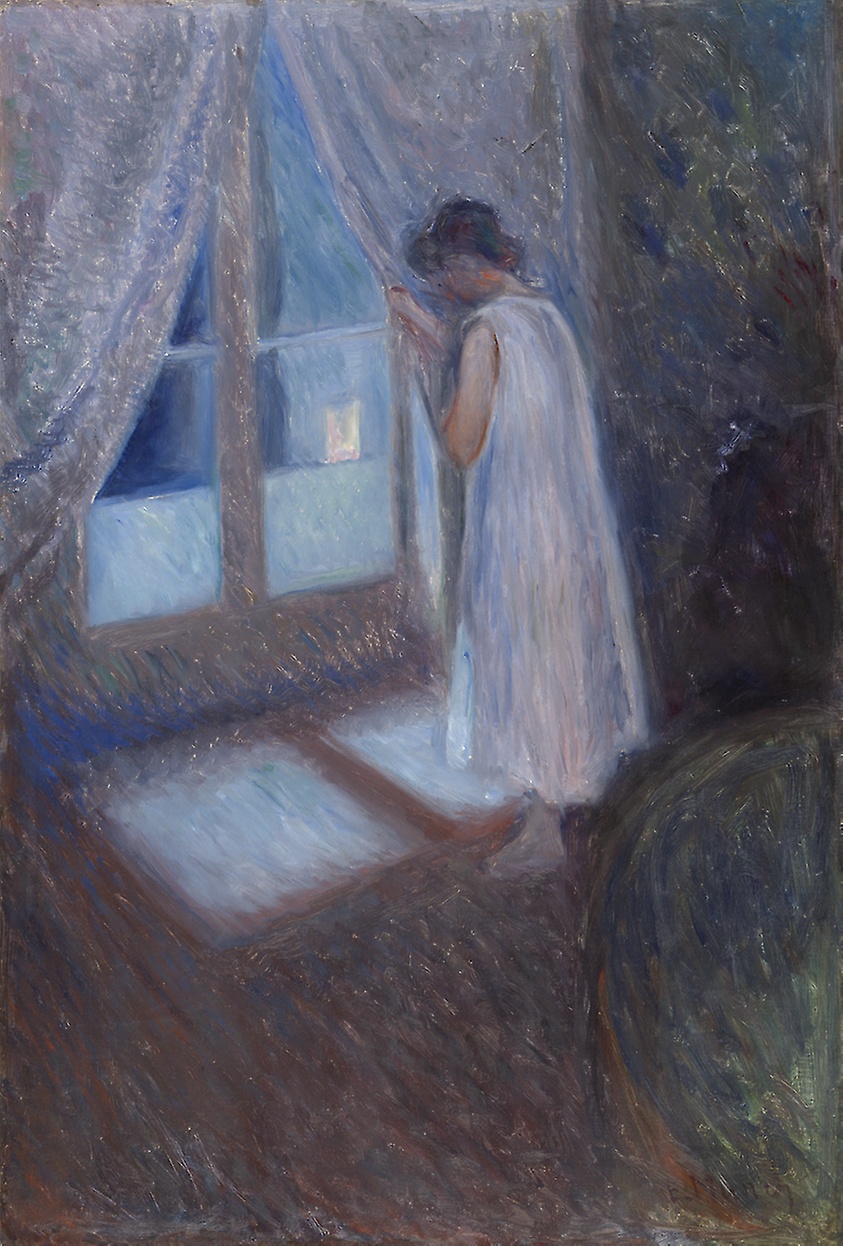
Featured art: The Girl by the Window by Edvard Munch

Life’s police car, lights flashing, on the sidewalk
in front of McDonald’s and two boys on the bus stop,

one boy moving quickly away from the other
who raised his hands and dropped his pack as the officer

approached, gun drawn. But how did the cop know
which one he wanted since both wore watch caps

and gray parkas and carried backpacks? He seemed
certain enough as he handcuffed the boy

then helped him into the back of the cruiser
his now gunless hand almost gently dipping the boy’s head

into what comes next, all we don’t see swallowing him,
the signal changing, day swallowing me until this morning

Read More

Luna de Miel

By Melanie Unruh

Featured art: The Herwigs by Edouard Antonin Vysekal

I like to practice what I’m going to say in therapy each week. The opening line is always the most important part because it has to be something attention-grabbing that still makes me sound stable.

I slept pretty well this week, except for Tuesday, when I stayed up all night watching a marathon of The Wonder Years. They played the one where Kevin touched Winnie’s boob.

It’s been six months, eighteen days, nineteen hours, and six minutes—give or take—since I last saw James.

This week I only made twelve lists.

My cat bears a striking resemblance to my therapist, but this isn’t because of their matching whiskers so much as the fact that they both make the same frowning concerned face when I tell them about my life. Boots and Dr. Andrews, who has tried without success, to get me to call her Maggie, are not formally acquainted.

Read More

Match.com/Matthew likes buttered toast, vulnerability…

By Elizabeth Powell

Featured art: Tujunga Canyon by Walter Elmer Schofield

My love lives in a little tiny box
Made of pixels and engineering. When I write him
He writes me back and when he writes me
Back, I write him. Even though we exist
Me/him, here/there: one day our band
Of consciousness will grow outward,
When science puts chips in brains
So all mysteries can be known—
Delusions, proclivities, sentences.
For now imagination a gangly vine
Grabs for a life. He has been so busy
Writing a narrative where he has no wife
That she has disappeared. So much first-person
Construct and banter. He has
A vixen schoolteacher held down
On the bed of his mind. And when he
Writes me he makes me
And when I make him I write him.
We are invented, in part,
By the wanting and not having
Of others. Soon someone else
Will pick him out of his little box
And begin again, wait for him
In the rain in front of the coffee shop
Where inside the donuts harden like
He can’t, and the red counter chair swirls empty
As if trying to conjure something so close.
But so close is almost, and almost is really
Far, still. She tries to pick him out of the crowd,
Ever hopeful, though night comes on like emergency.
And he is two places at once, virtual and real.
My love lives in a little box. Someone
Is making him
Into something else now.


Read More

Chemistry.com/Palmer is a Match–

By Elizabeth Powell

Featured art: Edna by Robert Henri

I knew you really wanted to meet me,
But I had the sneaky feeling you were an uber-Aryan
Chiropractor with homoerotic tendencies,
That maybe I should re-up with my academic
Asperger’s husband, and wear muu-muus on Saturday nights.
But I met you anyway before your snowboard race.
The style gel in your crew cut looked like ice,
Your red coat was puffy. You were disappointed
That my hair didn’t look like my picture. You implied
I was a liar. We walked down Main Street in Stowe
Past scented-candle-buying New Jerseyans
And Gnostic punk-rock townies eating baguettes,
My nose beginning to run in the cold,
Until we came to the cemetery and after you
Talked about your lying ex-wife, and your pretty ex-girlfriend,
You talked about a pair of little green baby shoes
That made you realize you were now too old
For children and I thought of the poetic
Significance of shoes, how used and alone
They stood for death. Your incoming text messages
Beeped us all the way to my car, which was German
But somehow not Aryan, where you told me good luck,
Shook my ungloved hand, then thought better
And gave me a hug
As if I were a patient on your ward.


Read More

Dear Doris Day

By Pamela Davis

Featured art: Untitled (Surreal Abstraction) by Benjamin F. Berlin

I trusted you to never change, when I was 15, and needed
to believe men and women sat up talking all night,
like the movie with you and Rock Hudson joking in a satin bed,

both of you in men’s pajamas you buttoned to the chin.
Alone in my room crammed with horse figurines, you
were all that stood between me and what hid under the sheet—

the straining warm blossom that held me in thrall. I believed
you’d always be Rock’s chum, immune to Cary Grant’s mink-
lined smile. I’d be like you, beehive my hair, keep my knees tight.

We could have driven forever, you and me and Rock
in a two-tone convertible he steered with his big, clean hand.
How could you fall for Clark Gable, a man with a moustache,

and clearly too old? A burglar’s eyes. Safecracker hands.
In the movie you played his teacher in twinset and pearls,
eyes big as pies when he cocked one leg over the edge of the desk.

I needed you to report him to the authorities, not follow him
to a nightclub. Later there would be torn sheets, cigarettes,
counting the days between periods. Bad men with keys.

But I never imagined you’d go out of style, show up in the tabloids
bloated and hazy, surrounded by stray dogs, and, last I heard,
living alone.


Read More

July 4th, 1984

By Maggie Mitchell

Featured art: Figures by Benjamin F. Berlin

Maddy is thirteen, almost fourteen. Her chest is as flat as a boy’s and she does not own a pair of Jordache jeans.

“I hate Fridays,” she tells her mother. What she means is that she hates everything.

“I know you do,” says Jude, understanding perfectly. “I’m not sure what you want me to do about it.”

“It feels like I’m in prison. There aren’t any windows in there.” She’s referring to her room behind the bar, to which she is more strictly confined than usual on Friday nights: Jude insists that she stay out of the way when it’s crowded. “I can hear people but I can’t see them.”

“Why would you want to see them? They’re adults at a bar.”

“But that’s all there ever is,” Maddy rails, not even caring if she makes sense. “Adults at a bar. I wish we could be normal.”

“That’s what you keep saying. You tell me what normal is, and I’ll see what we can do.”

Maddy whirls around and storms into her room behind the bar, daring to slam the door. She knows only what normal isn’t.

Read More

The Lecture

By Billy Collins

Featured art: Wrestlers by Thomas Eakins

If all of time were poured into a salt shaker,
human history could be represented by a single grain,
the professor of astrophysics claimed
as a shaft of light illuminated his head,

leaving me to marvel at how
there would be room inside for everyone—
for Mary Magdalene and Isaac Newton
and every month of the Hundred Years’ War,

and Andrew Marvell would have a place to think,
a garden in which to dwell,
and you would be in there as well
and your ex-boyfriend, the cheap bastard,

with his ridiculous sports car parked by a lake
in some small boring town and me
shaking the shaker furiously
over a plate of blackened fish and boiled potatoes.


Read More

At the Mall

By Carl Dennis

Featured art: Youth by Frederick Carl Frieseke

It’s a long time now since the cedar tree
That you and Martha Spicer inscribed
With your twined initials was reduced to shingles
For a house later torn down to make way
For the Northtown Mall, the very mall
You walk now on rainy mornings.
In a few more weeks of the exercise program
Prescribed by your doctor, you should feel the strength
Lost with your triple-bypass finally returning.
Then you’ll confront the years still left you
With the zeal they merit, or the fortitude.
Be sure you’re in line when the mall doors open,
Before the aisles fill with serious shoppers
Intent on finding items more sturdy
Than their bodies are proving to be.
Could Martha Spicer be among them?
What you felt for each other back then
Didn’t survive the separation of college,
Though now it seems careless of you
Not to have kept in touch. Maybe you’ve passed her
Unrecognized as she’s looked for gifts
To make her grandchildren curious
About the world they live in, a book, say,
Devoted to local trees. On the cover
A cedar stands resplendent, the very kind
She carved her initials in long ago
With a boy whose name may be resting now
On the tip of her tongue. Try to imagine her
Hoping he hasn’t wasted his time on wishes
That proved impractical, like her hill house
Bought for its vista that proved in winter
Inaccessible to a snowplow. If he made that mistake,
Let him move back to town as she did
And focus like her on keeping her windows open
So a fragrance blown from afar can enter
When it wants to enter, and be made welcome.


Read More

Forever

By Carl Dennis

Featured art: Soap Bubbles by Jean-Baptiste-Siméon Chardin

Even in Dante’s inspired version,
Heaven and hell don’t seem like regions
Appropriate for humans, being too static,
Too imbued with notions of the eternal.
Yes, for the sake of justice, the violent
Who get away with murder on earth
Ought to feel a heat more fiery
Than the coals of rage that burned inside them;
The betrayers of friends and patrons deserve a chill
Colder than the ice in their arctic hearts.
But shouldn’t their sentences have a limit?
Won’t their victims, the pillaged and trampled
And rolled to the wall, eventually grow
Uncomfortable in the balmy realm of the blessed
At the thought of their oppressors
In endless torment? Won’t they decide
A determinate stay is long enough?
It isn’t our place to stand in the way if Abel
Throws down a rope at last to Cain,
If Jesus takes Judas by the hand.
So hell, if imagination wins out,
Ought to be slowly emptying,
And then heaven as well, as the saints
Return to earth to help the sinners
Learn what damage they can undo
If they give themselves to the effort,
And what damage they’ll have to leave as is.


Read More

Engagement

By Adam Sol

Featured art: Reverie (Study for the Portrait of Frank Burty Haviland) by Amedeo Modigliani

The young man knows he’s going to die today, but he’s wrong.
The other young man figures the army is the best way to improve his life, but
he’s wrong.
They both think their weapons will protect them, but they’re wrong.
They both believe their prayers will help.

Their commanders have intentions and intelligence, but they’re wrong.
We’ve heard the story before. It’s wrong.
The news will document it, but it will be wrong.
The war on terror, the war on Islam, the clash of civilizations.

The explosion will exceed the necessity of the occasion.
The exchange of fire will be unbalanced.
The response will be disproportionate.
The reporter is factually incorrect, theoretically misinformed, morally reprehensible.

The clear typeface and perfect binding are misleading.
The reader is uncomfortably and inappropriately implicated.
The tranquil mind is insufficient to the task.
The young men, necks dirty and damp, advance.


Read More

The Ugly Law

By Jillian Weise

Featured art: Futurist Garden by Benjamin F. Berlin

Any person who is diseased, maimed, mutilated or
can I continue reading this? will it affect my psyche

so that the next time big Logos comes over
I will not be there in the room & instead I will be

wandering a Chicago street in my dress with my
parasol as a cane, on the verge of arrest, where arrest

could mean “stopping” or “to keep the mind fixed
on a subject,” where the subject is the diseased,

maimed, mutilated self of 19th-c. Chicago, the self
in any way deformed so as to be unsightly

& will I tell him to stop looking, tell him I’m tired
& I’m about to be arrested for walking in public

& I can’t possibly climax when I am an improper
person who is not allowed in or on the streets,

highways, thoroughfares or will he say we’re alone,
no one is watching, there is your bedside table

& there your mirror & who am I kidding? I won’t tell
him anything. There is no room in bed for this.

Read More

Abundance

By Chelsea Rathburn

Featured art: Elephant Combat by an unidentified artist

The island seemed in permanent full bloom.
Through hairpin curves, our driver pointed—mango,
lime, poinciana—this one hanging low,
that one as bright as flames. And in our room,
a riot of blossoms. Across the bed, hibiscus
letters spelled out Congratulations. Welcome.
Bottles of champagne, pitchers of rum
punch. Why would we bring up poverty or loss
or the scorpions we pounded with a shoe
by the bathtub drain, small and densely black?
We ate golden apples, and had a view
of the mountain from the shower. On the third day,
darkness dropped from my towel. I jumped back:
a welcome-flower no one had swept away.


Read More

How It Happened

By Chelsea Rathburn

Featured art: Girl in Checkered Dress by George Benjamin Luks

I blame that little village in Spain,
the one with the whitewashed houses
in a crescent along the sea,
a fleet of pastel fishing boats,
and that celebrated coffee with brandy.

A sour wedge of apple lurked
at the bottom like a tea-leaf fortune.

Because we couldn’t afford the fish
we ate pizza with peaches and oregano
on the beach, the sun and breeze conspiring.

Seeing us there beneath the cliffs
and the postcards of the cliffs,
who wouldn’t have predicted luck and beauty?
Can I be blamed for loving it all
and thinking it was you I loved?


Read More

Amerikanka

By Maria Kuznetsova

Featured art: Seated Female Nude in Profile, Bending Forward by Arthur Bowen Davies

I met a man in Russia, after my father’s funeral. It was only appropriate.

Papa always knew how to make things harder for me and I didn’t see why his death should be an exception. This is how it happened: after the service, I was taking a walk through the cemetery, hoping to get lost. The throng of admirers and chemistry colleagues had left long before, and it was just me there, staring at the grave of this little girl who died on her second birthday. I don’t know how long I must have been standing there, considering this, when I heard a voice say, “Excuse me, Miss. You dropped this. And this. And this.” A man came up from behind, holding my wallet, my passport, and the headphones from the airplane. He gestured toward my purse, which was hanging open.

Read More

Wet Carpet Awakening

By Kevin Stein

Featured art: Europeans Embracing by an unidentified artist

Cursing the stubbed-toe 2 a.m. call—my father?—

I picked up a woman’s feather-brushed gush, “Wilbur,

it’s a grandson! Jamaal José O’Bryant.”

And I, unhappily not Wilbur, croaked Wrong number as one does

when plucked frog-eyed off sleep’s lily pad.

She was old. Who else misdials the pay phone’s tiny numbers?

Who else marries a Wilbur, their grandchild an American blend?

Outside rain misted not cats and dogs but litters of kittens.

Her lavender sachet apology, my bed-headed threnody,  my 

No problem, and click. Lightning cracked night’s black egg

in halves I couldn’t tap back in place:

My father’s dead. I’m next.

Revelation arrives like that, thunder trailing the flash.

I rode the open window’s wet carpet awakening,

storm flipping its toggle above the wind-blown yarrow,

electric as any newborn. Shaggy, late autumn, nearly gone-to-seed-

bloom, naked ecstatic.

I floated my trial run out a window the rain had come

in. When the dark made light of me I was.


Read More

Playing My Part

By Sharon Dolin

Featured art: Dancers by Edgar Degas

I let him go. I complied. Adjusted. Saw. Did not see his disappearing
act of staying while leaving the body. It felt so familiar.
My zombie-mom (on Stelazine, Thorazine to tamp

her paranoia down), would be there/not there to make
macaroni and cheese, do the wash, help me with my Spanish.
I knew she was sick, I knew she loved me though she lay in bed until noon,

again in the afternoon, comatose with the New York Post, her arm bent
at the elbow to cover her face. This was what love could feel like—
somnolent, absent. Why be paranoid when he slept in the same pose.

Sometimes cooked dinner, did the wash. Who knew a blunt face
could hold so much hate. The child in me saw his numbing out,
going to bed early, not as aversion but a version of my mother’s love

and all I had to do—as when she’d be taken away, hospitalized, shocked—
was wait for his return. (Is there a Penelope inside every troubled wife?)
Didn’t my mom always come back?


Read More

Palimpsest

By Todd Hearon

Featured art: Purple Stylized by Hannah Borger Overbeck

What was the tongue we spoke when the lotus first
unfolded from the navel of the god, the one who dreams
the universe, and in whose ear we must have whispered
our hunger to hold each other? What were words
must now be reflex, shudder, blood, be impulse, pulse
a palimpsest of longing written over
eons, eons ago. If we could scrape
back bone, back blood, back breath to the original
dust the dreaming god himself has long
become, the universal dream a drift of ash
settling in some dark corner of the sun,
would we find ciphered there the DNA
relation to the tongues we speak today
when we want words to say what words can’t say?


Read More

Hominid Up

By Neil Shepard

Featured art: Portrait of a Man by Wilhelm Morgner

I write at night when the old hominid
climbs up to the highest branch of the brain

and crouches there in a leafy crotch
listening to the night-sounds snarling below . . .

his heart outracing the big cats of the savannah.

He’s glad I’m civilized and live indoors,
far from the tooth and claw. Glad my central

plumbing works, my TP dispenser full,
so he doesn’t have to shit off a limb,

wipe his butt against rough bark or let it cake.

Read More

The Two Lances

By Scott Nadelson

Featured art: Disturbed by Henry Keller

The summer I should have hit puberty but didn’t, I went to a Jewish sleep-away camp in the Poconos. It was an uncomfortable summer for me, full of insecurities, and not only because of my = slow physical development. Most of the kids in camp came from Westchester and Long Island, and even if their families weren’t much wealthier than mine—we were solidly upper-middle-class—they
showed off their wealth in ways that mine never did. Their parents dropped them off in Mercedes, BMWs, even the occasional Ferrari. Around their necks they wore 24-karat gold Chais and Stars of David. They were obsessed with brand-name clothing—Guess, Polo, Benetton. They talked about vacation homes on Nantucket, Cape Cod, Hilton Head. They had rolls of cash to spend at the camp store, which sold shampoo, toothpaste, soda, and candy.

Now, of course, I can see that such displays of wealth were signs of insecurity in their own right. These parents were the tacky rich, desperate to prove how high they’d climbed, and their children were spoiled and snobbish, nothing to envy. And how rich were they really if they had to ship their kids off for eight weeks of every summer to a camp subsidized by the Young Men’s Hebrew Association?

Read More

Any Time Soon

By Joshua McKinney

Featured art: Maine Landscape by Preston Dickinson

Folks said it was about the worst thing anyone in our town had ever done.
Afterward, friends stopped calling and wouldn’t answer their phones. Coworkers
avoided me. My accounts folded and the VP asked for my resignation. I moved
out, rented an apartment on the bad side of town. Had my food delivered. Only
went out at night. That was months ago. Lately, I’ve taken to going out days.
But in disguise: dark glasses, Raiders cap, knee-length trench coat. I sit on a
bench in the park and feed popcorn to the pigeons and squirrels. I never have to
wait long. Somebody will amble by and make small talk. Ask if I’ve heard about
it. An old man tells me my wife cried so hard a vessel burst in her eye. A girl in
a tracksuit says a neighbor chased me down the street with a tire iron. A red-
haired woman, who looks vaguely familiar, says she heard that after it happened
we had to put our German shepherd to sleep. That the crepe myrtle by our front
gate blighted and died in the span of a week. I’m not sure how much is true.
“One thing’s for sure,” she says, “folks around here aren’t going to forget any
time soon.” I tell her I probably don’t want them to forget. I say that I probably
feel more alive than I did before, and some people will do anything to feel alive.
A pigeon flutters to rest at the end of my bench. I tell her I’ve heard I lost my job
but still live in town. I say I’ve heard I have taken to venturing out during the
day. That I might be wearing a disguise.

Read More

Soul Patch

By Tom Noyes

Featured Art: Two Nudes in a Room by Ernst Ludwig Kirchner

Fresno, Fargo, Toledo. Albany, Tallahassee, Boise. I hit every town in a tux. When the crew and I crash the wedding—I try to time it so I’m rushing the aisle just as the bride and groom lean in for their kiss—the church erupts in confused gasps and worried whispers. Eugene, my best friend and agent, himself a three-time groom, holds the opinion that, in terms of nerves and anxiety, weddings are worse than funerals. With a funeral, what’s done is done. With a wedding, futures are at stake.

E’s theory of weddings could explain why things get hairy sometimes for the show and me. Three seasons ago in Dallas, the bride’s stepfather, an off-duty ATF agent, stood and drew his service revolver just as I reached the altar. Last season at a synagogue in Baltimore, one of the groomsmen, a former D-1 linebacker, took a running start and squared me up, yarmulke to sternum, knocking me flat and breathless. Usually, though, the spectators, ushers, bridesmaids and clergy recognize me, and relief sets in, and then euphoria. Kingsley Carter and his show New Digs for Newlyweds is in the house, and it’s all good.

Read More

New Ohio Review Issue 8 (Originally printed fall 2010)

Newohioreview.org is archiving previous editions as they originally appeared. We are pairing the pieces with curated art work, as well as select audio recordings. In collaboration with our past contributors, we are happy to (re)-present this outstanding work.

Issue 8 compiled by Ellery Pollard, Julia Smarelli, Benjamin Bird, Callie Martindale, Sarah Hecker, and Brady Barnhill.

Minding Rites

By David Yezzi

This guy I know, a rabbi, Friday nights,
on his way home against the sun in winter,
always stops at a florist or bodega
to buy a bunch of flowers for his wife.

Every week the same, a ritual,
regardless of her mood that morning, fresh
upsets at work, or snarling on the bridge;
he brings her roses wrapped in cellophane.

But isn’t there a ring of hokiness
in that? Why should a good man make a show
of his devotion? Some things go unspoken;
some things get tested on the real world,

and isn’t that the place that matters most?
So when you told me I should bring you flowers,
I laughed, “But don’t I show my feelings more
in dog-walks, diapers, and rewiring lamps?”

The flowers, I learned later, weren’t for wooing,
not for affection in long marriage, but
for something seeded even deeper down,
through frost heaves, and which might be, roughly, peace.

(It’s funny that I just assumed romance.)
Now there’s no peace with us, I wonder what
they might have meant for you, those simple tokens,
holding in sight what no rite can grow back.


Read More

A Giant Bird

By Kevin Prufer

Its great heart pounded like the distant sea
wounding itself against the cliffs.

+

We lived in its shade.

Sometimes, my daughter ran her fingers along that part of the breast
that swagged low over our camp.

It’s beautiful, she said, smoothing a feather’s twig-like barbs,
gazing past our mountain toward the burning cities.

+

What kind of bird is it?
                Some feathers were tawny, others tinged a perfect white.
Is it a sparrow?
                It may be a sparrow.
Is it an owl?
                I can’t see its face.
An eagle? I think it’s an eagle.
                                We often played this game.

Read More

Ocean State Job Lot

By Stephanie Burt

No one is going to make
     much more of this stuff now, or ever again.

Graceless in defeat
     but beautiful, harmless and sad
on shelves that overlap like continents,

these Cookie Monster magnets, miniature
     monster trucks, scuffed multiple Elmos, banners

that say NO FEAR
     and A GRILL FOR EVERY BOY
are a feast for every sense.

Some would be bad manners
     to give or bring home-

Read More

The Fake I.D.

By Scott Garson

She didn’t believe that anyone could believe that she was this person. This person had a weighty face. It looked weighty. Full of bone. The name was “Danna”—Danna Hollenfar.

Danna was, by printed date, twenty-two years old. In the photo her mouth and nose were pulled to the left, as if she was resisting a joke. But her eyes looked frank and hard.

“Danna Hollenfar,” she said out loud. She was doing her eyes in the mirror. “1311 Rand Boulevard.”

The boy at the door of the club, however, was too coked up to ask questions

Read More

Is That You, John Wayne?

By Scott Garson

The day kept changing. The sky would close in virtual dusk and thunder from the other side of the river would rumble the sodden hill. Then something would open. For a while the birds would sing their song to the shining grasses.

“Who are you going to believe?” she said. “Me or your own eyes?”

He turned from the window. He said, “Duck Soup?“

“Only bad witches are ugly.”

“Too easy,” he said to her. “Wizard of Oz.”

She lay on the wrinkled futon-couch and worked a gathered lock of her hair into a very tight braid. She wore underwear and her breasts spread out within her tank top, which was charcoal gray.

“We didn’t need dialogue,” she said.

“We had faces,” he responded, “Sunset Boulevard.”

“You’re somewhat good at this, aren’t you?”

“Somewhat?”

He was joking but his heart wasn’t in it. Through the screens, the light was in sudden decline, as if the fires of the sun had been doused. The Live Oak tree was a hex in the gloom and the bushes on the hillside were graves. He wondered why he felt like he’d known her for so long. He wondered what they were doing for dinner. He wondered when he’d felt like he thought he would feel at his age, which tomorrow was thirty.

Read More

All About Skin

By Leslie Adrienne Miller

On a reasonably sized female adult,
two square yards of the stuff,
all etched with nerves of wild
to be roused, altogether the largest
organ in the body. Unless you count
the considerable accumulation
of disappointment that sprouts
as fast as creeper in a chemical-free
yard. Or all those useless tears,
salt and mucus and plain old water
manufactured by the ducts every time
hurt shows up for dinner, rather more
often too, as the years advance,
putting his feet on the sofa,
leaving dishes in the sink. Perpetually
twenty with his tight ass and gorgeous
hands, he invents longing like a tall tale
and gets us to drink one more glass
of merlot than we’d meant to tonight.
If only we had more feathers and horn,
that sweet jacket of woolly lanugo we wore
in the womb and swallowed like a marvelous secret
just days before the world turned on the lights
and pronounced us girls.


Read More

Carnival Nocturne

By Mark Wagenaar

Peanut shells crackle beneath your pink slippers
as you pace. The players behind routines of a different sort
long after the show is over, long after the spectators
return home, their caricatures slipping from their grasp
as they unlock the front door. Teeny the strongman
is calling the torn names in the phone book
he ripped in half, as Vasserot listens outside, smoking
a cigarette with his left foot, his arms a phantom
presence he feels each time he reaches for another can
of peaches. Karlov the Great has gone to bed
regretting his dinner, three light bulbs & a seven-foot
feathered boa, while in the next room Madame Sossman
is about to win a red nose & a pair of floppy shoes,
unless Noodles can beat three Hangmans.
Monsieur LeBeau stands in the big tent, still listening
to the cheers of the departed crowd. His daughter
won’t return his phone calls, but tomorrow
will bring a new town, with a different name & story,
where anything is possible, & tonight the stars’ white flames
burn on their blue wicks – she’s out there, somewhere,
the one you left behind on the Serengeti, in the night
that paces in a circle with its one black shoe, beneath wires
no one will ever see, the sickle moon’s ivory
as beautiful as your tusks once were.


Read More

Living with the Dead

By Patrick Hicks

She was naked on the embalming table and I just couldn’t stop staring at her nipples. This happened two years ago when Ginny Pazinger ran a red light while she was text-messaging a friend. One of those big SUVs ran into her car and she spun around the intersection like a top. Shattered glass and chunks  of vehicle burst into the air, explosion-like. My family has been in the funeral business since 1882 so we expected Ginny’s body to be banged up pretty badly, we thought it would be a closed casket for sure, but her remains were in good shape thanks to the side airbag.

Read More

Always a Little Something Somewhere in the Purse

By Julie Hanson

I couldn’t determine her age. She was trying not to look me in the face.
I was approaching a bank of blue seating at Gate B-8,
her bank of seating, and I sat next to her.
I got out my glasses and reading.
I put them back in my bag.
How could I read when the woman seated next to me and trying not to cry
was only mostly succeeding?
I rustled through the inner pockets of my purse
until I found the travel pack of tissue, crumpled from the years,
flecked with leather dust. But as I offered it up, I saw that she, Thanks, anyway,
had already produced her own.
Isn’t that just like us?-always a little something somewhere in the purse
which can’t alter reality in the large sense
but might help us along in the small.

Her phone rang.

She wiped her nose and answered with her name.
No, she couldn’t show the split foyer this afternoon,
but Cindy in the office could.
Some kind of confidence had happened in her shoulders. And her voice:
genuine, helpful. She specified the freeways to avoid and better ways to take.
It sounded like L.A.
Her voice played the notes of continual possibility.
There was one more door at the end of disappointment,
and this might be it, it just might. Hearing her speak,
there isn’t a client who wouldn’t have straightened a bit,
curiosity increased.

She slipped her phone into her bag and rearranged her legs.
I glanced obliquely to our right and said,
“You handled that awfully well, Karen, under the circumstances.”
Then she told me everything.

O’Hare International Airport


Read More