After the handmaidens, blindfolded and proceeding by touch alone, have twined the masses of string across its enormous silvered surface, then the mirror-keeper, also blindfolded, sets a lit match to the central knot.
When they sense that the whole skein is ablaze, they bear the burning glass to the lake’s edge, and lower it into the icy shallows where the mirror-keeper strikes a single blow, shattering it along every line at once.
Then they lift it in its frame from the water to tap and test its face with their tongs, plucking out the fragments, swaddling them individually in silk to be dispersed throughout the land.
Now instead of making pilgrimage in order to not look into the virgin mirror, each family can cherish a shard to not look into without leaving home.
Featured Art: The Breeze at Morn, 1930 by Thomas Lowinsky
And here we see where the pages of the ocean were torn from their logbook as if in meticulous rage, though there’s no debris adhering to the binding, as might so easily have been the case. What to do with this stiff and empty cover? Pack it with snow and staple it all around, so it can retain its shape until the committee rends it open and shakes it out face-down, inviting the ragged pages to return in just the right sequence from every place they’ve flown.
Featured Art: Voyages of the Moon, 1934-7 by Paul Nash
No one knows its origins. Like carpools and happy hour, the Plan has simply always been. Its awkward page breaks and stilted phrasing, preservation of failed projects, employees
long departed, are evidence of its ambition, how it defies the limits of language, software, human thought. No one has ever read the Plan in its entirety. Attempts to download it
result in system crashes, sunspots, and recession. A single hard copy is rumored to exist, its pristine pages collated and punched, then stored in binders ordered on a shelf—
but no one knows exactly where. A hundred years from now, when the company has ceased to be and its headquarters crumble, the Strategic Plan will rest among the rubble waiting to be found.
Lacking an exact translation, its runic nature will give rise to cults that worship its straight lines, its acronyms and colored fonts. It will not inspire war, only art and rumination.
No one who encounters the Strategic Plan remains untouched. It features in the dreams of former employees who understand too late its vital truth: Every aspect of the Plan—
its ever-shifting goals, its layers of revision and appendices—acts as both map and goad. The Strategic Plan is perfect even in its flaws. It isn’t meant to be fulfilled.
Dad has three different chainsaws and Kevlar shin pads, the same glossy material protecting a spacecraft as it drifts into the Kuiper Belt where little flecks of undead planet fling around like buckshot and light from the sun takes a while to arrive.
I am glad that my dad is safe from the Kuiper Belt. Eventually something else will kill him, but for now he is cutting firewood into precise sizes. He is wearing a wide-brimmed hat. I am rubbing aloe into my own growing forehead, trying not to believe
that he grew up in the only town hit by a meteorite twice. One punched a hole in a roof then rolled under a table like a peach. The other lodged in a crossbeam that might well have been
his sleeping smile or the windshield of his idling El Camino. He’s asked that I sprinkle him into the woods when that something else falls from the sky like a bucket of nails.
Featured Art: The Keynote, 1915 by William Arthur Chase
It takes almost nothing to step into each other’s lives: a favor for a neighbor, a huge, upright Steinway there’s no one left to play.
All morning they labored together, the men. Everything they could think of to get it out of the van and over the curb— metal ramp, wooden boards, a jack, the old bed frame from behind the garage.
Dave had never asked my husband for anything before. The house he’d grown up in was already packed, mementos sold, his mother’s mind
skipping liberally among the decades, her fingers running through chords in the air or waltzing grandly through measures of Chopin. His father stooped from his own burdens, aged beyond his years, nodding when people talked about his new facility, so highly regarded, so clean. There was sweat, grunting,
my husband mumbled a curse as they argued about angles, pushed their charge up the cracked walkway, three shallow steps to the porch.
And because we have no better idea how to be with each other in our pain, when they’d finally struggled the monstrous instrument into Dave’s house, they could only wipe their hands on their jeans, crack their knuckles, and share a pizza, which they ate standing in the kitchen, hunched over its grease-stained box.
Featured Art: Oberon, Titania and Puck with Fairies Dancing, 1786 by William Blake
Rockin’ in jeans, T-shirt, and sneakers at the tiny bandstand by the pond, the ponytailed girl belts them out, the goldies of three or four decades ago. She’s hittin’ ’em with her best shot, makin’ it all hurt so good, but a closer look shows she’s no younger than the songs she sings, though not as old as most dancing on the worn-out patch between their lawn chairs and the stage this final Friday Night Live of a brief summer that in these parts is rarely without a hint of the fall.
The dancers, moving gingerly, stiffly, grin in unabashed acknowledgment that the tempo hasn’t changed but they have. One white-bearded fellow’s denims droop at the seat despite his tightened belt and taut bright suspenders, and an old lady stands at her walker and sways, dreamy-eyed, perhaps recalling, perhaps not, that these are the tunes not of her own youth but her grandchild’s. Beside her, a stout, gray-haired woman, no doubt her daughter, mouths the words, smiles, and holds her mother’s hands, steadying her as they move together to “Every Breath You Take.”
The surrounding mountains dim and the nearby pond (a broad, deep lake, really) reflects the stars. At its center sits an island, thickly wooded, uninhabited. As the sun moves on, the elderly drift away, and younger kids step in, accepting, for tonight at least, a mellowed groove. In time, the last notes of the final Friday Night Live will float out over the water. The dancers will linger briefly, then depart, grateful for the music they’ve been given.
Featured Art: Sleeping Bloodhound, 1835 by Sir Edwin Henry Landseer
“We may be in the universe as dogs and cats are in our libraries, seeing the books and hearing the conversation, but having no inkling of the meaning of it all.” —William James
On sunny, cerulean days I go all the way to eleven when I stretch and sniff among the leaves, whereas you stay inside, hunched over your moral universe. Old girl, if you stopped trying to decipher those fossil bird tracks, you might see the thermal-gliding hawk above or that zaftig possum gnawing on fallen persimmons under the window. I’m just saying your preference betrays a certain fear of your own nature. Remember last summer when you left me in the car to pick up a book they were holding for you, and a page or two in you recognized your own penciled and may I say obsessive marginalia, although you had no memory of the text itself? Whatever made you think your mind could be disenthralled with words? As a pup, I once took Mark Strand’s injunction in “Eating Poetry” to heart, devouring one or two slim volumes, but soon realized I prefer the raw material of life, what e e cummings calls “the slavver of spring”: smells of fresh earth, the ghostly scent of rabbits, even the mounds of dirty laundry piled up on your bed. If you found answers to your questions, do you truly believe those answers would transform you? So many of your species seem susceptible to revelation. We’re all browsers, old girl, without an inkling, waiting by the door for a treat or to be forgiven until our unleashed immortal part bolts for that hit of dopamine. Then all good dogs go to heaven.
Featured Art: Girl in a Blue Dress, c. 1891 by Philip Wilson Steer
In one photo, she’s wearing a sapphire blue dress, a black cloche posed rakishly over one eye, a corsage of pink rosebuds around her wrist. On the back it says JB & RPS, the man in shadow next to her. This was before the war, before they reinstated the marriage bar and she lost her job when she married my father.
One hot summer night, maybe five years after he died— we’d stripped down to our underwear to play Scrabble— I asked her about grad school and her fifth-floor walk-up with Mary Maud, about eating oysters at the Grand Central Oyster House every Sunday, and the gold lighter engraved in the Tiffany font at the back of her jewelry box, and I asked her if she’d ever slept with anyone besides my dad.
She took an extra long sip of her G&T and told me to mind my own business. Then reached over to put her X on a Triple Word.
the trees flaunting their flowers after a while their blooms will die and then swell into a fruit and I submit to you dear viewer this process is not monstrous
we’ve spent too much time
at night watching these shows where the queens keep making bad choices like torching the city with their pet dragons or with sickly green fire lit in tunnels underneath because they are mothers
they love their children too much or is it
not enough the flowers this spring are ridiculous on the way into the theater alone in broad daylight for some comic book sequel I can’t stop shoving my face into the showy pink organs of the parking lot trees
at night I’ve been balancing like a knife on my side of the couch the bed because I’m too tired already to have anyone really touch me
Because it’s Thursday, nearing five o’clock, Lucie is well into a doozie of a headache. Every week at this time little Jenny Baker hands her one as they sit side by side in the dining room and Jenny busily tortures the piano. She’s a narrow slip of a thing with a distracting, gum-baring smile made stranger today by a drift of tiny metallic stars sweeping across her cheeks like cosmic freckles.
Her orange high tops smack the stool’s taloned feet bapbap as she bludgeons the keys in an apparent heavy-metal version of “Long Long Ago.”
The piano, old and patient, takes it. Lucie, who is neither of those things, says, “A bit slower and softer now. See if you can find the melancholy.”
She uses her hands to play a phantom keyboard floating in the air. She must look ridiculous. “Sing the words if you like. I find that helps.” She is ridiculous.
Jenny, clearly having the same thought, grins at the keys, speeds up and hammers away. She doesn’t sing. She never sings.
What ten-year-old doesn’t sing?
But of course Lucie is confusing children with birds, Jenny with Bacchus, her grandfather’s sidekick and belter of sea shanty and Broadway schmaltz. Since moving back home, she has learned far more about thirty-year-old African grey parrots than about ten-year-old humans. Prefers them, too, if truth be told, even if they do bite. Lucie understands that people would find that small of her. But this ten-year-old human next to her couldn’t care less. A look of near madness flashes across the girl’s starry face. Her thin hair switches about her neck like an agitated tail. She’s seeing herself onstage, adoring fans at her feet. Next she’ll be peeling the stars from her face and tossing them to the crowd.
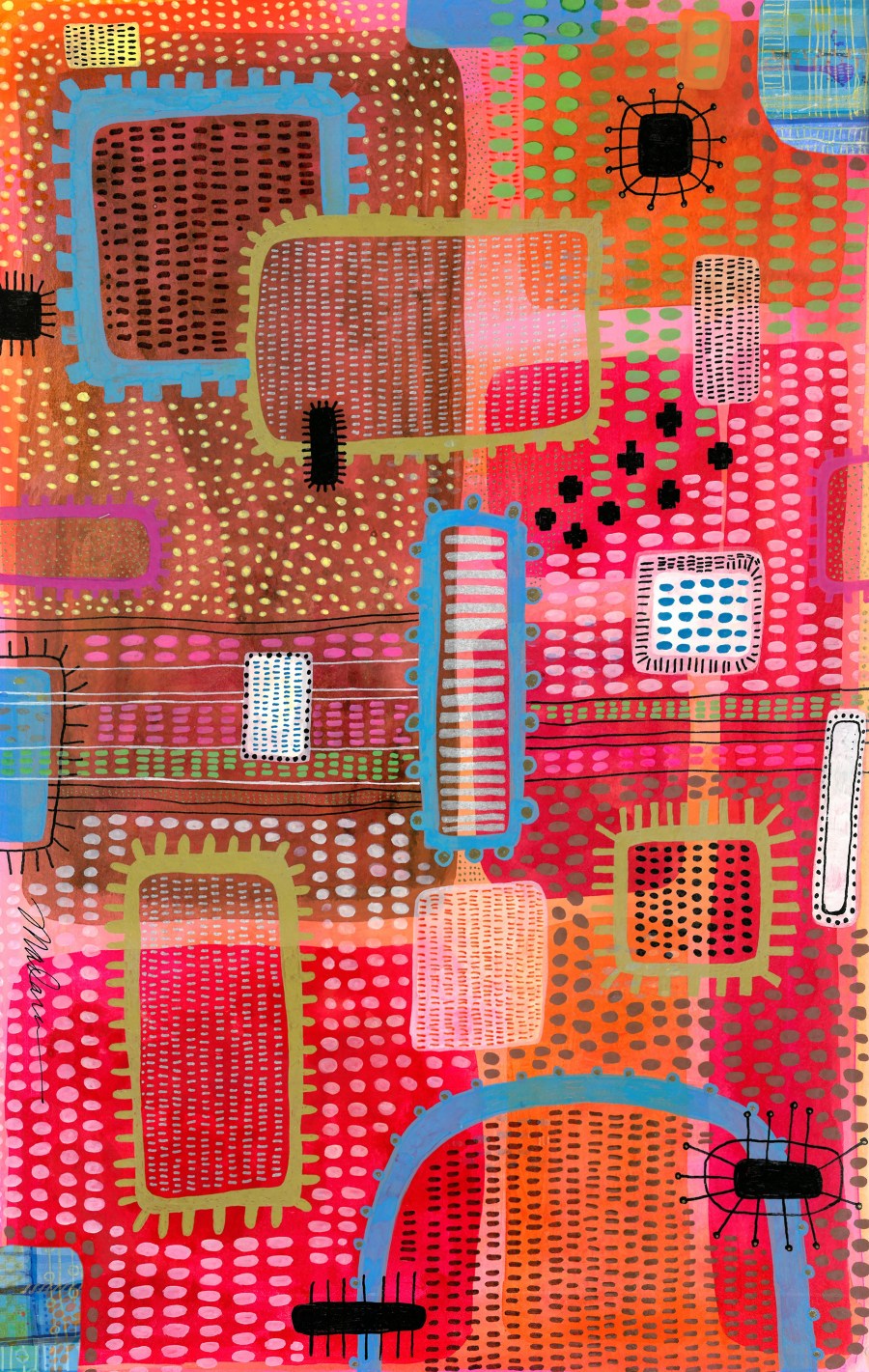
Featured Art: “Noise in the System” by Madara Mason
for my sons
This one has concentric frames that on close inspection are pink strips of floss. This one swims inside itself, three shades of blue. This one’s stripes are dead calligraphy: R.I.P. Abuela, R.I.P. Cousin Juan. This one grows bored and morphs into a sketch of a cartoon baseball twirling its handlebar mustache. This one begs God Bless. This one has sticker pistols saying BANG. This one’s wrists wear broken chains. This one is lost inside the glitz of caked-on glitter gold. This one is impasto red on red that bled on everything it touched. This one has forty macaroni stars and this one has the husk of a dragonfly where stars should be, its glue-gobbed wings unstitching from the corpse.
In the sixth grade I asked Sissy Morgan if she would go to the picture show with me on what was supposed to be my first date but when I said it her eyes got wide and her mouth fell open and she just backed off till she ran into a chair and had to sit down and didn’t say a word.
But during recess I could see her at the swings giggling and whispering to her girl friends and all of them staring at me but if it was a trick or what I didn’t know cause while I was waiting for the school bus she came up to me and said well all right but she would not go to the Paramount which all they showed was double-feature westerns with people like Sonny Tufts or Charles Starrett and if there was anything she could not abide it was Charles Starrett doing The Durango Kid.
But when I told mama she said not to worry because we could go see Forever Amber at the Visulite with Linda Darnell and Cornel Wilde which was kind of like Gone With The Wind mama said and the name was because of the color of her eyes which ought to be just the kind of story that a little girl would go for and what we will do mama said was I will drive y’all to the Visulite and meet you out front again when it is over.
Featured Art: French Knight, 14th Century, by Paul Mercuri
Breeders’ Cup, November 2010
In a different life she wins. In a different November in Kentucky she leans into the last curve of the brown-combed track as she passes the thick of the field. In that one, in a bar far away, in our lucky coats and muddy white sneakers, we rise with the televised crowd as she quickens at the flick of the jockey, as the grandstand churns at the distance beginning to close, as the line comes closer.
And we know it as her rider leans forward, as Zenyatta knows it in her legs as the horse before her turns and knows it’s over, the brown mane flying by in a whip of color and dust, as the stands become a flicker of white tickets, as her name is spoken skyward like a chant.
We didn’t say a word when the officer visited our classroom. We didn’t pass a note or mumble, didn’t blink when the TV flickered on, when the stats, wrapped in white, settled on the screen. We didn’t dare color outside the lines of the worry-eyed cartoon character buying weed from a teenage bully or the gang of stick figures shouting in the margins.
We pretended not to see each other, not to know the smell of bong smoke, late at night, how it would drift through the air vents with their laughter, how it would rise in a fog as we slept.
We pretended not to flinch when the egg hit the pan, the yolk thundering against the cladded aluminum, or when the officer pointed to the display of syringes on the screen, the scenes of cherubic teens snorting a line for the first time, the background darkening, their eyes, lifeless, because the result is death, the officer said, while pointing to a photo of a casket.
We pretended not to know how the dead could rise, how they rose each morning to put away our cereal boxes and make our beds, how they were waiting for us now in their long white robes smeared with peanut butter and hair dye, their tired bodies floating across the pearly linoleum floors, the bones in their fingers thrumming the edge of the kitchen sink to the sound of Clarence Clemons in their heads, “The Promised Land” rising like a dark cloud from the desert floor, their eyes lost in the throbbing autumnal light, the snaking of branches across the kitchen window, the tick-tock of the wind against the leaves, how it feels like eternity, as they watch for the bus, the broken ice maker buzzing, the dishwasher rumbling, milk parting their burned coffee, waiting for their children to return to them to wipe their small skulls clean.
Featured Art: (Untitled–Flower Study) by Mary Vaux Walcott
If an Amish family can forgive the man who burned their land, surely I can say hello to Jenny Perowski, who used to call me “fattie fat” in seventh grade math and had boys call my house, pretending to ask me out. That was twenty years ago. Now Jenny, if not fat exactly, is puffy as a slightly overstuffed chair. I’m thinner than her, and my pleasure feels more whiskey than cream, makes me want to pour out her Kors bag to rifle for candy, then slowly eat it in front of her like she once did to me. I know her cruelty was, at best, a misdemeanor. But anger is like a peppermint in a pocketbook—everything inside takes on its smell and taste. I could break it in my teeth, make it disappear. Instead, I savor the mint, let the sugar line my mouth like fur, linger far past what can be called pleasure. How good it would be to be better than this.
Featured Art: Project for an Overdoor by Carlo Marchionni or Filippo Marchionni
Through the municipal green, overpainted wire mesh obscuring the grammar school basement windows
comes the spank of a basketball not engaged in any game, just pounded in place in an empty, echoing cafeteria, then an outside metal door gets gut-punched open to release gruff-voiced janitor, belt keys jangling, cursing at the world
while from a first-floor office a stretch of plastic packing tape screaks off a roll as a phone rings and a copy machine whumps
as if providing a bass line to a class that, upstairs, bursts into a trebly, mocking laugh, after which,
yet farther up, in a distantly reverberant bathroom, a toilet flushes and keeps running even after a door slams shut and
all the old, hard memories flood back enough for me to know
that if a documentary film was made about daily life in grammar school—
with shot after shot of small, solemn faces taring out at us—
When Mr. Bridges died I knew the whole eighth grade would have to gather in the gym and sit there on those cheerless, folding metal chairs set up by string-bean Donny Graf the constant burper. Mr. Bridges was a substitute, we hardly knew him, but I knew that there we’d be, all of us, and there would be our stiff-grinning twitchy principal, Mr. Albert Fraze, to slowly, slowly stand and tell us what a deep and lasting loss this was for all of us. And later, sitting there three rows from the exit by fatso Robert Randall who’d socked me in the stomach on the 8 bus once, I knew that Mr. Fraze would drill us with the first long look that said, Every one of you should be ashamed, ashamed for even thinking about, for even thinking about thinking about turning your gaze away one ten thousandth of an inch: a man is dead today. And then would come this clumsy, freighted metaphor and though I doubt I knew the word (metaphor) I knew our Mr. Fraze: Mr. Bridges was a kind of bridge, he’d say, or found a bridge, or formed a bridge, or built a bridge, or was a bridge from ignorance to wisdom, from confusion to compassion, blah, blah, blah, which is exactly what he said so that sitting there I thought of that four-cabled quarter-mile Roebling tower bridge and I thought of its glittering river city Cincinnati since we’d studied it all week. I pictured its reaching, curving waterway, the great Ohio and I thought of the circling terns and swirling slicks and chemical froths and then I thought of a row of houseboats and a paddlewheel steamer with a single, smiling tourist, anyone and no one, waving once.
The city is cat piss and dog shit. It stinks, And the humid air molders. I lie in bed, Too hot to move, slick with sweat, wait for dark. Blue flies eddy over the cluttered sink. I’m broke. The change dish is exhausted. A Western Union stub is my bookmark. You never knew me. You’re in a Victorian Sea home, slicing, tasting a sweet cool peach, As an ocean wind lifts your long light hair. Your songs are old, your dresses European, And your view is vast down the empty beach. You pause, as long as you like on the stair. Memories sink, and I am forced to bear Life’s last thought: that you were never there.