How Do You Name a Hurricane?

By Amy Lee Scott
Selected as winner of the 2022 Editors’ Prize in Nonfiction by Eric LeMay

First, watch the storm gathering. On the map there is a bustle of white, so much like a twirling petticoat that spins faster and faster. When it gets big enough, the astronauts post photos. News outlets flash warnings. People clear supermarket shelves, hammer up boards, track down batteries. Outside, the wind thrashes.

*   *   *

Arthur. Bertha. Cristobal. And Dolly.

Use old names, like our grandparents’. Names that stick. That is why we began to name them: the old labels—just numbers—were not enough. We needed names to contain such catastrophes.

Why would anyone even live there? someone said after looking at photos of decimated islands. They are destroyed year after year.

We weren’t noticing the hurricanes. Here, we were scrolling and scrolling past black squares. Past Black faces:

George. Breonna. Ahmaud. The list went on.

*   *   *

Read More
Somewhere Outside of Loveland

By Amy Bee

Featured Art: “Design for 4-seat Phaeton,” by Brewster & Co.

My mom kicked me out this morning. If you’re still here by the time Doug gets home, I’m having you committed, she said, so I put on some jeans and ran to my old elementary school across the street. I headed toward the two tubes next to the monkey bars. I’d spent a lot of recesses in those coveted tubes. Now that I was in 8th grade, the whole playground appeared fake somehow, like a toy model version of itself.

I ducked into one tube and lay so my body conformed to the cool, smooth curvature of cement. Wrapping my arms around my knees, I pressed toward my chin, and wished myself as small as possible; maybe I could also be a toy model version of myself. Phantom spasms of her anger coursed through me like a second heartbeat. The way she’d sat on my back and pulled me up by my hair to hit my face. How no one loved me, she’d yelled, no one except her. How she was the only one who wanted me in the first place.

I gazed at the graffiti inked in marker crisscrossing the ceiling above me. It read like a map of the universe conceived by grade school astrologers. Terry eats poop! Stay 2 cool 4 school xoxo! Jenni wuz here! I brushed a finger along the faded words, and carefully traced the scribbles one by one; mouthing each word in quiet incantation over and over until eventually, my tears dried out and the only heart left beating was my own.

Outside, the weekend janitor mowed away at a stubbly soccer field. Birds chirped. Kids played foursquare on the blacktop. My stomach rumbled. I checked my jean pockets and found 50₵. Enough for two Little Debbie Rolls from the gas station.

Read More

Promised Lands

By Christie Tate

Winner, New Ohio Review Nonfiction Contest: selected by Kiese Laymon

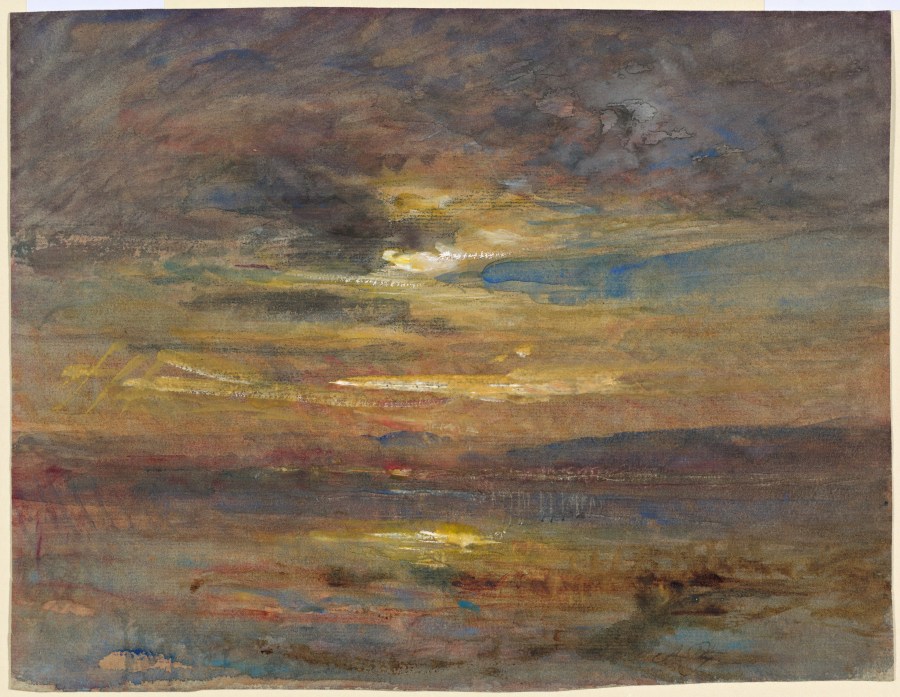
Featured Art: Sunset over a Pond, c. 1880 by François-Auguste Ravier

I.

The first time I walked into Grandma’s church, I was a little girl in white Stride Rite leather sandals and a pale yellow dress with a sash. The First Baptist Church of Forreston, Texas. There was no parking lot, so Grandma, like a dozen others, steered her big blue Chevy off the road into the grass in front of the sign welcoming all worshippers.

The white clapboard building looked like the school-church from Little House on the Prairie. Simple wooden porch with four steps. Plain white steeple. Two long skinny windows. Our regular church in Dallas was three times larger, had bells that chimed every hour, and its thick walls held colorful stained glass depicting Jesus carrying the cross, falling, dying.

My older brother and I trailed behind Grandma, who hung her big leather purse in the crook of one arm and used the other to grip the wooden rail to steady her arthritic knees. My brother and I jockeyed to sit next to her because we wanted to plumb her treasure-filled purse. Doublemint gum. A map of the highways crisscrossing the Texas plains. A keychain with a long plastic placard with her name blazed across it. Virginia. Same as the state. I liked to run my finger along the raised white letters.

Before we opened the door, we could hear voices singing “What a Friend We Have in Jesus.” I shot a look at my brother. We were late—something we were never allowed to be on Sunday mornings with our parents at Holy Trinity. My brother shrugged. I grabbed Grandma’s free hand and let the rush of air and music pour over me as she opened the door and led us to the back row.

Read More

The Uber Diaries

by Kyle Minor
Essay originally published in New Ohio Review Issue 24
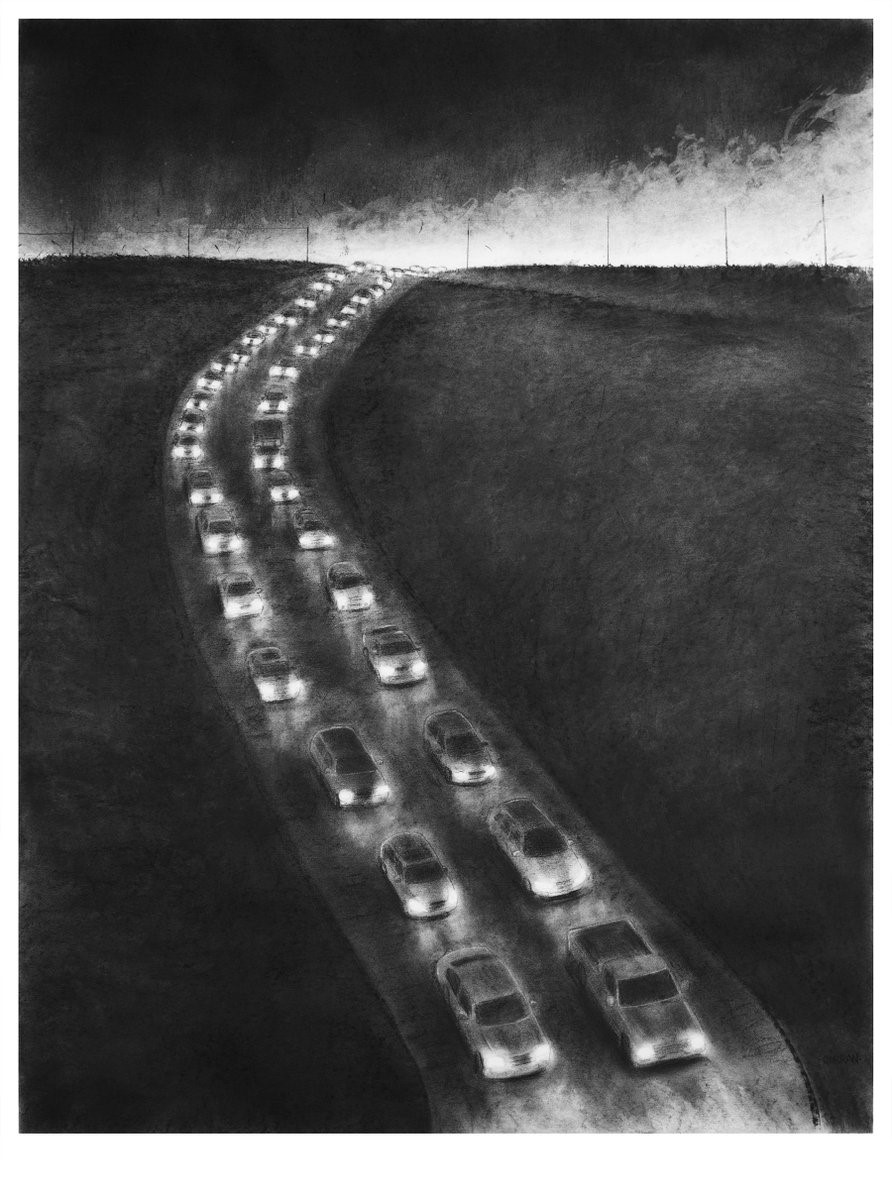
Featured Art: Evacuation by Corran Brownlee


Indianapolis, Indiana. Somewhere near Keystone Avenue and 62nd Street my iPhone pings. A college student from Hyderabad, India. He is pleased when I tell him he’s my first customer. He tips me two dollars.

*

I pick up my second customer in front of a bar in Broad Ripple. He gets in the front seat. His hair is grown to thigh length, and he is on some kind of party drug that makes him want to touch things.

“Please stop rubbing my arm,” I say. He apologizes.

Near Rocky Ripple, he takes off his shoes and socks and rubs his bare feet on the windshield.

His feet leave little rabbit marks. He is a large man with very tiny feet. When I drop him off at the donut shop, he doesn’t leave a tip. Read More

Holding On Is [ ]

By Kay Gram

Featured Art: “Cradle of Kleptocracy” by Madara Mason

[arms & legs]


Be my arms and legs. You’re strong. You can do it! Mom would say. Mom’s body was small, fragile, needed time to move, moved differently than other bodies. I always thought she was beautiful. She was—blonde, blue eyed, narrow nose, all symmetrical. Mom had a determined presence that demanded respect and she had mastered the performance of a Eurocentric female beauty. Outfits were planned, makeup was worn, perfume was sprayed. We were late to everything. Sometimes she fell down.

* * *

Mom was diagnosed with Limb Girdle Muscular Dystrophy, a rare and incurable neuromuscular disease, when she was thirty and pregnant with me. In our life together, she wasn’t able to lift heavy objects, things like pots or pans or dog food bags, her own body. She couldn’t run or dance or move very fast. She used a brown wooden cane, shiny wood, golden handle. When walking was too much, a wheelchair. I was her arms and legs. Elle was her arms and legs. We were good at being Mom’s limbs. Sometimes she held onto us when she walked and we took turns pushing her wheelchair. When she fell, we helped her back up. We loved Mom, her body, went to her for comfort, to cry, to laugh, for attention. Who could listen better? Care more about our days, our lives, our futures. Of course I miss her. She haunts me. Or her pain does.

* * *

  Read More