By Terri Leker Winner of the 2019 New Ohio Review Fiction Contest, selected by Claire Vaye Watkins
The coyotes moved into the woods behind my house just after I learned I was pregnant. On a quiet June morning, while my husband slept, I pulled on my running shoes and grabbed a leash from a hook at the back door. Jute danced around my feet on her pipe-cleaner legs, whining with impatience. It would have taken more than this to wake Matt, but I hushed her complaints with a raised finger and we slipped outside. A light breeze blew the native grasses into brown and golden waves as we wandered, camouflaging Jute’s compact frame. She sniffed the dirt, ears telescoping as though she were asking a question. When we reached a shady thicket of red madrones and live oaks, I unclipped the leash and wound it around my wrist.
It was over with Richard, had been since I’d found out about the baby. Anyway, I had come to believe that adultery sounded more illicit than it actually was. Between managing my schedule with Matt and making time to rendezvous with Richard, an affair often seemed more about time management than sexual gratification. I was meticulous with the calendar, but I would have known that the baby was Matt’s regardless, because Richard’s sperm could not locomote. He had told me so early on, while showing me the master bedroom of his faithfully restored North Oakland Victorian. His unexpected disclosure had interrupted my admiration of the exposed brick walls, so unusual for the earthquake-conscious Bay Area. Matt was having dinner just then with friends, thinking I was helping my mother set up her new television (she would be dead within a few months, but we all pretended to be optimists then), so he was eating eggplant parmesan at the Saturn Café as I lay with Richard on his king-sized bed, hearing words like motility and capacitation. Richard’s sober tone had suggested that I might comfort him in his sterility, which I did, if the definition of comfort was a passionate encounter that lasted as long as one might spend unboxing a 48-inch HDTV and connecting it to both Netflix and Hulu. But Matt and I had tried to have a baby for three years, so I took the pregnancy as a sign to recommit myself to my husband, who, predictably, jumped up and down on our unmade bed when I shared the news, attempting, in his white-socked excitement, to pull me up with him, not realizing that doing so might judder the bundle of cells loose, delivering me back to Richard and a childless but aesthetically pleasing life.
“Hundreds of couples toting AR-15 rifles packed a Unification church in Pennsylvania on Wednesday to have their marriages blessed and their weapons celebrated as ‘rods of iron’ that could have saved lives in a recent Florida school shooting.” Reuters, Feb. 28th 2018
They come wearing crowns of gold bullets in their hair, bodies drenched
in white satin, white lace, tulle, lining the pews on a weekday morning,
AR-15s in their hands, calling on god to save them. There is no
such thing as salvation, only the chosen and too few are chosen.
Children are told to stay inside, schools locked shut, swings hushed,
even the wind says, quiet, as the guns are blessed, dark O of mouths
waiting to exhale a ribbon of smoke. The children are told to crouch
in the closet, to stay still as butterflies on butcher knives
while the men take their brides and iron rods, saluting the book
of revelation, its scribbled last words, the coming of a new kingdom.
Don’t speak. Don’t breathe. Pretend you are an astronaut gathering wisteria
twigs in a crater of the moon. Pretend the twigs are the arm of a broken mandolin.
Someday, it will speak. Someday it will sing. DearGod, bless the self in the age
of the self, bless this bracelet of rifle shells, bless our god-given individual
right. I know you want to sing. You want to sing like blackbirds escaping
from the mouth of a grasshopper. But remember, we are only here
for a little while, so for now, keep quiet, pretend we are somewhere else.
Pretend we’re practicing our handwriting, the lollipop of a lowercase i,
the uppercase A, a triangle in an orchestra, the different sounds it makes
if you strike it the right way. Practice the slow arch of a R. Now—
form the words. Scribble run, scribble come, scribble mom, scribble when
will this be over? But for god’s sake, be quiet. Don’t cry. Just write. Scribble
on the walls, on your arms, scribble as if it’s the last thing you will ever say.
Pretend it sounds like music. And if the devil comes through that door, remember
to go limp, lie on the floor like a tumble of legos. Don’t move. Don’t speak.
Don’t breathe. Pretend you’re already dead. Remember, this is how you live.
The first thing Ilona saw when she got to the beach was the man, bleeding from his leg with a crowd of people around him. She was far up and away in Bill’s condominium, looking down at him from the master bedroom window with her two suitcases in her hands. The man held out his bleeding leg for everyone to admire. Half of the crowd looked down at the leg, half looked out at the ocean. After a minute, the man spread his arms out wide as if to show everyone how much he loved them. Thissssss much.
“It faces the beach, see? Just like I promised.” Bill came up behind Ilona and palmed her breasts. “What a view, huh?” But Bill wasn’t looking at the view. He had his short face in Ilona’s long neck and was missing out on the man and the leg and the crowd, which was just fine by Ilona. When Bill went out into the condominium’s kitchen, to show her sons some sort of fishing contraption, Ilona went right up to the window, still holding her luggage, and kissed the glass. She had been darkly depressed about herself and her life the whole trip down, and then the man with the bleeding leg appeared and something lightened in her. There was still some good in the world.
*
The first night, Ilona pretended to sleep in the guest room, to set a good example, but when she could hear her sons breathing deeply from the adjacent room and knew they were asleep, she went into the master bedroom and got into bed with Bill. She had accepted Bill’s proposal mostly—no, entirely—because she was penniless. Her husband had drunk himself to death because of the debt, and all she was was a speech therapist. How was she to pay for her youngest’s lung medication, much less electricity and soup? It only made sense to sleep with someone like Bill, even if the new ring lay on her finger like a lead bullet.
The undertow had carried Daisy far enough out to sea that her bullseye swim cap probably looked like a floating pastry to the judges, even with their binoculars. She hoped that rest of her looked similarly delectable to the Medium-Class blues that the scouting report had placed a reasonable 19% of hunting in the Frontier Belt; nobody had caught anything elsewhere, outside of a zebra shark that wandered into the Sandbar Belt that the chatterbox from Bethany Beach managed to cosh, catch, and drag. Not that she was worried by that bag; Chatterbox’s zebra had the telltale torpor of a bad fungal infection, so it barely put up a fight, and she’d repeatedly coshed more dorsal than skull and in shallower water, too, losing major accuracy marks that she couldn’t afford to have subtracted.
Daisy’s choice of enticement pattern – tread for ten seconds, followed by a burst of strategic thrashing – was fairly exhausting, with the current more active than the lifeguards’ flags were indicating, but the rumor was that deep-water endurance played up heavily with the judges at this particular beach, mostly due to sentimental reasons. It was apparently at this depth that the woman that this derby was named after, Betsey Gulliver, managed to drag in a four-foot thresher even after a whip from the tail of the shark in question had lacerated her left eye and given her ear a flat top. Thus, the parameters for this derby’s Spontaneous Technical Victory – cosh, catch, and drag a Medium-Class thresher – were established. The banner reading “Betsey Gulliver’s Thresher Derby” was stretched above the stands like a giant volleyball net, painted in garish lettering whose crooked slant was evident even from where Daisy was, as if the banner had been made in a group effort by the local middle school.
Sara doesn’t sleep anymore. Not for more than an hour at a time. Her body feels sore, her joints loose, as if a leg could slip free if she isn’t careful. It’s May, her first spring in the house, and the rain has been falling steadily since early April. The Mad River jumped its banks some weeks before, and, in a gesture of solidarity, Sara’s body has ballooned at the ankles, the thighs. She’s 38 weeks pregnant with twin girls, and even her fingers have grown thick, her wedding ring now worn on a chain around her neck.
Sara is beginning to think she’s made a mistake.
Her friends told her that from the start. Who gives up their whole life for a man they barely know? They took bets on how long she’d stay, calling up to see if he’d turned out to be a serial killer. But, when she announced the pregnancy, the jokes stopped. Phone calls stopped too, as if no one knew what to say to her anymore. The only bright spots were the times she allowed herself to dream about her past selves, a hundred different versions—waiting tables in the little black apron at 16, skin smelling of bacon grease; the summer she was so poor that she only ate peanut butter; reading in the gaudy canopy bed she’d had as a child; and the graffitied bathroom of the club where they’d danced to 80s music in college. Although it scares her, if the babies weren’t an actual part of her physical self, she would flee. Leave this sudden husband in search of Louisville or any one of her past selves, because this one. This one. This one would not do.
Featured Art: “Design for 4-seat Phaeton,” by Brewster & Co.
My mom kicked me out this morning. If you’re still here by the time Doug gets home, I’m having you committed, she said, so I put on some jeans and ran to my old elementary school across the street. I headed toward the two tubes next to the monkey bars. I’d spent a lot of recesses in those coveted tubes. Now that I was in 8th grade, the whole playground appeared fake somehow, like a toy model version of itself.
I ducked into one tube and lay so my body conformed to the cool, smooth curvature of cement. Wrapping my arms around my knees, I pressed toward my chin, and wished myself as small as possible; maybe I could also be a toy model version of myself. Phantom spasms of her anger coursed through me like a second heartbeat. The way she’d sat on my back and pulled me up by my hair to hit my face. How no one loved me, she’d yelled, no one except her. How she was the only one who wanted me in the first place.
I gazed at the graffiti inked in marker crisscrossing the ceiling above me. It read like a map of the universe conceived by grade school astrologers. Terry eats poop! Stay 2 cool 4 school xoxo! Jenni wuz here! I brushed a finger along the faded words, and carefully traced the scribbles one by one; mouthing each word in quiet incantation over and over until eventually, my tears dried out and the only heart left beating was my own.
Outside, the weekend janitor mowed away at a stubbly soccer field. Birds chirped. Kids played foursquare on the blacktop. My stomach rumbled. I checked my jean pockets and found 50₵. Enough for two Little Debbie Rolls from the gas station.
Featured art: View from Mount Holyoke, Northampton, Massachusetts, after a Thunderstorm—The Oxbow by Thomas Cole
In a sheepish prefatory note to the belatedly published “Kubla Khan,” Coleridge recalls a felicitous if ultimately frustrated exception to his usual habits of poetic composition. He writes that “all the images [in “Kubla Khan”] rose up before him as things, with a parallel production of the correspondent expressions, without any sensation or consciousness of effort.” Coleridge identifies his usual artistic challenge, here overcome with miraculous ease, as finding words for images. Those who seek to bring poets, and poetry, to life on film are confronted with the counter-difficulty of finding images for words. Or, more precisely, filmmakers face the daunting task of rendering the wrangling of words visually compelling. (The footage of Coleridge reciting “This Lime-Tree Bower My Prison” to delirious crowds at Wembley Stadium has been lost, regrettably.) So how do filmmakers inject motion and volume to a creative process that is presumably usually so still, so muted?
Featured Art: Valley with Fir (Shade on the Mountain) by Henri-Edmond Cross
Jean Cocteau recognized no boundaries between forms of art. He was a poet, a novelist, a playwright, and a visual artist, and each of these media also functioned as a bridge that led him into filmmaking—not just conceptually, since movies are a hybrid of all of these other forms, but often literally. He filmed two of his plays, Les parents terribles and The Eagle Has Two Heads, and wrote the screenplay for Jean-Pierre Melville’s adaptation of his novel Les enfants terribles, and his great 1950 movie Orpheus reimagines his 1926 play of the same name. Read More
Featured Art: Viennese Café: The Man of Letters by Moriz Jung
In the late Nineties I repeatedly watched Hal Hartley’s Henry Fool (1997), not really certain why. I had first rented it only because Parker Posey was in it, but the cult film stayed with me like the Sylvia Plath poems I fanatically read as a teen in my small county library in rural Minnesota. Both seemed like mostly impenetrable, but meaningful code. Both were transgressive.
The big difference between these obsessions was that I trusted what Plath was doing and didn’t trust Hartley. Or, I didn’t trust my obsession with the film, which follows the lives of two aspiring writers. What I find compelling twenty years later is that I have the same response. Henry Fool is funny, repulsive, wildly off the mark about the process of writing, and wildly provocative; and I now think that it’s something this otherwise explicit film withholds—the book-length, controversial poem which the plot is built on—that continues to fascinate and repel. Read More
Featured Art: The Chariot of Apollo by Odilon Redon
In my twenties, I moved around a lot. I spent much of the first half of that decade in New York City where I changed apartments at least once, and sometimes two or three times, each year. At twenty-seven I moved to New Orleans. At twenty-eight I ended up in Chapel Hill, North Carolina. At twenty-nine I was back in New Orleans, then at thirty I was in Richmond, Virginia, where I’ve lived, off and on, since 2000. With each relocation, one DVD moved with me every time: Poetry in Motion. Read More
Featured Art: Study of Arms for “The Cadence of Autumn” by Evelyn De Morgan
When I walked out on A Quiet Passion, the 2016 Emily Dickinson biopic, I decided I was walking out on all biopics about writers forever. 1 The genre has built-in structural problems that seem almost insurmountable. For one thing, a writer’s work is neither their life nor their personality. For another, staring out a window or at a blank page cannot be sustained on screen for longer than a single montage. Moreover, a life well-lived2 seldom has a coherent narrative arc.
Featured Art: Standing Girl, Back View by Egon Schiele
The film Maya Dardel, a 2017 American-Polish drama, written and directed by Zachary Cotler and Magdalena Zyzak, opens with a famous, gravellyvoiced, fictional poet, played by the mysterious Lena Olin, contemplating her demise. Sequestered at her hideaway in the mountains of Santa Cruz, California, overlooking the redwood forest (around the bend from where I happen to live) she’s decided to kill herself. But not before choosing a young, male heir, whom she will select by way of a contest, through a sort of Atalanta-esque maneuver. Only, instead of a race, she will subject her suitors to feats of sexual and psychological endurance. All of which she has announced on NPR.
Featuring poems by Ruth Bardon and Jiordan Castle and a new story by Joseph Rakowski, as well as a variety of timely pieces from previous print issues of NOR: poems by Tanya Grae, Okla Elliot, Emily Sernaker, and Emily Mohn-Slate; a story by Max Bell; and an essay by Kyle Minor.
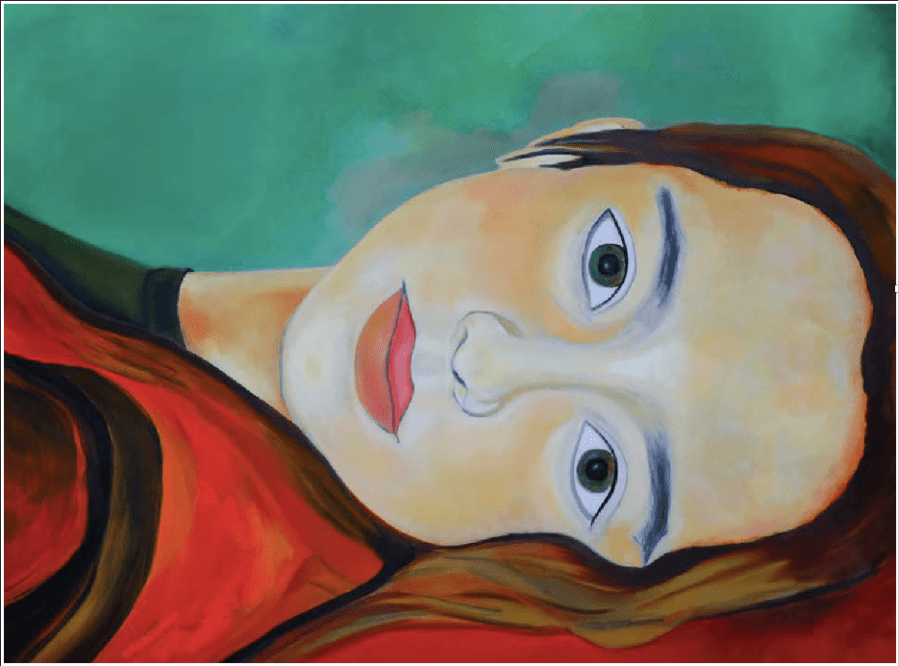
Each piece is accompanied by beautiful artwork, some by contemporary artists Corran Brownlee and Barbara Pierson, and others courtesy of the Metropolitan Museum of Art’s Open Access collection.
Newohioreview.org is archiving previous editions as they originally appeared. We are pairing the pieces with curated art work, as well as select audio recordings. In collaboration with our past contributors, we are happy to (re)-present this outstanding work.
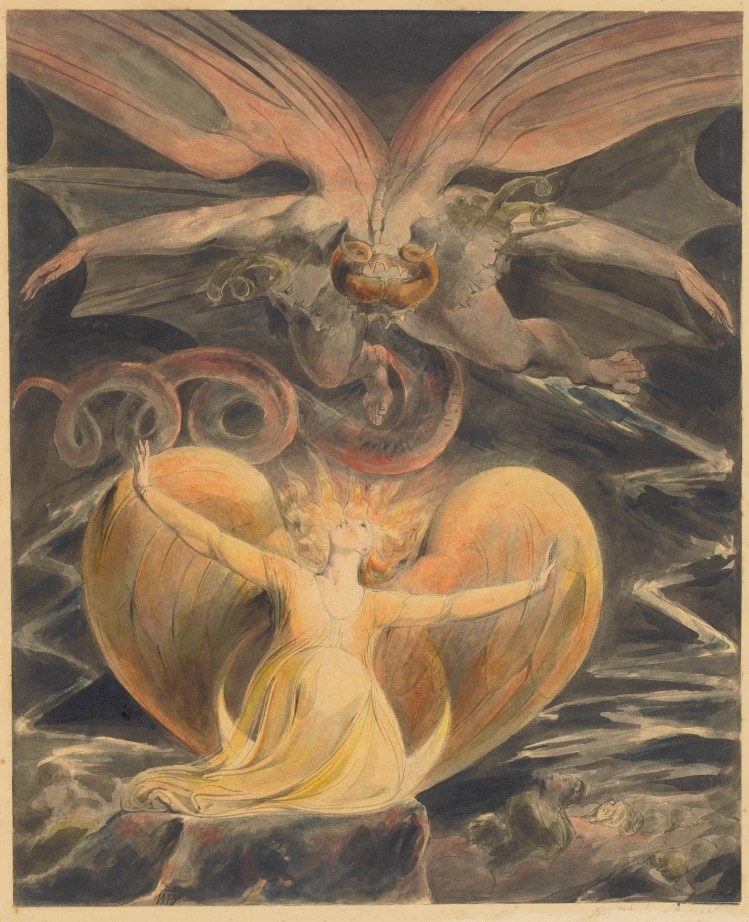
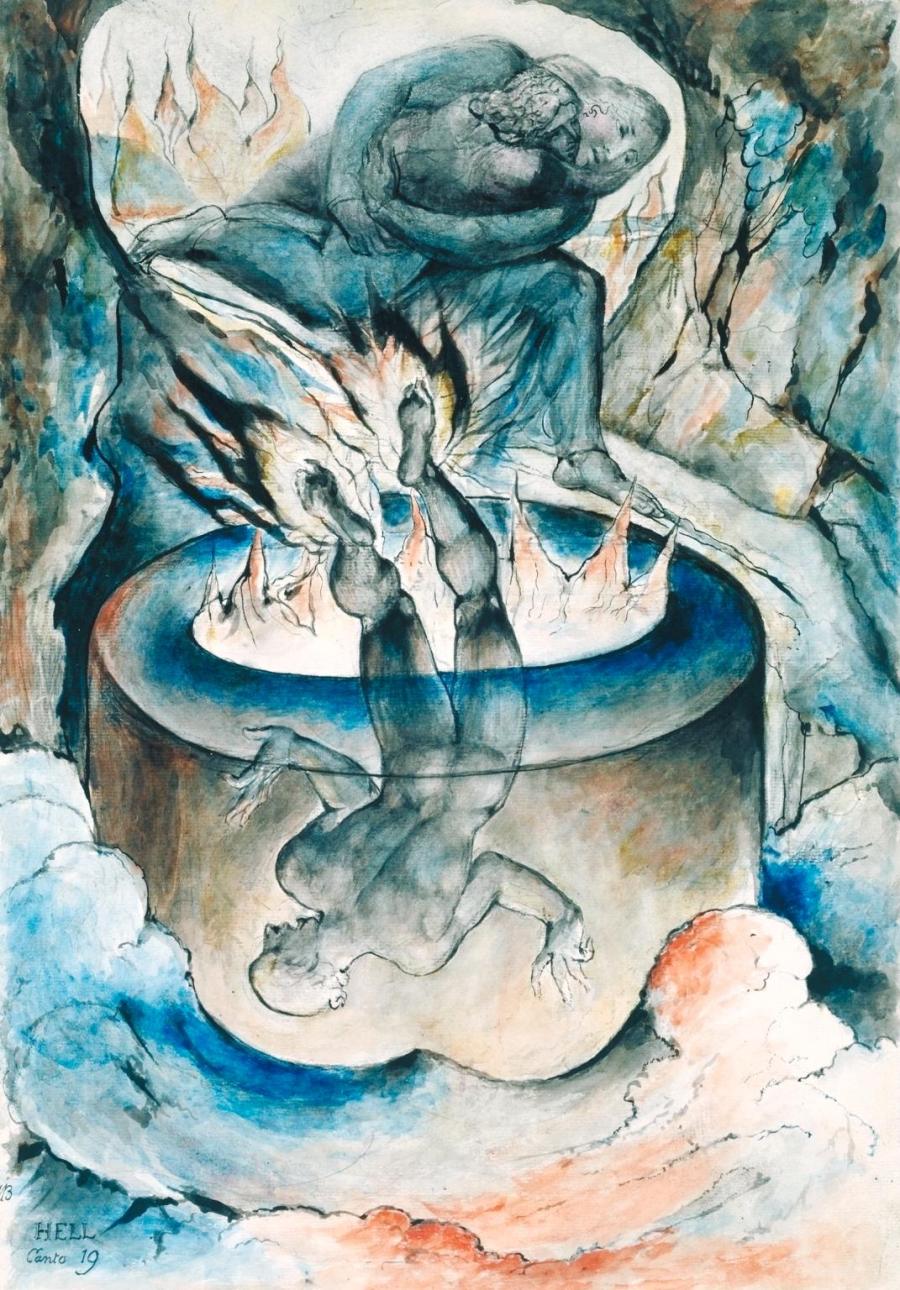
Featured Art: The Great Red Dragon and the Woman Clothed with the Sun, c. 1805by William Blake
My daughter’s in the kitchen, working out death. She wants to get it. How it tastes and feels. Her teacher talks like it’s some great, golden sticker. Her classmates hear rumors, launch it as a curse when toys aren’t shared. Between bites of cantaloupe, she considers what she knows: her friend’s grandpa lives only in her iPad. Dr. Seuss passed, but keeps speaking in rhyme. We go to the Queens Zoo and spot the beakish skull of a white-tailed deer tucked between rocks in the puma’s enclosure. It’s just for show, I explain, explaining nothing. That night, and the one after, my daughter dreams of bones, how they lift out of her skin and try on her dresses. So silly! she laughs, when I ask if she’s okay. Then later, toward the back-end of summer, we head to Coney Island to catch a Cyclones game. We buy hot dogs and fries. A pop fly arcs over checkerboard grass, when flush against the horizon she sees a giant wooden spine, a dark blossom, this brownish-red maze all traced in decay. She calls it Sad Rollercoaster, then begs to be taken home.
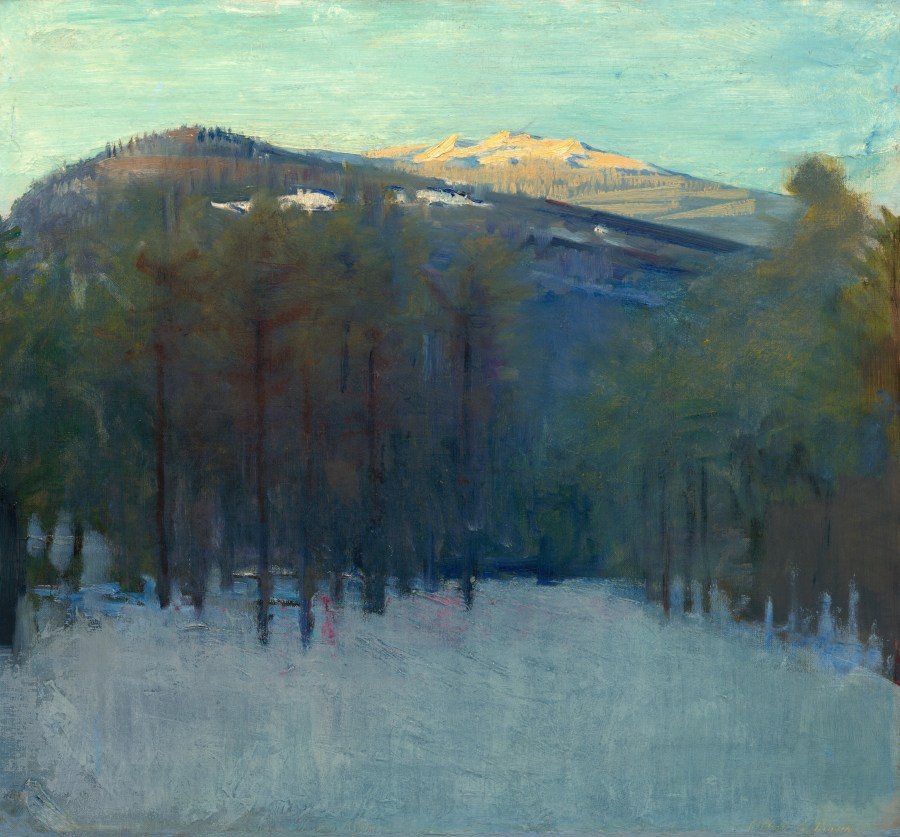
Featured Art: Mount Monadnock, probably 1911/1914 by Abbott Handerson Thayer
The first one is half a couple, young, their daughter four or five in pink snow pants and a pink flowered coat. They’re stopped at the top of the last long run, skis wedged sideways. She’s made it this far, and now she’s wailing I can’t do it I can’t do it I don’t want to— Almost everyone pauses before this sheer slope gleaming in late-afternoon sun, this almost-vertical descent that someone named Paradise. She’s sobbing I can’t do it and her father says What do you need? Do you need some fish? Do you need some T. Swift? He reaches for his phone and “Shake It Off” starts playing, and he barks like a seal and flaps his arms and stomps his skis a little like flippers, and she holds out her gloved hand and he puts Goldfish crackers in it, tosses a few and catches them in his mouth, and they start down Paradise, her skis in a careful pizza, her father telling her when to turn. The next one is older, bearded, his daughter older too, high school or college, hard to tell through helmet and goggles— she’s silent as he coaches: drop your shoulder, now shift your hips, now turn, drop your shoulder. I’m trying to translate his advice into something my own body could do—toes curled in my boots, skis crossed at the tips, poles flailing behind me and sticking in snow as I skid toward the trees. She’s making long slow turns; he’s patient, saying over and over good girl in a way that means she’s as frightened as I am and her goodness is his world and is, to him, absolute. She doesn’t look at him— she’s watching her skis as they glide back and forth through Paradise, watching herself not falling.
Fall in the Alfama district, and all the bright skirts float down the city’s aston- ishment of hills. The surprise of verticality, the step-polished marble underfoot, the sun reflecting up, and I am always already sliding, or else just about to slide. I claw at the shopkeeper’s rack of postcards, pause to watch the lipsticked London women in the glissade of new wedges with untried soles, to read the graffitied stucco wall: pura poeta. Not all of us who fall seem to mind; only yesterday, in a splintered tram, I stood behind a stern German who lost her grip around a turn. When she caught herself, the stoic control of her face opened into joy, her blue eyes dancing as she swung herself on the metal rail. When I tried to meet her smile with my own, hers vanished. I moved to the rear to dis- embark, the sudden brake shoving me into a sturdy old man who laughed and asked me something in a tongue I do not speak, though the message was clear. Listen, maybe falling is why we come here at all. Only the dark-eyed man in his fine suit—he wore your face, uncle, looked the age you were when you died— knew how to control the fall: loosen the knees, shift the body’s gravity forward, and never trust the temptation to lean back. Remember: only the dead are so surefooted they will never fall again. On the stucco wall, someone changed the words overnight to puta poeta; as I notice it, I feel again the shift of my sole, the tightening of muscles and think, for a flash, of the sacred duty of those still in warm and breathing flesh: to always be falling, and willing to fall for the world. My bag’s contents all around, the act of picking stones from the palm’s soft flesh—this, too, is holy. And with my knees on the cobbles, I look up
An ancient woman clips the wash to the clothesline. Crimson lace, floating.
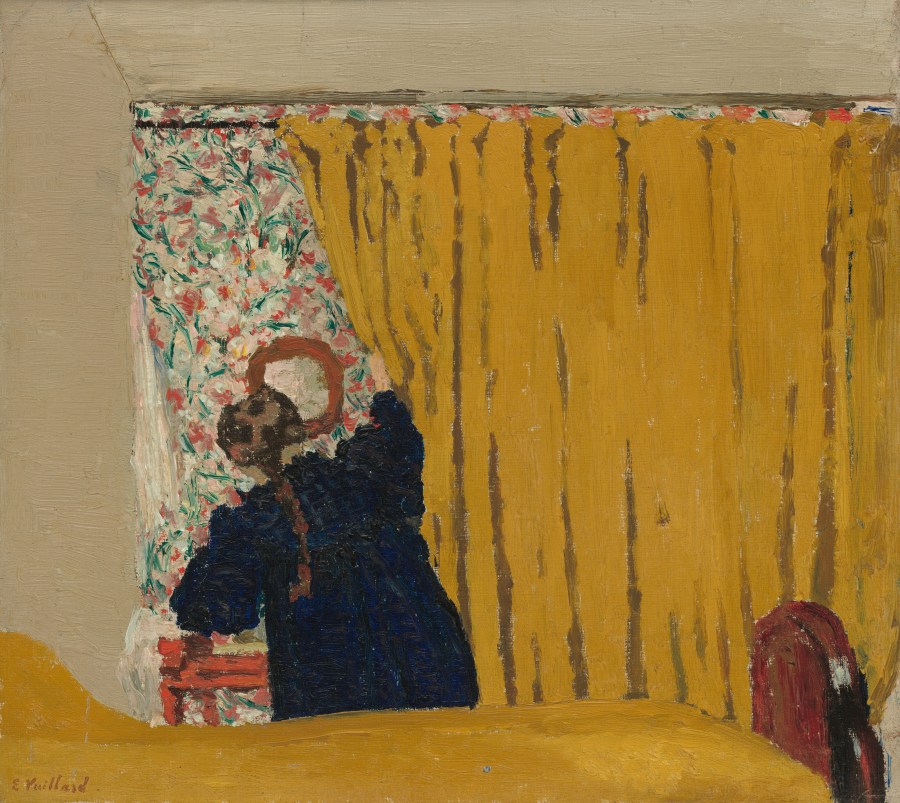
Featured Art: The Yellow Curtain, c. 1893 byEdouard Vuillard
–after Sharon Olds
our girl we’ll tell you how it was then how the lake spread out to the east of us how we sailed out on it tacking and jibing learning to round the marks how we walked miles under skyscrapers we could see no end we could have gone anywhere a year later the city collapsed down to our three rooms all was the rocking and the crying a bowl of black cherries water in the tub billowing yellow curtains how quickly the city spun down to you between us in our bed
Featured Art:Dynamic Suprematism, 1915 or 1916 by Kazimir Malevich
We may intend well at the outset and persist but much that happens happens of its own accord. We may awaken one day with but one bean left
but much that happens happens of its own accord. You can set yourself right; you can self-correct. I have been changed greatly by things I have read.
And yet I don’t know how to do this simple thing: lead another where it is best for me for him to be. It happens sometimes, though, mysteriously.
Maybe it’s a matter of pressure or physics and moral equity, the combination of any three things, the planes are more aligned than we think.
When an explanation is provided, we don’t listen. The mind will stop attending if it can. I thought Algebra all those years ago an exercise in patience;
little did I know that there’s a math for each of us. For what was the present, it was toil and struggle, try as one may, try as one might,
the engine is flooded: variables and integers, parentheses and coefficients . . . and when I wondered why the impact of History was outside of this,
Algebra gazed back at me, detached. Surely there is no one left on Earth who doesn’t love Bob Dylan, yet it’s possible that status may not last. The mind will stop—
will stop attending if it can, and that’s got to be a problem compounded by the plenitude of spam. I received my first Christian case of such on one February 26.
Featured Art: Rain Clouds Approaching over a Landscape, 1822-40 by Joseph Mallord William Turner
Driving to the baseball game on Highway 101, we looked at cloudbanks, stacked in bands from west to east, and in between were cloud-threads dangling down as if the layers had been torn apart— and this was virga— rain that formed but couldn’t reach the earth, like words that evaporate as they come to mind.
We’d moved to California in a storm, before the drought that forced us to save our water in a pail, trickle it on tomato vines, enough for them to live and leaf, but not to fruit. You grew impatient with the traffic, and I touched your hand in gratitude for the high fly balls we were about to watch fall, for idling motors and the Bach cantata in our car, its trumpets turning gold to match the clouds— those lavish clouds that tried but couldn’t rain.
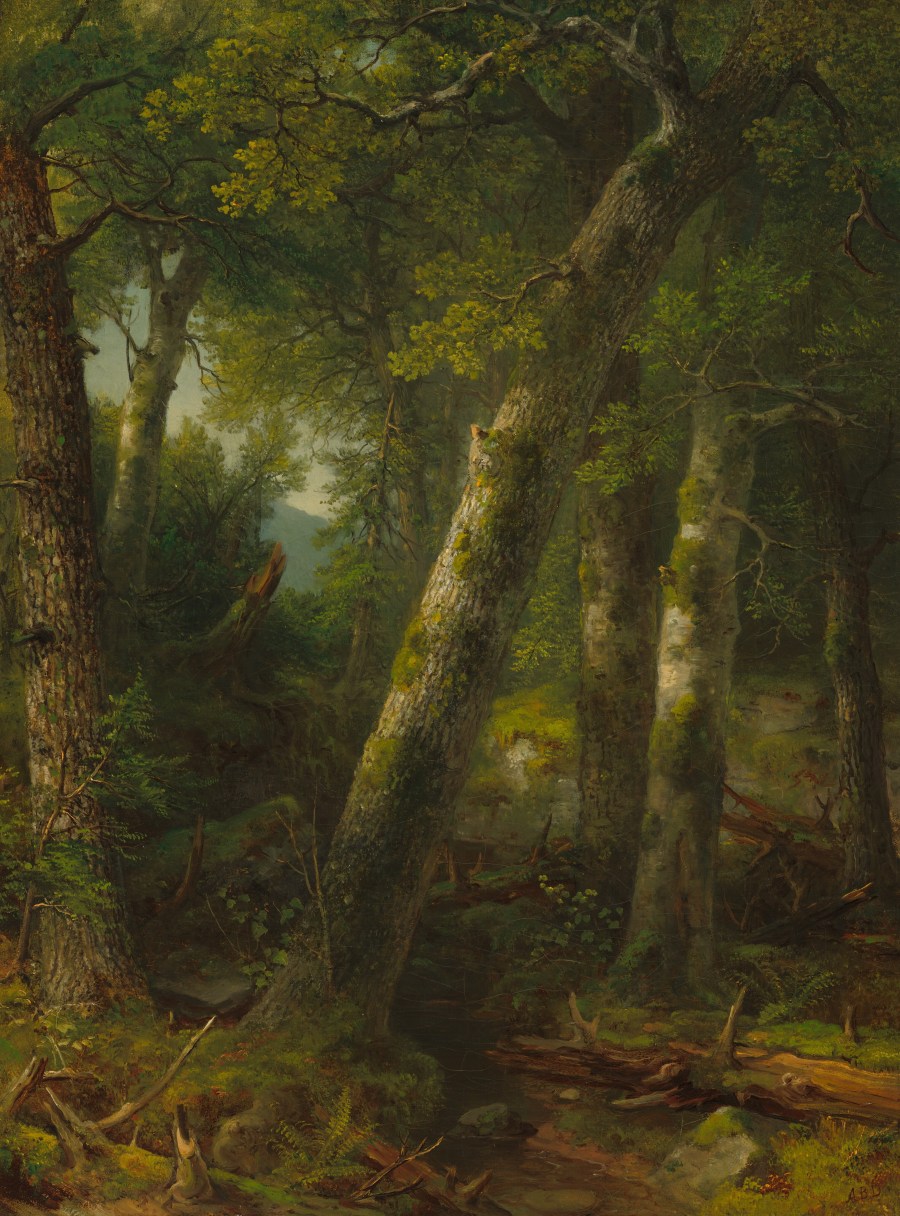
Featured Art: Forest in the Morning Light, c. 1855 by Asher Brown Durand
The coyotes moved into the woods behind my house just after I learned I was pregnant. On a quiet June morning, while my husband slept, I pulled on my running shoes and grabbed a leash from a hook at the back door. Jute danced around my feet on her pipe-cleaner legs, whining with impatience. It would have taken more than this to wake Matt, but I hushed her complaints with a raised finger and we slipped outside. A light breeze blew the native grasses into brown and golden waves as we wandered, camouflaging Jute’s compact frame. She sniffed the dirt, ears telescoping as though she were asking a question. When we reached a shady thicket of red madrones and live oaks, I unclipped the leash and wound it around my wrist.
It was over with Richard, had been since I’d found out about the baby. Anyway, I had come to believe that adultery sounded more illicit than it actually was. Between managing my schedule with Matt and making time to rendezvous with Richard, an affair often seemed more about time management than sexual gratification. I was meticulous with the calendar, but I would have known that the baby was Matt’s regardless, because Richard’s sperm could not locomote. He had told me so early on, while showing me the master bedroom of his faithfully restored North Oakland Victorian. His unexpected disclosure had interrupted my admiration of the exposed brick walls, so unusual for the earthquake-conscious Bay Area. Matt was having dinner just then with friends, thinking I was helping my mother set up her new television (she would be dead within a few months, but we all pretended to be optimists then), so he was eating eggplant parmesan at the Saturn Café as I lay with Richard on his king-sized bed, hearing words like motility and capacitation. Richard’s sober tone had suggested that I might comfort him in his sterility, which I did, if the definition of comfort was a passionate encounter that lasted as long as one might spend unboxing a 48-inch HDTV and connecting it to both Netflix and Hulu. But Matt and I had tried to have a baby for three years, so I took the pregnancy as a sign to recommit myself to my husband, who, predictably, jumped up and down on our unmade bed when I shared the news, attempting, in his white-socked excitement, to pull me up with him, not realizing that doing so might judder the bundle of cells loose, delivering me back to Richard and a childless but aesthetically pleasing life.
what if we plant roses beside the shed what if we paint the living room a muddy incarnadine what if you go on a diet what if we go to Paris what if the dog’s ghost follows us when the house is sold where will we go when the house is sold what if we try talking what if I could be nice what if we have to move in with your mother what if we could be honest about the weather what if like a father you get up only to leave the room what if like a mother I speak only in other rooms what if we redo the kitchen and you become a pastry chef what if we move to Phoenix what if I smash the Lennox what if I drive away what is good what if I drive away into a tree what if we cross our hearts what if we make applesauce what if you become what killed your father what if I can’t forgive what killed your father what if the kids could see us what if the kids become us what if the kids inherit everything
Dionysus! What is on your record player tonight? Turn up ABBA’s greatest hits and call me Chiquitita one more time. The night is young and we are ancient history, but dammit if you don’t throw the wildest parties.
All the columns choking on vines. Wisteria fronding from the lamp lights. And I, wishing I’d worn the dress you gave me at the beginning when the sex was still effeminate. The dress with the cape made of migrating starlings.
Masterpiece of murmurations. No matter, I prefer this prison jumpsuit. Gauche orange like a Halloween pumpkin. Oh! You should know by now how much better I carry my body when it is a trashcan fire.
Dionysus! Remember our first time? You came in the back of your father’s classic Panther West Wind. Now other people’s tongues pulse in your mouth. Now sirens from the downtown precinct. But not before,
Dionysus! Show us that party trick you do so well. The one where you pluck out your own femur and make WOMAN. The one where that WOMAN uses magic to ensure that her soccer team wins the World Cup.
Dionysus! Sneak us onto the edge of the River Styx. See which one of us skinny-dips into the deep end first. I’m betting it’s me who wakes up in your bed again after six too many red wines. I’ve never been good with endings
or perhaps it’s hard to leave behind a place where no one knows what you look like naked. And weren’t we once acquainted with each other’s morning-after tics? How I prefer the smell of citrus to coffee. How you only ever have human hearts
to offer. Plump and halved like papayas. The kind where a single bite shows you your own death. The kind where if you tilt one just so, it will catch the light and turn into copper. A penny you can throw at a fast-moving train.
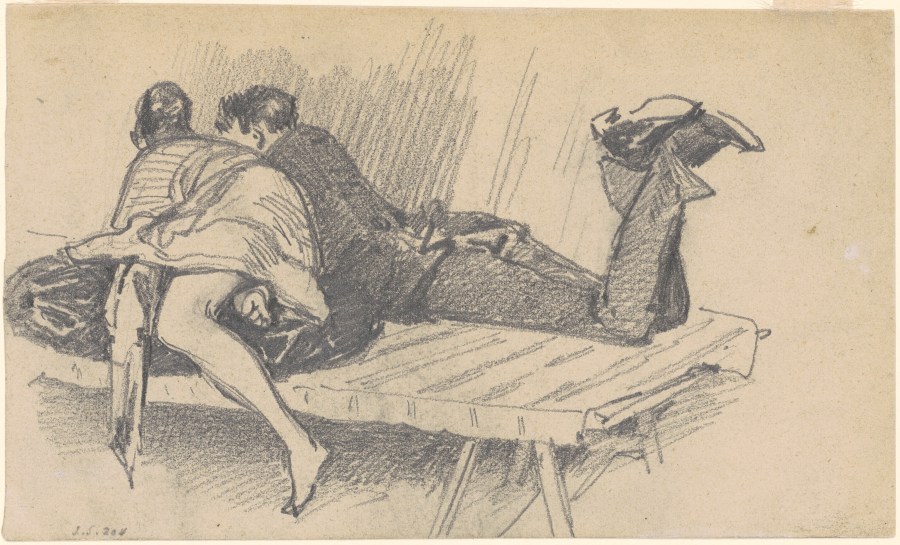
Featured Art: Couple on a Cot, c. 1874-1877 by John Singer Sargent
I once walked past a man on February 14th who was peeing on a window display, teetering on his tiptoes & bent backward aiming at the word love written in red curlicues. Robins fat as cupids watched from the hedges. At the end of the block I had to look again, too. He was still going at it like an acrobat or a camel. I thought I might do the same thing if I had the equipment because love was a spike in the vena cava or an arrow in the brain, the great spurns of fate turning kisses into thorns. Sometimes I make myself sick with nostalgia. I can’t help it if I listen to Dan Fogelberg Radio. I used to play Dan’s song “Longer” on the guitar & weep that my longest relationship was with my dog. She once pulled the sock out of a man’s shoe while he was wearing it in my doorway. My dog didn’t stop growling for an hour after he left. She knew he wasn’t for me, but who was? & then I met you. We once kissed all day long & lost weight. My students all got A’s, called themselves The Love Class. I once told you that in my next life I’d be a weatherperson & asked what you’d be. “Dead,” you said. If my dog had still been alive then she’d have known you were the guy for me. Even though we’ve been together longer than any forest primeval, I want to go to bed with you in this dark middle of an afternoon, tell you about the cumulonimbus & nimbostratus clouds that mean rain is on its way. Without any words, let me teach you the word petrichor, which means that earthy smell that accompanies first rain after a long spell of warm, dry weather.
“The Blood Still Works” stampedes through the nave and once the organ player’s shoulders seize with song, the spirit hits the pews in waves. I catch the loosening necks, the mouths’ new ease
as the congregants begin to speak in tongues; I move my lips, pretend to be saved, and next to me, my grandma convulses—the drums of the band a puppet master, a hex—
while ushers in white surround her, lock hands to keep us in. The preacher’s sermon builds to a screech, his sinners flitter fans like mosquito wings, and with his eyes he guilts
me into clasping hands: I repent for things I’ve yet to do. They jerk to tambourines.
—after “Ghetto Boy, Chicago, Illinois,” by Gordon Parks, 1953
Play house. Climb on a chair of shit-stained paisley in an alley, avoid the broken bottles. Cut your momma’s housedress, make a cape that’s maybe a size too big. Pose for this camera, strut
like the pimps that limp these streets in zoot suits, caned and gold-toothed. Know the power of a stuck-out hip, its demand for respect. Practice your slang, and call the women shorties until you luck out,
get slapped upside the head. Don’t turn around. Don’t look behind and see the world’s kept going, that Eldorado dropping down to the ground, its rims still spinning, pool-hall lights still glowing—
boy look into this lens, let me remember you like this, carefree, acting a fool like you always do.
My 11-yr-old son has forgotten not to eat on my bed He loves watching The Flash from my room with the widest windows, the warmest place in our house each winter,
& with the coneflower warmth of his brown skin veiled in his bright red suit, he tucks his kinky curls under the cap & ghosts from room to room undetected, sneaking
cookies till I climb beside him into piles of crumbs You’re grounded I echo & he is sobbing but what he says catches
the pit of wax burning always inside me We got him into special ed classes last year after years of fighting with teachers & breakdowns
over homework & his father yelling You’ve got to learn to listen & I kept insisting he’s trying, he just doesn’t understand & here he slides onto my floor,
tears & mucus streaming down his cheeks, onto the superhero costume he wears 24/7, the toddlers at the park following him around perennially because he’s Iron
Man, Flash, Capt. America— Mama I don’t know what’s wrong with me between hiccupping sobs I forgot—
I was hungry & your bed is so warm & I’m afraid I’ll go to jail when I’m a grownup I’m afraid I’m bad because I always do the wrong thing
& I’m hugging him on the floor where I’ve joined him as sirens flick onscreen thinking of how his little sister ties his shoes how years
back his best friend said You have to learn to tie your shoes—do you want your mom to tie them for you when you’re twenty? & we laughed before we realized
we should not have been laughing how at night I watch him breathing & pray because when I screamed at his father for screaming at him he said He has to learn
to listen! I’m trying to keep him safe—
Much later I ask our boy with a milkshake in his hand what he would do if the police, like they did to his daddy—
He beeps. Electronic Jeremiah is not here right now. Please leave a message. He flashes so quick, I never see him vanish.
Winner, New Ohio Review Nonfiction Contest: selected by Kiese Laymon
Featured Art: Sunset over a Pond, c. 1880 by François-Auguste Ravier
I.
The first time I walked into Grandma’s church, I was a little girl in white Stride Rite leather sandals and a pale yellow dress with a sash. The First Baptist Church of Forreston, Texas. There was no parking lot, so Grandma, like a dozen others, steered her big blue Chevy off the road into the grass in front of the sign welcoming all worshippers.
The white clapboard building looked like the school-church from Little House on the Prairie. Simple wooden porch with four steps. Plain white steeple. Two long skinny windows. Our regular church in Dallas was three times larger, had bells that chimed every hour, and its thick walls held colorful stained glass depicting Jesus carrying the cross, falling, dying.
My older brother and I trailed behind Grandma, who hung her big leather purse in the crook of one arm and used the other to grip the wooden rail to steady her arthritic knees. My brother and I jockeyed to sit next to her because we wanted to plumb her treasure-filled purse. Doublemint gum. A map of the highways crisscrossing the Texas plains. A keychain with a long plastic placard with her name blazed across it. Virginia. Same as the state. I liked to run my finger along the raised white letters.
Before we opened the door, we could hear voices singing “What a Friend We Have in Jesus.” I shot a look at my brother. We were late—something we were never allowed to be on Sunday mornings with our parents at Holy Trinity. My brother shrugged. I grabbed Grandma’s free hand and let the rush of air and music pour over me as she opened the door and led us to the back row.
I’m at the Museum of Fine Arts in Boston, drawn to Degas’ Racehorses at Longchamp. I remember the first time you left a message on my answering machine, mumbled your soft voice, said, I’m in the mood to go to the horse races tonight. A thing I knew only from the Pomona County Fair as a child where Grandpa lost our dinner money and Grandma fell down. On our date, we arrive before the 9th race, empty lot, attendants gone, the turnstile jammed, you jump over, I duck under. You dig a Daily Racing Form from a Coke–spilled trash bin, scrape up losing tickets off the cement. We sit at a table with TV monitors, gloomy lights, no view, no stands, no night air or dusty moon, no romance, just stray cats licking nacho cheese off chips, old men in torn fedoras with dead faces and nicotine-washed fingers. Today, I think of how your friends and I meant to secretly scatter your ashes over the turf after your memorial service, to let you rest while the ponies and the trotters kept pace. But I couldn’t give you up to the earth or take you out of the race yet, and even now through this oil on canvas, I can hear you say, Put me on the favorite, baby. You can’t win it, if you aren’t in it.
After my husband died, my dad drove my 2 1⁄2-year-old son to the lake at Tri-City Park to feed the ducks and throw rocks. Voices of carefree children on swings and slides nearby didn’t interest my pensive boy. And though he feared the wild geese at the lake’s edge, my dad said, He just needs something to throw across the dark waters. So, my dad bought big buckets of rocks from Home Depot, sat patient for hours while my son reached into the orange container, indiscriminate about which rocks would take the journey across the surface of the black rippled liquid. They each had their lonely airborne moment, as he frowned, flung his arm back and released, and released, and released.
Looking at my X-ray, the doctor says my hips resemble those of an eighty-year-old woman.
Weeks later, when I huff into a tube to blow out virtual birthday candles, my allergist mentions with what seems smug satisfaction that my lungs whistle like an eighty-year-old woman’s.
O hypothetical eighty-year-old woman— you skeletal model walking the hospital runway in this year’s open-assed robe, blue dots on cotton— how do you like being the It Girl of Mortality,
archetype of: You are nearly nothing?
No, I want a physician who lists my body’s features like a used-car salesman’s pitch— here’s a real beaut, light-pink ’62 Plymouth Valiant with a push-button transmission, perky butt fins, cat-print leather interior, a spur hanging from the mirror, and tires with some tread.
And its driver, an aging prima ballerina, rose-red hair and rhinestone glasses out for a spin on a racetrack, falling behind while the fans applaud for old-times’ sake, looping and looping before she veers off through a cow field.
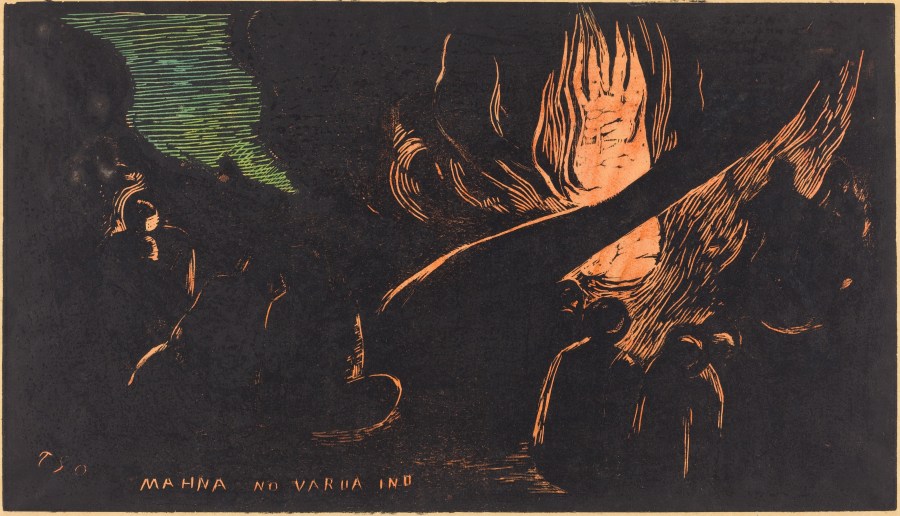
Featured Art:Mahna no Varua Ino (The Devil Speaks), 1894/1895, Paul Gauguin
He sits in thinned Hanes, reading The New Republic, one leg crossed over the other— picking at a flaked green toenail, some rot caught in the steaming air during amphibious assault on Guadalcanal.
And on weekends under wraiths of blue smoke, he visits with his buddies— men in striped bell-bottoms and afros, women with long noses and gypsy earrings, French professors from the university— organizing for the first farmworker for Congress, the first black man for president, the next Kennedy.
At five, he rises like a machine and feeds the mastiffs, leaves to teach high school, his civics students invading the city council, printing T-shirts in the garage, storming a precinct in Watsonville, registering voters around the vinegar plant and the lined-up shanties by the cabbage field.
He fortifies the teachers’ union with longshoremen and brings in the NAACP to meet the environmentalists. You gotta get ’em talking, he tells me. Like Tip and the Gipper. Everyone lifted up.
Except my sister and me, when— together with my mother—he sets upon us with whip and belt. Their cheeks, as they beat us, red as bruises, eyes glazed like they’re having sex.
Until I turn nine, his fist suspended over me, as I stand in front of the dead fireplace, a piece of sharp kindling in my hand, prepared to kill them both.
Doreen, he says, I’m not doing this shit anymore. So she beats us herself while he stays out till midnight attending meetings with the League of Women Voters.
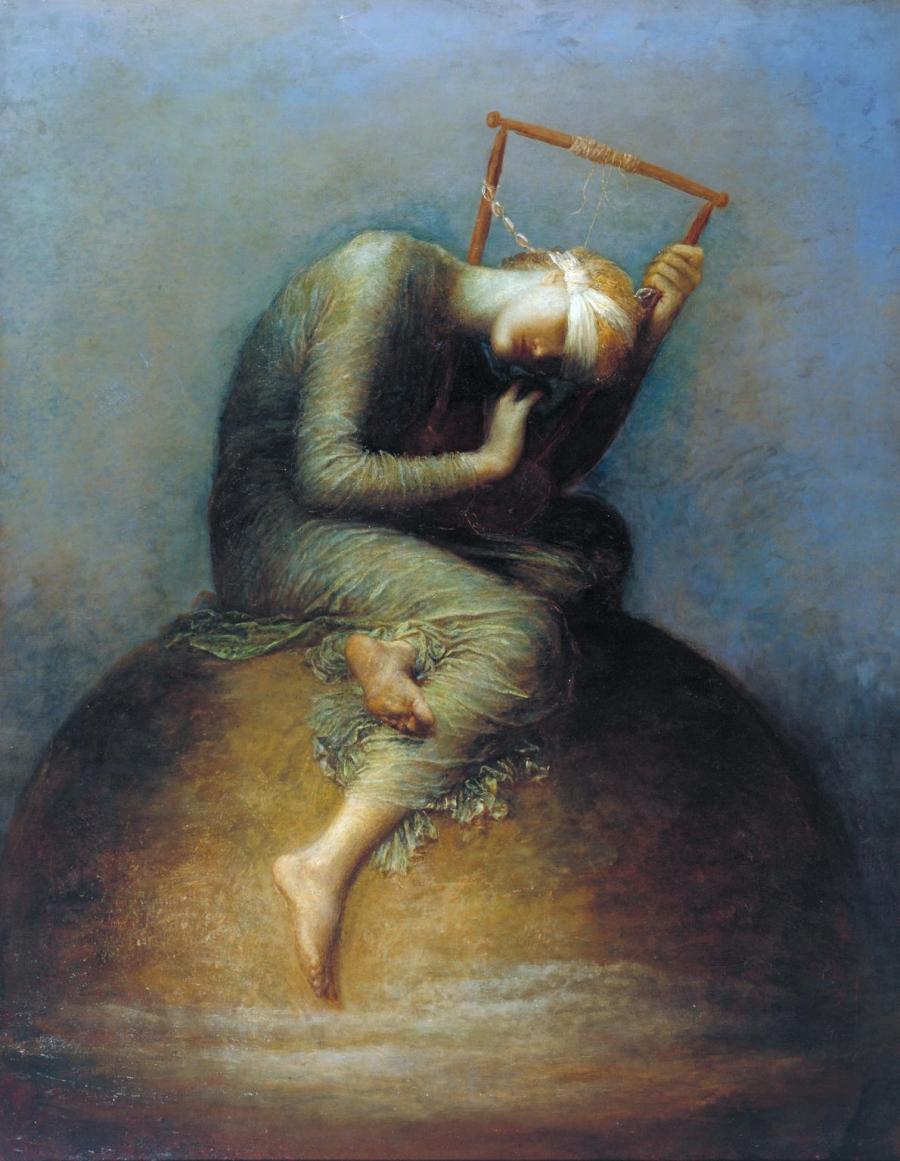
Featured Art: Hope, 1886 by George Frederic Watts and assistants
means whistle. A Spanish word that sounds like silver in the air, a little bird’s song Oh My Dear. Oh My Dear. Every year, the first time I hear that smooth silbato, it’s the first day of fall, a sparrow with a small stripe lining its eye, passing through with the dying days when the golden apple’s skin feels softer than in summer, a little more honey. Oh My Dear. Little girl, this is how it begins— school, getting up early, not knowing what you’re in for, what your friends will do to you, what you’ll do to them, what being one year older will mean in the world of a girl. What to fear and what to hope for.
Walk into the side of a mountain— some cave of limestone and chert. As the sparrow sings, light a fire. It’s cold outside. Let the flame flick the ceiling with the ghosts of wild gazelles, grab some coal, some ochre the color of crusty blood, and a rabbit’s thigh bones to trace them— stickmen running with laughing legs, spears carried high above their heads. See who walks out alive in spring.
After our parents left for Vermont, Ruby and I spent most of our time waiting for the Olympics. The world is coming to Los Angeles! the commercials told us, and the announcer’s tone was so excited and serious it seemed to imply that every American should prepare.
That summer was going to be a turning point for our family. We were in the final stages of a move to rural Vermont, where my parents were rebuilding a house they planned to have ready by the start of the school year. Once the house was inhabitable, even barely so, we’d all move in and complete the finishing touches as a family. We’d already chosen the stencils we’d use on the walls in each of our bedrooms. Mine was going to be silver, turquoise, and black.
In the meantime, my job—mine and Ruby’s—was to have the fun summer that my mother said we’d earned. We could contribute to the house by holding down our current fort, a converted garage in the Philadelphia suburbs. The beauty of the garage apartment was that it looked like a mini-version of the other houses in the neighborhood. My mother liked to point out that you could look at a picture of the garage and a picture of a real house, and you couldn’t necessarily tell which one was which.
But Philadelphia’s Main Line was only a stepping-stone in our journey. The goal was to educate ourselves in multiple ways, and the four years of high-class learning we’d done in the suburbs—in one of the best school districts in the country—was coming to an end. It was time for us to learn from the land, to shed our unscuffed shoes and make ourselves interesting.
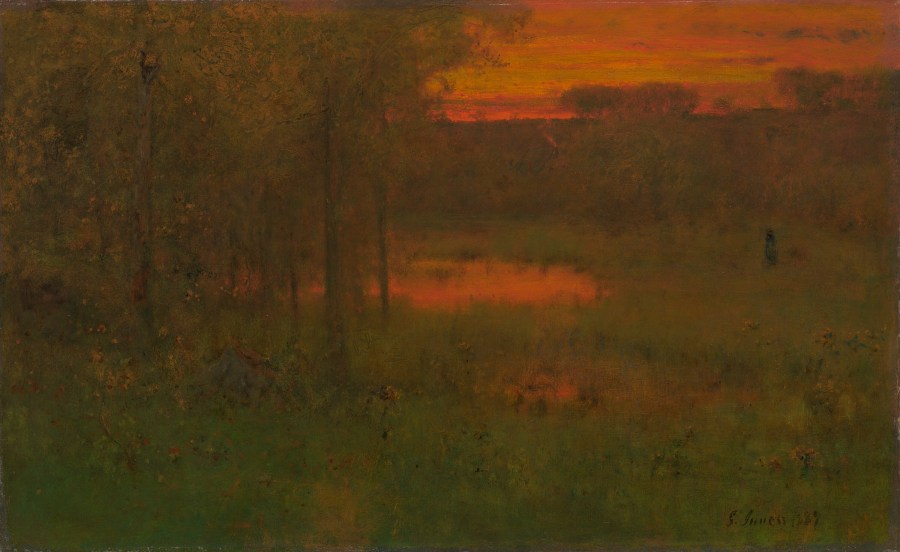
Featured Art: Landscape, Sunset, 1886/1887 byGeorge Inness
The sun sets red through clouds of ash made of normal stuff, like trees and brush, but also bedroom walls, Persian rugs, winter clothes, LEGOs, maybe the family dog.
At a safe distance from the actual disaster, we cough and small-talk about wind patterns, particulate counts. It’s everyone’s opening line on Tinder, something like, “I’ve got an extra N95 mask waiting for that special someone ;-)”
And I wake up halfway through a memory back from the dead of kissing my summer camp bunkmate, to practice for boys, scrunchies on our skinny wrists, hands in each other’s hair, a lump in my throat.
I can’t believe I lost this. My tiny, broken heart suddenly unhidden by the bonfire smell.
“And beyond the empty cage, a bedroom; and beyond a bedroom, the wood boards, beams, and floors holding the shape of the house; and beyond the house, a yard.” —from Jorge Luis Borges’ mislaid manuscript, Labyrinthian Architectures, a book that has been wished into existence
The day the tarantula escaped, my uncle joked, “The cage is empty.” He said it over cornflakes— the rock fallen off, the mesh lid mysteriously askew.
He smiled and slurped and chewed. We searched behind the couch cushions, among piano hammers’ knotted strings, in the broom closet
with its scary duster. (How many days had he let it out for a walk—crossing the afghan’s colored squares draped across the backrest?) At night I dreamt it crept
across the headboard as I slept, scuttled clacks, each foot a seed-hard talon, spilled tacks. Gramma finally found it when shaking the sheets out:
black and lacy it sailed through the air, then scampered under the bookshelf where it hid then disappeared beneath baseboards.
The walls breathe with it now, acrid, not unlike the air outside the zoo’s tropical house, toucans dripping guano black as the berries they ate.
I coax it with felled moths, pheromones exuding from their bungled heads after all night blinging the bulb’s sexless filament.
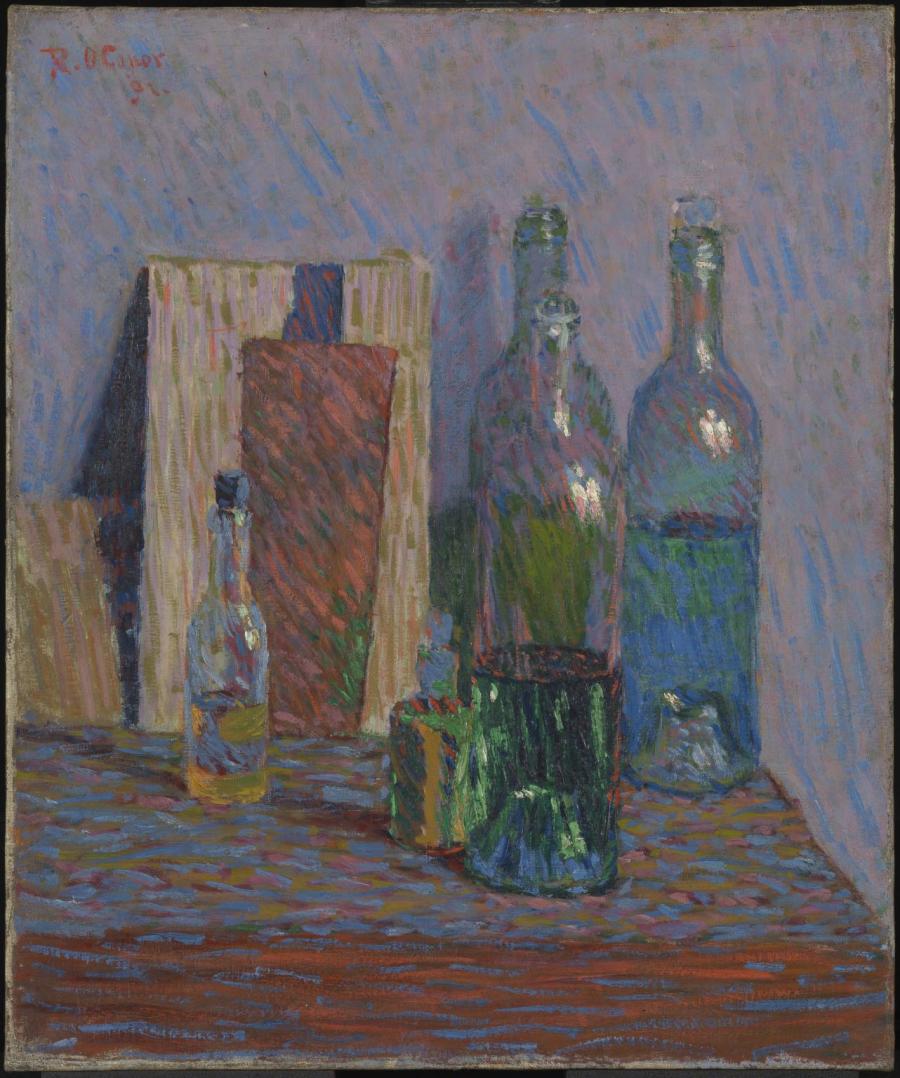
Featured Art: Still Live with Bottles, 1892 by Roderic O’Conor
Donny Banya does the room repairs or when he isn’t buzzed he does. I’m the night clerk. Alma runs the bar—plus she’s an artist. Big John, the owner, does the books and walks around and plans big changes to the parking lot and ground-floor Men’s. There’s other staff but tonight it’s just the three of us, or four including John who is dozing on the sofa by the magazines,
John who despite the plumbing in Room 21, despite the mold and the mice, despite the blinking signage and the boarded side-door, still thinks he’ll put the Twilite right. I got it on the cheap, he says. It’s beautiful. He dozes and the rest of us chat
and Alma says she’ll sweep and clean the lounge herself— “except I’ll need a hazmat suit.” We all laugh, John stirs and, stretching, sits up and lights a cigarette. It’s already hot in June. And with the A/C on the fritz and Alma set to quit and paint her nudes and trees full time it’s as if, beyond the grimy carpets and the dingy stairs
the air itself is greased with disappointment. Alma says the Twilite makes her sick— the room keys, the doors and doorjambs,
TVs, counter tops, the complimentary cups— the whole place is sticky. She says last week she saw a fly that couldn’t free its feet for take-off so she slapped it flat beside the guest phone where it’s stayed three weeks. Smudge with Reaching Wing, she calls it.
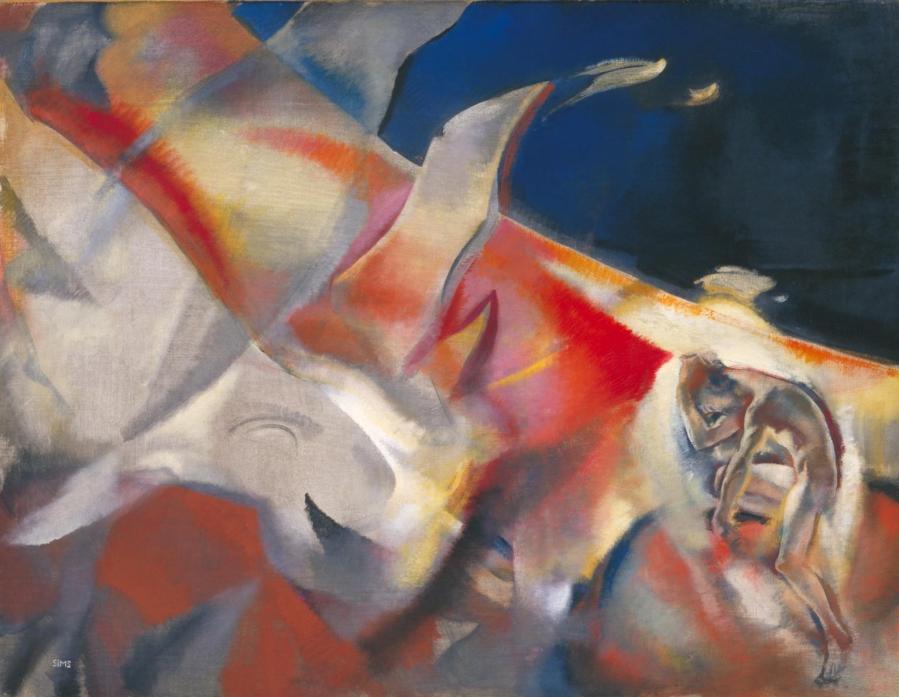
Featured Art: I Am the Abyss and I Am Light, 1928 by Charles Sims
My house cleaner passed away last week . . . need to find someone new . . . Prefer someone who charges by the hour . . . Bob 831-435-648 —posted on social networking site Nextdoor
Dear Bob, Perhaps you’ve noticed the smell of cinnamon and sweet rice drifting through your kitchen at night. So when the ice melting in your second glass of gin begins to sound like a woman singing “El Cantante,” you’ll know. It’s me.
We only spoke of cobwebs. La mugre y dust. You never asked me nada. I have a son. He misses my arroz con leche and my laugh.
Forgive me. I took pleasure in your bad Spanish. Yo estoy poquito embarazada sobre mío lío en el baño is strange in any language. I’m sorry you were a little pregnant on your own in the bathroom. Don’t feel embarrassed. I was once pregnant on my own too.
See how the stains on the tile around your toilet have started to take on the shape of my face. Mi cara! I can’t explain it. It’s just rust. I tried to scrub it off. But I was someone you paid by the hour.
Those final days, I know, I was going slow. Mucho dolor. Still, you owe me a check. But last week, en mi cama, I was filled with a longing to let go. Yo estaba acabada.
Bob, your number’s missing a digit. No one can reach you. Though I always thought you were like a creature in a tide pool who didn’t want to be touched. Qué lástima. We could have comforted one another.
I hope you won’t forget the way I folded your towels into a five-star destination, laundered your chones with lavender, made your bed a lifeboat of fresh linen. I gave you the world inmaculado. I was someone named Consuelo.
Featured Art: Little Walter’s Toys, 1912 by August Macke
Edison was allowed to spend one-third of his monthly spending money on manatee merchandise, but it usually came to about half. His mother was a marine biologist, and Edison had seen a photograph in one of her magazines when he was six and couldn’t stop looking at the manatee’s bloated snout and flippers like gray oven mitts pinned to the balloon of its body. He was thirty-one now and bought his own nature magazines to look for more pictures, more patient expressions on the floating creatures. Their eyes seemed to want to listen only to him.
He woke early on a Thursday worried about his spending money. He moved Harold’s plush tail and found his phone beneath an umbrella his father had given him. Edison paused to close and open the umbrella, watching the manatee’s face crumple and smooth. Ten years earlier, when his parents said he should have more independence, when his case manager found a retired woman on the other side of San Diego whose client with special needs had moved out of her basement room, they encouraged him not to decorate the walls like his childhood bedroom. “You’re grown up now, Eddy,” his mother said, and his father—so rarely in the same room as his mother and stepdad— nodded and squeezed his shoulder. But Edison had been up all night thinking about moving out of his parents’ house, just like his high school classmates. He was certainly going to decorate the room with manatees.
After the handmaidens, blindfolded and proceeding by touch alone, have twined the masses of string across its enormous silvered surface, then the mirror-keeper, also blindfolded, sets a lit match to the central knot.
When they sense that the whole skein is ablaze, they bear the burning glass to the lake’s edge, and lower it into the icy shallows where the mirror-keeper strikes a single blow, shattering it along every line at once.
Then they lift it in its frame from the water to tap and test its face with their tongs, plucking out the fragments, swaddling them individually in silk to be dispersed throughout the land.
Now instead of making pilgrimage in order to not look into the virgin mirror, each family can cherish a shard to not look into without leaving home.
Dionysus! What is on your record player tonight? Turn up
ABBA’s greatest hits and call me Chiquitita one more time.
The night is young and we are ancient
history, but dammit if you don’t throw the wildest parties.
All the columns choking on vines. Wisteria
fronding from the lamp lights. And I, wishing I’d worn
the dress you gave me at the beginning when the sex was still
effeminate. The dress with the cape made of migrating starlings.
Masterpiece of murmurations. No matter,
I prefer this prison jumpsuit. Gauche orange
like a Halloween pumpkin. Oh! You should know by now
how much better I carry my body when it is a trashcan fire.
Dionysus! Remember our first time? You came
in the back of your father’s classic Panther West Wind. Now
other people’s tongues pulse in your mouth.
Now sirens from the downtown precinct. But not before,
Dionysus! Show us that party trick you do so well.
The one where you pluck out your own femur and make
WOMAN. The one where that WOMAN uses magic
to ensure that her soccer team wins the World Cup.
Dionysus! Sneak us onto the edge of the River Styx. See
which one of us skinny-dips into the deep end first.
I’m betting it’s me who wakes up in your bed again after six
too many red wines. I’ve never been good with endings
or perhaps it’s hard to leave behind a place where no one knows
what you look like naked. And weren’t we once acquainted with
each other’s morning-after tics? How I prefer the smell
of citrus to coffee. How you only ever have human hearts
to offer. Plump and halved like papayas. The kind where a
single bite shows you your own death. The kind where
if you tilt one just so, it will catch the light and turn into copper. A
penny you can throw at a fast-moving train.
Jessica Hincapie is a writer and teacher living in Austin. She received her MFA in poetry from the University of Texas and is currently the Program Director at The Writing Barn, a writing workshop and retreat space in South Austin. You can find her work in The Indiana Review, Ruminate Magazine, Four Way Review, and elsewhere.
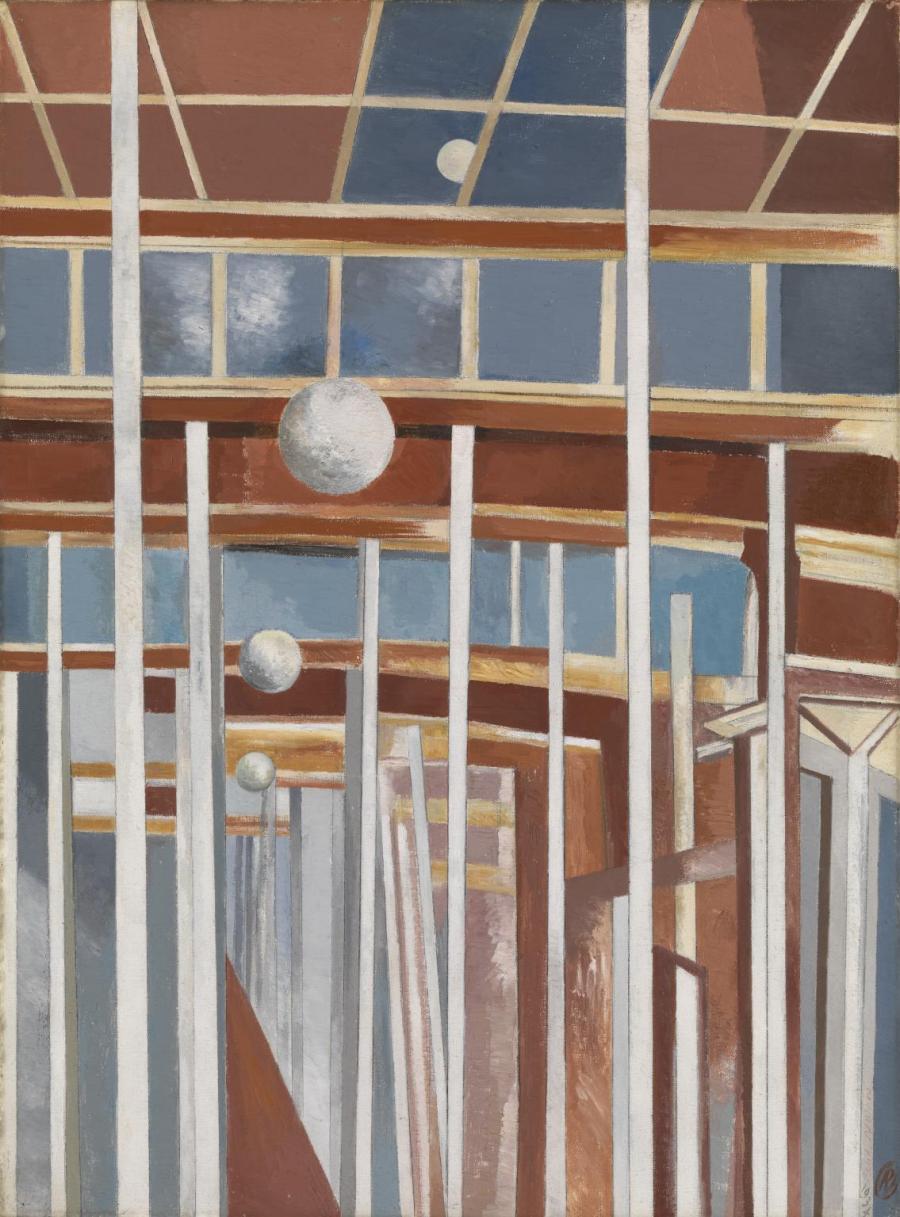
Featured Art: Voyages of the Moon, 1934-7 by Paul Nash
No one knows its origins. Like carpools and happy hour, the Plan has simply always been. Its awkward page breaks and stilted phrasing, preservation of failed projects, employees
long departed, are evidence of its ambition, how it defies the limits of language, software, human thought. No one has ever read the Plan in its entirety. Attempts to download it
result in system crashes, sunspots, and recession. A single hard copy is rumored to exist, its pristine pages collated and punched, then stored in binders ordered on a shelf—
but no one knows exactly where. A hundred years from now, when the company has ceased to be and its headquarters crumble, the Strategic Plan will rest among the rubble waiting to be found.
Lacking an exact translation, its runic nature will give rise to cults that worship its straight lines, its acronyms and colored fonts. It will not inspire war, only art and rumination.
No one who encounters the Strategic Plan remains untouched. It features in the dreams of former employees who understand too late its vital truth: Every aspect of the Plan—
its ever-shifting goals, its layers of revision and appendices—acts as both map and goad. The Strategic Plan is perfect even in its flaws. It isn’t meant to be fulfilled.
Featured Art: The Breeze at Morn, 1930 by Thomas Lowinsky
And here we see where the pages of the ocean were torn from their logbook as if in meticulous rage, though there’s no debris adhering to the binding, as might so easily have been the case. What to do with this stiff and empty cover? Pack it with snow and staple it all around, so it can retain its shape until the committee rends it open and shakes it out face-down, inviting the ragged pages to return in just the right sequence from every place they’ve flown.
Featured Art: Eternos caminhantes, 1919 by Lasar Segall
To ensure meetings have a clear, productive point, statements of need and rationale must be approved prior to invitations being sent. If two important
meetings overlap, please disregard the laws of time and space. Your project heads have far less power than they’d hoped, their agendas set by management,
inboxes filled with bad ideas. To ease the burden they’ve assumed, complaints must be voiced before the call to order. Late arrivals will be penalized
with dirty looks, wobbly chairs positioned in a draft. Because discussions may grow heated or not go your way, you may storm out of two meetings
a year and leave in tears from one. If these limits are exceeded, you’ll be elected secretary. Otherwise please stay until officially adjourned,
even if you’re bored or late for surgery. If a meeting runs over its allotted time, an alarm will sound. Continued failure to disperse
will cause the sprinklers to come on. To avoid a doorway bottleneck, you’ll be dismissed in order of seniority or usefulness. We tested
these new rules the same day they were written: we came, discussed, voted, and left impressed with our efficiency. If due to their constraints
we brainstormed less, explored fewer options or consequences, we found it a fair trade for the brisk pace, guarantee we’d escape getting drenched.
Featured Art: Second Beach, Newport, c. 1878-80 by Worthington Whittredge
Coach West had just finished grilling the dogs and we were all standing in line, going crazy with hunger. We’d had nothing but concession stand sno-cones after the doubleheader, and we were ready to eat our weight in barbecue. Rudy and I were going to do an experiment to see which tasted better on dogs—onions or relish. I was going to blindfold myself with my ballcap and Rudy was going to feed me one bite of each until I discovered the answer.
But Dad’s hatchback came skidding across the gravel toward the pavilion, a long dust cloud rising up behind it like the tail of a dragon, and I knew something was about to happen. The door popped open and his hand shot down to the gravel like a kickstand as he got out of the car. He left it running and didn’t shut the door behind him.
Coach West set down his tongs and gave Rudy’s father a look. They hopped off the pavilion deck and went to greet Dad. Marcellus’s mother, our Team Mom, took over at the grill, speaking loudly and brightly, asking what everybody was doing for summer now that we were done with the third grade.
Dad has three different chainsaws and Kevlar shin pads, the same glossy material protecting a spacecraft as it drifts into the Kuiper Belt where little flecks of undead planet fling around like buckshot and light from the sun takes a while to arrive.
I am glad that my dad is safe from the Kuiper Belt. Eventually something else will kill him, but for now he is cutting firewood into precise sizes. He is wearing a wide-brimmed hat. I am rubbing aloe into my own growing forehead, trying not to believe
that he grew up in the only town hit by a meteorite twice. One punched a hole in a roof then rolled under a table like a peach. The other lodged in a crossbeam that might well have been
his sleeping smile or the windshield of his idling El Camino. He’s asked that I sprinkle him into the woods when that something else falls from the sky like a bucket of nails.
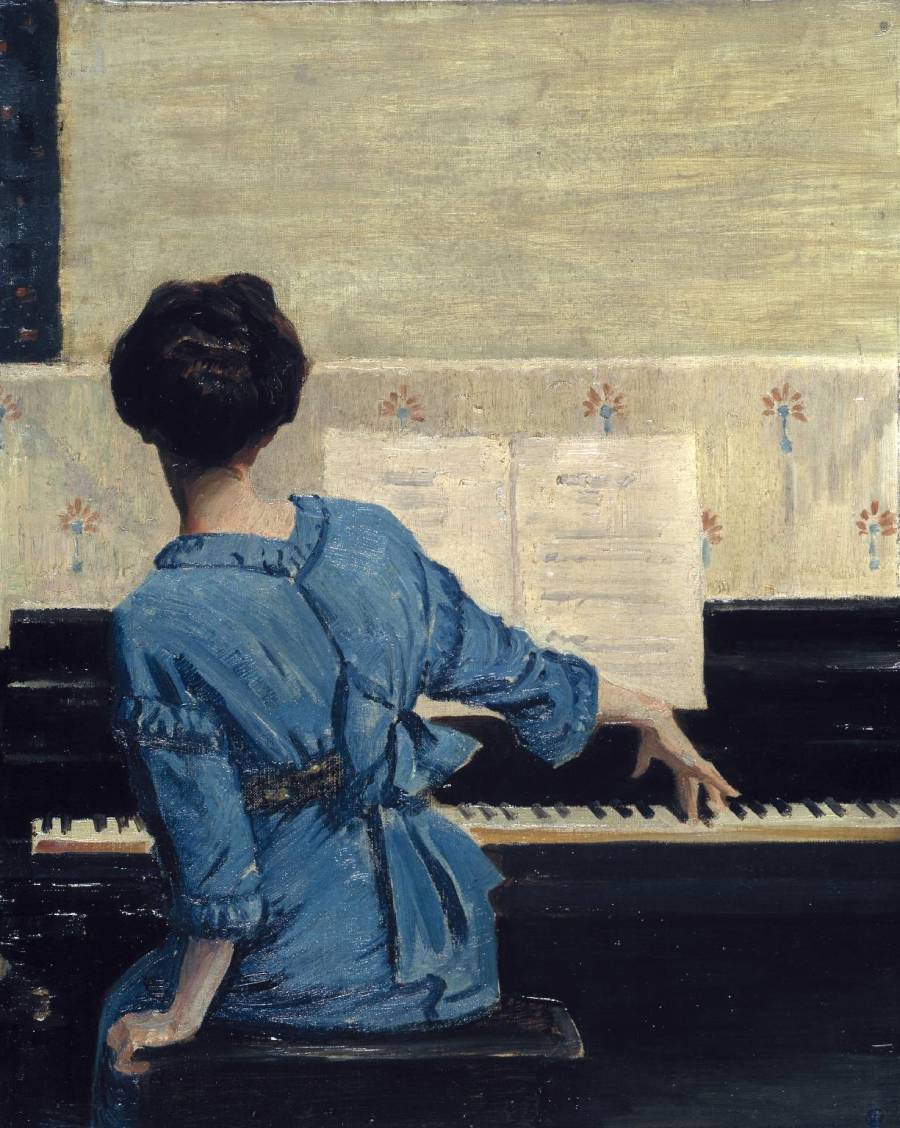
Featured Art: The Keynote, 1915 by William Arthur Chase
It takes almost nothing to step into each other’s lives: a favor for a neighbor, a huge, upright Steinway there’s no one left to play.
All morning they labored together, the men. Everything they could think of to get it out of the van and over the curb— metal ramp, wooden boards, a jack, the old bed frame from behind the garage.
Dave had never asked my husband for anything before. The house he’d grown up in was already packed, mementos sold, his mother’s mind
skipping liberally among the decades, her fingers running through chords in the air or waltzing grandly through measures of Chopin. His father stooped from his own burdens, aged beyond his years, nodding when people talked about his new facility, so highly regarded, so clean. There was sweat, grunting,
my husband mumbled a curse as they argued about angles, pushed their charge up the cracked walkway, three shallow steps to the porch.
And because we have no better idea how to be with each other in our pain, when they’d finally struggled the monstrous instrument into Dave’s house, they could only wipe their hands on their jeans, crack their knuckles, and share a pizza, which they ate standing in the kitchen, hunched over its grease-stained box.












 New Ohio Review