Author: newohioreviewonlineissues
The Classical Archaeology of My Skeleton
By Michael Derrick Hudson
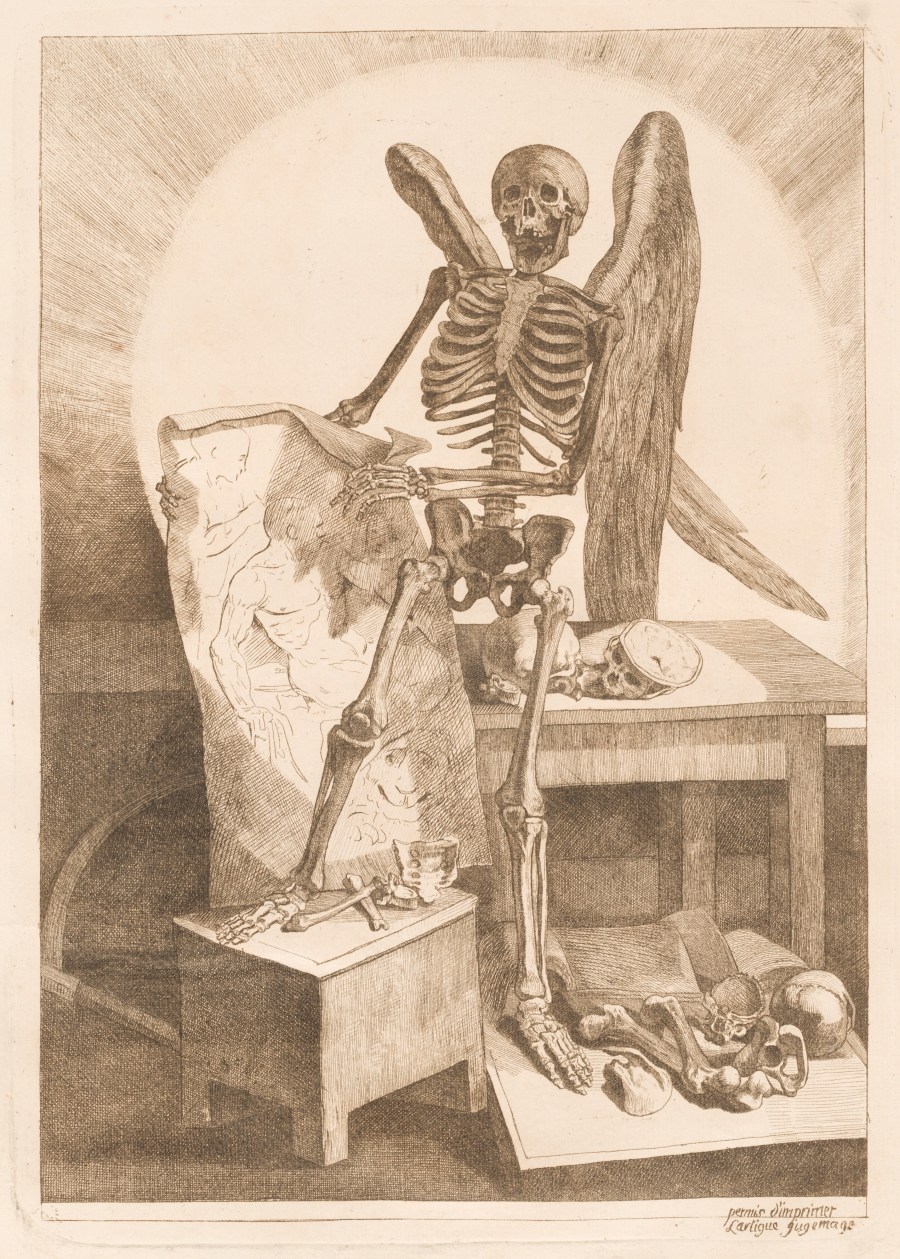
Featured Art: A Winged Skeleton Holding an Anatomical Drawing, 1779 by James Gamelin
You’ll trip over it whenever you stroll the Forum, teeth
and spalled vertebrae, my phalanges
used as pavers, liony yellow and crumbling in situ . . .
It’s so sad, this reduction to time’s kibble. Junked and
recycled, my gravel’s been scattered
citywide: wrists left to the lime-burners, molars sold
for scrap. My jawbone’s a goat corral
up to the hinges in fodder and filth. Of my ribcage
only a few splinters remain, still stuck
to the leathery black rind of Caesar’s heart. Tourists
shuffle through my pelvis, a grotto famed
for the cat-piss stench of centaurs, their pornographic
graffiti and the tarry stalagmites
of wine-dark scat. How their flinty hooves clattered
over the mosaics those nights when they’d gallop off
in pursuit of the virgins. Ah, the virgins! How easily they’d
slip our grasp, gathering up
lingerie and toothbrushes, blowing us kisses goodbye . . .
Scholars took years to identify my skull, the brainpan
fouled with mouse droppings, owl pellets
and busted amphorae, spooky winds shush-shushing
through the cracked dome. O lost luxury! Splendid baths
featuring salons, outrageous
cuisine and twenty-four-hour boutiques. Every niche
its own nude, every spigot its own flavor. Caesar whet
once his exquisite appetites here, a depilated tyrant
up to the jowls in his own broth. So much stale purpose, so
many dead language protocols. The tedium
of yesses and wants. So many same things over and over.
Read More
On Finding Out My Genome Includes About Three Percent Neanderthal DNA
By Michael Derrick Hudson
It explains a lot. The unappeasable nostalgia at sundown. Those oof-oofs
when first I wake up. Or that faraway doggy look
I get when gazing at full moons. Every doggy thing, in fact,
about these eyes: heterochromia, astigmatism, and a remarkable capacity
for registering disappointment. Furry knuckles. Weak chin. A receding
brow too shaggy for such latitudes. A touch of depression and
my susceptibility to tragicomedy. Clownishly splayed
size twelves. Occipital bun. Knock-knees. Gracile shinbones (but robust
pelvic girdle). Hypercoagulation. My adhesive, prehensile lips puckering
around a single grape. A craving to know my whereabouts. A real talent
for sniffing out thunderstorms. How easy it is for me
to spook. My susceptibility to hoaxes, too-good-to-be-true scenarios, and
going-out-of-business sales. Grooveless canines. Skin tags. My tripwire
gag reflex. The prelapsarian nightmares. My prototype
conscience. My poor handwriting. A dread of abstractions. The flowers
I’ve sent to corpses. My shambling gait. Flight always
before fight. My shrugs. A limp handshake. My prophylactic revulsions.
Read More
Sonnet with Acne and Hawk
By Robert Thomas
Wadsworth: the homeliest boy in homeroom.
My acne looked like the gentle foothills
of the Sierra next to his Rockies.
Kenneth, but kids (not me) called him the Wad.
Our class went on a field trip to the snow,
and I, the most romantic of the bunch,
wandered up the frozen river, giddy
screams of rowdy carousers soon eclipsed
by the softer scream of a distant hawk.
Ken came around a bend in the river,
hand in hand with Kate Dunn, her shirt open,
her breasts brazen in the pine-scented air.
No one spoke, but they had no fear, while I
was suddenly afraid of everything.
Read More
Bad News, Baby, Good News, Dog.
By Britt McGillivray
this morning a meme queen reminds me we are living
in a hot catastrophe. i’d been dreaming
about an island lover a small puddle away,
then woken by propane tanks exploding fire
in next-door’s tent city. where i live, we were in crisis long before
this. indoors i receive 2D dispatches, pull myself through
the endless scroll: bad news, baby, good news, dog.
slow-build cries of freedom from the vaccinated crowd. a pomegranate,
split just so in a drippy palm. where i live, we’ve been eyes cast up
and chins tucked down. masked indifference to ‘save’ our ‘souls’.
this morning a meme queen reminds me: when the world ends
grab for whoever makes you happy. they took the quote from O’Hara
in times of crisis, yada yada. i de-seed a pulsing pomegranate.
what do you call an unending interruption? limbo,
bardo; a sad sabbatical, turned normal. i double-tap a crisis, offer an orange
heart to a public miscarriage, twenty more dollars to mutual aid.
look! more pals engaged, island lover blinking, hot sun hitting
face. more touch, deferred. i thumb a gender bomb i don’t believe in,
identity derailed by blast of parental well-meaning. my face burns pink.
my veins throb blue. i had decided who i love, this juice
drips from knee to tile floor, again and again, more stains to clean
i tried, meme queen, my decision just didn’t want me. bad news, baby.
where i live, we learn to look away. i close my eyes, see speckled
skin, a welcome face. pulp slipping through a ripe, plump
laugh. i backtrack through rupture, thick and brutal. then, somehow,
passed. a fruit plate, some apple stars. the future
halved, in separate palms. bleeding out. split, just so.
a meme queen reminds me: we still live in a hot catastrophe.
yes, but we’ve been dreaming
a way out
Read More

Doppel
By Max Bell
Selected as winner of the 2021 Fiction Contest by Anthony Marra
Featured Art: King Lake, California by Albert Bierstadt
I hear every word. I know exactly where I am. Dr. Shelley, sitting across from me in her white lab coat in her air-conditioned Westwood office, has told me that I have cancer. The pain in my chest does not signal the cancer’s home but its most recent lodging. Each scan and test reveals that it is too late for any combination of surgery and chemotherapy. I should not have ignored the signs. I delayed it all for too long.
Dr. Shelley pauses after delivering the news, searching my face to deduce how soon she can relay more information, how quickly she should speak, how she should modulate her voice. No speed or timbre seems apt. I do not worry about how she will sound after the silence. Taking offense at anything in this moment, or in any other, suddenly seems a waste of valuable time.
Why have the movies lied when depicting the cancer revelation scene? The world does not dissolve into a warm haze. Everything is clear, sharper than before. It’s as though I am someone with astigmatism who’s found the perfect corrective lenses. The sun strikes through the glass of the office’s wall-to-wall window, accentuating the details of each object in the room. The ridges of the lone paper clip on Dr. Shelley’s desk are as clear as the dotted brushstrokes of the purple-red sunset that casts a shadow over the sand in the reproduction of Lemmen’s Beach at Heist, which hangs in a dark brown frame next to her college degrees. I can read the spines of the books on Dr. Shelley’s shelves, the letters on each embossed in muted gold on leather that looks like tanned human skin.
Read MoreDeep Nostalgia
By Peter O’Donovan
“Deep Nostalgia™ is the magical MyHeritage feature
that allows you to see the people in old family photos
blink, move their heads, and smile . . . The 10 additional
drivers released today allow you to see your ancestors
express a wider spectrum of gestures and motions,
for example, smile wholeheartedly, blow a kiss,
nod approval, and more.”
—MyHeritage.com
Hard not to fall deep into the fancy,
drawn into the scene as the face unstills,
blinks a bit, looks around at its surroundings,
then smiles vaguely as though just awakened
while decades melt away by our devotion
to those sacred photos, those icons of Them
revived to succor, to help us through.
But then, the illusion slips for a second:
lips open slightly too wide, reveal
dark & indiscreet blight underneath
with the miracle’s seams now visible,
skin jittering under electric current,
dead pixels stitched on an actor’s grin,
a magician’s trick, a carcass shuddering.
Perhaps They wonder where they are now,
trapped in this mannequin afterlife,
looping continually, dimly confused
at these orders received, contorted
to kiss and wink at our demand, to dance
for our nostalgia, to nod with praise
never offered, held greedily in the grave.
And so, They shall be remade to our need,
artifacts of longing shaped to be shared,
for remorse performed by social media,
by tweets and with tears for all of our followers,
as we watch their faces, again and again,
their characters molded as we reclaim
our heritage of old, our cold construction.
Read More
Scene of the Crime
By Peter O’Donovan
A worker appears just before your soirée,
a giant covered in mud and sweat-smell,
who placidly asks where you want the grave.
He won’t be turned away. He’s already been paid
over the phone by some mysterious figure.
You send him off to dig behind the willows
before the guests flit in and admire
your poorly secured rifle collection,
your recently sharpened knives,
your closets filled with elaborate disguises
and family secrets, barely concealed.
The guests mill about the salmon croquettes,
pass oblique glances and disrobe
between drinks, casually,
as though clothes were merely an interlude,
a short break for the flesh to rest itself,
while the waitstaff look on bored, stoic even.
Without your phone’s constant judgment, you breathe
relieved, you loosen up and criticize
the new regime, welfare recipients,
and your second-to-last lover, left for dead
and still a nag about it, won’t let it go.
The night winds on. Some disappearances.
A minor Party member makes a speech
on the need for greater transparency.
You dance to the old songs, those teenage dreams,
then fire a young waiter, capriciously.
The police arrive, but are easily bribed
with nothings, false promises of promotion.
The worker returns, smelling still stronger.
You refuse to leave, but are dragged out, pleading.
The guests applaud politely.
Read More
The Cabbage
By Peter O’Donovan
—after Jadeite Cabbage with Insects,
National Palace Museum, Taipei
Stumbling from the Qing exhibit
beauty-drunk on shape and glazes,
those flowing cerulean blues,
I heard a massing up the stairs,
a faint concentration calling
this pack of grannies rushing past,
with little charges almost electric,
an upward flood flowing to a plain
of people, pressing tour groups
enveloping some thing scarcely
visible, some dim verdant smudge.
I waded in, past the stragglers,
the dawdlers, the bored-slow slackers,
past the PRC operatives
skillfully disguised as sightseers
or weeping children, past the pious,
the museum completionists,
past them all, to the front, the fore:
a bok choy cabbage, barely there,
about the size of disappointment.
Mostly stem, a pale translucence
etched with veins, gentle threads curving
up discolored jade, blotchy, cracked
but weaving its flaws into form,
into ruffled leaves of sea-green,
broad blades glistening in half-light
with two grasshoppers in hiding,
revealing themselves by angles,
the slant of a leg not quite part
of that smooth verdure, that soft sway
of the foliage folding down
beneath the insects’ careful weight.
And then, I sensed it. A movement
in the stems. The faintest flicker
in the leaves, and beneath, the eye
of the locust beginning to glide
with all the swiftness of stone, taking in
this crowded, quickened place,
this tempest-blur of a time,
this maelstrom age,
this brief, sudden day.
Read More
The Last Day of America
By Benjamin Grimes
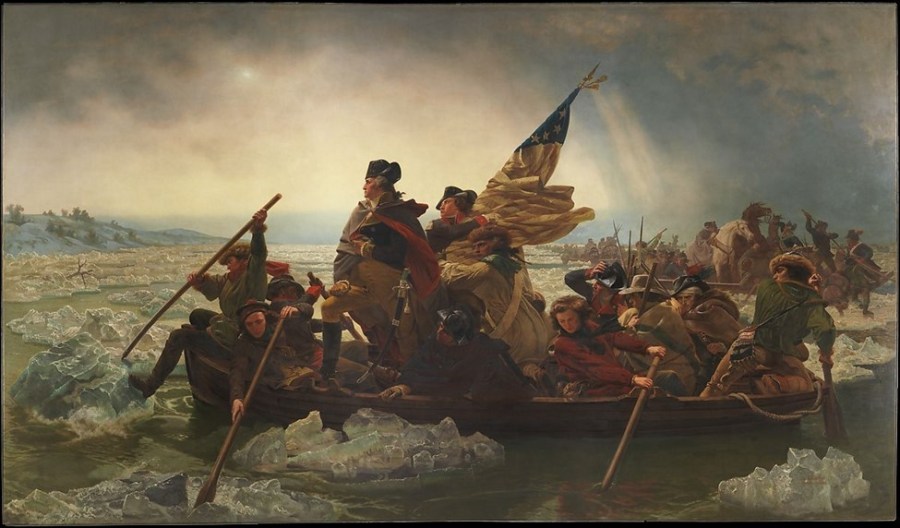
Featured Art: Washington Crossing the Delaware by Emanuel Leutze
I wake up on the last day of America.
There are sirens but a long way off:
I cannot tell if America’s last ambulance
is on its way or has already packed
the last emergency of America into its hull.
In the yard I stand inside American sunlight.
On tiptoe I creep through American grass, I climb
the fence to see what the American sky is doing.
It is making the last cloud, a cloud the shape
of America but not the shape of America
from a map. It is the shape of America as a child
concentrating tight around a crayon might draw America
in the last American kindergarten class. I want
to take a picture to remember the shape, the cloud,
the last day of America but buzz buzz buzz: here comes
the last American phone call. It is an American robot,
calling to let me in on all the Last Day of America
Big Box Giveaways. I agree to the last follow-up
email survey of America to show my appreciation
for the robot’s wherewithal & tact. I click 10 & 10 & 9
& hope it adds up to a raise when the robot’s hauled in
for the last American performance review. Of the last
humiliations of America even robots will not be spared.
For breakfast I toast the last American Pop-Tart
& head out for the last American errands.
There are many like me, wandering the aisles
as the last ghosts of America, unsure what it is
we’re haunting. There are many like me, eager
for one last peek behind the American screen.
I bring home the last shovel of America
& set to digging the last American hole.
I make a list of my ideas, the last ideas of America,
& bury it as deep as I can dig.
Read More
Despots
By Peter Maeck
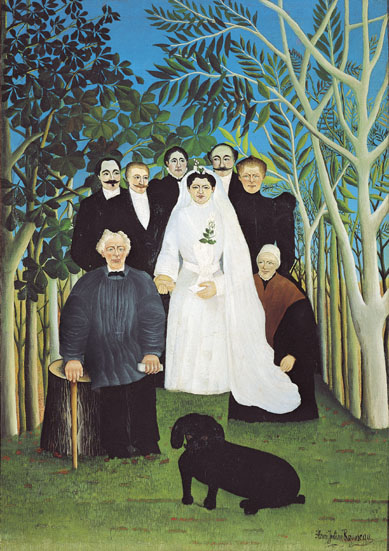
Featured Art: The Wedding Party by Henri Rousseau
It was doggerel, the sappy little poem
or, more aptly put, the limerick
which we’d dashed off in seven
seconds flat: our way of saying—thanks?
Yes, thanks, why not, for all they do for us.
Without them we could not, we let them think, exist.
Reciting such godawful we won’t even call it
verse brought up the bile into our throat but they
like little half-wit schoolkids being read some
nursery rhyme from Mother Goose sat glassy-
eyed, their elbows on the banquet table,
rapt.
Our betrothed and we repaired to
separate rooms that night, tradition
dictates that, and next day bright and early
we were standing face-to-face, you now
may kiss the Holy Book, I do, I do,
and all of that. Out there they sat,
some with, some without hats,
all haunch-to-haunch and sheening
in the monstrous August heat;
some had passed out.
Most heads of state like us will fly
to islands for their wedding night but
we did not, we like to show the common
touch, we took the bridal suite atop the down-
town Marriott. Below our window
they all stood unmindful of the storm
and soot, their lonely eyes imploring
us to step out with our champagne
flutes, post-coital cigarettes between our
milky lips. We did not, and indeed wished
not to disappoint.

Black Site
By Peter Maeck
Featured Art: The Yellow Books by Vincent Van Gogh
The guards awakened us, we’d barely
gone to sleep, they strip-searched first
the women then the rest of us (trim off the
limp, discolored outer leaves of late-picked
artichokes) but Frank refused to shed his
boxer shorts, not smart, he paid the price
for his recalcitrance.
WHAT HAVE YOU DONE TONIGHT?
WHO HAVE YOU SEEN?
WHERE DID YOU MEET?
WHAT DID YOU TALK ABOUT?
We shrugged, stayed mute.
(The artichoke grows wild in
shallow water, in canoes is
how you harvest it, our good friend
Nancy Sheffer says to trim the stalk,
cut off the limp, discolored outer
such and such.)
IF YOU NAME NAMES
THEN YOU ARE FREE TO GO.
By our silence we said no,
we won’t give up our friends,
that’s not what good friends do.
Then as expected we were hit with
pipes, my kneecap shattered with
one blow. Just think, I thought,
if I just shouted:
Nancy Sheffer!
She’s the one we met!
Here is what we talked about!
then all the blows would stop
and we would be released.
(The way to teach your cockatiel to
play with toys is play with them
yourself thereby to show your
feathered friend the way to
merry-make.) But we were
beaten every hour all that night
and all the rest of that whole week.
(A cockatiel needs time to feel at home
in human space just as, if we were birds,
we likewise would.) Now badly beaten Frank
is in a catatonic state. We do not dare to make
the sound that we would make
if we were fools enough
to weep.
(You want a good read pick up
Nancy Sheffer’s book about the
artichokes of New York State.) Frank
sprawls there on his back and looks
just like a cat run over by a Mack
truck. (Once a bird’s chicks fledge
they’re all pushed out and some
fly free and some are mauled by
catatonic cats in heat all howling
all the night. Trim off the outer part,
it’s blackened now and much too limp
to eat with pipes our best friend Nancy
Sheffer noted in her pioneering book.)
WHAT HAVE YOU DONE?
WHO HAVE YOU SEEN?
WHAT WAS THE SUBJECT OF YOUR CHAT?
We play dumb: What chat?
And then the pipes, the pipes,
she wrote.
Read More
Adrift
By Peter Maeck
The year we were a State Farm agent
we would rather now forget.
We hated scaring folks: Imagine that
your house incinerates or God forbid
you’re stricken with a fatal this or that
(it could be symptomless) or there’s
a workplace accident, you’re dis-
membered then what happens to
your spouse and kids? They’re up
the so-called creek.
Adrift, we turned to animal husbandry but we wept
to slaughter pigs; we planted beets but with the drought
we just gave up the naïve hope of ever making
gentleman farming work. We entered politics
sometime after that, ran for a City Council seat,
lost in a rout. We drowned ourself in drink.
Our spouse absconded with Meg and Mike
the twins and sued us for divorce.
Depressed, to say the least, we drove
out on a ferry boat, the one that goes from
Boxport out to Riley’s Point. We gunned it, shot
straight out the other end, right through the safety
chain, think Thelma and Louise. Our canyon, though,
was harbor water, sludgy, twelve feet deep. We didn’t die,
they pulled us out. The Camry was a total loss,
of course, the motor’s scrap once salt gets in it.
Stupid the attempt to drown ourself
in shallow water, better odds
out farther in the rip.
The blues run there, we caught one
at the age of six, in our father’s
Boston Whaler, never had a
better day than that one since.
One day a life can make.
Read More

A View of the World
By Linda K. Sienkiewicz
Featured Art: Woman at a Window by Casper David Friedrich
I believed I could communicate
with the female mink on my great uncle’s farm
until I put my thumb up to the cage
and she sliced the tip as keenly as a razor.
I believed Pippi Longstocking
could save the world.
I believed I could save myself
from the men my mother warned me about
the ones who might come up through the woods
from the far road by feeding them mud
cakes made with millipedes and spiders.
I believed I could live alone in a boxcar
with a can opener and blanket
and care for six orphans, too.
I believed my father actually would
flush my brother’s head down the toilet.
I believed if I walked three times fast
past the long picture window
my parents would not crash the car
on the way home from Talko and die.
I believed I was exotic when I danced with
two washrag triangles over my flat chest.
I believed germs followed me home
on my shoes when I used public bathrooms.
I believed even after I lied to my mother
about what I showed the boys behind the fir trees
that my heart was made of gold.
I believed my brother when he told me
we have one big eye in our head with two dots
from which we view the world.
Read More
Snapchat at the Magical Arctic Puffin Exhibit
By Shelly Stewart Cato
Maybe he has magic to keep himself
alive forever, says my little boy,
palms parallel to the floor,
elbows pulled in like a chubby T-Rex.
He grins and flaps and smoochy-lips
himself in the aqua glass.
A murder of teenagers captures it all.
Read More
The Dog Run
By Anne Cooperstone
The old adage that dogs look like their owners was not true at our dog run. The one of us with blond hair and collagen-plumped lips had a German shepherd. Another of us was a Persian Jew with a golden retriever. We were bulky with skinny vizslas, hard-looking punks with long-haired dachshunds. One of us was a young man with perfectly drawn eyebrows whose poodle had drawn stares ever since the day it played keep-away with a dead bird. Some of us were thirty-somethings clad in workout wear who paced the perimeter of the park, throwing tennis balls with plastic contraptions so we did not have to touch the slobbery felt. We had French bulldogs, five of them in matching harnesses. We had a corgi named Joy who was known to snap at dogs twice her size.
We did not raise our dogs in our own image. If we had wanted carbon copies, we would have had more kids. But we had dogs.
We were intimate strangers, united only by place and time. We heard everything. There were no secrets among us. Not due to trust, but to proximity. We did not know each other’s names but we knew which of us had to work through lunch, which of us was studying for the LSAT, which of us had no responsibilities at all. We knew who was fighting with their spouse, who was crying silently into their paperback because of their father or their landlord or the closure of their favorite neighborhood haunt and subsequent end of New York as we know it. We were the first to see new haircuts, tattoos, piercings. We were witness to sudden experimental and drastic shifts in fashion, one-night stands who came along for the morning walk. One of us was a short, bald man who wore khakis and spoke loudly to anyone who would listen about his incompetent urologist. Another of us was a woman with curly hair and perpetually crossed arms. We were Pakistani, Taiwanese, second-, third-, fifth-, eighth-generation immigrants who wanted our dogs to be happier than we were ourselves, which is why we spent our free time standing on a concrete island in the middle of the West Side Highway. One of us, fresh out of college, would go the rest of his life recalling the paradoxical remoteness of this park as his induction into adulthood. Fifty-three percent of American households have dogs, twenty-seven percent of New Yorkers. We were not special. We were not unclear about the difference between space and community. Our very unity hinged on our tacit refusal to acknowledge it.
Read More
Graduation Day
By Ian Christopher Hooper
Featured Art: Riders through the Canyon by Frank Nelson Wilcox
There was a time when
I measured the distance from June to August
in the rise & fall of empires, when
each summer night reached
from Jerusalem to Karakoram, when
the abandoned apple trees behind our house
became primeval forest, wild except for the shadow of rows, & as a child I dug
holes in the garden, found
buried treasure,
dredged the creek for the rusted shards of Excalibur,
wandered the streets with Sara & Michael
from the first hiss of the sprinklers
until long after the street lights winked on.
Then time came
unstuck,
the years collapsing into relationships, holidays, family,
formulations,
blueprints,
accidents & horrors, the sudden realization
there was never any age of kings,
just some rusted pennies & a splintered plastic cup buried in the mud.
How on that very last day of childhood, I picked up Sara
from her parents’ house, drove
her over to Columbine,
how we noticed there was no snow left
on the mountains, that it was
oddly hot for May.
A Flaw in the Mirror
By Ted Kooser
It was at eye-level, a small swirl in the glass.
I had to hold my head just so to see it.
Something had surfaced and seen me there,
and, with a flourish, turned back, leaving
the glare only slightly disturbed. Could it
have been someone I’d hurt years ago, or
a secret I’d kept so long that it had all but
disappeared, settling fathoms deep to lie
in the darkness, waiting, for fifty or sixty,
perhaps even seventy years? It seemed
there was something the flaw sensed in me
that had at last awakened it, and it had
risen up through and into my reflection.
It flashed, just once, and then it sank away.
Read More
A Stained Glass Window
By Ted Kooser
We can imagine this saint as if she were
seen from the side, a shimmering film
of iridescence, like that of a bubble,
those brilliant colors not actually there,
nor she with her golden pan-pipes, robe
like a waterfall, not cast in the glass itself,
but as if reflected from another window,
distant, two thousand years in the past,
yet at the speed of light across a shadowy
sanctuary, empty but for you and I,
the cold pews, rank upon rank of them,
turning their backs to us, facing all that’s
ahead, and the patron saint of music,
not yet ready to put her lips to the notes,
to play against this silence, St. Cecilia,
who sang out to God as she died.
Read More
Dancer
By Ted Kooser
Somewhere along the Front Range of the Rockies
someone who loved you poured you into the wind—
the you I remember, your hair up in pink rollers—
and then, without thinking, turned the carton
bottom-side up and gave it a pat, the dust of you
gone with your baby-talk lisp, the flat sound
of that news taking three years to reach me, over
five hundred miles of Nebraska, word of the you
I remember, on pointe, in scuffed ballet toe shoes
in that duct-taped, cardboard-walled “studio”
I fixed up for you in the stuffy hot attic above your
apartment, sweat on the hard forehead I kissed.
Not like you, the news of your death taking so long
to arrive, you always so quick and light, flouncy,
running away from me, over and over, then gone.
Read More
Alone
By Ted Kooser
One of my oldest friends, widowed a year,
drifts on, riding low in the water, north
into his eightieth year, his rudder
broken away, the stillness of ice fields
ahead, and little aboard but Hershey bars
and Diet Pepsi, as he floats in one of two
twin La-Z-Boys, his late wife’s dachshund
asleep on his lap, a big flat-screen TV like
a billowing sail, pulling them forward
into the years, his choice of the two
recliners now his—if he wanted to choose,
which he doesn’t—hers still with the last
of her flotsam around it, the Christmas
decorations she’d hoped to finish in time,
her hot-glue gun still at the ready,
the empty cardboard toilet paper tubes,
the red and white construction paper,
some of the red already glued in cones—
unfinished Santa hats—and cotton wads
to pinch apart for making Santa’s beard.
Read More
Picking Up After the Dead
By Ted Kooser
This brother and sister have come
hundreds of miles to sort through
the mold and clutter left in the wake
of their maiden aunt, who as the future
closed about her assembled a proof
of the past, heaped in the rooms
she’d played in as a child, her toys,
her picture books, piles of newspapers
nibbled by mice, and over the years
all of the black-and-white issues
of Life, though life for her was there
without having to pay for it, in color:
the bone-yellow ribs of plaster lath
where the ceilings had fallen, some
of the crumbled plaster on her bed,
and in the parlor an upright piano,
dark orange-peel finish clouded
with mildew and half of its keys
stuck down as if a tremendous chord
had been hammered into the silence
to fade only a moment before.
Read More
Winter
By Faith Shearin
Selected as winner of the 2021 New Ohio Review Nonfiction Contest by Jerald Walker
The last day of my old life, the one in which I knew my own identity, was Halloween 2018. I was out walking our dog, Wookiee, a small, flat-faced shih tzu with an underbite, through the streets of our Massachusetts neighborhood, when I felt the presence of my husband, Tom, though he was away, on a business trip in Colorado. It was evening and I was flanked by children wearing masks, capes, and wings, all of them carrying paper sacks of candy. I paused beneath a maple tree decorated with cloth ghosts, near a lawn littered with fake tombstones, and the dog sniffed the air where my husband’s apparition formed. I saw Tom materialize for a moment and he was young again: slender and dark, his hair a mass of black curls; he was opening the window of his dorm room at Princeton; I felt as if he was trying to show me something; I was aware of a rush of velvet air and the full intensity of his love before he vanished again, into the blowing leaves, and pumpkins, and the sounds of children knocking on doors. I was expecting him to fly home in a few hours and thought perhaps he had fallen asleep on a plane and begun dreaming of me; he sometimes came to me in dreams. But when I checked my phone I found no text; instead, there were a series of phone calls from a number I didn’t recognize, which turned out to be a hospital in Colorado, the last from a chaplain who said: your husband has had a heart attack and is being prepared for emergency surgery. I do not know if Tom was awake or under anesthesia when his ghost found me; I don’t know if he was fully alive or if his spirit was already seeping away. All night his Australian colleagues held vigil in the hospital, sending texts while fashioning boomerangs from coffee stirrers. By the following day, Tom’s sisters and mother and I converged in a waiting room, along with his friend Bob, who had flown home to Virginia from the Denver conference, then back again, when he heard Tom was in surgery.
Read MoreMimicry
by: Allison Funk
Last night I heard the barred owls calling
from the white pine that brushes
our windowpane, the muffling snow
falling all around. Where had they been hiding?
For months, silence. Or, perhaps,
lately distracted by my own weather,
I’d stopped listening,
having nearly forgotten the nights
we’d wake up together
to their plaintive cries and caterwauling,
their comic mating of cackles, hoots,
and caws. How much
had they been drinking?
you mused once, imagining a party
of ornithologists in a bar
slurring the owls’ Who looks for you?
Yoo-hoo, you’d murmur
before we joined the full-throated parliament
in their ecstatic racket.
Now, into the space that echoes
between us, I’m calling,
though you’re out of hearing.
I’m telling you who still looks for you
in the snow that keeps falling.
Read More
What Else the Grapefruit Said
By Sharon D. Kennedy-Nolle
Selected as winner of the 2021 New Ohio Review Poetry Contest by Diane Seuss
At the Primrose Gardens’ group home,
the guys share smokes around the picnic table;
the house itself exhales a heavy Lysoled and linty air.
Confined to an asphalt patch,
under the 24/7 eye of Neighborhood Watch
they slouch under overrated stars.
They have time: no AA tonight.
Under the driveway spotlight,
they lean, listening for the fenced dog’s advice.
Brandon swears, “Horror movies put me here,
that and the drugs.”
Back empty-handed from a ShopRite run, Little James explains,
“The grapefruits were talking.”
Grocery voices again,
“They say, ‘Don’t buy me.’”
Never mind the ice pick in somebody’s eye
that sent him up.
Inside, the house hums clean
as the dryers tumble on cycle “fluff.”
They’re like seven Snow Whites,
worn out after another day
of scrubbing, mopping, vacuuming,
as if conscience could be cleared by a good once-over,
and a well-made bed.
Conned on all counts, I’m here to see my son,
—the witch’s apple of my eye—
but they all greet, “Hiya Mom.”
Big Eric wails, “When you gonna bake that lemon meringue?”
I lie easily,
promising, “Next time, next time.”
Read More
Chain of Custody
By Sharon D. Kennedy-Nolle
Item Number EV-69-16 Case Number, CE-1896-16/SJS 64544:
Date, Time, Place of Recovery (12/29/16 @16:30 hours, Shaft 18 by boat launch),
Recovered By Det. Yemena Cortez. I must sign.
I must sign again after the Date, Time, Place of Receival,
From Locker 9 To Det. Carlson, Date (7/10/17).
An invoice, the detective in sunglasses called it.
It came envelope tidy,
and in that, officially sealed,
the last baggy
so hard
to scissor open; but when done,
it breathes the aftermath of you,
one month under, to the day.
(What strange moss-made creature
might you have become
if you had stayed at the bottom?)
Orange dust pimples the wallet,
faintly sprinkling my hands, my lap, like fairy spice.
Awful anointing, odd sachet,
all day I wear the smell of your death.
Must on my hands, old mold sweet,
sweet,
must on my hand, lips.
Read More
October
By Hannah Sullivan Brown
My mother calls to tell me she can no longer
tell the difference between memory and dream.
As she talks I walk the backyard—all day
I have watched a fat bee plunder
the same plush marigold, slowly
sinking his velvet face into the pollen,
raising it up again. My mother has been
dreaming of her dead father, has to ask
her sister what is real. Next to the bee
the eggplant vine has been fooled
into late flowering, lavender blossoms
swirled with white. In the warm
slow light I want to say to my mother,
who is still talking, with me it’s memory
and desire, losses that cling to branches
like glossy black clusters of chokeberries
long after the leaves have blown away.
Years ago a friend and I fell out—he insisted
on being in love with me, I couldn’t lie
that I liked his poetry—though I still
remember the line apricot skin, flush
in the morning.
I wish I had an apricot or an evergreen,
something sweet, cleansing. I like
to walk barefoot on dewy grass
to greet the day, though I’ve never
actually done that. I’ve done it
in my mind. Does that count?
Read More
Not Seeing Lorca’s House
By Hannah Sullivan Brown
One hundred and five degrees and everyone wants a taxi. I wait too long at the
stand in Plaza Nueva. The driver gets a call from his wife. He tells her he will
just finish this ride. He turns to me, ¿Entiendes español? His family adopted a
rescue dog that sleeps on a bed next to his daughter. The dog was abused and
has seizures during which he shakes and froths at the mouth. When a seizure
ends, he is disoriented, unable to walk straight. Slowly, the dog begins to smell
again and goes from family member to family member, remembering them. This
morning the seizures are worse than they’ve ever been, coming one after another.
The driver’s wife has tried everything and doesn’t know what to do. The dog
is stumbling around the house—delirious and frightened. I never understood, the
driver says, eyes meeting mine in the rearview mirror, why people were so obsessed
with their dogs, but now—I don’t know what we’re going to do. We have to
let the dog go and my wife, my daughter . . . he shakes his head. Getting out of
the car, I tell him how sorry I am and wish the best for his family and the dog.
He speeds away.
As I enter the museum, the man at the front desk points a thick finger at an
oversized wall clock—I am four minutes late for the last tour of the day and one
may enter only with a guided tour. I ask if there is a group inside and if I may
join late. He responds that yes, there is a group but no, I may not join. Hay un
horario, y hay que respectarlo. There is a schedule, and we must respect it. We
argue. I explain how I’ve tried to visit several times, but the kids, the heat, the
taxi, my last day. He repeats, Hay un horario, y hay que respectarlo. When it is
clear that I will not be allowed to enter, I sit on a bench in the orchard and study
the parched black apple trees. The man and other workers leave the house and
lock it behind them. There was no group; they wanted to leave. Inside the house
where Lorca spent the last summers of his life, his large writing desk remains,
his drawings, his piano—positioned as it was when he lived there. I have read
that it’s very moving. I have read Toda la noche en el huerto, / Mis ojos, como
dos perros. All night in the orchard, my eyes, like two dogs.
By now the taxi driver must be home. He scoops up the dog, wife and daughter
leaning into each other. The driver’s wife will lay a blanket from their daughter’s
bed across the backseat and he will set the dog on it, shushing him calm. The
dog’s heart races, white foam around his mouth. Soon the dog will be in the orchard.
He will see Lorca there and Lorca will take the dog’s heavy, healthy head in
his hands and off they’ll go to sit in a plaza, near a fountain, eating oranges,
trying to breathe in the jasmine so deeply that it will be impossible to forget the
sweetness, the brevity.
Read More
Callejeros
By A.J. Rodriguez
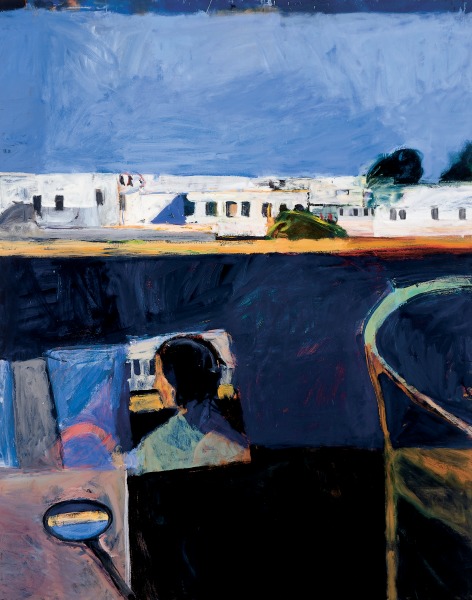
Featured Art: Interiors with View of Buildings by Richard Diebenkorn
“Blood and gore on channel four.” That’s what people said whenever QBZ-4, the station me and Paintbrush Martinez pulled the graveyard at, came up in drunk or sober conversations. It wasn’t really a joke, but we said it jokingly. It was just part of our language—like singing a nursery rhyme or dappin-up your homie at some backyard pachanga. We recited it like scripture, hummed it before sitting down on our sofa pews, before hitting that prayer-book remote, before entering the church of our living rooms or the confession booths of our sorry-ass bars.
“Blood and gore on channel four” was smeared on the streets, projected onto the heavens, and hardwired into the body of everyone in Albuquerque from the picket-fence, northeast-side gabacho, to the straight-out-the-Pueblo Indio, to la chola chingona hustling South Valley. But on the lips of those living lives flooded with fortune and security—culeros on that white-collar, whiter skin shit—it was a punchline, something to say after a sneeze. Lodged in the throats of los demás, all those scared-ass vatos and their families, it was a Hail Mary, a bulletproof vest, a way to savor your breath, remember your heartbeat.
Like them, I grew up on “blood and gore on channel four,” rehearsed the line year after year as I watched folks from the varrio become actors, turn familiar places into TV crime scenes where they played out the role of “meth user,” “gang member,” “tragic shooting victim,” or “drunk driver.” But I never understood it, the reality within the words, the physicality behind the images—not when I ditched home to study film on some diversity-ass scholarship—not while working nights at the Q with Paintbrush—not till the shit with Graci, Tío Albert’s ruca, hit the fan.
Read MoreChiba
By Amy M. Alvarez
My father called me chiba, mi primer hijo—
tomboy, my first son—knuckling the crown
of my head. He said I sat too mannish—
my knees splayed, forearms on thighs,
watching the Knicks on the couch
in his apartment. When I began my model
plane phase, he came to my mother’s house
to help me build an A-10 bomber—each piece
primordial green. We labored over landing gear,
inhaled foul rubber cement.
He mentioned boyhood dreams of building planes,
watching the work of his hands soar instead of clunking
to life like the radiators and refrigerators he worked on.
I told him I was proud of how he fixed what was broken.
My father half-smiled before burying himself in silence
and instructions. We added decals, painted a shark-
toothed mouth on the plane’s snubbed nose.
Read More
In Jezero Crater
By Kate Gaskin
Whatever was there has gone
to three and a half billion years
of dust. On Mars
a rover picks up a rock
and turns it over
in a river delta webbed
with dried arteries cauterized
by the sun. Daughter,
who lived for only an hour,
I too search for you
in the most barren places,
a vein that rolls before
a needle, a dawn that breaks
dim and drawn. I wish for you
an emerald canopy,
sapphire water, a world
where belief is a fact
that can be held
in my palm like a stone.
Here on Earth, you disappear
star–ash, sun–soot, moon–glow
while somewhere above
in the red star of another planet,
a robot measures
ancient silt into a vial
for human hands to touch
with wonder. What do I do now
with all this love?
Read More
Lightning Dragons
By Kate Gaskin
It’s a terrible thing to say,
but imagining my son’s death
comes as naturally to me
as watching a cat trot off
with a bird clenched in its jaws.
Today, there is a crushed
cedar waxwing in the street,
its golden tail feathers splayed,
the red cherry of its chest
popped open like a mouth.
I found it on my run and thought
how impossible it is
to be so small, so easily undone.
This boy of mine runs
away from me into busy streets.
A museum’s noisy crowd
swallows him whole. At school
he cannot sit still or listen.
Once, his teacher said he threatened
another child with the sharp end
of a pencil. I did not
believe her, but what I believe
will not keep him safe
from how others
inevitably perceive him,
and so I imagine
what it would be like to lose him
as he tells me about dragons,
how there are four types:
sun dragons, moon dragons,
rain dragons, and, his favorite,
lightning dragons that hatch
from eggs that erupt
in shocks of electromagnetic
radiation. See them flying now?
He points to the night sky,
its feathery moon and stars
like puncture wounds, while above us
heat lightning unsettles
the dark.
Read More
Mukahara
By Jessica Poli
Yesterday I saw a tree the color
of the sky it stood against
and thought of Rothenberg’s painting
of the translucent horse
barely outlined in a pink haze—the same color
that lit the glass buildings some mornings
in Pittsburgh, where I studied photography
for one misplaced year. There,
in a darkroom, a girl held my hips
while I mixed chemicals that smelled
like sweat licked off of skin,
and the shape of her hands
felt like shadows touching me. I told her
about the horse that lived
at the end of the road where I grew up,
how I fed it handfuls of grass
and dandelions from across
the electric fence. That horse
was a kind of shadow too, forgotten
by the neighbor who asked for it
for her birthday
and then never rode it. Rothenberg’s horse
is mid-gallop, legs folded,
body suspended
in the pink air. Where is that girl
from the darkroom now? She’d been living
in a tent in the woods when I knew her.
Her arms were covered in red crisscrossed lines.
She told me not to worry about her,
and I, young, didn’t. Later, I had dreams
of pink fields, a figure blurring
along the tree line.
Read More
Our Eyes Can See Colors That Don’t Exist
By Lisa Alletson
Magenta is a trick of the brain
my sister explains, her hair
abandoned like a trick of God.
I take her photograph as sunlight
muscles in on her bald head,
her daughter hugging her legs.
She glances at it, laughs.
Mom will like this one
because I look like an angel.
She does, backlit near Durham Cathedral
fourteen strands of golden hair—
a halo of wisps.
I like numbers, so I walk ahead
to read the date on the Statue of Neptune
between the Kate Spade store
and the old pub, looking back to watch
my sister cross the Elvet Bridge.
Her four kids trail behind her
as a busker sings Elton John,
How wonderful life is
while you’re in the world.
We fight about who will buy lunch,
not in a teasing way
but a way that makes her cry
big hard ugly tears.
Nothing makes her cry,
but her youngest is only five.
And I cry too, because
this is the fourth last time
I will see her.
Read More

The Hofstetters Go Back to the Hotel
By Will Kelly
Featured Art: Hotel Lobby by Edward Hopper
Dad was reading the encyclopedia from cover of A to back cover of Z right up until the week he died. He had been at it for two years, and was somewhere in the Es that night the tie rods failed. We’d never know exactly which article he left off on, because he could remember page numbers and had no need for bookmarks. He was amazing like that.
If five volumes in two years sounds unimpressive, I should add that this was on top of all his regular reading: all the novels, the popular nonfiction, the medical journals, and every one of those yearbook supplements that went with the encyclopedia itself. I don’t know of anyone else actually reading those things, but he did so every year as soon as they arrived in the mail.
I dream about Dad this morning. I dream he’s alive again, as are Peter and Denise, both of them adults now, though Mom and Dad are still young. Matt and Henry are there too, the former with his shins, the latter fully mobile. All seven of us are having a quaint dinner way up in an Alpine chalet. Halfway through our meal some beams split and the ceiling caves in, but nobody is hurt, just caked in plaster dust, which Dad starts vomiting out. And then laughing, and then taking a big gulp of his wine, even though it’s filled with debris.
Read More205 Bistro
By Brock Guthrie
Converted historic train station—perfect place
to sit with my family at this reclaimed farmhouse table
in view of the corrugated-metal-paneled bar
with its bowls of hardboiled eggs
instead of pretzels or peanuts
and to observe, with the intent to eventually eat,
this grilled watermelon salad
while waiting for my herb-crusted duck
which was free-ranged in nearby Marengo County
as Mina redacts with purple crayon
any semblance of the comical panda
on her coloring placemat
and Brooke says Manny kicked her kidneys
from inside her thirty-week womb. But look:
there goes Dennis, father of three, newly divorced
from his wife of fifteen years, and with him’s
old Pete, engaged to a woman we haven’t yet
seen proof of, each carrying a stein of golden lager
into the warm Thursday evening
of the spring-dappled beer garden
to watch, no doubt, underdog Auburn
take on top-seed UNC in the Sweet 16
on the bistro’s new 85-inch 4K Ultra HDTV.
Future Perfect
By Susan Kress
This mail is been
writing to you
because I have come
to understand
you want
to have received
your reward for
succeeding to rescue
me, a prince of royal lineage
with seven palaces
and still a wife
of beauty and resplendence
to find.
I will have been awed
by your patience shining
in its box of gold
but for you to stop from living
solitary
in the desert
and to have enter
in a garden of soft green
leaves, all I will have needed
is your name and date
of having been born
and a check you will
have written now to me
care of the federal government of
Nirvania.
Link here to make good
my trouble in sending you
a horde of dollars.
If you will have trusted
in this translucent
arrangement of letters,
I can promise you
a future perfect and
forever joy.
Read More
“You May Want to Marry My Husband”
By Susan Kress
We are at breakfast, he and I, enjoying Sunday
tea and buttered toast, browsing sections
of the newspaper. Here’s a thing, he says, a letter
written by a dying woman. She’s listed
all her husband’s assets, commending him—
a handsome, smart, kind, loving, pancake-
making man—to some future spouse.
I sip my cooling tea and do not offer any future
letter of my own as I watch him lick his
forefinger to mop up toast crumbs—
see beyond him through the window heavy
heads of peonies bowed down from summer storms.
Here’s the thing:
I most surely do not want my husband
to be happy without me. If I die first, he’s got
to miss me every minute (my cold feet, chili meat
loaf, helpful interruptions when he tries
to make a point). No one else can wear my opal ring,
put on my oven mitts, warm my yellow teapot.
When he turns the pages to another section,
looks up again, he’ll see that I am gone—
my orange chair quite empty—our cross-
word puzzle on the table, one clue left to solve.
Outside, the peonies have straightened up a bit.
With stakes, they’ll last another day or two at least.
Read More

One of Us and The Other
By Lisa K. Buchanan
Featured Art: Studies of Men and Women in Medieval Dress by Byam Shaw
One of us is eloquent at 11 P.M. on unhinged dictators and the threat of nuclear war. The other is half-lidded in pursuit of flannel sheets. Or was, anyway.
One of us is a rowdy sleeper, blankets swirling and pillows airborne. The other babbles. One repels intruders and struggles to defuse a bomb. The other dreams a question: Can the failure of bodily organs be contemplated in random order or must it be chronological? One flails, tossing a wild fist; the other yelps in pain. One laughs without waking up. The other wakes up if a neighbor down the block inserts a bare foot into a fleecy slipper.
One of us wonders whether consciousness came before matter; the other doesn’t. One grapples with matters of spirituality. The other cannot suffer the word. One burns with existential questions: Are we alone in the universe? What happens to our memories after we die? Does evil exist, like radio waves, beyond human will? The other talks to strangers on the bus.
One of us hotly refused to marry a person who didn’t believe in God. The other hotly refused to marry a person who did. Each stomped down the street in the opposite direction. Eventually, one pulled up to the curb and opened the door. The other had crafted a cutting refusal, but slid into the passenger seat instead.
One of us was expelled from Hebrew school. The other preached the gospel to sidewalk strangers. One wore hair grease and played in a rock band at thirteen; the other wore a white robe and hymned as a child of Job. One graduated high school with the titular distinction of Crush; the other, with a distinguished truancy record. One was tear-gassed at an anti-war protest in Berkeley. The other attended martini lunches in what POTUS 40 called “the place where all good Republicans go to die.”
Read MoreNothing Will Happen
By Jeff Tigchelaar
Don’t buy that, nothing will happen
I said to Johnny Cash
played by Joaquin Phoenix
early in that movie
when he was in Germany
when he was in the service
and saw some six-strings hanging in a store
and was like huhh guitars huh
and for some reason my wife cracked up
and had to press pause and use Kleenex
on her eyes and I thought
yes
because I hadn’t made or even heard
her laugh in a while
we were separated almost or mostly
her dad was dying plus Trump and Covid
then about an hour or so later (oh it’s a long one)
Johnny sees June
Carter alone in a diner
and figures what the heck
and starts heading over
and I figure what the heck and say
Don’t talk to her, nothing’ll happen
and my wife didn’t crack up like before
but she did laugh again
a real one not just courtesy
and I was like hell yes but of course
there’d be hard times
and there would be scenes
like the one where he rips
the sink from the wall
though it wasn’t in the script he just
summoned his rage up and did it somehow
and you can hear the gushing of the water off screen
as it all hits the ground
but an hour or so later in the credits
(toward the end but we stuck around)
the real June and Johnny start singing
and sing Maybe we can work this out
Oh honey I think we can
Read More
A Day at the Museum
By Kathleen Holliday
Despite blistered heels
in new shoes,
I can’t seem to leave this gallery
of sarcophagi.
I limp closer to a glass case
where displayed en pointe
a pair of tiny sandals lies
pristine, and I wonder—
never worn?
Parting the stream of visitors
two statues rise monolithic
a man and woman, side by side
each an arm circling the other’s waist.
Look at them, still standing
never turning back.
Look, I’d say, if you were here
how they’ve outlasted us.
Read More
A Fortune in Trades
By Cecilia Hagen
Once, for fixing a car, my husband was paid with a large bag
of small fish—smelt, frozen into a block that was flecked
with scores of silver eyes. I would bring a dull knife
out to the chest freezer and break off a chunk,
let it thaw in the sink and feed it to the cats and dog.
Another customer shaved off some of the cost of her engine rebuild
by knitting my husband wool socks that needed to be washed
a particular way, which I failed to do, because this customer
wanted to do more for him than knit his socks, and maybe did.
After they shrank, I could have but wouldn’t wear the socks myself,
a waste I could live with. In the pantry sat another trade, a jar
of home-canned venison I never dared to open.
Those purplish cubes of meat in their purplish fluid
pushed against the jar’s insides for years.
My favorite trades were the things the metalsmith made:
a hammered a rack for pans, a copper vase,
and three bright numbers that still mark that house—
beautiful things with the tang of the earth inside them.
Read More

Keepsakes
By Tanya Bomsta
First, it was a painting of sunflowers. He had always been afraid of them, had always thought their gaudy yellow petals blossomed from something sinister. And their height—it was unnatural, he thought, for a flower to stare you in the face. They were plants, not people. Christopher was tall himself, just about six feet. Tall enough to meet a short sunflower, but not quite tall enough to tower over one. It unnerved him, the way they seemed to look at him, the seeds in their disks like so many spider eyes. He shuddered every time he drove by the boundless fields of them on his way to work, with their leggy stems bending under the gross weight of their heads, their huge blank faces open and screaming in the wind.
But there had been a painting in the museum, and he hadn’t been able to stop looking at it. In the background, a nasty storm with deep purple clouds billowed against a bruised sky. In the foreground, the shadowed, golden petals of three sunflowers were being buffeted by the fierce gusts. Dark sky, dark flowers, the threat of storm so strong he almost turned his head and looked out the museum window to see if it was raining.
Read MoreOpen Mic at Tony’s Bar and Grill
By Tracey Knapp
There’s a man with the rope of a cowbell curled
around his Captain Morgan. He whispers his poems
from a stack of papers, sees your own and nods,
buys you a drink. No conversation needed.
Another person adjusts their blonde wig and quietly
sings Mi mi mi mi meeeee repetitively. You wonder
what song they’ll actually sing—their wig slightly off tilt.
A man cradles his ukulele like a baby. Everyone stares
into their drinks, performing their rehearsal, rubs
the dark worn wood of the bar. You doodle stars
on your pages. Half the people here will only show up
once. No one will tip, and they’ll leave their empty glasses
on the sticky tables, their printouts of songs and poems
on the floor. You were the first to arrive, not thinking
to stop home and put on something more formal
than yoga pants. It doesn’t matter. There is some
common urge to perform whatever thought you have,
to share with these strangers. It’s Sunday night
and raining. Why sit alone silently on your faulty couch
with the endless drone of 60 Minutes on the television,
the single-serving life of pasta and tomato sauce, the rain
driving the ants into your kitchen? Someone taps
the microphone, says HELLO, HELLO. The wig rises
to the stage, sings “I Fall to Pieces” unconvincingly.
Read More
A Working List
By Tracey Knapp
Tell your online boyfriend your real age.Sweep the seeds and leaves from the porch. The winds were harsh last week.- Practice sneezing more quietly. Stop the throat-scratch hacking. Who
could sleep next to that? Why are you still single? Ask your friends. They know everything about
your failures.- Dump your shitty friends who can detail your failures verbatim back to you.
- Do the dishes. Remove your socks from the bed sheets.
Bobby pins are not Q-Tips. Baby wipes are not bathtubs.Commit to eating like a person. With other people. Stop wasting your
money on wine and prepackaged food at the 7-Eleven.- Spend more time talking to yourself outdoors at night when stoned.
Stop drinking wine. Stop drinking. But only when alone. Except if you
were drinking with people beforehand, and you came home to your dog.Watch less TV. Except, re-watch the movie Frances Ha. You are a dancer,
and you have dreams.- All those goddamn books you buy and barely open.
- Make the world more beautiful! Take one earring, preferably dangled and
missing its mate. Hang it from an old nail or forgotten hook. A quiet,
lucky place. Quit losing earrings. Quit earrings. Quit things.Put your old jeans in a box and then the attic. And someday when you
move into a new bright house with a new love, you’ll pull them out, thin
and mothy, you’ll delight: I CAN’T BELIEVE IT! THEY ALMOST FIT!Grow things. Give away things. Give away your neighbor’s excessive
lemons. Your tight jeans.Recycle more. Stop hoarding the little gifts that someone gives you when
they kind of liked you because they barely knew you. The broken ceramic
rabbit isn’t even emblematic.- Appreciate your one good knee, your moisturized cuticles, and the hair
that grew back on your head after you got rid of that fucking IUD. Reach into that folder of old letters pull out the one with the nicest paper.
Don’t read it. Just touch it and let it be the cramp in the gut of all the
people who used to love you by hand.- Celebrate your old-man dog. In the following order, give him: a walk, a
scratch, a bath, a treat, a nap, a brush, a walk, a treat, a nap. - Write down a list of what you could do to be your best.
- Narrow it down to ten.
Read More
Absolution
By Kathleen Loe
The gravelly edge of the old macadam
crunches when Daddy Man veers, slightly over
his two-cocktail breakfast limit—whoa!
And Mama’s all, “Bi-ill!”, sherry sloshing
in her Dixie cup, me and my altar-boy brothers
welded to the backseat of red Chevy summer
vinyl, our own trinity, looking and not looking
for a tiny worn-out sign set meekly back
from the scorching road—St. Lucy’s Catholic Church,
faded and falling away, not the go-to
for the church-going in this neck of the north
piney woods. Far from a hundred cathedrals
sinking in the soft black silt of New Orleans,
we aim toward a single consecrated
gray rectangle stuck in the Chitimacha’s
red clay of North Hodge. Lucky pagans,
or even Methodists, might miss the turn
and be flung past the money-stench
of the paper mill, or further still to actual
wet towns with no need for Jubilee—
Jubilee, cross-dressing bootlegger
come to wax our floors and pocket the cash
and slip my mama her black-market hooch
every week in our dry-as-dust little podunk town
in East Jesus North Looziana, the pure
whitewalled tires of her luscious pink
booze-bought Caddy cutting trenches
in the sweet St. Augustine grass
of our front yard. It ain’t me that’s drunk
in this story about having to go to church
every damn Sunday morning all summer long,
no matter how crazy hot, no matter
if my best friend Bernadette is fixin’ to go
waterskiing on Black Lake instead,
worse thing about that being the snakes
you might wake falling in the wrong spot,
but I’d still pick some dozing water moccasins
over this weekly ecclesiastical misery.
Any minor road accident would be welcome
I pray, I pray we hit a huge nine-banded
armagorilla if it means I don’t have to go
to Confession today, having traded
The Examination of Conscience last night
for finishing Catcher in the Rye under the covers,
accompanied by muffled laughs from Johnny Carson
in my parents’ bedroom. Okay. Pinched
my brother, lied to Mama, ate my best
friend’s Twinkie. Wished and wished
that I was the pretty one, instead of her.
Read More
Tapping
By John Bargowski
I’d already watched him do it a hundred times,
my old man talking me through each step
since I was a young kid, forever warning me
about blow-off, all the hazards
of pressurized air as I stood behind him silently
mouthing: toggle, regulator, output port,
and watched him slide the tap into the spear
of the barrel and lock it down.
So as soon as I’d grown strong enough
to handle a full barrel,
maneuver it around the beer cooler, I followed
him into the basement of the D&J.
I can still hear the rattling compressor kick in,
feel the blast of CO2 sizz past my face,
the ache from the squeeze of his chapped hand
on my shoulder that big day
he shadowed me as I straddled the barrel
then opened the cut-off valve
and let the Rheingold stream through the tubing
to the upstairs spigot.
And after I sopped up spillage from the lip
of the bunghole, tumbled the empty
onto it’s dimpled belly and rolled it out
the double-sealed door into the cellar
then stacked it in a webby corner, I wish
I’d gone back inside, to finish the job,
scratched my name next to his on the rime
coated walls of the walk-in cooler.
Read More
Abu Hani’s Middle Eastern Foods and Gifts
By Sarah Cypher
Kelly took a bookkeeper/handyman job at his friend’s deli. He showed up at Abu Hani’s whitewashed corner shop in East Palo Alto three mornings a week. While Abu Hani prepped the food for the lunch crowd, Kelly squared the receipts and paid the bills. He made sure all the little lights in the deli’s sign were working and stocked the anemic rack of trinkets—hamsa talismans, blue-eye pendants. Then, if Abu Hani was still busy, Kelly sat at the register and charmed customers with his radio-announcer voice. The job, to him, was the most dignified way to hide that his energy was draining fast through the sieve of his sixties.
One morning when he was entering receipts in the side office, he heard a customer talking to Abu Hani. Kelly hovered at the door—he couldn’t place the accent, though its dense consonants were almost familiar. He poked his head around the corner. Over the top of the deli case, the guy looked like any of the old-country Arab geezers who came in for their weekly breakfast olives: that gull-wing hairline gelled back from the brow, hair so silver-bright it made a blurry reflection in the polished deli case. Abu Hani had stopped working and was leaning his bulk on his two hairy fists planted on the counter.
The man noticed Kelly standing there, and he swept up his parcels and exclaimed to Abu Hani, “But you are busy! I am keeping you from your day.” In a last flurry of goodwill, he paid his bill and left.
“New guy?” Kelly asked.
Read MoreUpcountry Detour
By Sydney Lea
An old man sluggishly waves a hand.
He looks spellbound, as if by an apparition:
A stranger, me, in a place few visit.
I’m sidetracked into my own odd spell—
Both sadness at bleakness and fascination.
There’s a sign in another dooryard, bizarre:
Atrini, World’s Finest Files.
A softball arcs on the blistered common,
A father pitching, a son at bat.
One newer car, a Buick, glitters
Like gemstone in front of a postage-stamp store.
Back lots full of witch-grass show unwheeled pickups
Dead amid whips of lilac and sumac.
I drive out of town past further signs:
BECKYS TRUCKERS HEAVEN ONE MILE
COME IN AND HAVE A “CUP” WITH BECK
BECKYS CLOSED FOR RENOVATION
Its windows, boarded over with wanes,
In brush beside it, a bedspring, a dryer.
I notice a black cat eyeing a bird
On its roof, too high for him to consider.
Read More
The hardest part of losing her mother in 2020
By Nancy Miller Gomez
was after the memorial, her laptop propped on the table
cluttered with half-empty teacups and books
as her mother’s body was buried two time zones over
in Louisiana. After the eulogies and prayers,
and the few people standing graveside walked away
and all the others clicked off, there was nothing to do.
But she couldn’t bring herself to close the screen.
So she sat a long time watching her own face
looking back, and imagined she was her mother,
and watched to see what her mother would have seen
if she’d been there, and in her expression
she could see the love she knew her mother had felt
that last time they’d talked. And then she was crying
and watching herself cry—as if she was her mother,
and the connection was like a counterweight
she could carry, as though an infinity mirror
had opened inside her. It didn’t matter then,
if she hit the red button that said “End.”
Read More
My Family
By Nancy Miller Gomez
I used to keep old black-and-white photos in my wallet.
They weren’t people I knew, just snapshots of strangers
fished out of a shoebox at a junk store: dark-eyed men
in bomber jackets leaning against muscle cars, or sitting
astride a tractor wearing khakis and an undershirt, a pencil
of mustache above their lip. Women with cat-eyed glasses,
dressed up in feathered hats for a night of gin rickeys,
arms draped across each other’s shoulders and angling
for the camera. Even in grayscale I could see their cheeks
were rouged and their lips were slick with lipstick.
Sometimes I would take these people out and show them
to someone I’d just met. This is my family, I’d say
and watch as they shuffled through the pile of strangers
politely noting how nice-looking they were.
I don’t know why I did this. But it felt good
that all anyone could ever know of me was what I was
willing to show them. This heavyset blonde posing
on the steps of a California bungalow wearing a fur coat
in the obvious heat of summer. These children splashing
in a kiddie pool on a lawn cluttered with beach balls
and hula hoops, a spray of water suspended mid-air
as the camera clicked on the girl’s congenial scream,
her brother’s swashbuckling grin, while father watches
from a folding chair, a beaming fat baby on his lap.
I keep them ready, these people I don’t know. That’s me
I say, pointing at the fat baby. I was happy then.
Read More
Cultural Appropriation
By Nancy Miller Gomez
—a mi esposo
I appropriate your tongue,
your lips, your teeth, the smooth
inner skin of your cheek.
I appropriate your rolled r’s,
and soft v’s, the way you say
wolf without the letter L
(the plural of which is wooves).
I claim the patch of hair
in the small of your back,
your brown skin, your mother’s molé.
I appropriate your mother,
rename her La Loca. I appropriate
your appropriators, the conquistadors
who came with their archangels
and saints, Our Lady of Guadalupe
with a chisel of moon
at her feet. I descend the ladder
of your lineage, past missionaries
and rancheros to inhabit your ancestors’
ancestors, the Nuhuatl gods
with feathered names I’ve learned
to pronounce. Coatlicue, the mother
of mortals, Huiztlilopotchli—
the hummingbird patron of War,
Tialoc—he who makes things sprout.
I appropriate sugar skulls and mezcal,
Día de los Muertos. Your pyramids
and painters, your Kahlo and Orozco.
Your poets, Octavio and Carlos.
I take your lowriders
and La Raza, the happy/sad
ting of mariachis singing.
I appropriate each sweet bite
of pan dulce and tres leches
and eat your street tacos
smothered with guac and tapatía.
I’ll take la plaza with its bandstand
and white ibis, the man selling
balloons and churros. And words,
nights filled with appropriated
besitos y sonrisas. Abrazos
and the rest of the Mexican lexicon,
all mine. I’ll take your lime and salt,
your fire and fault lines. And our son,
see where I have appropriated
your blood, your eyes, your love
of basketball, the sport you say
your people created, a game
played by the victors
with the decapitated heads
of their victims.
Read More
Siren Song
By Nancy Miller Gomez
A songbird mimicking the sounds
of emergency sirens has been
caught on video . . . —CNN
A starling has taught himself to sing
like an ambulance. Now the air is filled
with emergencies. Whee-o, whee-o, high and low,
a fire truck rides out of a mockingbird’s mouth.
Grackles impersonate police cars. They dive-bomb
the precinct parking lot, bashing their beaks
into the rearview mirrors of their rivals.
The magpie knows a lovely air raid. Now
she trills like a helicopter, next a chain saw,
then an AK-47. The quail stop, drop
and cower. Take-CO-ver they cantillate.
Whee-o, whee-o, high and low. Juncos,
pass to Vireos. Catbirds steal the flow.
The chickadees have gone on lockdown.
They bore like bullets through the bleeding bark
of the cedars. Crows reload from rooftops.
Read More

Watching the Wind
By Roger Mitchell
Featured Art: Wind by Mikhail Gordeevich Deregus
Lift a small shovelful of snow
without a shovel
off the stubborn blanket of it
in the field
and throw it completely away,
quickly, too,
so quickly you couldn’t find it ever
crawling
on your hands and knees, calling
out its name,
puff of purest cloud, smoke
of frozen fire,
wind’s breath, you,
with no shovel
and a handful of white air.
Read More
After Petrarch
By Emily Wheeler
A romance developed in my sixtieth year,
which gave me hope, perhaps inane,
surely extreme, especially in my verse,
and affirmed principles of affection and cheer.
My lover was tender, our love serious, useful.
It was as if in the afternoon, gray, crepuscular
an angel had arrived! And we both so secular!
Of course we never spoke of death, its easeful
nest, or the unlikelihood we’d ever alight
together in the tall trees or, quivering,
fly off at the same moment, but that was alright,
because, whenever new or found or at least not lost,
desire adds a drop to the earth’s thousand rivers
and briefly greens the grave, its bed of moss.
Read More
The Missing Poem
By Emily Wheeler
Less a description of a Thanksgiving
I remember than an invitation
to a party that asks many people,
some alive, some dead,
to fill the front hall
of the old house
with such loud joy
at faces long unseen
that few can reach the quieter
fire-lit room at the back
where cheese and bread await,
and raise glasses of the most delicious,
deepest red wine.
No war, no plague, no economic
collapse deflate the mood.
I make a beeline for my favorite aunt
in the corner looking out the window
at the black river. There I join her
bringing the news that the river
doesn’t mean what it used to mean,
now it’s behind her, not ahead.
Read More
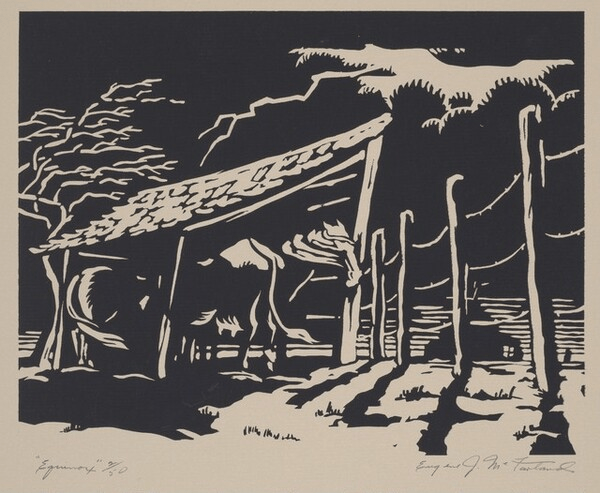
Vernal Equinox
By Kari Gunter-Seymour
Featured Art: Equinox by Eugene James McFarland
I’ve been thinking about last times
I never knew were the last—
grandma cooing me unconscious,
daddy whistling me home to supper,
my toddler’s toothless grin, tiny fingers
clenching wildflowers, the last time
I prayed, desperate for those departed,
how they flit ahead of us, flying.
Tonight the Big Dipper balances
on its handle. Tepid tree frogs peep
songs of resurrection. One morning soon,
I’ll eat a good breakfast, fill a water bottle,
pack a book, walk the fencerow into the holler,
rest beneath the eagles’ favored perch,
shake off this inexplicable sadness,
two cinderblocks where lungs ought to be,
let spring hold on to me for a while.
Read More
“When We Talk About Mountains, We Talk About Memories”: a Conversation with Ohio Poet Laureate Kari Gunter-Seymour
New Ohio Review editor, David Wanczyk: I’m speaking today with Kari Gunter-Seymour, a 9th generation Appalachian, and the current Poet Laureate of Ohio. Her new anthology, I Thought I Heard a Cardinal Sing: Ohio’s Appalachian Voices, will be published in March 2022. Kari, welcome. Can you tell us about the project generally and more specifically about your hopes for what it will bring to light about Appalachian poetry?
Kari Gunter-Seymour: I would love to do that, David. My hope is that people will become aware that Ohio is part of Appalachia. Because some people don’t know, and a lot of people forget that a quarter of the state of Ohio rests in Appalachia proper, and there are pockets of Appalachian families throughout Ohio, even in major cities throughout Ohio, that still practice those teachings and learnings from their Appalachian heritage and their culture. And so this book is all about bringing notice to that.
I think of us as being Central Appalachians. With roots deep in South and North. You know we had those who came up during World War II and the Great Depression to find work. To seek out the steel mills. We have to remember there was lots of coal and iron mining in Ohio early on, too. And so this book is specifically my dream of being able to give these voices an opportunity to sing. Because they’re different. We’re a little bit different.
We’re more of a mixing pot, I think, here in Ohio, because we are, as we’re finding out, Central. We’re not necessarily North; we’re not necessarily South, but we’re a really good mix of it all.
Read More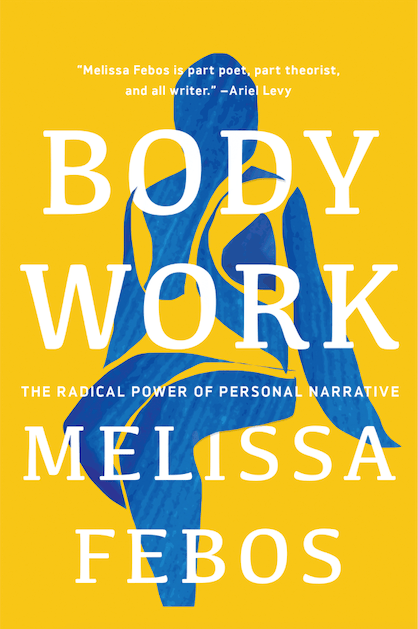
A Review of Melissa Febos’s Body Work: The Radical Power of Personal Narrative
By Morgan Riedl
A body can work and do work in many ways—a body can also not work, or perhaps another way of saying this is a society can make it harder for some bodies to work, in which case a body itself can become work. Our body can be our life’s work—a body of work is the work of our lifetime.
In Melissa Febos’s recent essay collection Body Work: The Radical Power of Personal Narrative, she investigates how bodies and writing intersect, how to tell the stories of our bodies and why we should. By mixing memoir and craft, Febos’s book does exactly the kind of work it argues is important, underscoring the power of the personal. I can’t help but think of the slogan from Second Wave Feminism here, the personal is political, and how today we might consider the personal is professional—that sometimes this binary, like so many others, subjugates certain bodies.
Read More
homecoming
By Caro Claire Burke
Featured Image: Shadows II by Sam Warren
It had been the loneliest summer of my life, which is maybe why I was so looking forward to seeing Beth.
I’d been living in the city for about four months by then. I still wasn’t quite used to the foul-smelling puddles, the fire escapes that blotted out the sky, the way the subway would be whispering along then suddenly scream to a stop, forever lurching me into the lap of some nameless and scowling person. And Beth was nice, I remembered: she’d been the type of girl in college who was always the first to laugh, the first to dance; the type of girl who never complained when we ran out of cold beer and had to switch to room temperature. She was a good sport, I remember a buddy saying once, and I’d agreed.
It was a clear Friday afternoon. I was headed to my mother’s house for the weekend, and the idea of leaving the city for a full two days had left me feeling light. I decided to throw my weekend bag over my shoulder and walk the fifteen blocks to the coffee shop Beth had suggested.
Read MorePill
By Louise Robertson
Sometimes I,
I mean you,
I mean I,
are
like an advil stuck
in a pocket of my/your throat
and I/you wonder if I,
I mean you,
I mean I,
am dissolving there—
easing the ligaments,
except the body
isn’t eased, nor ligaments
hushed and I can still feel you,
I mean me,
I mean you
there in the neck
waiting, in fact,
hard as a choke.
Read More

On the Inadvisability of Good Decisions
By Louise Robertson
Featured Image: Knowledge 2 by Sam Warren
I regret my good decisions while
staring at digital timestamps within
the carpeted walls
of my assigned cubicle as November
darkens to evening right after lunch.
I regret them as I climb
into the hybrid and track its mileage.
On an after-work walk,
plastic bags, candy wrappers, and
beer cans sprawl.
I decide to corral
strips of wild sheeting
massed into a wig of see-through hair.
A slippery ooze
crawls onto my hands.
I should have fucked that guy.
I should have broken my heart
over him and kept breaking those gears
—a clockwork that spends almost
all of its time junked
just for those
two moments everyday,
when it is exactly right.
Read More
Jetson Whirr
By Louise Robertson
The Prius should make a noise
as it creeps behind school children
scattering across the road,
sunlight and leaf shadows waving
around them.
It should be, as one petition
suggested to Toyota,
the sound of the Jetson car,
a whirr and a dapple of a sound.
But Toyota has done nothing — nothing.
The cars glide out each year,
shark silent.
When I was 11, at the school trip to Kings Dominion,
standing next to a plastic statue of George,
Maria Framingham declared she
had lost a $10 bill and so of course I checked my back pocket
and of course my $10 bill slipped out. Maria
picked it up and said she found her
$10 and I made no sound
and slunk away, my inner petitioner
demanding, “Hey, make a noise!”
And my inner Toyota doing nothing — nothing.
Seven Ways to Get Blindsided in a Restaurant
By Melissa Bowers
5.
I am in a restaurant when I learn Rob has a wife. It shouldn’t matter, since I’m already a wife, too—Timothy sits across from me, cutting a chicken strip into toddler-sized bites between swigs of his craft beer—but something catches in my chest at the sound of Rob’s name. Maybe it’s because Timothy and I are hardly speaking at the moment, or maybe it’s because of the person delivering the news.
Amaya is supposed to be a ghost from the past. She is not meant to materialize inside the life I have now, this many years after college, as she exits Timothy’s favorite burger place. I don’t notice her until she sidles over and leans against the edge of our table, runs an invasive finger around its glossy tiles, slowly, as if she’s trying to seduce them one by one. We exchange pleasantries: Nice to see you. Yes, it’s been forever. What are you up to these days?
“By the way, Rob got married,” Amaya tells me. “She looks a lot like you, actually—brown hair, kind of wavy. They have a daughter.”
She winces a little when she says it, in sympathy or solidarity, as though we both have the right to feel jealous. Then she tsk-tsks and sets her lips in a thin, apologetic line, flutters her fingers over her shoulder: “‘Bye, honey.” The finality of her hips swaying toward the door.
“That was the Amaya?” Timothy asks through a mouthful of ground meat.
I raise my eyebrows.
“Oh yeah,” he says. “We’re fighting.”
Read More
Ghosting
By Emily Kingery
Featured Image: Ghost Crossing by Ellery Pollard
The Ghost buys me a cocktail
the color of Barbie’s dream house,
the taste of the well. He shrieks
and stakes a tiara in my hair.
I am laden in plastic and ask
where he came from. He says
Barbie’s dream house. It’s time
for karaoke. Do you remember
high school, the back of the car
and your aching lips, rewinding
the tapes? He tucks my loose hair
and his laugh is my favorite
from the dead. Ghost, I tell him,
let’s smoke. He slides two cigarettes
from his sleeve. I laugh like a rabbit
I Said Maybe
By Allie Hoback
Featured Image: Untitled by Tanner Pearson
I can’t stop listening to your dumb wonderwall cover
that I asked for as a joke. I don’t know what you did
to make it sound all distant and a little haunted
but I want to projectile vomit when you giggle through the reverb
miss a chord and sing alltheroadsanananasomething.
Why do people hate this song and why do people only
ever play it on acoustic, it’s so good on electric or maybe
I just like you—oh fuck, do I like you? During sex I asked
how long you had wanted to do this for and you said
within the first ten minutes of meeting you and I said same
if not even longer, maybe before I met you, does that make sense?
Am I making sense? Should I seek professional help
if a fucking joke cover of wonderwall makes me want to grin
at every blank-faced stranger in a gas station, makes me want to stitch
your name into my underwear, makes me want to backflip
into the Atlantic Ocean where you are treading water—
and I don’t think that anybody feels the way I do about you now.
Read More
A Shark Story
By Erika Warmbrunn
A dark shadow lifted off the sand and floated forward.
“Sting-ray!” she thought, and reached up to pull her goggles down over her eyes. They had seen several rays during their dives that week. She hoped this would be a spotted eagle ray. Velvety black beneath an ebullience of crisp white dots, the spotted eagle rays had been her favorites. She ducked below the surface.
And saw that it was not a spotted eagle ray.
It was not a ray of any kind.
It was a shark.
She had never seen a shark before. Of course she’d seen a shark before: in a movie, in an aquarium. But that was the sensation: I’ve never seen a shark before, but I know one when I see one, and that shape swaying through the not quite crystal-clear water, that is a shark. It felt primal: ancient, encoded, instinctive recognition of predator.
Read MoreReading the Ancients
By Matthew Tuckner
What Sappho calls
the desiremind or the couragesoul
I call the swirling Chesapeake Bay
of my brain and sure
you could call the tugboat
trawling through the brackish waters
desire and yes
you could call the striped bass
sourcing speed from the tugboat’s wake
courage and sure
you could call the crushed beer can
scything the surf the mind and yes
the soul looks like a blue crab
when I close my eyes to picture it
aquamarine claw olive-green shell
I can’t quite place
the bird tipping its beak into the bay
to capture an absent worm
absent because fields
of eelgrass are emptied daily
by giant pesticidal blooms
heaps of dead fish
falling upwards
towards the surface
but in placing the bird
a red knot a piping plover
one could easily mistake it for
the faculties of the soul
particularly the appetites
so many Plato doesn’t even bother
to tally them though he does
warn of their penchant for battle
the appetites who are hard to see
when they stand still
like the piping plover for whom
they are often mistaken
yes I’ve been out combing
the waters for a new bird
one whose bright rusty throat
and striped back better represent
those flightier emotions
not even Sappho
has the words for
is it the tundra swan
with ass upended and neck submerged
searching for the eelgrass
that isn’t there
the tundra swan that birdwatchers
who don’t know better
call suicidal ideation
maybe the tawny-throated dotterel
is the one for me
if I cover my left eye
and squint my right the bird looks like
the dysmorphia that keeps me
out of the view of most mirrors
just look at this dotterel
can’t you see the pointed beak
that just screams
I want to be your worst best friend
a voice that sings
come breach that little bay
of yours come tie the sky together with
us birds a pointed beak that’s just dying
to be the Orpheus
to your Eurydice the kind of bird
that wants to kickstart
your katabasis a word
that if I’m reading the Greek correctly
can be widely defined as a descent
of any kind such as moving downhill
the sinking of the sun
a military retreat
clinical depression
a trip to the underworld
or a journey to the coast
Read More

Virginity
By Zuzanna Ginczanka
Translated from the Polish by Joanna Trzeciak Huss
Featured Image: Untitled by Tanner Pearson
We…
A frenzy of hazel trees, disheveled by rain,
a scented nutty buttery crush.
Cows give birth in the humid air
in barns, blazing like stars.
O, ripe currants and lush grains
Sapid to overbrimming.
O, she-wolves feeding their young,
their eyes sweet like lilies.
Sap drips like apiary honey.
Goat udders sag like pumpkins.
The white milk flows like eternity
in the temples of maternal bosoms.
And we…
…in cubes of peach wallpaper
like steel thermoses
hermetic beyond contemplation
entangled up to our necks in dresses
conduct
proper
conversations.
Read More
Zuzanna Ginczanka Biographical Note
By Joanna Trzeciak Huss
Any biography of Zuzanna Ginczanka (1917-1944), however short, should attempt to speak to her desire to define herself and her refusal to be defined by others. For her, social and artistic identity was something to be chosen and cultivated, but in the times in which she lived, identity ascribed by others was a matter of life and death. Born Zuzanna Polina Gincburg in Kiev in 1917, she fled shortly after the Russian Revolution with her family to the border town of Równe in Volhynia (present day Rivne, Ukraine), which was at one point part of the Polish-Lithuanian Commonwealth and was about to become Polish again in 1920. The destination was not accidental: it was the town where her Russian-speaking maternal grandparents were well-ensconced. Yet this provincial capital proved too confining for her parents, who abandoned her to the care of her grandmother: her father leaving for Berlin when Ginczanka was three and her mother for Pamplona, Spain after she remarried. Równe, a multi-ethnic city, was Ginczanka’s childhood home and it was there she attended a French pre-school and Polish elementary school and high school. She adopted the name Ginczanka, and though Russian was her native tongue, chose Polish as her language of poetic expression. Yet she was never able to obtain Polish citizenship and remained stateless throughout her life.
Read More New Ohio Review